


Pioneer Investments -

Agency Mortgage-Backed Securities (MBS) Market - March

PioneerFeatured

Tyler Patla - Senior Vice President, Deputy Director of Core Fixed Income, Director of Agency Mortgages, Portfolio Manager


Agency MBS Lagged in March’s Broader Geopolitical Selloff

Propelled by a significant increase in inflationary implications of the Middle East conflict and real yields, the 10-year US Treasury yield climbed 38bp in March, from 3.94% to 4.32%. The upward shift in the US Treasury yield curve weighed heavily on virtually every sector of the US bond market, and agency MBS was no exception. The geopolitical fault lines that emerged in late February deepened throughout March, as the US-Israeli military campaign against Iran escalated beyond initial investor expectations in both scale and duration, leading to the conflict's most consequential macroeconomic development: the effective closure of the Strait of Hormuz. With approximately 20% of the world's seaborne oil supply transiting this narrow waterway, the resulting disruption drove crude oil prices up 50% and reignited the inflationary concerns that investors had only recently begun to view as manageable. As investors contemplated slower global growth and higher inflation outcomes, the shift catalyzed a swift deterioration in risk appetite, triggering a synchronized retreat across equities, bonds, credit spreads, and even traditional safe havens. The 33bp increase in real yields was driven by a hawkish repricing of the Federal Reserve's long-term policy trajectory based on expectations they may need to combat near-term energy-led inflation and a surging term premium, reflecting the heightened risk compensation demanded by global investors.

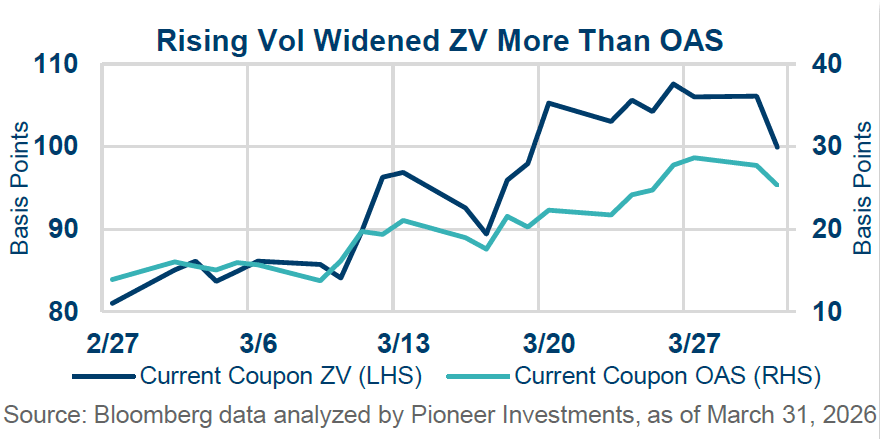
As geopolitical headlines flowed through to oil prices, inflation expectations, Fed expectations, and interest rate volatility, agency MBS widened over most of March before partially recovering on late-month ceasefire optimism. Consistent with their behavior in recent years, mortgage prices exhibited greater sensitivity to heightened interest rate volatility and yield-curve flattening than traditional cash flow models would imply. The Bloomberg US MBS Index returned -1.65% on the month, reflecting a -0.28% excess return to Treasuries. Sector option-adjusted spread (OAS) widened by 3bp to +24bp. Negative excess returns were driven by a mix of OAS widening and a rise in interest rate volatility, as illustrated by the graph to the right, comparing current coupon OAS to current coupon zero-volatility (ZV) spread, which showed larger moves as volatility expanded. Unlike prior months, the choppy performance only slightly outperformed corporate debt in OAS terms, and underperformed in nominal spread and excess return terms.

Image
Graph showing rising vol widened ZV more than OAS

Finally, a Basel III Endgame Re-Proposal

The Basel III Endgame saga has been one of the most contentious regulatory debates in US banking over the past several years. The original 2023 proposals, issued jointly by the Federal Reserve Board, the Office of the Comptroller of the Currency, and the Federal Deposit Insurance Corporation, were met with fierce industry opposition for dramatically raising capital requirements beyond international standards. After three years of waiting, the banking industry received an updated joint proposal from the three offices on March 19.

The shift from the 2023 proposals is stark, with capital requirements going down, in contrast with the Biden administration’s proposals that would have increased capital requirements by 16%. Instead, total capital requirements are falling by about 5% for banks with over $100 billion in assets, while the drop is nearly 8% for smaller banking organizations. The new proposals purport to align more closely with the 2017 Basel Committee standards, while compliance is aimed to be simplified by moving from a dual-calculation system (standardized and advanced approaches) to a single "Expanded Risk-Based Approach" for the nine largest US banks. Meanwhile, the Globally Systemically Important Banks (GSIB) Surcharge Re-Proposal revised capital surcharges lower by about 40bp. 

The potential benefits to the mortgage market are both direct and indirect. Directly, the updated proposals would convert the capital deductions for mortgage servicing assets into a less onerous 250% risk weight. This is designed to incentivize banks to remain active in mortgage origination and servicing, reversing a trend of migration to non-bank lenders. Also, some risk weightings for mortgage loans with lower loan-to-value ratios would be reduced, which could influence banks to retain more loans and reduce MBS market supply. Indirectly, long-awaited clarity that avoids a potentially increased capital burden of owning mortgage loans and MBS may spur bank portfolios to increase their pace of investing deposit growth into MBS, which had been suppressed since the 2023 proposal. Notably, no specific effective date has been proposed for the core Basel III Endgame re-proposal. The agencies are explicitly soliciting public comment on timing and transition arrangements. The GSIB Surcharge Re-Proposal, however, would take effect two quarters after adoption of a final rule, which is expected shortly after the end of the 90-day comment period.

Outlook: Range-Bound Dynamics, Driven by Exogenous Factors 

Image
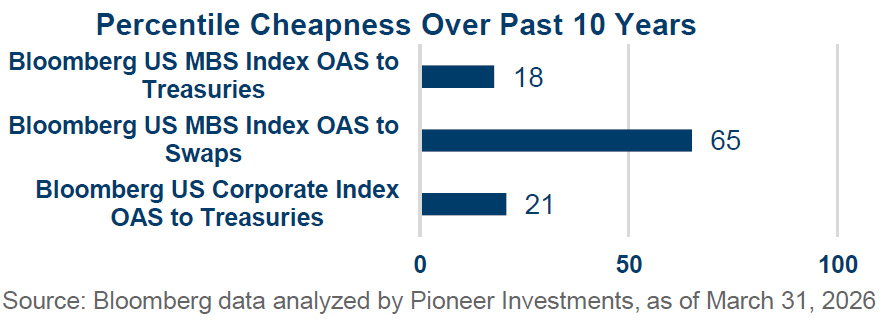
Bar chart showing percentile cheapness over past 10 years

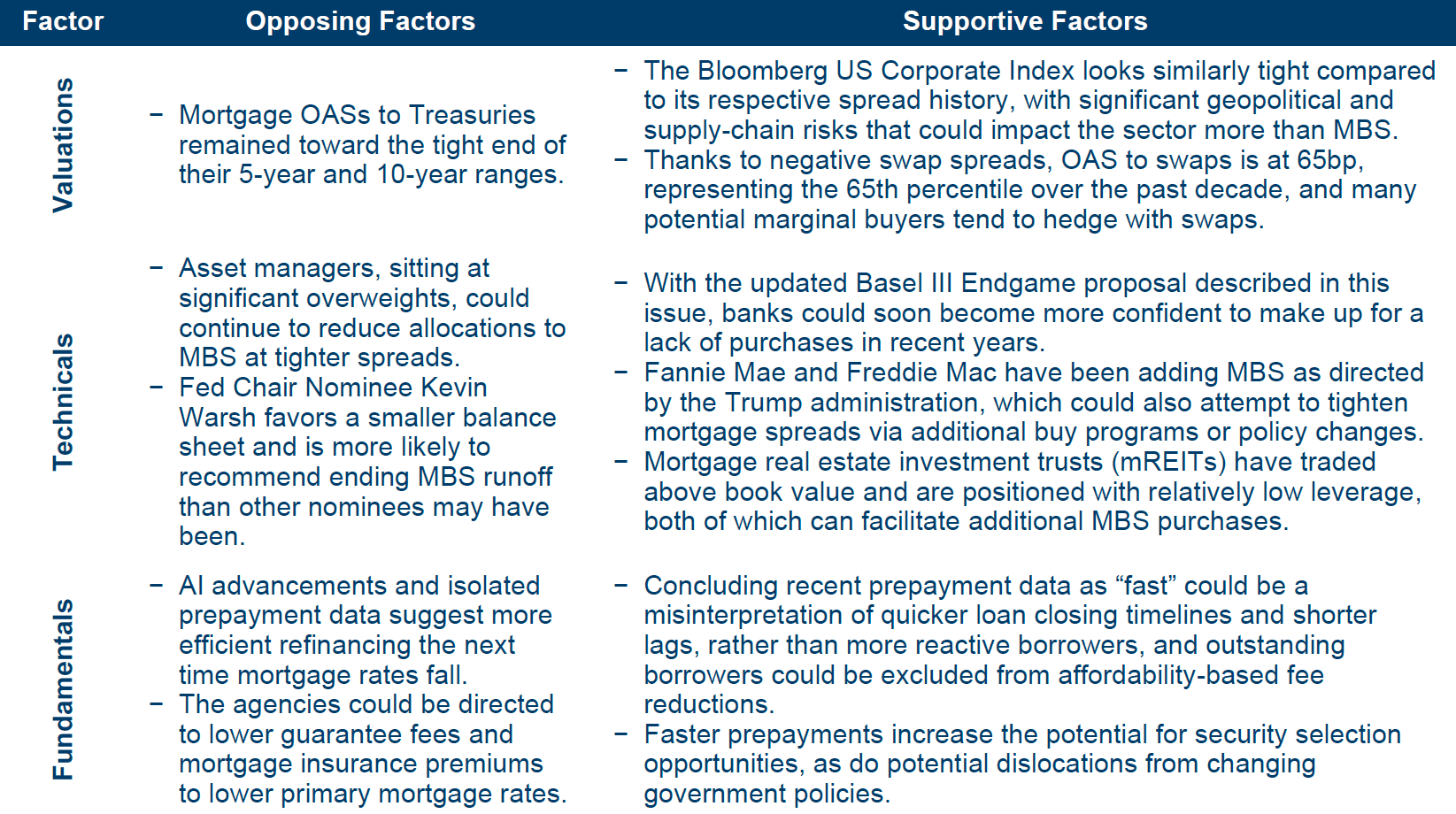
We believe agency MBS spreads are likely to remain range-bound, with movement within the range influenced by exogenous headlines and short-term dynamics. This regime held in March, as agency MBS spreads traded with high correlation to broader risk sentiment, implied rate volatility, and Fed expectations, all of which were driven by the Iranian conflict and the ensuring oil price shock. The passthrough to MBS spreads with implicit guardrails is a function of balanced valuations, technicals, and fundamentals:

Image
Table showing factors, opposing factors and supportive factors

The balanced nature of this table and price-sensitivity of marginal investors has influenced us to trade around in modest size as headlines moved markets. Broadly, the willingness of asset managers to sell at tighter spreads, with banks, overseas investors, mREITs, and Fannie and Freddie willing to buy at wider spreads, can provide both the resistance and support to maintain the range as macro factors oscillate. Our dedicated MBS portfolios are positioned conservatively, but we are more constructive on agency MBS as a positive contributor to an aggregate, multi-sector, or multi-asset portfolio. Additionally, we prefer MBS relative to swaps than to Treasuries, particularly because current marginal sources of demand hedge this way. Broader spread compression reduces relative value overall, but we are optimistic that prepayment uncertainty and headline-induced dislocations can provide dynamic allocation and security selection opportunities.


Read More from Pioneer Investments


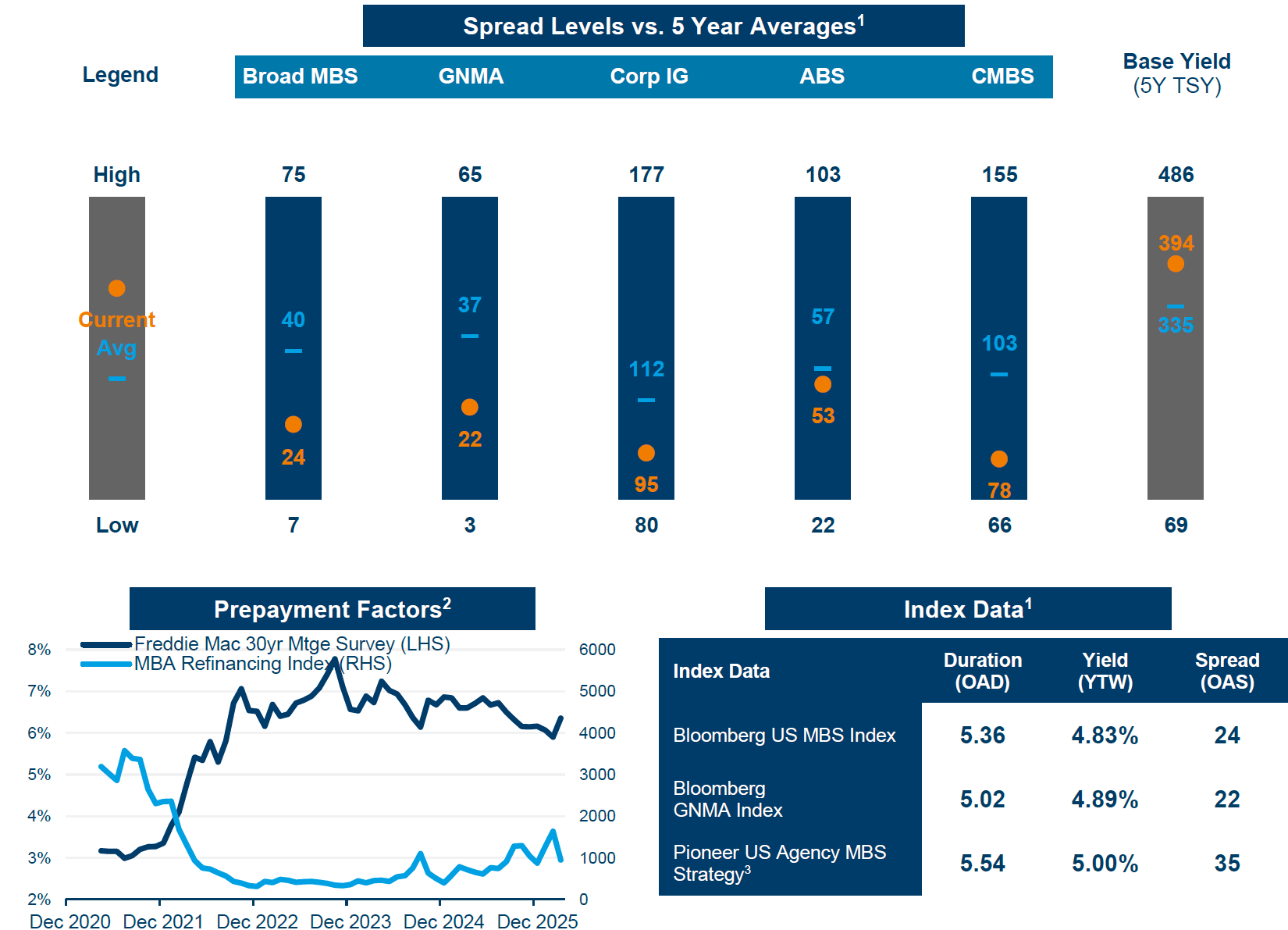
Securitized Market Dashboard

Image
Various graphs

Source: Bloomberg, as of March 31, 2026
1 Index Data: Bloomberg US MBS Index, Bloomberg GNMA Index, Bloomberg US Aggregate Corporate Average OAS, Bloomberg US Investment Grade ABS Index, Bloomberg US Investment Grade CMBS Index. 
2 S&P/Experian First Mortgage Default Index, MBA Refinance Index. 
3 The characteristics are of the representative account (gross, USD) in the US Agency MBS composite. Gross-of-fees returns are presented before management and custodial fees but after any transaction costs.

Image
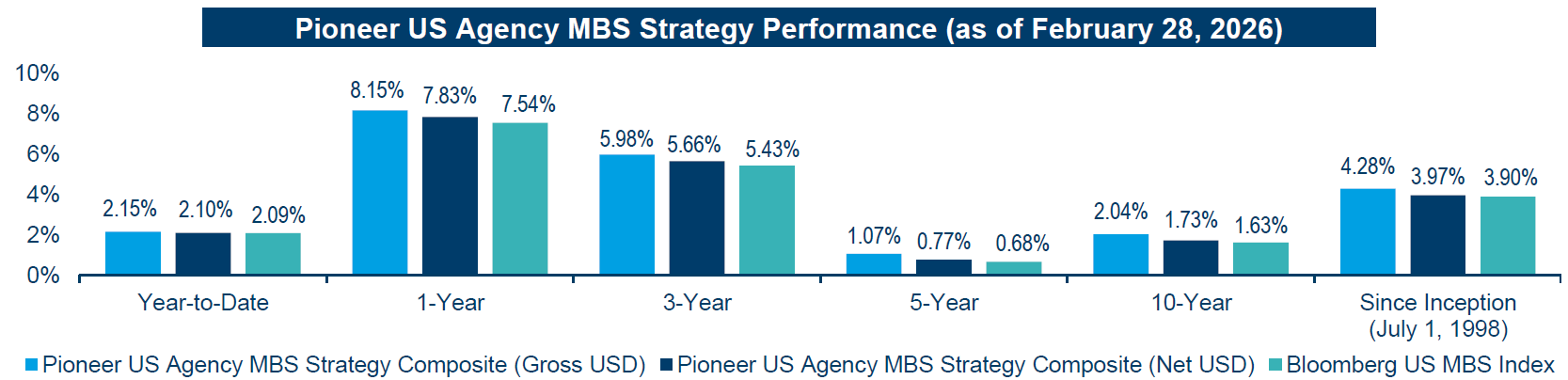
Pioneer US Agency MBS Strategy Performance

Source: Pioneer Investments, as of February 28, 2026
Performance prior to April 1, 2025 occurred while the portfolio management team was affiliated with a prior firm. Such members of the portfolio management team were responsible for investment decisions at the prior firm and the decision-making process has remained intact. Gross-of-fees returns are presented before management and custodial fees but after any transaction costs. The composite net-of-fees returns reflect net of model fees and are calculated in the same manner as gross of fee returns using the Time Weighted Rate of Return method. Actual fees may vary depending on, among other things, the applicable fee schedule and portfolio size.
Please refer to the GIPS® Report for additional information. Past performance is no guarantee of future results.


All investing involves risk, including the possible loss of principal. An investment should be made with an understanding of the risks involved with owning a particular security or asset class.
Unless otherwise stated, all information contained in this document is from Pioneer Investments, a Victory Capital® Investment Franchise. The views expressed in this presentation are those of Pioneer Investments as of the date noted, and are subject to change at any time. These views should not be relied upon as investment advice, as securities recommendations, or as an indication of trading intent on behalf of any of portfolio. 
The services and any securities described in this document may not be registered for sale with the relevant authority in your jurisdiction and may not be regulated or supervised by any governmental or similar authority in your jurisdiction. Where unregistered, they may not be sold or offered except in the circumstances permitted by law. Pioneer Investments is not making any representation nor does this document constitute a representation with respect to (i) the eligibility of any recipients of this document to acquire any securities or any services described herein in any jurisdiction or (ii) the eligibility of any recipients of this document to receive this document in any jurisdiction. If you are in doubt about the content of this document or your eligibility, you should obtain independent professional advice.
Each portfolio is actively managed. Sector allocations are subject to change. Holdings are subject to change and should not be construed as investment advice or a recommendation to buy, sell, or hold any security.Information relating to portfolio holdings is based on the representative account in the composite and may vary for other accounts in the strategy due to asset size, client guidelines and other factors.
Indexes are unmanaged; their returns include reinvestment of dividends and other income but do not reflect management fees, transaction costs or expenses. It is not possible to invest directly in an index. Past performance does not guarantee future results.
Advisory Services offered by Victory Capital Management Inc.

©2026 Victory Capital Management Inc.

20260408-5369546

Share this post

Sign Up Now for Full Access to Articles and Podcasts!

Unlock full access to our vast content library by registering as an institutional investor

Register

Contacts


Pioneer Investments

Pioneer Investments manages $132 billion in assets and has a long-standing history of innovation with deep expertise managing fixed income portfolios and creating customized solutions within the more opportunistic areas of the securitized market.

Pioneer Investments’ culture of innovation, in the securitized market, originated at Smith Breeden, where its founders developed early option-adjusted spread modeling techniques for MBS valuation. The innovative approach continues under Victory Capital, which manages over $9.1 billion for insurance companies. We are focused on delivering competitive risk-adjusted returns, while considering the accounting, regulatory, and capital management needs of our insurance clients to create long-term partnerships.  We understand the unique needs of insurers, and we provide customized and efficient risk-based capital solutions that align with insurers' risk tolerances and investment objectives.

Source: Pioneer Investments, a Victory Capital Investment Franchise, as of December 31, 2025
 

Jay Alexander, CFA, CAIA
Managing Director, Institutional Markets
jalexander@vcm.com
+1 (612) 965-5426
 
Emma White
Director, Institutional Markets
ewhite@vcm.com
+1 (617) 422-4569

Marko Komarynsky
Director, Institutional Markets
mkomarynsky@vcm.com
+1 (210) 697-3613

View the contributor page

Sign Up Now for Full Access to Articles and Podcasts!

Unlock full access to our vast content library by registering as an institutional investor .

Create an account

Already have an account ? Sign in

Ѐ Ё Ђ Ѓ Є Ѕ І Ї Ј Љ Њ Ћ Ќ Ѝ Ў Џ А Б В Г Д Е Ж З И Й К Л М Н О П Р С ΄ ΅ Ά · Έ Ή Ί Ό Ύ Ώ ΐ Α Β Γ Δ Ε Ζ Η Θ Ι Κ Λ Μ Ν Ξ Ο Π Ρ Ё Ђ Ѓ Є Ѕ І Ї Ј Љ Њ Ћ Ќ Ў Џ А Б В Г Д Е Ж З И Й К Л М Н О П Р С Т У Ф Х Ц Ч Ш Ā ā Ă ă Ą ą Ć ć Ĉ ĉ Ċ ċ Č č Ď ď Đ đ Ē ē Ĕ ĕ Ė fi fl œ æ ß