





We're currently experiencing email delivery delays. For urgent matters, please contact us directly at lindsay@insuranceaum.com.

American Century Investments®-

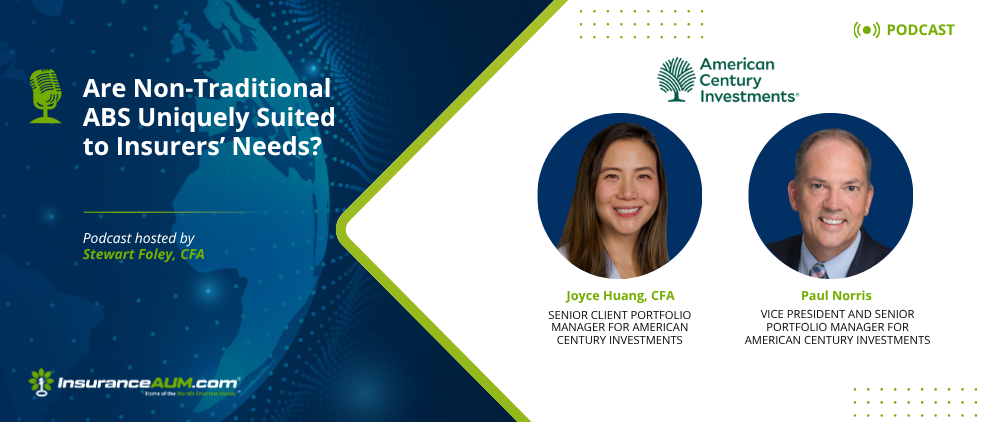
Are Non-Traditional ABS Uniquely Suited to Insurers’ Needs?

Image
American Century Investments Podcast Header

American Century Investments does not currently manage assets according to the model portfolio guidelines presented. Model performance does not guarantee future performance of any account or portfolio.

This strategy may not be suitable for all investors. Investment return and principal value will fluctuate, and it is possible to lose money by investing. There is no guarantee that the investment objectives will be met. The information is not intended as a personalized recommendation or fiduciary advice and should not be relied upon for investment, accounting, legal or tax advice.

The yield target is aspirational in nature and is not based on any criteria or assumptions. The target is not meant to reflect any projection or promise of performance. No guarantee or representation is being made that any account will or is likely to achieve the target shown.

The opinions expressed are those of American Century Investments and are no guarantee of the future performance of any American Century Investments portfolio.This material has been prepared for educational purposes only and is not intended as a personalized recommendation or fiduciary advice. It is not intended to provide, and should not be relied upon for, investment, accounting, legal or tax advice.

Investment return and principal value of security investments will fluctuate. The value at the time of redemption may be more or less than the original cost. Past performance is no guarantee of future results.

©2025 American Century Proprietary Holdings, Inc. All rights reserved.
FOR INSTUTIONAL USE ONLY/NOT FOR PUBLIC USE


Stewart: Hey, welcome back. We're thrilled to have you. One of the things I think I don't say enough is identify the podcast. This is the insuranceaum.com podcast. I'm Stewart Foley, CFA. I'm the managing partner of Insurance AUM, and I'm also the podcast host. This is our Executive Spotlight Series, where we talk with people shaping the future of insurance asset management. Today is a topic that doesn't get enough airtime in my mind, which is opportunistic: Securitized assets and why they may deserve a spot in an insurance company portfolio. And we're joined by Joyce Huang. Joyce Huang is a CFA Senior Client Portfolio Manager, and Paul Norris, Vice President, Senior Portfolio Manager at American Century Investments. Joyce and Paul, welcome. Glad to have you on.

Paul: Thank you, Stew.

Joyce: Thanks, Stew.

Stewart: So, we always started off the same way, and today we'll start with Joyce.

Joyce: Okay.

Stewart: So where'd you grow up? What was your first job, and what was the first concert you went to?

Joyce: So I grew up in Princeton, New Jersey, and my first job was a lifeguard at my neighborhood pool. So, I grew up swimming. I was on a swim team all through high school, so I loved it. So, it was kind of like a great opportunity to get paid while I was hanging out at the pool and getting a tan in high school. So can't complain.

Stewart: I was going to say you're one of those people who was super tan all summer. I always had a farmer's tan because we always had t-shirts on. We were working cutting grass, and I was like, dang it. So what was your first concert?

Joyce: I want to say my first concert was probably like NSYNC back in the day.

Stewart: Nice. There you go. 

Joyce: Definitely dating myself.

Stewart: Alright, Paul, your turn. Where'd you grow up, Paul, and what was your first job? And I bet your first concert was not NSYNC.

Paul: It definitely was not, Stew. I was going to go with Joyce's first concert as maybe Backstreet Boys or something like that. But, NSYNC is fine too. I grew up in a rural town called La Plata, Maryland, a long way south from Washington DC, which is why I have a little bit of an accent still. My first job was actually working construction, digging ditches and doing all kinds of stuff that I actually still kind of enjoy when I'm outside. It's not that I don't love my work today, but it's a nice change of pace.

Stewart: Absolutely.

Paul: First concert was the Beach Boys at the now-defunct Capital Center outside of Washington DC.

Stewart: Wow, there you go. That's a good one.

Paul: Yeah, it was cool.

Stewart: It's interesting. American Century is a very, very well-known name in the financial services community. And what's interesting, Joyce, is that American Century has been working with insurance companies quietly for a very long time. The question is, can you give us a quick overview of American Century and just an overview of the experience within the insurance asset management sector, and what does that client base look like today?

Joyce: Yeah, of course. I mean, I always like to say people have heard of American Century. It's normally on the equity side, and our founder, Jim Stowers, started the firm. He launched a number of very successful US growth equity strategies. So a lot of people think of us as that, but we have been managing money on the fixed income side for over 50 years, and as a company, we've been working with insurance clients for two decades. We have almost 25 different insurance clients that we have or managing different pools of money for them, from general account money to alt sub-advised, and it totals to just over $5 billion now.

Stewart: That's awesome. And it's good to know. Paul, I'm going to talk a little bit about the core topic here, which is that opportunistic securitized assets certainly have a bit of a tailwind right now. Can you talk to us about why and which types of insurers may benefit most from this asset class?

Paul: Thanks, Stew. I would say I've been kind of doing this for a long time. I mean, my own joke is I might be fully amortized by this point, but what I think is interesting… What I think is interesting, and I love that Stew is laughing, because that makes me laugh.

Stewart: I mean, most of the people in this business, what most of us are fixed income, we're bond geeks, most of us, right? And so that's a bond guy's joke right there. You know what I mean? It's good. So go ahead. Thank you. Sorry.

Paul: Right? Yeah, so I think a couple things we should probably level set. One is in terms of managing assets for insurers and opportunistic securitized, I think it's come in many different flavors, but my experience is that what we're trying to do is provide solutions for insurers. So that's really, it's not one size fits all. So, Stew, I would say for what we're doing and what I've done in the past is that this could work for life insurers, this could work for specialty, this could work for P&C, and it's really about, for us, creating a bespoke solution that fits the entity. And I think why I love my job is sitting down and talking with CIOs and others about how can we help you? And often I hear, and then I'll stop too, is like, Hey, I got too many corporates, man, I've got my five-year corporates are now eight to 10 years, and they've gone from single A to triple B minus. How do I really diversify a way without adding credit risk, taking more risk-based capital on in terms of a lower rating, and how do I not sacrifice income? And I always come back to what we call opportunistic securitize, which really a lot of people call esoteric. So, for us, we think it makes sense for a lot of folks, but it's really about listening to the client and providing them with a solution.

Stewart: Yeah, it's interesting. I mean, corporates are crazy tight right now as everybody knows. And I think that it's one of the reasons that this asset class has got a bid. Let's go one level deeper, though. I mean, what does your model portfolio look like in this space, and what are some of the characteristics that you're aiming to deliver?

Paul: So, Stew, without revealing the secret sauce that goes into the secret recipe, I would never want to give that to all these folks who are going to listen to this podcast. But, what I will say, generally we're looking to patrol the securitized markets and typically provide the insurance company a portfolio that would say have a weighted average life depending on their needs between, say, three and five years. And we're looking to be triple B corporates by 50 to 100 basis points. And so we're looking at frankly any asset class that bubbles up to the surface that has good relative value. And so I think for us, data center is something that everybody and their mothers are talking about. And to be frank, I don't think that has a lot of great relative value. Newer asset class hasn't been proven, spreads are kind of tight for what you're getting. And I, there are other places that nimble folks like ourselves can go to build a portfolio, whether that's some select triple net lease, some cell towers, or art receivables. So I think there are different flavors that we would build and use to put together a portfolio.

Stewart: I do feel like there's this tendency to take what's currently the case and project it to infinity, and you talk about how much compute power we're going to need and how much electric power we're going to need to run it all, and all that stuff. And you go, we're one breakthrough away from changing that equation. And I think it's interesting that your view on some of the asset classes that have been very much in vogue that perhaps need to be reexamined or reconsidered, but that leads me to you Joyce, which is insurers have a range of asset classes competing for shelf space, CLOs, private credit, ABF. How do opportunistic structured or opportunistic securitized compare to those, and what's the relative value story?

Joyce: Yeah, I think that's a really important question to answer because we know that insurers have a lot of options in front of them and frankly, I started my career right before ‘08 at Lehman Brothers, so you really have to look back to that era to get yields like you're getting in liquid fixed income right now. So it's not a surprise that over the last almost 20 years you've seen a lot of these more alternative asset classes pop up as a lot of institutional investors are looking for that yield.

In 2022, it made a lot of sense to have floating-rate fixed income because you had core bonds down double digits. I never thought in my career I would see investment grade bonds down that much, but CLOs performed well during that period, and that was during a stronger economic outlook. When things were going well, CLOs did well and it made sense. Now, when we're facing perhaps a slowdown within the fixed income team in American Century, we're calling it a growth scare. So, not a recession, but we expect growth to slow in the Fed to cut those yields on CLOs are going to go down pretty quickly. And don't forget the underlying pieces of those CLOs are bank loans. So, there is some inherent correlation to the equity market, to the business cycle that we think opportunistic securitized can actually provide a really nice diversification against that flow.

Stewart: And that's super helpful. Paul, it's back to you. I mean, let's talk a little bit about myths. What are some of the biggest misconceptions insurers tend to have about the securitized space, and what do you think they should understand better?

Paul: I think this is universal, so I don't want to cast a bad light on my insurance friends, but I would say having sort of working and building these esoteric portfolios for the last 12 years after the great financial crisis, I would say there's probably three things. One is I always hear that these are less liquid. Well, I think the liquidity in this day and age is dealer balance sheets have changed and they're devoting much less to trading, especially corporates. I think the liquidity is pretty close. I would say the other thing, and I don't know where this came from, is I always hear a single A in ABS doesn't equal a single A in corporates.

A single A in ABS is equal to a double B in corporates. And I'm like, oh gosh, we probably need to talk and I can show you some statistics coming out of the great financial crisis that show there are some asset classes that did really well coming out of that. And I was like, oh, by the way, we could go back to the WorldCom era and when all those corporates sort of blow up. So I think my point is there are some misunderstandings out there, and a lot of it has to do with the great financial crisis in the past history. And then I think the last one that I'll mention is that there's a lot of confusion between when folks hear the word CLO or subprime and then they confuse it with a CDO or subprime mortgages, and then they're like, I don't want anything to do with it. So I think I've become a bit of an apologist for securitized credit and trying to explain folks about what's real and what's not.

Stewart: Yeah, that education is important. I mean those are very different asset classes that you were listing there. So my experience is often the same. I mean, some institutions have organizational biases based on something that happened many years ago that in a market that is very different than today. And I think that you have to have an open mind when you're looking at opportunities and to really look at, analyze what relative value is, particularly given the backdrop of that insurer's operations, capital position, tax position, so on and so forth. But, Joyce, let's talk about American Century specifically. What can you tell us about an insurer's experience coming to American Century investments, managing their securitized allocation? What are the differentiators?

Joyce: I mean, I would say number one, we love to partner with our clients and form really deep relationships with them. And as Paul mentioned, our portfolios are all customized, so we're not a manager who's going to turn away smaller accounts. We love working with investors who want to be able to reach Paul, reach his team, get on the phone with us whenever they have questions because we know that this is a newer asset class and there's going to be a lot of questions from the board or regulators, and we have a lot of tools that we've developed in-house that can help us bring you the information you need. So we would love to partner with any clients out there who are looking for bespoke service, tailored portfolios, really consistent communication, thought leadership, things like that. I would say we pride ourselves on really, really good customer service in addition to obviously the table stakes. But I would say our secret sauce is really the client servicing and the access that you have to Paul and his team.

Stewart: And I mean, Paul, I understand that you offer, I mean you've been doing this for a long time and so you end up with customized solutions, right? And some folks don't understand the complexity of managing those customized portfolios, particularly when you have a lot of them, and that is often a systems issue. Talk a little bit about how these portfolios get customized access to the team. I mean, those are things that really matter to an insurance company. Talk to us about the service levels and the tools that you have at your disposal.

Paul: Thanks, Stew. I think at the crux of why we think we're going to be able to do this and do this really well for a long time and that we have really spent the human capital as well as money to build out world-class systems. And I will tell you that we have met with a couple of very large consulting firms across the globe and shown them our proprietary insurance technology for securitized, and they have said it's the best that they’ve ever seen. And so the teaser there is really that for a smaller boutique, and I would call us a boutique, and we put those things together to create a platform for insurers that will handle all of their regulatory needs that will handle any of the questions that they might have regarding the portfolio. If they need to get on the CFO needs to talk to the Chief Risk Officer, we've got a system in place that will provide true transparency for any questions that the C-suite might have all the way down to the CUSIP level. And so I think I take a lot of pride in that. We've spent a long time developing the system and it really allows us to one, manage credit risk for insurers exceptionally well. And then two, I think equally important is provide full transparency, 100% transparency to our clients at a CUSIP level.

Stewart: Yeah, I mean I think my notes have something about scan, which is your specialized risk management framework. Can you go a little further on how that provides information to both the investment team and the C-suite that you mentioned?

Paul: I think that's an important point, and one of the things that we really do with scan is we can look at a portfolio or a single asset from 30,000 feet at the portfolio level to talk about how your portfolio is doing for prepayments delinquencies. And then, if you want to drill down into an individual security, we can actually pull that security up live on the screen with you, Stew, if we were having a Zoom call, or we can PDF you a tear sheet in less than a couple seconds to your C-suite to have a discussion. And that's just sort of the broader view. I think what's most important is we developed what I would call key metrics that we follow that are proprietary to us, that help us figure out when we think a bond's going to get downgraded, when it could potentially take a loss that allow us to actively manage credit risk in a live setting. And I think that's sort of the power of scan is that it's all automated, it's all built into our enterprise system. It's not sitting on some spreadsheet that's going to break. This is a real system. It's live, it's our nerve center, it helps us make really good decisions on credit.

Stewart: I've worked at places that have great systems, and I've worked at places that don't. Man, it is a lot easier world and a lot better outcome with good systems, to say the least. So, as we wrap here, Paul and Joyce, what are a couple of key takeaways from the conversation today? And then I've got a couple of a little related but maybe a little bit more fun.

Joyce: I guess I can start with my key takeaway here is that we're talking about an opportunity here to get high yield like returns and higher credit quality. So this is really a very unique opportunity to partner with us, to look at this universe that Paul has a lot of experience in, and customizing a solution to meet your needs and more effectively than more traditional allocations that insurance companies have used in the past.

Paul: This is why Joyce is such a great partner. She just nailed it. I don't think I can add anything.

Stewart: Hey, that's perfect. So, thanks so much for a great education and opportunistic securitized. I've got a couple of fun ones for you on the way out the door. And I think this gets to the culture at American Century, which is one of the things I think that in anyone who's interested in talking with you wants to know, which is what are the characteristics of that you're looking for when you're adding members to your team, not what school they go to, can they use R or whatever, but what are the characteristics that you look for when you're adding team members?

Paul: Stew, I've worked at a few different places. This is the best place I've ever worked. The people here are so amazing, they're so smart, they're so dedicated. And I heard this, and it really resonated with me. People here are humble, hungry, and smart, and I think those are the types of people we're looking for. And if they fit that bill, that's who we are, and it's a really exciting place to work.

Stewart: I love that. Alright, so here's the other one you can have. This is lunch or dinner. Let's just make it dinner. Dinner for four, which means that each of you gets to invite one guest, alive or dead. Who would you most like to have dinner with? I'll start with you, Joyce. Who's your dinner guest?

Joyce: So, I would definitely love to have a conversation at a dinner party with Martha Stewart. I am so fascinated by her background. She got her start on Wall Street before she built her own multimedia empire and one of my biggest hobbies is baking. So I'm a big fan of hers and her cookbook, so would love to hear about all of that. But also we know she is friends with Snoop Dogg and all that stuff, so would love to hear about all the gossip she has on that side.

Stewart: Yeah, that's a great, there you go. So Paul, you've got Joyce, Martha Stewart, yourself, and who's the fourth?

Paul: I think I'm inviting Moses. I would love to hear Moses's story in his own words, in that the guy had a hell of a journey. He had to deal with a lot of people who were unhappy and complaining a lot, and I'm just like, wow. I would love to learn more about what was actually going on day in and day out and how he handled it and his risk management approach.

Stewart: Yeah, I will tell you, I have used this line, it is a tongue in cheek thing, but I always say everybody knows what was in one of Moses' arms, but nobody ever talks about what was in the other, which is the rules for insurance asset management. And I said those tablets have been passed down. And as a matter of fact, I got a call from Rich Kaufman today. He's leaving on some five month bike tour. I think he had the tablets last, but I'm not sure where they are right now. I swear to goodness. But very nice to have you both on. Appreciate you taking the time. We're thrilled to have American Century on our platform and we've been joined today by Joyce Wong, CFA, Senior Client Portfolio Manager, and Paul Norris, Vice President and Senior Portfolio Manager at American Century Investments. Joyce and Paul, thanks for being on.

Paul: Thanks Stew. Talk to you soon.

Stewart: Absolutely. Thanks for listening. If I have ideas for podcasts, please shoot me a note. It's Stewart@insuranceaum.com. Please like us, rate us and review us on Apple Podcast, Spotify, or our brand new YouTube channel under InsuranceAUM Community, where you can watch both audio and video. Thanks for listening. InsuranceAUM.com is the home of the world's smartest money. We'll see you next time.

Sign Up Now for Full Access to Articles and Podcasts!

Unlock full access to our vast content library by registering as an institutional investor

Register

Contacts


American Century Investments®

American Century Investments is a global asset manager dedicated to making a difference. For our insurance company clients, that means understanding your industry’s unique investment needs and challenges, including balancing liquidity with returns, along with managing complex accounting and tax-reporting requirements.

We can help you through our diverse range of fixed income, equity, and private investments. Our fixed income team’s mindset—dynamic approach to management, disciplined risk-taking, and deep relationships with clients—aligns particularly well with insurers’ needs. Insurers see that value, as 20* insurance-related clients entrust American Century with more than $3.7B* in assets under management. Overall, we manage more than $279B* in assets on behalf of individuals, intermediaries, and institutional investors.

*As of 6/30/2025

Kevin Eknaian
Head of North America Institutional
Kevin_Eknaian@americancentury.com
+1-646-658-7710


View the contributor page

Sign Up Now for Full Access to Articles and Podcasts!

Unlock full access to our vast content library by registering as an institutional investor .

Create an account

Already have an account ? Sign in

Ѐ Ё Ђ Ѓ Є Ѕ І Ї Ј Љ Њ Ћ Ќ Ѝ Ў Џ А Б В Г Д Е Ж З И Й К Л М Н О П Р С ΄ ΅ Ά · Έ Ή Ί Ό Ύ Ώ ΐ Α Β Γ Δ Ε Ζ Η Θ Ι Κ Λ Μ Ν Ξ Ο Π Ρ Ё Ђ Ѓ Є Ѕ І Ї Ј Љ Њ Ћ Ќ Ў Џ А Б В Г Д Е Ж З И Й К Л М Н О П Р С Т У Ф Х Ц Ч Ш Ā ā Ă ă Ą ą Ć ć Ĉ ĉ Ċ ċ Č č Ď ď Đ đ Ē ē Ĕ ĕ Ė fi fl œ æ ß