





We're currently experiencing email delivery delays. For urgent matters, please contact us directly at lindsay@insuranceaum.com.

Ares Management Corporation-

Backstage with Ares: Private Credit, Platforms & People

Image
08.21 Ares Management_Web


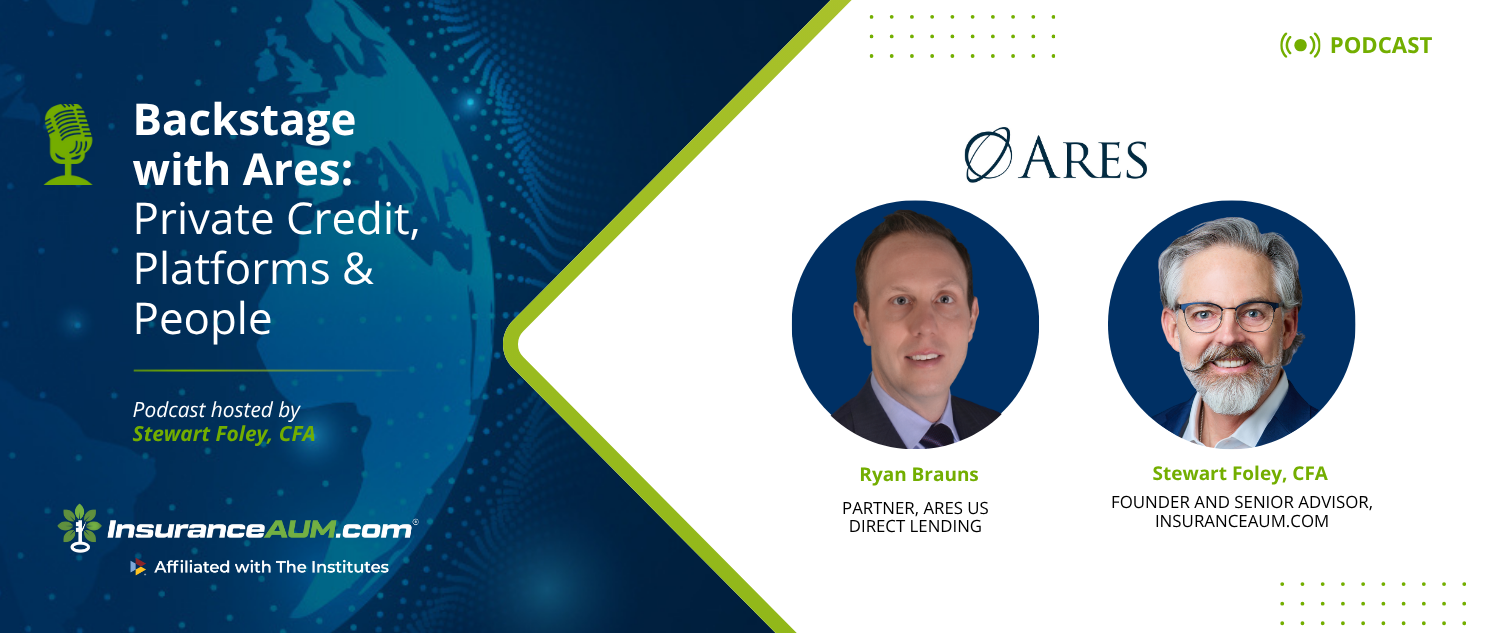
Stewart: Hey, welcome back to the home of the world's smartest money here at Insurance AUM. We're thrilled to have you join us. We have a small but very focused audience, and we're always talking about insurance asset management. We've got a great podcast for you today. The title is Backstage with Ares Private Credit Platforms and People, and we're joined today by Ryan Brauns, Partner at Ares US Direct Lending. Mr. Brauns also holds a BS Summa Cum Laude from Salisbury University, home of the Seagulls, and an MBA from Columbia Business School. I've heard of that place. Ryan, welcome. How are you today?

Ryan: Wonderful. Thank you, Stewart. Glad to be here with you guys, and I look forward to kind of spend a little time on US direct lending.

Stewart: Yeah, that's fantastic. So before we get going too far, we kind of want to know a little bit about you. Where did you grow up? And this is the newbie for us: what was your first concert?

Ryan: I actually grew up in Maryland. I spent most of my formative years in the Eastern Shore of Maryland, so a small town called Berlin, Maryland, just near Ocean City on the eastern coast. After high school, I actually went to Salisbury University, which was about 45 minutes away. Small town America, but really kind of where I grew up and my roots, and I really love it. So my first concert was actually Purple Rain, so that was Prince. So Sheila E. opened up. I don't actually remember how we ended up there. I remember it was me, my brother, my mom, and my dad. I don't quite remember the situation. I wish I had a better insight into it, but I've always been actually a Prince fan, and that's how I know him, as kind of his name originally. But yeah, it was a good show. I remember it still today.

Stewart: That's amazing. That's an amazing first show. That's a good one. We had some interesting answers, I’ll just say that, but that's a really good one. Let's talk about private credit. I mean, it's a broad landscape. A few weeks ago, Brent Canada and Bryan Donohoe were on, joined us on the show. Can you discuss where you focus on private credit at Ares and how the platform has grown over the years?

Ryan: Yeah, sure. So look, and if you've had the chance to listen to that podcast, I'll give you some perspective, but if you haven't, I'd go back and even take a listen because I think we spent a lot of time on real estate debt and infrastructure debt. As you think about what's occurred over the last five to 10 years, private credit's kind of taken on a kind of bigger meaning where I do think about it as directly sourced credit through different verticals across the US and candidly globally. So, bringing that down, I focus on the US, and within the US, you can think about what Ares has done is we've raised about $350 billion of assets in credit of about the $550 billion of assets globally. About $180 billion of assets is what I'll tell you is illiquid credit in the US. And what I mean by that is we tend to have built a platform and scaled through various fund structures and whether that be SMAs, commingled funds, our public BDC, ARCC, we have these different vehicles based on risk tolerances, where we've gone out and partnered with private equity sponsors and/or directly to end borrowers.

So that could be families, it could be individuals, it could be conglomerates where there's not a private equity sponsor. So over the years, what I would tell you in the US is we haven't really changed what we're doing, we've just gotten bigger. And what I mean by that is we used to finance businesses that were maybe $10 or 15 million in earnings. Now, we still do that today, but as our resources have grown and our pools of capital have grown, we are now financing businesses that could be $400, $500 million plus. But I'll tell you the core focus in the US for our business, which is US direct lending, is corporate credit. So you're underwriting an individual credit, you're providing a loan, and you're looking at the valuation of that company over a period of time. So that's the sector we're going to spend a little bit of time today on.

Stewart: Yeah, that's super helpful. And I assume that that increased size helps you access some opportunities that aren't available if you are not the size and scale that you are. I saw last year that Ares broke a record for having the largest US private credit institutional fund. How have you found the direct lending market recently, and what can you tell us about transaction activity?

Ryan: So in the US, the way we go out and originate deals from sponsors, I kind of think about it like an hourglass, where in the US, at the top, we raise pools of capital based on the underlying risk tolerances of our LPs or, therefore, investors. And we never put deals into those vehicles that weren't of that risk tolerance. So we might have a senior direct lending, which we think about as dollar one, some of the safest capital we might have for investors at Ares relative to what we do. And then we might have a junior capital fund, which might be preferred equity or junior capital. So, as we think about second lien and all of these nuances at the bottom, what we do is we go out and we originate deals from private equity sponsors where we might say, I can do revolvers, I can do first lien, I can do second lien, I can do preferred equity.

So, what we're left with is a highly flexible capital base where we can originate deals but then bring them back into our investment committee process and put them into vehicles where you're not taking undue risk for your LP base. So if you stop there for a minute, let's talk about the fund we raised, and we started fundraising for this. It was the Senior Direct Lending III. It's a co-mingled strategy fund that we started raising in 2023. It's consistent with our mandate that we've been doing for 20+ years, but as you point out, it's given us some flexibility. It's a co-mingled strategy where we raised just over 15 and a half billion dollars of capital, and then we have a levered sleeve in that. So in aggregate, it's about a $30 billion pool of capital, and then we have some co-investor vehicles along on the side of that. And with that pool of capital, we're able to go out and provide really a dollar-one opportunity for our investors, where we're providing senior debt, whether that be leverage of four times or six times, we can hit on what that means. But every credit we think about structure and loan-to-value ratios. So this is really a fund that was set up where we're taking dollar-one risk, and it's really 40% loan-to-value type deals that we're taking in that fund. And again, that's the SDL III series.

Stewart: That's super helpful. It would be helpful to just define what you mean by four times or six times you hear the term terms of leverage. And I just think oftentimes, Ryan, people throw terms around, and I do it too, and I'm like, if you told me, ‘hey, define that term’, I might struggle a little bit. So our audience tends to like it when we break things like this down. So that would be super helpful.

Ryan: Sure. Let me start with the term loan-to-value because it might be even easier to start there. So what we might do is we might go out and we find a credit that we really like and we think, just like buying a house, the value of your house is a hundred dollars. We will provide you with a loan for 40%. So we would call that 40% loan-to-value. The homeowner needs to come up with 60% of the dollars. The lender will come up with 40% of the dollars to help you buy that house. That 60% is called equity. And if you transcend that and use that analogy to buy a company, we might provide a private equity sponsor $40; they need to come up with $60. So that is one way to look at it, which is what we call loan-to-value.

The other scenario, which I mentioned to your point or benchmark, is what we call turns or leverage. And the way we think about it is the earnings of a company. We often hear the term EBITDA is earnings before interest, depreciation, and amortization. This is what we try to get down to the true cashflow of a business. I.e, when you think about all the expenses of a company, what is left to help service debt that is EBITDA. And we often talk about leverage in turns of that EBITDA - four turns, five turns or six turns - and a lot of people will say first lien and unitranche, I think about it as how much debt can the company support where you're prudently putting enough debt on the business to optimize the return to the private equity sponsor, but you still have free cashflow EBITDA on the business to help service that debt. So that's terms of leverage as we think about it.

Stewart: That's super helpful. And private credit's been, and this is certainly not news, has been a fairly popular asset class with the insurance community, and over the last 18 months, the result of that has been some spread compression in corporate senior direct lending. Has this been driven by elevated base rates or retail assets flowing into the market, or just kind of give us a little bit of color on the spread compression?

Ryan: Yeah, so it's interesting or both, or let's add another topic, which has just been a low M&A environment, and it sounds nuanced, but we get the question a lot of “Well, isn't there too much money chasing not enough deals?” And I think the answer is we are in a period where we have seen very strong fundraising within the sector of what I'll tell you is US direct lending private credit. So the focus of what we're here for today. What I think about is if you look at the truly addressable market, what we have seen is, to your earlier point, we've absolutely seen elevated base rates. So the private equity community says to us, listen, my company can only afford 7%, 8% if you go back and think about that turn of leverage to make the leverage buyout work that 40% loan to value deal. So I do think we're in an environment where spreads have been slightly compressed to a long-term 30-year average because of elevated base rates.

But I think about it that we price risk and we think about risk relative to where else can you put your money? And we want to really look at spreads relative to the liquid loan market and what we do with Ares in the US for US direct lending. So what I mean by that is there's a very efficient market called the BSL, the syndicated market, where banks are underwriting deals and then they sell that risk off into the market. So I'm trying to keep it a little bit simple. So instead of being in what we call the storage business, like we are at Ares, we take that loan and we actually own it, and we're a partner with the private equity community, the bank might underwrite it to go sell it. So that market right now, we think about it that we want to be 150 to 300 basis points premium to that market, and we've been holding between 175 and 225 basis points to that market.

So I think about it that if you're an insurance company and you want to think about “where can I put my money without taking more risk,” I would tell you there has been some compression, but that premium still exists relative to the liquid market, which we think is very important. I also think if you look at Ares, and I know if you listen to other podcasts about Ares and what we've done in different platforms, about 57% of the deals we do in US direct lending, somewhere between 50 and 60% a year, are to incumbent borrowers. These are borrowers that are already borrowing money from us, that are upsizing and growing, and need incremental capital to help fuel their growth plans. So that isn't new low deal activity. These are borrowers that are in the market, and it's a very efficient market. I think that ratio of retail money that you do hit on it has been driving increased competition in the market, but it's still such a small percentage. Even when you look at Ares' balance sheet or relative competitors, it is still a small percentage relative to the aggregate pools of capital.

And if you still look at, if you think about the ratios I was giving you with the value of how much of the debt is in a capital structure relative to the equity, we are still six times less, we think, the amount of dry capital for the private equity community. And what I mean by that is the dollars of private debt relative to the dollars of dry powder of private equity, they're still keeping the right ratios. So I think it's just more of a lower M&A environment right now because of the uncertainty. And I don't hang that on tariffs. I just look at, in the general uncertainty we've lived through in the last five years, we're just starting to feel like businesses have their rhythm and they're underwriteable. So hopefully that's helpful. I think that's the lens we think about credit and kind of how we're pricing risk in this environment.

Stewart: That's super helpful, and that kind of color, that insight on the breakdown between retail and institutional, and so forth. I mean, that's really helpful because it's not something that you see published or that we have any insight into. So I appreciate that information.

Ryan: Yeah, look, to your point, we all know, and look, I think that all media outlets do a great job of providing some level of transparency of what's going on within the regulated industry, but at the end of the day, what was new two years ago is not a newsworthy story. So everyone now is focused on what retail is, and what's going on? If the opening of the 401 (k) market happens, what does this start to look like? So I just think it's always just these news stories that are picking up on any changes in the underlying markets that are occurring.

Stewart: So let's talk about specific transactions. What are the most important aspects of underwriting transactions? So, in private credit, you hear about covenants, and are covenants hanging in there? Or where can you flex, and what are your kind of non-negotiables?

Ryan: If you think about what we do in the US, we end up, when we close a deal with a private equity sponsor for everyone's benefit, we have what's called a credit agreement. And within that credit agreement, there are rules of the engagement in the partnership, and you have covenants, and of those, you have positive covenants and negative covenants. That's the way you can think about it. Things you can do and things you can't do. And also, you have what we call financial covenants. And these are, if there is a situation where if we lent you four turns of leverage that I gave you earlier, and your leverage goes to six turns of leverage, we would say that most likely that means your earnings, the EBITDA, went down, and therefore your leverage went up. It's a ratio of debt to earnings. So as you think about that multiple, we would call it, it's kind of a break.

It's a break in the deal that says, “Hey, we didn't quite agree to what this is going. You gave us kind of a financial forecast, and you've underperformed that and we had rules, and that's a financial covenant.” That financial covenant kind of says, let's all sit back at the table and understand, did something change in this business? Do we need to reprice the risk? Do you need maybe the Mr. Private Equity or Ms. Private Equity sponsor put in more capital to make that ratio of debt to equity look better and more aligned with the deal we all agreed relative to the company, the industry? That's one I would say, covenants have relatively maintained their structure. I think in various cycles over the last 20 years, you've seen covenanted deals for 50 million earning EBITDA business companies up to 150. It moves and flows given market tolerances.

Right now, I would say a large portion of deals, $60 to $70 million of EBITDA and below, will have a financial covenant. There are certainly businesses that don't, but in general, that's a good rule of thumb right now in this market. Secondarily, is negative covenants, things you can't do, which are transferring assets out, doing things that would actually hurt our borrower. And you hear a lot about this right now in the marketplace, what are called LME protections, as you've heard all this language out there in the newspapers. These are just terms that have been coined to say, are there little “I gotchas” inside the credit agreement where if I close on a deal and I'll keep it simple, I close on a deal and I underwrite a manufacturing business, and there are assets, i.e, factories, what can you do with those factories? Can you sell them? If you sell those factories, do you have to pay down my loan, or can you use those cash proceeds to actually reinvest in the business?

So all of these are the things that we focus a lot on, and the negative and positive covenants and financial covenants are often not talked about in the press. What's talked about is economics: “a deal just cleared, its SOFR + 4.75”, what does that mean? It's the base rate SOFR plus 4.75% and we might get a point to two points upfront, 1% to 2%. Those economic terms have moved around over various cycles. I would say on average right now we're lending money between SOFR + 4.75% to 5.25–5.50%. for an average type business with 1 to 2% upfront, roughly. Where won't we give? The answer we won't give is these LME protections, this documentation. And the reason is because we're in a deal with a private equity sponsor, that credit agreement that deal we made lasts anywhere between four to six years, and the average duration, the average life tends to be three to four years.

So contractually, four to six, average, really, what happens in real life is three to four, that's a deal. In that deal, we want to say what can you and can't you do with the deal we all agreed to upfront. So I'd say we are incredibly focused on our protections in the document because our view is that when we close with a sponsor or a non-sponsored deal, we want to understand the rules of the road, and they can't change. So I would say there's flexibility and pricing risk, i.e spread and upfronts leverage. Where will we and won't we walk away from a deal, and then we will certainly walk away from non-economic terms as well, as well as financial covenants being too loose, et cetera, too wide if you would.

Stewart: That helps me. I appreciate that. So what do you see as the key risks or considerations in direct lending businesses that investors should be aware of? It's kind of the term that keeps you up at night, right? Yeah. Can you talk a little bit about that?

Ryan: Yeah, so look, you can talk about credit cycles, you can talk about leveraging the system. I think if you are working with a very disciplined manager, I mean, Ares has been doing this for 20 years, so we've been through cycles, our same investment committee has been intact. That is a worry we think about day to day, that is what we do. But if I think about the worry for the “what keeps me up at night,” it's really that I worry that our industry needs to self-police and make sure what we are doing correctly is putting investors – and that could be insurance companies, that could be individual investors – that they understand the risk tolerances of what we do, and they understand duration matters. And what I mean by that is if you have an insurance company that approaches Ares and says, “I have a pool of capital, me and my team or my advisors have said we want capital that generates a let's say 8 to 11% asset level return including losses and all of that over time and I want my money back over three years, five years, seven years, what does that duration?”

I worry because I do think what happened in the banks is I think there's been regulatory pressure because banks were using their capital reserves and they were mismatching. And what I mean by that is you were having a balance sheet at a bank with shorter-term duration risk, and they were putting out loans potentially and getting hung with loans that have 3, 4, 5-year-average lives. That's a duration mismatch. What I don't want to see in our industry is that we lose sight of the fact that we manage money for people, for constituents, for individuals, for pensions, where there has to be a duration understanding. So it comes back to your earlier question around this retail model. I really want to hope that our industry is self-policing and regulated in a way that we understand we're putting investors in the right products, such that they understand duration. I'm giving you money for three to five years that I can have access to for liquidity needs if I need it, but on average, we make some of our best returns during periods of volatility.

You go with a proven manager who understands how to price risk during periods of volatility, make money during periods like COVID, where we were supporting businesses in the US. We weren't being egregious with the way we were pricing risks, but we were able to help support the economy. So it's a long way of saying I want to make sure that we're actually looking at our product formation and we're really thinking about duration correctly, because I do think the regulatory bodies are comfortable with this private credit industry driving good duration and match. You have underlying liabilities or assets from managers, insurance companies that say I want three to five-year returns and they're going into products that are three to five years. To me, that is key, and that's where you don't get upside down on duration mismatch.

Stewart: Yeah, I mean this is the opinion of the host, but banks are funding long dated loans with overnight deposits and an FDIC backstop and you go, wait a minute, insurance companies are a much more natural provider of that capital because they've got an ALM alignment and they also don't have a risk of a run on the bank. So I personally think, and there's people going, oh, private credit, but at the end of the day, to me it's a more natural ALM alignment.

Ryan: Stewart, I'm not a regulator. I don't know why we have driven or haven't driven risk out of the banking system, but I think we all know what we've seen since the GFC and I think inherently, we are financial institutions that are managing capital and the regulatory body wanted to make sure it was landing in a sector of the capital where it made sense with sophisticated managers. And I think that's where someone like Ares is very helpful. So exactly to your point, Stewart.

Stewart: And you're the ones funding growth. I mean, we're a small business, banks don't want to lend to us, and at the end of the day, I think the insurance industry, in a way, is really funding a lot of economic growth. But you mentioned earlier that Ares has raised pools of capital in discrete areas of private credit. Can you talk about those areas, and have you seen insurers participating there, or have they remained more focused on generalist strategies?

Ryan: I'm going to take a little bit in pieces and I think I can get the answer at the end. So I'll start with, if you think about the pools of capital we've raised, we've raised what are called separately managed accounts, where we might manage large pools of capital for an individual, and I'm going to use the word entity to pick your flavor. We also manage, what I'll tell you more of are called co-mingled vehicles, where we might have some sovereign wealth funds, we might have US pensions, endowments, and, to your exact point, insurance companies, and what do I mean? So we have insurers of managed shapes and sizes and aggregate from the balance sheet perspective, smaller single-state health insurance plans, as well as much larger, I would say, global life insurers. So over the past 10 years, we have seen private credit replacing kind of publics below investment grade and doing that through taking up some maybe of the share where I referenced earlier that liquid BSL market or bank loans, et cetera, and also high yields.

So I would say we're in the early innings to your question of what are insurance companies looking at, I think they come into private credit and use it as an asset allocation across a much bigger, more sophisticated model, I would say it tends to be a 1% allocation early on and might gradually ramp to an aggregate of 5%. So again, we have what I've learned, the term called “access points,” how do you come into Ares, what's right for you? But we'll keep it consistent with what we've been doing for 20 years, and we'll put you in that end product. So within the commingled area, asset managers such as Ares have worked with insurers and rating agencies to structure vehicles that hold what I'll tell you are sub-investment-grade debt in ways that are more opportunistically or operationally efficient.

And importantly, that results in capital charges, which on a blended basis is more similar to holding the underlying asset in a separately managed account. So again, instead of accessing through SMA, we now have structures where you can access through a very efficient and operationally efficient structure, but what we've been doing for 20 plus years is investing in private credit in businesses from five to 10 million of EBITDA all the way to 300 million plus. It's what we've done, it's what we continue to do. We tend to be generalists as we underwrite credit, our investment committee of 11 folks, and views all of these opportunities. But what we have seen is some demand by different entities, and it's not been insurers yet, I would say. 

I would say these tend to be subsegments of this corporate credit. They tend to have specialty underwritings; they tend to have a separate analysis of highly specialized origination, kind of what I'll tell you where verticals, we have partners that kind of just look at space deals in this sector. I would say while we have pure adoption of these types of strategies in the US across other sectors or other pools of capital if you would, I think it's early days for the insurance companies, I would say most are more focused on our generalist strategy. So I think that kind of hits the fewer viewpoints for you. But again, multiple pools of capital. But I would say where insurance businesses have most focused their balance sheets with us today has been on, what I'll tell you are more of the generalist strategies that we run in the US.

Stewart: Ryan, one of my really dear friends who happens to be a CIO said to me, insurers have got their private credit deal all figured out. But it's interesting that there are plenty of insurance companies who have not made an allocation to private credit. Life carriers, a lot of these folks have had big private credit allocations for a long time, other firms have not. So how should they be thinking about private credit from an SAA perspective? I mean the other thing that happens, I think that people, and I'm guilty of this too, have a view of an asset class that's like 10 years old for example. So for insurance clients that have yet to make an allocation to private credit, how should they be thinking about it within their SAA? And are there structures in place now that make it more palatable than it was call it 10 years ago?

Ryan: Yeah, look, let's take that in two parts. So firstly, we have insurers of all shapes and sizes and kind of flavors if you would, for investing in direct lending. I think you have smaller single state health insurers to some of the largest global life insurance companies that are considering and have invested into private credit. So over the last 10 years we've really seen private credit replacing publics below investment grade and even maybe some exposure in BSLs or high yield where they think they just feel like on a risk-adjusted basis it makes sense in their portfolio allocations. So what we've typically seen is the slow entrance, and this is probably consistent across first time allocators to private credit in general, but insurance companies probably early on, maybe a 1% allocation with a gradual ramp to say up to 5%. And then amongst their own profiles will figure out where that might be cut away from or rebalanced away from, I should say. And then look at, I think asset managers and insurers have worked with rating agencies to structure vehicles that hold sub investment grade debt in a way that's more operationally efficient. And importantly the result in capital charges, which on a blended basis is much more similar to holding the underlying asset in a separately managed account. So yeah, I do think it's more palatable than 10 years ago. In general, from a structural and allocation perspective.

Stewart: One of the questions that we ask is really trying to get at the culture of a firm like Ares. So as we roll out of the summer intern season and hopefully a few college students who were introduced to InsuranceAUM over the summer will continue to listen to our podcast. How does Ares think about the next generation of team members? I mean, for example, what do you look for in summer analysts and associates that have made others successful in a private credit career?

Ryan: Yeah, so look, we Ares, we started our interning program officially, I would say more institutionalized it almost five years ago. And I would say the intent was how do we go out to universities in the US to find what we think are top talented students. So for that summer program, we really tend to think about is a twofold process like aptitude and attitude. And from an aptitude perspective, we're looking for technically strong skills. We typically have kids, we'll do a case study and have them think through credit and attributes and how do they differentiate and delineate their thinking.

And then attitude is candidly what's so important to us still in Ares as we've continued to scale is just our culture. So we get a tremendous amount of qualified students and I think you have to also look through all of these super qualified students and find someone who's also a great personality fit. So someone where we really think about the team culture aspect and just really coming on board. So all in all we try to use this program, we really evaluate them of kind of just fit and then aptitude and attitude and then subsequently out of those summer programs, we're very fortunate that we've actually been able to make offers every summer out of that intern program and then bring them back and become full-time employees post their schools. So really love the program. I think it's been great. It's really helped us kind of build our pipeline of really young, talented folks that we can internally train and kind of have a career in private credit. So it's been great. It's a good program we continue to invest in.

Stewart: It's so important for college students too. I mean it gives them a real look at what a career in that industry and into your industry looks like and it gives you a real look at how the person interacts with your teams and so on and so forth. I mean, when I was teaching, we had an internship program and it was really, I mean the experiences that the students got, it used to be interns you'd like, I don't know, whatever they were doing wasn't meaningful sometimes. The internships that we, and I'm sure it's the same with Ares are meaningful, you're getting meaningful experience and it's a great way to find new talent.

Ryan: And that was the point when I say we institutionalized it, we built out a training handbook. We have kind of mentor-mentees for the summer. The intent is really to make sure they feel that when they left for the summer, they were the equivalent of being a first year at Ares. And it's not come and just watch what we do. We really try to have them participate and draft in some of our memos and our underwritings. We have weekly sessions where they can ask questions where things didn't make sense. And I think in general the view has been we can do a really, really good job of training these folks ourselves. And to your point, they're getting great experience and hopefully it de-risks their decision of post-college. “I now actually understand what this job or career is going to mean. So I really enjoyed it and I really want to go back.” So I think we all think it's a win-win to have the program. For sure.

Stewart: That's super helpful. So, alright, last one, fun one. You can have dinner with up to three guests, one, two, or three. Who would you most like to have dinner with alive or dead?

Ryan: Okay, I'm actually a very big music buff and I'll probably upset people. They're like, “this is who you thought of as the greatest musician. Oh my god.” But anyway, so I actually happen to be a very big fan of the reggae movement. So I actually would have one of my members as Bob Marley, I might have to separate him out from a broader dinner, because I’ll get to the other two. So I need two dinners. But I generally think what he did for a cultural element for people to bring his music to the masses and actually bring, what I'll tell you is an asset class, a music class to the masses and bring reggae within to the elements of a lot of music. So there you have, I've been to Purple Rain and actually I very strongly believe in a lot of reggae and music. I just like the vibe of what it brings.

Stewart: It's cool because I mean Bob Marley had an amazing impact and he passed at a very young age.

Ryan: Very young age. And I'd be curious if you would folks thought of the documentary recently. I actually enjoyed it, but I know his family had a big part in the making of it. So secondarily, I do think I would want dinner with John Kennedy. I do think there's an element of history that's probably been lost from a former president. And then lastly I think Socrates. So I'm going to go all over the map. I just think so much of modern day, I don't think we look back in philosophical beliefs and kind of where we've gone. I worry more and more of the today's generation doesn't look backwards in our understanding is losing attention span. So I happen to be a historical element of looking backwards to understand how we can best go forwards. I think I read enough finance books, I listen to enough podcasts like yours, Stewart, that it wouldn't be dinner set up with financial executives.

I kind of think my wife tells me we all need purpose away from what we do in our day to day. So I'm trying to spend more time in my life thinking about when I leave every night, what really keeps me running it is finance. I love it, I love deals, but I also want to think about philosophical beliefs, historical views of maybe what we lost in John F. Kennedy in a different element of a presidency in a different time and error. And then I happened to be just thinking about something that not only brought music to the people good feelings, but also was doing something culturally for a community that Bob Marley came out of, I just think was beautiful at the time. So

Stewart: Super cool. You've been a great podcast guest and we've learned a lot and really appreciate you coming on today. Ryan, want to say thank you to the entire team at Ares as well, so thanks for being on.

Ryan: Sure, Stewart, we appreciate your support as well as amongst the insurance communities, so anything we can do to be helpful, we look forward to it and enjoy the end of your summer.

Stewart: Thank you so much. We've been joined today by Ryan Brauns, Partner at Ares US Direct Lending. Please remember to rate us, like us, and review us on Apple Podcasts, Spotify, or a brand new YouTube channel at Insurance AUM Community. My name's Stewart Foley. We are the home of the world's smartest money at InsuranceAUM.com.

Share this post

Sign Up Now for Full Access to Articles and Podcasts!

Unlock full access to our vast content library by registering as an institutional investor

Register

Contacts


Ares Management

Ares Management Corporation (NYSE:ARES) is a leading global alternative investment manager offering clients complementary primary and secondary investment solutions across the credit, private equity, real estate and infrastructure asset classes. We seek to provide flexible capital to support businesses and create value for our stakeholders and within our communities. By collaborating across our investment groups, we aim to generate consistent and attractive investment returns throughout market cycles. As of December 31, 2023, Ares Management Corporation's global platform had approximately $419 billion of assets under management with approximately 2,850 employees operating across North America, Europe, Asia Pacific and the Middle East. For more information, please visit www.aresmgmt.com.

Robert Torretti  
Partner  
Co-Head of Insurance, Americas Relationship Management  
rtorretti@aresmgmt.com212-515-3385

Amanda Healy   
Partner   
Co-Head of Insurance, Americas Relationship Management   
ahealy@aresmgmt.com212-515-3351


www.aresmgmt.com

Ares Management

245 Park Avenue, 44th Floor,

New York, NY 10167


View the contributor page

Image
ARES Logo


Sign Up Now for Full Access to Articles and Podcasts!

Unlock full access to our vast content library by registering as an institutional investor .

Create an account

Already have an account ? Sign in

Ѐ Ё Ђ Ѓ Є Ѕ І Ї Ј Љ Њ Ћ Ќ Ѝ Ў Џ А Б В Г Д Е Ж З И Й К Л М Н О П Р С ΄ ΅ Ά · Έ Ή Ί Ό Ύ Ώ ΐ Α Β Γ Δ Ε Ζ Η Θ Ι Κ Λ Μ Ν Ξ Ο Π Ρ Ё Ђ Ѓ Є Ѕ І Ї Ј Љ Њ Ћ Ќ Ў Џ А Б В Г Д Е Ж З И Й К Л М Н О П Р С Т У Ф Х Ц Ч Ш Ā ā Ă ă Ą ą Ć ć Ĉ ĉ Ċ ċ Č č Ď ď Đ đ Ē ē Ĕ ĕ Ė fi fl œ æ ß