





We're currently experiencing email delivery delays. For urgent matters, please contact us directly at lindsay@insuranceaum.com.

Blue Owl-

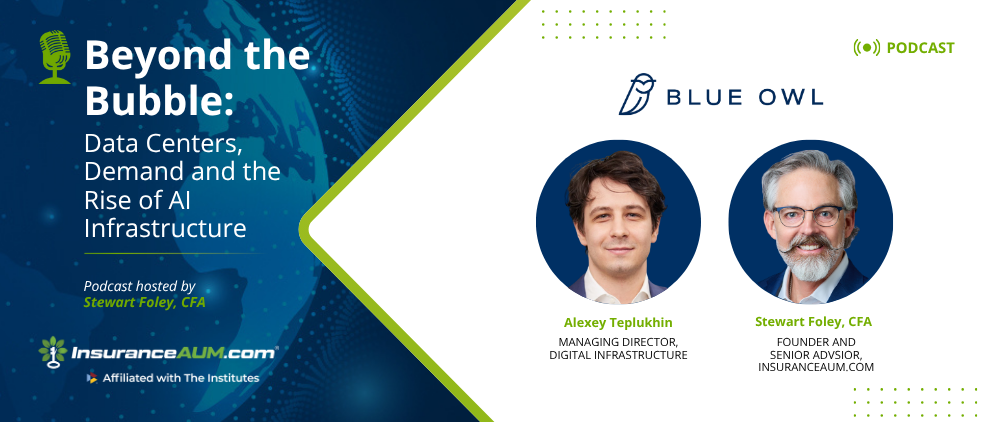
Beyond the Bubble: Data Centers, Demand and the Rise of AI Infrastructure

Image
Web_11.03 Blue Owl - 338


Stewart: Welcome to another edition of the InsuranceAUM.com podcast. My name's Stewart Foley, I'll be your host. Today we are talking about one of the most important and least understood parts of the modern economy, which are data centers and digital infrastructure, how they're powering AI, what drives demand, and what it means for investors. Joining me today is Alexey Teplukhin, managing director at Blue Owl Capital. Alexey, great to have you here. We're thrilled. I can't wait. I love this topic and we got a lot to talk about.

Alexey: Perfect. Thanks so much for having me on the show. I'm very excited.

Stewart: Yeah, it's funny, we've done over 300 of these and it's interesting that we just sold InsuranceAUM to the Institutes, which is a much larger organization. They oversee the CPC designation, they educate about 100,000 people, which is why they're a great fit for us because the purpose of these podcasts is to educate people, right? So they have podcasts, they educate people in that way. We educate people in this way. You are professor for a day here. But, before we get going there, can you tell us a little bit about you? For example, where did you grow up? I don't know, I've been asking different questions lately, but what was the first job you had? Not the fancy one.

Alexey: Yeah, sure. Not the fancy one. I dunno how fancy this job is now, but give you a bit of background. So I grew up in London. I was born in Estonia, a very small country out near the Baltic Sea, which is why I have an Eastern European sounding name, but perhaps don't sound very Eastern European in my voice. So I grew up in London, I lived there all of my childhood. I went to university there and then I moved to America in 2015. So I've been here for a little close to a decade now. My first job. Now, let's think about that. I think my first real job was a math tutor, so I worked at the end of every week I would teach people addition, subtracting, multiplication, those kinds of things. So yeah, that was probably my first non fancy job, I guess.

Stewart: That's interesting. I've said this before, but I started cutting grass when I was a little, little kid. My first job where there was a real paycheck involved, but it was printed on a printer. Wasn't somebody shoving a couple of bucks on my hand? I was at McDonald's, and I still remember some of the training still to this day, it was really good training. I mean, I think McDonald's is known for their training. This is back in the day when they had the VHS tapes and whatnot. Sos trust me when I tell you, that was back when the earth was still cooling. But so let's level set for people who hear ‘data center’, and I'm probably one of these, that picture a warehouse full of computers. What is it really? And what makes it an investible asset class?

Alexey: So I think you'll mental image of a data center is right. It is effectively a big box full of computers. The way I like to think about it is a little bit like this. Assume you are a small company and you needed to store your data, your emails, your customer data somewhere. You might have a server in a closet, somewhere in the office, in the basement, some of the office, what a data center is now or what we normally refer to as a hyperscale data center. This is really what we're talking about and what my firm invests in. It's like that, but in mega scale. We're talking about buildings that are half a million square feet, multiple football fields worth of size, but it's very simple. It's four walls on a roof. Inside of those walls on a roof are things like backup battery, backup generators, fiber optic cables, some cooling, whether with water or fans.

And then inside of those, what we call data walls are rows and rows of computers. A little bit like living in the matrix. It's just one computer server after another. And the reason why it's interesting from an investment standpoint is where we are today, almost everything that we do, every interaction that we have has some sort of digital component on it. Even this show, for example, this show is not going to be stored or saved on someone's phone or even on your computer. It's going to be sent to the cloud. And when it's sent to the cloud, that means it's actually sent to a server inside of a data center and accessed from that server by people all around the world. And so we think it's a very good investment or a very interesting investment I should say, because it's something that underpins how society operates today.

Think about online shopping. Think about just accessing work and processing work. Think about anything related to AI. Everything you do on your phone, you press a button, it's getting information from the data center. And so we think there's a tremendous need for it. And companies, hyperscale companies, you may hear me use this phrase, hyperscale companies are people like Microsoft or Amazon or Google or Meta or Oracle. Those are roughly the top five. They pay amounts to data center owners to rent that capacity and provide their data center services to the people. We are the owners of that data center and we're providing the environment for those services for people and corporations to use data.

Stewart: It strikes me as, and maybe listen, I'm from Missouri, so I got to keep it simple over here. People from Missouri just hate and they hate it when I say that, but look, I've been out there a long time. These are kind of the digital equivalents of, like, airports or toll roads, right? I mean, they're not optional. It's not like you can say, oh, I'm not going to use these anymore. I mean, this is the way life is today and the way it's going to be for the foreseeable future. Is that overstating the case or are you with me?

Alexey: No, I think that's totally right. And actually I use that analogy as well. I always think of these as basically airports or hubs of information. And the way to think about it is maybe 10, 15 years ago, if we were going to do a conversation like this, I would have to fly out and come see you. Now what do I do? I send the data, it gets stored in a data center and you access it. The data center has replaced the airport, it's replaced these kinds of meetings and allows us to speak virtually because it's hosting the data on that server. So I think it's exactly the same. It really is that center of operations of how data is exchanged. Now people communicate.

Stewart: It's interesting because, even podcasts and doing interviews with people, I mean, I'd have to get on a plane fly, come see you, have a microphone, have a physical recording device. We'd have to sit in the same room and do this. And when I first started, which was like 2020, we were trying to figure out how to do interviews and create a recording. And so to your point, we see it, it's evolved, right? But just talk a little bit about data centers have been around and I think I know the answer to this, which is why is this space so exciting right now? The AI side of it makes sense. I'm a bond guy and so I'm always looking for what can go wrong. And the question I guess I have, too, is if you can talk about this, are we one invention away from somebody going, “Oh, then the amount of storage space we need as a 16th of what we thought it was and we can do this on way less power.” Is that sort of risk real or is this structural and we are going to go from here up?

Alexey: Yeah, it's a good question and we get asked it all the time, what is the existential risk that makes this investment not as safe as perhaps it might appear to people? And the way I like to think about it is just there are a couple of facts about how data is used and how it's produced. So the statistic that I like to mention and gets told occasionally is in the last 18 to 24 months we have created, we as humanity has created more data than in all of human history. In the last 18 to 24 months, we've created more data just in that period that all of humanity before it.

Stewart: Is that because of AI?

Alexey: So AI is definitely a part of it, but AI is almost the wave that was over the existing wave of data generation. So when we look back as to the history of data centers, I'll take you through it a little bit. The first data centers were set up after the second World War. They were effectively rooms where people connected telecom cables together because the first data centers what's called for those, you remember carrier hotels literally where AT&T would connect to Verizon and T-Mobile and so on and so forth. That was the first kind of network hub and they were used by governments to speak to each other. They were used by the US to speak to Europe. That was the first data center. Then what happened? People started using the internet data storage happened, data access happened and data centers started being built specifically for storing and manipulating data.

Around 10 years ago was when hyperscale data centers, these large buildings that we invest in, started to become a thing. Why did they start to become a thing? Because you had the confluence of fiber optic cables, so you had the ability for people to send and transmit information at the speed of light. You had the software side, things like Microsoft Azure, Amazon Web Services, this was the software part of data centers. And so all you needed was now really big rooms full of computer servers working 24/7. That's really when this wave of data storage, data manipulation, data access from anywhere started. And so AI of course has accelerated that people are using more data than they did before. But all of this is just the exponential growth of 10 years ago, 15 years ago you didn't have an iPhone. Maybe you had a Nokia 3310 and you could play snake and you would send someone a text that was data. Now I'm FaceTiming people, I'm sending them large format videos. Think of how much more data is contained in that video than it's contained in that original text. It's exponentially more. And that's why we have exponentially large data centers.

Stewart: It's interesting you say that because we never did video podcasts, and we do now. We record the thing locally, we send it up to Vimeo, we send that. Then an editor picks it up on Vimeo, puts it back up, that's all in the cloud. But you're right, if we had just done this on a micro SD card on my podcast deck, it would've been a heck of a lot less data. And it's not like 10% or 50% less. It's like multiples less because videos really, really creates a huge file. That makes total sense to me.

Alexey: You are right. Essentially the data is being enriched, right? It is more interesting to see this video. You get to see each other than it is just to listen to so on. And that listening again is more interesting than just reading a transcript. So that's the kind of orders of magnitude of data progression. And so the second part of your question is, okay, well are we one step away from someone just saying, I've invented a new thing and therefore we don't need data centers? I think it's an interesting concept and we get asked about this technological risk and the first thing that people like to cite is Moore's law. People like to talk about every three years the ship size halve, the ship efficiency doubles and that all happens now, if you actually look at the progression of Moore's law, you're able to charge how efficient is the chip, how small is the chip? It is still getting better. Chips are still getting more efficient, but they're getting more efficient at a decelerating rate.

And the reason for that is the way we actually imprint something on a chip to make one or zero, the on/off logic gate that computers are built on, we're getting closer and closer to imprinting something on just one atom. I think right now we're at 17 atoms of width of imprinting and eventually we're going to get close enough to imprint on one atom. But once you hit that point, that's it. You can't, that is it. And so what you've actually seen is that efficiency curve is still improving but improving at a decelerating rate. So we're getting more efficient, but we're not getting exponentially more efficient. And

Stewart: It seems to me like it reminds me of racing, right? It's like the first 10 miles an hour is a lot less expensive than the last 0.5 miles an hour.

Alexey: You are entirely right. You're getting asymptotically close to that. Every incremental gain is so much more expensive and so tiny compared to the initial ones.

Stewart: Yeah, it makes sense to me because it's like how fast is it doesn't need to go infinitely fast. I know I'm not moving that fast. Please, go ahead.

Alexey: The other point is also what happens if it becomes more efficient? People question themselves. Okay, let's say you have a more efficient ship. Does that mean you're just going to stop? You're going to use the same amount of data and it's just going to cost less resources? Empirically what we've seen is as a technology becomes more efficient, people consume more of it. Just take this call for example. It's more interesting to see the people's faces than it is just to listen to it so you get a higher engagement. That's why people use it, right? It is more interesting and it's more useful and it's this concept called the Jevons paradox, I think it was referred to, which is as the technology becomes more efficient, people consume more of it. So your question was are we going to invent something that is going to be so efficient that it's just going to cancel this out? I think it's much more likely that we invent something that's a little bit better, not much better than it was before, but a little bit better. But people use even more of it because it is better. The data centers, at least the expectation is it's going to continue to go up.

Stewart: I've heard folks talk about a bubble in AI and I have to reveal my own bias here because, and when I taught, I try to do the same thing, which is let me tell you, I'm asking this question. I have an opinion, and the opinion for me is that AI has helped me be infinitely more productive. It has helped me be infinitely smarter. A friend of mine, a good buddy of mine named Jeremy, his grandfather turned 102. And he asked his grandfather, he said, what's the most amazing thing you've seen in 102 years? And he said, I need to think about that. I'll come back to you. He came back to him and he said that you can ask your phone a question and it'll give you the answer. Now that's amazing, but way more amazing to me, and when AI first started, everybody thought they're going to take over warehouse jobs. It's like not a bit. This is going after the most highly paid, most complex problems we've got. Talk a little bit about what you think the future of AI is, and keeping in mind that it wasn't that long ago that people were talking about it's going to be decades. Decades! And then all of a sudden the next day it's like, okay, it's here and then here we are. So talk to us a little bit about what you think the future of AI is.

Alexey: And look, it's a bit of a hard question to answer because the cone of uncertainty is just so massive. But the way I like to think about it is, and it really relates to the question which is I think people are extremely bad at estimating exponential change. In your mind, you can mentally calculate, okay, if I have a linear increase two times, this is two times that, okay, I understand what it looks like. People are awful at understanding how quickly something that grows exponentially can change. And you can go into a variety of thoughts about, you mentioned about the earth cooling, whether you can talk about exponential change there. But regardless, I like to think about it as, I don't know whether any of you any the listeners will remember the first Iron Man movie, there's a film, a Mob from Iron Man, and the main character Tony Star says, Hey, Jarvis, help me with this problem. And it's a computer that is just listening to him and his room and his workshop everywhere. At the beginning it was science fiction, right? This was a movie about superheroes. That's today. We have this AI.

Stewart: Absolutely.

Alexey: And it was amazing because then you think about other parts of technology which sound so sciencey or futuristic, how far are we away from it? Let's think about driverless cars. This concept that people are driving cars I think is going to become outdated in 20, 30 years. It's going to be a horror that there are people who are allowed to drive cars and endanger other cars and other travelers around the world, because a computer is going to be more efficient at it. There's going to be things about why did you go to a human doctor? You can plug in your results into a computer and pull on the collective knowledge of the medical field. And yeah, a doctor will help it, I'm sure, but you're going to be able to access everything, not just your one doctor's memory and learning.

Stewart: Well, that's funny you say that because there's a joke that goes, you know what they call the person with the lowest GPA getting out of medical school. The answer is they call 'em doctor, right? Sure it is. They're not like reviews on the person's sleeve of their jacket that says, Hey, this person knows what they're doing and this one does not. But it is interesting the AI and where it's going. I think it is so fascinating. I agree with you by the way, with regard to people driving cars. And it's interesting because I've had a number of people, and we have Waymo's here in Austin now, but they've been operating in Scottsdale for years. And people are like, oh, that freaks me out. And I'm like, well, you get into an Uber and you don't know if that person is okay or not, you don't know what kind of driver they are. And by the way, the thing that's keeping my 6,000 pound vehicle from colliding with another 6,000 pound vehicle going 65 miles an hour, the other direction is a painted yellow line. It is paint. There's nothing that physically keeps me away most of the time, at least here in Texas, there's not Jersey barriers everywhere here, but it does have implications for the property and casualty industry because riding auto insurance is going to, the nature of that game is going to change. Whenever we have guests on, I always want to ask them, if you see opportunity, you have to be concerned or be cautious about something, right? So every fast-growing space carries risk. What do you think? Is there anything that concerns you about this today?

Alexey: Yeah, absolutely. The thing that concerns me, actually, is trying to pick the winner. So what I mean by that is everything that we talked about is the actual services layer, how people will interact with AI, with the cloud. And what concerns me is that I might like to use a certain AI program. There's no reason why that is the AI program that is right. Imagine before Google dominated search, there were a couple of different search engines that were all used. There wasn't consensus yet. And then it became one.

Stewart: Netscape. Netscape was the market leader when it first came out.

Alexey: Exactly.

Stewart: The first time I ever saw the internet, I remember. And I was like, whoa. But it was on a Netscape browser. Nobody ever heard of Google by that. Exactly. But then suddenly people use it like Kleenex, I'm going to Google that. It's the standard.

Alexey: And so that's the fear of your backing the wrong horse. And it ties into your question about an AI bubble. There will definitely be AI companies that succeed and there will definitely big AI companies that fail. I think that is something that everyone can agree on. And so what I'm worried about and what we are predominantly worried about from an investment standpoint is we don't want to have to pick the winner to be successful. And so the way we invest, the way we think about deploying capital into these data centers is we want to be in the markets where whoever the winner is, they are using our data center. So we are leasing to at this point, extremely high rated counterparties. The hyperscalers, as I mentioned before, those are primary customers. If a new AI company came to us tomorrow and said, we have a great idea, we have an amazing technology, can we lease data center capacity to you from you? We would probably say no, because we don't know whether these ones are going to be the right ones.

And I know this analogy gets used a lot like we're building or we're investing in the picks and shovels, the bridges and roads, the airports, the infrastructure for this layer, what really worries me is there's definitely going to be whatever rationalization, some sort of formation of who the winners are in the software layer. I have no idea who will win. I'm just hoping, and our investment thesis is effectively predicated on, it doesn't matter, that person is going to have to use our data center because our data center is where the land and the power is. That's what we're really investing in.

Stewart: Yeah, it's interesting. I mean I remember I wanted wireless email so much and I was like, if I could just get email while I was out of the office... In retrospect, this may have been a disastrous wish, but Blackberry was it. Everybody was, that's it. And the iPhone showed up and just killed it. And then everybody's like, oh, I got to have a keyboard. And in about 10 minutes people are like, I don't need a keyboard. It's so interesting that particularly in technology, the leader can emerge pretty quickly and it's difficult to predict. So I think your approach makes sense.

The last thing before we go is power and water. You can't scale AI without power and cooling. I have seen some incredible projections on power requirements. Can you talk a little bit about that and who do you think is going to be, are there winners and losers there as well?

Alexey: Yeah, absolutely. So breaking down what a data center is, and I know we use our example of it's the building, it's the interior and then it's the computers inside. What we're investing in is the building and the interior. So really what we're providing is a very sophisticated power socket. You may plug a new computer server in the analogy in your home, you get a new computer, a new phone, a new PlayStation, whatever. You plug it into that power socket. So power and water and land really are the component parts of that power socket of that data center. So how we are thinking about it is, and you mentioned these large amounts of power demand, we are trying to find big contiguous pieces of land. I think the most recent data center deal that Blue Owl announced is a partnership with Meta. The total size of the data center campus is about the size of Manhattan.

So it's contiguous piece of land the size of Manhattan, and the amount of power it draws is around two gigawatts, which is a little bit more than the amount of power that the city of New Orleans draws. So the amount of places where that already exists, where it's just available and ready to buy is basically zero. It takes years to assemble these kinds of campuses. It takes years to negotiate with the power companies and that's why data center development is hard. And when you talk about winners and losers, it is again not obvious and it's very hard to find an obvious winner in anything. But you are looking at places next to population centers, large contiguous piece of land when there is power readily available. And so the winners are going to be people who invest in the power, people who are able to unlock land that's owned by other folks or needs to be somehow combined or rezoned. It's people who have development expertise are going to be the winners of this data center race because ultimately assembling land and power is a multi-year local job. And that's the guys who I think are going to be at the forefront of the next wave of data centers.

Stewart: Where is that data center?

Alexey: Well, the particular one is in Louisiana. It's a place next to the city of Monroe, which interestingly is the founding city of Delta Airlines.

Stewart: Wow, there you go. In some of these data centers is part of the infrastructure an independent power generation facility?

Alexey: So the truth is reliable power comes from the grid. If you need your data center to always be on, provide the most reliable power, you have to get it from the grid because that's multiple sources of power in grids don't frequently fail. If you have an independent source of power, that's great, but what if it goes down? For example, you were in Texas, I don't know whether you remember a few years ago there was an enormous winter storm and knocked out power in Houston and Dallas, I think in Austin a little bit as well. I happened to be in Houston at that time and independent sources of power were knocked out. Our data center was not. People moved into the data center to keep warm. And the reason for that is one single point of failure is difficult. So you have to have something connected to the grid for it to be a very useful data center or one that can provide for all the kinds of data center services. So it has to be close to people, has to be close to power. That's what you're looking for.

Stewart: It's super interesting to me. The more that we talk, the more interesting it is. It's been a phenomenal education. I really appreciate that. A couple quick questions on the way out the door. One is the purpose of this question is to get at the culture at Blue Owl and it goes something like this. What characteristics are you looking for when you're hiring new folks on the team there?

Alexey: Yeah, it's a good question actually because Blue Owl’s a relatively new company. So Blue Owl, I think, came together maybe four or five years ago. So we've really been able to build this culture from scratch. And the culture I think that Blue Owl tries to represent is work hard, be nice, don't be mean to your colleagues. That's part of it. But our CEOs like to say that they created this company so that you could work hard but have a work-life balance as well. I know everyone likes to say that, but you really feel it here. People like to work with their colleagues because they're friends, not because they like to work, because it's fun to sit in front of a computer. That's kind of the culture that we're looking for. How am I going to to still talk to you 15 hours after we started working earlier today? Yes or no? If no, you can be the most brilliant person. It doesn't work for the firm.

Stewart: I think that is a very, very well put. Alright, last one. Who would you most like to have dinner with? Alive or dead? And there's some little rules here. One is you can have one, two or three guest, dinners on us, and who would it be?

Alexey: So I've actually been dreading this question because I saw on other podcast it's a little bit of a referendum of whether I'm an interesting person or not and I was really examining it and boring that I really wasn't an interesting person. And then there's the meta question, should I say something work appropriate? I really want to have dinner with an investing legend or should I really give you the real answer, which is like what would be interesting to me? But...

Stewart: This is our second podcast today.

Alexey: Okay.

Stewart: And the person this morning said that they wanted to have dinner with someone who does base jumping in a flight suit in one of those squirrel suits. So listen, I think the world is your oyster at this point. Alexey.

Alexey: That's a good answer. Alright, well look, I'll pick three and you'll get a little bit of my personality for it. The first one is I really enjoy reading science fiction and fantasy novel. I find it very entertaining and the writer who I enjoy reading a lot currently is a person called Brandon Sanderson, and he recently finished 5 books out of a 10 book series that I'm sure will take him another 20 years to write. So I would love to have dinner with him if only just to get a little bit more of the story. Would love to progress that. The second person, and this is definitely a very nerdy answer, but one of the things I like to do to relax is to play a video game. And there's a particular video game director person called, I want to get this right. Hidetaka Miyazaki, a Japanese video game director.

Anyway, it's not important necessarily much about that, but the games that he makes are ones where it's really difficult and you are expect it to fail and lose the game many, many times before you finally succeed. And I think it's a very interesting concept of life because especially if you've done well and you've worked hard and you progress in your career and all these kinds of things, it can be quite frightening the concept of failure. And so I personally learned a lot from, and I know it sounds silly, playing a game and realizing that it's okay to fail and you're maybe expected to fail and in many cases everyone is going to fail before you ultimately succeed. That's really helped me as I think about my life.

Stewart: It's funny you say that because I used to say to my students all the time, I'm like, fail a lot early. You don't learn when you win, you learn when you lose and it's like fail a lot early and get it out of your system. You know what I mean? So I'm sorry, go ahead. So we've got two, who’s the third?

Alexey: That took me a really long time to learn. I'm still kind of learning that as I go along the third one, and honestly, because I think dinners should be exciting. I have two little kids, so anytime away from my family and wife, a very precious time, I would pick a comedian. So Ricky Gervais, who was one of the writers of a show I like called The Office. I would pick him because I think it would be very entertaining to listen to him.

Stewart: Oh yeah, for sure. I think he's brilliant.

Alexey: Those are my three. I want to learn about fantasy book. I want to play a video game and I want to be entertained. That's the dinner party for me.

Stewart: I love it. That's great. We've had a great education. The title of the podcast has been Powering the Future Data Centers AI and The Real Assets Behind The Digital Economy. Alexey, thanks so much for being on.

Alexey: Thanks very much for having me. Appreciate it.

Stewart: We've been joined by Alexey Teplukhin, managing director at Blue Owl Capital. If you like what we're doing, please rate us, review us on Apple Podcasts, Spotify, or wherever you listen to your favorite shows. It really does matter, folks, seriously. And you can also watch us. This is a video podcast. You can watch us at our YouTube channel at InsuranceAUM community. If you have ideas for podcasts, please shoot me a note at podcast@insuranceaum.com. My name's Stewart Foley. This is the Home of the World's Smartest Money, at InsuranceAUM.com.
 

Share this post

Sign Up Now for Full Access to Articles and Podcasts!

Unlock full access to our vast content library by registering as an institutional investor

Register

Contacts


Blue Owl

Blue Owl (NYSE: OWL) is a leading asset manager that is redefining alternatives. With over $251 billion in assets under management, we focus on providing businesses with private capital solutions to drive long-term growth and can offer institutional investors, individual investors, and insurance companies differentiated alternative investment opportunities that aim to deliver strong performance, risk-adjusted returns, and capital preservation. Together with over 1,100 experienced professionals globally as of January 31, 2025, Blue Owl brings the vision and discipline to create the exceptional.

Rich Goetze 
Principal 
rich.goetze@blueowl.com
908-501-6098

View the contributor page


Image
Blue_Owl_v_rgb_Blue_Owl_Blue

Sign Up Now for Full Access to Articles and Podcasts!

Unlock full access to our vast content library by registering as an institutional investor .

Create an account

Already have an account ? Sign in

Ѐ Ё Ђ Ѓ Є Ѕ І Ї Ј Љ Њ Ћ Ќ Ѝ Ў Џ А Б В Г Д Е Ж З И Й К Л М Н О П Р С ΄ ΅ Ά · Έ Ή Ί Ό Ύ Ώ ΐ Α Β Γ Δ Ε Ζ Η Θ Ι Κ Λ Μ Ν Ξ Ο Π Ρ Ё Ђ Ѓ Є Ѕ І Ї Ј Љ Њ Ћ Ќ Ў Џ А Б В Г Д Е Ж З И Й К Л М Н О П Р С Т У Ф Х Ц Ч Ш Ā ā Ă ă Ą ą Ć ć Ĉ ĉ Ċ ċ Č č Ď ď Đ đ Ē ē Ĕ ĕ Ė fi fl œ æ ß