





We're currently experiencing email delivery delays. For urgent matters, please contact us directly at lindsay@insuranceaum.com.

Milliman-

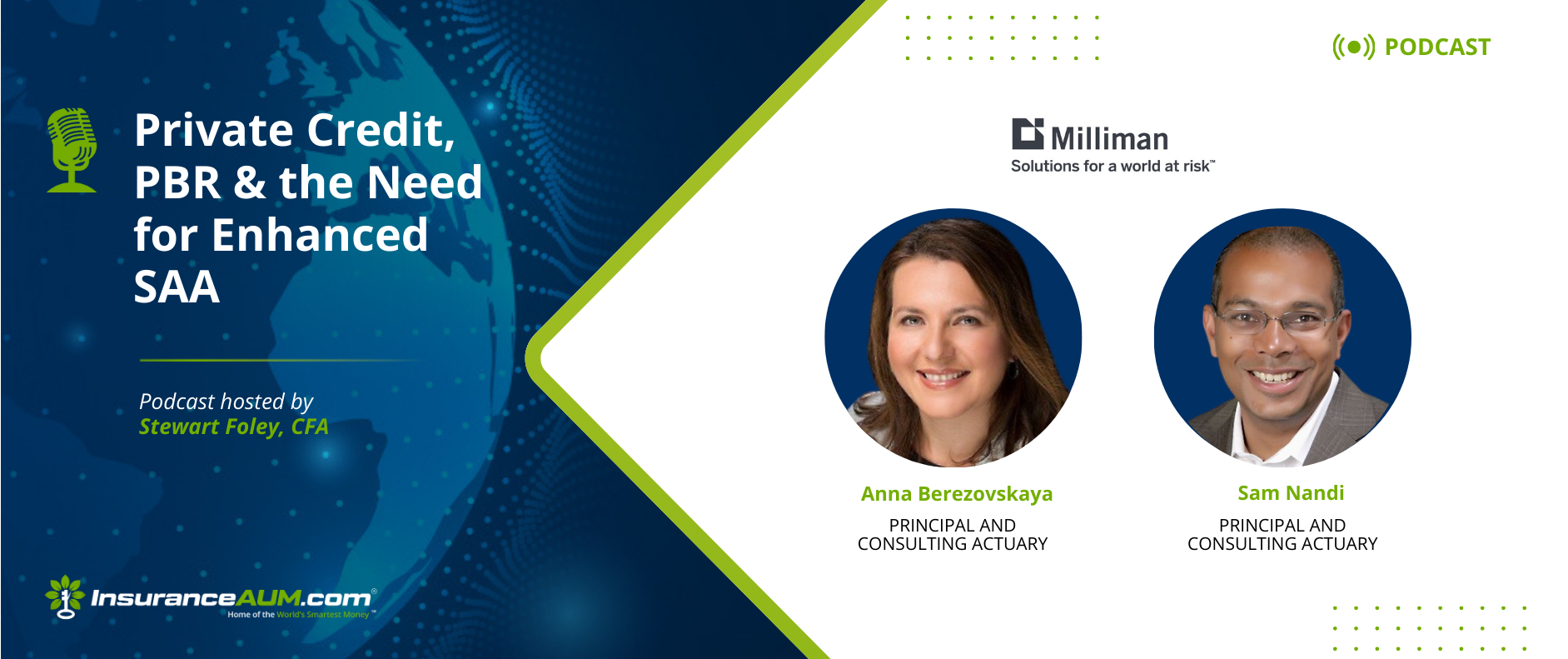
Beyond Yield: Private Credit, PBR & the Need for Enhanced SAA

Image
08.28 Milliman_Web


Stewart: Hey, welcome back to the Home of the World's Smartest Money. I'm Stewart Foley. This is the InsuranceAUM.com podcast. The title of this podcast is: Beyond Yield: Private Credit, PBR & the Need for Enhanced SAA. And we're joined today by Milliman's Sam Nandi and Anna Berezovskaya. Sam and Anna, welcome to the show. We're thrilled to have you.

Anna: Thank you. Great to be here.

Stewart: So, Sam, you are the co-lead of Milliman's Financial Risk Management Practice. You advise on over $180 billion across annuity hedging and asset strategies. Anna, you're a Principal & Consulting Actuary at Milliman's Life Practice. Can you tell us a little bit about yourselves, starting with what was your first job, not the fancy one, and how did you make your way to your current position? Anna, we'll start with you.

Anna: Yes, so my first job started in Louisville, Kentucky. That's where I went to college. Small University, Bellarmine University. Of course, Louisville, Kentucky, is known for horse racing. So I was very fortunate to be able to score a job at Churchill Downs, and during the  Kentucky Derby, Kentucky Oaks, they actually placed me on what they call the millionaires row, pretty high stakes gambling. I was working the parimutuel windows selling tickets and managing a lot of cash in the process. So a lot of responsibility for an 18-year-old, but was very fun and was part of that experience for a few years.

Stewart: I can only imagine that that was amazing. And so how did you decide to pursue, I believe that you're an actuary. Can you talk about how did you make that decision? That's a big decision, and I said to you on the prep call, there's a grand total of 0% dumb actuaries, so everybody has a lot of esteem for your professional expertise. How did you make that decision?

Anna: For me, it started with my passion for quantitative things. Mathematics. I'm a trained, in degree in mathematics with an emphasis on actuarial science. So, actuarial science is a great application of mathematical skills. I'm also very passionate about finance and investing, and it allowed me to kind of combine those mathematical skills with my finance interests, and this was sort of a perfect career track for me. Based in Chicago, I was very fortunate to, at the time, 25 years ago, find a very interesting opportunity with what back then was a small M&A focused consulting practice. So actuaries focused on mergers and acquisitions and the life insurance sector. So I joined the small practice in Chicago to do just that, and the rest is history.

Stewart: Yeah, that's awesome. I mean, it's interesting. I mean, I think Milliman, and you notice this in certain firms, but Milliman has a number of folks that have been there for a long time. I mean, you mentioned being there for 25 years. I know Sam's been there for over 20 years, and I think that that really has a lot in common with a lot of insurance companies, where folks spend a significant amount of their career with the same company. So Sam, how about you? Can you talk a little bit about your first job, not the fancy one, and how you got to your current seat at Milliman?

Sam: Sure. My first job, summers during high school, I went to high school in Fort Worth, Texas, so really, really hot in the summertime. My first job was working for a grocery store, part of a big national grocery chain, and it was basically bagging groceries and then carting them outside to the parking lot and putting the groceries away in the trunks of people's cars. I had to wear a long-sleeve shirt, long pants, and a bow tie, possibly that might identify who the employer is,  in a hundred-degree heat and kind of carting groceries out to people's cars. So that was kind of a first summer job. But in terms of my educational background and how I ended up at Milliman, I went to my undergrad to study engineering. The job market for the type of engineering that I was studying wasn't great when I graduated. So I did several different things. I worked on Wall Street for a year. I ended up going to grad school to pursue a PhD in economics. I did that for a couple of years and decided I did not want to be an academic economist. So I kind of floated around trying different things through my mid twenties or so until I came upon the actuarial profession, took the exams, got through the exams, and eventually ended up at Milliman.

Stewart: That's super cool. Shout out to my former colleagues when I was a professor. Shout out to my former colleagues who are academic economists. This is a very different discussion and very happy to have you both on, I mean, I think it's always helpful when we're doing these to kind of level set terms. And so, in insurers speak, how do you define strategic asset allocation versus portfolio optimization today? Is there a change from the classic mean-variance to multi-objective optimizations? And if you can talk a little bit about what balance sheet-aware optimization means. Let's get started with some kind of level-setting terms. Anna, you want to start with that one? Or Sam, you tell me who's the best for that one.

Anna: I can jump in. We've seen a very significant degree of evolution and how insurance life insurance organizations think about strategic asset allocation versus say 10 to 15 years ago. And this evolution has happened because of the shift in the types of investments that are now available, private investment structured assets, but also just the shift in the regulatory regimes that we've seen really across the globe. And it's very prominent in the US about how your investment portfolios impact the balance sheet, impact the risk of insurers, and insurers' ability to pay claims. So when insurance companies think about strategic asset allocation, it's with the objective of figuring out how can I really enhance the value of my in-force portfolio, the value of my products to the consumers, while managing to all of the various regulatory objectives and being as capital efficient as I can. That used to be a fairly straightforward equation.

So you could look at simply maybe liability durations, provide that to your asset manager, and they can do their magic to source assets, and everything works out. Now, we have principle-based regimes that apply a much more intricate set of rules around how particular asset classes factor through on your balance sheet. And it could be a lot of model-based approaches, long-term projections, regulatory nuances that you have to be able to rigorously model and consider if you were to truly understand the interplay between the investments and the balance sheet and the value of their organization. So a lot of the work that we do with our insurance clients now is to really help design frameworks and consistent repeatable processes that help them evaluate portfolio compositions, a variety of asset classes across a very complex set of conditions and constraints that they're facing and managing the value and risk of their organizations.

Stewart: Can you talk a little bit about, when we think about optimization of portfolios and insurance land, you see a variety of goals, right? Income yield, capital efficiency, earnings surplus stability, liquidity, collateral ratings, peer optics – there are a lot of different potential objectives. What do you see most often, and where do the trade-offs start to bite first? Is it private credit infrastructure versus gap earnings? I mean, where do you see some of these objectives collide? Sam, we'll go to you.

Sam: Yes, so it is hard to sort through all the different potential objectives that an insurer has and boil it down to sort of a manageable target. In our approach. We are focused on the value, like Anna said, of the business. What is the value of the business if it was going to be sold in the marketplace? What is the value of the future cash flows of the business to its current owners or investors, right? That's ultimately what we're trying to optimize, what we're trying to maximize. Now, all the other pieces that you described, Stewart, capital requirements, accounting considerations, liquidity issues, they should all be reflected, they should all be reflected in the modeling. They should all be reflected in the framework that you are using to do your analysis with as much rigor as possible. But, ultimately, the goal of strategic asset allocation should align with the goals of management in general, which is to maximize enterprise value.

Stewart: That's super helpful. Can you talk a little bit about, just from the standpoint of pattern recognition, is there a common blind spot that you see from internal insurance asset management teams regarding, say, governance cadence or stale SAA bands or siloed ALM? Are there things that you see that are relatively common mistakes or process issues around SAA?

Anna: Maybe I'll jump in here. One thing, when we consider this liability informed, SAA, what sometimes does get missed, and in particular when you consider a wide spectrum of life insurance liabilities, is the dynamic of those liabilities with things like policyholder, behavior-embedded options, and the unique effects that they can have on the profile of liabilities, which makes investments less static as if you maybe had kind of a pension liability or something that didn't have those aspects of policyholder behavior in them. So those considerations are often not considered as frequently or dynamically when asset managers think about setting investment strategies. And I think having something in place that's more regular, regimented, and frequent to really assess the value of those liabilities, the risk profile of those liabilities as they emerge under different market conditions, is very critical to avoid mismatches or gaps that ultimately could be very, very punitive on the life insurer’s balance sheet, either from a capital or reserving perspective.

Stewart: So with regard to third-party managers, you just mentioned this, is it mandate miss specification, is there a way to fix that that you've seen, and I know that you work on PE projects. Do you see the incentives leading to product-led asset-only optimizations and how to insurers guard against some of the pitfalls there?

Sam: Yes, I mean, I think from the asset manager's point of view, I think for asset managers to be successful in managing insurance assets, third-party asset managers to be successful in this space, they have to understand the liabilities. They have to understand, like Anna said, the nuances of the policyholder behavior and all the options that the policyholders have access to. They have to understand the regulatory frameworks and all the constraints that are imposed by whether it's the capital requirements, reserve requirements, or other elements of the regulation. And it's only through a rigorous framework for analyzing all those different features of the problem that they can get to an asset allocation that makes sense for a given insurer, given their business and given their objectives. So I think asset only view of strategic asset allocation for life insurance business is it's not sufficient.

Stewart: The next section that I've got here really deals with illiquidity premium meets reserving and reporting, right? So how does an increased allocation to private illiquid assets interact with principles, what's referred to as principles-based regimes? And I'd love for you to help me define what that means as well.

Anna: Sure. So principle-based regime is something that's a very hot topic in the US insurance industry now because we have new actuarial guidelines and standards that are going to impose principle-based approaches on asset intensive business starting from next year. Historically, life insurance companies measured reserves on say more formulaic or prescribed approaches, and the principle base regime moves you much more towards an internal model approach to calculating your reserves. And what that means as an actuary, you're going to be projecting the experience of your assets, liabilities, and future management decisions around how assets are going to be reinvested in investments under various market conditions. And you're going to be evaluating how much you need to set aside in order to meet all of your policyholder obligations under a wide range of market conditions. So it's typically a stochastic testing framework, and you've got to ensure that you've got sufficient assets set aside to meet the policyholder obligations under fairly adverse set of conditions. So, the principle-based regime is going to push the industry to really have to make a lot of assumptions and defend those assumptions when they're evaluating the performance of assets and liabilities across such a wide range of scenarios.

Sam: If I could just add something to that, to the audience members who aren't actuaries. I mean, I think the best way to think about principles-based reserving and capital is the idea that if you don't have a good match between your assets and liabilities across a wide range of scenarios, the outcome of principles-based reserving will be punitive. It will require you to hold additional reserves and or additional capital to make up for those mismatches between your assets and your liabilities. So I think that's the key takeaway from principles-based reserving for, let's say, the people who aren't hands-on working on the models as actuaries.

Stewart: And when you reference mismatches, is that key rate duration mismatches, cashflow mismatches? How are we defining mismatches there?

Anna: It could be a spectrum of things, but essentially it is typically mismatches in your cash flows, cash flows, and the liabilities. If you have a deficiency in the liquidity of assets to meet particular liability outflows, you're going to have to figure out how you're going to create that liquidity. And that could mean that you're forced to sell your private credit. That's a significant loss because you're looking at fairly adverse market scenarios where you're selling those assets, so you get penalized for it that way. Or it could be you're facing some reinvestment exposure in the future if you have excess premium income, and you've got to consider what future market opportunities would look like. So the principle-based frameworks, it becomes really important to have that cash flow matching over the duration of liabilities in order to avoid those penalties that you're going to be calculating under extreme market scenarios.

Stewart: One of the things that we talked about when we were preparing for this podcast had to do with liquidity and capacity for illiquidity. Can you talk a little bit about what signals tell you if a block of business is at or passed its illiquidity limit? And then, kind of related, if a CIO decides to add, call it 5-10% in private credit or infrastructure today, what's got to change in their liquidity governance? You mentioned stochastic modeling and contingency funding. Can you talk a little bit about how you think about liquidity capacity and the implications?

Sam: Sure. I think it goes back to what we talked about earlier in terms of having rigor around how you project out all of your assets, all of your liabilities through all of the regulatory constraints over a wide range of economic scenarios. It starts there. Now, if you do that modeling with kind of the right level of detail, the right level of rigor, then you will capture the extent to which your liabilities are liquid versus illiquid, right? And this goes back to topics around policyholder behavior and policyholder options that we raised earlier. If you've got business where your policyholders are likely to jump around a lot, jump in and out of their contracts, then that indicates that there's possibly less capacity for illiquid assets on the other side of the balance sheet. And vice versa. If you have very stable liabilities, policyholders who are very, very likely to stick around for a long time, then you've got higher capacity for illiquid assets. So I think it comes from really being detailed and rigorous in how we do our modeling, and the answers to these questions, the results of the model tell you, do I have more capacity for investing in illiquid, or maybe do I have less capacity?

Stewart: Yeah, that's super helpful. The next talking point I've got here has to do with structural shifts related to reinsurance, offshore sidecars, and regulation. Reinsurance. And you mentioned asset-intensive coverage earlier, I don’t know if I'm using the right term, but reinsurance, sidecars, and asset origination partnerships. How do they alter SAA/ALM and capital velocity, and are there regulatory developments that are going to have an impact here as well?

Anna: Sure. So, asset managers have been active in a variety of ways and structures of participating in life insurance. As you mentioned, reinsurance sidecar, even standing up and owning insurance businesses, we're often in the middle of transactions and situations like that to stand up new entities or to help stand up for insurance operations or get the sidecar going. With these situations and opportunities to create just an opportunity to try to be more competitive, let's say competitive defines the landscape. The asset-intensive reinsurance space is extremely competitive, especially when it comes to more well-established and known asset-intensive products like annuities. So it does challenge asset managers who participate in the structures to really push the envelope in terms of figuring out how much yield we can add to this entity or block a business that's transacting to optimize the value of that transaction for precedent or for potential investors that are going to be participating in the sidecar.

So this is where we often see very, very rigorous and iterative competitive approaches to how you conduct SAA through the lens of optimizing the value of the business to investors or other counterparties. So from the regulatory perspective, there is a fair amount of optimization that also occurs on a jurisdictional basis, I would say. So, of course, we've seen a lot of this occurring offshore and in Bermuda and the Caymans, and that's been historically viewed as a favorable landscape for bringing extra capital, and you've got to really understand the nuances of that regime as it's strengthened over the past couple of years and introduced a lot more governance and complexity. So keeping an eye on that is very important.

Stewart: Yeah, super helpful. And our last talking point is a learning opportunity for me, I want to be clear. This discusses a couple of new things that I'm not familiar with, which is talking about the present value of distributable earnings and also embedded value in an SAA process. So, can you talk about what is, what's affectionately known as PVDE and embedded value? It really has to do with making value creation measurable, the best I can tell, but I'd love to know more about this topic and how it relates to SAA.

Sam: Those terms and acronyms that you just put out are different ways of saying the same thing. Fundamentally, they represent the value of an insurance enterprise or a block of business by coming up with the present value of future cash flows generated by that business. So it's the same way in theory that you might value any company or any stock. You basically say, what do the future cash flows look like and what's the right discount rate to apply to those cash flows to come up with a valuation in life insurance, like Anna said, Milliman's been at the forefront of life insurance M&A for decades now. We've participated and supported clients in virtually every major transaction for many, many years. In life insurance discounted cashflow valuation, or you could call it PVDE, you could call it embedded value, is more complicated than it is for other types of companies, other industries, because you've got all these complex liabilities that you have to, and all these commitments that you've made to your policyholders that you have to be very careful and very thoughtful about projecting out into the future.

You have all of these assets on your balance sheet, some of which might be quite complex, that you have to project out as well, and all of the possible mismatches between assets and liabilities that also have to be projected out. And then you have regulatory constraints in terms of how much capital you have to be holding, not just today, but every step along the way, right? So discounted cashflow valuation ends up being a fairly complicated thing for a life insurance block of business. We've been doing this for decades, so I think we've got great process and methodology and approaches to handling this, and we've carried those methods from our work in M&A into SAA. So that becomes a very natural framework for us to talk to people who manage insurance companies and say, if you're struggling with what your SAA should target, if you're struggling with what your objective function in this optimization is, it should be maximizing shareholder value, and all the different terms you mentioned, Stewart, they're all basically the same thing. They're shareholder value.

Stewart: That's super helpful. Let me give you the opportunity to kind of, if you were going to summarize and have a takeaway for our audience from this podcast, Anna, what would it be? And I'm going to ask Sam the same question and I've got a couple of fun ones for you on the way out the door.

Anna: Sure, sure. I think what we were trying to convey is there is increased regulatory complexity and life insurance liabilities can be very nuanced and complex in themselves. So when you consider SAA, it's very difficult to just operate on rules of thumb or simple metrics. It's very important to construct a process where you can evaluate all of your underlying cash flows for the business risk scenarios, capital reserving constraints, and stay current with the emerging regulatory landscape around principle-based frameworks in order to maximize the value of the business you're supporting as an investment manager.

Stewart: Thanks, Anna. How about you, Sam?

Sam: Yeah, if I had to sort of summarize maybe some of the big picture takeaways here, I would say dialogue and teamwork. I would say in order to be successful at strategic asset allocation for a life insurance company, the people that are managing the assets have to be in close dialogue and alignment with the people who are overseeing the liabilities. In the case of third-party asset managers. Again, dialogue, teamwork between those two sides is really, really important. Getting all of that data, getting all of those ideas and thoughts in the same analytical framework, and then driving that analytical framework towards the right answer with both sides participating is ideal.

Stewart: That's awesome. Thank you so much. I really appreciate it. I've got a couple of fun ones framed the way out the door. You've both been with Milliman for over 20 years, and coincidentally, you've also just hired a good friend of mine, Todd Arbuckle, in the business development area. And which leads me to the question on a culture at Milliman, what characteristics are you looking for when you're adding members to the Milliman team? Either one of you can take it. I think it's important for audience members to get a sense of the culture of a firm.

Anna: Yeah, Stewart, you picked it up exactly right. We have a lot of individuals at Milliman who have been here for a very long, long time, so our culture really does reward that. And the reason that this happens within Milliman, and I think what we're looking for, is we're looking for folks that come here and are going to invest our careers with us. That's our mindset. Milliman has always kind of provided an opportunity for people to find their way, and what's important for us is for folks to be kind of curious and flexible when they come into the environment. Because of that very valuable opportunity, you don't know where things will take you, but being in a consulting environment gives you visibility, presence in the industry, and if you're listening to the problems and questions that our clients are asking, it could take you in all kinds of interesting directions. So it keeps it interesting, it keeps it open, it keeps it available for people to find their area of interest and path.

Stewart: That's super. So the last one is fun. This is a dinner for four, the two of you, and you can each invite one guest. Who would you most like to have dinner with, alive or dead? Sam, we're going to start with you because Anna just went, who's your guest? And then we'll come to you, Anna.

Sam: Yeah, the person that comes to mind, I just traveled with my family this summer to France and Spain. I was struck by the artwork and the biography of Pablo Picasso as being kind of a uniquely interesting figure in history and in art. A couple of things I would say about him that might make him a good dinner companion. One, quite literally, he saw the world differently than everybody else, and obviously that came through in his artwork. And then secondly, he wasn't sort of content to simply be like a technical virtuoso and focus on the very technical side of his art. He lived in interesting times and he made sure that his voice was heard through his artwork on the big problems and issues and conflicts of his time. So I think those qualities would make for a good dinner companion.

Stewart: I don’t know if you can see right over my head, but that's a Picasso art book right there. I've got another come over here, so I'm a big fan there. Anna, how about you?

Anna: Yeah, we'll go a little bit further in history, maybe. So I would say Peter the Great, and the reason I sort of focused on that personality is I grew up in St. Petersburg, Russia, so lived there for most of my childhood and through high school, and Peter the Great, kind of established the city. So it was a big presence just in of getting to know that historical figure and the impact that he had on Russia in particular, known as a modernizer, the time, and sort of responsible for creating the first newspaper and things like that. Really kind of cultural evolution of the country. So I think it'd just be interesting, given the evolution we're going through right now with all the tech, to have somebody who's lived through a different generation and version of that than 1600s and 1700s.

Stewart: That's super cool. What a great podcast. I really want to thank you both for being on and taking the time.

Sam: It's been our pleasure. Thank you.

Anna: Thank you, Stewart.

Stewart: You bet. It's been a great podcast. The title of it has been: Beyond Yield: Private Credit, PBR & the Need for Enhanced SAA. We've been joined today by Anna Berezovskaya, who's a Principal and Consulting Actuary with Milliman, and Sam Nandi, Co-Leader of Milliman's FRM. Thanks for joining us. Please rate us and review us on Apple Podcast, Spotify, or wherever you're listening to your favorite shows. You can also find us on our brand new YouTube channel at Insurance AUM Community. If you have ideas for a podcast, you can always shoot me a note at Stewart@insuranceaum.com. We are the home of the world's smartest money. Thanks for listening.

Share this post

Sign Up Now for Full Access to Articles and Podcasts!

Unlock full access to our vast content library by registering as an institutional investor

Register

Contacts


Milliman

Milliman is the global leader in financial risk management, with over two decades of experience helping insurers and insurance-focused asset managers navigate market volatility, regulatory change, capital pressure, strengthen balance sheet resilience and optimize portfolio outcomes.  

Our life and annuity risk management capabilities are grounded in deep actuarial expertise and span a wide range of products, including VA, FA, FIA, RILA, and PRT blocks. We help clients manage surplus volatility, create and optimize hedge programs, and comply with evolving accounting and reserve standards.

We engineer ALM, SAA, and portfolio optimization solutions across entire general accounts and targeted blocks, integrating private credit and illiquid structured assets. Our optimization approach incorporates return, risk, capital, and liquidity constraints to support detailed efficient frontier analysis across global regulatory regimes. In capital markets, Milliman supports the design and oversight of over $170 Billion in customized hedge and overlay programs across portfolios, currencies, and risk exposures.

In M&A, we are a trusted advisor, having supported more than three quarters of insurance and reinsurance transactions over the past decade, across major insurance acquisitions, reinsurance, and sidecar structures.

Milliman brings analytical depth and strategic partnership to help our insurance clients solve their most complex challenges, empowering them to grow with strategic insight and confidence.

Todd W. Arbuckle
SAA & ALM Strategic Advisor
Todd.Arbuckle@milliman.com
O +1 312.279.3066    M +1 312 953 7868

Tony Dardis, FSA, MAA, CERA, CFA  
Principal & Consulting Actuary
Anthony.dardis@Milliman.com
O 312 499 5795   M +1.312 804.7996  


View the contributor page

Sign Up Now for Full Access to Articles and Podcasts!

Unlock full access to our vast content library by registering as an institutional investor .

Create an account

Already have an account ? Sign in

Ѐ Ё Ђ Ѓ Є Ѕ І Ї Ј Љ Њ Ћ Ќ Ѝ Ў Џ А Б В Г Д Е Ж З И Й К Л М Н О П Р С ΄ ΅ Ά · Έ Ή Ί Ό Ύ Ώ ΐ Α Β Γ Δ Ε Ζ Η Θ Ι Κ Λ Μ Ν Ξ Ο Π Ρ Ё Ђ Ѓ Є Ѕ І Ї Ј Љ Њ Ћ Ќ Ў Џ А Б В Г Д Е Ж З И Й К Л М Н О П Р С Т У Ф Х Ц Ч Ш Ā ā Ă ă Ą ą Ć ć Ĉ ĉ Ċ ċ Č č Ď ď Đ đ Ē ē Ĕ ĕ Ė fi fl œ æ ß