




Income Research & Management-

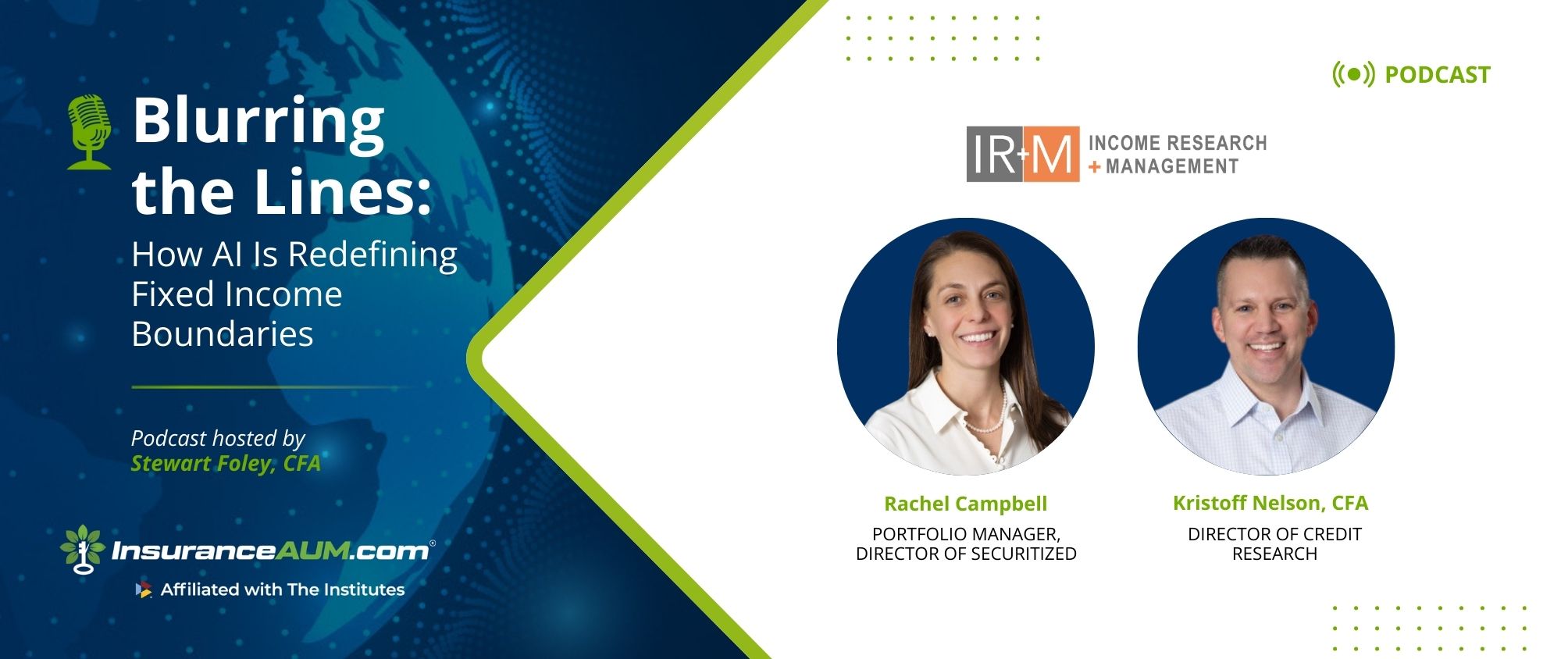
Blurring the Lines: How AI Is Redefining Fixed Income Boundaries

Image
03.12.26 Income Research_Web


Stewart: Hey, welcome back. It's great to have you. You've joined the podcast that's the home of the world's smartest money at InsuranceAUM.com. I'm Stewart Foley, CFA. I'll be your host, and we're thrilled to have you with us today. The title of the podcast is Blurring the Lines: How AI is Redefining Fixed Income Boundaries. And we're joined today by Rachel Campbell, Portfolio Manager and Director of Securitized at Income Research and Management, and Kristoff Nelson, CFA, Director of Credit Research at Income Research and Management. Welcome to you both. We're thrilled to have you on.

Kristoff: Thank you, Stewart. Thanks for having us.

Rachel: Thanks, Stewart. It's great to be here.

Stewart: We're thrilled to have you. We always start them off the same way. There's an icebreaker here. We'll start with you, Rachel. Where did you grow up? What was your high school mascot? And if you weren't doing this job today, what job would you most like to have instead?

Rachel: So I grew up in Middletown, Rhode Island, so not too far away from where I currently live in Boston. Middletown's right on the ocean, really close to Newport, so great place to grow up. And our high school mascot were the Islanders because while Rhode Island is not an island, Middletown is actually on Aquidneck Island. So we embraced that. And then if I were to have a job that different from what I have today, I think it'd be something to do with working with elementary kids. I've recently started coaching my 11-year-old son in soccer, and it's just been a ton of fun, it uses a different part of my brain. And the energy just really kind of pumps you up. So I think I try to choose a career where I could get more of that.

Stewart: Do you have a soccer background?

Rachel: I played in high school, although I was not starting lineup.

Stewart: Nice. Hey, listen, there's no judgment over here. We're just a family show. Hey, Kristoff, how about you? Where'd you grow up? What was your high school mascot? And if you weren't doing this job today, what would you like to be doing instead?

Kristoff: Yes, Stewart. I grew up in the town north of the Twin Cities in Central Minnesota, a small town on the Mississippi River called Aitkin. The town there had a history of agriculture and turkey farming. So our high school mascot was actually the gobbler. I've had an interesting lineage or family tree of mascots being turkeys, gophers, and beavers. I’m actually on my second career here in credit research. So maybe my third phase in life, if I were to not do it, and I love the job and love the firm here, would be blending my passions, which include learning new trades and crafts, being outside, and active in the kitchen. So, I think I'd be renovating a small house in the mountains where I can bike and ski and entertain guests in the winter.

Stewart: I love that. My life outside of here is I'm involved with the VCLA motorcycle community. So, I have a low rider, and we just went to a show out in McAllen. We did pretty well and ended up taking some video rollers that have gotten ... The video roller got 300,000 views, which is like all of the podcast views that we've ever had times two. It was 10 seconds long. So, I can appreciate interest outside of this for sure. So, for listeners who may not be familiar with Income Research and Management, can you give us an overview of the firm and talk about your investment approach a little bit? One of the things that I've always been impressed with is how quantitative Income Research and Management is. You're based in Boston, but what else should folks know about you?

Rachel: Sure. At a really high level, just as a way of background, our sole focus is US dollar denominated fixed income. We currently have $130 billion in assets under management across a wide range of clients, including a large and growing set of insurance mandates. A few unique features of the firm are that we're founded by a father-son team, John and Jack, and we've been privately owned since founding. And we currently have over 70 employee shareholders today. And I think what we believe our competitive advantage in terms of retaining top talent is our firm's culture. A lot of people say it, but I think we really embody it and put it into practice. So, we work hard for our clients, but we also spend a lot of time supporting our community and each other through a number of events and initiatives. In terms of our investment style, there's really three key tenets.

One is that we're bottom-up security selectors. So really digging into the details of all of the investment grade bonds or high yield bonds that we're looking at day in and day out. We're duration neutral. We do not take interest rate bets. We don't believe that anyone can really do that well, so we take that piece of risk off the table. And then third is no surprises. So, we like to build really stable and consistent portfolios that are going to generate returns above our benchmark over market cycles. So that's really our value proposition to our clients.

Stewart: Yeah, I think a lot of insurance asset management firms are duration neutral vis-a-vis that particularly if the benchmark is driven off the liabilities of the client, taking that duration risk certainly it introduces a multi-layer risk for the carrier in that they've got a set of liabilities that that duration is not changing based on interest rate movements. So that all squares from my perspective. Let's talk about a big picture theme. And just for whatever it's worth, we have an unpublicized quarterly call with a group of CIOs, and we're trying to get ideas and questions out that are anticipated to be asked by a board. And private credit headlines were a topic of conversation. And one of the things that was talked about was I've heard more and more concern about a bubble in data centers. And there was some discussion of that. Where are we today?

I mean, I think sometimes headlines don't do us any good because as you mentioned, Rachel, I mean, you got to get in the weeds, right? You got to really look into these securities and see what's going on. Where are we today in what many call the AI-driven data center CapEx super cycle?

Kristoff: Yeah, so I'll take that one. So maybe to put it in context, we'll start here at the beginning. So rewinding back, ChatGPT was first introduced in the Apple App Store in May of 2023. And then if you think about charting NVIDIA's stock that really started to take off at the beginning of 2024, spending has really focused on five investment grade issuers, the so- called hyperscalers, and we've seen capital expenditures growing sequentially each quarter since the middle of 2024. I think last year, Mark Zuckerberg, to me, really pronounced that there was a super cycle in place when he announced an arms race for both AI engineers and spending. And then from our markets to the corporate markets, this AI data center bond supply really started to emerge in the second half of this year. If you think about how much capital is being spent, the five hyperscalers, which are Microsoft, Alphabet, Amazon, Meta, and Oracle, spent around $200 billion in 2024.

That number almost doubled last year. And then if you look at consensus estimates this year, it's going to be about over $600 billion. So, to put that in context, the utility sector, which is a highly capital-intensive sector in its whole, spends around $200 billion. So, we're looking at multiples of expenditures. And then where does this go? We're seeing capital expenditure estimates rise through 2027, but it's going to really extend into the end of this decade. So maybe as an example, Meta is building a large data center in Northern Louisiana called Hyperion. It's a two-gigawatt data center, and it requires the local utility energy to build three power plants, connect it with transmission and substations before the lease term begins in June of 2029. And then from a utility perspective, because power is so important to these data centers, we're just starting to see the regulatory constructs, tariffs and what are called electric service agreements start to form whereby utilities have the approval to go ahead and really start building. So, the growth, the CapEx is ramping up, it's extending and it's moving into 2030 and beyond.

Stewart: It's super helpful and interesting. Where is the $600 billion going? Do you have some insight into where is the money? Where is it being spent?

Kristoff: Yeah, it's really spent on large data center campuses. So, these are really massive projects. So, the Hyperion data center project that I referenced there, it's over a $27 billion project to build that. So, thinking about the campus itself requires the data center shell and all the guts, the chips, the connectivity, the HVAC, all the materials that go into that project. So, a lot of it is being spent on these data center campuses themselves, in addition to underlying corporate expenses for the underlying fundamental businesses that's driving really the growth of hyperscalers away from the AI trend.

Stewart: Yeah, it's super interesting. And so, what industries and geographies are benefiting most from this wave of capital expenditure?

Rachel: Yeah, as we've seen with AI, everything's changing really quickly. And this phase of data center buildout is certainly different than we've seen in previous phases. I mean, data centers are not new in terms of an asset type, but the usage of these data centers is changing. And so, as we see data centers being built for AI training, the ones Kristoff is describing, the importance of location being in close proximity to end users is not top of the list anymore. What is more important today in this build-out is access to large supply of reliable power, large amounts of land and support of regulatory environments. So, where we've seen in previous phases a focus on building in tier one geographies or what they've deemed tier one, places such as Northern Virginia, Atlanta, Chicago, that's no longer a key input to this phase. And so, you're seeing construction happening, as Kristoff mentioned, in Northern Louisiana and places such as North Dakota and Michigan and among a lot of other states.

And so, the effect of this is really just much more broad-based and the build-out is going to impact more people across the US and also across different business types. High levels of construction activity in these areas, investments in the utility grid, increases in other industrial development to support these campuses just create a broader sort of web of benefit from this more diverse build out from a geographic perspective. From an investment perspective, as we kind of see this phase bring in changes to the data center evolution, our assumptions and filters when it comes to thinking about what's a good investment is also changing. So, the focus on only being in a tier one interconnection heavy hub is no longer as important in some of the newer data center construction sites. So, as the opportunity set widens, our framework has to as well, and it's moving quickly.

So, we're trying to keep pace. And I think one of the sectors where you can sort of map a lot of this build out and change is following the utility sector. It's a really good guidepost on where construction and development is happening. I know Kristoff covers that sector in pretty close detail. I don't know, Kristoff, if you want to share some thoughts from the utility side of things.

Kristoff: Yeah. So geographically, we see data centers being developed in deregulated power markets. So, think about the PJM and the Mid-Atlantic area, but that also, if you go around the US, it spans to the Midwest, the West Coast as well near tech centers. Texas, there's an extraordinary amount of growth, the Gulf Coast, and increasingly we're seeing ESAs announced in the south region. If you look at ERCOT, which is the electric system of Texas, that is expected to have peak load double by 2030. So, there you've got a situation where you've got cheap energy, and then you've got a willingness in the land to build these large data center projects. And in fact, the first Stargate project is being built in Abilene, Texas. From the utility perspective, the obvious beneficiaries are the independent power producers who just really benefit from the run up in power prices, but that also extends to the regulated utilities.

So, there's been a shift upwards and EPS growth from what used to be the low single digits to mid to upper single digits. So, a lot of growth from that perspective. And then there's a whole host of suppliers that benefit from these tailwinds to build the shell and then the guts of the data center itself. Internally, we track suppliers to data centers and we have a list of over 50 corporate issuers where we're watching a significant tailwind in some way, whether they're semiconductors, semi caps, foundries, HVAC, cooling, electrical infrastructure, a number of issuers there that have credit tailwinds to their back related to this buildup.

Stewart: I appreciate that, Kristoff. And it gets me to my next question, which is, what does the AI-driven build out mean for credit quality, particularly at the high grade level? And we've all been in this business long enough to see things like this happen where something gets super hot and then it gets super not. What does all this mean for credit quality and particularly high-grade credit?

Kristoff: Yeah. So, you think about the concentration of spending is in those five hyperscalers I laid out. Four or five of those hyperscalers are AA rated or higher in the case of Microsoft. So, to this point, credit quality has not been impacted much. So, if you look at those four hyperscalers, they have positive free cash flow, so they could internally fund their capital if they chose to do that. We've got underlying businesses that are growing top line double digits. And then if we analyze, if they would finance all of this with debt, it would raise leverage just a half a turn. So that group would have maybe internal leverage, which is somewhat inconsequential to ratings. There's just a lot of balance sheet capacity for that group. Having said that, Oracle is the outlier where we've got a BBB hyperscaler. They have strong underlying business fundamentals and growth, but they just don't have the cash flow to cover their $50 billion CapEx plan.

Last September, they came to market with an $18 billion bond deal. Spreads widened as a result because later we learned about the lease liabilities they were accumulating, particularly as it relates to OpenAI. They came back to our market with $25 billion more, but at that time they announced they were going to raise equity for half their capital plan. Spreads actually tightened on the news to show that they were managing capital around their investment grade ratings, and they are getting leeway from the rating agents. But needless to say, Oracle is the one hyperscaler that gets the greatest scrutiny. If you step back and think about the investment grade corporate index overall, banks are estimating hyperscaler corporate bond supply could reach $500 billion this year. So, if that were the case, there's a lot of AA and AAA bonds to be issued and actually raises the quality of the index.

And then where they're printing across the curve, we're seeing an increase in long bonds and duration, so lengthening the duration. Google this year issued a 50-year bond in dollars and even issued a hundred-year bond in Sterling. So, there's just a lot of appetite for duration across the curve and hyperscalers are hitting that market. It's not uncommon to see multi-tranched deals extending into 40s and 50s.

Stewart: Yeah, it's interesting to me. You think about the companies that were leading the way 30 years ago, and today's list is very different. And it's just interesting to me that it seems as though ... There's a woman named Betsy Ziegler who's the CEO of 1871, which is a tech incubator. And she said at a talk, she said, "Today is the slowest pace of change you're going to face for the rest of your life," which I thought was super interesting. And she's right, things are changing more quickly and it's incredible and it's fun to watch. But you talked about financing, and I don't know, I may have this wrong, I probably do, but I seem to see a headline yesterday that Amazon was looking at a very, very large deal. How will data center developers finance the next phase of this expansion? And you talked a little bit about this, but what do you think it means for corporate and securitized markets as we go forward here?

Kristoff: Yeah, Stewart, you're right. Amazon issued $37 billion in dollars on Tuesday and then hit the Euro market with 14.5 billion more. So, you're just seeing a lot of straight corporate debt financing this, but we're also seeing some creativity as well. So that Meta project that I announced, Hyperion project, they really got creative in terms of issuing a $27 billion structured bond that received an A+ rating. This is the largest bond ever printed. It was created with a SPV with Blue Owl and Meta, and that was privately placed, but then issued a QSIP later. So now that bond trades in our corporate market, and it has certain guarantees from Meta over the course of its life.  

If you think about going down in quality, there's definitely been an emergence of smaller scale data centers that are 500 megawatts or left being financed with secured bonds. Those typically get ratings around BB, are higher levered over five times, are in different phases of construction. They amortize differently. They've got different tenants, but in some cases, you've got hyperscalers that are the tenants. So, if you can make it through the construction cycle, you can get comfortable with those credits taking on AA hyperscaler risk for longer term. And then in utilities, there's a lot of issuance there as well, and they're really focused on maintaining their credit quality, which is important to them. So, there's an emergence of hybrid securities, which are subordinated securities that the rating agencies give 50% equity credit. So, when you think about managing their credit ratios and their ratings, it's helpful for them to issue a security that gives them some benefit in terms of ratings and quality.

Rachel, what are we seeing in your markets?

Rachel: Yeah, so securitization markets haven't been left out in terms of supply from financing. ABS and CMBS markets in particular are feeling the supply pressure. Here though, the asset types typically are more fully stabilized properties, not in the construction phase and come with a benefit of long lease terms to investment grade tenants. A lot of these data centers that are put into securitized trusts are primarily used for cloud computing workflow. We haven't seen a delivery of AI training data centers, but those will likely come as this build out continues. So, it's something high on our radar. One theme though that we've seen emerge related to this next phase of financing is with regards to capital recycling. This is particularly true with data center ABS. So, equity interests in these trusts are, we're starting to see a trend of that being sold by the sponsors to a variety of investors.

What this allows a sponsor to do is just free up capital and to put it towards the next build out or the next asset that they're looking to construct. What's interesting is that the deal documents for the ABS bond allows for this change of equity ownership without any consent from bond holders. So, the new equity agreements don't necessarily pose a near-term risk. We just see it as weakening sponsor alignment over the long term. We've seen it be important or alignment between bond investors and sponsors being really important in periods of market weakness. And so, it just makes us wonder, will these new equity owners be willing to invest in these older, more stabilized data center assets if they require significant maintenance three or five years down the road? Will they be willing to put money into retrofit it, for example? There's just also increased risks around timely repayment of principal.

If interest rates rise or spread levels move materially wider, the refinanceability of this debt just gets harder and an equity injection could be needed, but that's harder to do when it's third-party equity and not the sponsor themselves. So, this is a trend we're really watching closely and thinking about when it comes to what risk we're being paid for in some of these new deals.

Stewart: And you mentioned early at the top of the show that Income Research and Management is a bottom-up place. For those who might not know what that means, there's top down, which is more sector oriented, and there's bottom up, which is more security oriented. The question is, how is your team evaluating these deals and risks associated with them? And you've outlined, you both outlined, a number of considerations. How do you put all of that together to select securities?

Rachel: Yeah, it's something we think about day in and day out. And as you express, Stewart, the world is moving really, really fast. And so, you build out these frameworks and these investment filters, but they always have to evolve. And that's something that struck us at the end of last year is evolving our research process is only going to need to be more built into our process and quick. So, we've seen numerous examples in 2025 where the lines between structured products and corporate debt have really been blurred, and issuers are getting creative as we've kind of outlined. And as Kristoff explained, this is just the first inning of what we think is a really long build out of more data center assets. So, thinking about this more holistically, we're bringing together and really emphasizing collaboration between our corporate research analysts and our securitized analysts. And we think that by really aligning the two teams, advances our research effort in multiple ways.

It helps us expand our toolkit quickly as we start to see new deals pop up every week, every month here with new and creative structures, it brings together the corporate experts with the cashflow modelers on the securitized side to think about option costs, to model out call risk within some of these structures. And then secondly, it's taking the experience of both teams to memorialize a clearer language around risk. And so, what are the key risk factors within each of these deals? And there we can then present a menu of options to the portfolio management team using that language and a language that they understand regardless of whether it's a securitized opportunity or a corporate opportunity. It also gives comfort in the fact that both teams are lining up these risk factors and thinking about them within each of their own frameworks or when they're assessing a deal so that the portfolio manager team knows, yep, they've thought about this and they're communicating that risk and we're getting paid for it here, but maybe not in this other opportunity.

So we're trying to be more nimble and more flexible in terms of how we're growing out our risk framework and then putting together a more complete assessment and recommendation to the portfolio management team so that as they start to see a lot of data center opportunities in front of them, they kind of know what type of risk they're being presented with and where they want to take that risk. Our goal is not to say we don't want to invest in data centers. Our goal is to say, what is the best opportunity being presented to us through bottom-up security selection within this asset class?

Stewart: And one of the things that we did is on LinkedIn, I got a wild idea one day, this happens a lot to me. And I just put out a survey on LinkedIn and I said, "What question would you like us to ask? What question?" And the question came up like, what scenario would create headwinds for this theme or related investment opportunities? And I don't even know if this is possible, but ChatGPT just happened one day, at least in my world. I listened to a podcast of exceptionally bright people, blah, blah, blah. We are decades away from generative AI, and 10 minutes later, ChatGPT came out and changed everything. What I wonder is, is there some similar technological revolution or evolution that changes the requirements for these data centers or some version thereof? I mean, as an investor, what scenario changes the opportunity here?

Kristoff: Yeah, I think, Stewart, what you're kind of highlighting there is a deep seek moment where there's a shift perhaps in which is the emerging model that benefits. So, to the extent that you don't have an underlying business that relies on AI, that could be a major event for you. It's also very important to watch NVIDIA in terms of how chips are performing. Perhaps there could be a stepwise change in terms of the energy consumption that these GPUs have. So perhaps you don't have the power that's needed to fuel these data centers. It is moving very quickly. The market is all over headlines and it's just the pace of change is so rapid and even rapid within our own business as we're integrating some of these models ourselves.

Stewart: So, it's been a great discussion. As we wrap up here, how should insurance investors be thinking about the intersection of infrastructure and fixed income markets going forward?

Kristoff: I think what you want is you want to have a manager that has an integrated team that is looking at all of these deals across the quality spectrum and across asset classes. You want teams that are highly collaborative. So, you've got your media, your technology, you've got specialists that look at project finance, you've got specialists that look at structured cash flows and really identifying what the best securities and what the best risk reward opportunities there are and having those in your portfolios. And then thinking generally about your portfolio is keeping your exposures in check. So, there are a lot of beneficiaries from data centers and there's a lot of disruption from software as well. So just making sure that you've got a manager that isn't overexposed in one way or the other.

Stewart: Super helpful. All right, here's some fun questions. So, this attempts to get at the culture of Income Research and Management. And you guys have been on our podcast before, so you're not new to us, but I do think it's important, particularly for folks who are earlier in their career and they're looking for opportunities and looking to get into this business and achieve the senior positions that you both have. So, the question reads like this, "What characteristics are most important when you're adding to members of your team at Income Research and Management?"

Rachel: Yes, Stewart, we talk a lot about this as we look to build out a talent pipeline or bench within our respective research areas. But for me, it's growth mindset, a person who will join the team and really embrace and value what they can learn from us and the amazing folks on the team, but then take what they're learning and that kind of openness and pair it with their experience and viewpoint to elevate what we're currently doing and to really increase the investment impact on our clients. So that's one of the top priorities for me.

Stewart: That's terrific.

Kristoff: And I think I'd echo that. Really, it's finding candidates that have the aptitude, but more importantly, have the attitude and to have that mindset to constantly improve. We've got this internal saying to be ever better. So, it's on that lifelong journey of learning and improving and moving us along in that journey.

Stewart: Yeah, I've told a lot of students this. I'm like, half the battle in your interview is they're trying to figure out if they want to spend every day with you elbow to elbow. And the way that you approach the world and your intellectual curiosity, this business, you wake up to a slightly different set of facts every day. And every day it's like, oh, the president said this or this happened someplace else. And everybody's trying to figure out the implications for the financial markets. And I would argue some of the brightest people on planet Earth are in this business and trying to figure it out. There's not a lot of folks who aren't kind of pretty sharp, at least in my experience. So, I think that's super helpful. All right, last one. There's two of you, so you each get to pick one person. Alive or dead. Dinner is on us, by the way. I cleared it with our new owner. Dinner with one person, alive or dead, each of you. Who would it be? Let's start with you, Rachel. 

Rachel: Yeah. I would go with Janet Yellen. It might be a more intellectual conversation, intellectual dinner, but she's just been a pioneer in so many different ways and incredibly influential in terms of shaping modern monetary policy. And that's really at the crossroads of today's economic environment right now. But I think what I admire most about her is just the arc of her career and something that I have to put into perspective. Her career, her leadership really emphasizes that it's a marathon. It's not a sprint. You build credibility over time. You lean on your conviction or grow your conviction and your beliefs. And I'd just like to hear from her how she navigated criticism, moments of doubt, and especially in a politically charged environment where her decisions or opinions maybe were unpopular. So, I think that'd be a pretty interesting dinner conversation from my seat.

Stewart: All right, Kristoff, it's you, Rachel, Janet Yellen, a distinctly fixed income answer. And who else is coming?

Kristoff: I'm going to take a little bit more of an irreverent direction here and go with Anthony Bourdain.

Stewart: Oh, I love Anthony Bourdain.

Kristoff: Yeah, I would love to be a sidekick on set at a no reservations where you explore culture and food. So that would be my pick. I don't know how he and Janet Yellen would get along, but they'd be interesting anyway.

Stewart: I think it would be interesting. And you got to let Anthony Bourdain pick the menu, right?

Kristoff: Absolutely.

Stewart: Absolutely. You don't know what you're going to be eating, but it'll be interesting anyway. So, listen, thanks so much for being on. I really appreciate you both taking the time and just we learned a lot. This is a really important sector and it's one that a lot of people are looking at. So, I appreciate you both taking the time today.

Kristoff: Thank you, Stewart.

Rachel: Thank you.

Stewart: We've been joined today by Rachel Campbell, Portfolio Manager and Director of Securitized at Income Research and Management, and Kristoff Nelson, CFA, Director of Credit Research at Income Research and Management. Thanks for listening. If you have ideas for podcasts, please shoot me a note at stewart@insuranceaum.com. You can rate us like us and review us on Apple Podcasts, Spotify, or wherever you listen to your favorite shows. You can also watch this podcast on our YouTube channel at its InsuranceAUM community on YouTube. My name's Stewart Foley. This is the home of the world's smartest money at InsuranceAUM.com. 

Share this post

Sign Up Now for Full Access to Articles and Podcasts!

Unlock full access to our vast content library by registering as an institutional investor

Register

Contacts


Income Research

IR+M is a privately-owned, independent, fixed income investment management firm that serves institutional and private clients. Our investment philosophy and process are based on our belief that careful security selection and active risk management provide superior results over the long-term. By combining the capacity and technology of a larger firm with the culture and nimbleness of a boutique firm, we strive to provide exceptional service for our clients and a rewarding experience for our employees.

Rob Lund, CFA
SVP, Senior Client Portfolio Manager
rlund@incomeresearch.com
617-330-9333

www.incomeresearch.com
115 Federal Street,
22nd Floor,
Boston, MA 02110


View the contributor page

Image
IRM_icon

Sign Up Now for Full Access to Articles and Podcasts!

Unlock full access to our vast content library by registering as an institutional investor .

Create an account

Already have an account ? Sign in

Ѐ Ё Ђ Ѓ Є Ѕ І Ї Ј Љ Њ Ћ Ќ Ѝ Ў Џ А Б В Г Д Е Ж З И Й К Л М Н О П Р С ΄ ΅ Ά · Έ Ή Ί Ό Ύ Ώ ΐ Α Β Γ Δ Ε Ζ Η Θ Ι Κ Λ Μ Ν Ξ Ο Π Ρ Ё Ђ Ѓ Є Ѕ І Ї Ј Љ Њ Ћ Ќ Ў Џ А Б В Г Д Е Ж З И Й К Л М Н О П Р С Т У Ф Х Ц Ч Ш Ā ā Ă ă Ą ą Ć ć Ĉ ĉ Ċ ċ Č č Ď ď Đ đ Ē ē Ĕ ĕ Ė fi fl œ æ ß