





We're currently experiencing email delivery delays. For urgent matters, please contact us directly at lindsay@insuranceaum.com.

DoubleLine Capital LP-

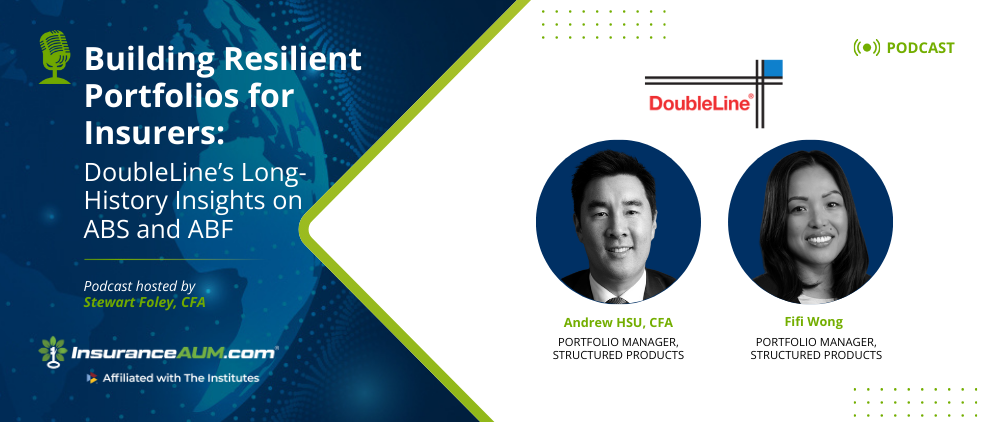
Building Resilient Portfolios for Insurers: DoubleLine’s Long-History Insights on ABS and ABF

Image
Web_11.13 Doubleline Capital - 340 (1)


Stewart: Hey, welcome back. It's great to have you, and thanks for joining us. This is the InsuranceAUM.com podcast, the home of the world's Smartest Money. And my name is Stewart Foley. I'm your host, and today's topic is Building a Resilient Portfolio for Insurers: DoubleLine's long history insights on ABS and ABF. And we're joined by Andrew Hsu and Fifi Wong, both of DoubleLine. Before I read your bios, I'd love to just welcome you both.

Andrew: Thanks so much for having us.

Fifi: Yeah, thanks, Stewart.

Stewart: We're thrilled to have you. Andrew, I'll start with you, Andrew Hsu. You are a CFA charter holder and portfolio manager in structured products. You joined DoubleLine at inception in 2009, and you oversee asset-backed securities, the team there, and you serve as a portfolio manager for the DoubleLine total return and ABS infrastructure income strategies. You hold a Bachelor of Science in Finance from the University of Southern California. And as I mentioned, you're a CFA charter holder. So I want to come back to you, Andrew, but before we do, where did you grow up, and do you have a favorite movie?

Andrew: Yeah, so I grew up in San Mateo, California, and that's just outside of San Francisco. And in terms of favorite movie, maybe I'll give you two just so the audience doesn't judge me too harshly or my coworkers, I'd say Princess Bride is one of my favorite movies. And then just to counteract that, I will say Die Hard One is also one as well.

Stewart: Wow.

Andrew: There you go.

Stewart: You see Andrew as a fixed-income guy. I call that a barbell. So, Fifi, you are a portfolio manager in structured products as well. You also joined the firm at its inception in 2009, and you also work in asset-backed securities as a contributing member of the structured products committee. You have a Bachelor of Science in Mathematics and Economics from the University of California in Los Angeles, otherwise known as UCLA. Fifi. Same for you. Where'd you grow up, and what was your first concert?

Fifi: Yeah, I grew up in the suburbs of LA. I was actually born in Hong Kong and immigrated here in the eighties with my parents, but definitely an LA kid through and through. My first concert was Coldplay during college. We went, my boyfriend, now husband, that was our first concert together, and also my friend's concert.

Stewart: Oh, wow, there you go. What is an LA kid? Through and through? Is there a particular characteristic there or is that, or should I already know that I'm from the Midwest, so you've got to bear with me?

Fifi: I'd say that an LA kid, those of us who grew up in LA, probably have similar movie and music tastes, maybe, and maybe even just food tastes. Those of us who grew up in Southern California, I think they would know.

Stewart: That's super cool. Alright, so give us a little bit for those who may not be familiar, can you give us a high-level overview of DoubleLine first, and how did you get into asset-based finance, and a little bit about how it fits in with your insurance clientele?

Andrew: Yeah, sure. So we are a fixed-income firm. We were founded in 2009. And a bit of an interesting story, the way we were formed is 45 of us left our previous firm and established DoubleLine as you know it today. Today, we're almost entirely employee-owned. We have approximately $100 billion under management, and headcount has grown pretty significantly from that 45. We're at 260 professionals right now. In terms of what we do here at DoubleLine, we cover virtually every area of fixed income. We have a strong presence in emerging markets, rates, corporates, but our core competency is in the securitized markets. I would say it's inherently part of our DNA and the majority of our AUM. And then within securitized, we're involved in both public and private markets, and then all four food groups, if you will. And that would be CLOs, mortgages, commercial real estate, and then also asset-backed us entering into the asset-based finance space.

I would say it stems from the dose of our firm, our CEO. He was really innovative and an early mover in the mortgage markets back in the nineties. He saw some inefficiencies there and an opportunity for our investors, and he stepped in aggressively into that market. Our entrance to the asset-backed finance market is similar but slightly different. It goes back more than a decade, and it was a result of us seeing a problem in the market and really trying to find an innovative solution to access that opportunity set. And then finally, the third part of that question that you're asking in terms of insurance companies, insurance partners, they've been critical to our success when DoubleLine was first getting started in 2009. Insurance companies were our first institutional clients. Some of them were also just getting started on their own. So we're in the same business lifecycle, if you will. And I'm happy to say we worked with them in a number of different capacities over the years, and now working with them on asset-based finance mandates. 

Stewart: That's super helpful. So you mentioned, Andrew, that there was a particular solution that you were able to come up with. Can you talk a little bit about that and expand on that impetus?

Andrew: Yeah, sure. And this was really how we first got started in asset-based finance. This was in 2013. The catalyst was that we were seeing a problem in the student loan market. And essentially what was happening was these loans weren't being paid off on a timely basis. We all know higher education is very expensive. Students were graduating with degrees that perhaps weren't all that marketable, or even worse, they were dropping out of school before they completed their degree. Now, some of these are issues; they started flowing through to the broader securitization market, where transactions were paying. So slowly they're extending past their legal final maturity. And because of this, transactions were at risk of being downgraded by the rating agencies. Certainly, to this audience, downgrade rating migration is very impactful to portfolios and, needless to say, spreads widened in the space. But we were looking at the existing avenues to access student loans, and the upside seemed really, really limited, and the downside seemed vastly worse.

So, in bond lingo, we determined that they had really negative convexity to capture this opportunity. We understood we had to look at other avenues, not the traditional routes. And long story short, we used our network, found ourselves up in the Bay area speaking to a startup using FinTech, which was a very novel idea still in 2013 to originate student loans. And when we underwrote these assets, and I'm referring to the student loans here that were being originated, they addressed all the problems we were seeing in the broader student loan market. These were loans to students from top-tier schools in very specific majors where you had a better chance of getting a high-paying job. They had already graduated, and they were employed. And then lastly, they had pretty high disposable income. Even after meeting all their liabilities, DoubleLine ended up doing the entity's first transaction ever. And while they were largely unknown back in 2013, SoFi became one of the most renowned lenders in the FinTech space today. And I can say both firms were really happy to get that one done and went on to further legitimize both of our business lines.

Stewart: So there's a lot of attention being focused on ABF right now, particularly private ABF. Can you tell us your view of the current investment landscape and how you're investing in it?

Fifi: Maybe I'll take that one. Asset-backed investing has certainly expanded tremendously over the last several years, right? You yourself, Stewart, have had a number of guests on your podcast just talking about ABF. Part of that is the growth of non-bank lending, but equally, I think this dynamic really reflects the fact that investors are looking for uncorrelated return streams, particularly as we've experienced this flattening of the credit curve over the last several years post-pandemic. As the market has gotten much bigger, the mix has also broadened beyond just consumer lending. 10 years ago, if we look at the asset-backed market, right, it was heavily, heavily consumer-centric. And while that's still a large part of the market today, the current investible universe actually reflects a very broad spectrum of economic activity from FinTech consumer receivables to assets operating in commercial industries, such as a securitization of a fleet of aircraft, data center securitization transactions backed by assets operating in the energy space. So it's really an exciting time to be a part of this evolution of the market.

Stewart: It's super interesting because of what you're talking about, which is new collateral types. And I've asked this question a number of times, and by the way, you mentioned previous podcasts. We had a client tell us that they synthesized the last 10 or so transcripts through AI to see how folks were talking about ABF, which is, I think, super interesting and innovative. But when you don't, there's not a lot of historical data on a particular collateral type. How do you get comfortable with the underwriting?

Fifi: Yeah, absolutely. And that's really key to what we do as the industry evolves, right? We're dealing with newer collateral and newer industries. As this industry evolves at DoubleLine, we heavily, heavily emphasize our underwriting process, right? Every two weeks, the team actually has idea generation meetings. We review all the usual things, such as current trends, flag any market shifts, assess any new industries, and new relationship pipelines. The goal is to work towards executable opportunities and actively broaden our sourcing base, which revolves around newer collateral, newer industries. But I think over the years, the team has certainly learned to prioritize businesses with longevity in mind over single-point in-cycle trades. And so that actually factors into any new industry and any new collateral types that we are looking at. Initially, when we enter the space, we'll certainly pull in technical consultants. When we look at aircraft initially, we actually hired technical experts to do plane-by-plane analysis alongside us so that we can learn along with them. I'm never going to be an aerospace engineer, nor does anybody expect me to be. But certainly, if I walk through an asset, a plane, for instance, as an example, and I'm sitting with a technical expert, at least then I can learn what are the mechanisms that drive revenue, what are the mechanisms that drive expenses? And that's how we really enter into any industry that we are looking to invest in.

Stewart: That's super helpful. So it's funny because when I started, everything was ABS, and it was pretty straightforward, but now we call it something else. We call it ABF. Can you talk about the distinction between ABF and other forms of private debt?

Andrew: Yeah, maybe I'll jump in here. So yeah, investors that have so many options today, and it does feel like when it comes to private debt, everyone has a slightly different way to categorize things. When we look at investments on our side, we just think about balance sheets. And in accounting 101, we're all taught this equation for the balance sheet assets equals liabilities plus equities. And we understand that that equation has to balance no matter what. Now the distinction for us is that for an operating company, whether you're doing direct lending or venture lending or anything in between, that you're dealing with a management team that can alter the balance sheet. So the assets of the firm can change over time, and that means to balance out, there needs to be changes to the liability and the equity side of the equation. I'm not saying this is a bad thing; it's not.

It's just that these variables can change, and you have to have confidence in the management team in managing or navigating this. Now, for an asset-backed investment or asset-based investment, you know what the assets are that you're getting when the transaction is consummated, the liabilities and the equity are structured at the same time, and cannot be altered by a management team. So the difference in my mind, and perhaps very simplistically, resides in the balance sheet for an asset-based finance type transaction, I think of a static balance sheet. And for private debt in general, I assume that isn't the case.

Stewart: And so can you talk a little bit about DoubleLine’s investment philosophy and process for ABS/ABF?

Fifi: Andrew mentioned this earlier. We have been investing in this space for a very long time, and importantly, the core securitized team has been doing this together through multiple cycles, many, many market dislocations, and not to continue to date us and age us, but Andrew and myself have worked together since the firm's inception, and even at a prior firm going back before the GFC all in the Securities, ABS/ABF to us area. So our investment process is really a culmination of all those lessons learned over the years, specifically in asset-based investing. I think what's paramount to our approach or our philosophy is that we are looking for cashflow-rich assets owned or operated by businesses where we can really form long-term partnerships and stay engaged through full market cycles. That's super important to what we do and what we look for in terms of investment partners.

And then of course, when those ideas really start to take shape, they all undergo our rigorous underwriting process, where we formally do an industry assessment, sponsor evaluation, onsite due diligence, collateral analysis, structural analysis, and negotiations. Not all structures in the asset-backed world fit all types of assets. So we have to make sure that all alignment of interests is there in any transaction that we do. You need to make sure triggers and controls are in place, should something go sideways. Obviously, principal protection and downside risk management are key to all of DoubleLine's strategies, including our insurance relationships. Then, of course, we overlay the firm's macro views to arrive at a more holistic approach to the whole opportunity, the latter, which is actually really important. We've been talking a lot about how much this market has grown and evolved, and we have to recognize that when an industry grows rapidly and in popularity, so quickly, underwriting standards can drift over time, especially if you have new entrants, right?

And that's why we heavily emphasize such a disciplined credit process combined with active risk management, even up to that broader macro positioning level. It certainly helped us avoid areas that later ran into trouble, I think, and maybe the most relevant example right now is related to the deterioration in subprime credit. We've actually been underweight the subprime consumer sector for over a year and a half now, which is the reason why we avoided the recent high-profile bankruptcies that we see amongst certain auto lenders. So ultimately, you have to let your credit work and experience across cycles guide what you avoid just as much as what you own.

Stewart: It's interesting because subprime has reared its ugly head again, and it seems like we have a hard time learning the lessons of the past. But it's interesting, and I mentioned earlier the new collateral types. I don't know how long you've been around this business, but when CMOs first came out, that's where all the opportunities were, right? I mean, the spreads were wider, the value was better because it hadn't been commoditized, right? So I can completely see how there's real value in these new collateral types, provided that you've got the expertise to underwrite them. And you've mentioned the longevity with which DoubleLine has been in this space. What else differentiates DoubleLine as an ABF manager in particular?

Andrew: So perhaps I'll respond to that one with our approach rather than contrast us with what others are doing in the space, just because there are so many different models out there. I would say we really, there are three attributes we really focus on here at DoubleLine as we approach this ABF opportunity set. The first is around scale. We are not the largest in this space, and self-admittedly, we do not aspire to be the largest. We've been in the asset-based finance for 12 years now. We built some great networks across many different industries, and then our size has allowed us to be nimble and selective, and that has served us well and our clients well. We tend to stay away from momentum traits, and generally, they produce beta-type exposure, and that's not really what we're looking for. And it allows us to be selective.

Fifi just got done talking about avoiding certain issues that certainly allowed us to avoid potholes over the years, including what Fifi mentioned around subprime right now, what we're seeing in that space. And also, I would say when we think about scale, it's difficult to say small, large, medium is the right way to kind of scale things. It's really for us to be at that program size to deliver what we promise to our clients at our current scale. We've been able to deliver, but certainly we wouldn't hesitate to curb our growth if we feel that's at risk. We've done that with other strategies in the past. Secondly is really around sourcing. We built great partners across several different industries, ranging from consumer lending to operators of physical assets, and then you, Stewart, and Fifi. You use the term longevity. I think that's the most important term for ourselves, but also for our partners in this space.

Longevity builds alignment of interest, and we see our platform as really helping build that alignment of interest. And the reason being so is because we manage the full spectrum of strategies, opportunistic vehicles invest in illiquid, high-yielding opportunities, and then our core and total return strategies require higher quality, more liquid type assets. And because of all this, the most important thing is that we are not point-in-time relationships with our partners. We want them to grow, we want them to have access to more efficient capital because we have the strategies to grow with them and really see ourselves as full-cycle partners, our operating entities.

Stewart: That's awesome. Thank you. It's been a wonderful education on ABF today. I've got a couple of fun ones for you on the way out the door. The first one attempts to look, get some insights into the culture at Double Line, and I'll take this to Fifi. What's important to you? What characteristics are important to you when you're adding to members of your team there?

Fifi: That's a really good question. I think for me, when I interview members of our team, particularly the younger generation, intellectual curiosity is by far the single trait that I look for the most in new hires nowadays. Access to information and knowledge is fairly accessible with ChatGPT. The college graduates that we interview are all very, very smart and accomplished individuals. It's the ones that have the drive, ambition, and intellectual curiosity to ask questions to continue to learn even after formal schooling has ended that I want to work with. Markets change and evolve, and our most successful hires, I think, are the ones who are most motivated to evolve along with it.

Stewart: That's awesome. Super helpful. So last one, when we have two guests, the rules are slightly different. So this is, who would you most like to have dinner with, alive or dead? And you get to each pick one because you'll be having dinner together. So, for a table of four, since we started with Fifi last time, we'll start with you, Andrew, who would you most like to have dinner with? Alive or dead?

Andrew: You know what, Stewart? I might defer this one to Fifi because I have two very different ones, the smart barbell trade. So, depending on who Fifi brings to the table, I might choose somebody else to liven up the discussion.

Stewart: Alright, there you go. Fifi, the ball's in your court, if you don't mind, who would you most like to have dinner with alive or dead?

Fifi: This is dinner, right? This is casual time, not work-related time.

Stewart: Correct. Although Warren Buffett is the leader in the clubhouse, followed closely by Jesus. So there's a wide spectrum of choices.

Fifi: Okay. Well, I'll still go with my first thought is that I like to travel, particularly out in the wild, going hiking, being outdoors. So I'd probably pick someone like David Attenborough since he'd probably have some great stories and he'd tell them in that iconic documentary voice and probably be really interesting.

Stewart: I love it. All right. Based on that answer, Andrew, who's your guest?

Andrew: Yeah, I had two. And I'll tell you one, Jerome Powell is one. So I don't think that would be a great mix. So I'm going to change up the personality types. I do like to cook a lot, and I like someone who's blunt, so I'm going to bring Anthony Bourdain to dinner.

Stewart: Oh, wow. I love Anthony Bourdain. It's just amazing. Yeah, that's a great choice. Alright, so I really appreciate you both being on. It's been a good education, and thanks so much to you both.

Andrew: Thank you very much, Stewart.

Stewart: We've been joined today by Fifi Wong, Portfolio Manager in Structured Products, and Andrew Hsu, CFA, Portfolio Manager also in Structured Products, both at DoubleLine. If you like what we're doing, please rate us, review us on Apple Podcasts, Spotify, or wherever you listen to your favorite shows. You can catch us on video, which this podcast is a video on our new YouTube channel at InsuranceAUM Community. If you have ideas for podcasts, please shoot me a note at podcast@insuranceaum.com. My name's Stewart Foley, I'm the host, and this is the Home of the World's Smartest Money at InsuranceAUM.com.

Share this post

Sign Up Now for Full Access to Articles and Podcasts!

Unlock full access to our vast content library by registering as an institutional investor

Register

Contacts


DoubleLine Capital LP

DoubleLine is a privately owned, employee-controlled asset management business founded by Jeffrey Gundlach and 45 colleagues in 2009 to offer investment management services with a cardinal mandate: deliver attractive risk-adjusted returns to clients. DoubleLine has been managing money for insurers since its inception in 2009. The firm's focus on securitized fixed income and risk management positions it well to manage money for insurers. The firm offers an array of fixed income strategies including dedicated ABS, private ABF, CLOs, infrastructure debt, commercial and residential loans, multi-sector fixed income and EM. We understand that the needs of each insurer can vary, and our insurance team is focused on providing our clients with unparalleled access to the investment team and creating custom solutions to meet their distinctive objectives. DoubleLine wants to be your fixed income partner.

Paul Schroeder, CFA   
Relationship Manager- Insurance  
paul.schroeder@doubleline.com
Direct: 213-372-3123 | Main: 813-791-7333


View the contributor page

Sign Up Now for Full Access to Articles and Podcasts!

Unlock full access to our vast content library by registering as an institutional investor .

Create an account

Already have an account ? Sign in

Ѐ Ё Ђ Ѓ Є Ѕ І Ї Ј Љ Њ Ћ Ќ Ѝ Ў Џ А Б В Г Д Е Ж З И Й К Л М Н О П Р С ΄ ΅ Ά · Έ Ή Ί Ό Ύ Ώ ΐ Α Β Γ Δ Ε Ζ Η Θ Ι Κ Λ Μ Ν Ξ Ο Π Ρ Ё Ђ Ѓ Є Ѕ І Ї Ј Љ Њ Ћ Ќ Ў Џ А Б В Г Д Е Ж З И Й К Л М Н О П Р С Т У Ф Х Ц Ч Ш Ā ā Ă ă Ą ą Ć ć Ĉ ĉ Ċ ċ Č č Ď ď Đ đ Ē ē Ĕ ĕ Ė fi fl œ æ ß