
CLO BBs and Equity
Stewart: Hey, welcome back. I always say this, I mean, welcome back to the Home of the World's Smartest Money. I really do believe that insurance asset management is the world's smartest money. It's not that we have a better crystal ball than everybody else, but it certainly is an interesting and ever-evolving set of investment complexities. I think a lot of us in this business really enjoy problem-solving and puzzles and so forth. And this is certainly our world. And so this is the InsuranceAUM.com podcast. We're now affiliated with The Institutes. We're very proud of that and their rich educational history.
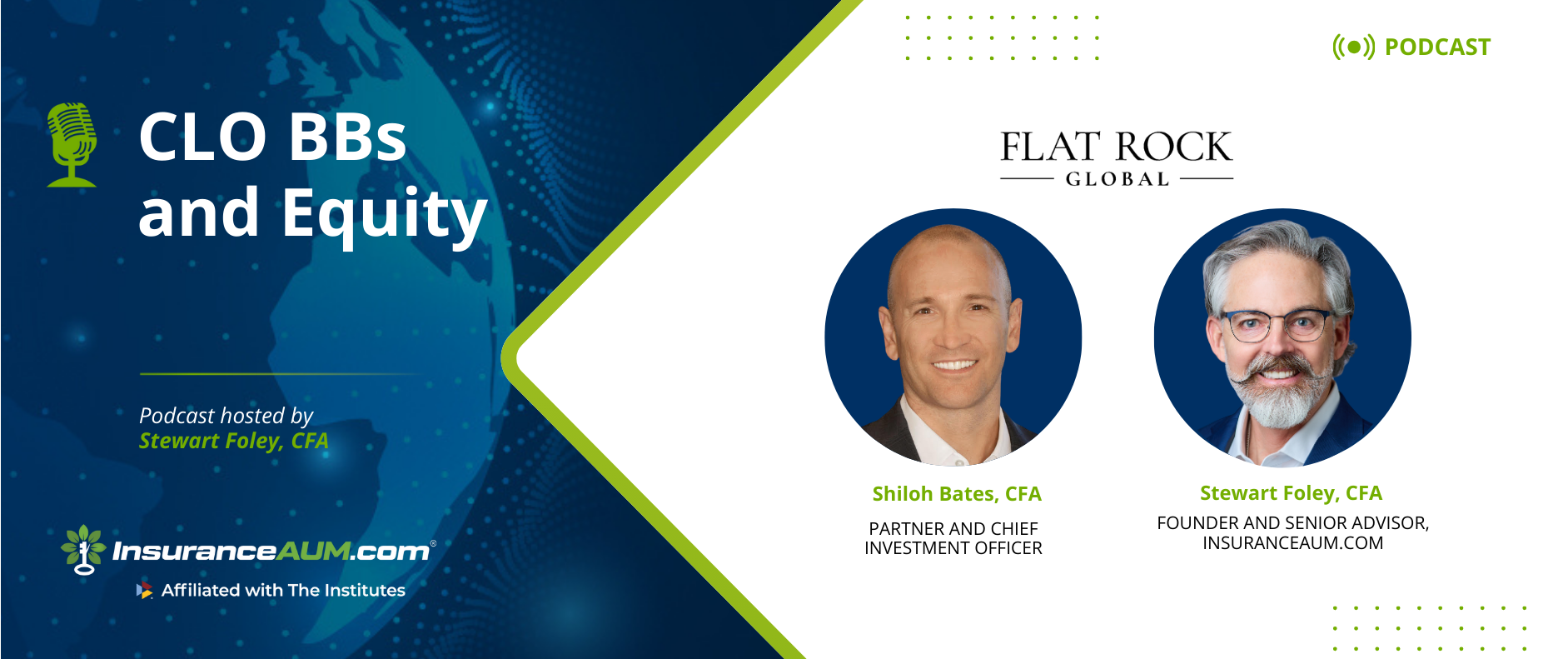
So, for those of you who don't know, my name is Stewart Foley. I'm the founder, and my title is now Senior Advisor to InsuranceAUM.com. I'm also the Principal Architect of the CIIAM designation, which is the Chartered Insurance Investment Manager designation. There is more to come on that. We're hoping for an early 26 launch, but you're finally going to be able to learn insurance asset management without spending 20 years of on-the-job training. So we're thrilled to have a fantastic guest today, somebody who is one of the most prolific investors in the CLO space, the author of CLO Investing, and the host of the CLO Investor podcast. Shiloh Bates, CFA, Partner and Chief Investment Officer of Flat Rock Global. Shiloh, welcome to the show.
Shiloh: Great to be with you. It's an honor to be on.
Stewart: Hey, listen, I really appreciate it from another podcast host. I think you'll be around episode 350, which is an astonishing number. Only 1% of podcasts make it to 300, but we keep having, what I really have to say, increasingly senior and accomplished guests. We have really good guests on this show, and for everybody who says to me, and you did right before we hit the go button today: ‘I really like your podcast.’ It's a good podcast. At the end of the day, it is really the expertise of our guests and the information that they share with us. Come on as a professor for a day here. It's really about learning and teaching about your asset class or your specialty. And so I know you've listened to a bunch of our podcasts. I want to start with our icebreaker, but we have a new one, which is that hopefully you'll be excited about. But I want to get more into your background because it's really interesting. But just to kind of start, where'd you grow up, and what job would you want if not this one?
Shiloh: I grew up in Arlington, Virginia. My mom worked in the Clinton administration, and everything revolves around politics in the DC area. So when I was younger, my aspiration was to be like a senator or a governor, and I studied political science as an undergrad and did a master's in public policy. And for me, the more that I found out about government and what working in government would be like, the less appealing it was. And this is 25 years ago, so this is at a time when politicians collaborated across the aisle. Now I think it'd be even less appealing, at least for me, to work in politics. So that was my initial focus. And then in graduate school, I made a transition to studying finance, and my first kind of real job was working for a bank, what is Wells Fargo today.
Stewart: Very cool. So what job would you want, if not this one?
Shiloh: So, one of my master's degrees is in financial mathematics, and a lot of financial mathematics training comes from physics, and so I think something very quantitative, either physics, math, statistics, something in this area, I think would be appealing to me. I really liked problem-solving, and so that's why I've kind of gravitated more towards math and working with numbers.
Stewart: It's interesting because you do, I mean, versus some of our guests, have some similarities in their background, but you have an academic and professional background in business. You've got political science from Virginia Tech, you've got public policy from Harvard, you've got financial mathematics at Chicago, statistics at Columbia, and somewhere in there, you were a psychological warfare specialist in the US Army Reserve, which is super interesting, and I want to get to that at some point. But let's talk about, setting the stage basically for our listeners, especially the insurance crowd. A lot of people are familiar with CLOs, but I always find that there are folks who appreciate a definition of the subject matter for the day. So what is a CLO, and what problem does it solve in the credit markets?
Shiloh: Sure. So the best way to think about a CLO is that it's a simplified bank. So if you buy stock today and like a JP Morgan or a Bank of America, they're in literally dozens of business lines. But the CLO is like a pure play lender. And so its assets are usually a portfolio of about $500 million of senior secured loans that could be private credit loans or broadly syndicated loans. And that pool of loans is financed with different securities, some rated AAA because of their seniority, down to BB, which is the junior-most debt sold by the CLO. And then at Flat Rock, we're specialists in CLO equity. So you could think of that as kind of being a bank's shareholders, where we get the profits of the CLO every quarter, and they're distributed to us. And when you're in the equity, basically, the investment that you're making is that you're getting high cash distributions because the CLO's assets pay a much higher rate than the CLO's financing cost.
Again, just like a bank rate. And so the risk you're taking though, is that you're on the hook for loan losses. So when loans default, that's going to eat into your return. And I can talk about how we think about that. Of course, it's not a knowable risk, it's a quantifiable risk. And in the equity, we target returns in the mid-teens. We also at Flat Rock specialize in CLO BB notes, which are the junior-most debt sold by the CLO today. The rates there are, well, SOFR is the base rate in my market. So that's the secured overnight financing rate. And we're earning SOFR plus 7% on CLO double Bs today. These are private credit CLO double Bs. And then finally, the CLO also sells a AAA-rated note, and that goes to banks, some to insurance companies, and increasingly CLO ETFs. And so the problem that the CLO solves is that you're taking 200 different loans that are on average rated single B by Moody's and S&P, and you're putting them into a trust or vehicle. And if you give somebody the first payment priority, like the AAA, they can get exposure to those loans, but end up with an AAA rating. And for somebody who really likes their risk-return profile of the loans, they might find it interesting to invest in CLO equity, where you get exposure to the loans, but with built-in leverage that has the potential to increase returns over time.
Stewart: It's interesting that I assume, and I'm sure we'll get to it, but underwriting for you has got to be a critical part of what you do. But one of the things that we hear from insurers, and I've always said this, I don't think that there are many insurance investors, CIOs. I mean they are by nature, somewhat contrarian, somewhat skeptical. They get pitched a lot of things, but I don't think anybody's buying anything that they don't really understand. And sometimes you'll hear an insurer ask what's actually inside a CLO? What types of private credit loans are there, and what's the underlying exposure?
Shiloh: Sure. So in each CLO, there's going to be, let's call it, 200 different private credit loans. On average, they're paying a rate of about SOFR plus 5%. These are loans that are usually created in leveraged buyouts. So a private equity firm purchases a company, let's call it, for 10 times its annual cash flow. They might write a check for half that amount five times, and they borrow the rest in the direct lending private credit market. And so the borrowings there end up in lots of different funds. They end up in lots of CLOs, potentially BDCs, both public or private, and also separately managed accounts. The companies generally have EBITDA of call it $10 million at the low end, but on average, we're talking about EBITDA of call it like $50 to $100 million, should the companies provide a material product and service in the economy. But they're also not companies that are in the s and p 500 or that you're going to read about in the Wall Street Journal. And so you've actually had a number of podcast guests on who have talked about direct lending. Well, I'm providing exposure to those exact loans sometimes from actually your podcast guests, but through this CLO or mini bank that I described.
Stewart: And so help me with this. Why might CLOs be superior or at least different than investing directly in those loans?
Shiloh: Sure. So one of the, I think selling points for CLOs is that you start with a question of ‘do you find private credit attractive? Yes or no?’ And if the answer is yes, I think, or let's say the answer is no. Let's say I'm a more conservative person. I think maybe the economy isn't in a great spot right now, and defaults are elevated, then you can choose a very senior CLO security and probably sleep very well at night. And then on the other hand, if you really like the private credit story, which is basically on the assets yields of nine or 10% and historical loss rates of about 60 bps, that's kind of the selling point for the asset class. And that's over a 30-year history. If you like that story. Again, you might want to put some kind of leverage on the assets and with the expectation of having returns that are even greater than just the yield on the original assets.
Stewart: And this is, I believe, dead center of the fairway for you, which is what's happening in the CLO equity and BBB market. It's been pretty eventful. Can you give us an update right now and give us an idea of what's driving markets?
Shiloh: Sure. And let me just maybe just add a little bit to your last question as well. The other kind of selling point for CLO debt securities, for example, is that historically they've offered better returns and more favorable loss rates than there are corporate counterparts. So, for example, if you invest in CLO BBs, which are the junior-most debt sold by the CLO, historically over 30 years, they have a default rate of about 25 basis points. So, almost a D minimis default rate. And if you compare that to high yield, that's about a 3% default rate per year or leveraged loans owned directly, that's about a 2.9% default rate per year. An attraction of CLOs is that, as a lender, you can lend money to one company that's very well regarded. Everybody thinks it'll be around for 10 years and will do great, but there can always be some kind of technological change or regulatory risk, or management turnover.
Any one company, no matter how well regarded today, could end up in default. Whereas in the CLO structure, to end up in a default in your BB or your other debt securities, there has to be a number of unlikely loan defaults, one after another, all chained together. And that's why you have this kind of minimum default rate for BBs and of course, it gets better as you go up the stack. So at BBB, there's even a lower loss rate there. So we're asking for an update. So let me give it to you from two different perspectives. So one is from the perspective of CLO equity. So this is the security that's taking the most risk on the exposure to the direct loan portfolio, and defaults are elevated is the reality. So there are a lot of different ways to calculate, and firms that put out different default rates, they don't always exactly marry up to what we're doing in CLOs, but the default rate, you could think of it as between three and 4% today.
And what are the kind of borrowers that are defaulting? It's not like one particular industry that's struggling, rather it's from 2021, where maybe a private equity firm overpaid for a business overleveraged it a little bit. That in itself is not necessarily an issue because you would expect revenue and EBIDTA to grow over time, but if there was some kind of management misstep, the business didn't grow. Well, these loans are floating rate, and the base rate used to be around zero. Now the base rate is a little bit shy of 4%, but it was as high as 5.25%. And so as rates went up, we saw that as this transfer of economics basically from private equity firms that own these companies to their lenders, who were earning a much higher rate than they used to. And so that's great, we benefited from that.
But the interest coverage ratio, so that's the ratio that compares a business's cash flow to its interest expense. I mean that used to be four times or better. Now it's a little bit less than two times. And not every business was able to have their interest expense double, like they just didn't have the cash flow or liquidity to support that. And so now we're in an environment where defaults are elevated. In fact, if you look at defaults on kind of a running five-year basis through, we're seeing higher defaults now again over five years than we saw through the global financial crisis. So during the GFC, defaults peaked at 8%, but very quickly were sub kind of 2%. They were also very low before the GFC. What my market has experienced now, or is experiencing now is these prolonged default rates with recoveries in the 50-cent area. And so for equity, that's been painful.
So, CLO equity has a negative return on average for this year. But from the perspective of the CLO BB, so again, the junior-most debt sold by the CLO, the reality is that elevated defaults are most likely just a problem for the equity. So the equity is taking the first loss risk on the loan portfolio, and there's not enough defaults in general that the BB would be affected. But it certainly has affected returns for the equity. Most BBs today, trade a par, people aren't seeing much kind of a risk there, but in the equity it's a different story.
Stewart: Well, it's interesting because a lot of CIOs have fixed-income backgrounds, and when you see a significant sell-off in an asset class that can create an opportunity, right? We've seen spreads out. Consumer sentiment is bouncing around. You saw a print, I saw a headline the other day that said it's as low as it's been since April. Does the sell-off that you're referencing here create an interesting entry point, or are you still cautious?
Shiloh: So I think it does create an interesting entry point. And when we launched our private credit BB fund about three years ago, we were very lucky in terms of the timing there. So we were able to launch a fund by discounted BBs and BBs with very high spreads versus where they are today, and really benefited. Now, for CLO equity, we see the same opportunity. So the default rates elevated, which's been negative, and prices have come down. Another factor is that the assets in CLOs that are performing well there to loans to private equity-backed companies, and they've been able to go to their lenders and ask for lower spreads because a lot of money has been raised in the asset class. And so when lenders agreed to the lower spreads, that's lower interest income into the CLO. So we've on top of the higher defaults, we've experienced some spread compression on the assets that we own. So what's happening now, though, is that LBO activity is picking up, and what we expect is that that should widen out the loan spread. So that'll be more opportunities for our CLO managers to buy loans again, hopefully at higher spreads. And then as the Fed reduces rates, that should mean fewer defaults over time, so less interest burden on the company and therefore lower default rates.
Stewart: And so one of the things that we hear from insurance investors is rated note feeders. And so, for the benefit of our audience, and I appreciate that you've unpacked some terms today, me prompting, and I really appreciate that. And you obviously have a pension for teaching a little bit here as well. So how do CLOs relate to rated feeders? Are they complementary? Are they competing or something else entirely?
Shiloh: Yeah, sure. So the funds we manage at Flat Rock, we do not have, we're not regulated insurance companies, so we don't have capital charges or anything like that. So the investments that we make, we're just trying to earn a favorable risk-adjusted return, and that's it. So rated feeders are a close cousin to the CLO. And the way I would think about it is imagine an insurance company wants to invest, call it 300 million, into a private PDC. Well, if they do it through just direct ownership of shares, they're going to the capital treatment on that, it's equity, and it's going to be very poor. So instead, they use rated feeder technology, which is a lot like a CLO, and it takes that 300 million, and it divides it into a senior piece, a senior debt piece, a junior debt piece, and equity. And so again, the insurance company ends up with 300 million in exposure to the loans. The return profile combined of the senior junior inequity should be equivalent to investing directly in the equity, but the capital treatment is much better. And so we've seen a lot of issuance of these rated feeders, and for us, we found interest, or we've been buying rated feeder equity and rated feeder BBs into our funds. Again, there's not a capital charge angle to it; rather, we just think they offer good risk-adjusted returns. But the genesis of the rated feeder is from insurance companies that wanted better capital treatment.
Stewart: That's super helpful. So if I want to go deeper here in this topic, I mean, it can be complex structuring securities can get, and your background is very quantitative, as you mentioned. What is the best way for an investor, particularly an insurance CIO or PM, to get deeper on the CLO topic?
Shiloh: Sure. So I wrote a book, it's called CLO Investing, with the focus on CLO equity and BBs. That's what we target at Flat Rock. So I published that two years ago, and the genesis of the book was during the COVID period. I had a lot of free time on my hands, and I realized that if you wanted to learn about CLOs, you can get on Google, and a lot of documents will come up, but you're kind of trying to piecemealing together the education. And so I wrote during COVID this 60-page document on how I approach the market, and I was really surprised at how many people read it, be it CLO, managers, bankers, I think my competitors, some of them probably read it. That gave me the idea to put together a full book. And that's basically the idea with the book: it's 220 pages of everything that you should want to know about investing in CLOs.
It should be there, I hope. So we published that, and then I realized about a little bit less than a year ago that the world had changed, and maybe I was a little bit slow to pick up on this, but I thought the way that I need to communicate with my investors is through long white papers with lots of citations and graphs and the like. And I think that everybody's attention span today, maybe even mine, has compressed quite a bit. And so I had the idea to launch a podcast in my space. So mine's called the CLO Investor, and every call it, three weeks or a month, I have somebody come on, and it's fun for me because I'm just having a conversation that I would otherwise have and enjoy. So I recorded, and we put it up, and I've been surprised at how many people download the podcast and enjoy them. And it's a way during this podcast we've talked about higher default rates, how that's affecting equity, that's been a theme for the year. And so it's like, well, from my perspective, it's like let's have podcasts, guests come on and talk about the default rate and why we think that we're kind of transitioning to a period of lower defaults where equity will really benefit. So I do this every couple of weeks, and on top of the book, I think that's another way that people can come up to speed on the asset class.
Stewart: It's been super helpful, and I've learned a ton today, and I appreciate that very much. I got a couple of fun ones. Swearing the way out the door, which is the first of one, is really attempted to, the intent is to get at the culture at your firm. And so what characteristics, either at your firm now or over the course of your career, what characteristics do you think are helpful in finding success in the asset management space?
Shiloh: Lemme give you two that kind of differentiate us. So one is that Flat Rock today manages about $1.6 billion, and we got into business a little bit over eight years ago. So during those eight years, we've seen nice growth. But I've seen some of our competitors, they've raised a whole Flat Rock in a month or a quarter. And I look at that, and I think, well, that might be good for the employees of the asset manager. If it's a publicly traded asset manager, it might be what the shareholders want. I assume that it is. But at Flat Rock, we're really just kind of focused on our track record. So we don't take money in unless we can invest it accretively. And we're first and foremost investors, not asset gatherers. And I think that's one thing that differentiates us, and I think it certainly shows up in our track record.
So that's one thing. Another thing that differentiates us is that, prior to COVID, we worked in midtown Manhattan and when we started working remote during the period, we realized that we worked very efficiently from different places and we started, we were growing during the COVID period and we started hiring people from all over the country rather than just in New York City, which was kind of our focus before COVID. And so we've developed this work remote culture where I spend a lot of time my day on Zoom and Teams, and every quarter or more we do something as a group where we're doing a client offsite where we're all kind of together for a number of days, getting that kind of water cooler time if that's how you think about it. And so for us, we're a smaller firm, we're 15 professionals, and what I'm describing, so again, works great for us, but if you're a big bank and you're taking people who recently graduated from college and trying to bring them through the ranks, our setup doesn't really work great. I don't think it'd work great for that. But for example, I've worked with our founder, Bob Brunwald, for like 12 years. So we don't need to see each other in person every day. We know what we're working on and teams, and Zoom work. Great. That's our takeaway.
Stewart: I mean InsuranceAUM is virtual, right? And we've got folks all over the place. Chicago, Florida, Ohio. We've got someone who works with us outside the US as well. And it works great. I mean, we never had an office, but it was really because when we started, we couldn't afford one. So we just kind of evolved into this culture. But so this question's coming so alive or dead, who is coming to dinner with you? You get up to three guests. Could be one, two, or three. Who's coming to dinner with you, Shiloh Bates, today?
Shiloh: So I read the biography, the Walter Isaacson biography of Benjamin Franklin, and I think he is really one of the greatest Americans, just in terms of what he could accomplish across so many different fields, from publishing, diplomacy, politics, inventions, I mean, what his mind was capable of was really impressive. So he'd be one, I think today, probably Elon Musk, a guy who's successfully running six plus companies, all while trash-talking on Twitter. That's pretty impressive to pull off, I'd say. And then a third one, I would need to think about it a little bit. I do a lot of in my after work and I think I would probably choose a jiu jitsu practitioner or an MMA fighter from back in the day, maybe, to round out the dinner.
Stewart: Oh wow. Okay. So here goes my naivete like a Chuck Liddell guy, but he's not a jiu jitsu guy, is he? Or is he?
Shiloh: Well, to be successful in the UFC, you have to have some jiu jitsu is the reality. So it is basically the skillset, there is jiu jitsu plus kickboxing is the formula for success. And what I find really interesting about the UFC is just the different matchups, the different styles, the different attacks is which makes that interesting. But somebody like Khabib is kind of one of the best of all times. He retired recently. John Jones, somebody who's also one of the greatest. I think it'd be fun to have dinner with him as long as you don't make him angry, I guess.
Stewart: Yeah, I think Dana White said that he was pound-for-pound the best MMA fighter ever, right? Is that John Jones?
Shiloh: Yes.
Stewart: He did that. John Jones. Yeah.
Shiloh: I take it you're a big fan as well.
Stewart: I do like it. I just don't know much about it. I've tried to learn, but I've never practiced. But do think it's amazing, the level of training, the level of fitness is incredible, and there are aspects that I'm less comfortable with, but it is interesting to follow.
Shiloh: Well, just think about it: in other athletic sports you're giving, you're a hundred percent running or lifting or whatever it is. Well, in the UFC, you're giving your hundred percent after somebody just punched you in the stomach.
Stewart: Yeah, exactly. That's right. Or something Tyson line. Right?
Shiloh: It's a very different kind of person who can succeed in that.
Stewart: Yeah, that's right. I think it's Mike Tyson's line that said everybody's got a game plan until they get punched in the face.
Shiloh: Punched in the nose. Yeah.
Stewart: That's right. So listen, thanks so much for being on. We've been joined by Shiloh Bates, CFA partner and chief investment officer of Flat Rock Global. Shiloh, thanks for taking the time.
Shiloh: Yeah, it's great to be with you. Thanks again.
Stewart: If you like what we're doing, please rate us or review us on Apple Podcasts, Spotify, or wherever you listen to your favorite shows. You can also check us out on our YouTube channel at Insurance AUM community. If you have ideas for podcasts, please shoot us a note at podcast@insuranceaum.com. My name's Stewart Foley, this is the home of the world’s smartest money at InsuranceAUM.com.
The InsuranceAUM podcast is available on




Share this post


Sign Up Now for Full Access to Articles and Podcasts!
Unlock full access to our vast content library by registering as an institutional investor
Sign Up Now for Full Access to Articles and Podcasts!
Unlock full access to our vast content library by registering as an institutional investor .
Create an accountAlready have an account ? Sign in