
Current Asset-Based Private Credit Insights
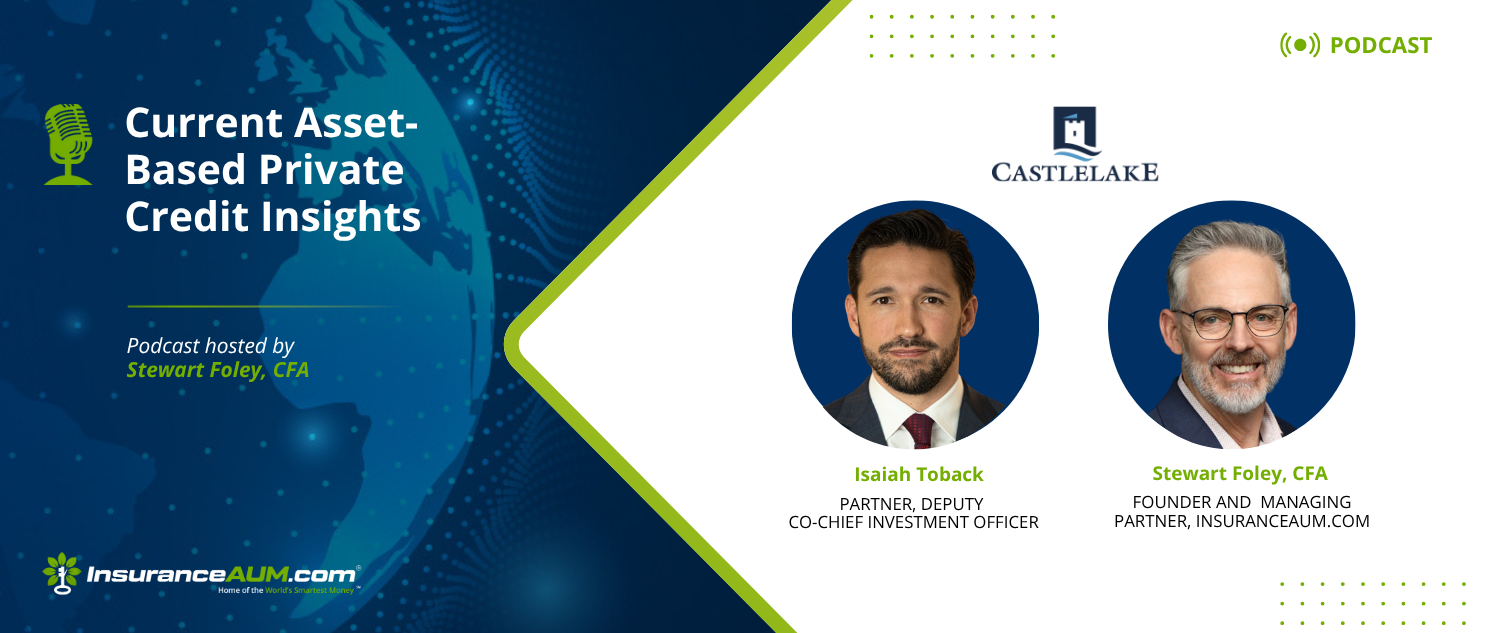
Stewart: My name's Stewart Foley, I'll be your host. Hey, welcome back. It's great to have you. Thanks for listening. I've got a great podcast for you today, all about asset-based private credit and I'm joined today by Isaiah Toback, partner and deputy Co CIO at Castlelake. Isaiah, welcome. How are you? It's great to have you and we're thrilled you're on.
Isaiah: Yeah, thanks so much for having me.
Stewart: I got a quick shout out that I got to get out to my neighbor before we get going. So my next door neighbor, Tobias, you may be interested in knowing, is an 82-year-old native Texan and he is quite an accomplished artist, and so we're doing a video podcast. So this is the intro of this piece of art. He has done a couple of hundred caricatures of cartoons of people in the neighborhood. There's a cafe down the street called Oak Creek Cafe and it houses about a hundred of his works. And you can imagine what an honor it was, being a relative newbie, for him to bring this thing that's over my shoulder back here, this little caricature of me wearing a pink shirt and pointing at an outhouse, which I was just, I want to say thanks so much Larry and appreciate you for that. And so happy to have Larry and his talent over here with us. It's always nice. But Isaiah, welcome and thanks for being here. I want to get started the way we always do, which is where'd you grow up? That's important. And what was your first job, not the fancy one, and what was your path to getting to this senior position that you hold at Kessley?
Isaiah: Absolutely. So I'm from just north of New York City. I grew up in a town Chappaqua, and that was where I had my first job. I was a bartender. I worked at the local French Bistro tending bar there. And in terms of how I got to Castlelake, so I came up through the banking system. I was always in structured credit and structured finance, and Slake actually was my client. So following the financial crisis, slake was a large owner of midlife aircraft and I've worked with them to help create the first midlife aircraft securitization. So while I've been at Castlelake for a little more than 10 years, I've actually been working with them for about 13.
Stewart: And just the curiosity, when you say midlife aircraft, that's aircraft that's been flying. Let's say it has a 30-year expected life and it's 10-years in. That's right?
Isaiah: Exactly. But all commercial aircraft. So the aircraft that we would fly on as consumers, most of the airlines in the world actually are heavy users of leasing in their aircraft. And there's a very large industry of aviation leasing and Castlelake’s a very active member in that market.
Stewart: That's cool. So is there any truth to the fact that or the idea that you speak your conversational or fluent in Spanish? Is that true?
Isaiah: I'm certainly not fluent. I have had the opportunity to use Spanish a fair amount though in my business career. So one of my many small chapters of my career was I helped build Castlelakes renewable strategy and actually did a fair amount of work in Argentina. So I did have the opportunity to negotiate documents in Spanish and sit on boards in Spanish, which was a very quick way to dust off my high school and college Spanish for sure.
Stewart: That's cool. So just for the sake of folks who might not know or be familiar, can you give us a high level overview of Castlelake, and talk to us about your unique insight into the asset-based private credit space?
Isaiah: Absolutely. So Castlelake is a pure play asset-based investor. We were founded in 2005, so we've been doing this for over 20 years. And the one thread that ties together all of our sub industries is really being at the asset level. So asset-based credit, which is really the primary form in which we invest today, is one subsegment of investing within the asset-based markets. And I do think from a unique standpoint, there are very few firms that have been in the market for as long as we have and really had it be the true dedicated strategy of the firm.
Stewart: There's an awful lot of talk about asset based credit right now, ABC as it's known, different firms use different terms. How does Castlelake define it? I mean, you mentioned mean this is your core competency, right? Yeah. And talk to me a little bit about how your approach is differentiated.
Isaiah: Absolutely. There's a lot there. Asset-based markets as a whole has been a concept. Asset-based investing and asset-backed securities and the likes have been around now for many decades. I think a private market solution for asset-based finance is what's relatively new today. And so you're right that there are many acronyms and in fairness to those different acronyms, we aren't all doing the same thing. In particular, there tends to be two areas of primary gravity, there’s asset-based finance funds that typically have a wider aperture. They're buying assets, they are financing assets, they're a solutions provider to the banks, which is fairly different than asset-based private credit, right? You mentioned ABC. When we say ABC, we are referring to the private credit offering within the asset-based markets. And that is driving private, frankly, securitizations to non-bank lenders and solutions, really providing an alternative from a lending perspective than what a non-bank lender might use by going out to the ABS markets. And so similar to corporate direct lending or corporate private credit, it is meant to be a primary lending strategy really for an alternative to what you might find in liquid fixed income.
Stewart: It's interesting because it seems like, and I was in a structured products back when the earth was still cooling, and it seems as though that the underlying exposures- I'm glad to see that my sense of humor isn't completely locked on everyone. So talk about the underlying collateral types and what are you seeing? I mean there's planes or shipping containers, but there's also new things. I was just on the phone today with somebody talking about music royalties in that, what of these new collateral types emerges? How do you assess whether you like the relative value or you avoid?
Isaiah: It's a great question. I think that most investors are looking for exposure to asset-based finance, whether as a private credit or as an opportunistic strategy looking for non-correlated returns. Typically we're looking for something incremental over what you can find in either the corporate equivalent market or the liquid fixed income market and trying to do so with less correlation and better downside protection. And so to your point, I think that some of these alternative and what we traditionally would refer to as esoteric asset classes within the asset-based finance markets lend themselves well to private credit solutions. So music royalties or pharma royalties or other forms of financial contract finance. At the end of the day, asset-based finance is typically taking a discreet portfolio of either cashflow streams, so whether those are financial assets, loans, mortgages, just the general contracts themselves or hard assets, think shipping containers, aviation real estate assets where you can in effect factor those cash flows on a reliable basis.
And typically one of the greatest driving and unifying factors that we see within the asset-based markets is diversification, right? So you'll typically have a portfolio that has many of these underlying assets. In the consumer space that might be literally millions of underlying accounts. When you look to larger format assets, whether real estate or aviation assets, you're typically looking at more like 25 to 50 underlying assets, but provide the level of diversification necessary. To your question though, I do think that as it relates to assessing the risk in those markets, we don't believe at Castlelake that we have the expertise to address the entire asset-based credit markets. And when we think about the asset-based markets, we generally think about that as a $20 to $30 trillion market. Our sub-markets that we focus on at Castlelake, they tend to be the largest food groups: residential mortgage, small balance, commercial mortgage, consumer, small business transportation assets. So that's about $7 trillion of addressable market value for us. I think it's really important to have that longstanding data history. And so to your point, while they are very compelling, many of these esoteric asset classes, I don't think they fit the Castlelake DNA.
Stewart: That's really important to know. So let's talk about the opportunity just a little bit. Where are you seeing the most compelling opportunities in the ABC space right now, and what do you think is driving that opportunity? And my little throw in part of this is, is there anything that's come up in the changing landscape of the last couple of months that you think impacts that opportunity set?
Isaiah: Certainly the last few years, and then there is some things going on in the last few months that will present opportunity or further change. I think asset finance, while it's existed very effectively going on five decades, and if you talk about the residential markets, going back much further than that, I do think that a private securities market or a public securities market, but the private securities market that we're seeing form is very much out of post-financial crisis regulation. Similar to what we've found within corporate direct lending lending, where regulation such as Basel, Dodd-Frank drove a lot of core business out of the traditional banking. What's accelerated the asset-based markets in the last few years has been subsequent regulation. When we think back to Dodd-Frank, we think back to Basel I, those were primarily targeting in many ways the corporate markets and pushing levered lending off the balance sheet of the banks.
What backfilled, particularly at the regional and super regional level here in the states, really that hole in the balance sheet for these banks was the asset-based markets. And so financing small businesses, financing and consumers financing, small balance commercial real estate is really what they transacted in as their core business in Bailiwick. In the last few years, subsequent regulations. So if we think about incremental changes by the OCC and the FDIC in terms of capital charges, Basel IV or Basel III endgame, whichever name you prefer to use, and its subsequent changes to capital treatment, those were specifically targeting the asset-based markets. And so that's really the catalyst that has allowed for this private securitization strategy to take hold. I think that was met at the same time with significant growth and market share by non-bank lenders. So if we think about many of us today have had some sort of interaction with a non-bank lender, whether it's as personal consumers when we're checking out of our Amazon accounts and we are offered a ‘buy now pay later’ option, or you might seek a private label loan of some kind or personal loan or an auto loan or a home mortgage that doesn't come from a traditional bank.
I think most consumers at this point have had an interaction with a non-bank lending market. And so for us it's really the confluence of these two events that happened separately, but really collided in needing to form a more stable private market solution. Right? Non-bank lenders, it's a fantastic opportunity for the end user, so end consumers getting customized credit to who they are outside of the traditional bank underwriting model has high utility. But what the non-bank lenders don't have are bank deposits. They don't have the ability to raise demand deposits to instantly fill that lending need. And so thus was born really the capital market for the opportunity.
Stewart: It's interesting because insurance companies match up particularly well for this.
Isaiah: Yes.
Stewart: I mean, depending upon the version of private asset, you can find an insurance company or a group of insurance companies where it's a very good fit. And the other thing that bank deposits bring with you is the potential for a quick exit, right? That's right. And that's not the case for the insurance community. They don't have that same run on the bank risk that's out there. So it's interesting that, and we just had an event on this asset class or a version of this asset class two weeks ago in Philadelphia, and it feels like a lot of people are talking about it right now. You covered some of the reasons that it's definitely getting, from a regulatory perspective, pushed off a bank's balance sheet. The timing is very good. There's a lot of non-bank lenders out there. How do you see this going? Do you think this is structural? Do you think that there's somebody in DC waves a wand and some of this regulation goes away and maybe the opportunity changes? How's your crystal ball these days?
Isaiah: We're asked that question a lot. I do think there is a broad push by the current administration for deregulation, and I think that there's a general acknowledgement that a lot of the current regulation has led to banks being substantially unable to do the core business of lending. They really function now in many ways as cash management and then lending obviously to certain parts of the absolute prime market and then lending to the investment grade corporate market. But, a lot of the core need for banks has changed. And so I do think that there's a general acceptance that some of that regulation has gone too far. However, there are a few mitigating reasons why that really won't matter, in our mind. So the first is, again, going back to the end utility to the consumer. I think the die is cast the moment we started using these to ultimately conduct our banking and stopped using brick and mortar banks.
I think our willingness as consumers to seek alternative finance completely changed. And at the end of the day, what matters to the consumer now is much more about getting the right form of capital for what you need as opposed to getting it from the same place where you do your banking. So I think the die is cast on the utility front. Likewise, I don't think that the administration can simply waive their wand for a few reasons.
So first, when we look what happened with banks first, Basels and international systems, so the US to unilaterally either withdraw from Basel, which would have a major impact to any bank that does international banking or we'd have to convince a much larger group than just the current administration to roll those back. Likewise, I think one of the compounding impacts that has happened here in the states are changes on the accounting front. So if you're familiar with CECL, current expected credit loss, it was an accounting change that does impact every financial corporate. It's not just banks, but is led to provisioning that is very unkind to any primary lender within these markets. And so you'd also have to have a series of accounting changes. I think that the coordination necessary to achieve that is highly unlikely. And even if it were to happen the amount of time it would take to have an impact from the momentum we're seeing already; I don't think Pandora can go back in the box.
Stewart: That makes sense. I'm with you on that. For whatever it's worth, as I think most people know, our audience is mostly insurance investment professionals. Can you talk a little bit about the key benefits of how ABC can be added into an insurance portfolio, both life and PNC? Right? Different duration targets is my understanding. This tends to be a little shorter duration, but certainly want to hear your thoughts there and what I think insurance investors are always concerned about the downside. What do you think they should be mindful of?
Isaiah: The asset-based private credit offering I think is substantially different than the public ABS offering. So let's just start there maybe and spend a minute there because I think most insurance companies have investors within public, particularly flow ABS and the APC strategy, whether it's Castlelakes or one of many other that are out there is substantially different, even if it on its face is a private securitization of similar assets. I think that most importantly there is a proactive selection of the underlying portfolios in the loans that we are creating. So at its very essence, the portfolios of assets that are being financed by our strategies are proactively selected by us, which is substantially different than a public market investor in ABS, right? So I think that the positive selection bias is the first starting place and offers a very different entry point into the underlying asset class.
Likewise, there is the ability to then use your understanding of that underlying portfolio to create a unique structure. I think that many participants within the asset-based markets, or at least the ones who are viewing it from the outside, believe that private credit in the asset-based markets simply means, “Hey, whatever I get in the public market plus 50 basis points.” And the reality is, while that's true, there is some incremental return, your point is well taken. That downside is probably the most important focus for anybody who's participating in this market. And so creating unique, bespoke and tailored structures is the key to our success long-term. And so while I think most public securitizations are bound by the rating agencies in terms of their structures for us, we are typically trying to find the best risk profile. And then if we are going to seek to drop that into an actual rated securitization, the product of what is ultimately syndicated to rated buyers, they benefit from that incremental structure.
Stewart: Yeah, certainly. I mean, I've talked to a couple of CIOs in the last week or so and rated structures. I think, formally, folks are talking about being concerned about or being interested in the liquidity and the rating of what they own. And one of the things I think that happens is that you get a pretty good sense for when you're in this market, you're closer to it than anyone else. I mean, if you manage my portfolio in this asset class, there's no way I would know it as well as you do. And people who haven't worked in an asset management firm just cannot conceive of how dedicated the people are, the specialists, how dedicated they are to their work, and they do an amazing job. But as a CIO that maybe isn't neck deep in asset-based private credit, what should I be looking for in a manager in and does the size of me impact that decision? And can you talk a little bit about are there scale advantages? What should I be looking for as a, I get to wear the CIO hat just once in a while, John Patton leaves me, let's me use his once in a while. So that's my question.
Isaiah: It's the right question. I think, to create these assets, which at the end of the day is we are creating the loans backed by these portfolio of assets. To do that effectively, I think any manager has to have each of three characteristics. You can't do two of them well, you have to have all three. You have to have a dedicated bilateral sourcing engine, so you cannot just snap your fingers one day and enter into these markets. It is one of the greatest risks we see in this space where every manager is trying to create an asset-based solution today. They're leading with pricing that tends to long-term be a losing game. At the end of the day, you have to have that direct line of experience, you have to have that direct line of relationship. So it's direct relationship coverage is the first. The second is underlying data consumption.
To do this business well, as I was saying, you need to be able to ingest the raw data. So all of the underlying data associated with the consumer profile or the small business profile and in the true line level format. So all the descriptive data, if we're talking to a consumer, it's not just FIO score, it's basically everything other than PII.
Isaiah: So we aren't getting anyone's social security numbers, but we are getting their level of education, their home ownership, their history of defaults, their income, and then yes, their FICO scores as well. And then looking at that pay string associated with that account, right? You need to be able to ingest large amounts of data to properly filter what is the right combination of those assets to create the most robust cashflow stream. So you have the direct relationship, you're pairing that with bringing in their data and working with them to best understand their asset. And then finally, it's having your in-house capital markets and structuring team, where you can take that data and use it to create not only the most effective unitranche loan, but then to actually work with the rating agencies, create private securitization, and make sure that you can own the most attractive parts of that capital structure. If you can't do all three of those things effectively, I don't think that you have a proper offering within this market.
Stewart: That is really well put. Thank you and very understandable. If there were a couple of key takeaways for our audience, I've got a couple of little unrelated fun questions. If there were a couple of takeaways you'd want our audience to have from this podcast, what would they be?
Isaiah: Well, first, I agree with one of the points you made earlier that insurance managers offer one of the most interesting liability sets into this opportunity. I think that the asset based markets offer a variety of different types of profile, think that if you are an insurance company and you're looking to invest in these markets, you can find the right manager for you, depending on what your individual duration needs are. So I do think that that is a key understanding.
Stewart: Going back a little bit. Quick question just to clarify on that. So if I come to you and I say, I need this portfolio to have a duration of four, you can work with me to get me there around a relatively narrow window and it's not going to be sliding all over the place because my liabilities are not sliding all over the place.
Isaiah: Yeah, there's absolutely an ability to construct the right duration profile. We typically tend to favor, at Castlelake, commingled fund structures. We do have a variety of bespoke SMAs and we do think that we can offer great solutions for individual needs. Having said that, I do think that that very much depends on the individual client. We can't find solutions for every counterparty.
Stewart: Right? You've seen one insurance company, you've seen one insurance company. The sure words were never spoken.
Isaiah: Yeah. So that's the first. The second, you asked a little bit about scale before, I don't think I properly addressed that, but it is a key to this market managing a private asset based market. I walk through the data infrastructure you need to build the team, you need to build from a capital markets execution structuring, and then to your point, actually managing all those relationships and being experts in these markets. It is an enormous undertaking. I think one of the mistakes that is being made in today's markets are teams that are taking a few private credit corporate team members and a few public ABS team members and saying, Hey, let's mash this together and let's figure out private asset-based credit. And I don't think that that's the right ingredient mix in order to have success in this space. Likewise, there is a component of scale with non-bank lenders, right?
Non-bank lenders today, as I was saying before, they've taken market share. They're looking to grow, they're looking for stability in their funding model. The example I like to give is, if you are a paper producer, you need to have many different sources of lumber. So yes, the public ABS markets can at times offer best execution for these non-bank lenders. All of them understand that they cannot be wholly reliant on the capricious capital markets, so they need a private market solution. But a lot of times that requires a scale counterpart that if you're the largest non-bank lenders out there, the ones that have the best models, have the best servicing teams and have really gone through the pain of creating all of that value, they're not going to want to transact for small deals. And so they are looking for partners to help them navigate, particularly if they're giving up best execution that they might get in the public ABS markets. So they're going to pay up for that commitment. The capital-C Commitment is really key in our mind, you to be able to really partner with them with where they are. And oftentimes that does require a scale solution.
Stewart: That's super helpful. And it's really interesting that you say that combining, it's kind of like saying, I'm going to take some really good football players and some really good soccer players and go play from a professional baseball team. You go, wow, okay. I mean, good luck. And at the end of the day, I've got a couple of fun ones for you. One's kind of serious, and it really gets into the culture at Castlelake, right?
Isaiah: Absolutely.
Stewart: So when you add members to your team or to the team at Castlelake, what are the characteristics that you're looking for from those folks? Not necessarily like, do you know Python or R? Not did you go to this school or that school, but what characteristics are you looking for?
Isaiah: Yeah, and you're right. Obviously depending on what we need, we will look for different hard skills. But I do think that we have a very particular culture type at Castlelake. We are a very low ego shop. Our approach to risk, generally speaking, is everyone has a unique lens into the underlying assets. So whether you're working on the data side of the business, the capital market side of the business, the structuring side, the asset underwriting side, you have a unique vantage point into how these assets function, right? Legal. I mean, our legal team offers a tremendous amount of value, right? Because these are highly structured vehicles. Because of that, we need to hear everybody's voice. We need to form consensus on risk, not just from one of those facets, but frankly, it is the amalgamation of doing all of that, right? You can have a great asset and if you mess up the structuring, you'll lose 10 times out of 10. The vice versa is true as well. And so for us at Castlelake, we try and promote a culture where everybody is going to bring their voice to the table. So it's a low ego shop. We are trying to bottom out risk constantly. So we want to hear from everybody. So not only is it low ego, meaning we want to hear from you, but it is also a situation of ‘we need to hear from you’, in order to really have success here.
Stewart: That's super helpful and interesting. And so my last one is a fun one. So you can have dinner with up to three guests, including yourself, alive or dead. Who would you most like to have dinner with? You don't have to take all three. I want to make sure you know all the rules. You can take one, two, or three, but who would it be? I used to do this when my students were thinking, I'd be like, I can just hear the Jeopardy music.
Isaiah: Alright, Eisenhower.
Stewart: Wow. Okay.
Isaiah: You got to talk to Dwight. My wife, obviously needs to be present.
Stewart: There haven't been enough of those answers, Isaiah.
Isaiah: Yep. And probably Earl Scruggs, the founder of finger picking for Banjo, around the same era as Eisenhower. Someone who I'd love to understand what it's like to break out and form your own version of music. One that I happen to have a particular affinity for.
Stewart: So who was the other? It was Lester Flatt and Earl Scruggs.
Isaiah: That's right. Wow.
Stewart: What an interesting group.
Isaiah: Yeah, I don't know if the two of them would've much to talk about across the table between Eisenhower and Scruggs, but my wife and I would enjoy it.
Stewart: No, that would be super cool. I really appreciate it. Our podcast today was all about asset-based private credit with Isaiah Toback, partner, deputy Co-CIO at Castlelake. Isaiah, thanks for being on. Certainly appreciate learned a lot today. Thank you.
Isaiah: Thank you for having me.
Stewart: If you have ideas for podcasts, please shoot me a note at Stewart@insuranceaum.com. Please rate us like us and review us on Apple Podcast, Spotify, or our brand new YouTube channel. Thanks for listening. We'll see you again next time on the home of the world's smartest money at insuranceaum.com.
The InsuranceAUM podcast is available on




Share this post


Sign Up Now for Full Access to Articles and Podcasts!
Unlock full access to our vast content library by registering as an institutional investor
Sign Up Now for Full Access to Articles and Podcasts!
Unlock full access to our vast content library by registering as an institutional investor .
Create an accountAlready have an account ? Sign in