
The Death of Public Credit Has Been Highly Exaggerated
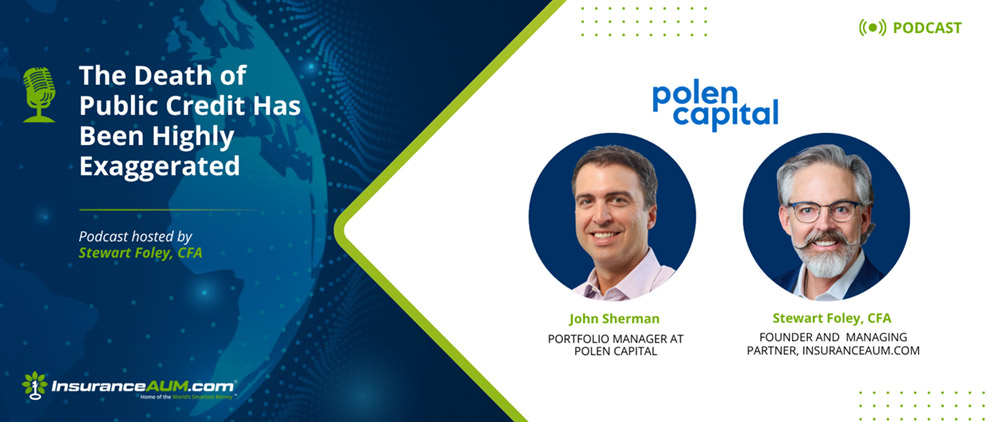
Stewart: Hey, welcome back. It's great to have you. Thanks for listening. We've got a great podcast for you today and I love the title, I think you will too. It's called The Death of Public Credit Has Been Highly Exaggerated, which I love. I think that's a really provocative title. And we're joined today by our subject matter expert or professor for a day, if you will, John Sherman, with Polen Capital. John, you are the lead portfolio manager at Polen Capital's Bank loan strategy and co-portfolio manager of both US Opportunistic High Yield and the Credit Opportunity strategies. Welcome to the show, my friend. We're glad to have you.
John: Thank you, Stewart.
Stewart: You are also, and this did not go unnoticed, as a former academic, you were a Magna cum Laude graduate from the University of Notre Dame in finance. So, well done academically. I have to say, as a former professor, that sort of stuff captures my attention. But before we get going too far, I'd love to understand a little bit about where you grew up, what your first job was, and then just a little bit about your career path to get where you are today.
John: Sure. So I actually have a bit of a unique story. I grew up in two areas. So, I grew up in the Chicago area up until eighth grade and then the Boston area after that. And it's interesting because after moving to Boston, I then went back to the Midwest. I love my Midwest background and went to the University of Notre Dame. And from there, I was a bit surprised that I did get that title that you mentioned, that I was a decent student, but surprised when I did get that achievement. And then from there, I went to an investment bank in New York, spent a couple of years in the analyst program. It was a great experience, met a lot of amazing people. And then I moved back to Boston, which is a place that I've been since then. I've lived in the Boston area for over 20 years now. I discovered this great firm called DDJ Capital. They did both public and private markets, which was very interesting for me. And it's been an amazing career. I've been here almost 19 years now. So it's been a great stint.
Stewart: And what brings you to us is you have a relationship with New England Asset Management or NEAM. I think they formerly go by NEAM Group. Full disclosure, it's my old firm. Have lots of friends still there. Just a shout out to Bill Rotatory, Chris Lack, and Harry Steris, who I think is getting ready to retire. I think Chip Clark just did, Vin DeLucia. So, a great group of people. Can you talk a little bit about Polen Capital's relationship there and how that all fits together?
John: Our firm is mostly institutional investors, public pensions, private pensions, and large institutional clients. But we had never had a reach into the insurance industry. We didn't have any clients there at all. And we met the NEAM group, which has a phenomenal culture. As you mentioned, there are a lot of people who have been with NEAM for north of 20 years. It's very similar to our firm. Once you go to the firm, you never end up leaving because you enjoy working there so much. And what I loved about it is with this partnership, we have access to the insurance industry, which I think are some of the most sophisticated and smartest investors out there. And without them, we wouldn't be able to get in touch with them, just given that we're a relatively smaller, less-known firm in the industry.
Stewart: Yeah, I mean we wholeheartedly agree with you and we actually, I couldn't believe that this was available, but we actually trademarked “home of the world's smartest money”. I think insurance companies, I think insurance investment professionals are the world's smartest money. It's not that they have a better crystal ball than everyone else, but it is that they have more externalities or outside factors that impact their investment strategy far beyond the capital markets themselves. So I'm on board with you, John, believe me. So let's jump in. We're calling this episode, The Death of Public Credit has been Exaggerated. We have an event coming up next month in July, where public credit or public securities really didn't get a lot of attention on the agenda. And everyone's talking about private credit and private assets, but what's the elevator pitch for public credit right now?
John: Yeah, so public credit is actually the same thing as private credit, except it offers better liquidity, no portfolio leverage on the assets that you invest in, and lower fees. It's pretty interesting to me the evolution of private credit because it's the same underlying product but with an amazing marketing spin. So it's the same asset class as public credit, but similar to bottled water, to premium coffee, to athletic wear. These are our products that, without the marketing, were already available, deliver great returns at much lower cost.
Stewart: It's interesting. I mean, private credit has been red hot, no doubt about it. How has it evolved over the last decade, and what are investors missing when they compare it to public markets?
John: Yeah, so private credit's a great niche asset class, and at its beginning, it was offering a bespoke solution. You're getting much higher returns for investing in small companies, good risk profile, and great covenants. But what we've seen over the last 10 years is that there's been a ton of money raised in the private credit space, and the covenants have been watered down. Now, the funds are so large that they're chasing the large public deals that were currently available. It actually has a lot of the same tones that happened in the private equity industry. It was once a niche asset class as well. And then there's so much money raised off the great returns that it had. And now what we're seeing in private equity, which is similar to private credit, is that they're targeting the same large companies, and they're levering them and earning the returns through financial arbitrage. So borrowing cheap and having that leverage. So all the interesting things that made the asset class popular when it was small have been diluted by all the fundraising that's happened since then.
Stewart: Makes good sense. I appreciate that. So let's just talk about public credit. What are the biggest changes that you've seen over your career? And I asked that question laughing because when I ran money with NEAM and prior to that at another firm in Chicago, an insurance company was sort of core bonds, and then a walk on the wild side was like 5% in high yield. So I think that not only have markets changed, but the asset allocation mix of insurance companies has changed a lot as well. So, can you give us the benefit of your experience in these credit markets?
John: I agree with you, Stewart. I mean, the markets have changed a lot. When I joined our firm in 2007, it was mostly high-yield bonds of public companies. And from there, we saw a big LBO boom, again with private credit raising a ton of money and just starting to buy companies and lever them up. And it was fueled by cheap debt on the levered loan side. Levered loans, or bank loans, were called that because the banks used to hold that risk on their balance sheet. And they started transferring that risk to big institutional investors, like us. Loans with all the money that was raised there, and, again, the previous good returns started to turn more into bonds, in that they used to have maintenance covenants. Maintenance covenants mean you have to maintain a certain level of performance. Those went away. So loans became more like bonds, and that market grew a bunch that you had second liens, which were junior loans, very risky loans, also getting syndicated to individual investors.
So the high-yield and loan markets became very risky because they were funding all these levered buyouts. And so then came private credit, which also took on a ton of risk as they get a lot larger. So we've seen this constant theme where massive fundraising has a result of moving the risk to where the money goes. And so, the money initially went to loans, and that's where the risk went, and now the money's raised in private credit, and that's where the risk has gone as well. And it's left us with a high-yield market that actually looks pretty good.
Stewart: That's interesting, and I appreciate that. And it kind of leads me to my next question. So, for allocators or insurance investment professionals looking at the high-yield index today, how should they interpret its construction?
John: The high-yield market is interesting because back in 2008, it was the hot market, so that's where the money was, and that's where the risk was. And so specifically, the high-yield market had a lot of CCC-rated debt. CCC-rated debt is very risky. The annual defaults are quite high, and recoveries are low. So if something goes into bankruptcy, you don't get that much money back. It's a very risky part of the market. So when you looked at the overall index, there was a large quantum of that CCC, highly risky debt. Now fast forward 20 years, or almost 20 years, a lot of that risk has gone to the loan markets and private credit. So what you see today is a high-yield market that has the lowest amount of the risky debt, which is the CCC-rated debt, and the highest amount of the highest-rated, non-investment grade debt, which is the BB ratings class. So the way that the market works now is you're, again, I look at it as a relatively safe market because there's not much of the lower-rated debt, and there's a lot of the higher-rated debt.
Stewart: It's interesting too, I think, if my memory serves me, there's typically a pretty big bump up between BBB- and BBB+ because a lot of institutional investors have an investment greater better investment policy statement. Right. Can you talk a little bit about any trends in the duration or just kind of spreads and yields that would help us get a little bit more color on that topic?
John: The market today is pretty low duration versus what it's been historically, and that's really driven as a result of very low-cost, high-yield bonds that were issued when interest rates were nearly zero. So what we've seen is that a lot of companies took advantage of interest rates being low and they issued 3%, 4%, 5% high-yield bonds, which, to people who have been in the industry a long time, isn't very high yielding. And what we've seen is that these companies have performed well, but they don't want to get rid of those bonds. And so the index in general has gotten a lot lower duration as companies don't want to refinance that really cheap debt. And this is in direct contrast to the environment that we had for 30, 35 years, which was a declining interest rate environment where companies, as soon as they could refinance their debt, they would because they get a cheaper cost of capital. So the way that the high-yield index works today is it's low duration, which to me is also a little bit lower risk because you have that event of maturity coming up a lot sooner than you would've over the last 10 to 15 years.
Stewart: Yeah, it makes total sense. So, as a bond geek myself, the name of the game is avoiding losses, right? First and foremost, because you make it in basis points and lose it in percentage points. And everybody who runs money in bonds knows that, which I think makes a pretty strong case for active management in high yield specifically. Do you agree with me, or am I off here somehow?
John: Stewart, that's a good point. And any bond investor would tell you that downside protection is the most important. You're not going to make your money on your big winners that double or triple in the equity world. What you want to do is make sure that almost all of your companies actually refinance themselves when they come due, and again, avoid those defaults. And the interesting thing about the high-yield asset class, and the reason what drew me to this asset class initially is that there's not many passive options to invest in high yield because unlike the equity indexes which reward companies for great things for becoming big because they have innovation or they generate a lot of free cash or they have this competitive moat that no one else can face. And so they get valued at very large amounts, so they get included in the index. And the high-yield markets actually almost the opposite.
The largest companies in the high-yield market and thus the highest allocations in a passive fund are oftentimes companies that were once big and great. That's what allowed them to issue a lot of the debt. But now many of them are languishing, but there are still huge percentages of the high-yield index because they issued that debt back when they were investment grade. And the investment grade markets are the same way. If you're investment grade and you can issue a lot of debt, that means you're a very good company. But in the high-yield market, if you have a lot of debt, that doesn't necessarily correlate to you being a great company. So that's why I think active management, you can choose the great companies, avoid the worst, and generate good returns for people.
Stewart: It's interesting because the way that I've never understood that point, it's almost as though passive has a structural disadvantage in high yield because the highest weights are going to be the companies with the most debt, not the company size, if I understood your explanation. Is that right?
John: That's exactly right. And I mean the other, I think interesting point, and the passive investing, a lot of the passive investing is done through ETFs, and because of the flows into and out of the ETFs, they're constantly trading the high-yield bonds. And in the high-yield market, it's not like equities. There's actually a pretty significant bid-ask spread. Bid-ask spread is the cost of which you buy something versus the cost of which you sell a bond. And those trading costs are real, and they can degrade your long-term returns. And that's another advantage that active managers have is that they can be buy-and-hold investors and avoid that frequent trading, which erodes investor returns.
Stewart: Yeah, it's a really, the bid-ask spread is something that I think a lot of folks don't understand, which is, and it really goes back to working with firms like NEAM. For investors who aren't really well-versed and with a lot of presence in markets don't understand how the trading costs work because it's not stated on the ticket. But the difference in bid ask, one of the key advantages to outsourcing to a manager that's focused in that market is that you're getting so much better trade execution. It's not only, yes, the credits you pick, but it's also when you have the scale advantage is real. And I think it's something that a lot of investors underestimate as far as the actual, the true cost of managing an investment portfolio. So I appreciate you bringing it up. Typically speaking, firms like Polen Capital are able to extract value in particular niches, and that really gets into finding value where others don't. How does that show up for you and your team? Where do you see opportunities? And I think it's always good to let folks know if there's anything that you're cautious about.
John: As we talked, there's the structural advantage of being an active manager, so you can avoid companies that are either in secular decline or their big weights in the indexes because again, their best days are past them. So that's one big structural advantage in active management in high yield. The other structural advantage that we've identified, and shout out to Dave Breazzano, who started our firm back in 1996, he was running a very large fund at Fidelity before he started our firm, which now has become Polen Capital. But he identified the fact that the lowest rated asset classes within high yield, so B minus and CCC, actually offer a lot of value. And the value there is that many clients don't want exposure to these asset classes because they are more risky. And the niche that we found in the lower-rated asset classes is that there are two types of companies that issue lower-rated debt, or have lower-rated debt, I should say.
There are companies that issue lower-rated debt because they're very good businesses that are growing quickly, they generate a lot of free cash flow, they have strong modes. Typically, they're identified by private equity firms that know that they can support that level of debt. So again, they issue these lower-rated notes and then they ultimately delever over time. And then there are the companies that used to be investment grade, or they used to be BB, or they used to be single B, and now they've been downgraded to CCC because their best days are behind them. And our approach is to identify the fast-growing businesses that get issued at these levels, so you get the higher yields and avoid the ones that are heading to history pretty much. And again, our approach is all about valuing a company, looking at how much debts versus the equity of the business, and identifying those companies that are rated CCC, but they're very valuable businesses, and thus there's a lot of equity value in cushion if something were to go wrong.
Stewart: That's super helpful. We've gotten an amazing education on public credit today. I really appreciate you being with us. If there were one or two major takeaways that you'd want our audience to leave here with, what would they be, John?
John: I would just say that public credit, specifically high-yield bonds, should be a core part of people's allocation. On one end, I view high-yield bonds as a Goldilocks asset class, not too hot, not too cold. If you look at the high-yield returns over time, they almost always outperform that of the global Ag Bond index because they have higher yields, and generally higher yields leads to better long-term returns. There are some periods of time that the global Ag will outperform, but over the long term, high yield will because it has higher coupons, so it should be a higher allocation than it might be on your safe budget. And then on the risky side, high-yield offers equity-like returns with half the volatility. You can get compensated 7%, 8%, 9% yields to invest in high yield, which are equity-like returns with lower volatility. So you could take some of your risk budget and also allocate it to high yield. So I just think it's a good Goldilocks asset class that people should have exposure to.
Stewart: That's terrific. I appreciate that. I've got a couple of questions for you on the way out the door, which are slightly off topic, but important nonetheless. The first one is one that we've talked about lately, which is what are the characteristics that you're looking for when you're adding members to your team there? And it really speaks to the culture of the firm, and it's not about what are the hard skills? Are they good at Excel? Can they write in Python, what school they go to, but more about the characteristics of the person. Can you give us a little insight there?
John: Yeah, so a couple of things that we look for when we add people to our team. Number one, we want them ethically to be strong. That's something that I was taught at Notre Dame, and they spend a lot of focus on ethics and doing the right thing for people and being honest. These are skills that I think have been unfortunately a bit eroded, but something that we think is incredibly important. And then from a social aspect, we spend a lot of time at work. Unfortunately, we spend more time at work than we do with our families in many circumstances. So you want to be with people that you like there. We want to know that they're good people, that they're someone that if you get stuck at an airport with a delay, that you'd want to spend the time with. I've been fortunate that I've worked 19 years with one of my best friends. I consider him part of my family. We sit right next to each other, and we've had a great time doing our jobs. It's a place, I think, similar to NEAM, where people want to go to work every day, and they enjoy working with their teammates, and they trust them. And again, they can disagree, but at the end of the day, they respect them, and that's really important.
Stewart: Yeah, I have to say, I had a really good experience. I think that the culture at NEAM is really terrific, and I mentioned Chris a while ago, but I've been in a few airports with Chris Lech, several other people there, and I think that really hits home, right? It's like you're traveling, you're tired, you're hungry, whatever it is, and you're kind of in it together with that person. But very good. So last one, fun one for you. You can have lunch or dinner with up to three guests along with yourself. Don't have to take three. You can do one, two, or three, but who would you most like to have lunch or dinner with? Alive or dead?
John: That's a good one. I would say my parents, although I'm fortunate that they're still around, so I am going to see 'em next week, would never turn out an opportunity, especially my mom, who really played an important part in my life. My dad had to travel a lot for work, and so she was always there for me, and I wouldn't be here if not for her, but if I had to pick three people that are no longer here, interesting people that I've read about recently, I'd say Bob Jones would be one. I'm a big golfer. I love the game. He had a very interesting career. I'd read the book Grand Slam, If anyone has interest in learning more about him. It's not Bobby Jones, it's Bob Jones. I think you'll learn that throughout the book. Would love to hear his story of his life from him, personally. And then there's Patty Maine, who is a bit of a polarizing character, but he was made famous through his role in World War II as part of the founding, the Special Air Services or the SAS.
These were some of the toughest human beings. They stood up to some powerful enemy forces. They never hesitated to be the first people on the ground. There's a really interesting, it's probably a bit sensationalized, but show SAS Rogue Heroes, that talks about his life, but there are also some good books about him as a person that I thought were pretty interesting. And lastly, I'd say Alexander Hamilton, because I don't think any of us would be here without him. Obviously, he was made famous recently with the Broadway play Hamilton, but he's the founder of the Federal Monetary System, which I think has brought great wealth to our country, has made it one of the best places on earth to live. A lot of prosperity has been driven by what he invented back when he was around, and I think he'd be a fascinating person to pick his brain and just talk about what's going on today versus what he created.
Stewart: That would be quite a table, I have to say. Those are interesting choices. I think that's good stuff. But in all sincerity, John, we really appreciate you coming on terrific education on public credit, and thank you so much for taking the time.
John: Thanks, Stewart. I really appreciate the conversation, and it was a very good time.
Stewart: My pleasure. Absolutely. We've been joined today by John Sherman, portfolio manager at Polen Capital. Thanks for listening. If you have ideas for a podcast, please shoot me a note at Stewart@insuranceaum.com. Please rate us, like us, and review us on Apple Podcast, Spotify, or wherever you listen to your favorite shows. And please subscribe to our brand new YouTube channel at Insurance AUM community. My name's Stewart Foley. We are the home of the world's smartest money at InsuranceAUM.com.
The InsuranceAUM.com podcast is available on




Sign Up Now for Full Access to Articles and Podcasts!
Unlock full access to our vast content library by registering as an institutional investor
Sign Up Now for Full Access to Articles and Podcasts!
Unlock full access to our vast content library by registering as an institutional investor .
Create an accountAlready have an account ? Sign in