


Pioneer Investments -

Developments in Venezuela and Potential Geopolitical and Financial Market Implications

PioneerFeatured

Paresh Upadhyaya, SVP, Director of Fixed Income and Currency Strategies


Executive Summary

  • US carried out a large-scale strike on Venezuela capturing President Nicolás Maduro
  • The motivations for the attack were stopping the drug trade, oil and regime change
  • Economic implications are clear with the possibility of an economic recovery for Venezuela that could have positive spillover effects on regional neighbors
  • Geopolitical implications lead to a Trump corollary to the Monroe Doctrine
  • Finally, we believe financial implications could benefit certain energy and defense sectors and more broadly EM assets, most notably Latin America (Latam)

What Happened

The US carried out a large-scale attack on Venezuela in a swift operation and captured President Maduro and his wife, Cilia Flores.

When

The military strike occurred overnight on January 3, 2026.

How

The military operation, named Operation Absolute Resolve, was a complex one that involved more than 150 aircrafts, including bombers, warplanes and reconnaissance planes. Some of the strikes involved knocking out the country’s missile defense systems and airbases. US cyber forces shut the power in Caracas. Finally, special operations forces captured Maduro. It is believed the US had inside support within Maduro’s inner circle and intelligence that made the operation proceed smoothly.

Why

The US motivations for capturing Maduro were:

  • Stopping the drug trade ꟷ the country is not a significant producer of illicit drugs. However, it is a source of transshipment of drugs from nearby countries like Colombia.
  • Oil ꟷ Venezuela has the world’s largest known reserves of oil.  President Trump has talked about investing and developing the country’s petroleum industry.  He has also talked about the need to recoup the investment in oil infrastructure made by US oil companies that were nationalized by Venezuelan governments in 1976 and 1998.  International arbitration panels ruled expropriation of US assets under Hugo Chavez (former President of Venezuela from 1999–2013) was illegal and awarded ExxonMobil and ConocoPhillips over $10bn in compensation.  
  • Eventual Regime change ꟷ President Trump and Secretary of State Marco Rubio have long called for Maduro to step down from power.

What’s Next

The US will be concerned about a political vacuum and potentially long lasting instability. It was clear from President Trump’s press conference on Saturday, January 3rd that he was not looking for the opposition to take power. There is speculation that the US agreed to keep the opposition out of any transitional government in return for cooperation from the Venezuelan military. This could explain why the operation went so smoothly. It appears the Trump administration is okay with an interim government, led by Maduro’s Vice President Delcy Rodriguez, ahead of eventual elections that are likely in 12-18 months.  She has been credited with stabilizing the economy, successfully dollarizing the economy in 2019 and leading recent negotiations between the US and Venezuelan governments to facilitate the exit of Maduro.  She is viewed as pragmatic and pliable according to the Trump administration.  She has been invited by the US to work with her on a cooperation agenda.  The incentive of lifting US sanctions and the threat of further military action should allow for greater cooperation between the transitional government and the US.

Economic Implications

  • Venezuela’s economy remains in a depression.  The economy has collapsed 74.4% since its peak in 2013 while its GDP per capita has sunk from $4,653 in 2013 to just $1,501 in 2024.
  • Removal of Maduro and the prospect of US investment could see a dramatic turnaround in the economic prospects for the Venezuelan economy.
  • Regional neighbors, like Colombia, Peru and Ecuador, could benefit from an improving Venezuelan economy with stronger export and investment growth.

Geopolitical Implications

  • Trump is willing to act boldly militarily like bombing Iran earlier and now attacking Venezuela.  This may make countries, such as China and Russia, wary of crossing Trump.
  • Trump’s corollary to the Monroe Doctrine is the “Donroe” Doctrine.  As laid out in the National Defense Strategy in December, it reestablishes US hegemony over the Western Hemisphere that should be cemented on (a) having friendly governments that cooperate with the US “against narco-terrorists, cartels and other transnational criminals”; (b) ensuring strategic assets, like the Panama Canal, do not fall into the hands of other foreign powers, presumably China and Russia; (c) securing US access to key strategic locations.
  • In the next 1 to 2 years, there is a chance of regime change in Cuba and possibly Nicaragua. The threat of US military action against Mexican drug cartels is a possibility especially if US relations sour with Mexico.

Financial Market Implications and Outlook

  • US Energy and global defense stocks are most likely to be winners.
  • Within the US energy sector, refineries exposed to the Gulf Coast are the bigger winners.
  • For the defense sector, this will reinforce higher spending already underway.
  • Overall, developed equity markets are not likely to react much to the Venezuela crisis.
  • Emerging Market (EM) assets (equity/fixed/FX) are expected to be winners, especially in Latam
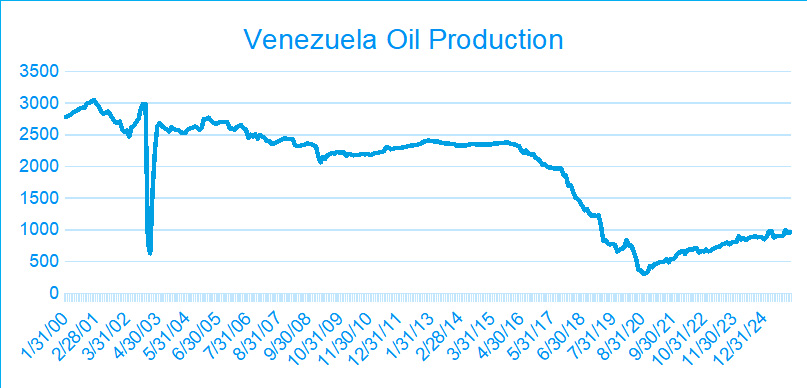
  • The outlook for oil prices in the near term are mixed.  Venezuela has been a small producer of oil but could see some volatility, as recent developments have shifted from disruption due to the blockade of sanctioned vessels to a potential recovery in production (see chart on next page).  For the country to see output rise from 1 million barrels per day (bpd) to 2 million bpd will take a lot of investment and could take 3 to 5 years.
     
Table 1: Venezuela Oil Production
Image
Generally decreasing Venezuela Oil Production from 2000 to 2024, increasing again after 2020

Source: Bloomberg as of January 2026.


Read More from Pioneer Investments


Important information
Unless otherwise stated, all information contained in this document is from Pioneer Investments, a Victory Capital Investment Franchise. The views expressed regarding market and economic trends are those of the author and not necessarily Pioneer Investments and are subject to change at any time based on market and other conditions, and there can be no assurance that countries, markets or sectors will perform as expected. These views should not be relied upon as investment advice, a security recommendation, or as an indication of trading for any Pioneer Investments product or service. This material does not constitute an offer or solicitation to buy or sell any security, fund units or services. Investment involves risks, including market, political, liquidity and currency risks. Past performance is not indicative of future results. 
The views expressed in this presentation are those of Pioneer Investments, a Victory Capital Investment Franchise, and are subject to change at any time. These views should not be relied upon as investment advice, as securities recommendations, or as an indication of trading intent on behalf of any strategy. Future results may differ significantly than those stated.
©2026 Victory Capital Management Inc.

20260105-5097538

Share this post

Sign Up Now for Full Access to Articles and Podcasts!

Unlock full access to our vast content library by registering as an institutional investor

Register

Contacts


Pioneer Investments

Pioneer Investments manages $132 billion in assets and has a long-standing history of innovation with deep expertise managing fixed income portfolios and creating customized solutions within the more opportunistic areas of the securitized market.

Pioneer Investments’ culture of innovation, in the securitized market, originated at Smith Breeden, where its founders developed early option-adjusted spread modeling techniques for MBS valuation. The innovative approach continues under Victory Capital, which manages over $9.1 billion for insurance companies. We are focused on delivering competitive risk-adjusted returns, while considering the accounting, regulatory, and capital management needs of our insurance clients to create long-term partnerships.  We understand the unique needs of insurers, and we provide customized and efficient risk-based capital solutions that align with insurers' risk tolerances and investment objectives.

Source: Pioneer Investments, a Victory Capital Investment Franchise, as of December 31, 2025
 

Jay Alexander, CFA, CAIA
Managing Director, Institutional Markets
jalexander@vcm.com
+1 (612) 965-5426
 
Emma White
Director, Institutional Markets
ewhite@vcm.com
+1 (617) 422-4569

Marko Komarynsky
Director, Institutional Markets
mkomarynsky@vcm.com
+1 (210) 697-3613

View the contributor page

Sign Up Now for Full Access to Articles and Podcasts!

Unlock full access to our vast content library by registering as an institutional investor .

Create an account

Already have an account ? Sign in

Ѐ Ё Ђ Ѓ Є Ѕ І Ї Ј Љ Њ Ћ Ќ Ѝ Ў Џ А Б В Г Д Е Ж З И Й К Л М Н О П Р С ΄ ΅ Ά · Έ Ή Ί Ό Ύ Ώ ΐ Α Β Γ Δ Ε Ζ Η Θ Ι Κ Λ Μ Ν Ξ Ο Π Ρ Ё Ђ Ѓ Є Ѕ І Ї Ј Љ Њ Ћ Ќ Ў Џ А Б В Г Д Е Ж З И Й К Л М Н О П Р С Т У Ф Х Ц Ч Ш Ā ā Ă ă Ą ą Ć ć Ĉ ĉ Ċ ċ Č č Ď ď Đ đ Ē ē Ĕ ĕ Ė fi fl œ æ ß