





First Eagle Investments-

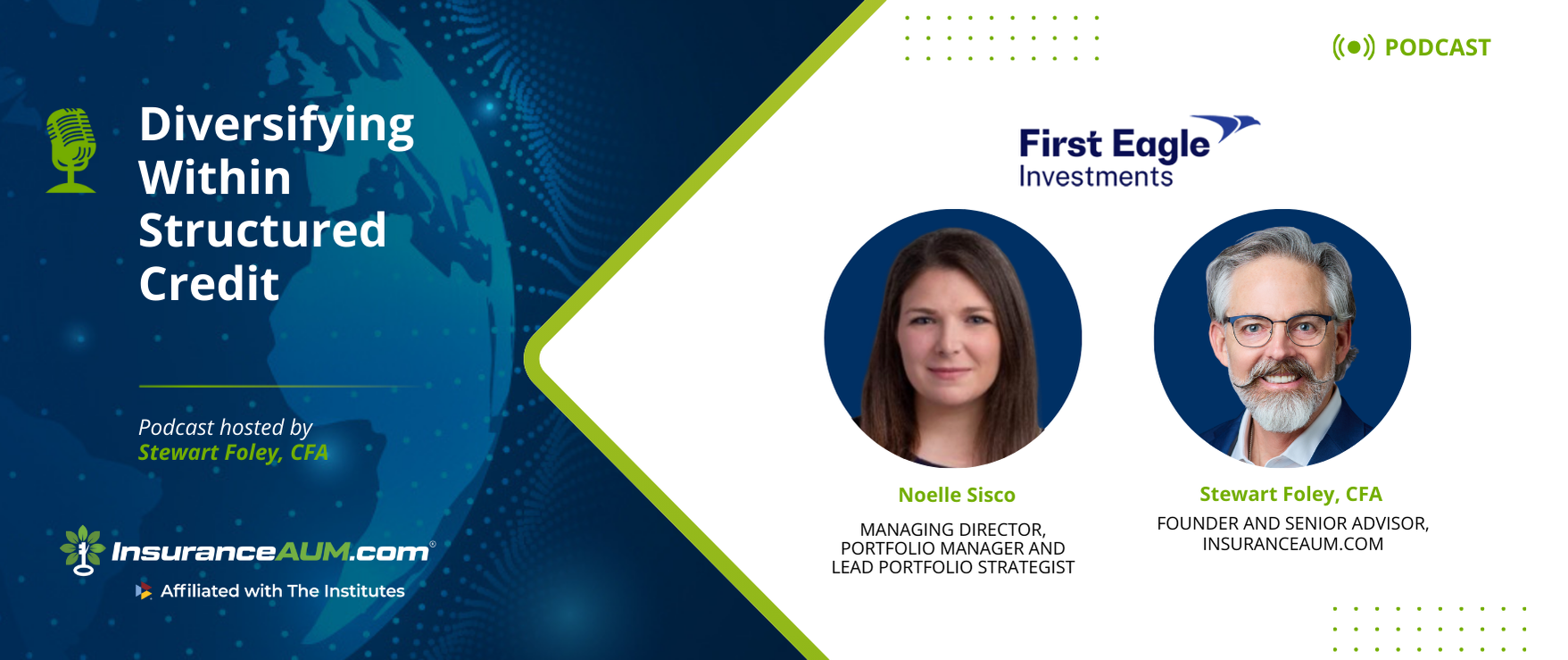
Diversifying Within Structured Credit

Image
11.18 First Eagle_Web


Stewart: Hey, welcome back. It's great to have you. This is the InsuranceAUM.com podcast. We are the home of the world's smartest money. My name's Stewart Foley, I'll be your host, and I want to say a special welcome to the members of The Institute's community, who is our new parent. So, for those who are newly listening to our podcast as a result of that press release, welcome, and thanks to everyone for joining us today. We've got a great podcast. We're talking about structured credit, a part of the market that can offer real value for insurers, if you know where to look and also where not to look. And I'm joined by Noelle, who goes by Elle, Sisco, Managing Director, Portfolio Manager, and Lead Portfolio Strategist at First Eagle Napier Park. Elle has worked across public and private credit markets. She's got a data-driven background, and she's been a key part of building their approach to multi-strategy credit. We're very happy to have you, Elle. Well, thanks for being on.

Elle: Yeah, no, I'm really happy to be here. Thank you.

Stewart: So we always start these up the same way, which is: where did you grow up? And I've been rotating this question. What was your first concert?

Elle: So I grew up in the New Jersey suburbs up in Mountville, New Jersey actually. I grew up in New Jersey. I then went and played division one softball at Rutgers, and then moved to Hoboken once I got my start in Manhattan. So I've been a Jersey girl through and through  

Stewart: D one athletes. In fact, college athletes in general are a pretty special bunch. When I was teaching about half of my students were athletes, one form or the other. You have to be really good with your time to get that done. What was your high school mascot, remember?  

Elle: Oh, the Mustangs.  

Stewart: The Mustangs. Alright. I love that. It's a touching story about your background. What about your first concert?  

Elle: First concert was Celine Dion. Very, very funny story there, but I'll spare the details. My dad took my entire family, moms, sisters, cousins, aunts, I think around 1997 during the My Heart Will Go On Era, post Titanic, and it was wonderful.  

Stewart: That's a big group. How many people is that?  

Elle: I think there's probably 25 of us.  

Stewart: That's hilarious. We've got a handful of people in multiple generations and it's so funny. Yeah. Alright, that's fun. We'll get right into it here. Some background would help, I think. So, who is First Eagle Napier Park, and what markets do you specialize in? And if you could include a kind of AUM and who may not listen every day, how are you defining structured credit? Private, public IG, yield, all that.

Elle: No, no, absolutely. I'm very happy to talk through this. So I work specifically at Napier Park, which is indeed a part of First Eagle Investments. First Eagle Investments, notably, is a large, tenured, privately owned asset management firm with a history that dates back to 1864, actually. So, a very longstanding institution across the platform. Overall, we managed approximately 176 billion in assets. And Napier Park specifically represents roughly 40 billion of those assets. Napier Park itself, we operate as First Eagle's alternative credit platform. So we are effectively the alternative credit investing arm of First Eagle Investments overall.

Stewart: That's super cool.

Elle: Certainly. And so as we think about our asset classes, alternative credit certainly has become a buzzword as of late, alternative credit, asset-backed financing, specialty finance, et cetera. But overall, it's a very large market and also fairly poorly defined as a whole. But I'll do my best to try to define exactly how we think about alternative credit. Trillions of dollars of investible universe effectively in any kind of asset that can be underwritten to a state of maturity with stated cash flows over time. And so, as we think about the universe, it's a single name credit, both in terms of public single names, think of it, yield bonds, levered loans, private single names like direct lending, securitized credit in the public sphere, which could be ABS structures, that are backed by underlying consumer loans, auto loans, equipment loans, which is ABS, just be very clear.

Asset-backed securities are backed by some type of underlying consumer asset. Likely, there would be mortgage-backed securities (MBS), which are securitizations backed by any type of underlying mortgage loan, from pure Agency MBS issued by Fannie or Freddie to non-QM loans. Could also be collateralized loan obligations, CLOs, which are structured backed by bank loans in the corporate sphere. And then there's also, sorry, I should note credit derivatives, which are securitizations backed by underlying CDS contracts, for example. And then there's the entire private sphere, which is a broad universe of structures and direct loans, which can be backed by again, anything from private residential loans to art financing to private consumer lending deals to asset-backed financing. There's a very wide array in there, but the core of it is financing assets that have set cash flows and set maturity dates.

Stewart: That's super helpful, and I appreciate it. So let's talk a little bit about how you think about investing in structured credit. And so the question comes out, what is your framework for evaluating this market and determining where you want to be? You'd mentioned it's very broad, lots of different options. How do you know where to look?

Elle: No, certainly. So at a very high level, our process is one highly rigorous, disciplined, and collaborative in the sense that our approach covers, we invest across various sectors. And so our overall insights need to be fed by the underlying portfolio management teams that cover their specific segments. So it's highly collaborative in that aspect, but our approach is really a combination of top-down investing in the sense of moving in and out of different asset classes based on their overall forward risk-return outlook. So we'll try to move around to ensure that our positioning goes to where assets provide the best relative value in our views, as well as assets that we think will perform best in consideration of where we are in the macroeconomic cycle. So that's kind of the top-down segment. And then all of that is fed from a pure fundamental bottom-up credit underwrite, which is performed by our various portfolio management teams.

That includes the fundamental underwriting and re-underwriting because we have to constantly re-underwrite our portfolios by each of the portfolio management teams, as well as determinations as to where within those asset classes the best risk-return opportunity might exist. So it's a hybrid top-down, bottom-up approach overall. And then in generating our target return outlook, it's really driven by three things. Once we kind of have the top-down and bottom-up, it's then a sourcing yield as credit investors. Of course, our base return profile is the asset's yield. So it's sourcing assets with a healthy yield profile and being able to source through various cycles. It is realizing that yield, again, as credit investors, you have to earn that yield. So getting the fundamental bottom-up analysis right and realizing that the yield profile is critical. And then three, which I think is quite different for us, is that we're very active in how we seek to manage our portfolios. And so that means being heavily invested over time or not as heavily invested, dependent on our view, and using bouts of market volatility to really actively manage and capitalize during volatility to seek to outperform our yield profile.

Stewart: Yeah, super helpful. And one of the things I ask on structured podcasts in general is that there are a lot of collateral types that didn't exist all that long ago. You had talked about various securitizations, music royalties, whatever it may be, cards, autos, homes been around a long time, but how do you get comfortable with the collateral types that are less trafficked or newer to the market?

Elle: Yeah, so the answer is in the collateral that it becomes the most important element of underwriting the deal. It's the nature of the collateral. I'll go into detail, but it's kind of the nature of the collateral, how the collateral is valued, and how often the collateral is valued by whom? Is it valued by? Are there many parties involved? And I guess I'll use this by kind of giving what will make us comfortable or not comfortable. So I think for us, as I mentioned, it's the collateral, but there's also the issuer, there is the actual borrower at play, which is important as well as the underlying structure. So there's the issuer, the structure, and the collateral, with the collateral being the most important thing in getting comfortable with the new asset class. And when we look at the collateral, if there's limited transparency into the pool, as in if it might be a blind pool or forward flow agreement where you don't actually know what's going to be put into the pool, that tends to be a very high bar for us and something that might be something that we might not look to pursue.

If there's limited transparency into how the collateral is valued, if it's not valued frequently, that would be difficult for us to invest and again, raise that bar. And then from there it's really how we can stress the collateral as well as the structure in seeking to ensure that we'll be able to earn principal back in stress environments. So the collateral is probably the most important, but then it's also the structure and the underlying borrower app play because you can use the structure to improve your protections, but that's only if you can get comfortable with the underlying assets or loans themselves, whatever is in that underlying pool. And just frankly on our side, because there has been so much talk this year of new asset classes for example, you're seeing a lot of lending in the AI space just this week over the past week or so, there's been meaningful issuance in AI related, but data centers have certainly been topical in data center securitizations, and that's an area for us that we've been looking at for quite some time and it's just something that we've not been able to get comfortable yet based on our view of long-term risk adjusted returns.

Another area that has been something we've looked at for a number of years would be CMBS, and similarly have avoided it on that same basis, given just frankly, the valuations can be a bit harder to come by in that segment. And so just gives an indication of what we have avoided thus far, but we are looking kind of across the new assets; it's just a matter of getting comfortable with the risk profile.

Stewart: It's interesting as a fixed-income person, whenever there's a lot of momentum in a trade, it always makes me wonder, right? You see a lot of momentum in data centers, and you go, well, I always feel like we're one invention away from needing a lot fewer data centers, or is there an innovation coming that could change the dynamic or the resources necessary to run AI or whatever it may be? And I'm certainly not an expert there, but I think a lot of people in the insurance business have a fixed income background and a lot of 'em think the same way, and they're slightly contrarian if not fully contrarian about momentum in particular. So when you look at your window, and you dust off the crystal ball, Elle, which is what we need you to do, of course, where in the universe are you finding the most attractive risk-adjusted yields? And really, I think part of the structure is the benefits of diversification or away from traditional corporates. Can you talk a little bit about that?

Elle: I certainly can, and I just want to reiterate your earlier sentiment. I think for us, what we like most about certain assets is the ability to look at very long-term histories and return streams to understand how they act during different periods of market downturns, like residential assets, like consumer assets, being able to underwrite pre- and post-GFC, for example, can be quite powerful. So I just wanted to kind of emphasize that point. I would say we share that view, having their longer-term history can be quite powerful. But as it relates to where we are right now, it's quite a difficult time for investing in credit. Now, certain areas are still providing meaningful return opportunities. I'll go into those, and maybe if it's okay, I can then touch on our broader macro outlook or big picture view.

Stewart: Absolutely. You're the guest. I'm just over here asking questions occasionally.

Elle: Well, I could talk about this for a very long time, so it's probably good to segment it out. But I think the areas that we're still seeing quite a bit of opportunity again within our core asset classes, probably number one would be within private residential lending overall, given that there is still a fairly meaningful supply mismatch in US housing. And so we like lending in that space for fairly healthy what we view to be a fairly healthy yield profile. We like European CLO tranches, for example, kind of European CLO Mezzanine, which has kind of lagged this year. We've seen U.S. CLO tranches move back into historical tights, which can be justified, but has moved back to tights, whereas Europe has still had a fairly healthy term premium. So we've been liking those assets. And then we still very much like credit derivatives trading, where we can generate a return profile while taking less beta exposure. So high level, I would say those three segments right now. And also, kind of the broad ABF, or asset-based financing landscape as a whole, we're still able to find interesting opportunities. We've just been very selective with those given bigger picture risks from here.

Stewart: Yeah, I mean it kind of leads me to my next question, which is, I mean, your team has talked about late cycle dynamics and elevated systematic risk. Are there areas you're avoiding or things that you are cautious about at the moment?

Elle: Certainly, yeah. I mean, I would say one area of full stop that we have been quite cautious on for some time would probably be lending in segments towards the subprime consumer. Historically, that is an asset class that historically has performed quite well, but there's been all this talk about the KS-shaped economy. And again, I can spend some time going into that, but we're in a cycle right now where you're seeing losses in that segment exceed, in some cases, what were witnessed during the GFC, and that's absent a recession, and that's absent yet a meaningful uptick in unemployment. And that's quite concerning because, as much as there's been talk about the growth in wealth over the past few years and household net worth as a percentage of income nearing all-time highs, that is certainly not the case across the board. So if I were to kind of lay out our views from a top-down perspective, I would say overall, as much as we like those three segments, residential lending, European mezz, and credit derivatives trading, our view right now overall is really that caution is conviction.

My colleague Amit Sani had tagged that in our recent quarterly letter, and frankly, I completely agree with it in the sense that it's quite a difficult time to be heavily invested in markets at this stage for three reasons, which have a number of sub-reasons. Number one, you have a booming but narrow, or at least up until November, you had booming equity markets, but very narrow, you even see it now, there's a stat where the weight of the top 10 stocks in the S&P 500 is now kind of at all-time highs for when that dataset has been tracked. So you have a very narrow equity rally that's really been driven by, obviously, technology, AI, data center-driven CapEx, and spending there. But that's not something that's been felt real economy-wide. You can even see that in kind of if you compare the returns of SPX versus the equal weighted SPW.

So one narrow equity leadership, two spreads across the credit universe, be it ig, high yield structured credit that are moving into tighter levels of their historical range and that are continuing to tighten to tighten. And why is that one you have all in gross yield-based buying, because all-in yields are still elevated because rates remain elevated still. So that's one yield-based buying. Two, you have still healthy growth. Most recent earnings were healthy, and fundamentals from a top-down perspective, still fairly sound. And three, you have this view that there's going to be a floor to any downside scenario due to potential monetary policy intervention or fiscal intervention. So you have one booming but narrow equity leadership, two spreads that are tight and can continue tightening further if we continue to have growth, and absent an economic downturn. But three, you have a very elevated idiosyncratic and broader risk environment.

So you have this growing risk environment overall. You can see it with idiosyncratic default events that we've witnessed this year. Even if you look at levered loans, the issuer-level default rate this year hit 10-year-plus highs. And that's again absent recession or true economic downturn. So elevated idiosyncratic defaults, you have meaningful weakness in lower quality corporates as well as within lower income consumers. And that is starting to pick up in the middle-income consumer bucket. And that's driven by a number of factors, including inflation, by the fact that price increases over the past few years, while they've been very beneficial to the top 10%, top 20% in of the equity rally, and the meaningful growth in home prices that hasn't been felt consumer wide. And so there's actually a data point that shows liquid assets by consumer decile or quartile, I believe it is.

And you can see that for the lower-income consumer, that's actually declined since COVID. And so that's something that for us is a negative because we are having a gradual uptick in unemployment. And so if you have a growth in unemployment while you're already having a weakened consumer, that tends to be something that could be quite negative. So again, those would be the three reasons why it's quite difficult booming, but the narrow equity market two spreads are tight and can continue tightening. And three, all of that against what we're seeing as elevated idiosyncratic risks and some late-cycle behavior in certain segments.

Stewart: On your subprime comment, I saw a headline yesterday about the percentage of Americans who are delinquent on their utility bills, which I think is an important indicator is like that's not something you just let go, right? I mean, it appears to me that you're starting to see some stress in the subprime, I don't know. Well, we shall see how it goes. Which kind of leads into my next question, which is I think sometimes people, I see how, and particularly in structure, where you go, well, one's as good as the next, but that's not true. And one of the things I think would be helpful is if you could share with us how do we separate real underwriting skill from simply writing beta in this market? What do you look at as a manager that you say, Hey, here's our alpha creation, if you will.

Elle: Well, I would say that the alpha creation, I think at least from our side and in my view, that it comes from, if I think of the three things, the source yield, realize yield and active management, I would say the latter two in ability to realize yield as in the fundamental analysis and the ability to use market volatility to generate excess returns as being most critical because the one thing I didn't note with respect to our market view is as a result of that view in terms of where we are in spreads versus risk profile, the big thing there is then, okay, maybe you're less invested right now so that you can be much more fully invested at a time when more opportunities present themselves, and that means maybe being less fully invested up in quality and up in cash. I should have noted that there.

But for us, as we are in the underwrite, our viewpoint is if we're looking at structures, what would be the underlying cumulative net loss history, delinquency history, are there changes in delinquencies and losses based on the year of origination? And we'll look at a new consumer deal right now, we'd be looking at the issuer's loss histories if they have it back to the GFC, if they don't have it long-term histories. And we'll try to figure out what patterns are at play and use that to generate whatever our decision is. It's not just looking at, okay, this is the deal, these are the underlying assets, this is the return profile. It is a much more fundamental review of what do those losses look like, how do they change over time? How has the issuer addressed various periods of difficulty, be it COVID or be it 2022? We really want to understand what the underlying process looks like.

And it would be a similar approach in terms of corporate investing for looking at CLOs, for example, we want to understand how the CLO manager will use how they're ramping for their portfolios, how much risk they're taking, are they a high-risk manager, high spread, or are they managing more conservatively? Do they actively manage? There's a lot that kind of goes into that, and I'm talking about it in the sense of qualitatively, there's a whole meaningful underlying analytics that goes into feeding those decisions and interpretations, I would say, of the data. And then from there, it's really actively managing the portfolio to generate the outperformance and that can enable managers to generate equity like returns while taking credit risks. And that's quite important for us.

Stewart: That's a good outcome. We have heard people say that they're seeing a convergence between private credit and structured credit. I guess the two-part question: is that true in your opinion? And if so, what are the implications?

Elle: That's a hard one. I think the difficulty here is that we are certainly seeing more deals that are public in nature, as in they are true public deals. You can look them up on Bloomberg; they have a QIP or an ISIN, but the actual liquidity of those deals operates more like a private investment, as in yes, it's publicly issued, but it operates like a private transaction. You could see that in middle-market CLOs, for example. You can see that in the SRT space as well as in certain other segments. So that is certainly something that you're seeing. I'm not sure exactly if it's private being structured credit or if it's a public structure credit operating more like private. I suppose the point is, nevertheless, there is some blurring of the lines there, but I think the most important element is then what is the liquidity profile and how can you underwrite the liquidity based that, because frankly, if it's less liquid, then you should be seeking to earn a higher yield profile than an asset that is very actively traded. So I think that's where the lines become a bit more complicated, but you are certainly seeing that in certain areas.

Stewart: That's super helpful, and I'm glad you brought up liquidity because it's kind my ending point here, which is that insurers care a lot about liquidity. How do you think about liquidity inside a structured portfolio, and is it possible that you have different levels of liquidity for different clients, or is the liquidity profile of the portfolios between clients similar?

Elle: Frankly, it depends on what the client is seeking to achieve. From our side, our head of risk, he's always quite adamant about one thing, which is the most important factor in managing structure credit is maintaining a healthy balance between assets and liabilities and assets and liabilities. In the sense of what you're referencing would be the underlying asset liquidity risk relative to the liquidity that the investor is seeking to achieve. And having a balance there is utterly critical mismatch. Asset versus liquidity in any sense is no good. And so for us, that's quite critical. It's really just a question of what an investor is seeking to achieve. Again, if you're thinking about kind of a higher quality portfolio, more like AAA, maybe down to BBB risk, that portfolio can be very liquid is less subject, I would say to meaningful liquidity interruptions. They can still occur, but they're less subject to, I would say, than if you're going down in quality into a BB, single B, or an equity.

And so the big point is it's really just a question of what this investor is seeking to achieve in terms of underlying quality relative to the type of risk profile that they may want. Certainly structured credit, when you think about structured credit as a whole, what we like about it is a historically very healthy yield profile relative to underlyings, historically meaningful, and less fundamental losses relative to the underlying. If you look at a CLO BB relative to a BB levered loan, for example, a BB impairment rate might be one 10th of the underlying loan. But with those two, what structured credit does have is the risk of liquidity interruption and therefore a portfolio must be built based on kind of what the underlying investors are seeking to achieve up in quality. More liquidity down in quality certainly would be subject to more liquidity risk.

Stewart: Is there a question that you wish was asked of you more often by an investor, like an insurance investor? Is there a question that you wish somebody would ask you, or you heard frequently that would help an investor, select a manager, or get a certain insight that would be helpful, given how well the asset class?

Elle: I'm not sure if there's any specific one. I think at the end of the day, what we are meant to do of course is generate a return for investors, but it's managing risk and I think what keeps you up at night kind of question, I think that is probably most important for a manager like us to respond to investors so that investors can really understand and appreciate the way different managers are thinking about risk, because that is ultimately the most important aspect of what we do is risk management. Yeah, I would say that's probably the most important.

Stewart: It's been super helpful. I've been thrilled to have you on, Elle, and thanks for taking the time to share your thoughts. You obviously know this market very well, and you can explain it. I often say that anybody can make complicated, complicated, but to make complicated, understandable, and accessible is super helpful. So I've got a couple of fun ones. Freeing the way out the door, one is really intended to get at the culture of your firm and what characteristics are most important when you're adding to the members of the team there?

Elle: I would say the most important aspect of how we operate as a firm is the collaborative nature and being able to work in a team environment, and from that perspective, I think the most important element is I think accountability and trustworthiness. In my view, most hard skills can be taught, learning how to develop financial models and things like that. Those are skills that certainly can be taught, but I really do think that the willingness to thrive in a team environment through accountability and being trustworthy is most important, in my opinion.

Stewart: Super helpful. Alright. What position did you play?

Elle: Pitcher.

Stewart: Oh wow. Okay. There you go. The thing that always strikes me about being a softball pitcher is how close you are to the batter. It's like, wow, are you close? Alright, last one. You can have dinner with up to three guests. It can be one, two, or three dinner is on us. Who would you most like to have dinner with? Alive or dead.

Elle: This is a fun one. I suppose I should be answering this with the names of the most influential economists or the most prolific thought leaders of our time.

Stewart: I would go with your gut on this. I think this is where people relate to you, to your decision, so don't worry about that. Although I will say Warren Buffett is the leader in the clubhouse, followed by Jesus.

Elle: Yeah, no, of course, Adam Smith, after that, no, I'm going to go in the alternate route. If I may have flexibility with this theoretical dinner, I would use it as an opportunity to create a musical jam session. I'm also a musician. I play the violin and the drums when I can.

Stewart: Outstanding.

Elle: Yeah, I still play in an orchestra every Thursday night. It's my favorite thing to do, so…

Stewart: That's awesome.

Elle: I would have Mama Cass Elliot. She would be there on vocals. I'd have Jimi Hendrix on lead guitar, George Harrison on Rhythm Guitar, and I'd try to keep time on the drums.

Stewart: I like it. Very nice. Nicely done. Great podcast. Really enjoyed, really learned a lot today. Thanks so much for being on. We really appreciate it.

Elle: No, thank you so much for having me. This has been great. Thank you.

Stewart: We've been joined by Noelle, who goes by Elle, Sisco, Managing Director, Portfolio Manager, and Lead Portfolio Strategist at First Eagle Napier Park. If you like what we're doing, please rate us and review us on Apple Podcasts, Spotify, or wherever you listen to your favorite show. You can see us on our new YouTube channel at Insurance AUM community. Thanks for listening. We really appreciate our dedicated audience, and we also appreciate the new folks who are joining us from The Institutes community. So welcome. My name's Stewart Foley. This has been the insuranceAUM.com podcast, the home of the world's smartest money. 

Share this post

Sign Up Now for Full Access to Articles and Podcasts!

Unlock full access to our vast content library by registering as an institutional investor

Register

Contacts


First Eagle Investments

First Eagle Investments is an independent, privately owned investment management firm headquartered in New York with approximately $176 billion in assets under management as of September 30, 2025.* Dedicated to providing prudent stewardship of client assets, the firm focuses on active, fundamental, and benchmark-agnostic investing, with a strong emphasis on downside mitigation. With over 15 years of experience managing assets on behalf of insurers, First Eagle is focused on meeting their unique portfolio and servicing needs through bespoke investment solutions and a dedicated insurance coverage team. The firm’s investment capabilities for the insurance market include alternative credit, fixed income, and global equities.

All figures related to assets under management (AUM) are preliminary figures based on management’s estimates and as such are subject to change.

* The total AUM represents the combined AUM of (i) First Eagle Investment Management, LLC, its subsidiary investment advisers, First Eagle Separate Account Management, LLC, First Eagle Alternative Credit (“FEAC”), (ii) Napier Park Global Capital (“Napier Park”), another subsidiary investment adviser and (iii) Regatta Loan Management LLC, an advisory affiliate of Napier Park as of 30-Sep-2025. It includes $3.3 billion of committed and other non-fee-paying capital from Napier Park Global Capital, inclusive of assets managed by Regatta Loan Management LLC and $1.1 billion of committed and other non-fee-paying capital from First Eagle Alternative Credit, LLC. Effective 5-Sep-2025, the investment activities of Napier Park Global Capital and First Eagle Alternative Credit (FEAC) have been aligned under Napier Park’s management and brand. First Eagle Alternative Credit, LLC is a distinct registered investment advisor within the Napier Park platform, acting in sub-advisory capacity to a number of First Eagle’s registered funds.

Katie Cowan   
Head of Insurance Client Solutions
katie.cowan@firsteagle.com(310) 893-2440


View the contributor page

Sign Up Now for Full Access to Articles and Podcasts!

Unlock full access to our vast content library by registering as an institutional investor .

Create an account

Already have an account ? Sign in

Ѐ Ё Ђ Ѓ Є Ѕ І Ї Ј Љ Њ Ћ Ќ Ѝ Ў Џ А Б В Г Д Е Ж З И Й К Л М Н О П Р С ΄ ΅ Ά · Έ Ή Ί Ό Ύ Ώ ΐ Α Β Γ Δ Ε Ζ Η Θ Ι Κ Λ Μ Ν Ξ Ο Π Ρ Ё Ђ Ѓ Є Ѕ І Ї Ј Љ Њ Ћ Ќ Ў Џ А Б В Г Д Е Ж З И Й К Л М Н О П Р С Т У Ф Х Ц Ч Ш Ā ā Ă ă Ą ą Ć ć Ĉ ĉ Ċ ċ Č č Ď ď Đ đ Ē ē Ĕ ĕ Ė fi fl œ æ ß