




We're currently experiencing email delivery delays. For urgent matters, please contact us directly at lindsay@insuranceaum.com.

Aberdeen Investments-

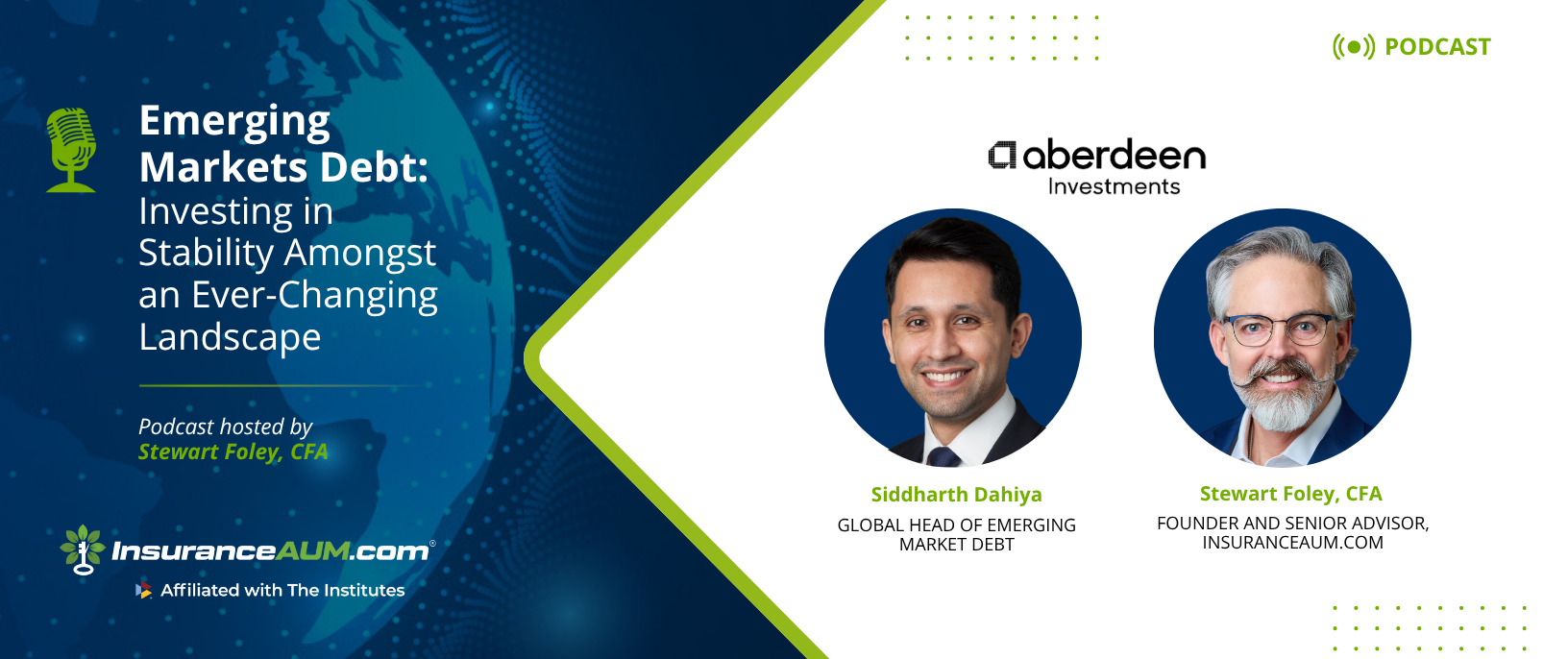
Emerging Markets Debt - Investing in Stability Amongst an Ever-Changing Landscape

Image
10.15 Aberdeen Investments_WEB (1)


Stewart: Hey, welcome back to the Home of the World's Smartest Money. I'm Stewart Foley. I'll be your host, and this is the InsuranceAUM.com podcast. Today, we're driving into a part of the market that has evolved dramatically: emerging market debt. We're going to be talking about that. The title of podcast is Emerging Market Debt: Investing in Stability Amongst an Ever-Changing Landscape. Joining me today is Siddharth Dahiya, Global Head of Emerging Market Debt at Aberdeen Investments. Siddharth, welcome to the show. How are you today?

Siddharth: Very good. Thank you, Stewart. Thanks for having me.

Stewart: We are thrilled to have you. You have an interesting background. You have a bachelor's with honors, by the way, in Electronics and Electronic Communication Engineering from Punjab Engineering College. You're a CFA charter holder. Can you give us a little bit about where you grew up, how you got in this seat, and also what was your first job, not the fancy one.

Siddharth: Yeah, absolutely. So Stewart, I grew up in India, and all my education and my upbringing were in India. I'm a child of the eighties and nineties in India, and it was a fascinating time to grow up in India. You could see the country's transformation. I really saw firsthand how the right kind of reforms and sorry to get really serious into this podcast straight away, but the right kind of reforms, economic liberalization, those kinds of things can really have a huge impact on a country's population and its future. So that experience really shaped the way I look at investments today and my first job, nothing fancy, was very basic. I quietly taught some math to school students for a bit. It was interesting. I kind of learned that simplifying difficult ideas is not easy. That was a big takeaway for me back in those days and that's something that I've kept with me. That job I think taught me a lot more than any spreadsheet could.

Stewart: It's really true. I mean the ability to take complicated concepts and put 'em in simple terms is really to me like the ultimate measure of mastery. When I was teaching finance, a concept like weighted average cost of capital, if you teach that enough, you really understand it. And the thing is, the questions that people ask you may have never thought of ever, and you go, oh, I see why you're asking me that. That's interesting. I haven't thought about that and that makes you learn even more. So I'm convinced that this is a good way to learn it yourself. So Aberdeen has deep roots in both insurance and emerging markets investing. Can you give us an overview in case somebody is not super familiar with Aberdeen, can you give us a little bit of a high level there and some experience on your EMD history?

Siddharth: Absolutely, Stewart. So Aberdeen's roots are in insurance investing; they run deep. We're really proud of that heritage. So the firm was born out of a merger between Aberdeen Asset Management and Standard Life back in 2017. And Standard Life, as many might know, is one of UK's oldest and largest life companies. It has a history of over around 200 years. Aberdeen on the other hand has been investing in EM debt for over 30 to 40 years. So we've really seen the inception of this asset class over that time. We've built experienced team of more than 30 investment professionals fully dedicated to emerging market debt. We also have a lot of on the ground presence, which local resources, which we think gives us an edge and that insurance sort of history of investing, insurance mindset, that long-term mindset thinking in years and decades, not just quarters. It is really embedded in the way we approach investments, particularly in EM debt. From an insurance perspective, we are really privileged to serve more than 150 insurance clients, and we manage more than $270 billion of insurance assets across the firm, across different markets. And that scale and our history of emerging market debt really allow us to tailor solutions that meet both regulatory as well as return objectives for insurance companies, whether it's across public debt or increasing across private debt as well.

Stewart: Yeah, the 200 years is amazing. It's a serious track record. I mean, your insurance lineage makes this especially relevant to our listeners, who are insurance investment professionals almost exclusively. Right. So let's talk a little bit about the structure of the EM credit space. Can you map out the opportunity set in emerging market debt? What does that universe look like right now?

Siddharth: Absolutely, and I think that is really the best place to start. When you look at EMD, what are the building blocks of this market? So predominantly, it is mainly made up of four constituents or four building blocks. Let's start with what we think is the most defensive, or in today's world, probably the most relevant to insurance companies: the hard currency corporate debt markets. This is investment grade rated 60%. IG 40% high yield is one of the biggest parts of EMDs, at about north of $2.5 trillion in size, relatively short duration—about four years. And it gives you exposure to about 70 countries. This we believe has shown to be the most defensive part of emerging market debt. The second part is the oldest part of emerging market, which is the sovereign hard currency space, which is slightly smaller at about $1.7 trillion is a notch or two lower in rating and slightly longer in duration.

It again gives you exposure to about 70 countries, but the high yield and IG is more equally split here and because of slightly longer duration and slightly lower credit quality, it tends to be a little bit less defensive. Then comes local currency. This is by far the biggest market in EM, probably worth about 15 trillion in size. It's a majority investment grade, and it has an intermediate duration. It generally benefits from periods of depreciating dollars, but also tends to have a slightly higher volatility than other parts of em. And then lastly then, this is sort of a subset of the currency sovereign market is the frontier market, which is now becoming a standalone market in itself. It is just under a trillion dollars. It's a couple of notches lower rated than other markets, but much more. Now, where it becomes really interesting for an insurance asset owner is that the corporate market is very relevant.

It offers really attractive spreads, offers chance for investors to diversify away from sovereign risk and it gives access to very interesting, very insurance oriented industries like infrastructure, energy, telecoms, those kinds of things. The hard currency market is the traditional core of insurance investors has been a part of their EM allocations for a long time. It's liquid, it's easy to model from a capital and solvency point of view, but it has slightly lower spread in the investment grade portion, but in recent years actually it's had some upgrades. So it's great from a capital treatment point of view, it's been beneficial. And then local currency is a bit more nuanced. Historically, insurers have avoided this market because of FX volatility and in general regulatory complexity. But real yields are really attractive in local currencies and increasingly we are seeing insurers starting to look at this market either on a hedged basis or standalone. And then lastly, the frontier market that I talked about is for some of the higher risk tolerance or people with higher risk tolerance in the insurance space, starting to look at frontier markets as well.

Stewart: Okay, so I've got a number of follow-ups there. So first is you said that the corporate EM market is $2.7 trillion. Is that right?

Siddharth: That's right, yes.

Stewart: How does that compare to the US high yield market? It's larger, yeah.

Siddharth: Yeah, I think the US high yield market is around $2.5 trillion or just under that. So it's slightly bigger than the US high yield market.

Stewart: And what did you say was the size of the local currency market?

Siddharth: The dollar equivalent size of the local currency market would be close to $15 trillion.

Stewart: $15 trillion.

Siddharth: Yeah. So this includes all the EM countries and all the local debt that they issue on the sovereign side. It's a big market. Not necessarily all of this is easily accessible there, but it's a large market.

Stewart: You mentioned the frontier market. How are you defining the frontier? How do I put that into countries and just so that folks know what the assets are in that space.

Siddharth: So the official definition of frontier changes, and it depends on who you talk to, but in very simple terms you could say that some of the smaller parts of the high yield universe of the EM sovereign market would constitute the frontier market.

Stewart: It's interesting because folks have long memories in the insurance industry and folks remember volatility in this space, but emerging markets have held up impressively well. Can you talk a little bit about what's driving that resilience?

Siddharth: Yeah, so just to recap, when you say they've held up well, what do we mean by that? Right. This year alone, sovereigns in the dollar space have returned north of 10%. Corporates have returned close to 8% and local currency, which has been by far the best performer this year has returned about 15%. So under the hood there is some really strong performance across EM asset classes and if you look at the last three years, this trend continues. So frontier market bonds, for example, I think cumulatively have returned 50%, close to 50% over the last three years. So very strong performance numbers. What is really driving this, it's a combination of some structural strengths in EM and some underappreciated tailwinds. So let's talk a little bit more about that. When I say structural strengths, I mean even though globally you could see credit markets are trading at relatively tight levels in EM, the fundamentals and technicals remained really strong.

So the other two legs to hold this market remained really strong. Let's start with local currency market, local currency debt. Historically, real yields in local currency have been around the 1% mark last couple of years, inflation was very high across the world. Real yield became negative in EM, but that has now rebounded and it's actually close to the highest it's been in over 10 years. It's close to about 3%. That is attracting a lot of attention. We have seen across developed markets, particularly in the US, we have seen an AI led euphoria in the market, but I think that is sort of hiding a deeper reluctance to own more dollar assets globally. I think what we have seen, and there are plenty of reports of Dutch pension funds and Danish pension funds reducing or increasing their hedge when they invest in the US market. So they do want exposure to these companies, but they don't want dollar exposure necessarily.

At least they don't want to increase dollar exposure. That is also beneficial for EM is the debt dynamics and otherwise fundamentals in EM tend to hold up quite well. When you compare to developed markets in general, investors have concerns around fiscal dominance in the US that is again not the case in large parts of EMD ratings are a big driver. If you look at credit ratings countries went through almost a decade of credit ratings being downgraded more than upgraded. So the net rating upgrade was firmly negative for over a decade, but in the last two years that has turned around and it's become firmly positive. So it's almost about a 10, 12 years. It's now on upward trajectory in rating. Just to give you some data, and this was the sovereign world in the corporate world. For example, in the quarter that just went by in the third quarter this year we had about north of $105 billion of bonds being upgraded higher in just the quarter gone and only about 20 odd billion of downgrade.

So the net upgrade was about $80 billion just in Q3. If you look at talking about corporates when you look at spread, so we like to look at compare markets, not necessarily just by spread, but we also look at how much leverage you're taking when you invest in a particular company. So we look at spread per turn of leverage. That ratio, when you compare it to developed markets, so let's say BB bond in EM versus a US high yield BB bond, the ratio is north of two times and BBB is almost three times. So it's a very healthy pickup for similar quality credit. We've seen strong issuance this year again, but technicals are strong because even though in the EM corporate space, we have seen issuance of almost 400 billion, net issuance is still negative. And for your viewers or listeners, net issuance would be the total issuance minus all the amortizations and coupons, and buybacks, and all of those things. So again, technicals and fundamentals in EM remain very strong. So there is clear underpinning to the strong performance that we've seen in EM assets this year.

Stewart: Just a couple of points here. One is when you mention real yield, just for those who may not know nominal yield is what's quoted and then you subtract out inflation and you get real yield, which is the real return, which is an economic term, which means net of inflation. One of my questions, I guess, has to do with if I'm a US insurer and what a lot of folks would say is, “Hey, I don't have any local currency-denominated liabilities, so I don't want to introduce that volatility or that mismatch.” How does it compare if I buy local currency EM and hedge it versus buying dollar-denominated EM? How does that come out on a net basis if I'm a US insurance carrier?

Siddharth: Yeah, I mean that's a very good question and it really depends on which country you're looking at. In certain countries you have very high rates and potentially the cost of hedging could be quite expensive. So on a net basis you may end up in a situation where actually buying the dollar bonds might be more attractive, but in other cases you may have a very strong view on the policy makers in that particular country reducing policy rates going forward, which would even on a hedge basis, you would make quite strong returns if you were just buying the bonds in that country. So it really depends on the opportunity that you're looking at.

Stewart: And if I'm a carrier and I have some liabilities and other currencies, is it possible to create a custom mandate that just has local currency in those spots? Can you create a custom mandate in that way?

Siddharth: You can absolutely create custom mandates in any way you want. So in the EM world, we have plenty of opportunities across both hard currency and local currency. We have countries that are doing better, countries that are doing worse. I mean, there are multiple ways of constructing portfolios. Absolutely, you could do that.

Stewart: Yeah, I've got a couple of friends who let me borrow their CIO hat once in a while, so I'll give it back. So private credit seems to be a very hot topic right now and emerging markets comes at it from a different angle. How does Aberdeen integrate private credit within larger EMD mandates?

Siddharth: It's a great question, Stewart. I think this is a question that we are increasingly being asked by clients who are looking to go beyond the traditional public EM debt space. So first, I think it's worth noting that Aberdeen's private credit team isn't new to this. We've been active for over a decade. We've deployed about 20 billion in this space across corporates, real estate infrastructure, you name it. So the depth of that experience gives us a really strong foundation right now within EM. Specifically, I think, let me start by clarifying what we don't do. So we are not in the mid-market PE sponsor-backed deals with high leverage. We don't do direct lending, at least not yet, and we are not involved in special sets of any kind in the private space. Let's be clear, that's something that we don't do. Direct lending could be on the horizon for us, but for now, I think we think that there's plenty of low-hanging fruit in areas where we clearly have an edge.

What we do focus on is loans and private placements from companies, countries, quasi sovereigns, borrowers in EM, often entities that we know on the public side. These deals come with very strong protection, covenant protection, and typically senior in the cap structure. One of the key advantages, I think, for us is access. We've had this longstanding relationship with banks across EM, and we get to tap into this really deep and differentiated opportunity set within EM on the loan side. Our objective in this space is twofold. First is to reach borrowers that don't typically come to the public market with an EM, and there are a few, and the second is to capture the illiquidity premium, right? We wouldn't invest in something just because it's private. We want to be tapping into that. Illiquidity premium tends to be around 200, 300 basis points within em, or that's the kind of stuff that we tend to look at generally.

I mean, we've been investing in a number of things of late. We have managed to achieve anywhere between SOR plus 400 to 600 basis points. We've looked at over 60 deals this year, just to give you an example. And the blended average of those deals would be yields north of 9%, high, 400 margins, about 200, 250 basis points, and a liquidity premium. So this is really attractive part. I think this is where it gets interesting for clients. We can run this as a standalone strategy or a mandate, but increasingly we're being asked to put this in the wrapper of a public listed or public bond funds, and we certainly think the lines between public and private credit are starting to blur, and we'll keep blurring in the future. So this is really exciting space for us.

Stewart: Yeah, super interesting. So it's a powerful combination and it draws on your experience right in that market. So before we close, are there a couple of takeaways that you'd want our insurance investor audience to take away from this podcast in particular?

Siddharth: Yeah, absolutely. I'd say two takeaways. One is that EM is going through a resurgence. I think EM has been ignored by many investors for the last few years has been the unloved child within credit markets. I think if you lift the hood and you see there's actually a lot of progress being made across EM, across different asset classes, there are clearly tailwinds and EM has gone through a somewhat turbulent time in the last decade or so, but come out on the other side with a fairly strong balance sheet. So that's the first takeaway. The second takeaway I would say, particularly for insurance clients, would be that there are a number of ways we can access this opportunity set number of different markets, a range of credit ratings, a range of different outcomes that you can achieve looking at EM and that certainly deserves a second look.

Stewart: That's super helpful. Alright, so I got a couple of fun ones framed the way out the door. The first one is intended to get at the culture of Aberdeen. You've achieved a very senior role here. You've been in these markets a long time, but more importantly, you've been in the asset management business a long time. What characteristics are you looking for when you're adding to members of your team? Are there any things that you've seen that have kind of led to successful careers?

Siddharth: Yeah, I mean, that's a very good question. I could rattle off a few, but I think just to keep things very simple, I'd say curiosity and humility would be the top two. Investing in EM is complex. No one has all the answers, so tend to look for people who ask good questions, who challenge assumptions, and who know when to listen and when to observe technical skills. Those can be taught, I think; mindset and attitude are what make a team exceptional. So yeah, those are the kind of things that we look for.

Stewart: That's super helpful. I think that's the humility. We had someone on a podcast yesterday who used a much more colorful term, but I understand your point, which is it's a team environment and you need people who want to work together and who are easy to work together with. So I get that. One last one's kind of fun dinner. You can have dinner with up to three guests, one, two, or three. We had somebody pick just one yesterday. Who would you most like to have dinner with alive or dead?

Siddharth: I think I could pick a lot of interesting answers to this. Let's just do not digress too much. I would say someone like, and it might sound a bit boring, but someone like he was a very inspirational figure. I'd say Lee Kuan Yew. His ability to transform Singapore from struggling post-colonial state to this economic powerhouse in what one or two generations is, I think, it's unmatched in the world. A lot of leaders today could learn a lot from him. A lot of policymakers could learn from him and his views on governance, trade diplomacy, all of these things I feel are extremely relevant today, would be amazing. And he was a sharpshooter, a straight talker as well. So I think if he opens up, would be great in a company.

Stewart: That's awesome. Anybody else?

Siddharth: Yeah, we'll keep it there I think.

Stewart: Oh wow. Okay. Two single guests in a row. That's awesome. Really got a great education today on emerging market debt. I really appreciate you being on today, Siddharth.

Siddharth: Absolutely. Thanks for having me, Stewart. Really appreciate it.

Stewart: We've been joined today by Siddharth Dahiya, Global Head of Emerging Market Debt at Aberdeen Investments. Thanks for listening. If have ideas for podcasts, please shoot us a note at podcast@insuranceaum.com. Please rate us like us and review us on Apple Podcast, Spotify, or wherever you listen to your favorite shows. If you want to us, we have a brand new YouTube channel at Insurance AUM community, and we're very happy to report that our views are up significantly. So if you want to check that out, you certainly can. My name's Stewart Foley. We're the home of the world's smartest money at the InsuranceAUM.com podcast.
 

Share this post

Sign Up Now for Full Access to Articles and Podcasts!

Unlock full access to our vast content library by registering as an institutional investor

Register

Contacts


Aberdeen Investments

Aberdeen Investments is a leading global insurance asset manager. While now independent, we were one of Europe’s largest insurance groups for over two centuries, until 2018. Today, Aberdeen Investment’s core strength is the breadth, depth and scale of our insurance investment capabilities. 150 insurers now trust abrdn to manage $230bn across public and private markets, making abrdn one of the largest independent managers of insurance assets worldwide.

Matthew DePont, CIMA
Director, Institutional Business Development
matthew.depont@aberdeenplc.com
+1 445-284-8590


1900 Market Street, Suite 200 
Philadelphia, PA 19103
 

View the contributor page

Image
abrdn_icon

Sign Up Now for Full Access to Articles and Podcasts!

Unlock full access to our vast content library by registering as an institutional investor .

Create an account

Already have an account ? Sign in

Ѐ Ё Ђ Ѓ Є Ѕ І Ї Ј Љ Њ Ћ Ќ Ѝ Ў Џ А Б В Г Д Е Ж З И Й К Л М Н О П Р С ΄ ΅ Ά · Έ Ή Ί Ό Ύ Ώ ΐ Α Β Γ Δ Ε Ζ Η Θ Ι Κ Λ Μ Ν Ξ Ο Π Ρ Ё Ђ Ѓ Є Ѕ І Ї Ј Љ Њ Ћ Ќ Ў Џ А Б В Г Д Е Ж З И Й К Л М Н О П Р С Т У Ф Х Ц Ч Ш Ā ā Ă ă Ą ą Ć ć Ĉ ĉ Ċ ċ Č č Ď ď Đ đ Ē ē Ĕ ĕ Ė fi fl œ æ ß