





We're currently experiencing email delivery delays. For urgent matters, please contact us directly at lindsay@insuranceaum.com.

Barings-

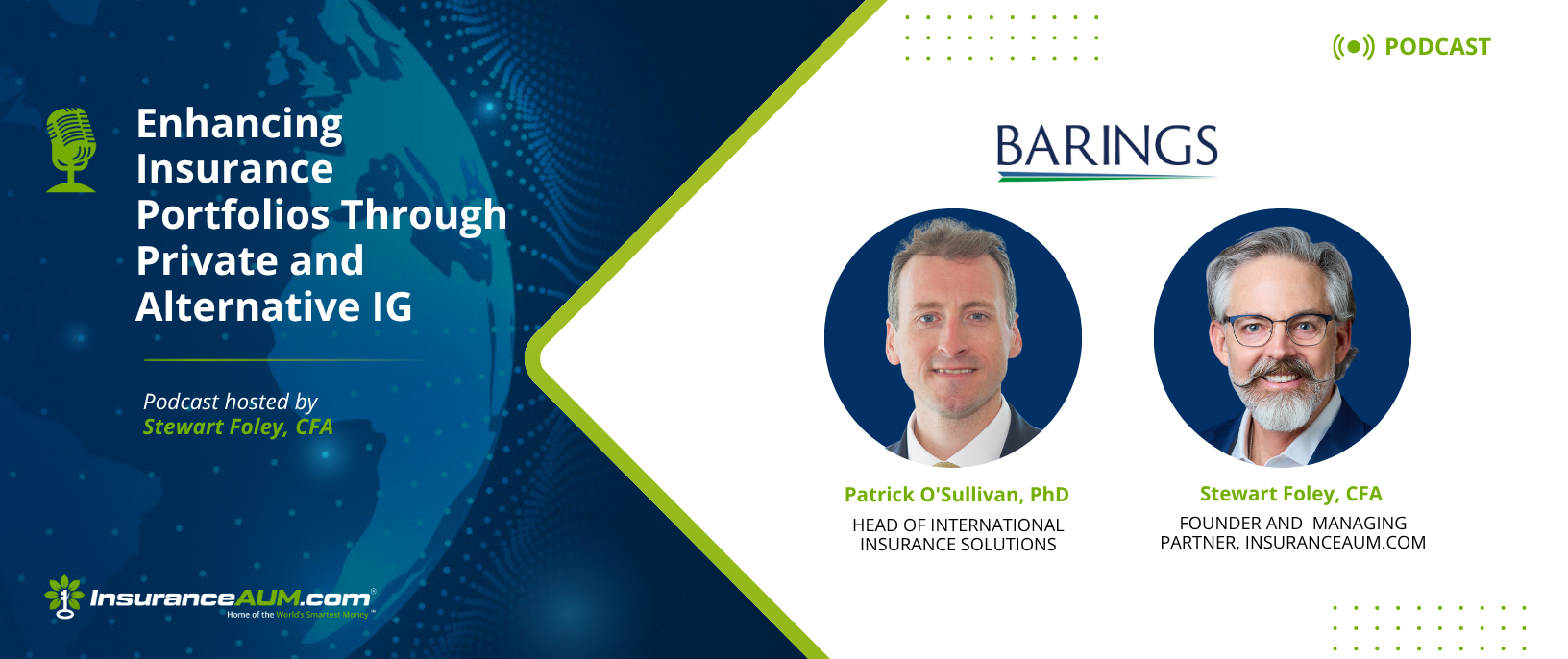
Enhancing Insurance Portfolios Through Private and Alternative IG

Image
07.11 Barings_Web (1)


Stewart: Hey, welcome back. This is the InsuranceAUM.com podcast. We are the home of the world's smartest money. And I'm Stewart Foley. I'll be your host. Today's topic is Enhancing Insurance Portfolios through Private and Alternative IG, and we're joined today by Patrick O. Sullivan, PhD, Head of International Insurance Solutions at Barings. He holds a Bachelor of Science in Financial and Actuarial Mathematics from Dublin City University and a PhD in Financial Economics from the University College Dublin. Patrick, welcome to the show.

Patrick: Thanks very much, Stewart.

Stewart: Before we get going too far here, where'd you grow up? And our new question is, what was your first concert? How about that?

Patrick: I grew up in the west of Ireland, from the mountains in the west of Ireland, so it was basically next up USA or Greenland, depending which direction you took off from the coast. So I spent the first 13 years of my life in Sligo, where I'm from, famous for its poets and its music bands. So WBB8 is famous for being a Sligo native of sorts, and also Westlife. I don’t know how many people would be familiar at Westlife, particularly in the insurance channels, but were a massive boy band in the two thousands or late nineties during that kind of phase of Backstreet Boys, et cetera.

Stewart: That's awesome. Which one was your first concert? Did you go to one of those?

Patrick: Oh, first concert, I think it might've been when I was going through my slightly gothy era, so it may have been a band called Korn.

Stewart: Oh, there you go. With a K, right? Korn with a K.

Patrick: Korn with a K and a backwards R, if I remember correctly.

Stewart: Yeah, there you go. Okay, good stuff. Can you talk a little bit about your career and how you found your way to becoming the International Insurance Solutions head at Barings? I'm sure that's an interesting story, and it would be also helpful for those who may not be familiar with bearings. Maybe just to provide a little bit of a high-level overview.

Patrick: Yeah, absolutely. So sort of a different career path to many in the industry. I would say when I was doing my undergraduate degree in financial actuarial maths, I really fell in love with the financial economics aspect of financial maths, and the insurance and pension side probably less so. Coming out of my undergraduate degree, I actually decided to go down and pursue a master's in quantitative finance, partially to tilt more towards banking and sort of hedge fund management. I thought I could potentially be a star head fund manager, but sadly that hasn't turned out to be the case. And during that master's program there was a research project being funded as Ireland tried to enhance its suppose graduate stream of highly trained financial experts. And so I was offered an opportunity to do a PhD, which I took, so I actually migrated from the master's program to the PhD program and spent four years studying portfolio selection, thinking through how different levels of confidence in information impacts investor decision making and how you can use information versus the market depending on your risk appetite, which lent itself quite nicely to my career later on when I got to think through asset allocation for insurance companies and pension companies at the pension funds at the start of my career.

But in between doing my PhD and moving into the city, here in London, I actually spent two years as a university lecturer in St. Hampton. Really enjoyed the opportunity to research and to teach, and I think that really helped me later on, as I kind of taught through the different questions, different stakeholders in an insurance company might have around their investment portfolio, how to explain some of those concepts to them. When you're dealing with insurers, you're dealing with so many different people who are thinking about investment, who are thinking about liabilities, thinking about risk. And so being able to think through all those lenses and explain complex investment strategies, derivative hedging programs, plus private credit, being able to explain simply how that works for an insurer to different people within insurers is, I think, an important skillset. So following my lecturing career, short tenured as it was moved to JP Morgan Asset Management, spent two years at JP Morgan, got a great opportunity to work with some great folks there in the multi-asset solutions business.

They had really got to learn from people how to really book clients front and center when you're thinking about investment decision making. And what was really nice is you were able to work on projects that then had a tangible outcome. So you were working with clients to understand how different changes could impact their portfolios. And then you were putting it into practice, which was quite different to when I was a lecturer and you might be working on a research project. And the end outcome of that research project was a paper that might be published, if you were lucky, three or four years down the line. So it was quite nice to be into more of a team-based environment. So following a couple of years at JP Morgan, moved on to Schroeders and joining their Portfolio Solutions Group. Spent six years there, built the global insurance solutions platform, worked with a lot of clients, got to really understand about how to put clients front and center.

And then the opportunity at Barings came up, and I wasn't looking to move at the time, but when I saw the suite of capabilities, Barings had everything from your traditional public IG and structured credit for global insurers, which is the cornerstone of any of their asset allocation through to a very wide array of private and alternative credit capabilities, which are so in demand at this point in time. It was just too good an opportunity to turn down. So, joined Barings a year ago to lead the insurance solutions effort here and really work with insurance companies to understand their challenges and then understand how the different capabilities at Barings can be tailored to solve their challenges. So very much taking a client-led approach, thinking through what are the challenges our insurance companies face and how can Barings' wide array of capabilities and private and alternative credit, complemented with our public credit capabilities solve those needs.

Stewart: Yeah, your skillset is in high demand at the moment, as they say, you've seen one insurance company, you've seen one insurance company, and it's hard to amass that knowledge to really understand it. And so today's topic with private and alternative IG, we have a flagship event next week. The agenda is set by our CIO executive council, and there really wasn't much in the way of public securities to be discussed. And I think you're right that the interest in private assets is high right now. And that gets us into the hot topic right now, which is securitized investment grade CLOs, RMBS, CMBS, and ABS. What in your mind makes that the asset class for insurers compelling right now?

Patrick: Yeah, so I think probably there are a number of different things about private and even public securitized and structured credit that are very attractive to insurers. And I think if you go back to I would say the 2010s, and I was very fortunate to have joined JP Morgan and then Schroeders at the height of the change in Europe towards much more customized and tailored public credit solutions. The 2010s were really dominated by insurers getting a much stronger view from an asset liability lens on their public fixed income portfolios and spreads at those times, relative to where they are today, were still relatively high. So they could deliver a high level of spread, a low level of yield, admittedly given where yields were, but a high level of spread. Rolling on to where we are now, I think the next decade, and particularly at the moment, is going to be dominated by taking that same customization, liability-focused lens and applying it to private and alternative credit assets.

Things like CLOs, things like structured credit, and making use of the derivative technology that we've been using over the last decade. Combining those with floating rate and structured credit products that will give us better yield or better spread rather when combined with derivatives, can give us the liability profile we want to hit, so we can retime cash flows if needed. We can layer on duration if we need it, with a level of prudence built in for any rate rises that may happen. And also get diversification away from that traditional public IG market because what we're seeing at the moment is you go back to pre-GFC, the migration in public fixed income has certainly been more BBB exposure, lots of people chasing after those securities thinking more truth, the IG lens here, and given that weight of demand that we see in public fixed income markets, spreads are naturally tightening.

If you look forward and you think about the graying nature of our population, more people coming to retirement, more people needing retirement solutions, which naturally leads you to think about fixed income securities. You've a massive demand for fixed income as a whole, but in particular, public fixed income. And as that weighs on spread, we get a good opportunity to enhance spread, enhance diversification, and access wider parts of the market through alternative and structured credit, including private credit. So I think those are probably the compelling reasons for insurers looking to these asset classes at the moment. And it's also in recognition that oftentimes, particularly for life insurers, they have quite liquid liabilities themselves. And so by being able to tap into some of these less liquid strategies or more complex strategies, they're able to make use of that illiquidity budget that they have and they also get to tap into a oftentimes floating rate asset class that even for non-life insurers who don't necessarily have long duration targets is quite appealing for surplus investments where they may not want to take much duration risk.

Stewart: I think it's fair to say that, at least based on my experience, working with structured securities requires a significant investment in analytics, and it is not a place for tourists. What should insurers be aware of in terms of capital treatment and any convexity risk that might be in there?

Patrick: Yeah, absolutely. It's very easy to look at a triple BCLO with a BBB corporate bond and think they're going to behave in the same way. But in reality, they have very, very different risk profiles. It's the same as the rating they get from a rating agency, and beyond that, there's a lot of divergence. So you've got to think about that convexity risk. You've got to be modeling through the different, potential future scenarios and how that can impact the cashflow profiles from your underlying collateral for your structured products and your CLOs and make sure that you understand how that asset class is going to behave in different interest rate or spread environments to understand how that will behave relative to your liabilities. So could those cash flows run longer than you'd expected them to? Could they actually prepay shorter? What are the potential implications there? So you really need to work with a manager who has da eep understanding of what potential future scenarios could happen, who has the analytical work to support you, but also thinks through what you're ultimately getting is access to underlying collateral.

How is that underlying collateral going to behave? So if you think about CLOs probably syndicated loans or thinking through middle market loan CLOs, you want to work with someone who has a deep understanding of that underlying collateral, so that they can look at it through a credit risk lens and understand how that collateral is going to behave through time. So that was one of the really nice things for me when I was joining bearings was you had a middle market loan business, you had a very strong high yield business and you had a very strong capability in structured credit and a large CLO business, both creating CLOs with our own collateral, but also accessing third party CLO managers. And so that combination is, I think, very, very strong because you have the high yield and the credit research analyst who understand the underlying collateral, and you've got deep expertise in structuring. So how those different waterfalls as structures are going to behave through time.

Stewart: That's very interesting. Kind of shifting gears just a little bit, I hear a lot about private investment grade offering some interesting opportunities. Where are you seeing the most opportunities, particularly in less crowded areas like portfolio finance, and maybe you could help us by defining portfolio finance, and is there any place that you're cautious? I always tend to like to ask if there's an opportunity and if there is a place that you're cautious about. So let's cover that if we could.

Patrick: Absolutely. So I think casting the mind to private IG, a lot of the larger life insurers and even large pension funds will already have exposure to your traditional or what I would call traditional private investment grade asset classes. You can think about infrastructure debt, for example, or private placements. Private placements in particular. Probably the closest thing we have in the private world to a traditional corporate bond. These are well trodden in asset classes. They have a certain level of beta to corporate bond markets as a whole in terms of the spread you can get, but you can still get a material premium over what you get in public markets. And when you're investing for the long term and you're going to use these assets to back liabilities, an extra 25, 30, 35 basis points over a 15-year duration has a material impact on the additional cash flow and return you're going to receive.

But then moving into kind of the expanded universe of private IG, thinking through portfolio finance, which you just mentioned, that's a really exciting asset class for us at this point in time. What is exciting about it is that there is such a runway in that asset class. So portfolio finance essentially is a tool that private asset managers can use to gain leverage on their underlying portfolios by partnering with our portfolio finance business. So we will make loans, we will provide leverage collateralized on underlying portfolios of private market investments to provide leverage to managers. You can think about your traditional direct lending mandate that might have a levered exposure. We are providing that leverage. We're super senior in the stack, directly originating these loans. And so there's a material premium for the customization and the additional bespokeness to the solution that is provided by the portfolio finance team.

Investment grade ratings, increasingly by bigtree rating agencies, and material spread pickups versus what you get in the public markets, but also in the kind of traditional private IG markets. It's a floating-rate asset in the most part. And so you need to think about how you manage that risk in terms of liability ALM matching. But it's a very, very popular asset class because you've got IG ratings, you've got a high level of spread, and ultimately, you've also got a high level of diversification in the underlying collateral pool. So you can think true to luxury exposure you get with lending to pools of direct lending funds, it might be one loan to that direct lending manager, but ultimately, you're getting collateral in the thousands in terms of the number of exposures you're lending against. So that's one particularly attractive asset class that we see at this point in time, where it is less crowded, particularly given the way we deploy our capital. And so that allows us to generate material premium, but you do need to think about how that asset class works for you in your broader asset liability lens. So, making sure you've got the right duration overlays, you understand what the potential cashflow profiles could be, and then managing your portfolio appropriately against your liabilities.

Stewart: And given your background, you're particularly well suited to answer this one, which is: What role does interest rate risk management play in these less liquid asset classes? It's not really a question I've ever asked, but I think you're going to have an interesting answer.

Patrick: Yeah. So, ultimately, I think if you step back and you think from the perspective of an insurance company, who you write liabilities, you make a promise to make good on cash flows in the future, interest rate risk management is the key consideration you're going to have. So you're going to want to manage that interest rate risk closely and make sure that your liabilities are really well matched from an interest rate perspective, we advocate for key rate duration matching to make sure you've got a good match in place across the curve and not just barbell in your portfolio because that can have some quiet negative outcomes depending on what happens with interest rates. That might immediately lead people to think, okay, I've got to invest in fixed-rate assets. I can't take floating rate exposure, et cetera. But we've had the technology in place from liability-driven investment strategies, very common across the globe now, that allow insurers and pension funds to synthetically add interest rate exposure, true derivatives to their portfolios.

And that means that you can invest in a much wider array of asset classes than just fixed-rate securities. But anytime you start using derivatives like any other risk management tool, you need to be very cognizant of all the potential risks that can happen. So, particularly when you're using derivatives and private assets, you really need to have a good understanding of what is my underlying liquidity need, and what could be my potential liquidity need? So when you've got derivatives in place, you need to think through, okay, what would happen if rates went up 1%, 2%, 4%? Do I have enough liquidity in my portfolio to withstand that sort of rate shock? And then make sure that you are taking that liquidity consideration into account when you're building your portfolio, particularly when you're investing in private assets as well. So if you don't truly have a liquidity budget, then you shouldn't invest in illiquid assets. But if you do have that I liquidity budget, if you do have the confidence that you've done the risk management, you understand what would happen in all of the different interest rate scenarios and you're confident that you can withstand those sort of shocks from an interest rate perspective on your overall portfolio thinking through your liability side as well, then private assets and alternative credit are a great source of additional premium. But all of those liquidity risks, collateral risks, interest rate risks, they're all pieces of the jigsaw that you need to solve.

Stewart: That's very helpful. I'm going to snap on my professor hat for a second. And for those who may not know what key rate duration means, the duration measures interest rate risk and key rate duration or what's known as partial duration, it measures interest rate sensitivity on various parts of the yield curve so that you can take a more granular approach to interest rate risk management and match those up with the timing of the cash flows of your liability. So that's awesome. Let's just talk about Barings’ global and multi-strategy approach. The questions really start out, which is why is geographic diversification relevant right now, and how do you think about capturing relative value across regions and strategies?

Patrick: So firstly, we are a global asset manager. We're serving clients in North America, in Europe, in the Middle East, in Asia Pacific. Each of these clients has its underlying currency needs. They have their underlying country preferences or regional preferences. And in order to build solutions that are really going to work for each of those insurance companies or broader institutional clients across the globe, you need a broad platform from a global perspective so that you can source currency exposures in the right currency to match client liabilities, et cetera, and to also give you the widest funnel possible to generate relative value and to access new and interesting markets. And there can also be spread advantages by allocating to particular regions over another, not even in private markets, but more generally. So you look at the CLO market, for example, you tend to see a higher spread in Europe than you do in the US, and there are a variety of reasons for that. One of those reasons is potentially that US insurers are heavy bidders of CLOs in the US market, whereas in Europe, you don't see much CLO investment due to the capital treatment of CLOs in Europe. And as a result, global insurance companies that do want to take CLO exposure can look at Europe as an additional source of premium relative to just investing in their local market. So, you've got that broader spectrum of investment opportunity is key in terms of taking a global approach.

Stewart: That's super helpful. Let me ask this with regard to just a follow-up there. Are there lessons you've learned that you would share about your experience working across these global regimes?

Patrick: Yeah, so a lot of the regimes will have their own nuances. They'll be quite different. If you're working in particular parts of the world, they may only recognize big three rating agencies, whereas in Europe or in the US, they will have a broader acceptance of rating agencies, for example. So you really need to tailor your investment solution to each jurisdiction you're working with, recognizing those insurers, different risk appetites, and different regulatory needs.

Stewart: And when you look out, I mean I'll ask you, I ask other guests to dust off their crystal ball. And so I guess I'm asking you to dust off yours. How do you see the relatively near to intermediate term outlook for private and alternative IG?

Patrick: I continue to expect that there'll be an increase in allocation to private and alternative IG assets. I think it's going to be driven from a number of fronts. I mean, speaking from a European perspective, or even more so sitting here in London, we're currently seeing a massive shift in liabilities from pension schemes in the UK, for example, to life insurers. Those life insurers have a specific need for private investment-grade assets to meet those long-dated liability cash flows. And if you forecast over the next decade, some people are putting that shift in assets to the order of a trillion dollars. So if you look at it over the next decade, a trillion dollars of liabilities moving from pension schemes to insurance companies, who may be allocating between 30 and 50% into private and alternative credit assets, suddenly you're looking at half a trillion of demand for private and alternative credit with an investment grade rating from UK life insurers alone.

And then if you think more broadly, as we have a grain population increased need for true retirement solutions, which are going to include some form of annuities, and cast your mind back to the 2010s when rates were really low, annuities weren't that attractive. Now with rates being higher and looking to be higher potentially for longer, that means annuity pricing is going to be quite attractive. Those single annuities are also going to be backed with a significant allocation to private and alternative IG assets. And that combination means there is a big demand for private and alternative investment grade assets that is unlikely to subside anytime soon due to the shift in liabilities onto insurance balance sheets, and just a natural grain of our population and the need for retirement solutions as people go into retirement having accumulated significant, hopefully significant retirement pots. I think if you look at Australia as well, for example, the APRA has recently published a consultation paper to introduce a matching adjustment framework. That's where you can take account of your liability backing assets in your discounting into the Australian market. So something we've had here in the UK since 2016, really, and that should hopefully spur the creation of the retirement solution market, including annuities in Australia, but that will also increase the need for private alternative investment-grade assets. So wherever you look around the globe, we are getting significant demand from insurance companies to make use of their illiquidity budget and to access private and alternative investment-grade assets to back the liabilities and the new liabilities. 

Stewart: We have had an amazing education on private and alternative IG. I have a couple of closing ones for you. The first one really kind of addresses or tries to address the culture at Barings, and it basically asks what characteristics are you looking for when you're adding members to your team? We ask this, it's not like the school, nor can they code Python, but what characteristics are you looking for?

Patrick: Yeah, so it's a given that you're going to need to be quantitatively strong to do these sorts of roles. Hopefully someone who likes to roll their sleeves up and start working with data and really get to the heart of a problem, which oftentimes will include some sort of financial modeling. So that's a given. But what you're really looking for is someone who can work across different teams because ultimately we're here, particularly with our insurance portfolio management team, to work across different investment strategies, different investment desks at Barings, and bring those capabilities together into a tailored client-focused solution. And that means you need to be a good team player, you need to be able to work with multiple different investment desks. You need to be able to work with your colleagues and the client group, and you need to be able to work with the client themselves.

So you need to be cognizant of the challenges the client may have, the different stakeholder needs, and make sure that your solution is going to address those challenges. So first and foremost, you're looking for someone with strong quantitative capabilities. Hopefully you're looking for someone with a decent level of EQ so that they can work across many different teams and think through what the underlying challenges the insurer may have, and someone who's going to think critically and make sure, okay, there are lots of different products I could use. There are lots of different investment capabilities I can use, which one is really best, or which combination is really best for this investment challenge? So you're really looking for a strong team player, a good communicator, and a client-centric individual.

Stewart: Yeah, that's super helpful. Thank you. Last one, you can have dinner with up to three guests and yourself. Don't have to be three. You can do one, two, or three. Who would you most like to have dinner with? Alive or dead?

Patrick: Yeah, I was dreading that this question would be asked.

Stewart: Don't dread. It's just supposed to be a fun one.

Patrick: I was thinking about maybe taking a very cheesy answer and saying my three sons – Art, Roch, and Conall, which I think would be a good get-out-of-jail-free card.

Stewart: Oh, that's good. Yeah, that's nice. What are their ages?

Patrick: Six, four, and two. So it's there, you go. A bit of a mad house at the moment.

Stewart: Well, I mean, I think if those are your guests, then you're having an early dinner. If you get to a restaurant right when they open, it's like just families with small kids, and they're in there screaming and yelling, and we used to do the same thing with my daughter. Same exact deal. That's a great answer. I think you're the first person who ever said their, well, that's not true. Maybe somebody else did. But you're a good man for taking on the 6, 4, and 2-year-old out there for dinner. We've had a great time and a great education today. Thank you so much for being on today, Patrick.

Patrick: Thank you very much, Stewart. Great to speak.

Stewart: We've been joined by Patrick O'Sullivan, PhD, Head of International Insurance Solutions at Barings. Thanks for listening. If you have ideas for podcasts, please shoot me a note at Stewart@insuranceaum.com. Please rate us like us and review us on Apple Podcasts, Spotify, or wherever you listen to your favorite shows. You can also check out our new YouTube channel at Insurance AUM community. My name is Stewart Foley. We are the home of the world's smartest money at InsuranceAUM.com.
 

Share this post

Sign Up Now for Full Access to Articles and Podcasts!

Unlock full access to our vast content library by registering as an institutional investor

Register

Contacts


Barings

Barings is a $470+ billion* global asset management firm that partners with institutional, insurance, and intermediary clients, and supports leading businesses with flexible financing solutions. The firm, a subsidiary of MassMutual, seeks to deliver excess returns by leveraging its global scale and capabilities across public and private markets in fixed income, real assets and capital solutions.  

*As of September 30, 2025

Ilena Coyle
Head of North American Insurance and Intermediary  
ilena.coyle@barings.com973-271-2400

www.barings.com
 
300 South Tryon St, Suite 2500,
Charlotte, NC 28202


View the contributor page

Sign Up Now for Full Access to Articles and Podcasts!

Unlock full access to our vast content library by registering as an institutional investor .

Create an account

Already have an account ? Sign in

Ѐ Ё Ђ Ѓ Є Ѕ І Ї Ј Љ Њ Ћ Ќ Ѝ Ў Џ А Б В Г Д Е Ж З И Й К Л М Н О П Р С ΄ ΅ Ά · Έ Ή Ί Ό Ύ Ώ ΐ Α Β Γ Δ Ε Ζ Η Θ Ι Κ Λ Μ Ν Ξ Ο Π Ρ Ё Ђ Ѓ Є Ѕ І Ї Ј Љ Њ Ћ Ќ Ў Џ А Б В Г Д Е Ж З И Й К Л М Н О П Р С Т У Ф Х Ц Ч Ш Ā ā Ă ă Ą ą Ć ć Ĉ ĉ Ċ ċ Č č Ď ď Đ đ Ē ē Ĕ ĕ Ė fi fl œ æ ß