




We're currently experiencing email delivery delays. For urgent matters, please contact us directly at lindsay@insuranceaum.com.

Loomis Sayles-

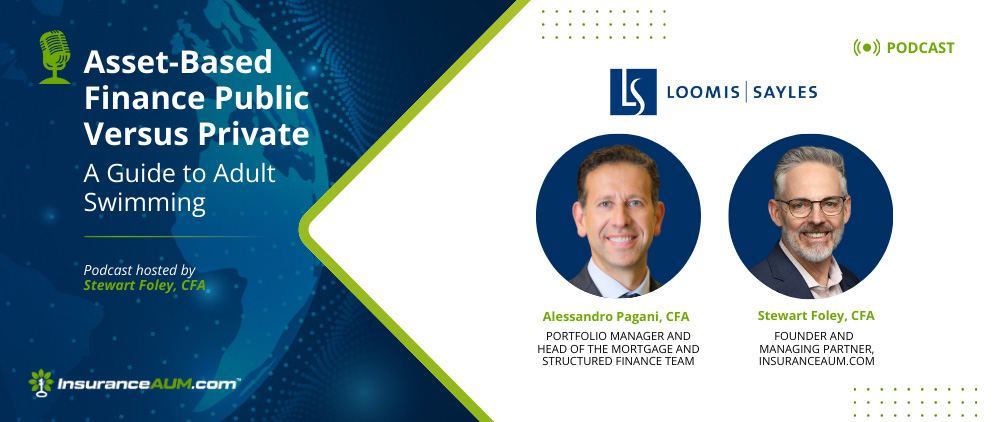
Episode 270: Asset-Based Finance Public Versus Private, A Guide to Adult Swimming

Image
LoomisFeatured


Stewart: Welcome to another edition of the InsuranceAUM.com Podcast. My name's Stewart Foley, I'll be your host. Hey, welcome back. We've got a great podcast for you today. The topic of asset-based finance is super hot, and it's the reason that we're doing this event in Philadelphia in May, on May 7th and 8th. And we are joined today by someone who was literally in this space as it was created, which I would love to talk about more. 

So the name of the podcast is Asset-Based Finance Public Versus Private, A Guide to Adult Swimming. Because when we were talking about doing this podcast we said it's definitely an adult swim in this asset class. And Alessandro Pagani is a portfolio manager and head of the mortgage and structured finance team at Loomis, Sayles. And Alessandro, we are thrilled to have you. Thanks for joining us. I look forward to this one. It's going to be a good one, and welcome to the show.

Alessandro: Well, thank you, Stewart, for having me, and I hope to live up to the expectations.

Stewart: Oh, absolutely, there's no doubt in my mind. So before we get going, let me just ask this, where did you grow up and what was your first job, not the fancy one? And talk to me a little bit about when you first started at First Chicago in '97 in Chicago. What was this market like back then?

Alessandro: Yes, absolutely. And as you can tell, well my first job was in Chicago. I was not born and raised there, I came from Milan, but I was lucky enough to join First Chicago Capital Markets as it was pushing into the term ABS market. So I joined the research group and they asked me to do securitization full-time. I said, "Absolutely." And asked, "What is it?"

Because as you said, it was really truly at its infancy and it was an exciting time to be there because a lot of things happened since 1997 and my entire career has been in that world first on the sell side, then more on a deep credit specialty managers manufacturing deal and doing private deals before it was fashionable and then I joined Loomis, Sayles. So I'm more in a capacity of managing money for a more traditional asset manager.

So I've seen the application of asset-backed finance in many aspects. And back then it was very innovative. I witnessed the impact of this new financing technique to each industry, and what I really learned is whenever you have a lot of capital chasing a new industry, everything changes. So you need to be mindful of what it does to the industry. Sometimes it works, sometimes it doesn't. We've gone through many bust and cycles. But yeah, that's the perspective I'm hoping to bring to your clients today.

Stewart: That's fantastic. I don't want to talk out of school here, but actually your first job was in the catering business, right? I mean, that was really not the fancy one. You said something about you knew the back entrance to every museum in the city, which is awesome.

Alessandro: I proudly know the back entrance of every museum in Chicago.

Stewart: Oh, that’s fantastic. So your comments about what happens when a lot of capital comes into a market, I think is really apropos for right now with asset-based lending. And everybody's talking about it. Is often viewed as a less crowded segment of the private credit space. Can you talk to us a little bit about the difference between public and private asset-based finance or asset-backed finance, and how do private ABS and whole loans fit into the broader private credit landscape? Why are we seeing a shift into this segment? It seems like it's super hot. Can you give us the opening overview?

Alessandro: Absolutely. I will try. And we'll start by saying there are no real industry definitions in this world where there is so much confusion about it. So I'll give you at least my perspective and try to offer some guidelines to distinguish between the segment of the market. Much has been said about the private credit market, about a $1.0 trillion of capital deployed. I heard about $1.7 trillion in total invested and committed capital. By and large debt term refers to private credit loans to corporations. That can be either unsecure corporate credit or cashflow lending.

The key issue here is that there is recourse to the issuer. The opposite of the spectrum is the world that I grew up in, the asset-backed securities. For that, I use the term one public or 144A is a relatively liquid world. Right now it's about a $3 trillion market is your classic asset-backed securities, commercial mortgage-backed securities, CLOs and non-agency RMBS. The non-agency RMBS is the market that shrank dramatically by about two thirds since the great financial crisis, but at over $3 trillion.

This is a market that has had a long history. As I mentioned, it really started in the mid '80s, started to grow in the mid '90s and at over three trillion represents one of the major sources of non recourse term debt where you can match the life of the assets with debt of the liabilities. Those are pretty well-defined markets. When you move to private asset-backed lending or asset-based lending, the world is a little bit fuzzy because I think there is a continuum. Let me see if I can try to provide at least my perspective on that. This private ABS, that market basically uses special purpose vehicles.

It's non recourse that there is a structure. It's very, very similar to your kind of public ABS market. It's done under a four to formal which has important implications on due diligence and the legal form, but it's fundamentally the same asset class just done in a different legal format.

Then you have at the opposite end of the spectrum whole loans. When you come to whole loans, there is no structure. You really have a seller of loans to the buyer. The buyer has full transparency on the assets that it gets full control of who services and so forth. Structure may be added later, but those are very different.

And then there is some informal secure lendings that are somewhat in between which may or may not have recorded. So I accept why there is such a confusion around it. The shift towards private assets really started before the rise in interest rates in 2022. It was really, in my view, the byproduct of the search for yield where every little incremental spread pickup mattered a lot. And so you could move into the private asset class and pick up the yield. Also, clearly a diversification.

The growth in private credit is so focused on corporate market that either on the public side, on the private side there is this create exposure to corporate. So as you move to asset-based lending, you have different sources of risk, more diversified, you reduce your idiosyncratic risk. So yield diversification and less idiosyncratic. A less-talked-about concept is control. And I think this is important. I think about public ABS as we are risk takers, meaning somebody creates the risk, creates the structure, and we're really pricing it. We have a choice of either going in and price it and going out.

When you move to private asset-backed lending, you can be part of the creation process. So you have that control of what type of risk. And even here there is a continuum. There are, again, the private ABS that I described earlier you're really much you take the structure there as you do in ABS. But club deals, you have more controls. When you have a directly originated transaction you really create the terms. But the element, if I want to simplify it, I think about it, I'm in the room manufacturing the risk and getting what I want versus being more of a risk takers. Hopefully that helps clarify at least how I think about that space.

Stewart: It really does and it helps frame the conversation really well. The next question really deals with the evolution of private asset-based lending. And when we think about this, the evolution of asset-based lending has shifted from banks really dominating whole loans and now you've got a broader range of issuers and investors, including insurance companies in no small way. Can you talk a little bit about how the increased interest rates and change in bank capital requirements has created this opportunity?

Alessandro: Yes, sure. As we started early about my early career. In the late '90s we had a group that was doing small private deals, and there was a very clear linear evolution of the specialty finance company that would initiate fund themselves through conduit. And then as they grew a little bit, they were able to turn the conduit facility into a term ABS. Usually small deals distributed actually to a few insurance companies.

And their idea is if they're successful they're going to grow and graduate to the 144 public markets where the costs are higher you need a larger size. But it was a process of growth out of the private market into the public. As the capital allocated to private market grew, so over the last 10, 15 years, there's been a really big shift whereby even large established issuers view private capital as a complimentary source of funding. When you sell whole loans you achieve different things on your balance sheet, both from a cash flow perspective and a P&L perspective and capital perspective.

So you have more issuers really play to markets. And this is interesting. You mentioned the rising interest rates, what that has caused is the fact of a big hole in the balance sheet of banks. They don't have to mark to market, but the impact of the decline in asset valuation is still there so the first stop lending in that space, accelerating this interest towards private lending, and then there've been some many cases sometimes outright sellers with doing maybe sometimes synthetic transaction credit risk transfer.

So really what has changed over the last few years has been an acceleration of the supply of these assets and a shrinkage of the loans. So it's actually a very exciting time to be in this market because you are at a confluence of a lot of capital going in there and a lot more supply. And as I alluded earlier, many different ways in which the structure can play from whole loans to ABS to something in between.

Stewart: Can you help me with just something I don't understand the term? Early in your answer you mentioned they're funded by conduit.

Alessandro: Yes.

Stewart: Can you just tell me what that actually means? I don't know what a conduit deal is. Are they borrowing? Just you can see, I don't understand it.

Alessandro: Absolutely. Absolutely. No, thanks for the question. We take things for granted. But conduit or warehouse lines is basically a form of financing that banks have whereby the issue short-term paper, commercial paper and the lending facility usually has a life below one year or whether it used to be in the old days, the growth in the conduit was in the '90s because when the facilities had less than 365 days, the capital required was very low.

The rules have changed a bit. But in a way view it as simply a warehouse line held by a bank where you continuously sell the new loan production. The banks funded either internally or by selling commercial paper, asset-backed commercial paper against it. And once you've reached your limits, then what people tend to do, they do the term ABS. So you take these assets and you pledge them to a securitization which is funded long-term to match the life of the assets.

Stewart: Super helpful.

Alessandro: Does that resonate?

Stewart: Yeah, absolutely. So let's talk a little bit about ratings and risk and see what we can learn about lessons from the past, if you will. So one of the things that we've talked about on this show is the reliance on a single rating agency for private ABS deals, particularly in newer asset classes. That brings back some memories of pre-GFC era where rating agencies face similar scrutiny. What in your mind, should investors be mindful of when it comes to ratings and how can they be confident that they aren't overly relying on ratings for their due diligence?

Alessandro: It's a great question. First, let me start by saying that the fact that you have only a rating agency is understandable for two reasons. One economic reason oftentimes the deals are small and so you need to be mindful of the fixed cost. Another reason is when this is applied to new asset classes you may have only one rating agencies that has issued ratings criteria. The deals are not a lot, there's just simply the niche nature of the market doesn't lend itself to have multiple rating agencies investing in it. So there's nothing nefarious around that.

But there are some risks and then I'll talk about what you can do as an investors about it. One, you need to be mindful that with one rating agency you have only one perspective. You don't have multiple rating agencies validating the assumption and reaching some type of agreement on the structure and on the credit enhancement. Having said that, major disaster happened when all rating agencies agreed. So that's not panacea for a perfect outcome, but you need to be mindful that it's one opinion that provides the ratings.

And a corollary to that, the economic incentive of the industry have not changed since the great financial crisis. Ultimately, the rating agency is paid for issuing the ratings and the deal and there are only certain level of credit enhancement that allow for the economics to work. So we need to be mindful of where the alignment of interest is. And frankly, even on the buyer side, particularly on the insurance side, the interests that aligned, the higher the rating, the lower the capital. So it all works very well together.

The additional risk in this newer asset class is that oftentimes you don't have a lot of data. So the story data through cycle when it's missing is really a problem. And you have very little disclosure on the purchase price. So sometimes you come up with loan to values, they seem very generous and very appealing, but you don't really know what was the purchase price, how much equity is really in it. You could have somebody buying an asset have a deep discount and then the valuations are much higher and you feel that you have an enhancement that is not really there.

The last one, this is something people don't talk about. As you move to private ABS, you no longer have an initial purchaser, the investor is the initial purchaser. So there is no arranger and dealer that are the due diligence of the documents, you have to do it. You not cannot rely on the initial purchaser to do the due diligence of the originator and servicer. There is limited involvement of the auditor, there is no comfort letter. So those are the realities of it. So I go back to what you said, how can they ensure, investors ensure that they're not overly reliant on the ratings for their due diligence?

It's very simple. You shouldn't. That's actually not the job of the rating agency. They take the data is given and then provide their knowledge about the asset class to provide a rating. You should simply not rely on the due diligence in the documentation. It's very clear that investors have to do their own due diligence. And that's something I think you need to accept. I talked about earlier about the control that you can exercise in this asset class, the flip side is that you have to exercise that control. You have to do the work. Can't buy the ratings.

Stewart: It's a great point. The question that comes to my mind, if this doesn't make sense, then just please pass. But is it possible that when a place like Loomis-Sayles doing your own due dilly, do you see discrepancies in ratings that are assigned to a deal versus what... Is that a way to capture relative value or can you identify mispriced assets that way or is the market just not that actively traded that you can arb the rating?

Alessandro: I mean, obviously the question is very relevant. It's tricky because it implies that all the trading relates only to the ratings per se. We think of relative value and other considerations around that. But let's say in the big picture the market is not treating ratings equally. If your assumption is the market prices rating is equivalent, then they will trade very, very similarly.

I can give you example of BBB equally rated BBB, corporates and autos that trade very similar levels and BBB conduit CNBS that traded a spread that is at least two times that. So there are major areas in there where the market really prices it very differently than the ratings. And by extension from a deal by deal there are definitely opportunities to say, well, there is a better collateral, better enhancements. The ratings, the enhancement level and structures tend to be sticky and sometimes they don't adjust as quickly to the shifts in the collateral.

So there are times, but by and large I think it is more of a by asset class and by asset class approach. I think it tends to be more of when an asset class is misrated. I guess probably the most obvious example, we had $3+ trillion dollars in non-HSRMBS that was fundamentally misrated because we never had in the data set what happens in the market when house prices go down 30%. We just didn't have.

Stewart: Yeah. No, it makes total sense.

Alessandro: Let me add one thing about what to do, it's, I talked about due diligence need. Oftentimes this is a market where specialty investors may be helpful. So investors really make a point of there being a specialist in a particular asset class. Then they have the scale to really know all the issuers and all the assets and develop that expertise that is absolutely necessary. The flip side of that is that they're always going to love the asset class in which are invested.

Stewart: Yeah, of course.

Alessandro: The ultimate initial investor needs to be in charge of the asset allocation or maybe have a manager that can partner with specialists when the time comes.

Stewart: Yeah, that makes total sense. One of the things that obviously differences in public versus private markets is liquidity and which leads me to mark to market. So I guess the key distinction between public and private markets is the stability of returns due to less frequent or model driven valuations in the private space. But that also means it's a little bit like, I don't want to know how fast I'm going so I'm not going to look at pedometer.

It also means that investors might be less aware of price and volatility. How should investors think about mark to market risk and liquidity when venturing into private ABS and whole loans? And here's really part of it too, Alessandro, is that insurance companies, the CIOs that I talk with, they always are struggling with how much illiquidity can I afford? And that's driven by their lines of business and so on and so forth. So this liquidity in this asset class is super relevant to our audience.

Alessandro: Yeah, obviously I can't opine on how much illiquidity risk they can take or not. That's a case by case basis. I do have a strong opinion that while the lack of volatility due to the more infrequent market may be beneficial and a feature of it, as you said, you can't be blind to the risk, you got to know your speedometer. So I'd always advise to look for similar asset classes in the public market where there is more transparency in the prices and try to infer the volatility.

Because risk is really volatility. I always tell people if I'm 100% sure that I'll lose 90% of my principle, I love that. I know exactly how to price that asset. So is the volatility of the pricing that matters informs a lot about the risks you have? Even if I don't have to mark to market I would work hard to find out what the underlying volatility of that asset class.

Stewart: So let's talk a little bit about relative value and spread compensation. You've highlighted the importance of comparing relative value between public and private ABS markets rather than comparing private ABS to corporate credit. Can you elaborate on how investors should be thinking about pickup in private markets, particularly in the context of non-recourse debt and the legal risks?

Alessandro: Yeah, I think you answered your own question. Meaning, private credit usually as a spread pickup to compensate for lack of liquidity in a little bit of increased credit risk and reduced alpha opportunities. In the liquid market, you can trade to generate alpha. You really cannot do it on the private side. May matter less for insurance company, but that's an important consideration. You need to overlay here, hear the non-recourse nature of the debt and the legal risks that I described. The structure introduces legal risks that are often not fully appreciated.

People hide it under the spread is wider because of the complexity premium. I don't know if non-recourse is complexity. Non-recourse is non-recourse. You got to get paid for that. That's why the issuer oftentimes is willing to pay more for a funding because of that non-recourse nature. So it's just important to have the relative value to asset back, which generally speaking trades at wider level than equally rated corporate. So there has to be that additional piece.

And overall, the way I think about it, I talked earlier about how issuers are setting themselves up to both have a public and a private program and they play the arbitrage. It makes sense that issuers should be set up the same way. So instead of having a long-term allocation to private, have the flexibility to switch between the two markets. And the way I think about it, I mentioned earlier about creation of risk. One big benefit of private transactions you can actually reduce risk.

You can have more senior asset classes, you can have lower advanced rates, lower LTV and keep the spread higher. So that's very suitable in worlds where spreads are generally tight. And so you can be defensive and keep the carry. And if you build a portfolio that cash flows pretty readily which is doable in asset-backed. When there is a dislocation you have the cash to deploy in the more dislocated public market, clearly the private market may not move much.

And also what happens in dislocations at the private market tends not to issue. Everybody shut, the market kind of shuts down. But I think there are ways of think about allocation between public and private opportunistically and also through the cycle, having the private investment more as your defensive piece of the portfolio that generates very attractive care.

Stewart: That's super helpful. At the risk of just absolutely like our audience going, can you unpack the difference between recourse and non-recourse? When you're talking about non-recourse in this, what does that mean just in the simplest terms?

Alessandro: In the simplest term is that you have pledged the assets in a special purpose vehicles that own the assets. The debt issued was issued to purchase those assets and you're going to get paid only from those assets. The originator and servicer may be involved in providing function, but if you have losses to the pool that the originator does not need to go bankrupt.

Stewart: Got it. Okay. That's super helpful. Thank you. I think one of the most interesting parts of this is there are emerging asset classes and the question obviously is opportunity or trap? So there are new asset classes coming out. And as you talked about earlier, and I remember I was in the mortgage backed market in the early '90s when it was new.

And there's often significant opportunities in asset classes that are relatively new. They come out wider and they tighten later and so on and so forth. At the same time, there's not necessarily the same track record of performance in those asset classes. So I guess it boils my question down to, as an insurance company, talk to us about the opportunities in these new asset classes, what they are, and are there any red flags that insurers should be on the lookout for?

Alessandro: Traditionally this space has expanded to new asset classes. There's nothing new. And not all of them were bad. In general, what has been common is that credit issues tended to be preceded by the rapid growth in an asset class. So whenever you see rapid growth, new flow of money, the antennas have to go up and you have to ask yourself, does it make sense? How is the industry being changed by this? So I think that's very important. I would also caution on where is the flow of money coming from? Where is this supply coming from?

So what was the market that was funding these assets before and why is it now shifting to the asset by market? And what you're likely going to find out is that the advance rates in the IBS market are way more generous than the prior ones. And then it goes back to the due diligence, what I mentioned earlier, think about purchase price, think about what is the real value of the assets? Forget about the valuation and the stated LTV, do work around what is the asset?

Ultimately who is holding the equity? Be extremely, extremely skeptical of asset classes where there's rapid growth and you are providing an exit for the prior investors. And, basically, the equity is really phantom equity because they monetize more than their original purchase price. And then this goes back to having known records.

Stewart: Right. Exactly.

Alessandro: So those are the big red flags and that's where we started with these adults swimming. That's where antennas have to go up and you really need to ask yourself, does it make sense? And what are the incentives? What is the skin in the game? Certainly not here's the rating.

Stewart: And one of the things I seriously appreciate is when our guests come on and they provide a balanced view. And there's good opportunity in this space, but as you mentioned, and I give you all the credit for the title of the podcast, it is an adult swim. You do need to understand what it is that you're buying here and if you don't have a talent internally, then go find the talent externally because there's a lot to know in this asset class. And I've gotten a terrific education from you today. I can't thank you enough for being on. I've got a couple of fun ones for you on the way out the door. If you are so inclined, and I've gotten to know you a little bit just in talking and I'd love to have some of your personality come out here, so if you're willing.

Alessandro: All right. I'm ready.

Stewart: Okay. So I want to take you back to when you were finishing your PhD and you're finishing your dissertation and you're looking out at this market, and one of the things I think that's super challenging as when you're coming out of school is you don't know what all the opportunities are. You don't know what all these places do. You've heard about it in the Wall Street Journal or Bloomberg or wherever, but you don't really know. So what would you say to somebody who is in early 20s, Alessandro Pagani, what would you say to that person about how to get into this business and what they need to know and do to wind up being in a senior position running a team as you have?

Alessandro: What a great question. The first let's say awareness I had was that the future is behind you. Meaning you are coming out of school and you're looking at all the careers that you heard about is what you see, but all that has happened. That's in the past. You're kind of walking backward towards your future. You don't know. And as a matter of fact, talents tends to be sucked into the growth area, which tends not to have the history.

So my advice would be go where the growth is. Don't be stuck with the preconceived notion that you had in school. I would've been an auditor or I would've been in Anderson consultant. That was my dream in coming to Chicago. And I went in a totally different direction because I said, "Ah, this sounds interesting. What is it?" And it has been an amazing 30 years. So that would be my advice. Be open to what pulls you.

Stewart: I love that. That's great advice. Okay, so last one. Lunch or dinner you can invite three guests alive or dead, who would you most like to have lunch with, or dinner? You can have up to three. You don't have to have all three. You can do one, two, or three, but who would you most like to have lunch with alive or dead?

Alessandro: That may surprise you. Mahatma Gandhi.

Stewart: Oh wow. There you go.

Alessandro: Bernard Montessier. That requires an explanation. He's the world very famous French sailor who went one and a half times around the world just because he liked it, as he said it, to save his soul.

Stewart: Wow.

Alessandro: That would make a fun conversation. The third one will be a political figure, probably Churchill.

Stewart: Wow, that's an interesting table.

Alessandro: There are no Italians in it.

Stewart: I understand. There's nobody from Missouri in it either so I'm not offended. I's great to have you on. It's another example of just an amazing guest part of the team at Loomis, Sayles. We're thrilled to have you on a really good education on asset-backed finance, and really it is an adult swim. So we've been joined today by Alessandro Pagani, CFA, portfolio manager and head of the mortgage and structured finance team at Loomis, Sayles. Alessandro, thanks so much for coming on.

Alessandro: Thank you. This was enjoyable.

Stewart: Thanks for listening. If you have ideas for a podcast, please drop me a note at stewart@insuranceaum.com. Please rate us, like us and review us on Apple Podcasts, Spotify, Google Play, wherever you listen to your favorite shows. My name's Stewart Foley. We'll see you next time on the InsuranceAUM.com Podcast.


This podcast was recorded on 14 January 2025. 
  
This marketing communication is provided for informational purposes only and should not be construed as investment advice. Investment decisions should consider the individual circumstances of the particular investor. Any opinions or forecasts contained herein, reflect the subjective judgments and assumptions of the authors only, and do not necessarily reflect the views of Loomis, Sayles & Company, L.P. Investment recommendations may be inconsistent with these opinions. There is no assurance that developments will transpire as forecasted and actual results will be different. Data and analysis does not represent the actual, or expected future performance of any investment product. Information, including that obtained from outside sources, is believed to be correct, but we cannot guarantee its accuracy. This information is subject to change at any time without notice. 
  
Any investment that has the possibility for profits also has the possibility of losses, including the loss of principal. 
  
Diversification does not ensure a profit or guarantee against a loss. 
  
There is no guarantee that the investment objective will be realized or that the strategy will generate positive or excess return. 
  
Past performance is no guarantee of future results. 
  
This material is not intended to provide tax, legal, insurance, or investment advice. Please seek appropriate professional expertise for your needs. 
  
Loomis, Sayles and Company, L.P. and InsuranceAUM.com are not affiliated. 
  
SAIF13yesrhs

Share this post

Sign Up Now for Full Access to Articles and Podcasts!

Unlock full access to our vast content library by registering as an institutional investor

Register

Contacts


Loomis, Sayles & Company, LP

Loomis Sayles matches its long history of alpha generating capabilities with the complex needs of its insurance clients. The firm offers a suite of differentiated fixed income strategies, each with clear and consistent investment philosophies. Experience in providing custom solutions is layered in to generate specific portfolios, designed to fit client objectives.
 

Colin Dowdall, CFA
Global Head of Insurance Solutions
cdowdall@loomissayles.com
(617) 449-8782

Lauren McDermott
Director, Insurance Solutions
lmcdermott@loomissayles.com
(617) 816-6301

www.loomissayles.com
One Financial Center
Boston, MA 02111


View the contributor page

Image
LoomisSayles

Sign Up Now for Full Access to Articles and Podcasts!

Unlock full access to our vast content library by registering as an institutional investor .

Create an account

Already have an account ? Sign in

Ѐ Ё Ђ Ѓ Є Ѕ І Ї Ј Љ Њ Ћ Ќ Ѝ Ў Џ А Б В Г Д Е Ж З И Й К Л М Н О П Р С ΄ ΅ Ά · Έ Ή Ί Ό Ύ Ώ ΐ Α Β Γ Δ Ε Ζ Η Θ Ι Κ Λ Μ Ν Ξ Ο Π Ρ Ё Ђ Ѓ Є Ѕ І Ї Ј Љ Њ Ћ Ќ Ў Џ А Б В Г Д Е Ж З И Й К Л М Н О П Р С Т У Ф Х Ц Ч Ш Ā ā Ă ă Ą ą Ć ć Ĉ ĉ Ċ ċ Č č Ď ď Đ đ Ē ē Ĕ ĕ Ė fi fl œ æ ß