
Executive Spotlight: Eric Partlan, CFA, CAIA, Chief Investment Officer at MassMutual
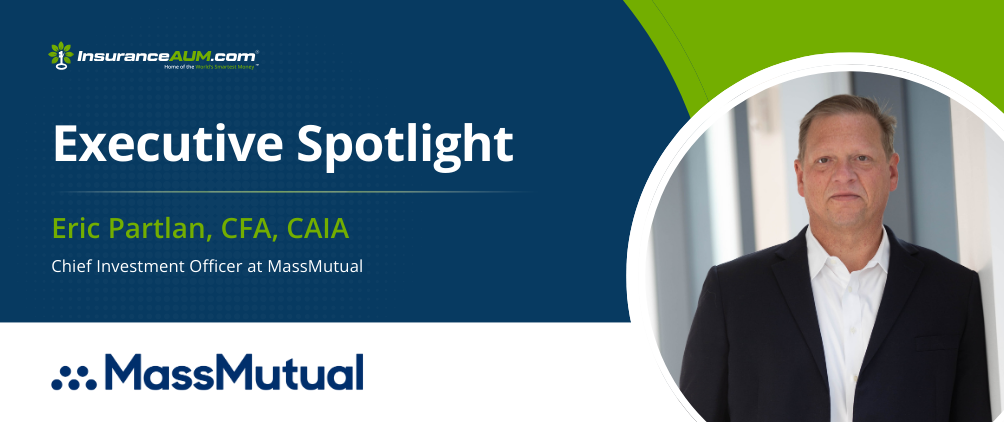
Stewart: Welcome to another edition of the insuranceaum.com podcast. My name's Stewart Foley, I'll be your host. Hey, welcome back. It's nice to have you. We have another in our CIO spotlight series today, and I believe that you are the largest insurance company CIO that we've ever had on. We're joined by Eric Partlan, who's the Chief Investment Officer at MassMutual. Eric, welcome and thanks for taking the time. We value these podcasts greatly and look forward to hearing what you have to say today.
Eric: Now, thank you so much for having me. We have a set of folks here at the firm obviously that listen to you regularly, so quite the privilege, so I appreciate it.
Stewart: Oh yeah, no, we're happy. I mean, you have a fairly robust set of CIO folks who listen frequently. Top of that list is Joe Eppers at Selective, and there's also Michael Demuth at Allianz and several others who are pretty dedicated listeners and MassMutual based in Springfield, Mass. Really, really highly regarded. Very well established. What can you tell us about MassMutual before we get going into more on you?
Eric: Yeah, let me tell you a little bit about MassMutual and sort of our business model and the mutual structure in general, but just stepping back and setting the stage, we were founded in 1861.
So we have policies that have been around for 80, 90, a hundred years. Hopefully, my policy will last that long. We'll see. But we've really, we think that we've helped generations of families and protect the folks that they love and that's our real goal. And there's some really unique advantages to being a mutual insurance company. At the heart of that, the distinction between the mutual and the public is just the fundamental difference in ownership and purpose. And so, a mutual insurance company we're owned by our participating policyholders. We don't have external stakeholders. It really creates a unique alignment of interest between the company management employees and the policyholders. Unlike the publics, we don't have to balance the demands of shareholders seeking profits. Mutual insures can focus solely on the long-term needs and well-being of their policyholders. So we have that ability to prioritize policy needs over profits.
We're not under any sort of pressure from the street to report quarterly earnings or to look at short-term views. And that really allows us to focus on long-term outcomes so we can invest in high-quality customer service, we can invest in very long bonds, we can invest in partnerships that are expected the last decades and so long as we think that's accretive to the policy holders over time it can make sense. And we think primarily in life insurance products, when you're talking about participating in life, it's going to lead to better outcomes, this mutual focus and it really allows you, again, to think about the long term but also to focus on the stability of the firm over the long term because a mutual insurer, we hope to be around as long as we've already been around if not longer. And that's just really important, we think, in the life insurance industry specifically.
The other nice piece is that rather than profits going to shareholders, we have the ability to return our profits to the policyholders in the form of dividends. So a similar dynamic where you might have a public passing out a dividend, we do the same. And so if we perform well financially, we have the ability to distribute the dividends to the policyholders. So we're really sharing the success of the company with those that we're insuring. And just recently, we paid the largest dividend in our history about two and a half billion, 157 the consecutive year of paying out a dividend. It's interesting and amazing, just the long-term cycles and what the company would've seen throughout its history. And we stand here with, we have a trillion dollars, about a trillion dollars of insurance and force. The last 10 years, we've paid over 60 billion in life and annuity benefits and it's just really focused on that alignment of policyholders and the company and doing what's best.
Stewart: I had the privilege of working at a Mutual early in my career and I'm familiar with those characteristics and view, so I don't want to go too crazy long before we go into the typical stuff. So, where'd you grow up and what was your first job? And here's the kicker on that. You have had an interesting career journey from aerospace engineering to hard sciences to now CIO, which is very atypical. So can you start with where you grew up and then kind of walk us through your not-fancy job into where you are today?
Eric: I grew up in Michigan and around the Detroit area. My first job, it depends I guess if you're depending you're focusing on a paycheck or not, but the first job was roundabout being a paperboy. So you used to get up at 4:30 or 5 in the morning, go pick up your papers and lay 'em on people's porches. We didn't throw 'em, we laid them there so they would be there. And I worked at the Detroit Zoo for a while, which was actually my first W2 can believe that working in the food services.
Stewart: Okay. So this is interesting because there's been a fairly long list of folks who were in the paper delivery industry at one point in their life and you're the second person. One person said that they were in charge of the reptile aisle at Elmer's Pet Shop pet and you have a zoo and you and I share the background of working in food service, which is I'm sure you'll attest, is super glamorous.
Eric: Yes, it is. It teaches you customer service if nothing else. It's a great place to start. It really is.
Stewart: It does. It is. So can you talk a little bit about balancing details with strategy and where this comes from? My understanding is that you have a real love for details and analysis and I'd love for you to loop back in your career journey from an engineering background to where you are today, but how do you balance out the deep dive into the details with the long-term perspective that you mentioned earlier?
Eric: Actually, lemme step back and just say a little bit about how I got there and then that would lead into sort of how we think about it. So you're right. So I went to university, studied accounting and mechanical engineering. I was really focused on getting a job back then. So, started out as an aerospace engineer, worked for about three years, went to grad school part-time and then ended up going to get an MBA and then a master's in engineering as well. Went to a hedge fund for a bit a year and a half, two years. And then I went to work at Babson, which is now known as Barings. So that is our 100% owned asset management subsidiary. I worked there for seven or eight years before coming up to MassMutual and I did a rotation through risk management, enterprise risk, and then I've been back in investments for the last 13 or 14 years.
So I think, when you tie in that detail level, it can actually be a bit difficult to move from engineering, where the focus is on the very detailed specs and how everything fits together and tolerances, et cetera. And pulling yourself up a bit over time to think at a bit of a higher level. So I went to bearings, I worked in structured credit, I worked on the desk for eight years, just learned a lot around structuring and it's not only CLOs for example, but we'll bit the structured market has just exploded. And so it's structured across asset classes and yet you need to think about the portfolio at a detailed level, but also just as importantly if not more so how does the structure work? Where does the structure go wrong? As I've moved up in my career, I've certainly had to pull it up a level or two and really learn to rely on the folks that are building that expertise now as I've sort of given myself more of a portfolio view and I have to take that. So, that's sort of going to the detail up to the portfolio level and eventually you get up to the strategy level, which is that long-term: Where do you want to be in the next 5 to 10 years?
Stewart: Do you find that folks with a quantitative background tend to gravitate towards structure? It's pretty heady math, some of those structures are complex. Did your quantitative background in engineering help you there or is it kind of not related?
Eric: It helped me, but I had more of a quantitative focus on the structured credit. I think there's a variety of backgrounds in structured credit. My first supervisor at Babson at the time was a lawyer and there are a lot of lawyers that work in structured credit, just really understanding the structure and the documents and how everything flows. Fundamental analysts who work in structure, they're really looking at underlying what's the underlying portfolio, do we like the portfolio or the characteristics of it? Depending on the type of asset class you will have quantitative people that might be modeling it out, looking at scenarios, think of things around simulation or in the old days, modeling out the markets. But there's room for everybody in there. So, the desk I worked on just had a huge array of experience and a whole bunch of different backgrounds. So, it's actually a very interesting place to work just given the broad knowledge set that you can build.
Stewart: It's always interesting in those environments. What else people do, what else their interests are, you go really typically it's like those folks who have those interesting academic backgrounds also have interesting hobbies and whatnot.
Eric: Yeah, I have to admit that is one thing I really like about investments and it's just the variety of backgrounds, the people you meet, it's just fantastic. I mean everything from history and English majors up to PhDs in math—everybody has a place.
Stewart: Yeah, it's so true. And I mean when I taught, we used to get folks who'd come in and say, I'm looking for finance majors with a three five or better and dah, dah dah, dah. And they go, of course I was a history major with a two seven.
Eric: Yeah, exactly.
Stewart: But you know what I mean? He'd go, well, why not? Why not recruit that talent that's kind of worked out for you?
Eric: Yeah, exactly. Worked out for you.
Stewart: That's right.
Eric: Don't make the assumption.
Stewart: That's right. But you've built a strong team with a combination of seasoned leaders along with rising talent. Could you talk a little bit about how you strategically balance experience with fresh perspectives to prepare your team for the current and future challenges.
Eric: Yeah, I think we all need a sampling across from new college graduates all the way up to folks that have been in the industry for 30, 35 years. I think the view of a cycle, for example, and who the heck knows if we have any more cycles after it's been a long time since we've had a real one, the view of the cycle is really important. So we're going through a real estate cycle right now. We have our real estate head has been in real estate for again 35 years. But it's also really important to grow that talent from a junior level because otherwise you're just not going to have it in five, 10 years when I retire, who's going to take over for me and the person who comes up to take over for me? Who's taking that? Who's taking over for them? So just following it backwards at junior level, real intellectual curiosity, real sort of passion for learning.
It doesn't matter in my opinion so much what that passion is for learning, but they want to learn, they want to work with others. They have sort of a mind that can think detailed level and to your earlier point, a little higher level to think about how does it fit in to an overall portfolio strategy that we're trying to build. So I think it's really important to have through the cycle as well as junior folks who are going to learn the next time we go through a cycle, what it really means to underwrite in our case largely credits and think about how that's going to perform in a bad scenario.
Stewart: It's interesting. You kind of led me to my next question, which is the fact that Mass Mutual has been significantly ahead of the curve in private credit. You were involved in private credit a long time before it became as popular as it is today. So how do you think being an early mover has given you an advantage and how do you maintain that advantage as private credit markets continue to evolve?
Eric: To your point, so I have a private placement memo on my desk from the fifties that's sort of been passed down from generation to generation and it's for an oil and gas company. We did a very early deal with Walmart, for example, in that same timeframe. So we've been doing what you would think of as private credit for the last 75, 80 years. Now, of course there was a time when everything was private other than maybe railroad bounds, the world's changed quite a bit. So we have been doing it for a long time. We have a lot of experience in the private credit, I'll call it a silo, but I think it depends on, there's a, people will talk about private credit in a bunch of different ways. I think a lot of folks think of it as middle market loans, but be private ABS, private placement, investment grade bonds, fund financing.
There's a whole bunch that's buried within that complex. And depending on what it is, it might require structuring expertise, it might require fundamental analyst expertise, it might require some quantitative expertise or it might require all three. So you can pull from people who've been traditionally trained in one of those other asset classes. I'd call it a public or a public ABS or CLOs for example. I dunno if you think of them as public or private, but you can pull from those folks to work on the private and the difference becomes liquidity premium and perhaps some complexity premium as well. But to your point, we've been doing private assets in one form or another for decades and decades. Our primary asset manager, Barings, has a very large private complex and we utilize that as much as we can. As a long-term insurance provider, we are happy to take that liquidity premium.
Stewart: I may have the number slightly wrong here and please correct me, but your 285 billion of general account supports insurance and retirement products. How do you approach asset liability management, otherwise known as ALM, particularly in navigating uncertainty in the markets and evolving risks?
Eric: Yeah, that's a good question. Yeah, so you're right on the number. Obviously fluctuates from time to time, but as you said, we have both life insurance, annuities, and a few other products as well. But we start with the liabilities generally and we think about what are the characteristics of the liabilities that our policyholders are purchasing, and so we can match that up with the types of assets that we see and the types of assets that we like. And I don't mean to get into literally sort of interest rate matching or spread duration matching. Really, what I mean is the characteristics of the assets that we're using, how does it match the characteristics of the liabilities that our policyholders are buying? And there is a whole bunch of ways to think about that. We can warehouse an asset. For example, if we see something we really like that's a 200, two 50 million position, we can buy it and then look to issue a liability on the other side, for example, to fund it.
Or we can sell the liability, we can build in appropriate delay costs, for example, in purchasing an asset and then we can buy the assets afterward. Just there are different models there. We operate a bit in both from a core ALM perspective as we think about it on interest rate risk, that's not a risk that we take. And so, I don't have a fundamental belief that over the long-term, we have the ability to think about where interest rates are going, whether they're going up or down. And so it's a risk that we would just rather not have. We'd rather have credit risk because we can underwrite that and we can know what that means. And we've seen that through cycles. Rate risk is much harder.
Stewart: It's interesting too, and I'm a little bit practicing without a license here, but we just did a module from our CAM designation, the chartered insurance asset manager designation, which is we're working in concert with an organization to bring that, and we're working on the fundamentals right now, and we just did the module on ALM with Bruce Fox from Genworth. And so he was talking about the behavioral component of those liabilities. That's not just interest exposure but also disintermediation risk that has to be considered, right? So, it's not a purely quantitative study that there's also a behavioral component in there as well, which makes it equally or more challenging I would think.
Eric: Absolutely. It reminds you on the asset side, it reminds you of maybe of prepays and mortgage backed securities, for example. So somebody who buys an annuity and if their rate is at 2%, 2.5%, maybe that's where it was in the midst of covid. If rates jump up to 5 or 6%, they should. And they probably are doing the math around, do I stay with what I have or is it better to lapse and purchase a new policy? So you're absolutely right. There are a lot of very smart people within MassMutual that spend a lot of time modeling that, what we would call lapse risk and thinking about how that interacts with the assets.
Stewart: Yeah, thank you. That's helpful. So you had mentioned strategic partnerships as a potential competitive advantage for MassMutual. Could you share a little bit about your philosophy on partnerships and perhaps an example of how this strategy has created value for you?
Eric: Yeah, I have a real fundamental belief that over the next 5 or 10 years that picking your partners, working with your partners is going to lead to much better outcomes than what I would call scatter shotting and thinking about mandates with a whole bunch of people. I'd rather be focused on people that I trust, that I think do a good job, that I think work well with our firm that have views, that are similar to ours because I think we can share in the risk, but also share in the reward. And then the best example we have is Barings, which spun out of MassMutual in the early nineties. We intentionally spun out Barings again, at the time it was called DL Babson, then Babson, then Barings. But the idea was, okay, we've got a great investment department, let's raise external assets because we think about outside of our participating whole life, every dollar and profit that's made goes to the policyholder so it feeds back to the policyholder by the dividend.
And so we took that opportunity and we were very early in it. We think particularly foreign insurance company to spin that out and build that business up over time. There are hundreds and hundreds of billions in assets. And so it's worked out really well. If you think of our GIA is about 280 billion and maybe the net amount of fixed income is 200. They're managing a lot of external assets. And that gives us not only that profitability stream, but it gives us an increased opportunity set because it allows our asset manager, Barings, to focus on a bunch of different markets. Maybe we don't have an interest in a specific market at the current time, but they can build that out knowing that clients have that demand. And then we can benefit from seeing that flow if we decide to pivot in at some point. So Barings is far and away our biggest example of that, but we have others as well.
So we own half of a longevity insurer in the UK, for example. We recently purchased a position in a firm called Atlas SP, and that's really around private ABS flow. So when we think about that and we think about the partnerships that we're trying to create, it's that long term, decade long, what's the mentality? How are we thinking about it and what do we want to do with it? And so you invest with somebody, maybe you're in a partnership, if they don't need liquidity for 15 or 20 years and there's just going to be a dividend policy put in place to return cash, it's fantastic. We love that.
Stewart: That's super interesting.
Eric: Yeah, just tying it back to your very first question, it's really, it's that long-term view that we can take.
Stewart: And you don't have to worry about quarter-to-quarter earnings and whatnot. So this one's a little bit of inside baseball, and if you don't want to go there, you just tell me. But I've heard that there's a story behind Eric's parking only and a scooter at your office. Can you talk a little bit about the open plan layout and the impact on your team's culture and collaboration and maybe a little bit of fun along the way?
Eric: Yeah, you're pretty tied. You're tied closely to the rumor mill, aren't you, Stewart? So that's fantastic. Yeah, so there's an area in Boston that's called the Seaport, and MassMutual along with the development partner, helped start to build that out about 15 years ago. And so we built a number of buildings there, which it's been great for the city, it's been great for us. One of the last remaining two parcels that we own, we built our building on. So MassMutual has a building in Boston, and we're split between Boston and Springfield, still more in Springfield, got folks in New York, obviously. But Boston is the second biggest office that we have. And as you mentioned, it's an open office layout, which what that really means is there aren't assigned desks. There's different types of environments within the building, whether you like to sit at open tables with views of the harbor and the airport, you can sit there. If you like to be in a cube by yourself, you can sit in a different part of the building. And you can move from floor to floor if you'd like, with very few exceptions.
And look, honestly, it's going to be person to person, how they think about it, how they like. It's going to depend on, we don't have desks that we are permanent at, so we don't leave most of our materials at the desk. So, are you comfortable carrying your stuff back and forth? We have lockers if you're not, but it's a different environment than what I'm used to, where we've typically sat on what I would just generically call trading desks. And parts of it are great. Parts of it are more difficult and everything else in life, you have to adapt to it. And so it's really interesting. But I will say that the flow and communication moving between groups, so between investment management and the CFO office, for example, I walk 30 feet and I can talk to the folks I want to talk to, which is really neat.
Stewart: Yeah, I mean I worked in an open environment too more, but the trading desk that you described, and it really does help with communication. To be able to hear the traders and hear the analysts and getting together in that morning call and whatnot was super helpful. I got a couple of fun ones for you, the way out the door. The one's not super fun, but it's interesting, especially to folks who are earlier in their career, and you touched on this a moment ago, but when you are looking to add members to your team, what characteristics are you looking for? Not necessarily major or school or whatever, but are there characteristics that you look for in someone when you're considering adding team members?
Eric: Yeah, absolutely. And obviously from firm to firm, it's different, but I would think at the top of our list is probably intellectual curiosity. We have the benefit, a relatively small group within MassMutual because we operate as asset allocators. We have the benefit of working across, you name an asset class, and we're probably working and seeing what's happening in that asset class. Again, we had the benefit of partnerships, so we'll structure them up within IM or within corporate at MassMutual, and people will have board seats, and there's just all sorts of really interesting work to do. So it might be a little bit different. If you want to be an expert in a specific asset class, you can do that, but you're probably not going to spend a decade unless you maybe move down to Barings, which we're happy when people move back and forth, which is another advantage we have, but you're going to have the chance to sort of expand your horizon.
So we have a huge preference for humble, not overly, but being humble. We don't really have a star culture at MassMutual within the investment management department. Just doesn't make a whole lot of sense for us to operate in that sort of environment. And then just continuous improvement. I'm working on something, how do I make it better? I'm working on a deal. What am I taking with me next time to look at the next deal? Or I'm working on a partnership with Firm X, what am I learning there that I'm going to remember for the next time around? And so again, we have backgrounds, all sorts of different schools and all sorts of different undergraduate majors, so it doesn't matter so much to it. I mean, it may guide you to a certain type of job, obviously, but we have it all. And I think it's really around that. Just be curious, get to know people. It never hurts to reach out. What's going to happen is somebody's going to ignore you and best that's going to happen is they're going to spend some time talking to you. Just be open. So I think that's largely it.
Stewart: That's good. And the last one is totally fun, and it goes like this. You can have lunch or dinner with up to three guests. Doesn't have to be three. It could be one, two, or three. Who would you most like to have lunch or dinner with? Alive or dead?
Eric: Oh, I've got three. Unfortunately, they're all dead, I think, unfortunately. So I'm a big history buff. I sort of really interested in how the world came to be in its current form in certain ways. So I would love to have dinner or lunch with Jesus, with Muhammad. And then on a personal sort of level, I think I'd probably step back maybe eight, 10 generations of my own family and maybe meet with a, I don't know how my great, great Samad would add three dots after that grandfather or grandmother just to see where we all came from, because I don't really know. So I think all of those would just be just absolutely fantastic conversations, I think.
Stewart: Absolutely. And the interaction between the group too, imagine, right? That's the interplay between the group and with you being in modern times and others from other times. I can only imagine what would happen if you were to show your seven times great grandfather your iPhone.
Eric: I think there's been a lot of movies made about that over time, Stewart, so I think you're right.
Stewart: Absolutely. I really appreciate you being on, there's not a lot of CIOs that are operating at the level that you are. I really appreciate your willingness to come on and share some insights with our audience. And you're welcome back anytime. We'd love to have you.
Eric: Oh, thank you so much. Looking forward to seeing you over the summer in Chicago. I think it is. Right. And really appreciate the time, and feel free to reach out to me.
Stewart: I appreciate that.
Eric: Folks are interested.
Stewart: Thank you so much. We've been joined today by Eric Partlan, CIO at MassMutual. Thanks for being on and thanks for listening. If you have ideas for podcasts, please shoot me a note at Stewart@insuranceaum.com. Please rate us, like us and review us on Amazon, Apple, Spotify, or wherever you listen to your favorite shows. We are the home of the world's smartest money. Thanks for listening to the insuranceaum.com podcast.
The InsuranceAUM podcast is available on




Share this post


Sign Up Now for Full Access to Articles and Podcasts!
Unlock full access to our vast content library by registering as an institutional investor
Sign Up Now for Full Access to Articles and Podcasts!
Unlock full access to our vast content library by registering as an institutional investor .
Create an accountAlready have an account ? Sign in