





We're currently experiencing email delivery delays. For urgent matters, please contact us directly at lindsay@insuranceaum.com.

GCM Grosvenor-

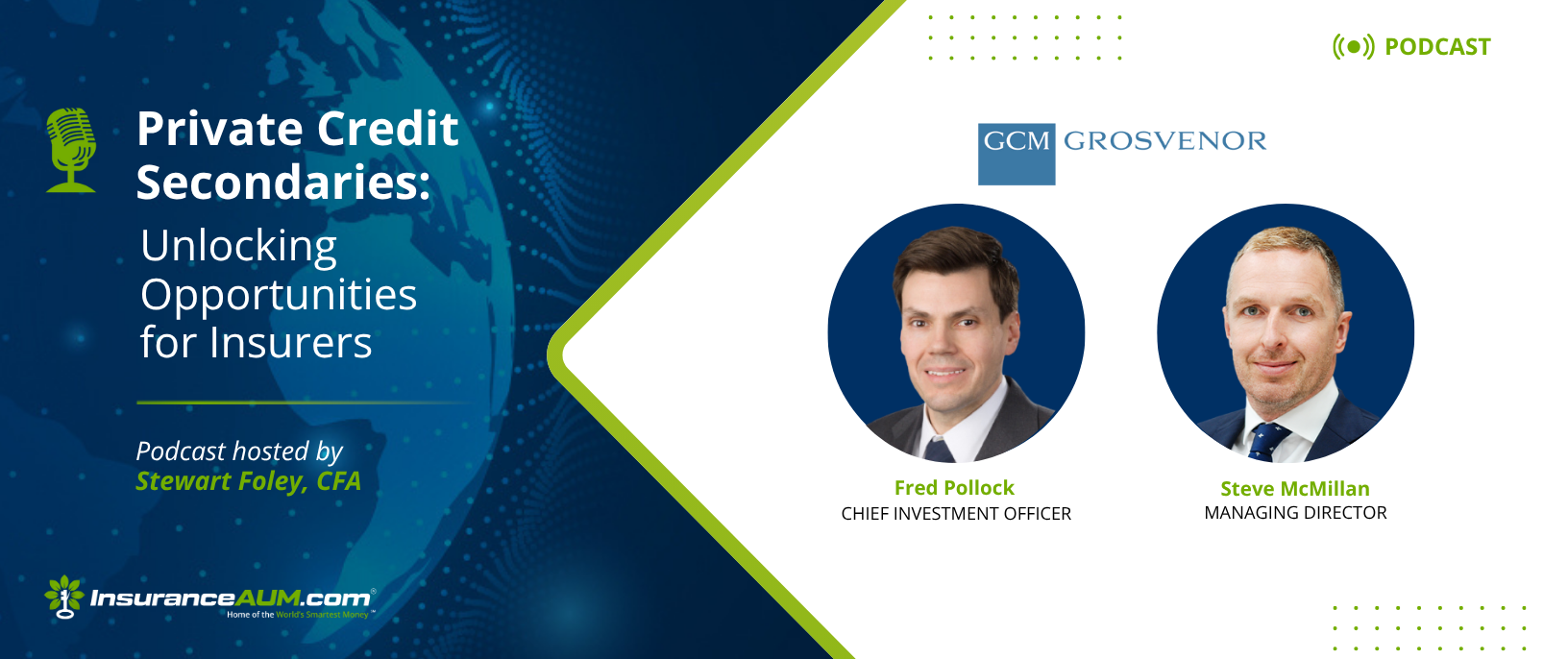
Episode 299: Private Credit Secondaries: Unlocking Opportunities for Insurers

Image
05.20 GCM (secondaries)_Web


The views presented in the podcast may include some of the speakers’ views and may not represent the views of GCM Grosvenor or others.  Also, any specific names are provided only as example. Further, past performance is not indicative of future results.


Stewart: Welcome to another edition of the InsuranceAUM.com podcast. My name's Stewart Foley, I'll be your host. Hey, welcome back. Thanks for joining us. You're listening to the InsuranceAUM.com podcast. My name's Stewart Foley, I'm your host, and the topic today is Private Credit Secondaries, Unlocking Opportunities for Insurers. And we're joined today by Fred Pollock, CIO, and Steven McMillan, head of credit research from GCM Grosvenor. Gentlemen, thanks for taking the time. We certainly appreciate you being on. We've got a lot to cover. I want to get started the way we always do. Maybe we'll start with you, Fred. Tell us a little bit about where you grew up and what was your first job. And I mean we don't get a tremendous number of CIOs on, and that is a lofty position that a lot of people strive for. Can you tell us a little bit about the path to getting there?

Fred: Thank you very much for having me, Stewart. I grew up in Cherry Hill, New Jersey, so south Jersey, just south side of Philadelphia. So I'm a Philadelphia Eagles fan, not just this year, but my whole life. So in case people wonder whether I just became a fan after they won the Super Bowl, I came out of law school, went into the investment management industry right away, had worked at Deutsche Bank for a year and then moved over to Morgan Stanley, spent the first half of my career at Morgan Stanley doing all sorts of things, meaning a very diverse set of investment skills were developed. So we traded securities for the firm. We developed and built up what was called a merchant bank, so it was all the illiquids, private equity, private credit, infrastructure. And then I went to work directly into the infrastructure fund and worked on private transactions, owning and running assets and managing those assets over time.

I joined Grosvenor after that about 11 years ago. At first I wasn't the CIO of the firm, so the first couple of years I built up our opportunistic practice that ended up leading me to work with all the different verticals across the firm. So real estate and infrastructure and private equity and credit. And I think because of my diverse background and because I had worked in so many different parts of the alternative investment universe and touched all the different asset classes, it became a logical thing for me to join all the different investment committees. And then I became the CIO of the firm five or six years ago. So it was one of these things about having a really broad skillset and touching everything that I became kind of a logical person to then help from an investment perspective, get to work with everybody like Steve, and kind of govern those practices.

Stewart: That's very cool. Steve, we're coming to you. Where'd you grow up and what was your first job? And talk to us a little bit about how you became the head of credit research at GCM Grosvenor.

Steve: Thanks Stewart, and great to be here. So I grew up in Essex, which is a region just east of London in the UK. I'm still based in London. People can probably tell I'm English. My first job, I actually took a year between finishing high school and going to college. I did a ton of different jobs. My first actual job was on a dockyard unloading a ship, which I haven't actually levered into my professional career, but that was technically my first job. And I actually thought I was broad, myself, until Fred gave his kind of background. It turns out I'm just broad within credit. So unlike Fred, I've actually had my whole career within credit markets. So I started my career on the capital markets team of an advisory firm. I then joined Lloyd's bank pension fund where I ran their credit and private credit allocations, really when the private credit market was just keeping off on coming out of the financial crisis. I then had a five-year stint at a credit manager and I joined Grosvenor five years ago. And within Grosvenor I oversee all of our funds raised activities on the primary and secondary side.

Stewart: And Fred, GCM Grosvenor has been with us for a little while, but I'm not sure how much of a household name it is among the insurance investment community. And for those that may not know, can you give us an overview of GCM Grosvenor and what you do and what areas you touch? We're going to be talking about private credit, secondaries in particular today, but your offering is much broader than that. And I think it would be helpful to get a little background.

Fred: I think you're right, by the way, that in the insurance community, we're not as well known and it's one of the things we're trying to rectify. So the firm's over 50 years old, it's exclusively focused on alts and we manage a little over $80 billion US of capital across hedge funds, private equity, real estate infrastructure and private credit. Kind of the main strategies, I'm loathe to say it, but I think we're extremely well known in the institutional market. So you think insurance companies, pension plans, sovereign wealth funds, et cetera, we're known to some insurers and we've had some insurance clients for decades kind of in some of those different areas. But it's definitely a market that has an increasing allocation to alts and we should know better. And it's part of, we've obviously built up an insurance solutions team. We're kind of getting deep in that market.

I think our client share there in terms of both mindshare as well as allocations has been growing kind of over this period of time and we want to continue that In terms of each of these areas, I think the logical ones where the ports of entry right now, one of the main focuses is private credit. It's just one of those areas that's synergistic with the balance sheet of most of the insurance companies. And it's an area where Steve and I and others spend an enormous amount of time actually communicating that out. And I think we're starting to see a lot of success in that in terms of client support around it. But I think that's right, Stewart, and we'd love people to know us a little bit better in this space. We're one of the oldest most established brands in alts, but I think we're probably not known as well as we should be.

Stewart: Well, you've got an asset in Tom Hobson out here making sure that they're on the circuit, if you will, and we're thrilled to have you on today. Insurers, as you mentioned, have been steadily building exposure to private credit, particularly in direct lending. That's one piece of the puzzle. And Fred, what else is in the private credit universe and can you walk us through a broader private credit market map and give us a sense of the size of the opportunity set, just kind of starting with the broadest as we can?

Fred: Yeah, of course. I think one of these evolutions is even in people's mindsets. So I think over the last kind of 20 years, what private credit meant changed a little bit. So historically speaking, I think when someone would say private credit or a lot of our clients would say private credit, what they really meant was corporate direct lending, which is kind of a $1 trillion market. So, big market, growing, backing sponsors and other companies kind of doing different lending and other forms of direct lending on the corporate side. But most of the private credit market meaning about another $20 trillion worth of assets is in the non-corporate non-direct lending space. So really, what you're talking about things like asset backed, consumer loans, mortgages, different types of exotic type or niche areas that are pretty big, think of shipping and pharma royalties, et cetera. So I think it's a little bit of an iceberg effect.

People see the top of the iceberg, which is corporate direct lending. It's what they know of. They know all the big names in that space like Golub or Antares or others. But the reality is underneath the water is the other $20 trillion and it's where we spend a lot more time. So if you think about our coverage, our research, I'll steal a little bit of probably what Steve's going to say and give him credit, which I think we do an exceptionally good job across the team covering all of the different areas of credit, including those other spaces. So when Steve gets time, make sure you ask him a decent number of questions about that because I think that's the real focus and I think that's where there's more value to be added to our insurance clients, frankly. Meaning, I think the direct lending market on the corporate side has become a little bit commoditized. It's relatively easy to understand. The fees have come down as a result of that in terms of cost and other things. Some people implement that themselves. I think when you get outside of that universe, you get to the other $20 trillion of the $21 trillion, people need a lot more help and I think that's where folks Grosvenor can be helpful to them.

Stewart: That's super helpful. I do know that just based on a multitude of factors, the macroeconomic outlook is on some folks' minds, right? Particularly in private credit. I've also heard folks talking about liquidity. Can you talk to us a little bit about your macro outlook right now for private credit, how it relates to those factors? And then I want to get over to Steve and get into the private, the secondaries, which is kind of the focal point of the podcast.

Fred: Yeah, I'd be happy to. So I think you have to go back in time a little bit to set the stage, which is rates were zero or base rates were zero for a very long time. And now we've been a couple of years into this idea of normalized rates. And I think it's commonly accepted now that those normalized rates are the go-forward basis, meaning I don't think anybody's base case is that we're going back to zero interest rates. It might be lower, but we're not going back to zero. So you're going to have reasonably historically normal base rate. Today, you have reasonable spreads, maybe even slightly tight spreads, meaning markets are not particularly extended. The macro outlook, in my opinion, people are pretty complacent in a way that doesn't make total sense to me. So we talk about this all the time at growth, meaning there's a lot of uncertainty.

I think there's economic uncertainty, the odds and the risks of a recession, you couldn't really argue that they're higher than normal any given year odds of a recession on kind of 10% to 15% just because it's a year and right now it's probably more like 30% or 40% odds that you have a recession in the next year. I think the uncertainty around things like certain policies that the US is instituting like tariffs, it'd be really hard to argue that there isn't a lot of potential stress and uncertainty associated with some of those changes. And it's got to work its way through the system regardless of what the rates are. By the way, even if it ended up being 10% tariffs, that's still very meaningful and it will cause change and it will cause some stress, economically. I think the other thing we were watching very closely, almost every measure of consumer activities kind of poor right now and there's a lot of stress on the consumer side in the US and Europe and in other markets.

So our writ large macro thesis is that the market should be pricing more of this potential stress and more of the uncertainty than they are. I use the word ‘complacent’ and that doesn't make us scared to deploy. I think it's always foolish to get out of risk assets and try and time markets to do all these things. I don't really know anyone's capable of doing that; if Warren Buffett can't do it, we certainly can't do it. But I do think it means you need to be super selective about the nature of what you're doing. I wouldn't want to own the beta of credit right now is probably a nice way of saying it. I wouldn't want to own the beta much of anything right now. So we are really looking for selection and alpha and intelligently grafted portfolios kind of around that. And if you talk to most of our clients, CIOs around the globe, different folks, I think they've shared this view basically, which is there's a lot of uncertainty. You're not really getting paid to absorb the beta now a lot of them feel like, “Who moved my cheese?” Because the markets reflected this a month ago and now they don't really reflect it and everything's kind of back to where it was. And then you get pressure and stress and people sort of say, well, maybe I should just own the beta of all these different markets and I don't need to do all this extra work and be selected. But we think in the long term that extra work, the selectivity being kind of opportunistic around these is the right way and it's why we end up finding our way to things like secondaries and credit. It's a market that is less efficient, has more opportunity for being selective, being opportunistic and taking advantage of some of those imbalances in terms of supply and demand of some of the different credits. And so that's why we're spending a lot of time talking about it today. We think this is a good place to be in a market that has that complacency and has some of the uncertainty that I described.

Stewart: So Steve, let's turn it over to you and pivot to private credit secondaries and just kind of help us with what are the market forces driving the emergence of this opportunity set and at what stage do secondary markets tend to form and how large is this corner of the market? And the reason I think it's important that secondaries, and I've said this on other podcasts, insurance companies have a liquidity need and clearly they can get more yield, more return in private assets and the liquidity component is always something. And it seems to me that a robust secondaries market is hopeful and may result in higher allocations by insurance companies if they're comfortable with the liquidity. So, can you talk to us a little bit about an overview of private credit secondaries that just to kind of start?

Steve: Sure, and I'll come back to a couple of the thematic sources of sellers, shortly, but I think you kind of hit the main point really, that every large primary market eventually has a functioning and vibrant secondary market. So as we've seen the primary private credit market explodes over the last 15 years but really accelerated over the last 5, it was always going to happen and it was kind of very natural to us that there ends up being a sort of secondary market in private credit as there is in private equity infrastructure, real estate. So we get asked a lot, as you can imagine, how persistent is this opportunity that there are clearly very attractive deals to do today, but is this market going to go away over the next 6 to 12 months? And I think our conviction level is very high that the thematic reasons of sellers might sort of evolve through time.

But in general, this is just some very large growing primary market. Fred mentioned that anywhere between $10 and $40 trillion of non-corporate private credit assets that are going to be need to be funded by private capital over the next couple of decades. It’s just very intuitive that there's a functioning secondary market. That said, we do see thematic pockets clearly in terms of sellers that come to the space; it used to be called the DPI effects. Clearly, realizations on both credit and private equity have been slower over the last couple of years and investors are looking to use other portfolio management tools to generate liquidity. Change of leadership's an interesting one. We see a lot of people that might've had a change in leadership at the top or within credit departments and want to pivot strategy or pivot allocations to different general partners and still see pockets of stress in the UK, the LDI crisis a couple of years ago, we're still seeing some sort of fallout of that.

So I would say they're the three main markets to the extent we do see thematic selling. But to your question around where are we now versus where we could get to. One measure that people used in a secondary space is what's the annual deal flow of secondaries over the total outstanding primaries, as the denominator. Credit secondaries had a record year in 2024; that ratio is around 30 basis points. In other private asset classes, it's around two points. So I think people can have a philosophical debate, it’s shorter duration, so maybe it doesn't go all the way up to where private equity is, but I don't think you need to reach very far to believe this market will keep growing and can keep growing as the primary market continues to grow over the coming years.

Stewart: And it kind of gets me into the next question which is talk a little bit about the core benefits of investing in credit secondaries. And you mentioned one component that I've heard, which is shorter duration, but I've also heard things about diversification, discounted entry points. Can you elaborate on those and kind of talk with us about some of the characteristics of private credit secondaries that you find compelling?

Steve: Yeah, there's a ton of utilities that relates to portfolio construction and portfolio management by purchasing secondaries or entering the market by secondaries. You mentioned diversification, you get vintage diversification, sub strategy diversification, you typically are fully ramped day one, so it's a very efficient way to deploy capital in performing assets. There's a reduced blind pool risk and there's shorter duration, which is an attribute to some people and other people would prefer longer duration. But I think we would want to bury the lede. One of the things that we find most attractive is we are buying assets cheap and we want to benefit from all of the other utility functions which Joe just described, but at its core, investors in today's market have an opportunity to buy high quality performing credit assets at which I would consider meaningful discount. I think that is the main attribute and there's sort of secondary ones which compliment that.

Stewart: And one of the things I've heard over time is that there's not a J curve. I think I've got this wrong, but that has to do with private equity, right? It's not private credit.

Steve: It's a little bit of bias, I think, if I've obviously been in private credit my career, so I like this space, unsurprisingly, but if we were to criticize our own industry... Fees were transported from private equity into private credit and that's starting to move, as Fred mentioned, there's more capitals entering the space, but there still is a J curve element in a subset of private credit investing which can be mitigated in secondary transactions.

Stewart: That's super helpful. And just from a pricing standpoint, what factors go into determining the price of credit secondary transactions? I mean I can imagine that there's a mix of fun life cycles, strategy type, underlying performance, and maybe even portfolio construction, but you mentioned being able to buy solid assets and I mean I think you'd have better transparency and you know exactly what you're buying, but can you talk a little bit about what drives price?

Steve: Yeah, and I'll kind of touch on where we think our edge is and how we're sort of approaching the market shortly. I think you are exactly right. There's a ton of factors that goes in. If we think of one extreme, a large direct lending portfolio that's highly diversified, roughly deployed with a blue chip manager. That's going to be very competitive. And taken to the other extreme, a single asset that's underperforming, last asset in the fund with a manager no one's ever heard of is going to be extremely cheap. So I think they're the kind of the two extremes in terms of transactions and, obviously, the more you relax different parameters, the pricing is dynamic. I think by far the two most important considerations are size and sort of sub strategy. So we see a large bifurcation between large direct lending transactions, which, frankly, are quite competitive. That's where most of the capital has been raised in the space over the last couple of years and everything else. So while we've tried to positions stood our fund to do is level the breadth of Grosvenor’s credit practice and sort of history and space relationships with managers to facilitate differentiated origination and underwriting and really look to source performing high quality diversified risk, but away from those more competitive multi-hundred million dollar direct lending transactions.

Stewart: I think one of the things that is underestimated by folks who are the LP community is the level of expertise and analytics that it requires. There's an old joke that goes, there's no such thing as bad bonds, just bad prices. And being able to identify value in those secondaries is no small feat. I mean, that's the name of the game. So can you talk a little bit about the team and what that effort looks like to the big liquid ones is one thing, but there's value in some of those off if you will, off the run names. Can you talk a little bit about that side?

Steve: I'll come and flip to Fred in a second because I think he's well placed just to talk more broadly around how we've tried to build and staff our credit vertical over the last five years, but specifically on secondaries, there's a lot of smart people in this market, as you guys know, you've had a time on your podcast. Our goal is to really lever our platform and our role as a very strategic investor to get differentiated deal flow and underwriting expertise. So we have a very large team which Fred will talk to. We want to pull across all of that expertise, but really our goal is not to try and be smarter for them the next folk, but really lever our role as being we either our GPS largest client or our largest prospect. And that I would say is a huge area of differentiation.

Stewart: And Fred, just talk a little bit about the team, but I guess maybe to add on a little bit, is GCM Grosvenor’s exposure to other aspects of the private asset landscape? Is that helpful in your efforts in private credit secondaries?

Fred: Ultimately all our other verticals are essentially the consumers of the credit. So think of private equity, think of real estate, think of infrastructure, think of what we do in the hedge fund business and all those businesses think about the consumer dynamics for a lot of those businesses across the board, sort of like what they're doing in their lending and so they're the consumers of the credit. So being able to see the private credit market landscape from kind of a supply side as well as the demand side in terms of how prices, for example, if I go to a bunch of board meetings or have conversations with our private equity sponsors and they're all saying “We can't believe how easy credit conditions are right now and we're all red and the terms we're getting are stupid and the lenders are not inserting enough covenants in terms of what's going on,” alarm bells should be going off when you go back and sit down with your private credit IC to talk about kind of what's going on, and you see that across the board and it leads you to pockets of opportunity. In terms of the team, it actually is probably one of the most complex asset classes to really get your arms around, and it therefore requires the most sophisticated team.

And what do I mean by that? You really need to understand private credit on a lot of different levels. To be a really smart participant in credit secondaries, you need to know the whole marketplace. So you need to know all $21 billion and what the relative value is in each of the different pockets to figure out where you want to play, you need to understand the supply demand dynamics we just talked about, including the consumption dynamics, what people are doing across the board. When you finally identify an area that you're interested in, you need to know all the players and you need to know them in a real fundamental way. How is it aligned? Who are the people who are working there, which are good shops? What's your bad shops? Who looks great when the environment is great and the sun is shining, but as soon as there's a cloud and there's a little bit of distress, they actually aren't staffed very well, dealing with that and they don't have a lot of experience in those negative cycles.

And so you lose value, you kind of need all of that. And then let's say you find the right pocket with the right players and you think this is interesting and you kind of have the right dynamics. Well now you need to know the assets. And so we built up a team of people who could all, and have all done this stuff directly. They've worked in all these places. They come from the Apollos and they come from the Blue Mountains and they come from the Carlisle and they come from the different direct lending shops and they've done all this stuff directly. They know themselves what it's like and how to of originate and they're fully capable of doing that, but then they can rip through the individual assets also to understand the dynamics and the value to set the most important thing, which is price, in the secondaries market.

You can solve a lot of ills. If you're in the wrong place or you're working with the wrong people, you're not going to solve that with price. But assuming you got those two right, you can solve a lot of the asset level issues with price and therefore getting it kind of right in terms of being disciplined about it is good. The other thing I'll tell you, which is not even team related, it's more like kind of system related. I think Steve and the team, they do a phenomenal job of covering the whole universe. So they're seeing 10, 20, 30 opportunities for every 1 that they have to execute. And so you can be disciplined on price but still fill the book, still have the right amount of risk and still people capital deployed kind of judiciously over time and not have those issues where people kind of commit and never really get deployed.

You're able to do it while being select. I think it's critically important in this category. I think when people raise a ton of money and it's a relatively narrow space and they're sort of just market takers, it's like the classic man with a hammer, everything's a nail. And they just end up doing every transaction and you get the beta in the market. I don't think we want the beta of the market, if that makes sense in terms of the way that we're exposing ourselves. So I think it's all those things, but I'm pretty proud of the team and we have a great team and there's senior level people. It's definitely got a senior bias to it and they could all be running practices in each of these areas and instead they're evaluating practices and sifting through the assets and trying to help price secondary trades around these things.

Stewart: That's super helpful and thank you for that. I want to go back to you, Steve. Let's talk about sourcing and access because I think deal flow is always worth talking about. So what does the competitive landscape look like for private credit secondaries today? And Fred mentioned, and you mentioned too, there's a lot of very smart people in this space. How difficult is it to find the most compelling deals?

Steve: Yeah, great question. I couldn't agree with Fred anymore around in general, size is not your frame of credit. So yeah, I think we've been very deliberate looking to appropriately have a fund target which allows us to operate in the least efficient areas of the market and have a very low hit rate. In terms of what we're underwriting, I think that 5% to 10% is typically what we're transacting on versus what we were able to originate. But if we were to step back, I think like I said before, the market's kind of bucketed into three. There's the focus on large direct lending transactions. You can deploy a lot of capital into that. In a high base rate world, you're probably going to be fine, but these assets aren't coming at a deep discount. Maybe you get a couple of points and you're able to use a bit of leverage to engineer some IRR. So it's not bad risk, but you're probably doing a tiny bit better than the market beta to sort of use Fred's parlance.

The other extreme, you have some kind of hedge funds or specialty firms looking to bid tail end assets, illustratively bid 25 cents looking to recover 50 cents. And then you've got those in the middle of which we are one where looking to lever our platform to originate less competitive but performing assets. And I think being able to look at non-direct lending is a key edge for us here. As Fred mentioned, the asset-based lending market is huge and a lot of people it's just still very restricted there. So we've been very successful in originating, but we've consider at least as high quality if not high quality funds on the asset-based lending market and they'll typically come at a 15 point discount relative to a 2 to 5 point discount on direct lending.

Stewart: And Steve, once the credit is in the door. Can you talk a little bit, and this is a big question, but can you talk a little bit about the underwriting at GCM Grosvenor and what that process looks like from sourcing to pricing and execution?

Steve: And I think this is key, and Fred touched a little bit around our approach here and how we've staffed. So everything we do, we will fully underwrite on a bottoms-up basis. So every transaction and it might be a portfolio with 10 underlying funds. Every fund we will fully model, we will typically calibrate our upside case to our manager's base case and our experienced managers, they're rarely under optimistic on their portfolios. And then we'll be applying haircuts as it relates to losses, duration, capital return and other parameters. So we end up with a profile of scenarios, we have a downside scenario, we have a severe downside scenario and then we're using that to calibrate our bid prices. I think one of the nice attributes of credit secondaries is given you’re buying at that discount, and these are diversified portfolios, this thing looks very good in downside scenarios, it's very hard to calibrate exactly are we going to end up base case? Are we going to end up upside case? But these things are hard to break if you're buying things 15 points cheap and you're diversified and performing. And I think one of the attributes that people very much like in this space is you can run significant default assumptions through portfolios and still be in that kind of high single digit type return profiles.

Stewart: Steve, it's my understanding, and maybe you can help me with this, that you're exploring a rated structure which, as you know, is attractive to insurance companies because I think a lot of times folks are looking at what's my return on regulatory capital. Can you talk a little bit about the rated structure that you're exploring and why you're going down that path?

Steve: Yeah, as you can imagine, we've had a ton of conversations over the last six months with existing partners of ours and potentially new partners around the secondary strategy, both the market more broadly and specifically what we're doing. And it seems to resonate with the insurance channel and I'm not sure whether that's sort of Tom and Yuan doing a very good job or whether there's something inherent in the strategy, but I think one of our takeaways a few months ago is this is a strategy that seems attractive to insurance companies and on the back of that we wanted to create an implementation option, which in rated four to make that implementation as efficient as possible for the insurance channel. So no difference in terms of how we're managing the underlying assets. It would all be the sort of same exposure then our other partners are getting but just different and more efficient way for the insurance community to access the risk.

Stewart: Yeah, that's super helpful and I want to go to you Fred, to wrap up here a little bit. So can you give us a couple of key takeaways from this podcast today in that would you please include some of the ways that GCM Grosvenor is differentiated in this space?

Fred: Yeah, happy to. So I think if we have the kind of key takeaways we think about. The first, the private credit market is extremely attractive and people are increasing their allocations including the insurance market, and I think that's going to continue for a long period of time. As they're doing that, the market is getting more differentiated and more sophisticated and deep, just like private equity. So the idea of private credit secondaries, it's coming and it's coming faster than it developed in these other areas. Earlier in this podcast, Steve talked a little bit about how it's still a really small market relative to the primary market and that's true, but it's catching up fast and I think everyone needs to find a partner and needs to figure out how they're going to go about making their investments and figuring out their allocations in this space. I think GCM Grosvenor is differentiating this space in a lot of ways that the first one, we just have a very large platform and decades of experience working with all the underlying credit funds across all these areas.

So we know all the areas and we know all the players and those are the first two things you need to do to be successful in any sort of private credit secondaries transaction. We've then built up an extremely sophisticated team that's able to evaluate the other parts of that, including the underlying assets and appropriately price the assets. I think the latter one, what we're proud of what we've done is actually kind of the easier one people can hire folks and figure it out. It is not possible to build up the platform, build up decades of experience and build up the relationships in the network that we've built up over a long period of time because we've been allocating to these funds for decades and decades. And so I think that's really what's differentiated. And then you need to have a great team and you need to have a greater approach. You need to be disciplined on pricing to take advantage of it. So I think those are the things that kind of differentiate us and I think everybody needs a partner and we would love to have conversations with different participants in the insurance space about how we could be helpful to them or just how we can educate them a little bit about what we're seeing.

Stewart: It's been a tremendously informative discussion on private credit secondaries. I appreciate you both giving us your insights and the benefit of your experience. The last two questions I've got, one is related, you mentioned the team a couple of times and the question gets back to kind of the culture and it goes, what characteristics are you looking for when you're adding to your team? Not necessarily like can they use Python and did they go to this school or that school? But really more about what characteristics are you looking for when you're hiring?

Fred: It's a complicated mosaic is the right way to put it. And so what do I mean? Everybody has to be smart, everybody has to have industry experience, everybody needs to be able to model and do the investment analytics and all the rest. I think of that as table stakes. The things that are truly different and important when you go to hire, it's really about the people. How much are they going to adhere to our culture? So Grosvenor has no walls and no barriers. Everybody is expected to work together in the mission to improve the outcomes for our clients regardless of where you sit, what group you work in or what have you. That kind of unified open architecture approach to kind of going after alternative investing is hard to build, but it is our culture and they have to fit into it.

How do I put it? The body will reject the organ transplant if the people really aren't wired to do that. If they want to kind of do everything themselves and be a little bit insular and they really care only about their own activity and their own performance and it won't work. You have to be kind of it And really, what am I saying? You have to be a team player to fit into our culture and in credit credit, I can't think of an area where it's even more essential to be a team player. It's sourcing its relationships, its execution. You're going to build a portfolio with 30, 40 positions. You have negative convexity and credit, which means you're going to have to rely on the people next to you to be executing just as well and to be building a great portfolio. And so we try and kind of adhere to that approach. So we reject people more on culture once those other things. If you get through the paradigm, if you get through all of that in the gauntlet, you get to the end. It's really because you don't fit is why people get rejected in our system as opposed to all the other stuff.

Stewart: That's super helpful. So the last one's a fun one, it's dinner for four, the two of you and you get each get to invite one guest, alive or dead. Who would you most like to have lunch with? Steve, I want to start with you. Who would your guest be?

Steve: I might try and tee Fred up on his guest. I'm going to invite the tennis player Alcaraz. I think it'd be super interesting, we won't have to talk about investing on markets, talk about high performance, what it's like to be a Gen X’er and at the top of his field. So he's who strung to my mind.

Fred: How about you Fred? I am glad I got to go second because I get to think this through more than Steve. I'm very grateful for that ordering. I'm inviting Ben Franklin. So I've always thought Ben Frank was kind of one of the most interesting people. He was a statesman, he was a successful business person driven, kind of came and rose from nothing and figured out how to make it work in kind of a lot of different cultures. And so he's the one I'd be inviting, sort of talking about what's going on and what I'd be fascinated know, what he thinks about what America looks like today versus what he hoped it would look like back in kind of the founding of the country.

Stewart: It's really interesting because you guys were participants in our recent Philadelphia event and we had a, I don't know what the right term is, docent or historian, that was that his job is he dresses like Ben Franklin and knows everything there is to know about him. And it was super interesting. He said that the building we were in, the hotel we were in was the first building in Philadelphia that was designed to accept electricity in advance. And I was just like, it's fascinating. And the other thing that's interesting about Ben Franklin, I think I've got this right, he was involved in the founding of one of the first insurance companies that's still operating today called the Philadelphia Contribution Ship. So there's definitely an insurance tie back there too. So I really enjoyed having you both on. We've been joined today by Fred Pollock, CIO, and Steve McMillan, head of Credit Research at GCM Grosvenor. Thanks for being on, guys.

Steve: Thanks Stewart.

Stewart: Thanks for listening. If have ideas for podcasts, please shoot me a note at Stewart@insuranceaum.com. Please rate us like us and review us on Apple Podcast, Spotify, Amazon, or our brand new YouTube channel. We are the home of the world's smartest money at InsuranceAUM.com. We'll see you next time.

Share this post

Sign Up Now for Full Access to Articles and Podcasts!

Unlock full access to our vast content library by registering as an institutional investor

Register

Contacts


GCM Grosvenor

GCM Grosvenor (Nasdaq: GCMG) is a global alternative asset management solutions provider with approximately $86 billion in assets under management across private equity, infrastructure, real estate, credit, and absolute return investment strategies. The firm has specialized in alternatives for more than 50 years and is dedicated to delivering value for clients by leveraging its cross-asset class and flexible investment platform.  

GCM Grosvenor’s experienced team of approximately 550 professionals serves a global client base of institutional and high net worth investors. The firm is headquartered in Chicago, with offices in New York, Toronto, London, Frankfurt, Tokyo, Hong Kong, Seoul, and Sydney.   

For more information, visit: gcmgrosvenor.com

Tom Hobson 
Managing Director 
thobson@gcmlp.com 
(484) 800-5073

900 N. Michigan Ave, Suite 1100,
Chicago, IL 60611


View the contributor Page

Sign Up Now for Full Access to Articles and Podcasts!

Unlock full access to our vast content library by registering as an institutional investor .

Create an account

Already have an account ? Sign in

Ѐ Ё Ђ Ѓ Є Ѕ І Ї Ј Љ Њ Ћ Ќ Ѝ Ў Џ А Б В Г Д Е Ж З И Й К Л М Н О П Р С ΄ ΅ Ά · Έ Ή Ί Ό Ύ Ώ ΐ Α Β Γ Δ Ε Ζ Η Θ Ι Κ Λ Μ Ν Ξ Ο Π Ρ Ё Ђ Ѓ Є Ѕ І Ї Ј Љ Њ Ћ Ќ Ў Џ А Б В Г Д Е Ж З И Й К Л М Н О П Р С Т У Ф Х Ц Ч Ш Ā ā Ă ă Ą ą Ć ć Ĉ ĉ Ċ ċ Č č Ď ď Đ đ Ē ē Ĕ ĕ Ė fi fl œ æ ß