




TPG-

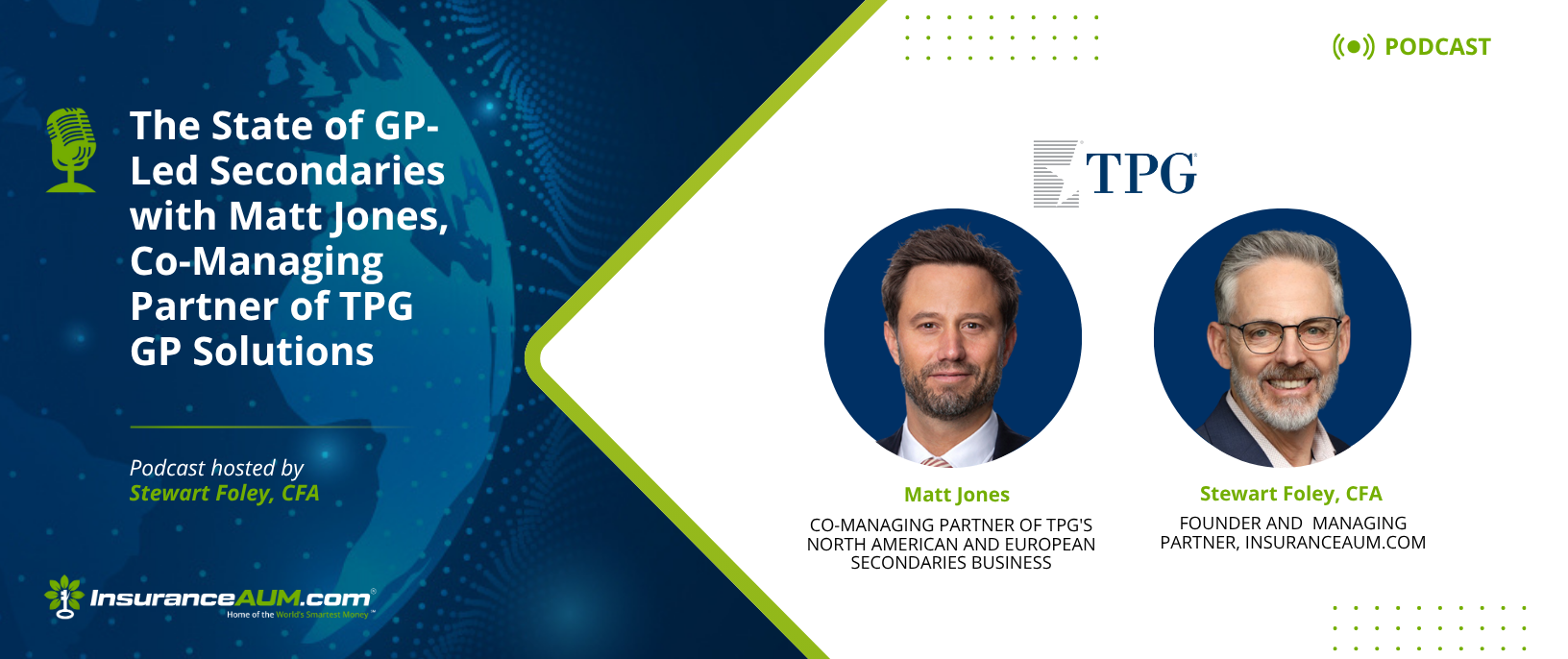
Episode 303: The State of GP-Led Secondaries with Matt Jones, Co-Managing Partner of TPG GP Solutions

Image
05.30 TPG (secondaries)_web

Stewart: Hey, welcome back. It's great to have you. This is another episode of our Executive Spotlight Series, and our goal is to talk with leaders defining the future of insurance asset management. And we never really talk about this, but our overarching goal of these podcasts is to educate people about particular asset classes and interview CIOs to see where they see opportunities and risks and so forth.

We are here to talk secondaries, specifically GP-led secondaries. And joining me is someone with deep expertise on this subject, Matt Jones, co-managing partner of TPG's North American and European secondaries business. Matt joined TPG in 2022 after two decades at Pantheon, where he co-led their global secondary strategy. He's worked across the full life cycle in this space, from strategy to sourcing to investment execution. Welcome to the show, Matt. Thanks for taking the time.

Matt: Very happy to be here. Thank you for having me.

Stewart: So we always start the same way, which is, and we've added a new question, so I'm anxious to hear what our audience thinks of it, but it is, where did you grow up? What was your first job? Not the fancy one. And what was your first concert? That's the new one.

Matt: Oh, wow. Okay. So I grew up across a number of different places, actually. I was originally born in Kent in the UK, in a town called Chatham. And then we moved to Detroit, Michigan, actually, when I was about nine years old because my father worked for Ford. And so we lived in Detroit, Michigan for three years in the late 1980s when the Pistons won the NBA back to back. So it was a good time to be there.

Stewart: Little bit of a culture change from Kent to Detroit.

Matt: It was, but it was a lot of fun. And Detroit at that point in time, it was a great place to grow up, I mean, and I'm sure it still is, but it was the late 1980s and the place was booming. So we were there for three years and then my father got moved to Spain again with Ford, and so I ended up having to go to boarding school in the UK, and I obviously saw my parents during the holidays. And so I went to boarding school in Kent in the UK, which is where I was originally from. And then after that, I went traveling for a year and then came back, obviously went to university, went traveling for a year, came back to the UK, and started work. And then I was based in the UK for approximately 10 years, and also in New York for 10 years. So I've moved around a fair amount. In terms of my first job that I ever had, the first job actually was probably washing windscreens and changing oil of cars at petrol stations or gas stations, as I guess you'd call them in the US, which I did for a couple of summers when I was at school. So that was my first job. 

Stewart: That's super cool. I mean, our advisor, a gentleman named Jonathan Kalman. He is neck deep in this business, but he started as a mechanic as well. So yeah.

Matt: I wouldn't listen. It is quite funny. I wouldn't say I was as good as a mechanic. I was literally washing the windscreens and changing oil or topping up oil rather just for tips at a gas station over a couple of summers. I did a variety of jobs when I was younger. I picked fruit on farms, I worked in a factory, I waited tables, I did all sorts of things. And obviously, this was just to get money when you're younger and a student, I think those kinds of jobs are important. It's important to get experience of a wide variety of jobs when you're younger and learn a lesson about the value of hard work and how you've got to work hard to make your way forward. With regards to the first concert I attended, that's a harder one. I can't actually recall which was the very first concert that I attended. I mean, there's one that sticks in my mind, which is the Rolling Stones. I saw the Rolling Stones at Twickenham many years ago. That was very cool. But I've been to, obviously, a large number of concerts since, but I think that may have been the first. I certainly didn't go to many when I was a kid.

Stewart: No, no, no, no. Us. I mean me either. My first one was Billy Squier opening up for Pat Benatar, and we didn't give a hoot about Pat Benatar. We only wanted to see Billy Squier, right? And this was in the day before, there was no digital tickets. You had to show up the day before, you had to go to the place that sells tickets. They give you a line ticket, you have a number on it, then you get in the next day, you come back, you get in line according to your line ticket, and then you can buy as they go. Right? So it was a relatively low-tech deal.

Matt: Yeah. Sounds it, sounds it.

Stewart: But let's dig into the heart of it here. So let's start with the basics, right? So, GP-led secondaries, how did it come about? How has it evolved over the last few years?

Matt: I'll take a step back and define what we mean by GP-led secondaries when we use that term. Basically, a GP-led secondary is any transaction that is being instigated by a general partner. So, if you think about the secondaries market, you have LP secondaries, and those are secondary transactions that are instigated by a limited partner and investor in a fund. And there, they just sell a position in a fund to a secondary buyer who replaces them in that fund. And the general partner, the private equity fund manager, really doesn't have a great deal to do with the transaction. They have to approve the replacement investor, that's it. But the GP-led transaction, by contrast, those are transactions that are actually instigated by general partners. So they're front and center in the deal. And perhaps if I could talk about how the market came about, it'll give a greater illustration as to the structure of these deals and why they occur.

So the market really started to form post-financial crisis, and that was when, those that were invested in private equity at the time might remember, there were a large number of funds that had struggled to raise any further capital, and they had legacy assets in their existing funds, which they couldn't sell. And they had investors who were tired and wanted their money back, and they started to be called zombie funds because they couldn't raise any more money. And so the secondary market stepped in at that point in time, working with the general partners to restructure those funds and take the assets from the existing fund, move them into a newly formed SPV, reappoint the manager of that fund—so the manager continues to manage those legacy assets just within a new vehicle—and give them more time and more capital to try and manage those companies out to a successful exit.

Those deals were pretty hairy, and they were pretty hairy because often they were around lower-quality managers with questionable assets that couldn't be sold. And so the secondary players were coming in to solve a problem. You had these funds that couldn't raise any more money. They were running out of management fees. Investors wanted their cash back, and so a secondary players came in to restructure the whole situation. But as I said, there were problems with those deals around the quality of the companies and the quality of the managers that typically did them. And so to begin with, there was a little bit of a stigma around GP-led transactions that it was only lower-quality managers that would pursue them. And that was across the course of I'd say 2010 to 2012. But gradually, 2013, 14, 15, you started to see some higher quality managers realize, well, hold on, we've got some good companies still stuck in an older fund where actually the fund needs to be wrapped up, but we just want a little bit more time with these companies and a little bit more capital to maximize their value.

And so maybe we can use this transaction structure around our older funds. And so then you started to see higher quality managers doing it with their older funds, where their older funds have run out of time. Everyone on the line is probably aware that private funds have a 10-year life. So, funds that had run out of time, assets that weren't necessarily lower quality, but they just needed more time and more capital to maximize their value. And so they started to restructure their old funds and gradually started to see more and more of these transactions. And then it evolved further where you had more innovative general partners, private equity managers who said, well, hold on this structure that's being used to restructure older funds, why can't I just move one company into a newly formed vehicle, replace my existing investors? So I get to own that company for the next leg of its private ownership.

And the reason behind that is with the private equity fund structure, a 10 year vehicle, even if you have a tremendous asset, a company that's massively outperformed and you've earned three, four times your money on it, historically you had to sell that company, even if you knew that that company had a trajectory up until the right thereafter, and it was going to generate a lot of money for whoever then bought it. You had to get cash back to your investors. And so some general partners started to realize, well, let's use these structures as a means of holding onto that company. We can provide cash back to our existing investors because it represents a sale for the existing fund. Move that company into a newly formed SPV, called a continuation vehicle. We, as the existing manager, would continue to manage the asset and the secondary buyer effectively just replaces their investors, the secondary buyer sets the price of the transaction also.

And so people started to realize you could use these structures as a means of holding onto your best assets. That then completely changed the dynamics in this market, and it led to certain dynamics that you see in the single company space that weren't present in the fund restructuring. And those dynamics are fund managers started to pick their very best companies to move into these newly formed vehicles. And this single asset GP-led market as it became known, started to benefit from tremendous positive selection bias managers looking at their portfolio and thinking, well, hold on. Out of all of my companies, I know that one's got a lot more upside. I don't want to sell it to a competitor. Let's move it into this newly formed vehicle. And so it benefited from positive selection bias and deal after deal after deal, you saw fund managers bring in their very best assets from their funds, and not necessarily at the end of the fund's life, but halfway through the fund's life.

It was a means of providing liquidity to their investors, but maintaining ownership and control of the asset for the next leg of its life. That single asset market really started to kick off in 2017, 18, when it was really formed. And since then, it's grown at a rapid rate. Now, the GP-led market overall is now about half of the overall secondary market. And the single asset GP-led market's been the fastest growing part of the secondary market for the last four to five years. And the single asset space now is about a quarter of the overall market GP-led about half of the overall secondary market. So it's seen rapid growth and a lot of evolution since the first deals were done post-financial crisis.

Stewart: That's super helpful, and what a great explanation. I just want to add one little minor thing: for people who don't know what SPV is, I'll give it a shot, right? It's a special-purpose vehicle, and that's a bankruptcy remote trust that says that if the originator or the GP, something happens to them and they go away, the investment does not. Is that a fair assessment of what SPV means?

Matt: Listen, an SPV is just a legal entity. It's just a legal entity that will hold the company in much the same way. It's the same thing as a private equity fund. So if you think a private equity fund, many of them are structured as Delaware Limited partnerships came in limited partnerships. And when I say an SPV, especially formed vehicle, it's exactly the same structure. There will be Delaware Limited partnerships or Cayman Limited partnerships. So the same structure as a normal private equity fund from a legal basis, but it's just specially formed for that company. And so it's just terminology. Unfortunately, our industry is littered with lots of terminology that people who operate within the industry become accustomed to, but forget that people who are outside of it may not be familiar with, but all it means is a legal entity that holds that company, and that legal entity will be a partnership. And so when we invest in one of those continuation vehicles, as they're called, to hold that company for the next leg of its ownership, we become a limited partner in the same way that an investor in a private equity fund is a limited partner in that private equity fund. 

Stewart: Super helpful. Yeah, absolutely. So, let's talk risk and reward for a minute. How do you think about the risk-return profile of GP-led secondaries relative to traditional buyout strategies? The other side of it is, and I think this is true, can you talk a little bit about what a J-curve is and why these secondaries don't have one?

Matt: Yeah, perhaps I'll start by explaining what a J-curve is. So a J-curve is in private equity where you invest in a fund, a normal buyout fund, and a normal buyout fund will charge fees on commitment. So from day one, once you commit, you are being charged fees because obviously they're out there looking for transactions, they've got their team, they're incurring expenses, so they need a management fee from day one. So you are starting to pay a management fee before they have even made an investment. And what that means then is for the first year, maybe slightly longer, it'll depend upon the fund, your returns will be negative because they have not yet made an investment. Or if they have made an investment, it's still held at cost, right? So the very first investments held at cost, and then you've got management fees and expenses pulling down the returns of the fund.

And so what you typically see is negative returns in the first year or two of a private equity funds life. And then as those companies start to perform and you start to see equity value build up within those companies, you start to see the value then start to increase thereafter, which is why it has that J shape that people refer to. So that's the J-curve. And anyone building a private equity portfolio for the first time should expect there will be negative returns for the first year or two. One of the reasons that people have invested in secondaries, and it's not the only reason historically is because there is no J-curve. So it tends to be a very nice compliment to the rest of your private equity portfolio. And then on the LP secondary side it's typically because you are buying companies and you're buying fund positions at a discount to their NAV, and then as soon as that transaction is closed, that discount gets reversed.

And so you get an instant uplift on performance. And so you really don't get the negative part of the J-curve that you see on typical buyout funds. In the GP-led market, it's the same impact but for a slightly different reason. When we are evaluating our transactions, typically we are looking at a valuation date that is three, six months in the past, and once we have agreed a value, it may take three or six months to complete the transaction. So by the point that we have actually completed the transaction, you've already seen EBITDA growth continue within the underlying companies. Value has been built up within the underlying companies. And so typically very shortly after you close the transaction, you'll see an immediate write-up in value. And so this is why in the secondary market, you don't get the same J-curve that you do in the rest of the buyout market.

And then with regards to the risk rewards of the GP-led market versus in a single asset GP-led transaction versus a normal buyer, we would argue very strongly that across this marketplace, single asset GP-led transactions benefit from lower risk and a greater certainty of outcome relative to normal buyout. And it's important when I say that because, of course, the return is always the other part of the equation. These deals are being underwritten to the same returns as a buyout. You're investing in a single company, fund managers don't want to do these deals unless they have confidence there's a lot of upside left, otherwise they just sell the company rather than move it into a continuation vehicle. So the deals are being underwritten to the same returns as in buyer, but we and other market participants would argue that there's much lower risk in the transaction.

Now let me explain why they're lower risk. Number one, as I said, there's a positive selection bias. So you're typically getting companies at the higher quality end of across the private markets. But the main reason why there's lower risk is because you are investing in a company that has a demonstrated track record of performance. So if you think about a buyout manager when they invest in a company, every company on day one, they think it will be successful; otherwise, they wouldn't do the deal. If you fast forward five years, then they know very well which company they regret buying, which company has outperformed which company's a mediocre performance. And it's with that knowledge five years in on average, typically across our market, that they are picking one company from their portfolio to move into a continuation of it. So they have already owned it for four to five years.

They sit on the board, they know everything there is to know about the business, they know about the that's about to be won, the contract that's about to be lost. And we are investing alongside the manager, the existing manager in the company. And this is an important point to understand about the single asset GP-led market. When that company gets moved into the continuation bit and it represents a full sale for the existing fund, the manager who manages that company, when it gets moved in, they will get some proceeds back from the sale of that business. They will then reinvest those proceeds into the business alongside the secretary buyer, and often, they'll put more money into the business on top. And so, typically in these transactions, you see some of the strongest alignment you'll see anywhere across the alternative space. So in a normal private equity fund, a fund manager would put 1 to 2% of the capital in a normal private fund would be from the fund manager in continuation vehicles, typically it's 5 to 15% of the capital has come from the fund manager investing into that company.

So they've got a lot of skin in the game. Now, these managers that are investing alongside you, they've known the asset for the last five years, and they've hand-picked it out of their portfolio as the one that they want to own for longer. And if you think about a new buyout transaction, you have a new owner, new company management, new strategy, often a capital structure with additional debt, well almost always a new capital structure with additional debt layer on with a continuation vehicle. You have same owner, same company management, same strategy, the same capital structure typically without additional debt being put but on. And they have demonstrated success in doing what they have been doing over the last five years. And so when you invest five years in, you've got much greater knowledge, much greater visibility around the performance of the company, and therefore a greater certainty of outcome thereafter.

And so this is why we argue they're lower risk. And actually, it started to come out in the industry-wide figures. There have been industry-wide performance reports done now that show a much narrower dispersion of returns relative to buyout, but performance in line and a much lower risk of loss. So I would argue they have the capability to generate the same returns, but with lower risk. An important caveat to that, however, in the buyout space, you could see a company make five times in our space, typically underwriting to two to three times cost. You would typically won't see a company generate five to six times, but as I said, lower risk with that deployment.

Stewart: Yeah, it makes total sense. A tongue-in-cheek comment, I'm sure you may have noticed that there's some geopolitical volatility in the US. How has the current market backdrop, rates, valuation, and macro trends affected activity and deal structure in the GP-led space?

Matt: Yeah, anytime you see volatility in the broader macroeconomic market, it tends to be beneficial for the secondary market. If you look back through the financial crisis, you look back through even actually post-tech bubble in 2001, 2002, through the financial crisis, through COVID. Those are typically the years when secondary markets make their best returns. Whenever there's volatility, whenever there's dislocation, it creates opportunity. And the secondary market has always been relatively nimble and able to take advantage of those opportunities that come forth when you see dislocation and the broader marketplace. So I think that's the broader backdrop. Typically, when you see dislocation and volatility, this market tends to do well. We like to call it an all-weather strategy as well. I mean, it does well when markets are doing well as well. This particular bout of volatility that's been driven by all of the discussion around tariffs and other events that have happened in the broader macroeconomic arena, there's a couple of impacts coming out of that.

Number one, we think we will be able, we're already seeing on the deals that we're negotiating currently, pricing has come down a little, right? So we are able to then invest in high-quality businesses, businesses that we've been pursuing for some time and have a high degree of conviction around at lower prices than we would've been able to six to nine months ago. So it's good from an entry valuation perspective. Equally, we think this volatility will drive even more fund managers to consider continuation vehicles. And the reason behind that, fund managers are under immense pressure to generate what everyone in the industry calls DPI. Now, what is DPI? It’s distributions to paid in, is what that stands for. Basically, private equity managers have not been handing back cash to their investors because the exit markets have not been, the M&A markets haven't been great.

The IPO markets have been shut. So it's been hard for private equity managers to sell businesses. And that pressure to hand back cash to sell businesses is only growing, and it's got more and more and more acute, I'd say, over time. And everyone was hoping this year would be a great market for M&A. It's not proven to be the case. So that pressure was just growing on private equity managers. When you are under pressure to sell businesses, the easiest business to sell is always your best business. It's the one that other people from across the market want to buy. But of course, a private manager doesn't want to sell their best business in a poor market environment, and they may test the valuation of that in the market and run an informal process or even run a formal process and get feedback from the market where the manager thinks it's worth 15 times EBITDA as a valuation multiple.

The market comes back and says 12, and the manager says, well, hold on, I'm a buyer at 12. I know anyone that buys this business at that price is going to make a lot of money. And so then they start to think, well, I don't want to sell at that price because I know the buyer's got to make a lot of money. I'd much rather move it into a continuation vehicle. And so they start to explore these transactions and of course the continuation vehicle enables their existing investors to get their cash back and enables the manager to continue to own and operate that business and benefit from the upside, upside thereafter. So we think the volatility overall will allow us to enter into companies at better valuations and it will drive more deal flow into our market. And to be honest with, I mean our market is already very busy before the volatility, but we think it's going to drive it to an even higher level of activity. 

Stewart: Let's just go just a little bit deeper and talk about sourcing. So, talk about how GP-led deals are sourced, and once a potential opportunity is on the table, what steps are you taking to diligence that transaction?

Matt: So, perhaps if I talk about the sourcing first, and then we'll move on to diligence. Our market is heavily advised. So, there are a lot of intermediaries, advisors, brokers, whatever you want to call the banks and groups that perform that role. And there's a reason behind that. The reason our market is heavily advised is because these are conflicted transactions. So as I said, the fund manager is making a sell decision for their existing fund, but they're also buying because they're investing in a continuation vehicle that is buying that company from their fund. So whenever these transactions occur, the fund manager has to go to the limited partners advisory committee for their fund and seek consent for conflicted transaction. Now, in order to get that consent, their investors, their existing investors want to know that arms length process has been run around the transaction and that a third party advisor has been appointed to ensure because there's a conflict.

The fund manager is both a buyer and a seller, so they want an advisor to be involved to ensure that there's been some degree of competition, arms-length pricing, et cetera in the process. So it tends to be a heavily advised market. Having said that, what you are seeing as the market develops is an increasing number of deals being sourced directly. And when I talk about sourced directly, what do I mean? And we can come on to talk about some of the differentiations in the marketplace, but there are groups entering the market now that are integrated or more integrated with buy platforms. And if you think about a buy platform where you may have a team that's focused on software and they've been following the top software assets in their market for some time, wanting to buy them eventually. And then when they approached the manager to try and buy a software asset that they've been following for the last three years, the manager said, well, it's not for sale. I'm thinking about a continuation vehicle.

Well, at that point, the direct software team that specializes in that area may then refer the continuation vehicle to their in-house secondary team. And so you are seeing referrals come from buyout teams across the marketplace where they have a secondary team that's integrated with their platform, which is not common across the market, but we're seeing new entries, new entries of that type in the marketplace. You also have general partners now reaching out early to potential leads to see if people will act as a lead on their transaction. The last thing you want to have happen if you're a private equity manager is to go to all of your investors and say, I'm doing this continuation vehicle. I want you to clear conflicts. It's a tremendous company. And then you can't get financing. You can't get a secondary buyer interested, and our market is heavily undercapitalized.

There aren't that many lead buyers relative to the opportunity. And so to counter that risk, what you see is fund managers putting feelers out early. So before they run any process, sometimes before they point an advisor, they start to talk to prospective bias. Might you be interested in this company? What would the parameters of a transaction look like? And if they get a lead buyer interested, then they'll appoint an advisor, then they move forward with the full process and run a process. So the sourcing a lot of these deals now as starting out more on a bilateral basis, an early conversation with a fund manager, but then they'll appoint an advisor and run some degree of competitive process thereafter. And it's important to understand, well, the level of competition in our market is limited. There aren't that many lead buyers, and it's partly a function of the market being relatively mature. It's grown very rapidly, but there are new players trying to come into the market.

Stewart: Yeah, it's interesting that you mentioned the new players because that leads me into our next question, which is: there are more players entering, and from your seat, what really separates the high-quality groups investing in single asset continuation vehicles today? I mean, if I'm an investor, how do I know? What should I be looking for?

Matt: Sure. This market is very, very different from the traditional secretary market. If you think about the traditional secretary market where you are buying fund positions, a position in a fund, and typically they're very diversified. So, when you look at a deal in the LP secretary market, there may be 10 fund positions or 20 fund positions. Each of those funds has 10 to 20 companies underlying it. In an average deal, you could be looking at 200 to 400 companies just in one transaction. And traditional secondary buyers, when they build their secondary funds, they may have 5,000, 10,000 companies. So it's much more akin to a diversified private market index, if you will. The skills involved in evaluating that type of transaction, very different to the skills involved in evaluating a single company. And when you invest in a single asset space and the funds that invest in this space are typically much more concentrated generating alpha rather than base their conviction strategies.

So when you think about the characteristics that you need to be successful in this marketplace, I'd put the players in a couple of buckets. So you have the traditional secondary buyers who do participate in the single asset market, and the reason they participate, they see the opportunity, right? They see these are the best companies from this private equity fund. You can generate buyout returns. Of course, we want to try and play in that market. It'll boost the returns of our overall fund. But their entire expertise and investment committees and investment teams, the history is all built around buying big diversified portfolios, and they have no sector expertise. They have no direct investment experience. I would argue when you are evaluating single companies, that is much closer to direct buy to investing. And so having direct investment experience and sector expertise, so you can actually truly understand what you're buying because you're buying concentrated positions, is really, really critical.

So you've got the traditional players, and increasingly I think they're going to find it difficult to operate in this market because there are newer entrants coming into the marketplace who are integrated with buyout platforms, who were bringing sector expertise to the table. And when they're evaluating these companies, they're bringing a wealth of healthcare software expertise that other players in the market. And fundamentally, I'd sort of boil this down to a question, which is, if you're going to put your money into a transaction, into a company, who do you want making that decision? Do you want someone with many, many years of direct investment experience, sector expertise that operates every day of the week in that space, or do you want a generalist player that is normally buying big diversified portfolios? And so to me, this market is evolving, it's becoming more direct in nature, and I think you'll see those that succeed here over the long run will be those that have the capabilities that I've mentioned, sector expertise, direct investment experience to bring to the table when they're evaluating these deals.

Stewart: As we wrap here, I mean one of a tremendous education on GP-led secondaries. I've learned a tremendous amount today. What are a couple of takeaways for our audience that you'd like 'em to remember out of this podcast in particular? And then I've got a couple of fun ones for you.

Matt: And then you've got a couple of fun questions, did you say?

Stewart: Yeah, of course.

Matt: I mean, it's hard to summarize in a couple of takeaways. I guess what I'd say is I've been investing in the secondaries market for 23 years now, and across the marketplace, and we've seen exponential growth in this market, and it's generated tremendous returns consistently across cycles. Everyone has always tried to find the best fund, and within the best fund, what drives your interest in it? It's the best companies. And never in the past did you have the opportunity to access just the best company from within a private equity fund and this market for the first time. Now you have the ability to access the best company with a proven track record. They've invested in the company over the last four to five years. It's proven its success, but it's the first time you've been able to invest in the best company from a private fund as selected by the manager themselves. And so this is why this market is so exciting, and I don't think it's not going to stop growing. The desire for a private manager to own their best asset for longer rather than sell it onto a competitor is not going to go away.

Stewart: Yeah, I agree with you. So the first one is, when you're adding members to the team at TPG, what characteristics are you looking for? Not the school they went to or can they use…? Are they an Excel wizard? But what characteristics are you looking for when you're hiring folks?

Matt: It's a great question because for me, the school they went to is less important. Typically, when we're looking at CVS and batches of CVS, everyone we're talking to is talented and smart, and they've typically gone to good schools. For me, the most important characteristics in an individual enthusiasm, a desire, and a willingness to prove themself and work hard, and a passion for investing. If you've got those three characteristics, you're going to do well. You do see people that are immensely qualified, who don't have the right attitude, aren't passionate. They've gone into investing because they're happy to be smart at maths, not because they're genuinely interested in it. I want to work with people who on their holidays, are picking up investment books because they're interested in it, right? And they're enthusiastic. They want to prove themselves. And if you've got someone like that, even if they don't have quite as much experience as the next guy, they'll learn quickly. They'll learn quickly, they'll get up to speed, they'll be great team members. It really comes down to attitude and interest. Interest in what we're doing.

Stewart: Yeah, that's super helpful. I will just say one little caveat. I'm hoping on their holiday, they're listening to our podcast, but that's a little selfish. So last one, fun one. Dinner with up to four guests. Don't have to be four, can be one, two, or three. And you, who would you most like to have dinner with alive or dead?

Matt: That's an interesting question. Who would I most like to have dinner with, live or dead? I've been asked this question in the past and have completely forgotten my answer I gave at the time. 

Stewart: That's perfect. Well, this can be new.

Matt: New. I'll have to think off the cuff. Who would I most like to have dinner with? It's a very, very difficult question. Well, probably, I feel compared to say someone on the investment side, given this is an investment podcast.

Stewart: You don't have to. I mean, we've had answers all over the place. 

Matt: I studied economics at university economics and politics, and so I've always been interested in both economics and politics. I mean, I kind of think it would be interesting to have Margaret Thatcher and Karl Marx at the same table to see how that discussion went, and maybe Adam Smith. Mil Freeman. People like that would be fascinating, I think, to talk to. So yeah, always with the sort of economic slash politics.

Stewart: I love it. We've gotten a great education on GP-led secondaries today. We've been joined today by Matt Jones, co-managing partner of TPG's North American and European secondaries business. Matt, thanks for taking the time. We really appreciate you being on.

Matt: Thank you for having me. That's a lot of fun. I appreciate that.

Stewart: Good stuff. Thanks for listening. If I have ideas for podcasts, please shoot me a note at Stewart@insuranceaum.com. Please rate us, like us, and review us on Apple Podcast, Spotify, or our brand new YouTube channel. Thanks for listening. We really do appreciate this audience. We are the home of the world's smartest money@insuranceaum.com. We'll see you next time.

Share this post

Sign Up Now for Full Access to Articles and Podcasts!

Unlock full access to our vast content library by registering as an institutional investor

Register

Contacts


TPG

TPG is a leading global alternative asset manager with $269 billion in assets under management. Jim Coulter and David Bonderman, former colleagues at the Bass Family Office, created TPG in 1992 and opened the firm's first offices in San Francisco. Today, TPG is led by CEO Jon Winkelried, who became sole CEO in 2021 after serving as Co-CEO since 2015.

A Unique Perspective    
With our family office roots, entrepreneurial heritage, and West Coast base, TPG has developed a distinctive approach to alternative investments based on innovation-led growth, an affinity for disruption and technology, and a distinctive culture of openness and collaboration.

Innovation and Organic Growth   
Our principled focus on innovation has resulted in a disciplined, organic evolution of our business. Incubating, launching, and scaling new platforms and products organically—often early in the development of important industry trends—is embedded in our DNA. Over 30 years, we have developed an ecosystem of insight, engagement, and collaboration across our platforms and products, which currently include more than 300 active portfolio companies headquartered in more than 30 countries. With an extensive track record, a diversified set of investment strategies, and a strategic orientation towards areas of high growth, such as technology, healthcare, and impact, we are helping shape the future of alternative asset management.

Strategic Acquisition   
In 2023, TPG acquired Angelo Gordon, marking a significant expansion into credit investing and offering real estate capabilities that are complementary to our current strategies. This strategic transaction meaningfully expanded our investing capabilities and broadens our product offering, underscoring our continued focus on growing and scaling through diversification.   
 

Matt Heintz   
Co-Head of Insurance   
mheintz@tpg.com   
(312) 779-8957


245 Park Avenue   
New York, NY 10167


View the contributor page

Sign Up Now for Full Access to Articles and Podcasts!

Unlock full access to our vast content library by registering as an institutional investor .

Create an account

Already have an account ? Sign in

Ѐ Ё Ђ Ѓ Є Ѕ І Ї Ј Љ Њ Ћ Ќ Ѝ Ў Џ А Б В Г Д Е Ж З И Й К Л М Н О П Р С ΄ ΅ Ά · Έ Ή Ί Ό Ύ Ώ ΐ Α Β Γ Δ Ε Ζ Η Θ Ι Κ Λ Μ Ν Ξ Ο Π Ρ Ё Ђ Ѓ Є Ѕ І Ї Ј Љ Њ Ћ Ќ Ў Џ А Б В Г Д Е Ж З И Й К Л М Н О П Р С Т У Ф Х Ц Ч Ш Ā ā Ă ă Ą ą Ć ć Ĉ ĉ Ċ ċ Č č Ď ď Đ đ Ē ē Ĕ ĕ Ė fi fl œ æ ß