

We're currently experiencing email delivery delays. For urgent matters, please contact us directly at lindsay@insuranceaum.com.

AEW Capital Management -

Fed Rate Cuts & CRE Value Reflation

The Federal Reserve building in Washington, D.C., with the U.S. flag flying on top, sunlight streaming through clouds in the background, and autumn tree branches on the right.

Michael Acton, CFA® - Head of Research & Strategy, North America

At the recent Federal Reserve policy conference in Jackson Hole, Wyoming this August, Federal Reserve Chairman Jerome Powell declared “the balance of risks appears to be shifting” between the Fed’s dual mandates of price stability and full employment.1 Specifically, Powell noted that recent, revised employment data show “that payroll job growth slowed to an average pace of only 35,000 per month over the past three months”, far below the pace of job growth over the same period last year. More broadly, Powell observed that “while the labor market appears to be in balance, it is a curious kind of balance that results from a marked slowing in both the supply of and demand for workers.” While not stated directly, Powell was likely referring to the recent abrupt decline in foreign workers stemming from changes in immigration policy on the labor supply2 combined with the continued decline in job openings (labor demand)3.


"While the labor market appears to be in balance, it is a curious kind of balance that results from a marked slowing in both the supply of and demand for workers."

Jerome Powell - Federal Reserve Chairman


With respect to inflation, specifically inflation related to the implementation of the administration’s new tariff policies, Powell argued that “a reasonable base case is that the effects will be relatively short lived—a one-time shift in the price level.” Financial markets interpreted these statements as an indication that the Fed’s Open Market Committee (FOMC) is set to resume lowering policy interest rates following a pause in rate reductions since the end of 2024. Betting markets are now pricing in a nearly 90% probability that the Fed Funds rate is lowered by twenty-five basis points at the September FOMC meeting.4

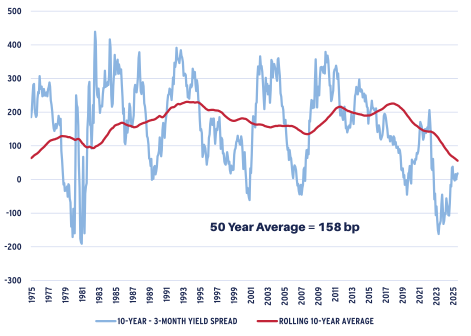
While lower short-term borrowing costs will likely provide both psyche and practical benefits to property investors, the more significant consideration is the degree to which lower policy borrowing rates translate into lower longer-term yields generally, and property capitalization rates specifically. In most time periods, longer-term Treasury bonds command higher yields than shorter-term instruments. Over the past 50 years, the average spread between the ten-year and three-month Treasury yield has been slightly more than 150 basis points (see Figure 1). On a ten-year rolling average basis, this spread has declined from more than 200 basis points at the end of 2016 to approximately 60 basis points today. The key question for all investors, property investors included, is how much term premium, the extra yield for holding longer dated instruments, will bond investors demand as the Fed resumes lowering shorter-term borrowing rates? That is, will the yield curve re-steepen toward levels comparable with historic experience or continue displaying historically aberrant behavior of little or no term premium?

Figure 1
Shape of the Yield Curve – Spread Between 10-Year and 3-Month Treasury Yields

Image
Fed-Rates-Cuts-and-CRE-Vlaue-Reflations-Charts_Artboard-1_2025-09-09-203338_gooz

Source: Federal Reserve Bank of St. Louis, as of September 1, 2025.

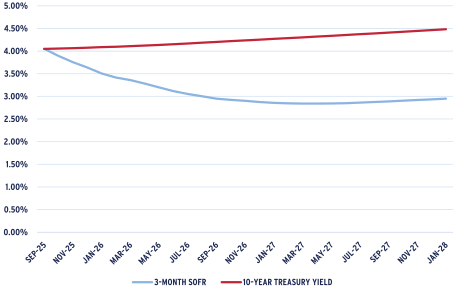
We believe there are several key reasons to expect a re-steepening of the Treasury yield curve. Most importantly, the U.S. federal budget deficit is extremely large and is now projected to be much greater than it would have been prior to the passage of the recently enacted One Big Beautiful Bill Act.5 While recently increased tariff rates provide some revenue offsets to these budget impacts, recent court rulings create heightened near-term uncertainty regarding any future tariff revenue.6 Additionally, despite Chairman Powell’s assessment of the inflationary impacts of tariffs being a “one time shift in price levels”, he also observed that "one-time does not mean all at once... it will continue to take time for tariff increases to work their way through supply chains and distribution networks. Moreover, tariff rates continue to evolve, potentially prolonging the adjustment process.” Having been surprised by outsized inflation following the pandemic, we expect bond investors will maintain a more cautious term premia stance for some time, particularly with respect to the deficit, as well as the uncertainties associated with tariff policy. To this point, we offer the current forward rates for short-and longer-term yields, showing an expectation that the Fed lowers its overnight borrowing rate to approximately 3% by the end of 2026 but that the ten-year Treasury yield sustains at or slightly above current levels, thereby widening the yield curve back to approximately 150 basis points.

Figure 2
Forward Yields

Image
Fed-Rates-Cuts-and-CRE-Vlaue-Reflations-Charts_Artboard-2_2025-09-09-203426_exwp

Source: Chatham Financial, as of August 29, 2025.

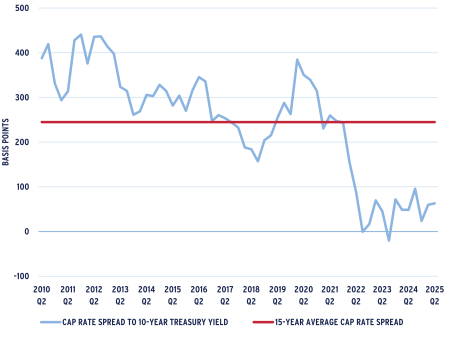
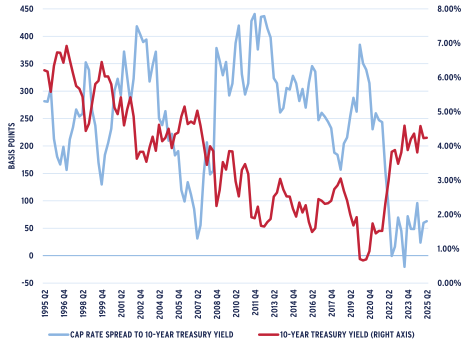
For property investors, current appraisal income yields (capitalization rates) present a similar challenge. Historically, property cap rates have been greater than the ten-year Treasury bond yield. Figure 3 shows the average property yield spread to be approximately 250 basis points over the past 15 years. Since the middle of 2022, however, this spread has been significantly lower, averaging less than 50 basis points. Just as the yield curve will likely need to re-steepen as the Fed resumes lowering policy borrowing rates, property valuations will likely also need to “grow” back into some degree of positive spread to Treasury yields. As such, we expect most of the near-term benefit of any additional lowering of interest rates by the Fed to show up in the property investment market through lower property financing costs, not immediately higher valuations.

Figure 3
NPI+ Average Cap Rate Spread to 10-Year Treasury Yield

Image
Fed-Rates-Cuts-and-CRE-Vlaue-Reflations-Charts_Artboard-3_2025-09-09-203453_pshm

Source: NCREIF, as of 2025 Q2.

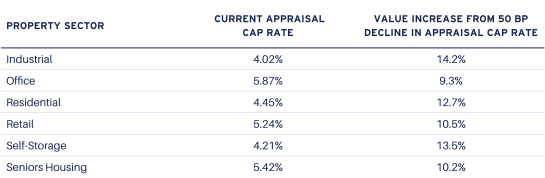
Finally, any eventual impact of a decline in interest rates and subsequent lower property yields (cap rates), will likely vary across property sectors. In a period of falling yields, assets with longer duration – the period over which investors expect to receive cash flows from their investment – will typically show the greatest appreciation in value. Properties with longer leases, such as some office buildings, are generally considered to have greater duration and therefore greater sensitivity to any changes in the overall yield environment. At the same time, assets with lower current yield also have greater duration as more of the ultimate total cash flow of the investment will be from the residual value at the end of the investment period. Table 1 illustrates the current valuation (appraisal) cap rate of the various property sectors in the expanded NCREIF property index (NPI+).

Table 1
Current Appraisal Cap Rate and Value Change from 50 bp Decline in Cap Rate

Image
Fed-Rates-Cuts-and-CRE-Vlaue-Reflations-Charts_Artboar4

Source: NCREIF, AEW Research, as of 2025 Q2.

Table 2
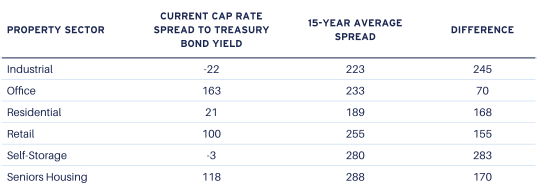
Current Cap Rate Spread to Treasury Bond Yield and 15-Year Spread

Image
Fed-Rates-Cuts-and-CRE-Vlaue-Reflations-Charts_Artboard-5_2025-09-09-203750_kyws

Source: NCREIF, AEW Research, as of 2025 Q2.

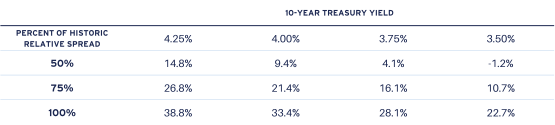
From this, one might reasonably conclude that the property sectors currently priced with the lowest yields would likely benefit the most from falling interest rates and property yields, but such a conclusion ignores the historic relationship between property yields and Treasury bonds. In past cycles, lower than average cap rate spreads to Treasury yields were typically restored to more normal levels largely by a decline in Treasury yields. If, as we suspect, Treasury yields are slow to fall in the current environment, property yield spreads will be restored largely through property income growth. As of 2025 Q2, the NCREIF property index showed an aggregate blended capitalization rate of approximately 4.7% with an average spread to the ten-year Treasury yield of 225 basis over the prior 15 years. To fully restore the current yield spread to the historic average, the NPI average cap rate would need to increase to approximately 6.5% and would require an increase in property net operating income (NOI) of nearly 40% if Treasury yields were unchanged (see Table 3).

Figure 4
NPI Aggregate Cap Rate and Spread to 10-Year Treasury Yield

Image
Fed-Rates-Cuts-and-CRE-Vlaue-Reflations-Charts_Artboard-6-06

Source: NCREIF, as of 2025 Q2.

Table 3
NOI Growth Needed to Restore Historic Cap Rate Spread to Treasury Yield Under Different Assumptions of Future Treasury Yield and Share of Historic Spread Restored

Image
Fed-Rates-Cuts-and-CRE-Vlaue-Reflations-Charts_Artboard-7_2025-09-09-204031_efiv

Source: NCREIF, AEW Research, as of 2025 Q2.


Conclusion
Lower cost of capital is broadly positive for the economy and investment performance. As such, investor optimism is appropriately buoyed by the prospect of the Federal Reserve restarting their process of policy rate reduction that began in September 2024 and paused just three months later. While lower borrowing costs will help many aspects of commercial real estate investment, property investors should, however, temper their expectations for significant near-term positive value impacts. Property values are linked most closely to the long end of the yield curve, not overnight borrowing rates. Today, the yield curve is near flat and will likely need to steepen during the initial stages of additional rate cuts. This means that long yields will simply not fall as much as or as quickly as short rates. More importantly, property yields (cap rates) have historically settled at meaningful positive spreads to Treasury yields, typically 200 basis or more depending on property sector. Today, these spreads are very low and, like the re-steepening of the yield curve, will also need to widen. If, as we believe, Treasury yields are slow to fall, most spread restoration will come instead from property income growth, making investors focus on asset selection and property management which will be even more important than during prior valuation cycles.


Read More from AEW Capital Management


1 August 22, 2025. “Monetary Policy and the Fed’s Framework Review,” Chair Jerome H. Powell. “Labor Markets in Transition: Demographics, Productivity, and Macroeconomic Policy,” an economic symposium sponsored by the Federal Reserve Bank of Kansas City in Jackson Hole, Wyoming, Federal

2 See, for example, “What the data says about immigrants in the U.S.”. Kramer, Sephanie Passel, Jeffrey S. Pew Research Center. August 21, 2025. https://www.pewresearch.org/short-reads/2025/08/21/key-findings-about-us-immigrants/

3 U.S. Bureau of Labor Statistics, Job Openings and Labor Turnover Summary – July 2025. September 3, 2025.

4 See, for example, CME Group Fed Watch. September 1, 2025. https://www.cmegroup.com/markets/interest-rates/cme-fedwatch-tool.html

5 See Estimated Budgetary Effects of Public Law 119-21, to Provide for Reconciliation Pursuant to Title II of H. Con. Res. 14, Relative to CBO’s January 2025 Baseline. July 21, 2025

6


For more information, please contact:
MICHAEL ACTON, CFA®

Managing Director, Head of Research & Strategy, North America

michael.acton@aew.com

+1.617.261.9577

JAY STRUZZIERY, CFA®
Head of Investor Relations
jay.struzziery@aew.com
+1.617.261.9326

This material is intended for information purposes only and does not constitute investment advice or a recommendation. The information and opinions contained in the material have been compiled or arrived at based upon information obtained from sources believed to be reliable, but we do not guarantee its accuracy, completeness or fairness. Opinions expressed reflect prevailing market conditions and are subject to change. Neither this material, nor any of its contents, may be used for any purpose without the consent and knowledge of AEW. There is no assurance that any prediction, projection or forecast will be realized.

Share this post

Sign Up Now for Full Access to Articles and Podcasts!

Unlock full access to our vast content library by registering as an institutional investor

Register

Contacts


AEW Capital Management

For over 40 years, AEW Capital Management, L.P. (AEW) has provided real estate investment management services to investors worldwide. As one of the world’s largest real estate investment advisors¹, AEW and its affiliates manage $87.0 billion in private real estate equity, debt and listed securities across North America, Europe and Asia (as of June 30, 2025). Grounded in research and experienced in the complexities of the real estate and capital markets, AEW actively manages portfolios in both the public and private property markets and across the risk/return spectrum. AEW and its affiliates have offices in Boston, Los Angeles, Denver, London, Paris, Hong Kong, Seoul, Singapore, Sydney and Tokyo, as well as additional offices in eight European cities. For more information, please visit www.aew.com.
 

¹Source: “2025 IREI.Q Real Estate Managers Guide”. The Guide, published annually by Institutional Real Estate, Inc., ranks real estate managers based on the gross value of real estate AUM ($m) as of December 31, 2024. As of June 30, 2025. AEW includes (i) AEW Capital Management, L.P. and its subsidiaries and (ii) affiliated company AEW Europe and its subsidiaries. AEW Europe and AEW Capital Management, L.P. are commonly owned by Natixis Investment Managers and operate independently from each other. Total AEW AUM of $87.0 billion includes $42.2 billion in assets managed by AEW Europe and its affiliates, $4.4 billion in regulatory assets under management of AEW Capital Management, L.P., and $40.4 billion in assets for which AEW Capital Management, L.P. and its affiliates provide (i) investment management services to a fund or other vehicle that is not primarily investing in securities (e.g., real estate), (ii) non-discretionary investment advisory services (e.g., model portfolios) or (iii) fund management services that do not include providing investment advice.

Chad Nettleship
Insurance, Investor Relations
chad.nettleship@aew.com

617.261.9485


2 Seaport Lane
Boston, MA 02210


View the contributor page

Image
AEW.png

Sign Up Now for Full Access to Articles and Podcasts!

Unlock full access to our vast content library by registering as an institutional investor .

Create an account

Already have an account ? Sign in

Ѐ Ё Ђ Ѓ Є Ѕ І Ї Ј Љ Њ Ћ Ќ Ѝ Ў Џ А Б В Г Д Е Ж З И Й К Л М Н О П Р С ΄ ΅ Ά · Έ Ή Ί Ό Ύ Ώ ΐ Α Β Γ Δ Ε Ζ Η Θ Ι Κ Λ Μ Ν Ξ Ο Π Ρ Ё Ђ Ѓ Є Ѕ І Ї Ј Љ Њ Ћ Ќ Ў Џ А Б В Г Д Е Ж З И Й К Л М Н О П Р С Т У Ф Х Ц Ч Ш Ā ā Ă ă Ą ą Ć ć Ĉ ĉ Ċ ċ Č č Ď ď Đ đ Ē ē Ĕ ĕ Ė fi fl œ æ ß