

MetLife Investment Management -

Financing Water Infrastructure for a Thirsty World

Water treatment facility with large circular basins at sunset.
 
Key takeaways:
  • The need for investment in water and wastewater infrastructure is vast, due to both aging systems and high demand from data centers, agriculture and industry.
  • Water and wastewater infrastructure encompasses a wide variety of investable assets that fit different risk-reward profiles.
  • As policymakers and the public focus more intently on the water supply, private infrastructure lenders and developers must ensure they are financing sustainable infrastructure systems and underwriting to adequately manage water supply risk.
  • Water and wastewater systems have many of the key attributes of other types of private infrastructure debt, including long-dated, contractual cash flows; covenants and other structural protections; and potential inflation linkages and pass-throughs.

The world is increasingly thirsty, and the need for investment in water and wastewater infrastructure is vast. With government budgets stretched, private infrastructure debt can play a key role in financing the systems that keep industry, agriculture, technology and the general public hydrated.

Our Head of Infrastructure Debt for the Americas & Asia Pacific Patrick Manseau and Jeff Nelson, CEO of Colorado-based water/wastewater infrastructure developer PERENfra, recently appeared together on a panel at MetLife Investment Management’s Insurance CIO Summit. Ahead of that appearance, they provided us with their views on a few of the top questions investors should keep in mind about financing water infrastructure.

What’s driving the need for water and wastewater infrastructure?

Aging water and wastewater systems serve other types of industry, agriculture, and public water consumption, and they’re in need of repair and replacement. In 2025, the American Society of Civil Engineers gave U.S. drinking water infrastructure a C- grade and a near-failing D+ to wastewater infrastructure, noting that even after funding increases, 80% of water utilities reported that their revenues did not cover the cost of providing drinking water. The U.S. Environmental Protection Agency estimates that the United States needs $625 billion in water infrastructure investment over the next 20 years for replacing aging or deteriorating pipelines, as well as treatment and storage infrastructure.1

Between the years of 2010 and 2020, the United States Geological Survey showed that crop irrigation and thermoelectric power generation each accounted for about 43% of U.S. water usage,2 by far the lion’s share of all water use. Since then, of course, AI has come onto the scene and changed the picture. The United Nations estimates that global data center electricity use could nearly double from 448 terawatt hours (TWh) in 2025 to 945 TWh in 2030 as AI gains more traction, which equates to a need for an additional 9.3 trillion liters of water.3

Data centers use water to cool the semiconductors powering AI inferencing, or day-to-day calculations, as well as the more water-intensive process of training. The amount of water used depends on the system. Closed-loop systems that run water through pipes near the equipment and recycle it thereafter are more efficient than immersion systems, in which more water evaporates. Likewise, data centers in cooler climates can pipe in air from the outside, reducing the need for water.

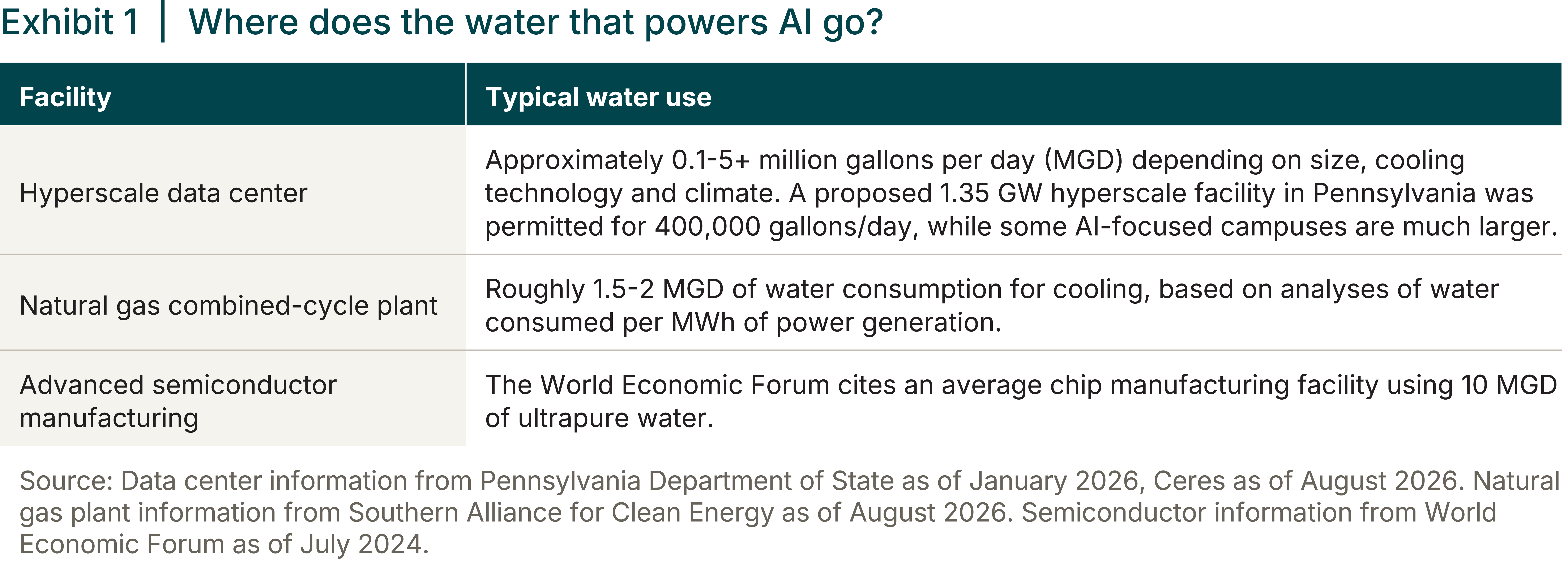
Yet, Bank of America estimates that only 25% of the water use attributable to a particular data center happens at the data center itself.4 The rest occurs during power generation and semiconductor fabrication (Exhibit 1). Increasingly, policymakers and the public are looking past data centers to focus on total water usage, which at times can result in inflated estimates of usage, Nelson said.

MetLife Investment Management exhibit showing water use associated with data centers

What role can private credit play in financing water and wastewater infrastructure?

With local, state and federal budgets stretched both in the U.S. and many parts of the world, government funding is almost certainly insufficient to build infrastructure at the scale anticipated. Private capital, including both private debt and private equity, is likely to play a key role in upgrading existing infrastructure and developing new assets.

Just as investors can finance a data center, its computing equipment and the power generation behind it separately, private infrastructure debt can finance water supply, treatment and reuse assets with their own contracts, collateral and risk profiles. Yet, as the public and policymakers grow increasingly concerned about the water supply, lenders must carefully consider how to properly underwrite risk.

What water and wastewater infrastructure assets can investors finance?

A wide range of investable assets will be needed to meet the growing demand for water. Some of these are directly related to data centers, such as closed-loop cooling infrastructure or new water supply systems specifically for data centers or co-located power plants.

Other assets may address rising water and wastewater demand not only for data centers, but also for communities, including:

  • Treatment facilities for brackish or otherwise non-potable groundwater
  • Wastewater treatment and reclaimed-water systems
  • Pipelines, pumping stations and storage
  • Regulated water and wastewater utilities
  • Municipal utility districts and systems serving new developments
  • Advanced metering, leak detection and conservation projects
  • Capacity expansions or upgrades to existing municipal systems

Within these types of assets, investors can find financing opportunities to fit a range of risk-return profiles. Funding operating regulated utilities is a core opportunity, while core-plus opportunities may include contracted projects with limited construction or ramp-up risk. Investors searching for higher yields may focus on development opportunities that depend on customer hookups (i.e., providing a private water source to a new neighborhood) or financing smaller, unrated utilities.

What makes private infrastructure investments in water and wastewater systems potentially attractive to investors?

Ultimately, water and wastewater infrastructure have the same characteristics that make financing other kinds of infrastructure attractive to institutional investors, Manseau says. These include long-duration cash flows, providing an essential service, revenues that tend to be regulated or have long-term contracts, the potential for inflation linkages or cost passthroughs, and the structural protections that are often available in private debt, such as covenants and seniority in the capital structure.

Yet, water is also different. Because of its direct tie to the AI infrastructure build-out, water and wastewater infrastructure provides exposure to AI growth without lending directly against a data center or rapidly evolving computing technology. Investors in projects that rely directly or indirectly on data center demand should pay careful attention to who the data center counterparties are, contractual protections such as covenant and offtake agreements and whether the infrastructure would be useful if the data center it serves becomes obsolete or goes offline.

How can investors manage supply risks and reputational risks associated with water projects in particular?

Nelson says that in the race to build new data centers, many developers are using the first available water source or water sources they inherited when they bought a property or piece of land. Some hyperscalers are increasingly interested in “behind-the-meter” water systems similar to the “bring-your-own-power” systems that allow them to access water directly from (or nearby to) their data center locations, rather than through a local municipal utility provider.

In the end, water risk is a hyperlocal issue that depends on the condition of specific aquifers, watersheds and local utility systems. But infrastructure investors concerned about stable supply, permitting and public opinion should carefully consider a few factors, first among them being the source of their water.

Using surface water such as reservoirs and rivers is controversial, and supply may be unpredictable. In the hot, sunny U.S. Southwest, for example, the Colorado River is both prone to evaporation and a critical source of water for both farms and households, spurring both state and federal scrutiny of how its flows are used.

A better option, he noted, may be an underground aquifer filled with non-potable groundwater. That water may have suspended solids or other minerals that would require extensive treatment to make it drinkable, but water infrastructure owners can use minimal treatment to avoid scaling, or mineral build-up, while the water is being used to cool the data center equipment.

A water infrastructure investor’s diligence may also include which other users are drawing from the same water source and how access will be monitored and controlled in the future. Nelson says it’s in an infrastructure owner’s best interest to pull water from aquifers in places with groundwater conservation authorities or districts that “keep track of how many straws are sucking water out of the ground,” he said. “There are places where you can drill as many wells as you want and literally suck an aquifer dry. It’s not sustainable.”

Finally, investors must consider the rights to the water they plan to draw on.

  • Will they own, lease or have a permit to withdraw water?
  • If they own rights, are those rights transferable and enforceable?
  • How long do the rights last?
  • What are the possible mechanisms through which an investor could lose access to infrastructure rights, including senior claims, adjudication or curtailment? In other words?
  • Who is liable if a water source is contaminated?

Ultimately, water is one of the most precious resources a community has — and whether the AI investment boom continues or not, the infrastructure that manages both fresh water and wastewater treatment and disposal is aging. As private infrastructure investors look to provide the water and wastewater infrastructure that makes the future possible, they must also make responsible and sustainable investments that fully consider the risks to supply.


READ MORE FROM METLIFE INVESTMENT MANAGEMENT


Endnotes

1 U.S. Environmental Protection Agency. “EPA’s 7th Drinking Water Infrastructure Needs Survey and Assessment.” September 2023. https://www.epa.gov/dwsrf/epas-7th-drinking-water-infrastructure-needs-survey-and-assessment

2 Medalie, L., Galanter, A.E., Martinez, A.J., Archer, A.A., Luukkonen, C.L., Harris, M.A., and Haynes, J.V., 2025, Water use across the conterminous United States, water years 2010–20, chap. D of U.S. Geological Survey Integrated Water Availability Assessment—2010–20: U.S. Geological Survey Professional Paper 1894–D, November 2024, p. 47, https://doi.org/ 10.3133/ pp1894D

3 UN Scientists: AI Is Threatening Natural Resources for Billions

4 Bank of America. “Data center construction creates a resource shock.” June 2026

Disclaimer

Readership: This document is intended solely for the addressee(s) and may not be redistributed without the prior permission of MIM. Its content may be confidential, proprietary, and/or trade secret information. MIM and its subsidiaries are not responsible for any unlawful distribution of this document to any third parties, in whole or in part.

Risk of loss. Your capital is at risk. Investing in the strategies discussed herein are subject to various risks which must be considered prior to investing. All investments are subject to regional, industry, market, political, regulatory, competitive, business, financial, and other risks. For a more complete list please contact your sales representative. Investment in the strategy described herein is speculative and there can be no assurance that the strategy’s investment objectives will be achieved. Investors must be prepared to bear the risk of a total loss of their investment.

Unless otherwise specified, the information and opinions presented or contained in this document are provided as of the date noted herein. It should be understood that subsequent developments may affect the information contained in this document materially, and MIM shall not have any obligation to update, revise, nor affirm. It is not MIM’s intention to provide, and you may not rely on this document as providing, a complete or comprehensive analysis of MIM’s investment portfolio, investment strategies, nor investment recommendations. You should consult your independent advisors in determining whether such investment or advisory service is appropriate for you in light of your particular circumstances and relevant legal requirements. You may not rely on this document as the basis upon which to make an investment decision.

Past performance is not indicative of future results. There can be no assurance that any investment objective will be met. No investment strategy or risk management technique can guarantee returns or eliminate risk in any market environment. No representation is being made that any investment will or is likely to achieve profits or losses or that significant losses will be avoided. There can be no assurance that investments similar to those described in this document will be available in the future and no representation is made that future investments managed by MIM will have similar returns to those presented herein. Unless otherwise noted, all information herein has been presented in U.S. dollars. Actual returns may increase or decrease due to currency fluctuations.

MIM often uses benchmarks for the purpose of comparison of results. Benchmarks are used for illustrative purposes only, and any such references should not be understood to mean there would necessarily be a correlation between investment returns of any investment and any benchmark.

Any referenced benchmark does not reflect fees and expenses associated with the active management of an investment. MIM may, from time to time, show the efficacy of its strategies or communicate general industry views via modeling. Such methods are intended to show only an expected range of possible investment outcomes, and should not be viewed as a guide to future performance. There is no assurance that any returns can be achieved, that the strategy will be successful or profitable for any investor, or that any industry views will come to pass. Actual investors may experience different results.

Information is unaudited unless otherwise indicated, and any information from third-party sources is believed to be reliable, but MIM cannot guarantee its accuracy or completeness. All information is sourced from MIM unless otherwise noted.

The securities and any other products or services referenced in this document may not be licensed in all jurisdictions, and unless otherwise indicated, no regulator or government authority has reviewed this document, or the merits of the products and services referenced herein. This document and the information contained herein has been made available in accordance with the restrictions and/or limitations implemented by any applicable laws and regulations. This document is directed at and intended for institutional and qualified investors (as such term is defined in each jurisdiction in which the security is marketed). Before acting on any information in this document, prospective investors should inform themselves of and observe all applicable laws, rules and regulations of any relevant jurisdictions and obtain independent advice if required.

Where applicable, the Manager may determine to terminate any arrangements made for marketing the Shares in one or more jurisdictions in accordance with the AIFM Directive and UCITS Directive respectively, as may be amended from time to time. Investors and potential investors can obtain a summary of investor rights and information on access to collective redress mechanisms at www.metlife.com/investments/regulatory-disclosures/investor-rights.

Last updated 31 July 2026. For additional legal and regulatory disclosures including other cross border information, please refer to www.metlife.com/investments/regulatory-disclosures/global-disclosure-statement.

Share this post

Sign Up Now for Full Access to Articles and Podcasts!

Unlock full access to our vast content library by registering as an institutional investor

Register

Contacts


Image
MetLife Investment Management Logo

With more than 150 years of heritage, we deliver stability, disciplined risk oversight, and aligned investment strategies purpose-built for insurers. Our conviction-led, specialized teams span public and private markets, targeting dependable income and long-term total return. Recognized by Pensions & Investments as one of the world's Top 10 third-party insurance asset managers, we combine scale and expertise to help insurers address increasingly complex investment challenges. From strategic asset allocation to innovative, capital-efficient portfolio construction, our dedicated insurance specialists design solutions around each insurer’s unique objectives. Backed by on-the-ground expertise in 19 countries, we navigate regulatory and capital constraints with confidence across life, health, P&C and reinsurance.
 

MetLife Investment Management
One MetLife Way
Whippany, NJ 07981
 

Madhavi Chugh, CFA
Global Co-Head of Insurance Solutions 
madhavi.chugh@metlife.com
(609) 216-6691

Jeannine Heal, CFA
Global Co-Head of Insurance Solutions 
jeannine.heal@pinebridge.com
(732) 778-4734
 

View the contributor page

Sign Up Now for Full Access to Articles and Podcasts!

Unlock full access to our vast content library by registering as an institutional investor .

Create an account

Already have an account ? Sign in

Ѐ Ё Ђ Ѓ Є Ѕ І Ї Ј Љ Њ Ћ Ќ Ѝ Ў Џ А Б В Г Д Е Ж З И Й К Л М Н О П Р С ΄ ΅ Ά · Έ Ή Ί Ό Ύ Ώ ΐ Α Β Γ Δ Ε Ζ Η Θ Ι Κ Λ Μ Ν Ξ Ο Π Ρ Ё Ђ Ѓ Є Ѕ І Ї Ј Љ Њ Ћ Ќ Ў Џ А Б В Г Д Е Ж З И Й К Л М Н О П Р С Т У Ф Х Ц Ч Ш Ā ā Ă ă Ą ą Ć ć Ĉ ĉ Ċ ċ Č č Ď ď Đ đ Ē ē Ĕ ĕ Ė fi fl œ æ ß