





We're currently experiencing email delivery delays. For urgent matters, please contact us directly at lindsay@insuranceaum.com.

New England Asset Management-

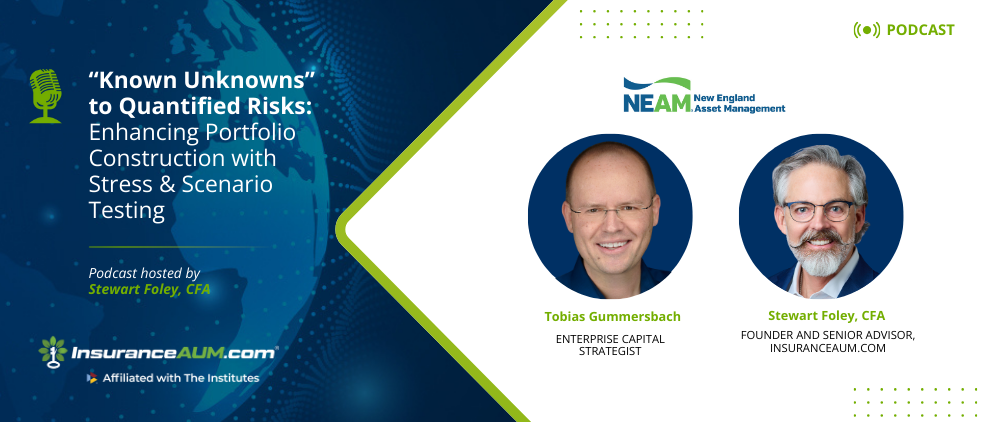
From “Known Unknowns” to Quantified Risks: Enhancing Portfolio Construction with Stress & Scenario Testing

Image
11.03 NEAM_Web


Stewart: Hey everyone. Welcome back to the Home of the World's Smartest Money. I'm Stewart Foley. This is the insurance AUM.com podcast. Before we get started here too far, I want to give a quick shout out to the CFA Society of Chicago for hosting their fantastic annual dinner. Huge thanks to Chris Vincent, who's the CEO there. Congratulations. They won CFA Society of the Year, very well deserved, very well run society there. Their annual dinner gathers folks from the Chicago Financial Services, community and others outside of their entire team. Susan, Suzanne, everybody there did a great job. I want to give another special shout out to our Lake Forest College students, my former students, who were there, one of them is Michelle Greenway Charlotte, formerly Austin, now Kasan and her husband Jimmy. Jimmy wasn't able to make it, but I am now old enough to have grand students.

So congratulations to Jimmy and Charlotte on their seven month old daughter and also Anthony DerManulian, who's at Kroll. He is a little later than the two of those folks, but also a great guy and went on to get his master's in accounting at Notre Dame. So just great to see everybody. We had about 20 folks there at that event and we love being one of the co-premiere sponsors there. So huge shout out to those folks and thanks so much for that. Let's dive in. The title of today's episode is From Known Unknowns to Quantified Risk: Enhancing Portfolio Construction with Stress and Scenario Testing, a title only in Insurance Asset Management Professional would love. And we're joined by Tobias Gummersbach, who's Enterprise Capital strategist at Nim. Tobias, welcome to the show. We are former colleagues. I'm thrilled to see you again, and welcome.

Tobias: Yes, thank you very much for the introduction. No, it is a genuine, they say that with emphasis is genuine pleasure to be on the show today. You mentioned that we have been colleagues before. I share a lot of fond memories and I guess we are still doing the things that we liked to do back then, which is sharing thoughts, insights, ideas, to anybody who likes to listen and with the ultimate goal to make our insurance clients better organizations. Is that right? Would you not agree with that?

Stewart: Absolutely. Yeah. I had a wonderful experience at what was then known as GR-NEAM. A lot of the folks are still there. I mean, Bill Rotatori is still there, Chris Lech’s still there. Our colleagues are still there. And so I had a wonderful experience, learned a lot. I want to kind of give you a little background on you. For those who might not know, Tobias focuses on capital management, advanced risk analytics and corporate development for US insurance companies. He's been with NEAM since 2010 after interning there in 2008, when we were there together while studying abroad at Trinity College to buy US holds degrees in international economics and finance from the University of Tübingen and pursued a postmaster's study at Hamburg Business School. He is also lectured undergraduate statistics at Tübingen and has worked in the investment industry since 2008. And you joined a gentleman by the name of Jim Bachman who's not there any longer, but Jim did a lot of interesting work. I'm thrilled that you've taken that back up and I want to get into it with you. But before we go too far, can you tell us where you grew up and what was your first job? Not the fancy one.

Tobias: Oh, sure. I can give you the full gamut here as too. So the accent gives me a way and I found out very early that my last name just doesn't roll here. Some people go with Mr. G. That is a little easier, but a little bit on the background. Born and raised really in the southern part of Germany. So now everybody say Oktoberfest. It's not Oktoberfest land. I was born and raised to the west. It's close to a black forest area. It's Swabia. So I'm officially a Swabian now. I can almost see you Googling what are the traits of Swabia? And I can tell you there's two things. They're probably true. Number one, they're incredibly stingy, and number two, they are absolutely passionate about engineering. So when you think engineering, Mercedes, Porsche, Audi, these are all organizations that called home to the towns and the surroundings where I lived.

So we are all engineers, by birth, essentially. And I guess a lot of my friends went to engineering school and joined these prestigious companies. And I think of myself as being an engineer by heart as well. I'm engineering, I'm building portfolios. You think about all the different parts and components that go into it to really make the engine run smoothly and these things as they come together and you see that all the parts doing their respective jobs and you have this high-powered engine that's just performs well in all different kinds of environment. Something makes me incredibly proud, happy, and that's why I'm here. That's why I'm here still 15 years after I joined, always in my role. So that answers a little bit on my background. Now, not the fancy ones, Stew, if you are going to promise not to share or disclose, I worked and I would never put that on a resume, I worked for a local garbage collection company. So I was way back in the years and I got fired from it.

So I would kind of come, oh yeah, you get fired from that. I did get fired from my very first job. My job was to pick up a few hundred postcards that had been mailed in over the day and people were essentially saying we're specifying all the trash that he wanted to have picked up, TVs, bad frames, all of that. And my job was to put the addresses into the computer system along with what had to be collected. And it turned out that I wasn't really great at it, especially I would get these numbers turned around once in a while. Was it a 3-7 or 7-3? So I caught a few, but I slipped a few, sent the garbage trucks into the wrong direction. So one morning I came in and they called me in the room and said, Tobias, we don't think this is the job for you. And I said, yeah, I couldn't agree what I think this is not the job for me. And they fired me, essentially, on the spot. But in hindsight now, it's really the only character flaw that I have. Do you know me? Right, absolutely.

Stewart: I wouldn't necessarily call that a character flaw. I mean I've actually, I've experienced similar things. Today's discussion really is from your publication, which is the title of podcast. Give us some context. I mean, what prompted a renewed focus on stress and scenario testing for insurers and why is this topic particularly relevant today?

Tobias: Yeah, Stewart, it felt like the right time. So when we look back 30 years, we really had three major events that stand out that affected insurance company's investments, as some of them still do today. I mean, we had the global financial crisis and then we had a period of relative calm. And then we had two major big events in the last five years, which is obviously COVID in 2020. And then the rapidly rising rate environment of 2022 and 2023. And when we look at insurance portfolios today, we still see a lot of unrealized losses here and there from bonds that were purchased prior. So it's definitively something that's affecting us and just the magnitude of these two big events in such a rapid timeframe that gives us pause. And then we are looking at the stock markets. We are looking today at this phenomenal up around in equity market valuations, all time heights fueled by enthusiasm about AI.

We coupled with historically tight credit spreads. So the conversations that take on, there'll be a hearing in these investment committees and the boardrooms are, “Hey, what can we expect? Is there going to be deflation? Is there going to be, will we see setbacks?” So it's probably a good idea to think about these types of things. Then from a regulatory perspective, it really never went away. Just to name a few here to Bermuda, BMA just conducted a global financial crisis stress test this year where they subjected their insurers to Seema and Cayman. They did something similar to use stress and scenario testing, yield curve shifts, equity valuations, real estate market valuation, declines losses. And the NAIC is working on new capital charges for CLOs. That partly involves stress and scenario testing. So definitively topical, and I'm going to give you one more. We see increased investments into a liquid private types of investments, debt and equity that require careful considerations really in terms of evaluation of liquidity and complexity risk.

So we have that. So it's a mouthful. So it's definitely topical and you mentioned it as well, it's also known unknowns. That's something that is really important to us that I would like to highlight. This is the quantification of events that we technically know exists, but we do not know when they occur, the severity, and how they impact our portfolios. So the example is COVID, right? I mean a global pandemic was not something that we have never experienced or heard of. I mean we just need to go back to early 20th century 1918, Spanish flu affected millions of people globally and produced millions of deaths. So it had to come back at some point. We didn't know when and the severity and how we were impacted by it. So known unknown, really. There are risks out there that we know they are out there, but we might have a tough time to quantify those. To the extent that we can, and that's what the publication really argues, that there might be a way to actually turn them into actionable insights.

Stewart: And it's interesting when we talk about if you can explain just about stress and scenario testing, what it actually involves. So we're talking about what metrics you use, how is it different from traditional risk measures such as duration, credit risk, liquidity. I'm sure that the engineering background was super helpful, at the intro here. I mean, you're a quantitative guy and I think it's fair to say that the depth and breadth of NEAM’s work in this area is really good. And I'm glad that folks are able to hear from you about the work that you're doing here. So talk to us a little bit about SST and how it works.

Tobias: Right? Yeah, absolutely. We spend a tremendous amount of time, and strengthening, stress scenario testing risk frameworks. And when I joined as an intern in 2008, now I must say it was an exciting time for me, but I didn't have skin in the game back then, right? I mean with crisis meetings back then, and it just kind of took it all in. And when I rejoined in 2010, I started to develop or help further developing these risk platforms. So when we think about stress and scenario testing, we think about them really adding value in two particular aspects. Number one, we're going to talk about that a little more in a second. It's an aggregation across different risk factors on the one hand. And then these serve the purpose of communicating risks because we find that it's actually pretty intuitive to do so. So let's start with the first one.

Let's look at aggregation of risks when here preferably into a single number and into something that really matters to us, a dollar loss estimate. So let's take for example a typical US insurer with a typical US insurance portfolio that would be comprised majority wise out of fixed income securities, and then to some extent equities and alternatives. So when we think of the major risk factors that impact that portfolio, it's the asset classes that we buy, the sectors that we invest in as a treasury structured securities as a municipals, corporates, what's the interest rate sensitivity? We can measure that one individually by duration. We are familiar with credit ratings to give us a day about the credit worthiness. What is it a, Single A, AA illiquidity or loss given default risk asset utilization, how many equities do we have? How much high yield do we have?

We might have foreign exchange rate risk in the portfolio. So we really only need to look at our investment guidelines and we would see them spelled out very carefully. They're captured here. It says what's the minimum allowance, what's the maximum tolerance that we have duration credit wise? But what is oftentimes lagging, Stew, is the aggregator. So a mechanism that translates all of these individual risks into a single number and express is then into something that we use and understand. So for example, you have two portfolios. One is short duration, low credit quality. The other one is long duration, high credit quality, which one is more risky? We really can't tell that easily. So what we try to do here is to find a bottom line. We kind of bring it to one number and then we compare these risks and there's two ways that we go about it.

We subject both portfolios to historical and hypothetical stresses. So historical stresses, global financial crisis, COVID, the rate increase of 2022, something that we have actually seen and experienced. We have these prices, it's pretty easy to take today's portfolio back and drag them through these periods of stress and just measure how these portfolios would have performed. And then we have hypothetical events that have not yet happened. So we need to pen to the paper and make some assumptions. So a recession is stagflation in today's environment will very likely look very different than the last times. And then looking at potentially large scale natural catastrophe events, military or trade tension or an escalation, there's a few of those right now. Russia and the West, we have China and Taiwan, we have China and the US in terms of trade, are tensions there. So as we think about them, these types of stresses, we think they're really intuitive, they're relatable and they're easy to communicate. I can go on have one more, but I wanted to see what you think here.

Stewart: It's interesting to me that you didn't just stop at stress events and metrics. You're elevating these concepts into integrating them into portfolio construction and rebalancing. Can you talk a little bit about that process? You've talked about aggregating risks, but ultimately what we're trying to do is build a portfolio. So talk to us about that process.

Tobias: Yeah, what we really found, Stew, and that's interesting, we see usually stress and scenario testing apply traditionally to existing portfolios. So we have our risk registers, we enter in our risk once every quarter. We have a traffic light system, potentially green, orange, red, red is we need to take some action. Green is we’re all set, but we don't really see it apply that much for portfolio construction work. So we measure it in hindsight or we don't use it proactively. And I think that's what we wanted to get to here is to say there is, and the reason for that could be multifold, but it's probably because applying a stress scenario event to existing CUSIPs to an existing portfolio is much easier than to a hypothetical portfolio. So really to bridge that gap, we said how can we apply these things for portfolio construction purposes, and there's something interesting that we can do.
So number one, what we can do is we can link levels of investment return that we want to achieve with risk exposures as measured in terms of stress and scenario losses. So for example, we might want to consider an investment return of let's say 5%, but that means we have to accept that a minimum risk of, let's say 16% loss, in a global financial crisis scenario. And since there's rarely a free lunch, usually the higher the return, the higher the risk that we need to take. So obviously this is not a new concept, it's efficient frontier. We are all investment professionals, so these risk return trade-offs are at the heart of what we are doing, but we don't usually take these stress and scenarios into account because it's not our primary metric of risk. It can become pretty informative when we do that. So I'm going to give you one practical example.

So we might be looking at a particular asset allocation strategy where we say, Hey, let's extend duration, let's say 1.5 years. We're going to drop the credit quality one notch maybe from a single A or from a to a single A minus. And we are introducing 15% of risk assets, right? On paper it might look great, in line with our investment guidelines all good, why not do that? So if I told you that a great financial crisis loss of that particular portfolio is going to quadruple from your current portfolio, you might set back and say, well that's not something that we want to do. And this is really what we see these types of metrics do. They add this tangible benefit because they force that type of discussion often revealing counterintuitive outcomes. And that forces a discussion about the risk tolerances that we thought we had and the ones that we truly have.

Stewart: It's a great point, and I think there's people on this podcast, I know that listen, and have experienced something like this. So if you say to the investment committee, equities can be down 30% and everyone nods and then when they're down 28%, it's a very different discussion. And you do discover what’s the difference between people's risk capacity and their risk tolerance. You explore the difference, the trade-offs between limiting potential losses and targeting higher returns. I think that you'd agree with me. We can both come up with scenarios where we all die and it's over. I mean we can all come up with scenarios that are so bad that “Oh, great financial crisis rates go up 700 basis points, whatever.” We can come up with bad scenarios. How do you strike a balance between optimizing a portfolio's prospective return and limiting those losses and how does liquidity fit into that analysis? That's one of the game over scenarios where you run out of liquidity. How does that all come together? No, I think

Tobias: This is a great question at the heart of what we try to do. When we do strategic or enterprise-based asset allocation work, you usually, in these types of optimization frameworks, you have to pick one number for risk. You can only optimize for one, keep track of the others. So precisely to what you said, we would not optimize the portfolio towards a great financial crisis scenario, right? That's a once in a 200 or once in X year event. But what we would want to do is we would pick our primary metric of risk and then keep track of these other micro risks as we do with duration, as we do with liquidity, as we do with convexity, and keep them as extra numbers available to us. And then we look at the outcomes and we might hone in on a particular asset allocation that we like.

Now we look at the great financial or any of the stresses scenario tests that we apply and we say, are we good with that portfolio? Yes, if that asset allocation fits the bill, obviously we are good. However, though that portfolio could look great on paper as I just mentioned, but not and say, well no, we are out of risk tolerance. We cannot live with that type of risk exposure. We had a practical example here where an insurance client asked us to do that and we looked at a particular allocation that looked great and then they said, no, we just can't have that amount of loss exposure. So what we were able to do is kind of treat that asset allocation a little bit, a little bit to ensure that our stress losses are acceptable by leaving a little bit of return on the tables too. That had to happen. So there was a cost of that constraint that came to us, but it was perfectly acceptable to that insurer and turned out to be a great asset allocation, a recommendation for them. So I would really say thinking of budgets, you do ERM, you have these thoughts, use them as a budget and not stop at doing risk tracking and risk measurement.

Stewart: It's a great point. When you mentioned ERM, just for those who might not be familiar, that stands for Enterprise Risk Management. So this is an ad-lib question and you can pass, is there such a thing as a standard to determine liquidity needs for a P&C carrier? I've heard people use things like TRPM, things like that. Is there anything in your work that, is there any sort of standard that anyone applies for the kind of threshold liquidity need for a P&C carrier?

Tobias: No, not really. Not to the best of my knowledge that we see consistently applied. What you usually do is on liquidity, you run very severe stress tests and you find that breaking point where your organization is essentially running out of cash. So think of it as a reverse stress test and you say, how severe does it need to get in a multi-year framework before you’re just broke? You might almost use that one and then say, okay, I want to have twice the amount of cash or liquidity to make sure that that's not going to happen to us. So no particular one number fits all, as far as we know.

Stewart: As far as we know. That's super interesting. I mean, liquidity has a cost. We see it in illiquid assets getting a premium. So obviously being liquid has, there's a cost to that, but I think it's an interesting discussion. Right. So if we could leave our audience with a couple of key takeaways from your research, what would they be?

Tobias: Yeah, it is really that assessing investment risk is so important. It's equally important to what we do on the underwriting side and stress and scenario testing, such a helpful component to help fill these wide gaps that we have in our investment risk landscape. You know that there are risks out there that will affect the portfolio, so let's try to make a best guess or best estimate to try to gauge how bad it might affect the organization. And the other one is to the extent that we do all of these things already as part of our enterprise risk management frameworks or own risk insolvency assessments because we've invested into talents and systems and all of these good things, don't stop there. Think of these if you have a loss allowance and if you say, when does it turn red on your ERM? And then to say right now, am I getting adequately compensated for that risk that I'm taking? I might not be reaching my barrier, which is a great news, but how if we move this a little further and we can go a little more greenish, can we get better compensation for the risk that we are taking? So don't think of risk necessarily risk tracking as the check the box. We need to do it for the regular type so we can make it actionable and use it for portfolio construction. That will be the two key takeaways here too.

Stewart: It's been super helpful and really educational. I mean, I think you do an amazing job with the work that you do, and I encourage folks to check out the things that you're publishing. The quality is very good. And I got a couple of fun ones for you out the door. So the first one really gets, and I know the answer to this one better than I usually do when I ask this question, but what are the characteristics that you're looking for when you're adding to members of the team at NEAM? For those who don't know? The firm was founded by a gentleman named Jerry Lynch. Jerry instilled an incredible culture in the firm and was respected and admired by many, many people. Bill Rotatori was my boss when I was there. Tremendous guy, great guy to work with. And so I kind of know, I've been behind the curtain there for a minute, but today in your work, what characteristics do you think are most important when you're adding folks?

Tobias: I think you mentioned it. Insurance is a people business. It's the culture of people, colleagues that we work with that defines who we are and how we build these lasting relationships with the clients. We are looking for that people quality skill, and of course we need all the technical skills and all of these good things, but it's the client mindset, the client focus, and that being the driver be able to strive in a team-based environment. Now, two things I think that I would highlight. One is thinking outside the box. We all put that on our resumes, but it's a very rare trade to have and find. So really doing that work, making that work on behalf of your insurance clients, that is important. And the other thing is reemphasizing what would've just said, having the heart in the right place to doing right by our clients internally and externally. That's what defines us. Then that's what generates what we can bring to the table, what we do bring to the table.

Stewart: And what we do bring to the table. I had a friend one time say to me, “You don't think outside the box. You don't see a box.” And I can tell you that that has not worked well for me in various organizations, which is why I created one. But at the end of the day, you have to be thinking, you have to come up with things that are not already being done or look at things from a different perspective. And that's where discovery comes from. That's where innovation comes from. I know that you do that in your work. The last one's fun for you only. Who would you most like to have dinner with? Alive or dead? You can have up to three guests, one, two or three dinners on us. We have a new owner, but I still think they'll pick up this dinner. So who would you most like to have dinner with? Alive or dead?

Tobias: Spontaneous reaction here is to anybody doing base jumping, preferably with a wing suit. Very spontaneous, base jumping. You have one of these wingsuits on and now the question is, Swabians. They're not risk takers. You can probably tell from our conversation. I'm not sure if I would be jumping with that person, but I would definitely like to have a dinner with that person.

Stewart: Person to have dinner with 'em, just to find out. Have you seen any of the videos on YouTube where these folks are like...

Tobias: Yeah, isn't it crazy, Right?

Stewart: ...they are. Yeah. And I mean, I'm a motorcycle guy. People are like, oh, it's so dangerous. And it's like, it is dangerous. Don't kid yourself. But it's a long way from jumping off of a cliff in a wingsuit. So, good stuff. Tobias, it's great to have you with us. It's nice to see you. I haven't seen you in a long time. I really appreciate your insights, your expertise, and thanks so much for being on.

Tobias: Well sure. No, I do appreciate it. It was a pleasure and I might do this again. Thanks very much, Stew.

Stewart: I hope so. We've been joined today by Tobias Gummersbach, enterprise Capital strategist at NEAM. If you like what we're doing, please rate us, review us on Apple Podcast, Spotify, or wherever you listen to your favorite shows. If you want to see what we're up to, check out our new YouTube channel at InsuranceAUM community. My name's Stewart Foley. This is the Home of the World's Smartest Money, at InsuranceAUM.com.
 

Share this post

Sign Up Now for Full Access to Articles and Podcasts!

Unlock full access to our vast content library by registering as an institutional investor

Register

Contacts


New England Asset Management

New England Asset Management (NEAM) strives to be integral to the success of our insurance industry clients by providing investment management solutions through a team of skilled professionals dedicated to delivering exceptional client service. We aim to build true, enduring relationships with our insurance company clients by combining three core attributes:

Dedicated Teams    
NEAM is staffed with dedicated teams of knowledgeable insurance and capital markets professionals.

Actionable Tools    
Our combination of talent and technology is designed to support all aspects of your investment management.

Tailored Solutions    
We are acutely aware of the unique concerns and challenges insurers face on a daily basis and so these are reflected in our investment process.

Our comprehensive offering includes a wide range of services:

  • Asset Management Services
  • Enterprise Capital Strategy Services
  • Capital & Risk Analytics Platform
  • Investment Accounting & Reporting Services

www.neamgroup.com
74 Batterson Park Road
Farmington, CT 06032


View the contributor page

Sign Up Now for Full Access to Articles and Podcasts!

Unlock full access to our vast content library by registering as an institutional investor .

Create an account

Already have an account ? Sign in

Ѐ Ё Ђ Ѓ Є Ѕ І Ї Ј Љ Њ Ћ Ќ Ѝ Ў Џ А Б В Г Д Е Ж З И Й К Л М Н О П Р С ΄ ΅ Ά · Έ Ή Ί Ό Ύ Ώ ΐ Α Β Γ Δ Ε Ζ Η Θ Ι Κ Λ Μ Ν Ξ Ο Π Ρ Ё Ђ Ѓ Є Ѕ І Ї Ј Љ Њ Ћ Ќ Ў Џ А Б В Г Д Е Ж З И Й К Л М Н О П Р С Т У Ф Х Ц Ч Ш Ā ā Ă ă Ą ą Ć ć Ĉ ĉ Ċ ċ Č č Ď ď Đ đ Ē ē Ĕ ĕ Ė fi fl œ æ ß