

We're currently experiencing email delivery delays. For urgent matters, please contact us directly at lindsay@insuranceaum.com.

T. Rowe Price -

From The Field: How Our Sustainable Bond Framework Can Drive Real Impact

TRPFeatured

Matt Lawton Portfolio Manager, Global Impact Credit Strategy
Ellen O’Doherty Analyst
 

Key Insights

  • The sustainable bond framework drives high‑impact investments by scrutinizing the validity and additionality of projects they back to reduce greenwashing risks.
  • We use the framework to actively engage with labeled‑bond issuers to increase the financed activities’ potential of addressing the most significant issues.
  • Our updates factor in recent market changes, such as regulatory shifts and growing issuance complexity, to capture these benefits more efficiently.

Impact investment markets have evolved greatly in the past few years in terms of complexity, breadth, and even definition. Active managers in this space therefore need to be agile, adapt to these adjustments and help ensure that their impact assessment frameworks remain relevant. 

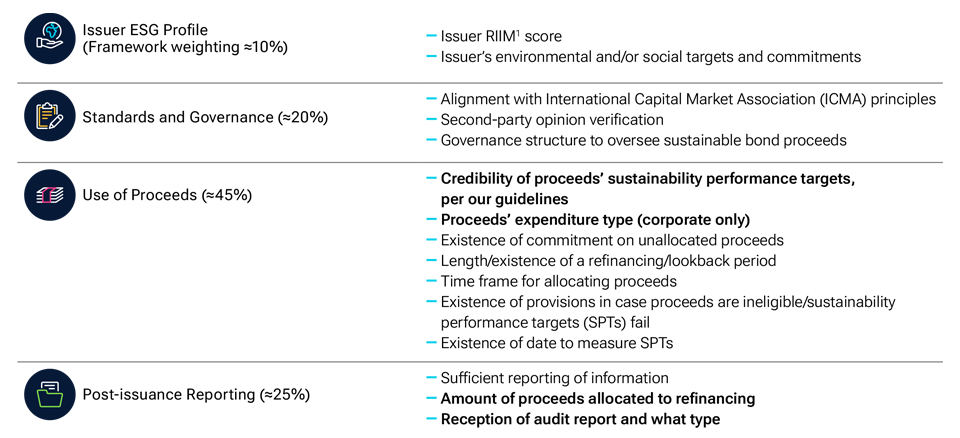
T. Rowe Price has long recognized the need for robust frameworks, having launched our sustainable bond framework in 2020. It uses four key aspects to accurately scrutinize the intentionality, additionality, and measurability of sustainable bond securities from an impact perspective, namely the Issuer ESG Profile; Standards and Governance; Use of Proceeds; and Post‑issuance Reporting.

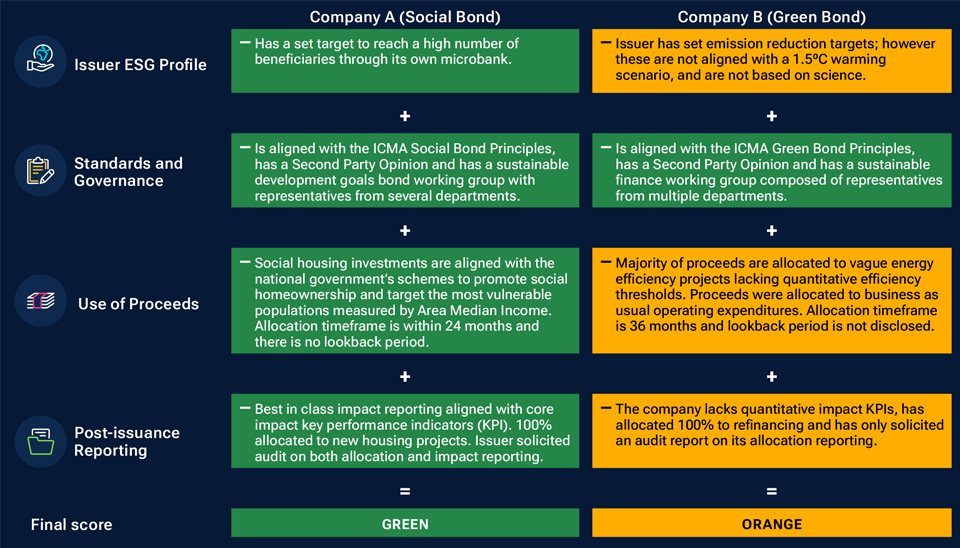
The framework takes the weighted‑average score of these four aspects and provides a traffic‑light score, acting as a data point within the security selection process.

On one level, it provides us with an opportunity to engage with companies pre‑ and post‑issuance on financial and sustainability strategies at every level, allowing us to obtain a clearer picture on the effectiveness of each labeled bond. On another, it can help us evaluate expected financial performance of labeled bonds, as we perceive that credibly structured labeled bonds should perform better than bonds lacking impact potential.

How impact investing has evolved

In the past few years, we have also observed several ways in which the impact investing market has changed. These include: 

  • Changes in impact definitions by regulators. What authorities bracket as impact investing has changed over time. This makes it more difficult for investors to accurately assess opportunities as the addressable market is shifting.
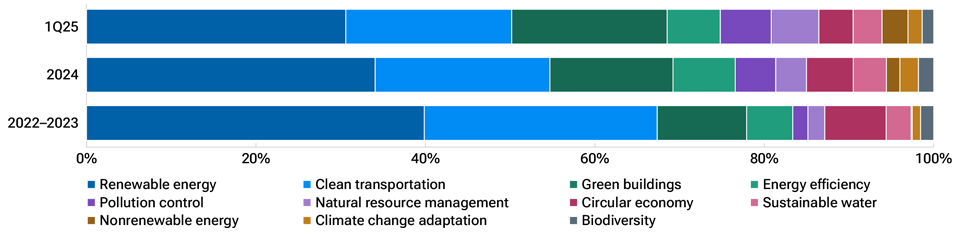
  • Growing issuance complexity. How issuers use sustainable bonds has become more complex, both in terms of impact theme and security structure. Recent innovations on labels include blue and orange bonds. These securities finance water projects and gender‑equity strategies, respectively; for example, DP World issued a USD 100 million blue bond in December 2024 to fund projects focusing on marine transport and pollution and port infrastructure. Historically, the majority of sustainable bond issuance covered renewable energy, green buildings, and clean transportation.
  • We are also seeing a growing variety of bond structures. These include new labeled securitized instruments, sustainability‑linked loan bonds, and outcome bonds that align project impact performance to financial returns.
  • Mislabeling and greenwashing concerns. Sustainable debt markets’ growth has heightened worries that some securities may not be as societally impactful or labeled as accurately as they appear. Around 85% of institutional investors believe greenwashing has become a greater problem over the past five years, per professional services firm EY,1 while a Morgan Stanley survey from December 2024 demonstrated that changing regulatory guidance and greenwashing were two of the top three key challenges to sustainable investing.2 In addition, issuers are using labeled bonds to position themselves in the eyes of the market and their customers as innovators in finance and sustainability and not just to access capital.

Fine‑tuning the framework

We have enhanced our existing sustainable bond framework in light of these and other changes, to better align with the fast‑changing dynamics of the modern market. The updates focus on the Use of Proceeds and Post-issuance Reporting aspects of the framework, which together make up most of its weighting (roughly 45% and 25%, respectively). 

  • We have updated our guidelines on assessing the credibility of specific social and green bond project categories, aligning them with market taxonomies, the United Nation’s Sustainable Development Goals and the Climate Bond Standard.
  • The framework now evaluates the proceeds’ type of use, with the view that different applications such as capital expenditure, operating expenditure (opex), or acquisition spending can be an indicator of impact. For example, an automotive manufacturer using proceeds to support increased electric vehicle capacity would, in our view, have a greater long‑term impact than if it allocated proceeds to maintenance opex, which may not support structurally long‑term incremental capacity.
  • We now consider the proportion of proceeds allocated to refinancing. A higher amount used to refinance older technology indicates less additionality, in our view, compared with issuers using most proceeds to finance new projects.
  • The framework also assesses any third‑party audits done on impact metrics. We believe this can help confirm the measurable impact of use of proceeds bonds, for instance, by assessing whether the issuer has solicited an audit on allocation data or impact data. 

An active approach to labeled bonds

As the labeled bond market continues to mature and grow, it is incumbent on investors to not only evaluate issues using their own assessment frameworks, but also to be willing to adjust and improve them over time as markets progress.

The updates aim to position our framework for the sustainable markets of today, considering new market guidelines and experience on proceeds use and post‑issuance reporting trends. This complements and sharpens the framework’s existing benefit of providing us with a way of informing our issuer engagement through the life cycle of a transaction. We will continue to review our framework as the market evolves.
 

Green bond proceeds’ use is diversifying

(Fig. 1) Green bond use of proceeds by project type.

Image
Infographic showing the sustainable bond model’s four aspects and what each entails.

As of March 31, 2025.
Source: Bloomberg Finance L.P., T. Rowe Price analysis.
 

We have enhanced our existing sustainable bond framework...to better align with the fast-changing dynamics of the modern market. 

– Ellen O’Doherty
Analyst


Updating our sustainable bond framework for 2025

(Fig. 2) Key parts of our four aspects, updates in bold

Image
Horizontal bar chart showing the different types of usage for green bond proceeds from 2022 to Q1 2025.

For illustrative purposes only.
Source: T. Rowe Price.
1 Responsible Investing Indicator Model (RIIM) is a proprietary tool developed to enhance research and aid better decision making. RIIM rates companies in a traffic light system measuring their environmental, social and governance profile and flagging companies with elevated risks: Green=No/Few Flags, Orange=Medium Flags, Red=High Flags.


Our sustainable bond framework in action

(Fig. 3) How our screening process can help decision making.1

Image
Infographic highlighting updates to the sustainable bond model’s four aspects.

For illustrative purposes only.
1    Responsible Investing Indicator Model (RIIM) is a proprietary tool developed to enhance research and aid better decision making. RIIM rates companies in a traffic light system measuring their environmental, social and governance profile and flagging companies with elevated risks. (Green=No/Few Flags, Orange=Medium Flags, Red=High Flags).
Source: T. Rowe Price.
 

For certain types of investments, including, but not limited to, cash, currency positions, and particular types of derivatives, an ESG analysis may not be relevant or possible due to a lack of data. Where ESG considerations are integrated into the investment research process, we may conclude that other attributes of an investment outweigh ESG considerations when making investment decisions.


Material risks—The following risks are materially relevant to the portfolio:

ABS and MBS risk—Asset-Backed Securities (ABS) and Mortgage-Backed Securities (MBS) may be subject to greater liquidity, credit, default and interest rate risk compared to other bonds. They are often exposed to extension and prepayment risk.
Contingent convertible bonds risk—Contingent Convertible Bonds may be subject to additional risks linked to: capital structure inversion, trigger levels, coupon cancellations, call extensions, yield/valuation, conversions, write downs, industry concentration and liquidity, among others.
Convertible bonds risk—Convertible bonds contain an embedded equity option which exposes them to risks linked to equity as well as fixed income. They may be subject to higher market and liquidity risk.
Credit risk—Credit risk arises when an issuer's financial health deteriorates and/or it fails to fulfill its financial obligations to the portfolio.
Default risk—Default risk may occur if the issuers of certain bonds become unable or unwilling to make payments on their bonds.
Derivatives risk—Derivatives may be used to create leverage which could expose the portfolio to higher volatility and/or losses that are significantly greater than the cost of the derivative.
Distressed or defaulted debt—Distressed or defaulted debt securities may bear substantially higher degree of risks linked to recovery, liquidity and valuation.
Emerging markets risk—Emerging markets are less established than developed markets and therefore involve higher risks.
High yield bond risk—High yield debt securities are generally subject to greater risk of issuer debt restructuring or default, higher liquidity risk and greater sensitivity to market conditions.
Interest rate risk—Interest rate risk is the potential for losses in fixed-income investments as a result of unexpected changes in interest rates.
Liquidity risk—Liquidity risk may result in securities becoming hard to value or trade within a desired timeframe at a fair price.
Prepayment and extension risk—Mortgage- and asset-backed securities could increase the portfolio's sensitivity to unexpected changes in interest rates.

General portfolio risks—To be read in conjunction with the portfolio specific risks above:
Capital risk—The value of your investment will vary and is not guaranteed. It will be affected by changes in the exchange rate between the base currency of the portfolio and the currency in which you subscribed, if different.
Counterparty risk—An entity with which the portfolio transacts may not meet its obligations to the portfolio.
ESG and sustainability risk—May result in a material negative impact on the value of an investment and performance of the portfolio.
Geographic concentration risk—To the extent that a portfolio invests a large portion of its assets in a particular geographic area, its performance will be more strongly affected by events within that area.
Hedging risk—A portfolio’ attempts to reduce or eliminate certain risks through hedging may not work as intended.
Investment portfolio risk—Investing in portfolio’ involves certain risks an investor would not face if investing in markets directly.
Management risk—The investment manager or its designees may at times find their obligations to a portfolio to be in conflict with their obligations to other investment portfolios they manage (although in such cases, all portfolios will be dealt with equitably).
Operational risk—Operational failures could lead to disruptions of portfolio operations or financial losses.


Important Information
This material is being furnished for general informational and/or marketing purposes only. The material does not constitute or undertake to give advice of any nature, including fiduciary investment advice. Prospective investors are recommended to seek independent legal, financial and tax advice before making any investment decision. T. Rowe Price group of companies including T. Rowe Price Associates, Inc. and/or its affiliates receive revenue from T. Rowe Price investment products and services. Past performance is not a guarantee or a reliable indicator of future results. The value of an investment and any income from it can go down as well as up. Investors may get back less than the amount invested.
The material does not constitute a distribution, an offer, an invitation, a personal or general recommendation or solicitation to sell or buy any securities in any jurisdiction or to conduct any particular investment activity. The material has not been reviewed by any regulatory authority in any jurisdiction.
Information and opinions presented have been obtained or derived from sources believed to be reliable and current; however, we cannot guarantee the sources’ accuracy or completeness. There is no guarantee that any forecasts made will come to pass.
The views contained herein are as of June 2025 and are subject to change without notice; these views may differ from those of other T. Rowe Price group companies and/or associates. Under no circumstances should the material, in whole or in part, be copied or redistributed without consent from T. Rowe Price.
The material is not intended for use by persons in jurisdictions which prohibit or restrict the distribution of the material and in certain countries the material is provided upon specific request. It is not intended for distribution to retail investors in any jurisdiction.
Australia—Issued by T. Rowe Price Australia Limited (ABN: 13 620 668 895 and AFSL: 503741), Level 28, Governor Phillip Tower, 1 Farrer Place, Sydney NSW 2000, Australia. For Wholesale Clients only.
Brunei—This material can only be delivered to certain specific institutional investors for informational purpose only. Any strategy and/or any products associated with the strategy discussed herein has not been authorised for distribution in Brunei. No distribution of this material to any member of the public in Brunei is permitted.
Canada—Issued in Canada by T. Rowe Price (Canada), Inc. T. Rowe Price (Canada), Inc.’s investment management services are only available to non‑individual Accredited Investors and non-individual Permitted Clients as defined under National Instrument 45-106 and National Instrument 31-103, respectively. T. Rowe Price (Canada), Inc. enters into written delegation agreements with affiliates to provide investment management services.
Colombia, Chile, Mexico, Perù, Uruguay—This material is prepared by T. Rowe Price International Ltd - Warwick Court, 5 Paternoster Square, London, EC4M 7DX which is authorised and regulated by the UK Financial Conduct Authority  - and issued and distributed by locally authorized distributors only. For professional investors only.
DIFC—Issued in the Dubai International Financial Centre by T. Rowe Price International Ltd which is regulated by the Dubai Financial Services Authority as a Representative Office. For Professional Clients only.
EEA—Unless indicated otherwise this material is issued and approved by T. Rowe Price (Luxembourg) Management S.à r.l. 35 Boulevard du Prince Henri L-1724 Luxembourg which is authorised and regulated by the Luxembourg Commission de Surveillance du Secteur Financier. For Professional Clients only.
Hong Kong—Issued in Hong Kong by T. Rowe Price Hong Kong Limited, 6/F, Chater House, 8 Connaught Road Central, Hong Kong. T. Rowe Price Hong Kong Limited is licensed and regulated by the Securities & Futures Commission. For Professional Investors only.
Indonesia—This material is intended to be used only by the designated recipient to whom T. Rowe Price delivered; it is for institutional use only. Under no circumstances should the material, in whole or in part, be copied, redistributed or shared, in any medium, without prior written consent from T. Rowe Price. No distribution of this material to members of the public in any jurisdiction is permitted.
South Korea—This material is intended only to Qualified Professional Investors. Not for further distribution.
Mainland China—This material is provided to qualified investors only. No invitation to offer, or offer for, or sale of, the shares will be made in the mainland of the People’s Republic of China (“Mainland China”, not including the Hong Kong or Macau Special Administrative Regions or Taiwan) or by any means that would be deemed public under the laws of the Mainland China. The information relating to the strategy contained in this material has not been submitted to or approved by the China Securities Regulatory Commission or any other relevant governmental authority in the Mainland China. The strategy and/or any product associated with the strategy may only be offered or sold to investors in the Mainland China that are expressly authorized under the laws and regulations of the Mainland China to buy and sell securities denominated in a currency other than the Renminbi (or RMB), which is the official currency of the Mainland China. Potential investors who are resident in the Mainland China are responsible for obtaining the required approvals from all relevant government authorities in the Mainland China, including, but not limited to, the State Administration of Foreign Exchange, before purchasing the shares. This document further does not constitute any securities or investment advice to citizens of the Mainland China, or nationals with permanent residence in the Mainland China, or to any corporation, partnership, or other entity incorporated or established in the Mainland China. 
Malaysia—This material can only be delivered to specific institutional investor. This material is solely for institutional use and for informational purposes only. This material does not provide investment advice or an offering to make, or an inducement or attempted inducement of any person to enter into or to offer to enter into, an agreement for or with a view to acquiring, disposing of, subscribing for or underwriting securities. Nothing in this material shall be considered a making available of, solicitation to buy, an offering for subscription or purchase or an invitation to subscribe for or purchase any securities, or any other product or service, to any person in any jurisdiction where such offer, solicitation, purchase or sale would be unlawful under the laws of Malaysia.
New Zealand—Issued by T. Rowe Price Australia Limited (ABN: 13 620 668 895 and AFSL: 503741), Level 28, Governor Phillip Tower, 1 Farrer Place, Sydney NSW 2000, Australia. No Interests are offered to the public. Accordingly, the Interests may not, directly or indirectly, be offered, sold or delivered in New Zealand, nor may any offering document or advertisement in relation to any offer of the Interests be distributed in New Zealand, other than in circumstances where there is no contravention of the Financial Markets Conduct Act 2013.
Philippines—ANY STRATEGY AND/ OR ANY SECURITIES ASSOCIATED WITH THE STRATEGY BEING DISCUSSED HEREIN HAVE NOT BEEN REGISTERED WITH THE SECURITIES AND EXCHANGE COMMISSION UNDER THE SECURITIES REGULATION CODE. ANY FUTURE OFFER OR SALE OF THE STRATEGY AND/ OR ANY SECURITIES IS SUBJECT TO REGISTRATION REQUIREMENTS UNDER THE CODE, UNLESS SUCH OFFER OR SALE QUALIFIES AS AN EXEMPT TRANSACTION.
Singapore—Issued by T. Rowe Price Singapore Private Ltd. (UEN: 201021137E), 501 Orchard Rd, #10-02 Wheelock Place, Singapore 238880. T. Rowe Price Singapore Private Ltd. is licensed and regulated by the Monetary Authority of Singapore. For Institutional and Accredited Investors only.
South Africa—Issued in South Africa by T. Rowe Price International Ltd (TRPIL), Warwick Court, 5 Paternoster Square, London EC4M 7DX, is an authorised financial services provider under the Financial Advisory and Intermediary Services Act, 2002 (Financial Services Provider (FSP) Licence Number 31935), authorised to provide “intermediary services” to South African Investors. TRPIL’s Complaint Handling Procedures are available to clients upon request.  The Financial Advisory and Intermediary Services Act Ombud in South Africa deals with complaints from clients against FSPs in relation to the specific services rendered by FSPs. The contact details are noted below: Telephone: +27 12 762 5000, Web: www.faisombud.co.za, Email: info@faisombud.co.za
Switzerland—Issued in Switzerland by T. Rowe Price (Switzerland) GmbH, Talstrasse 65, 6th Floor, 8001 Zurich, Switzerland. For Qualified Investors only.
Taiwan—This does not provide investment advice or recommendations. Nothing in this material shall be considered a solicitation to buy, or an offer to sell, a security, or any other product or service, to any person in the Republic of China.
Thailand—This material has not been and will not be filed with or approved by the Securities Exchange Commission of Thailand or any other regulatory authority in Thailand. The material is provided solely to “institutional investors” as defined under relevant Thai laws and regulations. No distribution of this material to any member of the public in Thailand is permitted. Nothing in this material shall be considered a provision of service, or a solicitation to buy, or an offer to sell, a security, or any other product or service, to any person where such provision, offer, solicitation, purchase or sale would be unlawful under relevant Thai laws and regulations.
UK—This material is issued and approved by T. Rowe Price International Ltd, Warwick Court, 5 Paternoster Square, London EC4M 7DX which is authorised and regulated by the UK Financial Conduct Authority. For Professional Clients only.
USA—Issued in the USA by T. Rowe Price Associates, Inc., 1307 Point Street, Baltimore, MD 21231, which is regulated by the U.S. Securities and Exchange Commission. For Institutional Investors only.
© 2025 T. Rowe Price. All Rights Reserved. T. ROWE PRICE, INVEST WITH CONFIDENCE, the Bighorn Sheep design, and related indicators (see troweprice.com/ip) are trademarks of T. Rowe Price Group, Inc. All other trademarks are the property of their respective owners.

ID0008202
202506‑4518446

Share this post

Sign Up Now for Full Access to Articles and Podcasts!

Unlock full access to our vast content library by registering as an institutional investor

Register

Contacts


T. Rowe Price

T. Rowe Price is a global asset management firm with broad investment capabilities across Equity, Fixed Income, Multi-Asset and Alternative Strategies, highly committed to excellence in service and putting client interests first. We understand that insurers have many unique considerations impacting portfolio design, and we are proud to work with many of the largest insurers in the world delivering diverse and custom solutions designed to meet those needs. Our dedicated insurance relationship managers act as an extension of your team and serve as a conduit to the T. Rowe Price organization while proactively bringing the firm’s vast resources to bear. We offer a consultative, problem-solving approach and the ability to implement solutions based on specific client objectives, constraints, and risk tolerance.

Ben Riley 
Head of Insurance 
benjamin.riley@troweprice.com 
410-345-2223

Chase Uhlein, CFA
Senior Relationship Manager
chase.uhlein@troweprice.com
410-577-3077

Blayze Hanson, CFA
Senior Relationship Manager
blayze.hanson@troweprice.com

Taylor Davis 
Relationship Manager 
taylor.davis@troweprice.com 
410-577-2054


1307 Point Street
Baltimore, MD 21231

 

View the contributor page

Image
trp_logo

Sign Up Now for Full Access to Articles and Podcasts!

Unlock full access to our vast content library by registering as an institutional investor .

Create an account

Already have an account ? Sign in

Ѐ Ё Ђ Ѓ Є Ѕ І Ї Ј Љ Њ Ћ Ќ Ѝ Ў Џ А Б В Г Д Е Ж З И Й К Л М Н О П Р С ΄ ΅ Ά · Έ Ή Ί Ό Ύ Ώ ΐ Α Β Γ Δ Ε Ζ Η Θ Ι Κ Λ Μ Ν Ξ Ο Π Ρ Ё Ђ Ѓ Є Ѕ І Ї Ј Љ Њ Ћ Ќ Ў Џ А Б В Г Д Е Ж З И Й К Л М Н О П Р С Т У Ф Х Ц Ч Ш Ā ā Ă ă Ą ą Ć ć Ĉ ĉ Ċ ċ Č č Ď ď Đ đ Ē ē Ĕ ĕ Ė fi fl œ æ ß