




AEW Capital Management-

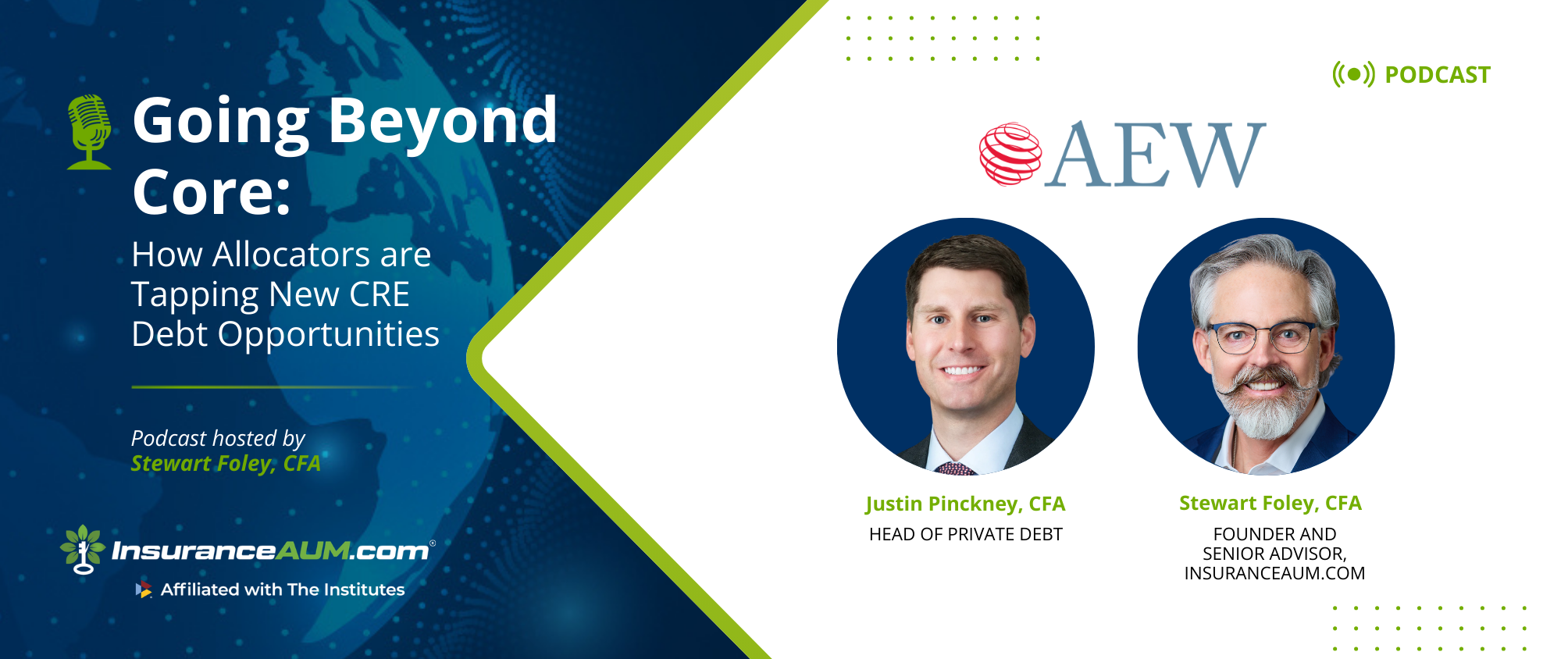
Going Beyond Core: How Allocators are Tapping New CRE Debt Opportunities

Image
02.10.26 AEW_Web


Stewart: My name's Stewart Foley. I'll be your host and we're thrilled to have you with us today. The title of today's podcast is Going Beyond Core: How Allocators Are Tapping New CRE Debt Opportunities, and my guest today is Justin Pinckney, CFA, Head of Private Debt at AEW. Justin's a Managing Director, a member of AEW's Debt Investment Committee and part of the firm's senior leadership team. Prior to joining AEW, Justin held senior roles at Mercer Alternatives and Michelin North America. He began his career underwriting commercial real estate and middle market lending. Justin, welcome to the show. How are you man? Thanks for taking the time.

Justin: Absolutely. Great to see you again, Stew.

Stewart: It's nice to see you as well. We've got a little bit of a new icebreaker. We'll get going right away here. Where did you grow up? What was your high school mascot, and if you weren't doing this job today, what job would you most like to have instead?

Justin: So I grew up in a small town in South Carolina by the name of Walterboro, it's just west of Charleston, which many people know. Our high school mascot of college in Prep Academy was the Warhawk, and I was very proud to represent the Warhawks on the football field and on the basketball court at a small family-oriented K through 12 private school. What job would I be doing if I wasn't doing what I'm doing now? I'd like to say football coach, but I think that ship has probably sailed because my only professional experience there is coaching an 8 to 9-year-old youth team. I'll say we were undefeated for the record, but I think that probably falls short of the qualifications needed to coach a high school football team today. But whether it's football or something else, I think I'd look to align my career with something that allows me to be competitive, long-term oriented, and that's something that has a direct impact on people.

You mentioned in my bio that I have a background as an allocator. Honestly, I think I'd return to that because it really aligns with the principles that I'd like to see within a career. So returning to the allocator roots and a role that has permanent capital where we could focus on compounding that capital over decades and most importantly, where we could have a direct impact on people, whether that's pension participants or policy holders or university students or any other charitable organization. I do think that that is a career that has a tremendous amount of impact and a lasting legacy potential.

Stewart: That's really cool. As a two-sport, high school athlete, there's a lot of demand on your time. I was a college professor for a while and I know that collegiate athletes have to be really good time managers, so admirable stuff there. The football coach just says, shout out at Lake Forest College, Jim Katanzero, who's affectionately known as Coach Kat. He's about the size of me and you and Chad put together, and he is a heck of a nice guy, and I think that leadership out of coaching, I think there's so much more that he does, and I know that if you were in that seat, you would do than just coach football shaping folks' lives. The leadership skills that are learned in team sports I think also tend to follow through with careers in finance. A lot of times those go hand in hand.

Justin: We have quite a few former college athletes on our team.

Stewart: Yeah, there you go. So let's just step back for a moment and get a market view on real estate credit today. Give us a little bit on AEW in case there are folks who don't know the depth and breadth of that organization. And then it's funny, we all talk about you can't time the market, but everybody wants to know is this the right time for real estate credit?

Justin: Sure. So high level AEW has been around since 1981. We are exclusively a real estate investment specialist across public and private markets. The vast majority of our capital is on the private market side. We're very fortunate to have capital through separate accounts and commingled funds that allows us to invest across the risk spectrum. Everything from stabilized core assets all the way through opportunistic risk profiles and really everything in between that goes for debt and for equity. So we have around 85 billion of assets under management today globally, and around half of that is based here in the US where I sit. And so being a real estate investment specialist, I think as we approach credit and as we look at credit more broadly, we specifically look at it through a real estate lens. We don't look at it through some fixed income lens. We are very, very close to our assets, our sponsor relationships, and the markets that we cover.

So you asked probably the thousand dollars question today. I know you've had quite a few guests come on and talk about the merits of real estate credit over several years. I firmly believe it's still a very good time to be an investor in real estate credit. You're right, you can never time the market. But what I would point to is that relative to let's say last decade, you still have quite a bit of advantages within real estate credit today that we're probably lacking back then. The first one is short-term interest rates are just higher, right? We're not looking at a zero interest rate environment that we were through most of the 2010 era. Today, yes, rates have come in by 175 basis points or SOFR has come in 175 basis points or so, but it's still much higher and at an elevated rate today than it has been historically.

So the building blocks of returns start there than you layer on loan spread. Loan spreads have also come in as more liquidity has come into the environment. I think ultimately we're looking at a more balanced environment today, so probably healthier than what we were seeing three years ago. For instance, when spreads were wide terms were very much under lender's control, but you didn't really have much to finance and in many cases you were looking at a lot of stress of what you were financing at a time where property values were going down. So spreads are compressing, but still look pretty favorable relative to other asset classes, particularly on a comparable credit rating scale. I think beyond that, you would look to leverage availability. So very plentiful back leverage ability today for commercial real estate. And I think in terms of the collateral basis that we're looking at very broadly, we can point to and say real estate values are down around 20% peak to trough.

There's a lot of dispersion in those numbers with office being one of the outliers to the downside and areas like lodging and some healthcare sectors that are a little bit higher in terms of the value that they've lost. So I think in terms of risk adjusted return, you're looking at a pretty outstanding environment for real estate credit and I think we're all welcoming. Everyone within this industry is welcoming the opportunity to have a little bit more balance looking forward. I won't lie though, it's not the layup that it was three years ago in terms of absolute return when you could go to market and probably get close to a 10% unlevered return today you are making some trade-offs with more balance within the market. So you're taking a little bit more risk here and there. But ultimately I still think that the overall yield profile is quite favorable and the overall relative value stance of commercial real estate credit looks a lot better than many other asset classes.

Stewart: Alright, thanks so much, Justin. That's great. So let's talk about where AEW is finding opportunity and the title of the podcast has to do with beyond core, right? So where do you see the most compelling opportunities today and talk about how that might differ from what others are focused on.

Justin: Sure, happy to. Yeah, this is a point that we like to make that the capital markets are very dynamic. So if you look to this answer 12 months from now, it may be totally different, but it's certainly different than what we would've said three years ago, for instance, where we probably would've emphasized core sectors because it's a risk off environment, there's less liquidity, you really need to go to the known. But today, what we like about alternative sectors broadly is really driven by fundamentals, right? They have better supply demand imbalances than maybe some of the core sectors like multifamily or pockets of the industrial sector for instance. And that's really driven by demands for healthcare, for instance, and things like senior housing, very, very limited supply. And it's been proven out over the last two years that the fundamentals are real and we believe that they will continue.

So I mentioned senior housing, that is an area that we absolutely like, and if you look at that within housing versus maybe multifamily, you can look at those side by side and say, well, the fundamentals are better in senior housing, the loan spreads are higher. It's very likely that you'll be able to negotiate a better loan doc with better controls, more lender rights than what would be market for instance today within multifamily. So that's an area that we're leaning into and an area that we're comfortable leaning into on senior housing because we've been active there since the 1990s. But it's not universal throughout alternative sectors. It's not just ignoring core sectors, it's really looking at where the best risk adjusted returns are. So I would say maybe the counter to that would be something like data centers, which are getting a tremendous amount of hype today, a tremendous amount of momentum.

A lot of that is on the construction side and I see why, right? You're looking at some of the best credit quality tenants around with many of the AI hyperscaler names that have historically been very good credits. But if you compare that with industrial construction, for instance, an area that we have been very active in over the past few years, I would note that you're taking probably one of two risks within data centers that you're probably not taking with industrial at large. Data centers, you're probably taking a large, concentrated bet, for instance. These campuses are huge. I think one of the more recent ones last year was an 18 billion origination for a data center campus, huge. Whereas you're never going to get to that scale on industrial. Those will be 150, $200 million bite sizes, something that an individual investor originator can take down the whole loan, whereas I don't know many pockets of capital that can solely take down an 18 billion piece of paper.

So the other risk is if you're not concentrating, you're probably part of a large syndicate where you were in many ways passive along for the ride, probably never going to be to the point where you can step up and speak for that whole origination. I think the other interesting part on data centers versus industrial is that because of some of the great credit quality that you're getting in data centers, spreads are very tight, duration is elongated, right? Because these are longer term build outs. Whereas what we like about industrial is that you're kind of in and out two years in many cases, which we like to be able to recycle that capital we mentioned before, it's hard to know exactly what's going to be happening two, three years from now. And so that allows you to recoup, have a pretty good line of sight into repayment of that capital and then redeploy that into another opportunity that who knows what will have evolved in that timeframe. So again, it's not to say alternative sectors are universally invoked today, but there are very strong pockets of fundamentals that we're looking to tap into.

Stewart: Makes sense. So let's talk a little bit about today's CRE debt underwriting playbook. How are you thinking about underwriting CRE debt in today's environment? Both in terms of generating return, but I think often for our insurance audience more concerned about protecting capital?

Justin: Sure. I think you just need to be very honest at the risk that you're willing to take within this environment. Like I mentioned earlier, it's not the layup that it was three years ago where you were showing up and getting an unlevered 9, 10% return. Today, it is harder and you are having to take some additional risk in order to achieve that same level of yield and total return. So being very honest at what level of risk that you're going to take. It could be you're advancing more proceeds, which may be a perfectly reasonable thing to do in an environment that's now got stable property values going on seven quarters. You could be taking on more credit risk with the underlying tenants. You could be taking on it more risk by borrowing more money through a note-on-note financing or selling your assets into a master repo agreement where you are effectively taking more leverage as a borrower.

You could be taking more execution risk. But I think one thing that AEW and many like us are probably unwilling to do is to pick up additional yield by sacrificing asset quality, by sacrificing borrower quality or by going into markets that just traditionally have offered less liquidity. So I think we need to keep a pretty high bar on the types of assets that we're willing to lend on and then really truly underwrite the risk that we're willing to accept elsewhere within the structure or within the underlying business plan. So you are having to take and stretch a little bit more on some of those risks. But again, I think comparing that to other asset classes that haven't revalued or asset classes that are starting to show some cracks, I still think that real estate credit has a pretty outstanding leg to stand on in terms of defending its basis.

You're still able to get pretty reasonable loan docs. And I think as we approach the market, one of the key things that we want to be leading on is leading on sourcing where we are controlling the borrower relationship, leading on underwriting, leading on loan documentation and negotiation because we want to be the sole party at the table when dealing with the borrower or one of two parties and not inviting a bunch of other investors into a syndicated piece of paper or a large club where you're really starting to dilute down your ownership of the loan. So I think those are some of the ways in which we're approaching it, but we don't really have a one size fits all playbook for underwriting. I mean, we go into some going into construction lending for instance, you've got a 0% debt yield going in, no cashflow coverage, and you're ultimately building to what you think is a defendable basis. And other times you're doing it as a cashflow lender and you're looking at what an appropriate stabilized debt yield would be relative to spot cap rates within that particular sector. So I think it comes with time in the market and an organization that's been around real estate for 40 plus years in order to dictate which playbook is associated with a particular origination.

Stewart: Yeah, I mean I think that when you have that situation, sometimes you hear about lender on lender violence, and it seems to me like that approach would limit your risk there. There's often folks will talk about an information advantage because I mean, look, at the end of the day, these are challenging markets, right? They're complex. You have to understand many different things to do the successfully over time, and that often breaks down into an information advantage or an execution advantage or both to come up with an outcome advantage. So can you explain to our audience, educate us on how these show up in practice?

Justin: Sure. So on the information side, certainly, I mean, I think everyone subscribes to ultimately the same research notes, research providers, and that's very helpful to inform the way the market is moving. But by the time it hits your inbox, it's often stale. And so I do think it requires a little bit of an extra step in order to develop and maintain that information advantage. And that is having strong relationships within the market that are again, giving you that market feedback in real time as opposed to on a stale basis. So having a portfolio that you could look to and have asset managers say, well, this is the way that rents are trending, this is the way that expenses are trending, this is where we're seeing by market some momentum, obviously very, very helpful. But I think ultimately it's about building that mosaic and what do you invite into that mosaic to build that information? Advantage is incredibly important, and I think it's really as simple as collaboration. Are you collaborating within the industry? Are you collaborating with brokers, with financing partners, with your borrowers? What are they seeing on the ground? And inviting as much information to build that mosaic as possible. That goes within the same four walls of our organization too. We need to be working together in order to really suss out where the opportunity is and maybe where it's trending against maybe not being as great of an opportunity.

Stewart: So you've obviously got a lot of relationships given the longevity firm. It seems to me that it's not only about the information advantage, but also what information creates an advantage. It's not just like, Hey, I got all this, I need lots and lots of data. It's like, but over time I would think that you know what to look for. Is that fair to, I mean it's an information advantage in terms of the timeliness, but also what, I don't want to put words in your mouth, but it seems to me to make sense.

Justin: Yeah, I think it's what, and then what do you do with the information as you were alluding to. So I think that gets into your second point about execution. What do you do with the data? I think from an execution standpoint is really a lot about control and influence and monitoring. Maybe again, it's as simple as that, right? If from an execution standpoint, you want to make sure you are constantly staying in front of your borrowers. We don't want to be the type of lender, and I don't think anyone listening to your show wants to be the type of lender that gives a loan out and says, call me if anything happens. Let us know if anything goes off track and the loan's repayable in three years. So if it's not repayable in three years, we're defaulting you and we're going to foreclose. That's a terrible lender relationship, and that's really not what anyone's aspiring to do.

So again, I think it's simple like treating people like true partners and your borrowers included of what's going on, checking in with them on a regular basis, making sure you set appropriate guardrails in place that allow them some flexibility to execute their business plan as they see fit. And then allows you to step back to the table and have a conversation if something goes off track. And that is a conversation that is meant to protect them and meant to protect you as a lender. So I think from the execution standpoint, it's really about going back to your playbook of executing the basics of real estate, it's asset management and making sure that everything is smooth and on track and to the events. It's not. It's making course corrections along the way without these dramatic lender on lender violence issues or defaults that ultimately can lead to a greater potential for loss. That's one thing we just can't have as lenders. Credit loss is a killer.

Stewart: And I guess as you mentioned that I was thinking it's almost like an early warning system. The canary in the coal mine, you can fix stuff early, but once the wall falls off the building, it's a little late. So it makes total sense to me. So when you think about insurance companies in particular incorporating CRE debt into their portfolios, so kind of two flavors of this. One is, if I have an existing real estate debt portfolio today, how do I think about diversifying or different areas of the market, which is kind of what we're talking about today, sort of new opportunities or things that aren't beyond core, or if I'm new to the party, how do I think about it as an initial allocation?

Justin: Sure. I think many of the groups that we speak to are on the insurance side, and so I think most people do look at it as a diversification component to their overall portfolio. So I think if you look at any time series of floating rate, high yield real estate credit, you're going to show very little correlation with equities and fixed income. So I think step one, adding that element to your portfolio should provide looking forward some additional diversification. I think many people look to it as a yield enhancement relative to what they could originate internally. And a lot of the groups we talked to, as you mentioned, have existing not only portfolios, but existing teams of people that are originating on the insurance company's general account. So I think where we can come in and compliment that hopefully in a meaningful way is maybe those existing portfolios are concentrated around a particular region of the country or a particular loan size or a particular loan type.

I think in many cases it might be long-term fixed rate stabilized properties, not really what we're doing. So what we aim to do is compliment those existing exposures by doing shorter term originations, floating rate executions, and likely stepping out a little bit on the risk curve by leaning into transitional lending. So lease ups, renovation plays, even construction, where you can pick up that additional yield. So I think that's where the partnership really is effective between the private sector and insurance companies. And I think the most important part is it probably has a place in many insurance investor portfolios, whether you're a P&C company and you like the additional liquidity you get by focus on bridge loans as opposed to these long-term CMLs, that could be helpful to hedge against those liabilities that are shorter dated, or whether you're a life co that again has a very solid organization and already originating those CMLs on behalf of your own organization, maybe looking to the yield enhancement and doing so in a capital efficient manner that allows you to capture that additional yield without setting aside additional reserves to preserve against that risk. So I do think there's a number of different ways that it could come through investor portfolios and we're actively seeing those opportunities to partner today, but I think most of what we're seeing is, and in most cases insurance companies already have that initial allocation into real estate as opposed to building it from the ground up today.

Stewart: Super helpful. So I went out on LinkedIn about a month ago and I said, what questions would you like me to add the podcast? And the one that came back was this one, which is what scenarios would create headwinds for this strategy? I always want to make our guests balance the opportunity alongside of things that where you're cautious. So is there a set of circumstances that you would think that would arise that would create headwinds in CRE debt?

Justin: Absolutely. I think we've just lived through one of them, which is interest rates and what that does to the underlying collateral value. So rising long-term rates typically equals lower values for bond and bond-like investments like real estate. So certainly that is at the forefront and one that we've just lived through, hopefully we're not going through that again. It seems like interest rates on the long end have been pretty stable. And then again, that has led to pretty stable property values over the past year and a half or so. It's also many sectors can be pretty cyclical within real estate. And so any broad macroeconomic recession is certainly is something that can affect the underlying tenant's ability to pay rent. And so I do think that's something that clearly can impact real estate, but real estate to me is not something that you can necessarily put in a box.

I mean, you have as broad of sector exposure as the consumer and multifamily all the way through data centers, which is capitalizing on the huge hyperscaler AI build out. You've got senior housing, which is more of a healthcare oriented need and everything in between. So it's not that all sectors that we pursue are equally affected by a recession in the macroeconomic environment. And I think finally it's just general liquidity within the market. So the less liquidity, the less options you have to get a loan refinanced. And again, a lot of that can go hand in hand with the interest rate environment and the macroeconomic environment, but I think ultimately it's our job as lenders to protect against repayment risk, right? First and foremost, you want to get repaid the principle that you're lending out and then duration risk, right? We're focused on that three to five year loan term. It's really our job to get repaid within that timeframe and not go in a situation where maybe your principal's not at risk, but you can't find an exit source of liquidity. You can't return that capital to investors and maybe you end up on year seven, year eight, year nine of a bridge loan that was intended to last three years. So as long as we're doing that, I'd say we're doing things right and almost agnostic as to what the interest rate and economic environments are.

Stewart: That's super helpful. It's been a great education on this topic and it's differentiated because as you mentioned, we do podcasts on particular asset classes and we often have folks say, well, you just covered that, but at the end of the day, things change and last week's different than this week, and you had mentioned 12 months from now, it's like even one month from now, things can be different, I mean, significantly different. So I just really appreciate you coming on and giving us a good education on this. I've got a couple of more for you in the way out the door, and the first one is really intended to get at the culture of AEW, which I think sometimes it's hard to get across in a white paper or whatever, but what characteristics, and this isn't the only place you've been in your experience, what characteristics make for a good addition to your team?

Justin: Sure. I love this question. So glad to see this as a feature of all your guests, but I think the bar is so high within the industry, regardless of what place you're in on IQ and execution capabilities, a lot of that you can screen through on a resume flipping through resumes, looking at their past history. So I think the bar is just so enormously high there that there's so many people that are qualified for a variety of different roles in the industry that we take that as a given. What I like to focus on, and I think what AEW generally likes to focus on is the EQ aspect. Again, we promote incentivize collaboration throughout the firm. We do think that that's kind of our secret sauce. And again, it's pretty simple, but the ability to collaborate and bring out the best of the whole, I think is central to really getting real estate and doing so over long periods of time.

So screening for EQ is enormously impactful for us, and it's harder to do that at times, but I think that's where taking someone out to dinner, getting to know them on a more personal level, obviously checking many, many references in order to ask a pretty innocent question of, tell me how this person interacts with their coworkers. Tell me projects that they've led. Tell me about what others would say about them. Like some basic non-invasive questions that most references are happy to answer, I think is indicative of how high an EQ could be for a new individual coming into the team. But that's something that we strive to get right? One thing that we think that is absolutely impactful, because we're not hiring stars like the star culture type. We're not looking for people that just want to take the ball and play hero ball and not really involve anyone else. Real estate is something that requires a lot of people to get right. And if you're ignoring your colleagues or not taking their advice, you're probably going to be on a short leash here at AEW.

Stewart: Really helpful. Alright, this one's coming. So you can have lunch with up to four guests, including yourself. I always say that dinner's on us, we have a new owner, so I got to check, but at the end of the day, who would you most like to have dinner with? Alive or dead? You don't have to have all three guests, by the way. You can do one, two, or three. I want to make sure all the rules.

Justin: I'd like to be at the table. So I guess I'll check myself off of that. And then I gave the sentimental answer last time, so maybe now we'll go with the more business friendly one. And I'll say, I'll look through some of the best entrepreneurs of all time. I don't know if you listened to the Founder's Podcast, but that is a great study of individual entrepreneurs, people that have been transformational in changing industries and changing America or the globe in many ways. So I'd go with some of the more recognizable names like a Cornelius Vanderbilt, John D Rockefeller, and Andrew Carnegie. I can't imagine the stories that they would be able to tell about the Gilded Age and truly building America's shipping and railroad and energy and steel industries. But I think that would just be great to be a fly on the wall.

I'm sure there would be lots of arguments over who did it right, who was the best philanthropist, who was the most impactful. But I do think it would be fun because they all generally lived around the same time. Some of them interacted together, but I truly think it would be a great study of what drove them as humans, what they were able to extract and determine about the world around them. And frankly, it'd be fun to see how they would look at the world that has been built today of what's going on with AI and this huge infrastructure spend that we're going through now. So I just think that would be super fascinating.

Stewart: Yeah, it's interesting as an entrepreneur, right? I thought it was, I didn't fit, I didn't think in just career wise. I think entrepreneurs think in a different way, and it's sometimes challenging. I mean, I think the people that you're mentioning, they were at the absolute pinnacle of their industry. They did massive things, but there are also entrepreneurs that don't get any sort of heroic reception, but still are out there slugging away.

Justin: Oh, yeah.  

Stewart: It's an interesting mindset because it is so hard to start a company, but it is a really interesting idea that you would interview entrepreneurs. I mean, I think that's a really cool answer. So I really appreciate you being on, Justin. It's been a great education for our audience here today, and just really thank you so much for taking the time.

Justin: Thanks too. Look forward to seeing you next month in Philadelphia.

Stewart: Absolutely. We'll see you there. It's a great point. We've got a great Real Assets Forum that's coming up in Philadelphia on March 18th and 19th. If you are an insurance allocator, you are more than welcome to attend. Check out our website under the events tab. It's right on top. I've been joined today by Justin Pinckney, CFA Head of Private Debt at AEW. If you like what we're doing here, please rate us, review us on Apple Podcast, Spotify, or wherever you listen to your favorite shows. We also have a new YouTube channel at InsuranceAUM community. If you want to watch us, you can watch this podcast too. That's fun. So thanks for joining us. We look forward to seeing you next time. My name's Stewart Foley. I've been your host on the InsuranceAUM.com podcast. 


Share this post

Sign Up Now for Full Access to Articles and Podcasts!

Unlock full access to our vast content library by registering as an institutional investor

Register

Contacts


AEW Capital Management

For nearly 45 years, AEW Capital Management, L.P. (AEW) has provided real estate investment management services to investors worldwide. As one of the world’s largest real estate investment advisors¹, AEW and its affiliates manage $85.9 billion in private real estate equity, debt and listed securities across North America, Europe and Asia (as of December 31, 2025). Grounded in research and experienced in the complexities of the real estate and capital markets, AEW actively manages portfolios in both the public and private property markets and across the risk/return spectrum. AEW and its affiliates have offices in Boston, Los Angeles, Denver, London, Paris, Hong Kong, Seoul, Singapore, Sydney and Tokyo, as well as additional offices in eight European cities. For more information, please visit www.aew.com.

¹Source: “2025 IREI.Q Real Estate Managers Guide”. The Guide, published annually by Institutional Real Estate, Inc., ranks real estate managers based on the gross value of real estate AUM ($m) as of December 31, 2024. As of December 31, 2025. AEW includes (i) AEW Capital Management, L.P. and its subsidiaries and (ii) affiliated company AEW Europe and its subsidiaries. AEW Europe and AEW Capital Management, L.P. are commonly owned by Natixis Investment Managers and operate independently from each other. Total AEW AUM of $85.9 billion includes $42.5 billion in assets managed by AEW Europe and its affiliates, $3.5 billion in regulatory assets under management of AEW Capital Management, L.P., and $39.9 billion in assets for which AEW Capital Management, L.P. and its affiliates provide (i) investment management services to a fund or other vehicle that is not primarily investing in securities (e.g., real estate), (ii) non-discretionary investment advisory services (e.g., model portfolios) or (iii) fund management services that do not include providing investment advice.

Chad Nettleship
Insurance, Investor Relations
chad.nettleship@aew.com

617.261.9485


2 Seaport Lane
Boston, MA 02210


View the contributor page

Image
AEW.png

Sign Up Now for Full Access to Articles and Podcasts!

Unlock full access to our vast content library by registering as an institutional investor .

Create an account

Already have an account ? Sign in

Ѐ Ё Ђ Ѓ Є Ѕ І Ї Ј Љ Њ Ћ Ќ Ѝ Ў Џ А Б В Г Д Е Ж З И Й К Л М Н О П Р С ΄ ΅ Ά · Έ Ή Ί Ό Ύ Ώ ΐ Α Β Γ Δ Ε Ζ Η Θ Ι Κ Λ Μ Ν Ξ Ο Π Ρ Ё Ђ Ѓ Є Ѕ І Ї Ј Љ Њ Ћ Ќ Ў Џ А Б В Г Д Е Ж З И Й К Л М Н О П Р С Т У Ф Х Ц Ч Ш Ā ā Ă ă Ą ą Ć ć Ĉ ĉ Ċ ċ Č č Ď ď Đ đ Ē ē Ĕ ĕ Ė fi fl œ æ ß