
MetLife Investment Management -

Healthy Labor Market in the Face of AI

IAUM_Article_Banner_MetLife-HealthyLaborMarketInFaceOfAI_1004x422
 
Key takeaways
  • Labor market improvements are real, but hinge on tighter supply.
  • Manufacturing employment has been steadily improving over 2026, and youth unemployment struggles have been greatly exaggerated.
  • Labor force participation is being dragged down by older workers exiting the labor force.

Despite high inflation, geopolitical and tariff risks, and weak hiring activity, the labor market remains surprisingly resilient. After struggling in 2025, the manufacturing sector has been posting healthy job gains in 2026. New college graduates may be having difficulty finding jobs due to less hiring (and maybe some effects from AI), but youth unemployment is also at historical lows. Declining labor force participation is driven by older workers leaving the workforce. There are shifting dynamics beneath the surface, but the labor market remains broadly stable.

Manufacturing employment continues to improve

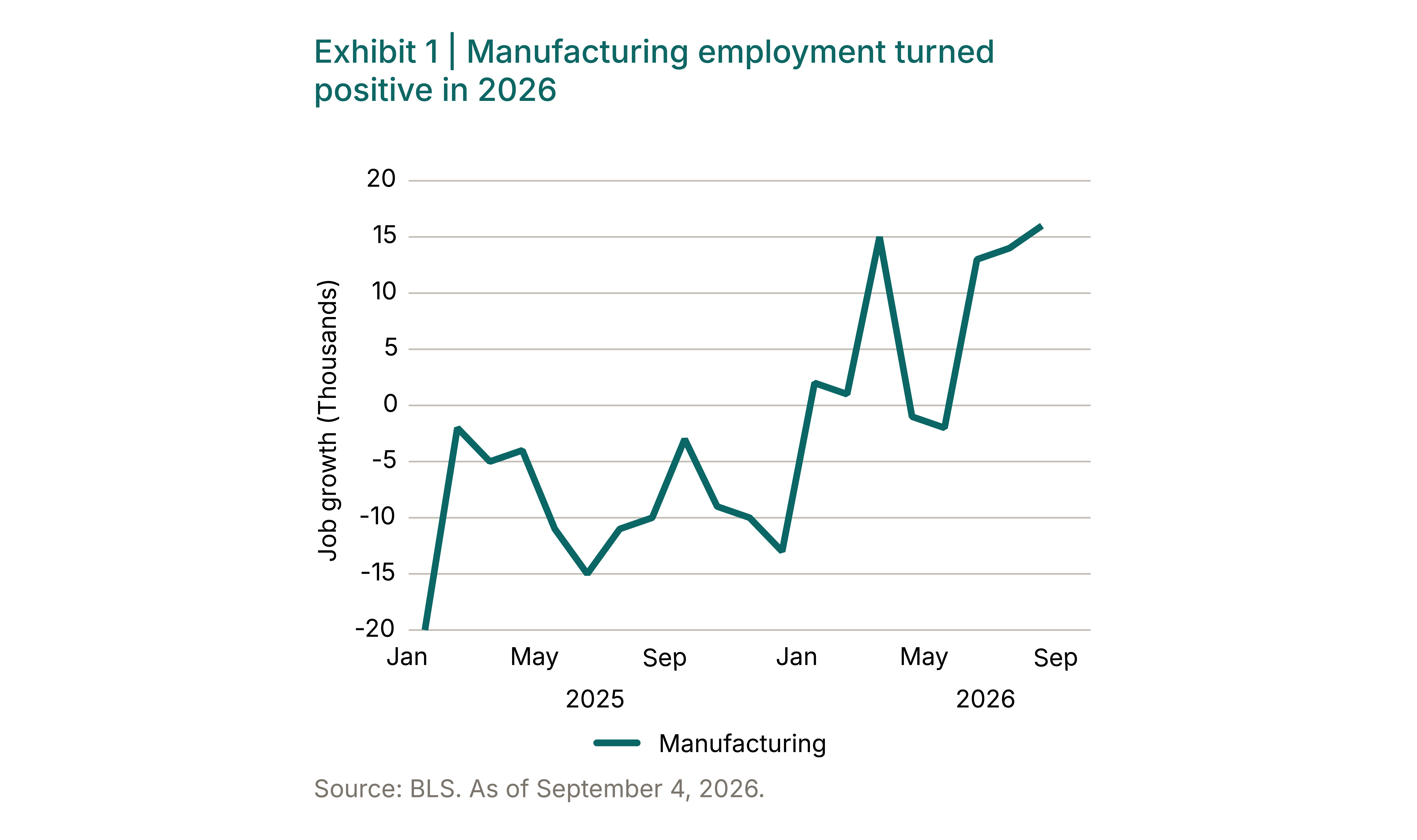
The manufacturing sector did not see a single month of positive job growth in 2025; in fact, it shrank every month. Since the beginning of 2026, however, manufacturing jobs have grown again. In August, U.S. Bureau of Labor Statistics (BLS) data show that 16,000 manufacturing jobs were created.

While most employment gains are still led by services industries, goods-producing sectors like manufacturing and construction have started to contribute to job gains after spending 2025 adapting to tariffs and geopolitical risks.

Overall, payrolls growth has been volatile around a flat trend, especially due to the massive drop in federal government hiring, but private payrolls present a less negative picture.

Chart showing U.S. manufacturing employment trends

Is AI reducing youth unemployment?

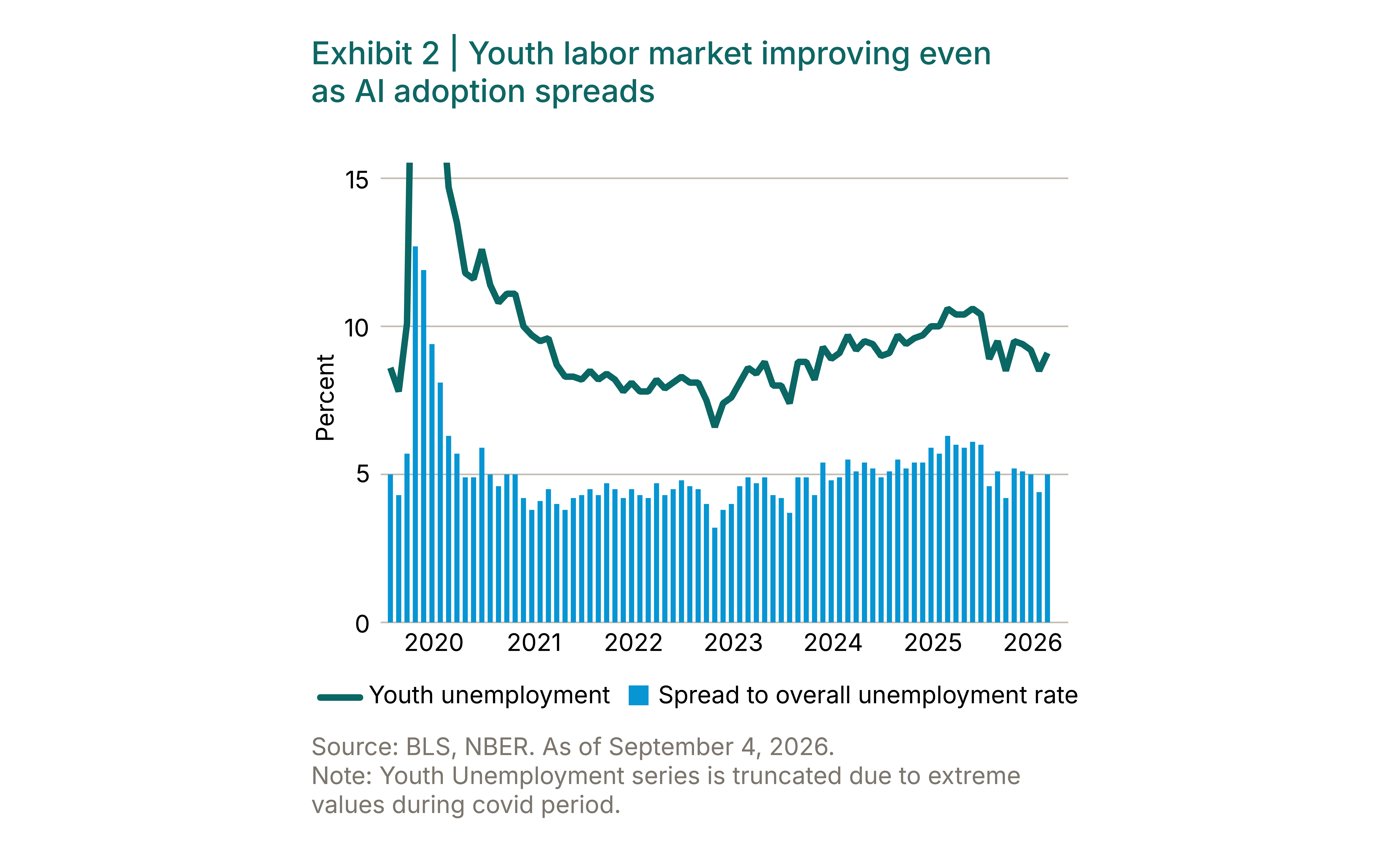
Even as new college graduates may be experiencing difficulty finding jobs, youth unemployment has been falling. The latest BLS data show that unemployment among those aged 16-24 was 9.1% in August, down from 10.6% in November 2025.

The level of youth unemployment is relatively low and has improved substantially since climbing above 10% in 2025. Youth unemployment is also low relative to overall unemployment; the spread between the two has similarly narrowed since last year.

Some new graduates may have had difficulty finding jobs due to AI–especially in specific sectors. But any AI-related job effects must be seen in the context of a relatively good labor market for this demographic.

Chart showing recent U.S. youth unemployment trends

The labor force participation decline is driven by older workers

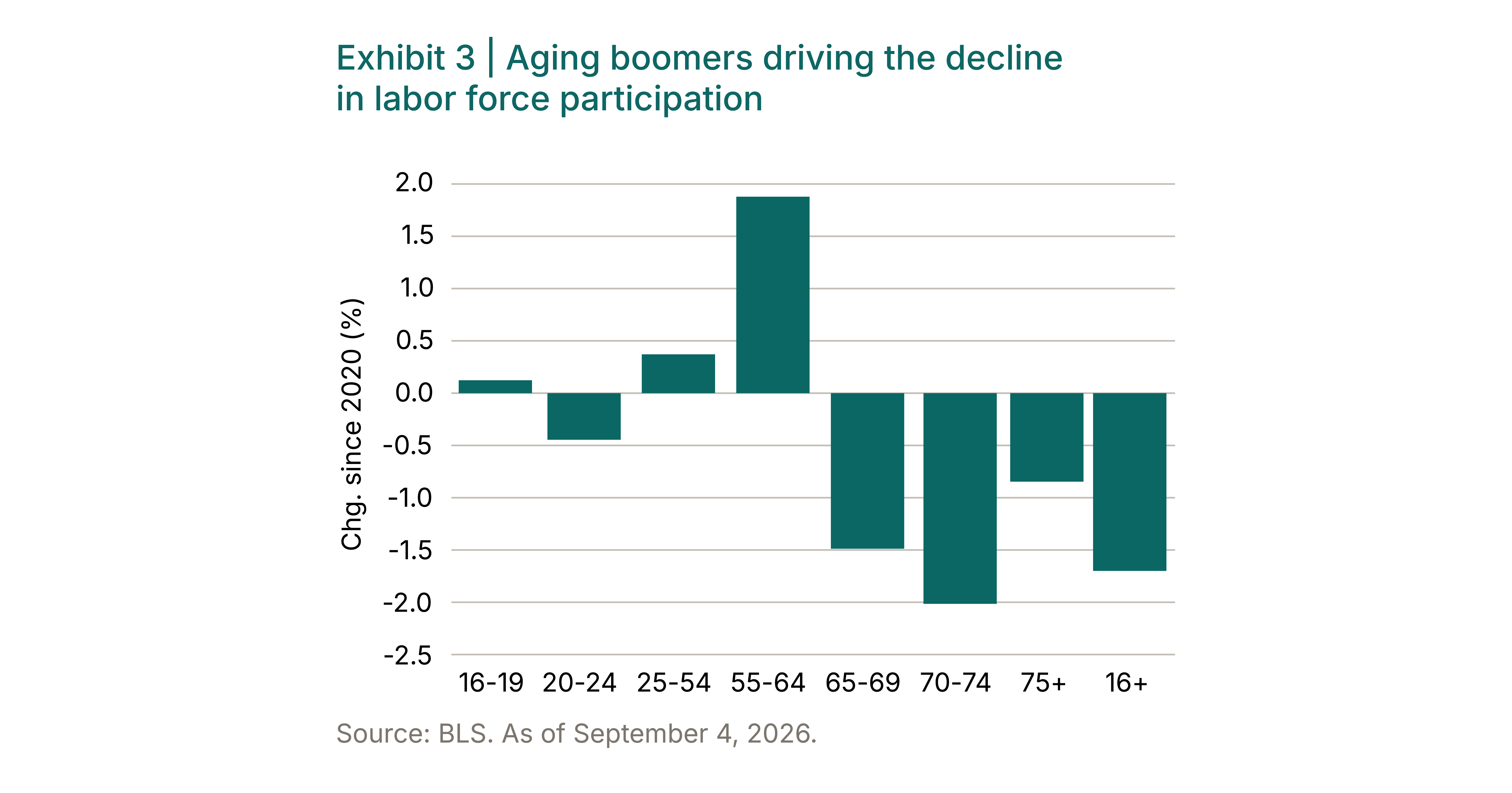
Changes in labor force participation are mainly being driven by baby boomers—those aged 62 and over— leaving the labor force. Younger workers are entering the labor force, but only at marginally positive rates.

The latest BLS data show that the overall 16+ participation rate has declined since 2020 despite increases in the participation rate of 25-64-year-olds, emphasizing how skewed the labor force is toward older workers.

As older workers retire, it is possible that more opportunities open for younger workers, increasing their participation.

Chart showing labor force participation trends by age group

Outlook

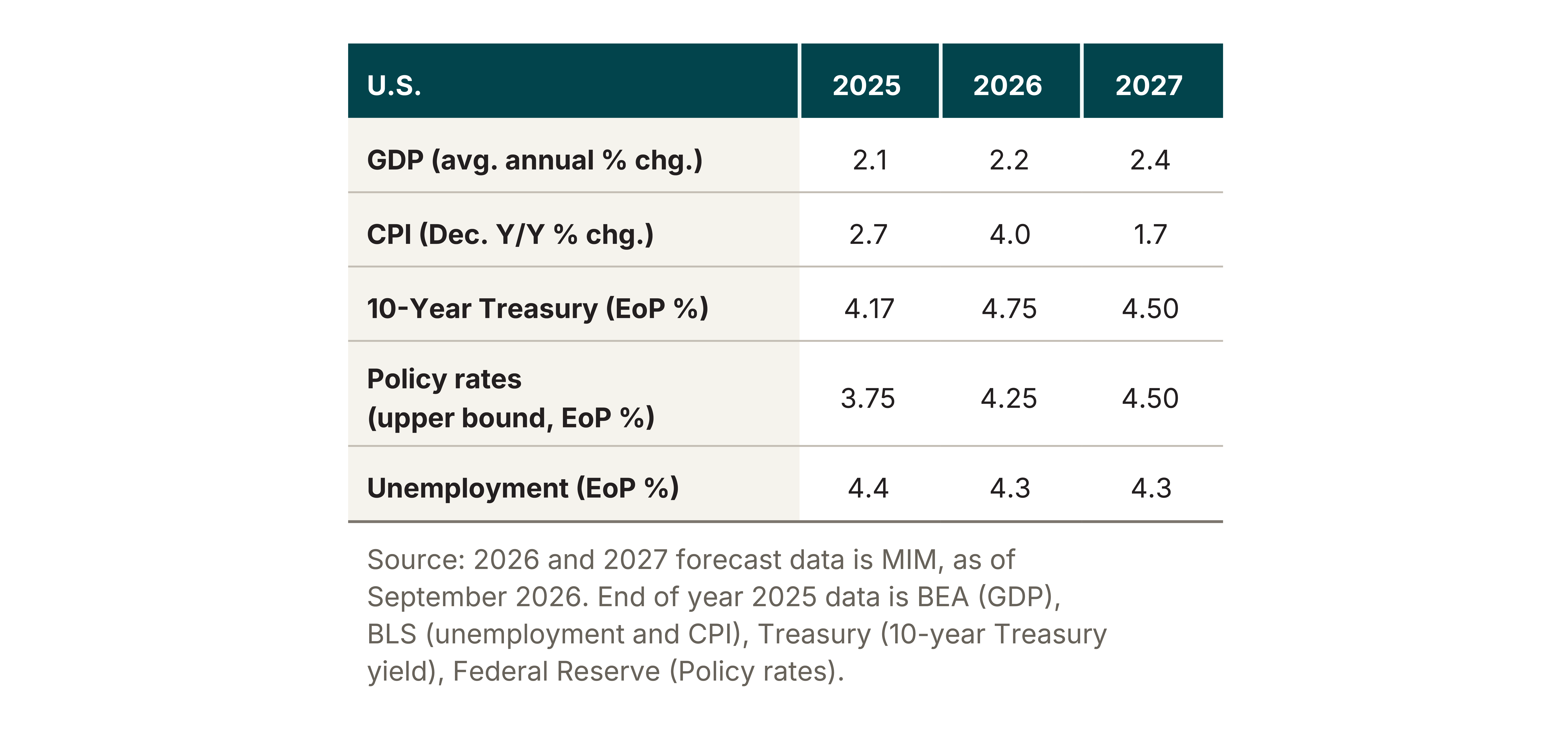
We have revised down our growth forecast marginally compared to last month, due to a slightly weaker second quarter. Our CPI forecast is further revised up by 60 basis points to 4.0%, as the conflict in Iran continues, and oil prices, shipping and transportation costs are hit.

We also expect the Fed to hike once more this year in December, followed by another hike in the first quarter of 2027.

Given the higher inflation, reasonably solid economic growth and markets paying more attention to the fiscal situation of the U.S., we have revised up our 10-year Treasury forecast from 4.50% to 4.75% for year-end 2026.

MetLife Investment Management economic outlook table

Risks

There are two main risks to our current outlook.

First, the Iran conflict has already gone on longer than many expected, and it is entirely possible that its effects continue into next year. If inflation continues to be a problem (or the two rate hikes currently expected by markets are not enough), then the Fed will likely raise rates more than currently expected. This would push up both the policy rate and 10-year outlooks.

Second, the AI boom is seeing multiple threats to its unconstrained growth of the last several quarters. There are the misalignment concerns expressed by several AI companies, which raised worries about disruptions to internet-connected services including infrastructure, and the secondary risk of tighter regulation. Another concern is the popular shift against AI in the U.S. and its effect on future growth. There are also rising concerns about the business models that support valuations and the level of borrowing in the AI- and AI adjacent sectors.


READ MORE FROM METLIFE INVESTMENT MANAGEMENT

Disclaimer

Readership: This document is intended solely for the addressee(s) and may not be redistributed without the prior permission of MIM. Its content may be confidential, proprietary, and/or trade secret information. MIM and its subsidiaries are not responsible for any unlawful distribution of this document to any third parties, in whole or in part.

Risk of loss. Your capital is at risk. Investing in the strategies discussed herein are subject to various risks which must be considered prior to investing. All investments are subject to regional, industry, market, political, regulatory, competitive, business, financial, and other risks. For a more complete list please contact your sales representative. Investment in the strategy described herein is speculative and there can be no assurance that the strategy’s investment objectives will be achieved. Investors must be prepared to bear the risk of a total loss of their investment.

Unless otherwise specified, the information and opinions presented or contained in this document are provided as of the date noted herein. It should be understood that subsequent developments may affect the information contained in this document materially, and MIM shall not have any obligation to update, revise, nor affirm. It is not MIM’s intention to provide, and you may not rely on this document as providing, a complete or comprehensive analysis of MIM’s investment portfolio, investment strategies, nor investment recommendations. You should consult your independent advisors in determining whether such investment or advisory service is appropriate for you in light of your particular circumstances and relevant legal requirements. You may not rely on this document as the basis upon which to make an investment decision. Past performance is not indicative of future results. There can be no assurance that any investment objective will be met. No investment strategy or risk management technique can guarantee returns or eliminate risk in any market environment. No representation is being made that any investment will or is likely to achieve profits or losses or that significant losses will be avoided. There can be no assurance that investments similar to those described in this document will be available in the future and no representation is made that future investments managed by MIM will have similar returns to those presented herein.

Unless otherwise noted, all information herein has been presented in U.S. dollars. Actual returns may increase or decrease due to currency fluctuations. MIM often uses benchmarks for the purpose of comparison of results. Benchmarks are used for illustrative purposes only, and any such references should not be understood to mean there would necessarily be a correlation between investment returns of any investment and any benchmark.

Any referenced benchmark does not reflect fees and expenses associated with the active management of an investment. MIM may, from time to time, show the efficacy of its strategies or communicate general industry views via modeling. Such methods are intended to show only an expected range of possible investment outcomes, and should not be viewed as a guide to future performance. There is no assurance that any returns can be achieved, that the strategy will be successful or profitable for any investor, or that any industry views will come to pass. Actual investors may experience different results.

Information is unaudited unless otherwise indicated, and any information from third-party sources is believed to be reliable, but MIM cannot guarantee its accuracy or completeness. All information is sourced from MIM unless otherwise noted.

The securities and any other products or services referenced in this document may not be licensed in all jurisdictions, and unless otherwise indicated, no regulator or government authority has reviewed this document, or the merits of the products and services referenced herein. This document and the information contained herein has been made available in accordance with the restrictions and/or limitations implemented by any applicable laws and regulations. This document is directed at and intended for institutional and qualified investors (as such term is defined in each jurisdiction in which the security is marketed). Before acting on any information in this document, prospective investors should inform themselves of and observe all applicable laws, rules and regulations of any relevant jurisdictions and obtain independent advice if required.

Where applicable, the Manager may determine to terminate any arrangements made for marketing the Shares in one or more jurisdictions in accordance with the AIFM Directive and UCITS Directive respectively, as may be amended from time to time. Investors and potential investors can obtain a summary of investor rights and information on access to collective redress mechanisms at https://www.metlife.com/investments/ en-us/regulatory-disclosures/investor-rights/.

Last updated 31 July 2026. For additional legal and regulatory disclosures including other cross border information, please refer to www.metlife.com/investments/regulatory-disclosures/global-disclosure-statement.

Share this post

Sign Up Now for Full Access to Articles and Podcasts!

Unlock full access to our vast content library by registering as an institutional investor

Register

Contacts


Image
MetLife Investment Management Logo

With more than 150 years of heritage, we deliver stability, disciplined risk oversight, and aligned investment strategies purpose-built for insurers. Our conviction-led, specialized teams span public and private markets, targeting dependable income and long-term total return. Recognized by Pensions & Investments as one of the world's Top 10 third-party insurance asset managers, we combine scale and expertise to help insurers address increasingly complex investment challenges. From strategic asset allocation to innovative, capital-efficient portfolio construction, our dedicated insurance specialists design solutions around each insurer’s unique objectives. Backed by on-the-ground expertise in 19 countries, we navigate regulatory and capital constraints with confidence across life, health, P&C and reinsurance.
 

MetLife Investment Management
One MetLife Way
Whippany, NJ 07981
 

Madhavi Chugh, CFA
Global Co-Head of Insurance Solutions 
madhavi.chugh@metlife.com
(609) 216-6691

Jeannine Heal, CFA
Global Co-Head of Insurance Solutions 
jeannine.heal@pinebridge.com
(732) 778-4734
 

View the contributor page

Sign Up Now for Full Access to Articles and Podcasts!

Unlock full access to our vast content library by registering as an institutional investor .

Create an account

Already have an account ? Sign in

Ѐ Ё Ђ Ѓ Є Ѕ І Ї Ј Љ Њ Ћ Ќ Ѝ Ў Џ А Б В Г Д Е Ж З И Й К Л М Н О П Р С ΄ ΅ Ά · Έ Ή Ί Ό Ύ Ώ ΐ Α Β Γ Δ Ε Ζ Η Θ Ι Κ Λ Μ Ν Ξ Ο Π Ρ Ё Ђ Ѓ Є Ѕ І Ї Ј Љ Њ Ћ Ќ Ў Џ А Б В Г Д Е Ж З И Й К Л М Н О П Р С Т У Ф Х Ц Ч Ш Ā ā Ă ă Ą ą Ć ć Ĉ ĉ Ċ ċ Č č Ď ď Đ đ Ē ē Ĕ ĕ Ė fi fl œ æ ß