





MetLife Investment Management-

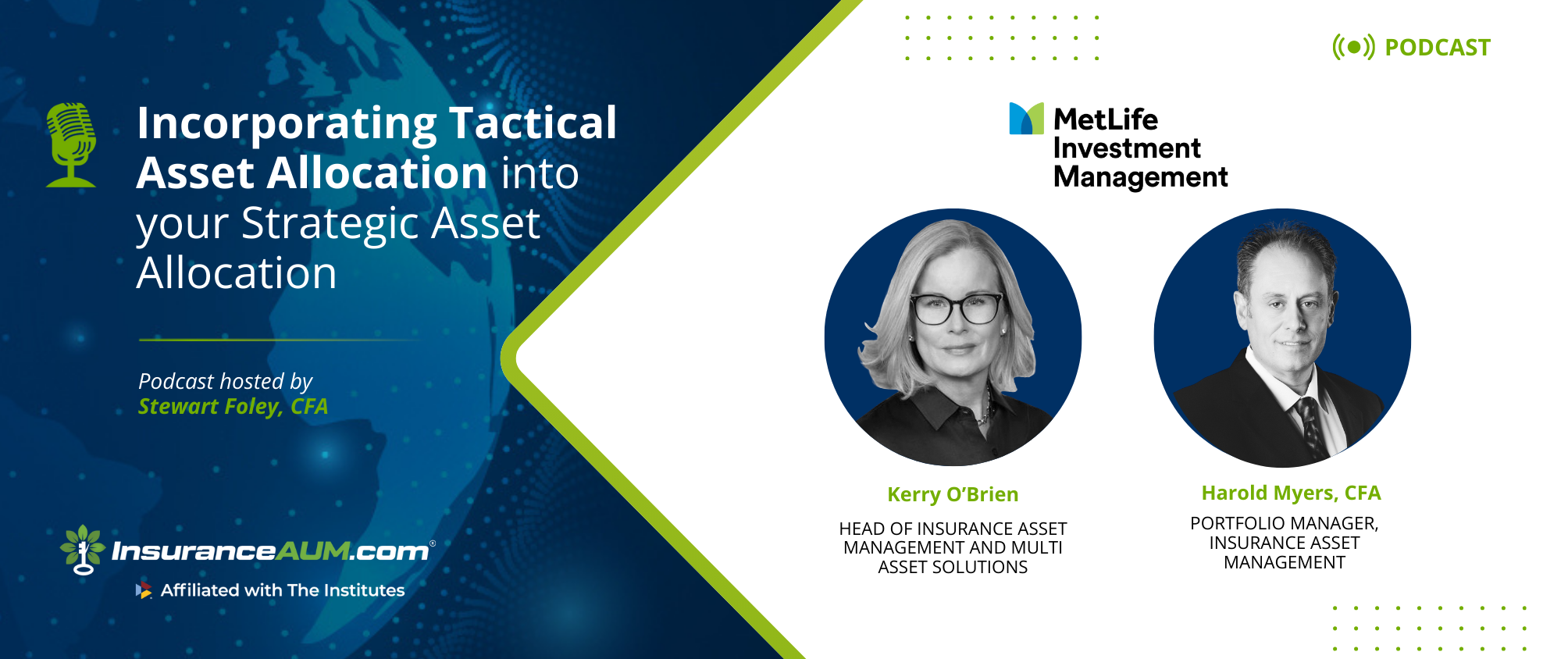
Incorporating Tactical Asset Allocation into your Strategic Asset Allocation

Image
MetLife Podcast header


Stewart: Hey, welcome back to The Home of the World's Smartest Money. It is 2026. We're thrilled to be back with you. For those of you who don't know, my name's Stewart Foley, CFA, founder, and senior advisor to InsuranceAUM.com. Also the principal architect of the upcoming CIIM designation, which stands for the Chartered Insurance Investment Manager designation. As many of you know, or most of you know, there is no textbook for insurance asset management. This is an attempt being issued by the Institutes, which is our parent, and I think it is expected in the first quarter of 2026. And I think when you see it, you'll be impressed with what they've come up with. So, super happy to be back here. Took a little time off over the holidays. This is a really important topic, and it is an insurance investors’ podcast today.  

This isn't asset-class specific. This is really about things that you deal with on an ongoing basis that, suffice to say, nobody gets paid necessarily to talk about this topic. The topic is how tactical asset allocation, or TAA, fits inside a long-term strategic asset allocation framework. And for insurers, as you all know, it's not about market timing, it's discipline, governance, capital efficiency and making thoughtful adjustments in response to changing market conditions. Given the geopolitical environment, there's plenty of what's affectionately known as exogenous shocks to markets, in addition to the typical, economic impacts as well. I'm thrilled to be joined today by Kerry O'Brien, Head of Insurance Asset Management and Multi-Asset Solutions at MetLife Investment Management, and Harold Myers, CFA, director and Portfolio Manager, within MIM’s Insurance Asset Management Group (MIM stands for MetLife Investment Management). Together, they bring decades of experience managing complex insurance portfolios across cycles, geographies and capital regimes. Kerry and Harold, welcome to the program.  

Kerry: Thanks, Stewart. Great to be here.  

Harold: Thanks for having us.  

Stewart: Yes, we're thrilled. Here we go. So icebreaker questions. We've gotten a slightly new one for 2026, but we're going to start with Kerry. Where'd you grow up? What was your high school mascot, and what job would you like to be doing, if not this one?  

Kerry: So I grew up on Long Island, in a town called Bethpage. I went to Bethpage High School, home of the Golden Eagles. And if I were not doing this job right now, I would like to be a ski instructor teaching young people how to ski. I actually contemplated that when I was outsourced in this investment world — insurance outsourced — and we were going to have some time off. And I thought, you know what? Maybe I'll make it to the mountain for this season and teach kids how to ski. But anyway.  

Stewart: That's super cool. I’ve got two stories for you. My daughter was in Park City over the holidays and sent me a picture of the mountain, which was dirt, like 0.0” of snow. The second thing is when I was way younger, like 30 years ago, I was in a class where it was all kids and me. And on skis, I'm like 6'5". And right when the instructors started talking, I lost my balance. I was on the low side of the hill because I'm so much taller than everybody else. I mean, I was like 30 and the next one was like 7. So I fell over, and I dominoed all the kids down. I mean, it was so embarrassing — I can't even tell you. So Harold, next up for you, same set of questions. Where'd you grow up? What was your high school mascot, and what job would you like to be doing, if not this one?  

Harold: Yes. So I grew up in Orange County, New York in the small town of Montgomery, which is about an hour and a half north of our Whippany office here in New Jersey. And my high school mascot was the Eagles. The job I would like to have after insurance asset management — and I guess only if I could go back in time — would be the lead guitarist in a famous rock band. I played in a lot of bands when I was younger, and I had delusions of grandeur for quite a long time, until I realized that my talents and abilities were probably better served for insurance asset management.  

Stewart: Listen, man, that's awesome. I mean, really seriously, somebody said this — I can't remember who it was, but it was a pretty famous quote that said — even movie stars want to be rock stars. So, absolutely. I love it. Now let's get into it here. I think it's really about the foundation. So for insurance investors, how do you define strategic asset allocation, and why does it remain the foundation for a successful investment program? I think that goes to you, Kerry.  

Kerry: Yes. Yes. So, it's a very thoughtful question, and one that is really embedded in insurance asset management and the insurance business, given that the purpose is to build resilient portfolios that are capital efficient, provide the income to pay claims and are able to weather all sorts of fluctuations in the market. So, when we think about doing a strategic asset allocation, we need to factor in a number of core principles, which include matching the liabilities. And that means understanding how liabilities behave in all sorts of scenarios, generating stable predictive income from the assets that are purchased, and then preserving capital and maintaining regulatory solvency. So, there's a lot of different components that must be achieved when building a strategic asset allocation. And it's something that is a core principle across all of the insurance companies that I've worked for in the asset management industry.  

I've grown up in insurance asset management. I would say there's not a lot of variance as to how it's done. It's more a case of when you move tactically, when there's changes, and that, of course, is evolving with new asset classes, and we'll get to the tactical side of it. But the strategic side is sort of creating that playbook, but then you have reality hit in markets and asset classes behaving in different scenarios. You mentioned all the exogenous shocks that we must consider and then react to. So it's really dynamic, but the strategic asset allocation really sets that line in the sand of what we're thinking about — more with a long-term perspective for keeping the stability and the capital of the insurance company steady, strong and able to be there for our policyholders, which is of the utmost importance.  

Stewart: Yeah, it's super helpful. You said that you grew up in this business, and I've grown old in it. So we've got that going on. You mentioned tactical asset allocation, and Harold, this is really for you. How do we define or think about tactical asset allocation in the context of an insurance portfolio and inside the confines of the strategic asset allocation or SAA that Kerry just outlined?  

Harold: Yes. So continuing with what Kerry said, implicit in your SAA is that it's the optimal mix based upon all the factors and considerations that she was mentioning. And so, inherently, it's a passive strategy or, as I'll sometimes call it, a ‘set it and forget it’ strategy, where you're not really expecting a lot of active management. But in contrast, tactical asset management really isn't a set it and forget it or a passive strategy. Instead, asset managers will be much more active in executing sector substitutions and deviating from that target mix at times in order to take advantage of market conditions when they've seen possibilities to add value, or even at times to preserve value by de-risking the portfolio if they think the market environment is deteriorating in some way. But, there is risk there, and the obvious criticism is that you could get it wrong, you could end up having poor market timing, and then you would end up hurting your returns and all the other considerations Kerry was talking about, in the long run.  

Stewart: It's one of those things that in my experience, is challenging at times when opportunities arise in markets, requiring flexibility from the insurance company to take advantage of those opportunities. I think it has to do, to some extent, with the investment committee giving the internal team enough flexibility to do that because sometimes these opportunities don't last forever. The markets are relatively efficient over time. How do you deal with the potential lag in approval of a tactical idea, or does that flexibility already exist in the investment policy guidelines in advance?  

Harold: Yes. So I do think that flexibility is there, and a lot of it is, like you said, the integration with all the other teams and kind of going through the workflow. And so what we'll typically do is analyze any tactical repositioning ideas or trades on a pre- and a post-execution basis, checking our sub-sector exposures across all asset sectors and making sure that we're adhering to internal policy and guideline constraints. And then, that socialization starts to expand where we start talking with our asset sector teams, subject matter experts, ALM working groups, governance teams and so on. At that point, we start to tee up and start coordinating the executions. I think another point that's worth noting is that these tactical ideas can vary quite a bit in terms of size and scope. Sometimes they're relatively innocuous and can be within a single asset sector, but then at other times, the ideas can be much greater in magnitude, $500 million, $800 million, $1 billion or more, such as when we're repositioning a pension risk transfer (PRT) portfolio or another large business, and they can span across multiple asset sectors.  

So when that happens — I'm focusing on the tactical side here. We may work with banks and look to coordinate program trade executions. I've always found that to be a helpful tactical tool to reduce your funding delays and your transactions costs at the same time.  

Stewart: Yes, it's super helpful. And that brings me to the governance cadence and tools section. If you could, Kerry, just start us off with how does MetLife?... MetLife Investment Management has considerable analytics tools. How do you implement tactical decisions and remain in compliance with all of your third-party asset management clients' individual guidelines and investment policy guidelines and limits?  

Kerry: Sure. Yes. We have every client's investment policy guidelines embedded into our compliance dashboard. So we know each day where we stand as far as limits on issuers, sectors, asset classes, if there's a duration band — where we are within that duration band — quality, WARF (weighted average rating factor, all of that is on our compliance dashboards, our portfolio management dashboards by client. And then of course, the team has a lot of knowledge and visibility into how each client thinks about risk, and what their risk tolerance is. Often we do whole balance sheet analysis. So it's not only managing the assets, but it's also recognizing the liability — is the behavior optimizing portfolios within a regulatory regime? Is it cash-flow matching in Bermuda? Is it RBC? Is it someplace in Europe? So all of that is part of how we manage client portfolios and client assets. If we have a tactical opportunity, and I go back to Liberation Day in April, for example — when we wake up, this news hits, spreads blow out — 40 to 50 basis points in investment grade, over 100 in high yield.  

What do we do? We know what we're able to do from an exposure standpoint in the portfolios. And then of course, we have our teams on the desk that have names that they like in different sectors. So it's all hands on deck, identifying opportunities, where can we position them? And then we're able to do that tactically. We don't have to stick to the strategic playbook. We can move into the realm of spreads blowing out. We have private allocations, but maybe we should think about the greater liquidity — and maybe more opportunity in public markets — because private markets tend to lag on the repricing. So there's definitely a pivot. There's definitely a lot of discussion on the desk about what to do in an event like that. When spreads blow out, we want to take advantage of that. But we also, at the same time, we have recession probabilities going from 30% to 80% to — we're already in a recession.  

So there's just a lot of work, and it's exciting work to do on behalf of our clients. And then it's also — we're getting inquiries from clients about ‘what do we do in this situation?’ And what's nice is a lot of them see it as an opportunity, although the tariff news was pretty hardcore.  

Stewart: My next question really goes back to Harold —picking up on Kerry’s point, how do market dislocations, credit cycles and rate environments influence your tactical decisions over time?  

Harold: Yes. So, over the course of my career, I've seen a lot of different market events and dislocations. But just to use an example, COVID-19 is one that really stands out. Just as a reminder, I know nobody's forgotten the shutdowns and all the other uncertainties, but risk assets really got hammered in the beginning, falling about 32%, 34% or so in that first month. And at that time, or in times like it, I think portfolio managers struggle to be objective and not get driven by their emotions. And so from my perspective, capitalizing on moments like that starts first with just taking a step back and trying to see things from an objective or even a contrarian perspective. I think you have to look at it as the price of admission of being an asset manager. We're here to guide clients through tumultuous times like that. So, as that's happening, I try to remind myself of some famous contrarian quotes.  

One of them is “The time to buy is when there's blood in the streets,” And then another one is “A pessimist complains about the noise when opportunity's knocking on the door.” Whatever they are, we could come up with a bunch of other ones, but I think those are really helpful reminders to give you a different perspective because if you can be measured and sift through all that noise, there can be opportunities to add exposures that you're comfortable with on the cheap. And I thought the pandemic period was a really interesting time to do that across all asset sectors and ratings cohorts. I'm remembering structured finance in particular, we'd often see really attractive entry points for pass-throughs, collateralized mortgage obligations (CMO) and asset-backed securities (ABS) due to forced and panic selling. Whereas at different points in time, like the post-Global Financial Crisis (GFC) years and the Quantitative Easing (QE) era, when we were all constantly dealing with historically low rates and spreads and being more offensively minded or aggressive, so to speak — looking for opportunities was a lot less compelling.  

And so, I think those are the times to have those internal discussions where you can be a little more self-reflective and be a little more defensive or cautious. I think encapsulating all of it, what it really requires is that continuous dialogue. It's a daily discipline. Any of these tactical ideas and so forth that you have, have to align with your client's risk appetite and the guidelines, of course, like Kerry was saying, but you have to go beyond that too and really engage the client and just talk with them every day. You have to move beyond the formal processes and the formal metrics and just make sure that you're integrating with each other, and you're on the same page throughout the process.  

Stewart: Yes, it's interesting. Those are a couple of great quotes. We should probably implement a quote section in these podcasts, but if somebody — if I've got this wrong, somebody can DM me on LinkedIn — but I think it was one of the Rothschilds who said, "Buy when there's blood in the street and sell too soon," which I think is a fabulous quote. So getting back a little bit, I mean, and Kerry, you both kind of mentioned this. When you say risk or the perception of risk to an insurance company, that can vary quite a bit between insurance companies, even if they look very comparable on paper. When you think about what we're talking about here, what do you think are the most important risks and constraints you manage when you're executing tactical shifts within an insurance investment portfolio?  

Kerry: Yes, it's understanding what the goals of the portfolio are. Some are just to support the liability. So you're doing asset-liability matching (ALM), but you're less flexible with a tactical shift because you don't want to sort of dislocate or mess up the ALM. So you have less flexibility, but then we have sleeves where we can just generate alpha. Those are much more fluid dynamic — where we're able to — whether it be a surplus sleeve or a sleeve of an asset class — position it on behalf of a client. So there's more leeway to take advantage of spread widening or pivot from public to private. Really, as Harold mentioned, it's understanding the client's objectives, being connected with that client. So when there is a dislocation, you can go in there and optimize it and really get our best ideas from the platform.  

And our platform, as you know, is broad, it's deep, with very talented investment professionals. So it's really a great time to be able to showcase that and just be aware of which clients are open to that when the opportunity does arise.  

Stewart: Yes, super helpful. Harold, are you good there, or did you want me to come to you as well?  

Harold: Sure. I mean, I agree with everything Kerry said. I think the only thing I might add here is that if you become overly robotic or mechanical in your approach to your portfolio construction and your tactical ideas, there is a risk there. And I think it's one of those things where you really need to use experience and apply some art and science in order to get the best results possible. Because again, if you become overly robotic and mechanical, your risk is that your optimization is being overly simplified and gravitating much more toward absolute yield. And like Kerry was alluding to, there are a lot of other considerations that are often equally or even more important than just yield alone, depending upon your client and their circumstances.  

The impact to your cash-flow matching, their risks regarding liquidity or views on the risks of liquidity, right? If you have a longer-term investor versus a shorter-term investor, if it's a property and casualty portfolio, they'll be focused much more on liquidity and shorter assets. But if you're managing on behalf of a client who has a much longer-term liability, like a whole life liability with younger demographics, then their view on liquidity and their ability to take risk is going to be drastically different.  

Stewart: Yes, it's really true. I mean, your point about the robotic nature is a good one, and I'll slap my ‘professor of finance’ hat on for a moment, but models are based on historical data. They're based on historical correlations and historical volatilities and historical returns. And while the future may rhyme with the past, it may be very different. And your point about the art of this, there is art, and it’s taking into account your experience over long periods of time in a variety of situations and doing your best to forecast what is going to happen in the future. I mean, I think your point about COVID-19 is really well taken. When that first happened, inflation was the last thing on anybody's mind. And yet the economy did better than we thought, and we ended up with inflation, but you've got to be able to adapt to what the market is giving you, which I think you articulated really well.  

And that leads me to my last point here, which is the road ahead for tactical investing. Looking forward, how do you see tactical and relative value investing evolving for insurers over the next several years? Do you think that more people will be looking at this? It obviously has benefits. Dust off your crystal ball and tell us about the future.  

Harold: Yes, sure. Insurers have been increasing their allocations to private assets and asset-based finance for several years now. I know that's a subject you've covered maybe one or two times, right? But joking aside, assessing public and private assets, that compartmentalization has really eroded. Insurers are looking at both spaces on a holistic basis, net of capital, considering illiquidity and so on. But to your point about the crystal ball — where I think insurance asset management is probably going is that the insurance asset managers are going to be looking more and more toward customized solutions like securitizations for better capital treatment, repacks, warehousing, rated feeder structures and so on. And when you think about it, these are all just ways to restructure different collateral pools and different asset classes to get better capital treatment, for income enhancement, to accelerate your funding, and even at times to improve your ALM.  

And I also think it's a way for smaller companies, in particular, to get access to sectors where they may not have scale or capabilities, or they have barriers to entry of some kind. And so I think maybe the final thought about this, in terms of the future, is that insurance asset managers are going to be moving more and more toward AI-driven solutions and just automation in general, so that they can keep up and continue to be agile and have more flexibility with changing market dynamics and a changing regulatory landscape.  

Stewart: Yes, that's super helpful. I really appreciate that. It's really a thorough and thoughtful answer. We've come to the part of the program when we ask you a question that really reflects the culture at MetLife Investment Management. And I'd go to you on this, Kerry — what characteristics are important to you? You've had a very successful career with a few different firms, all of them top tier. I was talking with a young person yesterday, who's a rising junior at UCLA, about his desire for an internship. And it's really about that student. I gave him some podcasts to listen to. I said, just go to the end and listen to this question, which is: what characteristics are important when you're adding to members of your team — beyond the hard skills and quant skills that I think are kind of table stakes for this business?  

Kerry: Yes. Great question, Stewart. So I would say, and as our president at MIM says, “Asset management is a team sport,” and we certainly take a team-based approach to asset management. So team fit is number one and essential to landing a job at MIM. You have to be a team fit; you have to be a strong collaborator; you have to be curious about markets and learning and be willing to roll up your sleeves and do pretty much anything that is required to get to the end result. We have a solutions and advisory platform, with a client-first focus, going above and beyond for the client and the team. So that's really one of the key attributes. And it is table stakes to have all that analytical acumen, be able to build spreadsheets, know how to use AI. As you know, AI is penetrating our business, all businesses.  

So being able to use AI, be productive, and at some point down the road, be able to have it impact our ROIs — but not as yet. So yes, definitely be a team player and be very curious about insurance. I know that insurance has this view of being sleepy, but it's not sleepy at all. Maybe one day long ago it was, but it's very dynamic, exciting, and there's a lot going on in insurance asset management.  

Stewart: Kerry, I couldn't agree with you more. I am the flag bearer of the ‘Insurance Asset Management Is Cool’ Parade. So trust me, I'm with you. I think this is a great industry. I love it. I love the insurance side of it as well. So all right, final question. There's two of you, so you each get one pick. Dinner's on us. Who would you most like to have dinner with, alive or dead? Harold, we started with Kerry last time. I'll come to you, and then we're going to go to Kerry.  

Harold: Oh, thanks. This is a problem because I enjoy talking, and I definitely like to eat. So I would need an unlimited budget and calendar, I think, to get everybody in that I really would like to. But since I'm only limited to one, I'm going to go with Jesus, I think.

Stewart: There you go.  

Harold: Is there a bigger historical figure? If they still know who you are, and they're talking about you 2000 years later, I think that's the first person that I want to have a meal with and talk their ear off.  

Stewart: It's funny you say that. I think Buffett's the leader in the clubhouse, but Jesus is second. And we've had some other folks say that, and it’s a great answer. Thrilled with that. Kerry, how about you? It's to be Harold, Jesus, and you, and who else? Please speak to me.  

Kerry: Stewart, I'll disappoint you. I'm going to say the same person I said during our last podcast a year or two years ago, and it's Warren Buffett. I've had a crush on Warren since I was probably in middle school or high school. I’m just so intrigued by his track record, how he approaches the market, people, his family, his lifestyle — I would really love to enjoy a lunch with Warren.  

Stewart: It's funny, I think I may have mentioned this, but when I worked at one of the firms in my past, which was owned by Buffett, owned by Berkshire. And I had the opportunity to be in two different sessions where they invited senior members of the team. There were about 500 people in the room, and he was there, and he is such an interesting person. He's exactly the same person that you see on CNBC or Bloomberg or wherever else he speaks publicly. He is so... it seems like common sense when he says it, but so few have been able to do it. So I really appreciate both of you being on. It's terrific to have subject matter experts who really know their stuff in the insurance asset management business in the weeds, and so, very happy to have you both on.  

Kerry: Great. Thanks for having us, Stewart. It's been a pleasure. Appreciate it.  

Harold: Thank you.  

Stewart: We've been joined today by Kerry O'Brien, head of Insurance Asset Management and Multi-Asset Solutions, and Harold Myers, CFA, Portfolio Manager, Insurance Asset Management, at MetLife Investment Management. If you have ideas for podcasts, please shoot me a note. It's stewart@insuranceaum.com. If you'd like to watch us, some folks on video these days, we have a YouTube channel at InsuranceAUM Community. My name's Stewart Foley. I'm your host on the InsuranceAUM.com podcast.  


Disclosure

MetLife Investment Management (MIM), which includes PineBridge Investments, is MetLife Inc.’s institutional investment management business. MIM is a group of international companies that provides investment advice and markets asset management products and services to clients around the world.  This podcast presents the speakers’ opinions reflecting current market conditions. It has been prepared for informational and educational purposes only and should not be considered as investment advice or as a recommendation of any particular security, strategy or investment product or services. Unless otherwise specified, the information and opinions presented or contained in this document video are provided as of the quarter end date noted herein. It should be understood that subsequent developments may affect the information contained in this document materially, and MIM shall not have any obligation to update, revise or affirm.  This podcast may contain forward-looking statements, as well as predictions, projections and forecasts of the economy or economic trends of the markets, which are not necessarily indicative of the future. Any or all forward-looking statements may turn out to be wrong. All investments involve risks including the potential for loss of principal. 

Share this post

Sign Up Now for Full Access to Articles and Podcasts!

Unlock full access to our vast content library by registering as an institutional investor

Register

Contacts


MetLife Investment Management

MetLife Investment Management and PineBridge Investments now have more to offer as a top-tier global investment platform. With more than 150 years of insurance heritage, we combine the strength of a global, top-tier investment manager with expanded capabilities across multiple capital frameworks. We offer life, property & casualty, reinsurance, and healthcare clients a broad range of total return, income, and yield-enhancing solutions. Backed by $122B in insurance Client AUM1, our expertise spans fixed income, private credit, real estate, equities, and multi-asset strategies. Our proprietary origination and structured deal flow help insurers improve liability alignment, balance-sheet resilience, and capital efficiency, supported by teams across 19 countries.

Madhavi Chugh, CFA
Global Co-Head of Insurance Solutions 
madhavi.chugh@metlife.com
(609) 216-6691 

Jeannine Heal, CFA
Global Co-Head of Insurance Solutions 
jeannine.heal@pinebridge.com
(732) 778-4734

MetLife Investment Management
One MetLife Way
Whippany, New Jersey 07981


View the contributor page

Sign Up Now for Full Access to Articles and Podcasts!

Unlock full access to our vast content library by registering as an institutional investor .

Create an account

Already have an account ? Sign in

Ѐ Ё Ђ Ѓ Є Ѕ І Ї Ј Љ Њ Ћ Ќ Ѝ Ў Џ А Б В Г Д Е Ж З И Й К Л М Н О П Р С ΄ ΅ Ά · Έ Ή Ί Ό Ύ Ώ ΐ Α Β Γ Δ Ε Ζ Η Θ Ι Κ Λ Μ Ν Ξ Ο Π Ρ Ё Ђ Ѓ Є Ѕ І Ї Ј Љ Њ Ћ Ќ Ў Џ А Б В Г Д Е Ж З И Й К Л М Н О П Р С Т У Ф Х Ц Ч Ш Ā ā Ă ă Ą ą Ć ć Ĉ ĉ Ċ ċ Č č Ď ď Đ đ Ē ē Ĕ ĕ Ė fi fl œ æ ß