



Barings -

Infrastructure Debt: A Strategic Anchor in a Shifting Landscape

BaringsFeatured

Infrastructure debt is evolving into a cornerstone of institutional portfolios. Barings explores how macro trends, financing shifts, and investor innovation are reshaping the market and unlocking long-term value.

Image
Orhan-Sarayli
Orhan Sarayli

Head of North America, Global Infrastructure


How does Barings define infrastructure, and why is a disciplined approach essential?

Infrastructure is a term that’s often used loosely to describe a diverse group of asset classes ranging from power plants to data centers. At Barings, we apply a disciplined framework to ensure clarity and consistency in our investment strategy. We categorize infrastructure into six sub-sectors:

ECONOMIC INFRASTRUCTURE
  • Transportation-related strategic assets such as toll roads, seaports, airports, railroad rolling stock
UTILITIES AND PIPELINES
  • Regulated or unregulated distribution and transmission assets, which typically carry water, sewage, electricity, natural gas, and other fuels
POWER GENERATION
  • Renewable energy generation assets (solar, wind or hydro), batteries, and electric vehicles (EVs)
SOCIAL INFRASTRUCTURE
  • Government-sponsored public-private partnerships and social housing, and development of hospitals, parks, government buildings and social housing
MIDSTREAM AND STORAGE FACILITIES
  • Commodity product storage, energy, and non-energy assets
DIGITAL INFRASTRUCTURE
  • Towers, fibre cabling and data centres in well-understood markets or regimes

This structure helps us avoid chasing trends and ensures we focus on areas where we have deep expertise.

What macroeconomic forces are driving the growth of infrastructure debt?

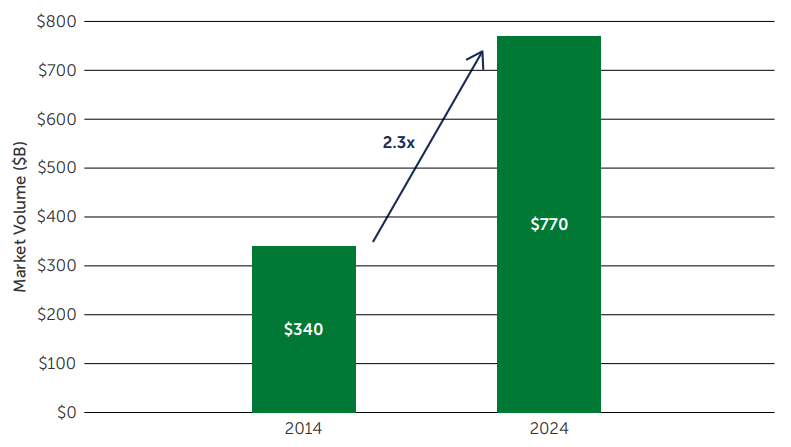
Over the past decade, the infrastructure debt market has undergone a dramatic transformation. In 2014, the total volume of private infrastructure financing was approximately $340 billion. By the end of 2024, that figure had more than doubled to over $770 billion.1 This growth is driven by two major forces: the digital revolution and the global energy transition.

Digital infrastructure, particularly data centers, is expected to require up to $7 trillion in investment by 2030.2 Simultaneously, the shift toward sustainable energy sources—away from coal-fired plants and toward renewables—is projected to demand another $7 trillion globally.3

These trends are not just reshaping the asset class; they’re embedding infrastructure into the fabric of daily life. From rooftop solar panels to fiber networks powering AI, infrastructure is becoming increasingly decentralized and consumer-facing.

This evolution has created a resilient and expanding opportunity set. Infrastructure is no longer a monolithic concept centered on airports and power plants—it now includes assets that touch every aspect of modern life. The sector’s growth is supported by strong structural tailwinds, including government policy, technological advancement, and shifting consumer behavior.
 

Figure 1: Total Global Market Volume Deployed 
Image
Graph showing doubling in Total Global Market Volume Deployed from 2014 to 2024

Source: Infralogic. Debt issued by closed transactions across the infrastructure market. Includes M&A, refinancings and greenfield project financings across banks, credit funds and capital markets. Data as of March 31st, 2025. Data run as of April 9th, 2025.
 

How is infrastructure being financed today, and what role do institutional investors play?

Historically, infrastructure was financed by governments, utilities, and banks. However, fiscal constraints and evolving energy needs have created a significant funding gap. Governments are facing budgetary pressures, and utilities are grappling with the need to modernize their grids to support decentralized energy generation and increased demand from AI and digital technologies.

Banks remain key players in infrastructure financing, but they are increasingly challenged by the scale and velocity of capital required. This has opened the door for institutional investors and asset managers to play a more prominent role. Innovative financing structures are emerging, such as partnerships between utilities and institutional managers. These arrangements allow utilities to carve out discrete assets, retain operational control, and raise capital without tapping public markets.

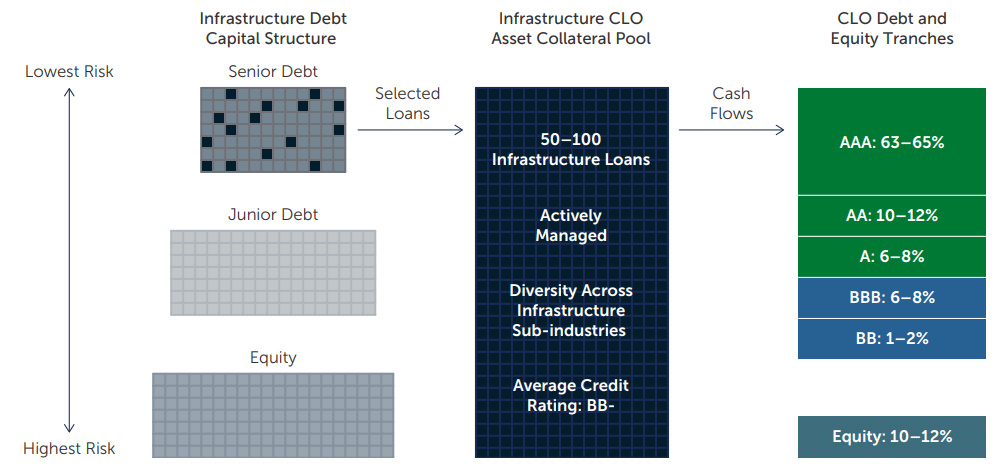
Infrastructure CLOs (collateralized loan obligations) are another breakthrough. These vehicles enable investors to access diversified tranches tailored to their risk-return profiles. They offer a scalable and flexible way to participate in infrastructure debt, addressing challenges such as limited rated deals and concentration risk. The rise of these tools reflects a broader trend toward democratizing access to infrastructure financing and expanding the investor base.
 

Figure 2: Typical Infrastructure CLO
Image
Chart showing Typical Infrastructure CLO layout

Source: Barings
 

Who is investing in infrastructure debt, and how is the investor base evolving?

While insurance companies have long dominated the infrastructure debt space due to their longdated liabilities and favorable capital treatment, the investor base is diversifying rapidly. Pension funds, sovereign wealth funds, asset managers, and high-net-worth individuals are increasingly allocating to the asset class.

Pension funds, for example, typically target 2–5% allocations4 to infrastructure, but given the scale of the opportunity, that figure is likely to rise. Sovereign wealth funds and pension plans—historically equity investors—are now expanding into debt. Retail-oriented institutions are also exploring ways to participate, signaling untapped potential.

This broadening base reflects infrastructure debt’s maturation and its appeal across investment mandates. The asset class offers a compelling combination of stability, diversification, and yield. As more investors seek exposure, Barings is developing tailored products to meet diverse needs, whether under fixed income, real assets, or alternatives. The goal is to provide scalable solutions that align with institutional frameworks and risk appetites.

What is the return profile of infrastructure debt, and how can investors build diversified exposure?

Infrastructure debt is predominantly investment-grade, offering stable returns and low risk— ideal for conservative investors like insurance companies. However, Barings has expanded its capabilities to include non-investment-grade strategies and infrastructure CLOs, which provide higher yield potential and broader access.

Compared to traditional corporate debt, infrastructure debt often delivers a premium, even at the investment-grade level. The asset class also provides diversification and resilience, particularly in volatile markets. For investors seeking higher yields, non-investment-grade strategies offer compelling opportunities, though they require careful management due to their illiquid nature.

Barings is addressing challenges such as limited rated deals and concentration risk by working with rating agencies and developing tailored products. Infrastructure CLOs, for example, allow investors to choose tranches that match their risk-return profiles, enhancing flexibility and reach. These innovations are helping investors build scalable, diversified portfolios that align with their internal frameworks and long-term objectives.

Infrastructure debt is still a relatively young industry, but its evolution is creating new opportunities for diversification and growth. As the market matures, we expect to see continued innovation in product design, risk management, and investor engagement.


Read More From Barings


1. Source: Infralogic. Debt issued by closed transactions across the infrastructure market. Includes M&A, refinancings and
greenfield project financings across banks, credit funds and capital markets. Data as of March 31st, 2025. Data run as of
April 9th, 2025.
2. Source: McKinsey&Co. As of April 28, 2025.
3. Source: BloombergNEF. As of December 7, 2022.
4. Source: Barings. As of August 22, 2025.


IMPORTANT INFORMATION
Forecasts in this document reflect Barings’ market views as of the preparation date and may change without notice. Projections are not guarantees of future performance. Investments involve risk, including potential loss of principal. The value of investments and any income may fluctuate and are not guaranteed by Barings or any other party. PAST PERFORMANCE IS NOT INDICATIVE OF FUTURE RESULTS. Examples, portfolio compositions, and investment results shown are for illustrative purposes only and do not predict future outcomes. Actual investments may differ significantly in size, composition, and risk. No assurance is given that any investment will be profitable or avoid losses. Currency exchange rate fluctuations may impact investment value. Prospective investors should consult the offering documents for detailed information and specific risk factors related to any Fund/Strategy mentioned.

Barings is the brand name for the worldwide asset management and associated businesses of Barings LLC and its global affiliates. Barings Securities LLC, Barings (U.K.) Limited, Barings Australia Pty Ltd, Barings Japan Limited, Baring Asset Management Limited, Baring International Investment Limited, Baring Fund Managers Limited, Baring International Fund Managers (Ireland) Limited, Baring Asset Management (Asia) Limited, Baring SICE (Taiwan) Limited, Baring Asset Management Switzerland Sarl, Baring Asset Management Korea Limited, and Barings Singapore Pte. Ltd. each are affiliated financial service companies owned by Barings LLC (each, individually, an “Affiliate”). Some Affiliates may act as an introducer or distributor of the products and services of some others and may be paid a fee for doing so.

NO OFFER: The document is for informational purposes only and is not an offer or solicitation for the purchase or sale of any financial instrument or service in any jurisdiction. The material herein was prepared without any consideration of the investment objectives, financial situation or particular needs of anyone who may receive it. This document is not, and must not be treated as, investment advice, an investment recommendation, investment research, or a recommendation about the suitability or appropriateness of any security, commodity, investment, or particular investment strategy, and must not be construed as a projection or prediction.

Unless otherwise mentioned, the views contained in this document are those of Barings. These views are made in good faith in relation to the facts known at the time of preparation and are subject to change without notice. Individual portfolio management teams may hold different views than the views expressed herein and may make different investment decisions for different clients. Parts of this document may be based on information received from sources we believe to be reliable. Although every effort is taken to ensure that the information contained in this document is accurate, Barings makes no representation or warranty, express or implied, regarding the accuracy, completeness or adequacy of the information.

Any service, security, investment or product outlined in this document may not be suitable for a prospective investor or available in their jurisdiction.

Copyright and Trademark

Copyright © 2025 Barings. Information in this document may be used for your own personal use, but may not be altered, reproduced or distributed without Barings’ consent.

The BARINGS name and logo design are trademarks of Barings and are registered in U.S. Patent and Trademark Office and in other countries around the world. All rights are reserved.


Share this post

Sign Up Now for Full Access to Articles and Podcasts!

Unlock full access to our vast content library by registering as an institutional investor

Register

Contacts


Barings

Barings is a $470+ billion* global asset management firm that partners with institutional, insurance, and intermediary clients, and supports leading businesses with flexible financing solutions. The firm, a subsidiary of MassMutual, seeks to deliver excess returns by leveraging its global scale and capabilities across public and private markets in fixed income, real assets and capital solutions.  

*As of September 30, 2025

Ilena Coyle
Head of North American Insurance and Intermediary  
ilena.coyle@barings.com973-271-2400

www.barings.com
 
300 South Tryon St, Suite 2500,
Charlotte, NC 28202


View the contributor page

Sign Up Now for Full Access to Articles and Podcasts!

Unlock full access to our vast content library by registering as an institutional investor .

Create an account

Already have an account ? Sign in

Ѐ Ё Ђ Ѓ Є Ѕ І Ї Ј Љ Њ Ћ Ќ Ѝ Ў Џ А Б В Г Д Е Ж З И Й К Л М Н О П Р С ΄ ΅ Ά · Έ Ή Ί Ό Ύ Ώ ΐ Α Β Γ Δ Ε Ζ Η Θ Ι Κ Λ Μ Ν Ξ Ο Π Ρ Ё Ђ Ѓ Є Ѕ І Ї Ј Љ Њ Ћ Ќ Ў Џ А Б В Г Д Е Ж З И Й К Л М Н О П Р С Т У Ф Х Ц Ч Ш Ā ā Ă ă Ą ą Ć ć Ĉ ĉ Ċ ċ Č č Ď ď Đ đ Ē ē Ĕ ĕ Ė fi fl œ æ ß