





We're currently experiencing email delivery delays. For urgent matters, please contact us directly at lindsay@insuranceaum.com.

SLC Management-

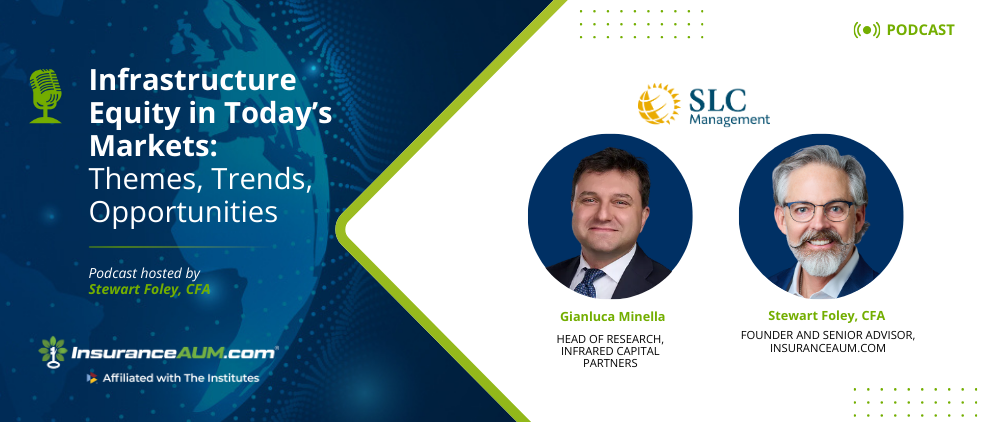
Infrastructure Equity in Today’s Markets: Themes, Trends, Opportunities

Image
10.22 SLC Management_Web


Stewart: Hey, welcome back to the Home of the World's Smartest Money. I'm Stewart Foley, and this is the InsuranceAUM.com podcast. There are a couple of things I want to go through before we get going here. One is I think is that many of you saw our recent announcement of a sale to The Institutes. A lot of the folks on the investment side aren't as familiar with The Institutes, but everybody on the operating side is. They are the governing body of the CPCU designation in Property and Casualty space, sort of the CFA of Property and Casualty underwriting. They do a number of other professional development and designations. They educate about 100,000 insurance professionals a year, and they are aligned with us on that. Also, they are very pro-industry. They have a number of P&C industry CEOs on their board, and they're also financially secure, which is helpful to allow InsuranceAUM to grow on a stable foundation going forward.

I'm hoping that you'll give us half the grace that you've given me over the years. I'm still involved and will be going forward here, but I just want to mention it. They care about the LP to GP ratio at events. They are dedicated to education as well. So, really, a good partner, and we're thrilled to be there. Shout out to Pete Miller, the CEO, who is involved in a number of industry things. I'd encourage you to check out his podcast as well. So I also want to give a shout out to Joe Eppers, who's the CIO over at Selective, who texted me this morning and asked me about the CIIM designation and where were we with that. For those of you who may not know, we are working with The Institutes, the group that purchased InsuranceAUM, on the Chartered Insurance Investment Manager designation, which we're calling CIIM, and we are trying to teach insurance asset management at least at a fundamentals level.

It is a daunting task as many of you can imagine. We have been helped by no less than 40 subject matter experts across the industry to create a curriculum from scratch. We are expecting to launch that on February 26th. So more to come on that. And now for today's podcast, the title of today's podcast is Infrastructure Equity in Today's Markets: Themes, Trends, and Opportunities. Infrastructure continues to gain momentum among insurers. New data from SLC Management's Global Insurance Survey shows that allocations are on the rise with us insurers starting to close the gap with their global peers. Joining me as our subject matter expert professor for the day is Gianluca Minella, who's the Head of Research at InfraRed Capital Partners, part of SLC Management. Gianluca brings more than 17 years of experience, including the Abu Dhabi Investment Authority, DWS, Fitch S&P, and now leads the infrastructure research function. You provide insights and analysis across the infrastructure asset class for investors globally. Gianluca, welcome. It's great to have you on the show.

Gianluca: Sure, thank you very much. It's great to be here with you.

Stewart: Alright, so you had mentioned that you're not familiar. Listened to one of our podcasts, so this is going to be new to you, but it's old hat for all of our dedicated listeners out there. Where did you grow up, and what was your first job? Not the fancy one.

Gianluca: Sure. I grew up in Rome, and I happen to be in Rome today. I studied partially in Milan and in the US, and my first job was actually in Milan at Moody, where I worked on utilities. So, one of the first infrastructure sectors. This is about 20 years ago, and at the time, infrastructure was a relatively boring sector. I wouldn't even call it an asset class because not many institutional investors and insurance companies were focusing on that asset class, and certainly, we're in a very, very different place. Today we've gone through 20 years of expansion for this asset class, and it's going beyond, sort of like the traditional sector, such as utilities, transportation, airport, store roads into way more interesting sectors that are essential for decarbonization and digitalization. Just think about data centers. So there is a lot to talk about.

Stewart: Good deal. And one of the things I think that would be helpful is that SLC Management is involved, owns a number of boutiques, and they have relationships with other asset managers; InfraRed Capital Partners is one of those relationships. Can you give us a high-level overview of SLC Management's Global Insurance Group and how InfraRed Capital Partners fits in?

Gianluca: Sure. So SLC Management is a global asset manager with over $300 billion in assets under management. So a fairly big players as you said under SLC, we have an umbrella of different companies that have individual and specific experience on different sectors of the asset management industry such as SLC Fixed Income Crescent, that is very experienced in private debt and has over $48 billion in assets under management, BGO, that is active in the real estate space with almost $90 billion assets under management, and InfraRed, that is active in the infrastructure space with around $15 billion asset under management. In particular, InfraRed is actually one of the oldest infrastructure asset managers. It traces back to the early two thousands when, again, infrastructure wasn't really an asset class and as such is a global manager with a lot of experience globally across different infrastructure strategies.

Stewart: Yeah, it's interesting. I got into this business when insurance was a backwater and nobody cared, right? I mean, nobody cared. And there are some OGs at SLC. Bart Hall is a guy who, most of the way, got me into this business. And then Randy Brown, who's the CIO, both good friends. We've got a great relationship there, and very happy to be working with you on this podcast. SLC Management recently completed a major survey. It showed that insurers plan to increase their allocation to infrastructure over the next two years. From your perspective, what are the key characteristics that make infrastructure equity such an attractive asset class for those insurers?

Gianluca: So historically, infrastructure equity has been adopted by institutional investors as a diversifier and, in particular, a diversifier from fixed income. It's no wonder that in the context of very low interest rates for about a decade after the great financial crisis, we saw strong demand for assets such as infrastructure that would be low risk, high yield, certainly providing a premium above government bond yields, and an element of diversification. And in particular, what we saw is that initially, insurers, especially in Europe, and we'll discuss regulation later, were really attracted by this illiquidity premium or premium above government bond deals, but by the long duration of this asset class, which really matched well their liabilities. However, what has happened is that today we are in a completely different environment where interest rates are higher and return targets are higher, and while this is somehow shaping demand for a different type of assets with a higher risk return profile, we have seen a sea change within infrastructure too because while as I explained at the beginning 20 years ago, we were talking about very traditional stable infrastructure sectors, new utilities, toll roads.

Today, the asset class has expanded meaningfully on the back of the mega trends of digitalization and energy transition, which means something. It means that today there is the opportunity to leverage this asset class also as an equity replacement and capitalize somehow on sectors that do offer these defensive characteristics that I discussed before, but also offer an opportunity for growth. So if you wish, the appetite from insurance is emerging as a strategy which could be summarized as being able to play offense with a defensive asset class two and being able to really capitalize on the mega trends to generate higher returns.

Stewart: Yeah, it's interesting. Part of your survey, and I mentioned this at the intro, US insurers are starting to catch up with global peers. There are reasons for that, right? It's predictable cash flows. I was a municipal treasurer for a minute, and it's what we used to call essential service revenues, right? It's not things that when people are driving untold roads to work or wherever, it's not like, oh, the economy slowed, so I'm not going to drive to work anymore. I just think that it's interesting that you're seeing this trend in insurers. What do you think is driving that change in approach?

Gianluca: Sure, and just to answer a very important point to make as we explain why this asset has expanded within insurance investment is, as you correctly said, this is a resilient asset class on paper where barriers to entry, monopolistic characteristics, all enable us to have predictable and visible cash flows in the long term linked to inflation. So, a great proposition, even more so what we learned in the last few years during COVID, is that while this may not always be true, at the same time, for every sector, think about COVID, tall roads stopped operating, for example. But look, utilities started outperforming, and digital started outperforming because we were all working from home, and ultra-low interest rates made utilities very attractive. So what is very important to recognize is that this is an asset class that derives its resilience from the diversification across sectors that have completely different exposure to economic variables.

Why is this important? Because this is exactly what the European insurance recognized now, around 10 years ago, when deciding to reduce effectively the capital charges for infrastructure investment within a YOPA within the European insurance regulation solvency framework. So just to be clear, I'm sure everybody knows this on this channel, but infrastructure equity investments often receive favorable capital treatment under a certain regulatory framework, which really can influence the appetite of insurance companies for this type of asset class. And we have historically seen this starting under the Solvency two framework in Europe, where suddenly insurance companies allocating to infrastructure investment would see a favorable treatment for their capital allocations, meaning a discount in the capital charge that they would have to set aside when doing an investment in infrastructure. Now we know that in the US there have been reforms recently, but infrastructure equity typically doesn't get any capital benefit beyond the equity treatment, meaning it's treated similarly to other equity exposures. But hey, I just explained why infrastructure can be a great substitute also to equities, providing potentially some resilient return pickup driven by the mega trends. And then clearly another good example is Bermuda, where infrastructure equity often enjoys 10-20% capital requirements reductions in the jurisdiction, reflecting really what I just described. So, the perceived low risk and long-term stable cash flows that this asset class can provide you with.

Stewart: Yeah, it's super helpful. I'm glad you mentioned Bermuda. One of the things I think that most insurance investors are looking for is not only sources of income but diversified sources of income that improve the risk-return profile of the portfolio. Right? So, can you talk a little bit about how infrastructure equity stacks up against other alternative asset classes when it comes to risk-adjusted returns and diversification? Is there something that's unique about the return drivers that fits particularly well for insurers' balance sheets?

Gianluca: Sure. So we should think about infrastructure not as an asset class, but a collection of asset classes. In reality, it's extremely complex because we don't only have different sectors, but we also have different contract profiles. Some assets may be fully regulated and completely shielded from the economic cycle. Some may have inflation linkage, some may not. Even more so, an individual asset can lend itself to many different strategies. Some investors may buy that asset for yield and be extremely cautious in the way they manage it. Some investors may decide to use that asset with a capital expansion strategy, betting on its growth. Think about an airport, for example, in a strategic location that may need some CapEx to expand. Why am I saying this? Because effectively, infrastructure stands in the middle between real estate and private equity, if you wish. So it is an asset class that does provide, especially on the core end of its strategies, a profile that tends to be similar to real estate in the sense that it is focused on yield, long-term cash flow, predictability, and inflation linkage.

But it acts as a diversifier from real estate because data show that it tends to be more resilient to economic cycles. And again, the inflation linkage point is extremely attractive at that end of the spectrum. On the other side, as I explained, infrastructure does potentially provide for what we call core plus or value add strategies, a combination of return factors that include yield, but include capital appreciation. But as such, it does compete sometimes with private equity in terms of risk-return profile, but it has fundamentally different characteristics. Why? Because strategies that do focus on the growth element of infrastructure do rely on the stability that I was discussing before, and focus a lot on organic expansion of assets. So while typically private equity strategies may focus on consolidating different players and the market with an M&A strategy, infrastructure strategies tend to be way more prudent, be less aggressive in terms of financial engineering, and really expand assets through CapEx because guess what?

These assets are a lot in demand. Think again about an essential service such as an airport, a toll road, or even renewables nowadays. So as I explained, this is an asset class that can act as a diversifier from more of a fixed income strategy, but also a private equity equity strategy while really relying on some key benefits that investors like which are really the inflation linkage, which has proven to be extremely strong now that inflation is higher, we have data that evidence it, but also this progressive growth that is through the cycle and independent from economic cycle to some extent that investors and insurance companies really like.

Stewart: And so you mentioned inflation, and it kind of gets me to the macro backdrop, right? So, how do macro factors like interest rates, you mentioned inflation, but the broader economic environment, affect the performance of infrastructure equity? Are you seeing different behaviors between core, core plus, and the value-added strategies that you mentioned as the cycle evolves?

Gianluca: We do, just to give you an idea, today, we have enough data across different sectors, and there are plenty of data providers with factor models and plenty of evidence of assets that, for example, InfraRed owns. So we have a lot of data, and what we see is effectively that the more we do focus on the core end of the market, the more the cash flows of infrastructure assets are bulletproof in the sense that these are utilities, these are long-term contracted assets with inflation linkage. So, as such, the cashflow element of it is effectively fixed-income-like. However, what this also means is that the duration element tends to be quite elevated duration risk tends to be quite elevated. In other words, the more we move towards the core end, the more we are exposed to interest rates and particularly duration.

So long-term government bonds are very different from real estate and private equity. The latest years have shown us how these two asset classes tend to be more exposed to central bank rates because debt tends to be more short-term, refinancing is more frequent, and so central bank rates are affecting the lending market effectively and impacting these more infrastructure is more exposed to the long end of the curve. Now, if we move along the risk space, I was thinking about sectors that tend to be more cyclical, such as a toll road or strategies that are focusing more on an element of growth in the assets.

Again, think about the example of an airport that needs to expand. Well, in that case, we still do have an element of exposure to interest rates on the long end of the curve, but progressively, we're in producing other risks which are more typical of equity investment, such as, for example, GDP exposure or sub-sectors of GDP, toll road will be exposed to consumption and freight transport, for example. So, industrial production, but again, as we move up, the risk and the element of financing of assets and short-term financing may play a role too. But look, all of this is great because all I was explaining before is that what investors can do is consciously build portfolios and diversify them to really tailor the risk profile, risk return profile they want in that specific strategy to match their needs and infrastructure offers plenty of sectors and strategies with this diverse risk return characteristic that enables us to tailor that portfolio that way.

Stewart: That's super helpful. By the way, you mentioned the longevity, or how long you've been involved in this asset class. What are some of the biggest thematic shifts that you've seen shaping infrastructure today? For example, where do you see the strongest opportunities emerging, and are there areas where you're cautious? I just think that anytime we're talking about opportunities, the contrarian in me always wants to talk about whether you're cautious about anything. So, can you give us a little bit of background on how things have changed?

Gianluca: Look, as infrastructure investors, we are cautious by definition and risk-averse by definition in the sense that what we like about the asset class is that, fundamentally, although the world is moving fast, we can rely on assets that are essential and such are more stable. Does it mean that this asset class doesn't move? Absolutely not. Over 20 years, you have seen waves of changes in the market, call it regulatory risk that has shaped successes and failures across some of these sectors. I'm thinking about the renewables impacted by retroactive changes to regulation in 2012, as there was the sovereign wealth crisis in Europe, and some governments had to cut some subsidies. So to some extent, what we see today in the US is not new to infrastructure investors. I'm thinking about COVID, I'm thinking about what has impacted many assets in the short term, but I would say that the main difference compared to 10, 15 years ago is these mega trends now.

So, as we are going through a redefinition of the infrastructure platform globally, we see that dramatically falling technological costs in battery storage, renewables in computing power, and sharply rising demand for some of these assets are really leading to an acceleration in demand and supply for infrastructure. And this is something that has changed the nature of the asset class compared to 20 years ago, as I was describing. What are the main trends? Decarbonization? It is a 2 trillion opportunity every year. Just to give you a sense, this is more than the size of the Australian GDP every year. Digitalization is a one and a high trillion opportunity when you look at the annual investment needs. And then clearly demographic changes are also driving big investment opportunities. But perhaps these are a little bit less of a focus of institutional investors because we are talking mainly about opportunities in emerging markets to build new core infrastructure, such as tall roads within decarbonization and digitalization.

Just to answer your question, there are some risks happening. Take decarbonization, for example, energy transition, and I just mentioned it. Globalization has recently reshuffled that mega trend, especially Europeans were betting on the decarbonization of energy, heavily relying on subsidies. And today, as a result of the global uncertainty driven by the Russian Ukraine war and effectively Russia closing the taps of gas to Europe, we have seen that we have moved from energy transition to energy security in Europe. So sharp demand for new power to supplement the missing gas and, importantly, also try to reduce the costs of that energy, which have spiked. So that is a factor that has acted both as a risk, as an opportunity in the European market. If we talk about deglobalization, that can be a phenomenal opportunity as well. We have seen the negative effects of it to some extent in the European energy space.

But look, if you think about North American LNG and how valuable it has become for global supply chains, we have seen some North American LNG companies even listed tripling in value over the last five years. And again, the reshuffling of supply chains is driving a lot of demand for infrastructure. So we see a big opportunity there. I've left digitalization as the last sector. This is a sector that, until 10 years ago, used to be called telecom infrastructure, and it was really boring. It was fundamentally telecom towers. And then we've seen the wave of fiber coming to the market, providing an opportunity for fiber deployment, which, to some extent, is playing out or has played out in many markets. And we have seen that while in some markets it has been a phenomenal opportunity for resilience returns and utility, like in other markets, fiber has led to a lot of competition within operators.

So has not really delivered on the promise of low competition as we would want for infrastructure. But finally, data centers. This is not a new topic. Data centers have been around for a long time as part of REITs. These were income-generating assets. Today, we see phenomenal growth in that space. It is an extremely complex environment, but I will tell you the following: even stripping off the AI component, which is clearly what is driving today's growth, especially in the hyperscaler end of the market, data center demand is growing because of the migration from private to public cloud due to the data consumption that we are seeing. And in our opinion at InfraRed, the opportunity is very strong and not only in the hyperscaler market, which is focused on the AI topic, which we may well discuss later if you want. But the colocation space is the one where we see an opportunity to diversify away from these large data centers that are focused on global hubs, even in North America, and really to provide infrastructure assets that are in demand but are also shielded from some of the systematic risks that we may be experiencing.

Just to give you an idea on hyperscalers: North Virginia in the US. About 70% of the data within the internet flows from North Virginia, 30% of the global data center capacity is located in North Virginia, in Lauderdale. If you look at the power prices in that region, we have seen a meaningful increase because of the strong demand for power the data centers are creating. And at the same time, we see strong correlation with water prices and water scarcity. So to some extent, water and energy are correlated, and this is a factor to consider when you are deciding to acquire or invest in an asset, which may be very heavily exposed to these factors in the long term. So what I'm trying to say is that within the digitalization space, within data centers within and either is a phenomenal opportunity, but today we need to be extremely cautious when we select individual assets, their location to make sure that these actually deliver on what is promised on the team IE resilient cashflow and sort of the growth profile that we have invested in.

Stewart: Yeah, it's interesting and I mean there's always critics, right? And some would say that infrastructure valuations have become stretched. There are concerns about the valuation of private assets in general because there's been so much flow, but that really usually for somebody in your seat that turns to pricing discipline and value creation. Can you talk a little bit about how you manage value creation, particularly for those insurers who can't afford a lot of drawdown risk? 

Gianluca: Sure. So first of all, a comment on valuations in infrastructure today we are in a very different place compared to where the listed markets are, excluding hyperscale data centers, which have seen a meaningful increase in price and for meaningful increase in price. I was looking at some statistics the other day from BCA prices per square foot for a North American hyperscaler data centers have moved out of memory from $500 per square foot to $980 per square foot. Wow. But actually, if you look at valuations in infrastructure, because they are mainly based on DCS and because of the higher interest rate environment we've seen have actually come down and have actually recently only stabilized. So the premium of private assets in the infrastructure space today is very attractive. That's why you see some investors rotating out of equities into infrastructure and private assets. But again, it depends on the sector.

So data centers are priced aggressively today. Value creation is extremely important, however, because it's the one tool that enables you to generate value independently from the purchase price. Let me explain what I'm trying to say because I don't want to say something inaccurate here that may be seen as looking at things with excessive risk. So number one, we talked about the fact that this is an operational asset class. So if you buy a real estate asset, there is very little you can do apart from collecting the rent and managing the building effectively. Think about managing an airport. You may be paying a price for that airport, but you have the opportunity to manage it, actively attract new airlines, and spend some CapEx to expand it. So by definition, we've seen that the ability to use CapEx and the ability to manage the business profile of an asset gives you an element of resilience and an element of growth potential independently of the price.

Particularly, the price plays a role when you're looking for yield. But then, if you think about these mega trends, well, the demand is for developing, building, and expanding new assets. In this case, the purchase price plays a very little role because actually, in many cases, you are partnering with business owners who are interested in setting up an industrial partnership with you for the long term for developing an asset. So think about somebody who is developing a new platform with renewables and battery storage. A lot of it is on paper, clearly a lot of it is in enshrined in the regulation, but the purchase price plays an ED role. It's the CapEx that you will be investing that will be defining the asset value and clearly requires a lot of experience and a lot of knowledge from a manager, such as InfraRed, to be able to successfully transition that asset into a valuable asset that can be exited then to core player. So what I'm saying is the price is relevant, but in the context of today's mega trends, a little bit less because the focus is mainly on asset expansion.

Stewart: Yeah, it's super helpful. ESG is a term that has created a fair amount of controversy in the US, and I'll just leave it at that. Are we at a point where ESG and performance are converging, or is there still tension between the two?

Gianluca: I would say that in its infancy, and as a European, we have seen the infancy of ESG more than what has been seen in North America. ESG was a bit of a flawed concept in the sense that methodologies have developed very rapidly, sometimes ahead of regulation and sometimes ahead of the factual evidence that would enable a manager to pick or exclude certain investments based on certain criteria. Luckily, today we are in a very different spot because, meanwhile, especially in Europe, regulation has caught up. So we have a very clear regulatory framework that is partially adopted globally with the SFDR regulation, where managers need to declare exactly what we are doing, whether they're an Article six, Article eight, Article nine, and for this, I mean Article eight, you do focus on incorporating in your risk management some criteria on sustainability. Article nine, you are clearly stating that you're replacing some of your financial return for some impact.

So positive impact on your investment, but also other methodologies have evolved. I'm thinking about grab, for example, and in fact the ESG has been substituted by the term sustainability today, which is way more relevant, and for infrastructure, I would say has always directly been there. Think about what it means to own and manage a water company or an airport. The impact that you have on communities, the impact that you will have on the resilience of a certain region when it comes to the provision of water. So what InfraRed does and many other peers do is they incorporate the sustainability factor, whether these are environmental factors, whether these are factors focusing on community and diversity within their investment decisions, excluding certain assets, think about all power plants, but also managing actively certain assets to make sure that certain targets are achieved. When it comes to improving the sustainability profile of these assets, is it affecting valuations?

Well, it's very difficult to prove because we are looking at assets that often focus on 20, 30 years of cash flow. So the impact, you know, of incremental CapEx or opex that you may have to turn an asset into a sustainable asset may be negligible compared to the macros wings. We have seen in recent years think about the impact of COVID, for example, or the massive change in interest rates by three 400 basis points in the last few years. So being able to isolate the valuation component becomes very difficult. And also being able to isolate it in the discount rate element when you are looking at the risking an asset becomes difficult. But look, the evidence is growing. Extreme water events have increased, and the impact of physical climate risk on assets is way more visible today than 10, 15 years ago. As such, I think that we are on a path for the rapid inclusion of these factors more and more in the valuation of infrastructure assets, if not from a quantitative perspective. From a qualitative perspective, I give you an example. Literally last week, Venice airport traded. It is an asset that had been acquired by a manager about 10 years ago and was sold to another manager literally last week. Very interesting to note. Venice airport is effectively on water, only one meter above water, in a city that is affected by tides, despite the fact that there is a barrier now that has been built, and the impact on valuations of the risk has been close to zero.

Stewart: That's interesting. So got to ask you to dust off your crystal ball for a second. You talked a little bit about the evolution over the last decade, and the question is, what's your outlook for the next 5 to 10 years, and how does it influence the asset allocation strategies for institutional and insurance investors in particular?

Gianluca: We do forecasts in infrastructure. I must admit that if I look backward at the accuracy of this forecast, it's been good but not excellent. Like everybody else in the industry, we do provide some forecasts. We try to understand how things will go, but then things like COVID happen or there are meaningful interest rates changes, and the world may be in a very different place than we were thinking. But this type of forecasting us in the strategic asset allocation and helps us think about stress tests as well, and think about what could go wrong and what could go right. So if today I look at infrastructure or projections that are very clear for core infrastructure assets, on the equity side, you are at about 10%, which represents a premium over high-yield infrastructure debt, as it should be. This wasn't the case about two years ago when interest rates came up rapidly.

Debt was actually in the private space, yielding more than core infrastructure equity that had not repriced yet. So you saw a lot of interest in debt, then today we're seeing the opposite. We have recently partnered with a PG, a very large Dutch pension fund that has actually decided to invest in social infrastructure equity with InfraRed recognizing despite other benefits for the strategic asset location, but the attractive entry return there. When we look at Core Plus, we are at around 12% on a 10 year basis. While value add is at around 15% and value add entry returns don't really change too much over time because it's the part of the asset class that is a little bit less exposed to systematic risk factors, such as interest rates, and more business risk if you wish. Because we're talking about expanding and developing new assets, how does this stack up compared to listed asset classes?

Just to mention, I came back recently from a large and long roadshow in Asia and North America, and most investors do have on a tenure basis assumptions for US equities in between six and 7%. Now, these assumptions may prove wrong, but historically with valuations where they are today, I think returns on a 10-year basis above 6% have been difficult to achieve, which really explains how investors are using infrastructure as a fixed income replacement when they do focus on the income component and the PG element. A PG example is a very good example on this, but more and more we see investors focusing on infrastructure as an equity replacement because they see these mega trends as an opportunity to get some growth above the US equity outlook, which may well not be 30%, 40%. We are talking about the asset class that expands gradually, it expands. That's the point.

Stewart: Yeah, super helpful. And Gianluca, it's been a tremendous education on infrastructure today. I really appreciate you being on. I got a couple of fun ones, mindful of our time here. We're a little long, but I just want to make sure we touch on these. This one really attempts to get at the culture of InfraRed. What characteristics are you looking for when you add to members of your team?

Gianluca: First of all, we must explain that infrastructure is a very diverse asset class. So when we are looking at our team, we want to ensure that we cover that in terms of the ability to understand different geography and different sectors. As such, we are a global manager with a strong presence in North America and a strong presence in Europe, and that's where we focus. That's where our DNA is. That's where we know the market inside out, and we have the boots on the ground. Clearly, this is an asset class that requires strong knowledge on specific sectors, but to some extent, we also like individuals and professionals that have, if you wish, are a bit generalists when it comes to understanding infrastructure as an asset class and underwriting infrastructure investment cases. Because, as I said, it's a complex asset class and lateral thinking is extremely important. When we do think about risks and opportunities, ultimately, what we're looking for is investments that are resilient through the cycle. And so being able to look at that investment from different angles, different perspectives, and make sure that it is a strong performer from a risk-adjusted basis is the most important thing for us, and to support our clients in achieving their risk-return calls.

Stewart: And the last one is a fun one. If you could have dinner with up to three guests, you don't have to do all three; you can do one, two, or three. Who would you most like to have dinner with, alive or dead?

Gianluca: I would definitely choose Leonardo DaVinci.

Stewart: Wonderful.

Gianluca: Diego Maradona.

Stewart: Okay, you've got to tell me who that is. 

Gianluca: He is one of the greatest football players in history, an Argentinian one, and perhaps why not Margaret Thatcher, who in the 1970s in the UK gave birth effectively to infrastructure as an asset class by starting the privatizations in the UK that have ultimately given birth to this asset.

Stewart: I just appreciate you so much. Thanks for a great podcast today, and thanks so much for taking the time.

Gianluca: Thank you, Stewart. It was a pleasure.

Stewart: Thanks for being here, and thanks to SLC Management for your partnership. Thanks for listening. If you have ideas for podcasts, please shoot us a note at podcast@insuranceaum.com. You can rate us like us and review us on Apple Podcast, Spotify, or if you're watching on our brand new YouTube channel at Insurance AUM community. My name's Stewart Foley. We're the home of the world's smartest money at InsuranceAUM.com.

Share this post

Sign Up Now for Full Access to Articles and Podcasts!

Unlock full access to our vast content library by registering as an institutional investor

Register

Contacts


SLC Management

SLC Management is a global institutional asset manager that offers institutional investors traditional, alternative, and yield-orientated investment solutions across public and private fixed income markets, as well as global real estate equity and debt. Our clients include life, P&C and health insurers and reinsurers, both domestic and international. We manage client portfolios along the duration spectrum and in multiple regulatory and tax regimes. Throughout our engagements, we gain a deep understanding of our clients’ specific situations and their evolving needs. As a global insurance asset management group, we work in tandem with our clients to deliver integrated solutions tailored to meet their objectives.

Barton R. Holl, CFA
Head of Insurance Strategy 
Barton.holl@slcmanagement.com 
T: 781.263.5363 | C: 617.485.6671

Brett J. Lousararian, CFA
Senior Managing Director, Head of Global Insurance Group 
Brett.Lousararian@slcmanagement.com  
781.263.5363

96 Worcester St
Wellesley, MA 02481


View the contributor page


View our LinkedIn Newsletter - Insurance Pulse

Sign Up Now for Full Access to Articles and Podcasts!

Unlock full access to our vast content library by registering as an institutional investor .

Create an account

Already have an account ? Sign in

Ѐ Ё Ђ Ѓ Є Ѕ І Ї Ј Љ Њ Ћ Ќ Ѝ Ў Џ А Б В Г Д Е Ж З И Й К Л М Н О П Р С ΄ ΅ Ά · Έ Ή Ί Ό Ύ Ώ ΐ Α Β Γ Δ Ε Ζ Η Θ Ι Κ Λ Μ Ν Ξ Ο Π Ρ Ё Ђ Ѓ Є Ѕ І Ї Ј Љ Њ Ћ Ќ Ў Џ А Б В Г Д Е Ж З И Й К Л М Н О П Р С Т У Ф Х Ц Ч Ш Ā ā Ă ă Ą ą Ć ć Ĉ ĉ Ċ ċ Č č Ď ď Đ đ Ē ē Ĕ ĕ Ė fi fl œ æ ß