




We're currently experiencing email delivery delays. For urgent matters, please contact us directly at lindsay@insuranceaum.com.

State Street Investment Management-

Innovation in Asset Management

Image
07.29 State Street Investment Management_Web (1)


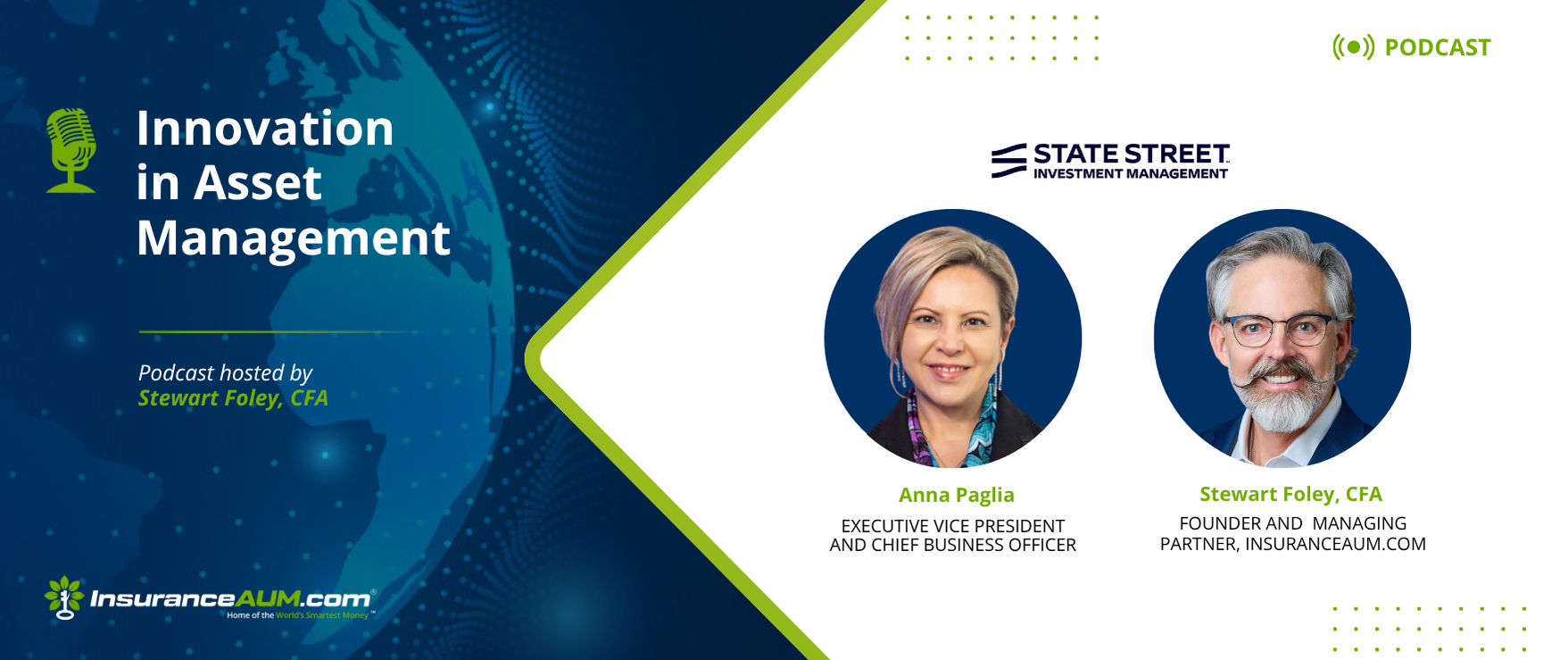
Stewart: Hey, welcome back, and it really is a welcome back for me. I managed to get a week away after our successful annual meeting in Chicago, and I was fortunate enough to spend about a week with a very, very close friend of mine named Ernest Chalaques. We met in business school 24 years ago, and he has a beautiful place outside of Kenora, Ontario, on Lake of the Woods. And my cellphone decided to go swimming on the morning after I arrived. So I really was literally completely unplugged, which was met with dread initially, but quickly became bliss as I had time to write and some time to watch some mindless movies and so forth. So I'm very happy to be back, excited to be back in this studio. And I am excited about this podcast, which is entitled Innovation in Asset Management. And we are joined today by Anna Paglia, Executive Vice President and Chief Business Officer at State Street Investment Management. Anna, welcome.

Anna: Thank you so much. It's my great pleasure to be here, and your time away sounds like the perfect vacation, perfect getaway. So I'm really jealous.

Stewart: The loudest thing I heard was loons, which is a beautiful lilt. Your background is super interesting. Anna, you have a Juris Doctorate, a JD from LUISS Law School in Rome, a law certificate from Kingston University School of Law in London, and a Master's of Law from Northwestern University School of Law in our original home of Chicago. So I'd love to know more about you. You have somewhat of an atypical background in the insurance asset management space. Can you talk a little bit about how you got where you are today? You're a very senior executive at a very large firm, and I really think that folks who are listening who are earlier in their career benefit from hearing your story.

Anna: Yeah, absolutely, Stewart. It's interesting because if anyone had told me 30 years ago that I would be here today, I would've laughed or cried, or I would've been a little scared because what I'm doing today is so outside the scope of what I thought my plan was going to be. And I'm a planner. I always wanted to be a lawyer, and as you went through my academic achievements, I realized how much of a dork I was because I couldn't get enough of law school. I graduated from law school in Italy, in London, and in Chicago. This is how much I love that.

Stewart: Believe me when I tell you you're a good company. There are a bunch of us who are geeks. I am at the top of that list. So you've got good company here, Anna, believe me.

Anna: There you go. I love the club. I love the club. I love to be part of that club. And I was lucky enough to find a job as a young lawyer in a law firm in Rome. I was in love with intellectual property law. I was in a place that allowed me to do that because I was in the entertainment department of that law firm. So think about an artist going on tour. There is a crowd and an army of lawyers assigning contracts. I was one of them. And at that time, the European Union passed the usage directive, allowing mutual funds to be passported across member states. It was a very big thing. Now, if you think about the US, the Investment Company Act was passed in 1940. It took about 40 to 50 years for Europe to catch up to that. But I was there at that time, at that place, and my law firm started an investment management group.

And guess what? I was taken out of the entertainment division and placed into investment management. I knew nothing about asset management, and I knew nothing about financial markets. I thought my life was over and my career was over. And little did I know that was it. I just so happened to find my passion, to find my love, to find something that I've been doing for 27 years, and I want to continue to do until I retire. I have a high conviction in this industry. I have a high conviction in what we are doing for our clients, and this is really something that makes me happy about coming to work every day. I moved from the legal team to the business quite a few years ago, but I continue to do what I have been doing all along: serving clients.

Stewart: It's an inspiring story. It really is. I mean, most of us, most of the geeks like me, always wanted to be in the investment management business, and I'm glad that you're more than welcome, obviously. So recently, State Street Investment Management just rebranded and announced an achievement that is a significant milestone of $5 trillion in assets under management. How does that break down, and what are you most excited about?

Anna: Well, starting from the last part of your question, I'm really excited about everything that we're doing here at State Street, $5 trillion to begin with. Everything that starts with a T. Every asset manager that has trillions of dollars under management - that's amazing. That's an accomplishment in itself because it doesn't happen by accident. Managing assets is a privilege. This is not something that should be taken for granted. Managing assets means that certain clients have really taken the time to screen across the different providers, and they have picked you; they have entrusted you with what they really, really care about. So crossing $5 trillion to me is incredibly exciting. The other thing that is exciting, as you mentioned, is the rebrand: State Street Investment Management. Words are not just words, and your name is something precious because your name really captures your identity. And I'm excited about the rebrand because this market is about evolution. Nothing remains the same. Your financial needs evolve, your clients' needs evolve, and if you continue to evolve with them, this is where the T (trillion-dollars) becomes important. The next target is going to be $10 trillion, and this is going to be really associated with our ability to continue to deliver on the promise to our clients. So I'm super excited about that.

Stewart: That's super helpful. Here's a weird trivia thing for you. I heard this years ago. $1 trillion in single-dollar bills reaches 66 miles into the sky. There you go. There's your tidbit for the day.

Anna: Wow. Wow. That goes into the bucket of weird things that I didn't know I needed to hear before this podcast. That's great.

Stewart: So you've recently launched a public and private credit ETF. How did that come about, and what makes that interesting for insurers?

Anna: Let's think about what we do here. SPY. I think that you are familiar with SPY. 32 years ago, we launched a product and gave birth to an industry. This is what the ETF industry should be about. It should be about democratizing access to financial markets. It should be about allowing every investor to receive the same opportunities, no matter their size. Going back to my past and what brought me here, you know what, Stewart, my mom and dad were not wealthy. We never fit into that category of wealthy people who could afford to buy a hedge fund, or back in the day, even buying a mutual fund, there was a minimum amount of investment of $15,000, which today, I mean, thank goodness, is not the case anymore, but that was the situation 30 years ago. Now, my dad would make $10,000 a year. He was a school teacher.

He never stood a chance; he never had an opportunity to really benefit from the compounding effect of financial markets. And that was also one of the reasons that drove me to the ETF industry because I thought this was the bridge. This is the bridge that is going to connect the wealth gaps within our society. And this is the essence of ETFs. Now, think about the evolution and where markets are today. There is one frontier that has not been broken yet, and that is private markets, private assets, whether it is private credit, real estate, or private equity; this is still a segment of the financial markets that is limited. It's limited based on whether you are a wealthy investor. It's based on your assets, whether you are an institutional investor. And the idea of creating public and private ETFs is really around democratizing that part of the market. And by the way, this is just the beginning. It's not a coincidence that everybody in the industry talks about the convergence between public and private. And we like to believe that that convergence started with our ETF because we are building liquidity in an environment in which liquidity did not exist. We are building transparency in an environment in which pricing was opaque, and we are doing that in a wrapper that everybody understands and that everybody appreciates and that can be accessed. It's accessible to investors, no matter how big or small.

Stewart: I'm sure your father is incredibly proud of your accomplishments. I can relate to that origin story a little bit.

Anna: He wouldn't even know how to describe what I do for a living.

Stewart: I think that's a common problem for all of us: it's not easy to just answer “What do you do?” And I learned through experience that when you say I manage money for insurance companies versus I'm a professor, you get a very different reply because most people know what a professor does, and most people don't know what an insurance asset manager does. So I can appreciate that too. But besides ETFs, which I think State Street Investment Management is well known for, and you mentioned SPY, but beyond that, what else does State Street Investment Management do, and what should insurers be aware of going forward?

Anna: That's a really good question. If you look at the platform, there are some things that I call the shiny objects. So those are the things that make State Street Investment Management known for. If you read the financial publications every day, you will see an article about our ETFs day in and day out. So our ETF franchise is definitely the shiny object because they are listed, because they're marketed, because everybody talks about ETFs. Our ETF's franchise accounts for about $1.6, $1.7 trillion in assets, depending on the day, depending on the news in the market, depending on valuations. In addition to that, we have a very successful cash business that accounts for more than half a trillion dollars. If you look back in the last couple of years, it's funny because cash was never this sexy thing to talk about with clients up until we woke up to a rude awakening about interest rates, interest rate hikes, and uncertainty about where interest rates are going to go. And now, cash is becoming a very powerful way to manage your portfolio. In addition to cash, we have a very successful retirement business. State Street Investment Management is the fourth largest administrative or retirement assets globally and is the second in the US. I don’t know how many people know that. And the rest of the franchises are really institutional assets, insurance companies, pension funds, everything that we can do in a way that is customized, that is self-tailored, and that scales.

Stewart: And the title of the podcast is Innovation in Asset Management. Let's talk about that just for a minute. What do you think are the leading innovations or disruptions, and how do you organize your teams around those goals and objectives that are really, I mean, I think right now is sort of a golden age of innovation here, so lots going on. I'd love to hear your perspective.

Anna: You know what? I'm just so happy that you used the word disruption because when it comes to innovation, I think this word is misused and abused these days. Let's face it, everybody wants to be an innovator. And I don't blame them. Nobody wakes up in the morning thinking, “You know what? Today I would really like to be number two, or today I would really like to be a follower.” It doesn't happen. Everybody wants to be an innovator, but innovation in itself doesn't solve a problem. Everybody can do something new, but it doesn't solve a problem for a client. The real innovation is the disruption. And the disruption is very different from innovation. Disruption is something that happens. It changes the way you do business, and you don't even realize that. It's the classic iPhone moment. I think everybody remembers the iPhone moment. I remember my own iPhone moment when I opened the box, I looked at the tablet, and I went like “oh my goodness, I can click the icon of Safari and I can actually be on the web and I can actually read those web pages.”

I mean, that was a transformative moment. And when it comes to innovation in this industry, people think about new products. Yes, that's only part of the disruption, but the other part of the disruption is how do you attend to your client's needs? And when we think about innovation, we really think about it through the lenses of our clients. For example, insurance companies, insurers. We realized that one year ago that we needed a specialized team to look after those clients. And we have created a team. We have built a team within our financial institution group that only specializes in insurance companies. This team wakes up in the morning, goes to bed at night, talks to insurance, trying to understand what problems are affecting their business, what goals they are trying to solve, and whether that goal can be accomplished via new products or new technology. This is what we make a commitment about.

It's not just about building a fund. We have a very eccentric or very new and novel portfolio management strategy: looking at the problem from the upside down, starting from the end outcome, what does great look like? And building backwards from there. And it's not always a product. It's not always an ETF, it's not always cash. It may be a solution, a combination of that. It may be technology. We made investments in certain FinTech companies over the last few years that will allow clients to customize their portfolio in a way that is automated at scale and can accomplish their goals. So we look at the entire ecosystem and whatever we build, we always do that in a way that we think is transformative, not just innovative.

Stewart: That's super helpful. You have outside partners. What criteria do you use when you're choosing outside partners, such as Blackstone and Bridgewater, et cetera?

Anna: That's a very good question. What we're doing with partners is kind of unique because if you look at the rest of the market, there is a tendency to do things internally. There is a tendency to do things yourself. I understand that. I don't think it's wrong, but at State Street, we have a different view. And when I think about State Street Investment Management, I always laugh because I think of this company as a company with the wisdom of a 95-year-old person, but the curiosity and the ego of a 5-year-old kid, meaning we know what we are good at and we know what we are really, really good at. We are good at capital markets, liquidity, ETFs, cash, retirement, and insurance. So we are really good at that, but we're not good at everything. And I'm not sure that I believe people when they say that they can do everything, because maybe they do, but that means they may end up being mediocre at everything.

So when we decide to partner, there is usually a process behind that. First, we identify a gap, and by the way, Stewart, not every gap needs to be filled. We don't need to be everything to everyone. So when we identify that gap, we ask ourselves, is this a gap that we can fill ourselves? And if the answer is yes, that's perfect, we'll do it. If the answer is no, we are going to look for the best in class in that category. And I can give you a number of examples. Last year, we partnered with Galaxy because we had a high conviction in the digital assets ecosystem, and we wanted to give an opportunity to our clients to participate in the growth of that digital assets ecosystem. And we said, we are not crypto natives. Personally, I have been studying cryptocurrencies and blockchain technologies for the last five years.

I know enough to be dangerous, but not enough to do something about it. It'll be like playing doctor on TV. I watch medical drama all the time, I know the lingo, but believe me, you don't want to see me in that OR. So we said: this market is growing, let's bring a friend. Let's bring people who do this every day for a living. The same thing happened with Apollo when we said we wanted to bring together public and private markets. Who is the best in class here? And we started talking to Apollo. I can give you other examples. Bridgewater, same thing, risk parity, we brought who invented the risk parity strategies. Blackstone, same thing with senior loans, actively management of senior loans portfolios. So our strategy around partnerships is really bringing best-in-class together so that maybe you cannot provide the best outcome alone, but you can certainly provide the best outcome by bringing a friend to that conversation.

Stewart: Yeah. I love the way you explain that. This is a really hard question, but I think it's an important question because of your vantage point. Where do you see the asset management industry 10 years from now?

Anna: That is a really hard question. I think that the asset management industry in 10 years is going to look nothing like what it looks today. I think technology is going to play a critical part. I think that markets are going to be unlocked. We are going to see liquidity in segments of the market where liquidity is not present today. I think that blockchain technology and tokenization are going to play a major role in the way every investor manages their own portfolio. I think that here, the keyword is convergence. I remember a time where maybe you remember that time too, where you would watch TV in a room, you would answer the phone in a different room, and by the way, the phone was attached to a wall. You would listen to the radio in your car, or you would listen to the radio in a different room in your house. Convergence was the iPhone moment. And that convergence has not happened yet in financial markets or in the banking industry. And I do think that technology and tokenization, blockchain, are going to bring that convergence in the way we manage our portfolios. And that's going to be a confluence of financial products, customized solutions, customized portfolios, and technology. This is what I think we are going to be in 10 years.

Stewart: That's terrific. I do remember those days. I used to tell my students, " It was scary when those dinosaurs were walking around.”

Anna: I was there too.

Stewart: I don’t know. I think I'm a little more advanced regardless. So Anna, as we are kind of on the back end of this, what are the key takeaways that you want our audience to bring with them from this podcast?

Anna: Well, I'd like the audience to think about a variety of instruments that sponsors, advisors, managers, just like State Street Investment Management, can bring, especially with insurers. Let us do something for you to make your life easier and to make your job easier. When I think about insurance companies and fixed income instruments, for example, you have two choices. One is to select your bonds, do the due diligence, have a team of people selecting bonds, or the other option is to let us do the work for you. And you don't have to compromise. If there is a specific outcome that you want to see, you don't have a limited option out there. We have the ability to customize the portfolio, to customize products in a way that really meets your needs. So I think that the takeaway is really try to identify those things that you can outsource to make you more effective at the way you attend to your clients, because that's our job. Our job is not to own the ultimate client. Our job is to make sure that insurance companies can use every tool and lever in their possession so that they can be better and more effective at their jobs.

Stewart: Yeah, that's super helpful. So the next question is really geared toward the culture at State Street Investment Management, and it goes like this. What characteristics, not pedigree, not hard skills, but the characteristics you're looking for when adding to your team?

Anna: That's such a great question. Again, I love the way that you talked about the hard skills because I have my own view when it comes to hard skills and soft skills. So hard skills can be built, and hard skills are portable. If you don't know ETFs, we'll teach you. If you don't know cash, if you don't know retirement, if you don't know insurance companies, we'll teach you. That's easy. So I actually, and I'm going to say that publicly for most roles that I interview for, I don't even read the resume because I always assume that if a person is in front of me, those people working behind the scenes, HR, talent and acquisition, they have done enough groundwork to make sure that the right people are sitting in front of me. I always look at the soft skills, and the soft skills are critical because you cannot teach them.

So during those interviews, I really try to understand the soft skills. So first of all, you must be in this industry for the right reason. I think I said it before, this is not a job. This is a privilege. It's a privilege. We make a difference between a person sending a kid to college or not, a person retiring with dignity or not, a person going on that vacation of their dreams or not. We have a big responsibility. So if you are just looking for a job, maybe this is not the industry for you. You have to come to work feeling the weight of that responsibility, being obsessed with your clients, and making sure that your clients' interests come first. Every time you walk into this office, it's the Spiderman role: with big power comes great responsibility, and I want to make sure that everybody understands that.

And then a second is how well do you work with your clients? Because this is a team sport, there are no winners. There is just a team that works together to help a client. You are not always the key person who holds the account and makes the client happy. You are a piece into a matrix, into a spider web, into an ecosystem. Because to really attend to the needs of a client, you need a product specialist. You need top leaders. You need people who can write, and you need people who can source data. It's a team sport. We win as a team and we lose as a team. And by the way, not everybody gets a trophy. So also that competitive spirit, that hunger, that willingness to do everything that you need to do to win the trust of a client and to keep the client. This is what I really look for in people, and this is what I think a culture should look like if you want to be in a winning team.

Stewart: What a great answer. Wow, that's a great answer. Alright, so here's the fun one. On the way out, you can have dinner with up to three guests. Doesn't have to be three; it can be one, two, or three. Who would you most like to have dinner with, Anna? Alive or dead?

Anna: Oh, alive or dead. Okay. So first of all, I would like to have William Shakespeare at the table because I would really like to understand if he existed, if it is a he or she, and what he or she looked like. I was really fascinated by this character growing up. The second one that I would bring to that dinner is my old teacher of Latin. Yes, it's a lady by the name of Alessandra D’Ansili. She was the hardest teacher when I was in high school, and she was so strict with her grades. Everybody hated her, feared her. And right now, I mean, she's the one who had the biggest impact on my life, so I would really have her at dinner too. So William Shakespeare, Alessandra D’Ansili, I would have the owner of the Italian restaurant where I served the table. So when I was in law school, because he didn't know that back then. I did not know that back then. But he was my first mentor. He was my first real mentor who taught me so much about hustling, about client centricity, about doing the right thing, and about working really, really, really hard to make a client happy. And then I would've a number four person who is my husband, who is the person that sees me. It would be nice to invite him to that dinner too.

Stewart: That's really nice. That's really nice. I didn't even start off by asking you, where'd you grow up? Where did you grow up, and what was that all about?

Anna: I grew up in a little town, 40 miles south of Rome, and growing up there was amazing.

Stewart: What was the name of the town?

Anna: The name of the town is Boville Ernica, and it's like one hour, one hour drive south of Rome. It was the best time of my life, even if I didn't know it back then. It was a time when everybody knew each other, and everybody cared for each other. I had these long family lunches, Sunday lunches that were like three or four-hour deals, and I thought it was just a pain. But right now, I wish we could go back and have those experiences again. I wish my kids could be exposed to that, but that's where I grew up, and this is where the entire Paglia journey started.

Stewart: That's so nice. You were fascinated with William Shakespeare, and I was fascinated with a guy named Bob Hannah, who was the two 50 motocross champion. I thought he was the coolest guy ever. Goes to show you. It goes to show you. Right. So you know what, you had mentioned a privilege to manage money. It has been a privilege to have you on the show. We really enjoyed having you on. We've been joined today by Anna Paglia, who's the executive vice president, chief Business Officer at State Street Investment Management. Anna, thanks for taking the time today.

Anna: Thank you for having me. It was great to talk to you. Thank you.

Stewart: You too. And thanks for listening. If you have ideas for podcasts, please shoot me a note. It's Stewart@insuranceaum.com. Please rate us, like us, and review us on Apple Podcast, Spotify, or our new YouTube channel, where you can watch your favorite podcast as well. My name's Stewart Foley. This is the Home of the world's smartest money at InsuranceAUM.com.
 

Share this post

Sign Up Now for Full Access to Articles and Podcasts!

Unlock full access to our vast content library by registering as an institutional investor

Register

Contacts


State Street Investment Management

At State Street Investment Management, we have been helping to deliver better outcomes to institutions,  financial intermediaries, and investors for nearly half a century. Starting with our early innovations in indexing and ETFs, our rigorous approach continues to be driven by market-tested expertise and a relentless commitment to those we serve. With over $4 trillion in assets managed*, clients in over 60 countries, and a global network of strategic partners, we use our scale to create a comprehensive and cost-effective suite of investment solutions that help investors get wherever they want to go.

*This figure is presented as of March 31, 2025 and includes ETF AUM of $1,553.58 billion USD of which approximately $106.42 billion USD in gold assets with respect to SPDR products for which State Street Global Advisors Funds Distributors, LLC (SSGA FD) acts solely as the marketing agent. SSGA FD and State Street Global Advisors are affiliated. Please note all AUM is unaudited.

Benjamin Woloshin   
Head of Insurance    
Benjamin_Woloshin@ssga.com (929) 567-5882

Meta Tomai Curry   
Head of Insurance Strategy   
Meta_Curry@ssga.com (929) 567-5697


One Congress Street, Boston, MA 02114-2016


View the contributor page


Sign Up Now for Full Access to Articles and Podcasts!

Unlock full access to our vast content library by registering as an institutional investor .

Create an account

Already have an account ? Sign in

Ѐ Ё Ђ Ѓ Є Ѕ І Ї Ј Љ Њ Ћ Ќ Ѝ Ў Џ А Б В Г Д Е Ж З И Й К Л М Н О П Р С ΄ ΅ Ά · Έ Ή Ί Ό Ύ Ώ ΐ Α Β Γ Δ Ε Ζ Η Θ Ι Κ Λ Μ Ν Ξ Ο Π Ρ Ё Ђ Ѓ Є Ѕ І Ї Ј Љ Њ Ћ Ќ Ў Џ А Б В Г Д Е Ж З И Й К Л М Н О П Р С Т У Ф Х Ц Ч Ш Ā ā Ă ă Ą ą Ć ć Ĉ ĉ Ċ ċ Č č Ď ď Đ đ Ē ē Ĕ ĕ Ė fi fl œ æ ß