





We're currently experiencing email delivery delays. For urgent matters, please contact us directly at lindsay@insuranceaum.com.

Principal Asset Management-

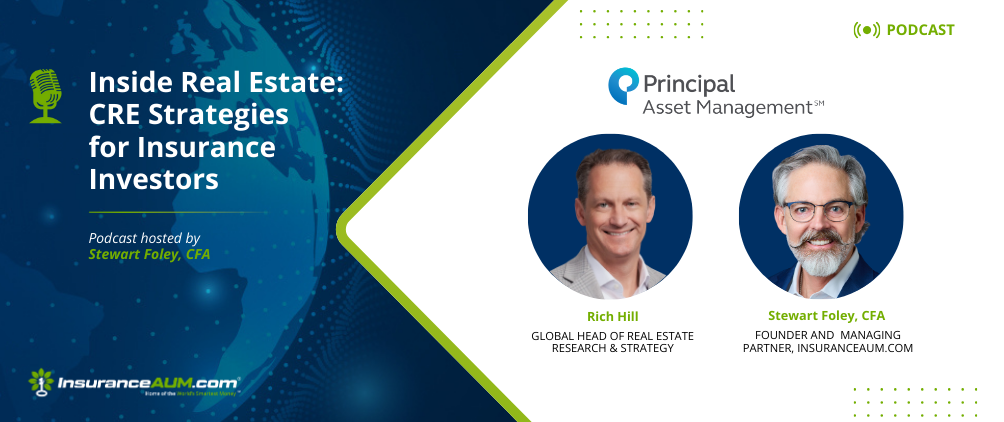
Inside Real Estate: CRE Strategies for Insurance Investors

Image
08.19 Principal_Web (1)


Stewart: Hey, welcome back. It's great to have you. My name's Stewart Foley. I am going to be your host. I'm also the founder of InsuranceAUM.com, and I've spent, I don't know, like 30-something years managing insurance money and talking about it. So, thrilled to be on with you today. We've got a great podcast for you. Our topic today is Inside Real Estate: CRE Strategies for Insurance Investors, and I'm joined by Rich Hill, Global Head of Research and Strategy for Principal Real Estate. Rich, thanks for taking the time. Thanks for being on, man. We're going to have a great podcast today.

Rich: Yeah, I'm really looking forward to it, Stewart. Thanks for having me.

Stewart: My pleasure. We always start in the same way. Where did you grow up? And this is a new question, somewhat new: what was your first concert?

Rich: Wow, so you're throwing me for a zinger. I like the second question a lot, but let me first address where I grew up. I grew up in Charlotte, North Carolina. My dad was a mall manager. I lived up and down the East Coast until I was around four. We moved to Charlotte for him to manage what I refer to as one of the forgotten and poor malls across the United States when they were still a thing. So while I live outside of New York City, I like to tell people I'm probably the least New York City person you're going to meet. My family is primarily from Kentucky, so somewhere between North Carolina and Kentucky. That's sort of where I grew up.

Stewart: So tell me about your first concert.

Rich: So the first concert that I ever really remember was Lollapalooza in the early 1990s.

Stewart: Wow.

Rich: A hundred percent. And I fell in love with the music. It was, I'm going to get this mixed up, but it was probably Pearl Jam, Beastie Boys, a whole bunch of others, and I must've been 13 or 14 years old. It just absolutely blew my mind. So I'm a little bit of a music freak. My kids tell me I have the worst music ever. I like to think I have the most sophisticated music taste ever, but not everyone agrees with that.

Stewart: Yeah, I get a similar review as you from my daughter. So let's talk about evaluating Commercial Real Estate (CRE) opportunities. How are insurers weighing the current range of opportunities across commercial real estate, especially given the market dislocation, rates, and fundamentals?

Rich: Yeah, so if you'll allow me to, maybe I can just get on my soapbox for a second.

Stewart: Absolutely.

Rich: And size up what we're actually talking about today. So commercial real estate is actually a huge asset class in the United States. It's about $25 trillion.* That makes it probably the third largest asset class in the United States, behind fixed income and equities. Debt is a very important component of that because most people buy a commercial real estate property, and they leverage it to some degree; they finance it. So debt's around $5 trillion of that $25 trillion. The third point I like to make is that everyone considers commercial real estate as a singular asset class, but in reality, it's 18 different subsectors that fall under a singular umbrella. I like to tell people it can sometimes be like a kindergarten class, all these subsectors are acting differently at different points in time. I only say that because commercial real estate's gone through a huge reset over the past two and a half to three years, with valuations down 20% and I think a lot of investors are rightfully saying, “Hey, is this still an asset class that should be a big portion of our portfolio?” We think it should be, and I'm happy to elaborate on that, but maybe I can pause there, see what questions you have, and where you want to go next.

Stewart: Yeah, that's great. I mean, I've got a good relationship with Ed Kakenmaster at your firm, and I've heard about Principal's four-quadrant approach. Principal emphasizes public and private debt and equity. How should insurers think about entry points across these quadrants in today's environment?

Rich: So this really gets to the crux of what I think Principal leads with and what I spend a lot of time talking to investors about. You are absolutely right that we firmly believe investors should take a four-quadrant approach to investing in real estate. As you said, public versus private, equity versus debt. The first point  I want to make is I'm often asked, “What do you like more, public or private, or equity or debt?” In some respects, I reject the premise of the question. We think there is a home for all of the various different quadrants within portfolios, and there are times in which you're supposed to be overweight one versus the other. So this is a really big, meaty topic, but let me not bury the lead and just answer your question. We do like private real estate debt right now, it is our number one pick across the four quadrants.

That doesn't mean that we're always going to like private real estate debt, but right now we favor it. And there are a lot of reasons for that. But the three things I would highlight to you are number one, returns are high. Not only is the risk-free rate high, so I'm talking about (Secured Overnight Financing Rate (SOFR) or 10-year treasury rates, depending upon if you're lending fixed or floating, but the spread at which you're lending on top of that risk-free rate is pretty attractive right now. So you're being compensated for the risk, if you will. The second point is that lending standards are still pretty conservative, and you're lending on valuations that have already reset 20%-25% lower, as I mentioned previously. The third point, which I don't think gets enough attention, is just the stability of returns. Debt is really attractive because it provides a constant, steady stream of income. So right now, we really like real estate debt opportunities. You can get those in open-ended funds, you can get those in non-traded REITs, you can directly originate loans. There are a lot of different ways you can do it, but we think debt is quite attractive right now.

Stewart: That's super helpful, and I'm going to ask a question that contains some terms that I probably need to have defined. You had mentioned these 18 sub-sectors and we're going to talk a little bit about them here. So are insurance portfolios leaning more toward core, core plus solutions, or are you seeing demand for more opportunistic strategies, and what's driving it? But really, maybe if you can start with, can you delineate the difference between core, core plus, opportunistic, and whatever else is on that spectrum?

Rich: I'm so glad you asked the question because I think a lot of people take for granted these terms, and oftentimes, we in the business, we throw them around, and they can sound like jargon. So let's break down what core is versus core plus versus value add versus opportunistic. Core plus is sort of what I refer to as a stable bond-like profile. You're going to achieve historically high single-digit, 10% unlevered total returns through the cycle for buying core commercial real estate. These are stabilized, cashflow-producing properties, and the valuations are usually pretty stable over time, and you're getting your returns through a combination of income and capital returns. It's the safest component of commercial real estate. I sort of compare it to an investment-grade bond, if you're thinking about fixed income, if you will. Core plus just offers a little bit more return than core, and often it has a value-added component.

I just threw out jargon to explain one of the property types, so let me explain what value add is. Value add is really simple. It's exactly what it sounds like. You're buying a property that has either been mismanaged or its occupancy is not at the levels that we would consider to be stabilized. So you buy it at a discount to what you think the stabilized value would be, and you spend time, money, and energy stabilizing that property over time, and you're compensated for that in terms of higher returns. Opportunistic is another bucket. Opportunistic is basically an opportunity that comes around at the beginning of every cycle, where you can take advantage of a dislocation in the market. It has very little to do with fundamentals. You’re really taking advantage of a dislocation. Opportunistic strategies are really interesting right now, but they're not going to exist in three- to five- years' time. But when you think about that $25 trillion commercial real estate market, the vast majority of it's core, and you should think about value-add and opportunistic strategies as satellite strategies around core. So I threw a lot at you in a short period of time, and I'm still cognizant of the question you asked about how insurance companies are thinking about investing in these. But before I go there, do you have any questions about how I outlined that?

Stewart: No, that's perfect. I mean, I appreciate that. If you had orders of magnitude, how much of CRE is core? Do you have an estimate?

Rich: Yeah, two-thirds to 75% today.

Stewart: Yeah. Okay, good deal.

Rich: It's the vast majority, and it could actually even be higher than that. It is the vast majority of commercial real estate.

Stewart: And where are you seeing demand from insurers today if you think about those different buckets?

Rich: Yeah, so let's rewind and let's talk about, historically, what returns could be achieved when you invest it in core real estate. Core real estate has historically offered unlevered total returns in the high single-digit range. So call it the 8%-10% range if you will. Once you put leverage on it, because leverage was very creative historically, you could get to levered returns in the low double digits to maybe even the teens. That's really important because - guess what? - when you're an insurance company, the regulatory capital requirements of owning private commercial real estate equity on your balance sheet are actually quite high. So you sort of need to be in this double-digit range, net of regulatory capital requirements, to achieve the returns that you want to achieve. Historically, that was actually pretty easy to do. It's a little bit harder to do right now. We're projecting generically 5% unlevered total returns in 2025. That's probably not going to pay most insurance companies' bills.

Over the next five years, that goes up to around 7%, and over the next 10 years, that goes up to probably 8%-9%, much closer to the historical averages, but still, it's not as easy to make core-like returns as you did previously. That does not mean insurance companies are not focused on core, but they're acutely focused on what property types are going to generate the highest net operating income growth, so revenue minus expenses to achieve those returns. I told you 10-year unlevered total returns are going to be in the high single-digit range, but you can find some property types that do substantially better than that. So I think there's a lot more focus on picking the right property types out of those 18 different sub-sectors that I told you previously. I want to talk about what insurance companies are doing with opportunistic and value-added. I think it's important, but before I go there, I dropped a lot on you on core. Any questions about that?

Stewart: No, I'm good. I think that's interesting how you're forecasting that forward. It's really instructive. So please go ahead.

Rich: Yeah, so the answer is we do think insurance companies are going to, I don't know what the right word is, I don't know if it's dabble, have higher allocations, but we do think insurance companies are going to participate more in value-add and opportunistic than they did previously. They're going to have to take a little bit more risk, that's maybe the wrong term, but a little bit more risk to achieve higher returns, given core returns are not going to be as easy to achieve as they did previously. So what is an opportunistic-like strategy? Development is an opportunistic-like strategy, developing data centers, which we do. We think is really interesting. So there are development strategies out there. There are also interesting value-add opportunities right now because we're coming off a late cycle environment where a lot of people in 2019, 2020, and 2021 thought you could buy anything in commercial real estate and it would turn to gold. Well, guess what? That didn't really happen. So there are select opportunities to increase the alpha of your portfolio by adding allocations to opportunistic and value-add in addition to core. You're not going to get all your allocation from opportunistic and value-add, but you can help increase your alpha if you will.

Stewart: I think one of the things that people say “you've seen one insurance company, you've seen one insurance company,” and the risk tolerance and what's defined as risk can be quite varied. But there's one thing, there are a few things I think that are common, and insurance companies are always concerned about downside protection. Right, and which leads me to sector resilience, which sectors—industrial, multifamily data center, or others, are showing the most resilience, and why are there areas that you or your clients are actively avoiding right now?

Rich: Before I answer that question, let me talk about the resiliency of the commercial real estate sector. The past 10 years have not been a really great time to be a commercial real estate investor. There are numerous reasons for that. Demand for .com, technology, media, and telecom (TMT) stocks, a rising rate environment recently, that's pressured valuations, but it hasn't been a great environment to be a commercial real estate investor. Nonetheless, the past 10 years annualized total returns have been 5% or so. You've actually done a lot better than bonds. I only lead with that because I have a hard time believing the next 10 years are going to be anywhere as challenging as the last 10 years. So I'm telling you the last 10 years were 5.5%. That feels like an okay level to think about the bear case for commercial real estate over the next 10 years. The next point I would tell you is, if you're looking at five-year annualized total returns, five-year annualized returns have never meaningfully gone below 0%.

Sort of a remarkable statement. Commercial real estate goes up and down, but you've never really been noticeably below 0%. That has occurred in the S&P 500, and it has occurred with high-yield bonds. So commercial real estate actually ends up being a little bit more stable because the income components are really important, and you get this capital appreciation. I think the market's forgotten that. But to answer your question about what various different property types, look, what do we like about commercial real estate? I describe commercial real estate as a next-generation asset class. It has become a new economy asset class. It is not my grandparents' commercial real estate sector that was dominated by the core four of retail, multifamily, hotel, and maybe even a little bit of industrial. What is now really important is these new asset classes that didn't exist 10 or 20 years ago.

Things like data centers, cell towers, seniors housing, and single-family rental. Believe it or not, these next-generation asset classes are around 70% of listed REIT market cap. I know we haven't talked about listed REIT, but publicly traded real estate, about 70% of the market cap is in this next generation. About 40% of the $25 trillion market that I mentioned to you is in these next-generation asset classes. So, we do like some of these high-growth, less cyclical asset classes, like data centers, for instance, like seniors housing, for instance. Those are really interesting. On the other end of the spectrum, sectors like open-air shopping centers have become really, really attractive because the sector's been de-risked. No one wanted to build a new retail property from 2010 until 2020, and then you had this great Darwinistic event that occurred during COVID, where it right-sized all the underperforming real estate, retail real estate. So you're left with an asset class that is trading at wider levels because no one wanted to buy it for 15 years, and it has really stable fundamentals. So it comes back to the point that you were making, no one size fits all for every investor. We do like some of the next-generation asset classes. We like some of the more stable, and then we're picking our spots in things like multifamily and industrial because we think those are not going to be as easy as they were over the past 10 to 15 years.

Stewart: I've been dying to ask somebody like you this question, and I don't know if this is on anybody's radar screen or if I I’ve just been sitting in my office too long, but I am always hesitant when there's a projection that just goes up forever. And when I hear folks talking about the need for AI compute and the need for data centers, it's just like a straight line up. What I wonder is, is there a technological advancement coming that reduces the need for that? And is there something that you think could impact the attractiveness of data centers, which has become, as you mentioned, a really important part of the CRE market?

Rich: It is a question that I'm glad you asked because not a lot of people are asking it. When people talk about data centers, they sort of think about it as a single property type, but it has morphed into actually three different types of data centers in our mind. First of all, it's cloud. What is a cloud data center? That's basically when you and I go on and order something on Amazon that uses clouds and cloud data centers provide the data for you to buy something from Amazon. The second is inference AI. Inference AI is when you and I go on ChatGPT and ask it a question, and it already knows how to answer that question. It's going to an inference AI data center. The third type of data center is a generative AI data center. Generative AI data centers are being used to help machines learn how to be AI.

I describe an inference AI data center as powering your taxi that doesn't have anyone in it and the generative AI data center is telling the taxi how to drive before it gets on the road. Why am I saying all of this? Well, we really like cloud and inference AI data centers because there's in-place demand for that. We're more cautious on generative AI data centers because we don't think the hyperscalers know how much AI demand is going to be available in 5 years, or 10 years, or 20 years' time, and we want to be humble about that. I'm sure some people do very well, but there has been a lot of spec building in that generative AI space, and it's going to be interesting to see what happens over the next three to five years because things are moving really, really rapidly, and whenever anything moves really rapidly, change occurs. I describe the data center space as moving from infancy to toddlerhood, and when you move from infancy to toddlerhood, you probably start stumbling, and maybe you'll have some bruised knees from time to time.

Stewart: Yeah, it makes sense. So let's just talk about maybe an underappreciated opportunity. So if you had to highlight an underappreciated opportunity in real estate that insurance investors aren't talking enough about, what would it be, and is there anything that you think is overdone?

Rich: Well, when anyone asks me this question, no two cycles are the same, but I'm sort of reminded of what happened in the late 1990s with commercial real estate and how much it underperformed in the late 1990s. Why did it underperform? Well, there was demand for .com, there was the Russian debt crisis that led rates to skyrocket, and there was deregulation of telecom, which put interest away from commercial real estate into telecom. But low and behold, we got into the early 2000s, and commercial real estate did quite well, and why did it do quite well despite us being in a recession and risk assets pulling back? It was because it was fairly valued relative to the rest of the economy, and the market started to recognize that old boring cash flows were actually pretty interesting. Again, no two cycles are the same, but there are some similarities if you squint hard enough.

I only say that because commercial real estate is one of the more disliked asset classes in the world. There are a lot of people who are sitting here saying, “Does it work in my portfolio still?” We think it does. We think the next 10 years are going to be pretty good, and the real benefit of having commercial real estate in your portfolio is that it does something different than the rest of your portfolio. Usually, when the S&P 500 is going down, commercial real estate's more stable. So I think there is an underserved opportunity to say, well, maybe I am supposed to be contrarian, and maybe I am supposed to be owning commercial real estate. In terms of opportunities that we think are interesting, I would point at the top of the list, seniors housing. Most people say, “What is senior housing?” It's really independent living and assisted living for baby boomers, if you will.

It's a really attractive asset class because there's a rising tide of an older generation, and these asset classes are producing really attractive net operating income growth. I'm going to go one step further, and I'm going to say we actually think housing makes a ton of sense in the United States. While most people talk about an undersupply of housing in the United States, we actually have a housing mismatch. Not so much a housing shortage, but a housing mismatch. We built too many homes of certain types of some markets and not enough homes in other markets. We think looking at housing totality across apartments, manufactured housing, student housing - that's a really interesting strategy. Where are we cautious on? Look, like a lot of other people, I think here and now we're cautious about office, maybe for not the reasons many people think. It just takes a lot of money to reposition office property to make sure you have enough tenants to drive demand. At some point over the next three to five, certainly 10 years, office is going to be really interesting again, but we're still a little bit cautious about it. We think there are easier ways to make attractive returns.

Stewart: Yeah, it makes total sense. I can tell you that with my mom and senior housing is a really big deal, and those that do a good job of it, and what tends to happen in that situation is that you go from mom's okay living by herself to mom's not okay living by herself, and I need to find a place now. And it's not like you can plan way ahead for that necessarily. You certainly want to maintain their independence, but there's a safety consideration there too. So I think that's a very interesting point. And I just want to kind of just throw this out, it’s not necessarily real estate related, but Principal also manages a large affiliated general account. How does that experience translate into managing portfolios for non-affiliated or third-party insurance companies?

Rich: Look, the answer's really simple in my mind. We've been in this real estate game, so to speak to use real technical terms, for quite a long time. We've seen numerous cycles, and we've seen them not across just debt and not across equity, but we've seen them across public and private. What it tells us is a lot about when you're supposed to be cautious and when you're supposed to be maybe less cautious. I like to joke with people that commercial real estate investors do a really bad job of buying low and selling high. Commercial real estate investors like to buy everything when it feels really good and sell everything when it feels really bad. Look, we're a Midwest insurance company. We like to manage for predictable cash flows. What that leads us to do is take chips off the table when things feel really good and maybe become a little bit more constructive when things don't feel so good.

Effectively, what we're trying to do is just manage through the cycles and recognize that the good times don't last forever, and oftentimes the best returns come in the aftermath of markets like today. The second point I would make to you is that we think it's really important to have a vertically integrated strategy. We learn a ton from what our lending business is doing, and it helps inform what we're doing on the equity side of the business and vice versa. The ability to talk to both sides of the business is really strong and I think creates a ton of synergies, but that also holds true for the public and private markets as well. What I don't think a lot of people recognize is how powerful a signal the public markets can be. The public markets are leading indicators of both downturns in recoveries, and the public markets started to send a really strong signal to us in October of 2023, almost two years ago, that commercial real estate was on the cusp of troughing. Listed reevaluations is up more than 30% since then, so it would've been a good signal to heed. Bottom line, I think having come back full circle here, the four quadrants really allows us to have a really rich and deep view of how commercial real estate performs across different cycles and frankly, the ability to look at public versus private, equity, and debt means that you can recommend something that we think is compelling at all points in time during the cycle.

Stewart: That's super helpful. Alright, so I've got some closing ones for you. This question really speaks to the culture at Principal, and it goes like this. What characteristics are you looking for when you're adding members to your team? Not necessarily the school they went to, or can they code, but the characteristics?

Rich: There's three things that stick out to me more than anything. First, I tell people, take your job seriously, but don't take yourself seriously. That's a long way of saying just be humble. Number two, be a hard worker. My grandfather pumped gas for a long portion of his life, and he always taught me that hard work is more than smarts, and I think there's probably a lot of truth to that. So a hard worker who's willing to roll up their sleeves and nothing’s beneath them. Then the third part, which is sometimes harder, is being intellectually curious. If you're intellectually curious, you're a hard worker, and you're humble, those three things together can take you a really, really long way, versus someone that's really smart, arrogant, and thinks all work is beneath them. I'll take the person that's humble, a hard worker, and intellectually curious all day long.

Stewart: Yeah, super helpful. You mentioned you're a Midwestern insurance company, and there's a certain set of values that go with that, and those, the hard work and dedication, are kind of core Midwestern principles, right? I'm a product of the Midwest as well. The last one's more fun, and that goes like this. You can have dinner with up to three people. Who would you most like to have dinner with? Alive or dead? Now you can go one, two, or three. Your option.

Rich: So first, I grew up a huge soccer fan. For anyone that's listening in Europe, that's futbol in Europe, my family's still a big soccer family. I would love to have dinner with Pele and not to understand what he did, but how he got from being a poor Brazilian to being the height of soccer. I think that would be really interesting. Number two, easily Nelson Mandela. I'd love to understand just his approach and all his trials and tribulations. That would be quite interesting. Third, that's a tough one. I don't know. It's a toss-up and I wouldn't want to jeopardize any of my ability to have dinner with someone that's no longer alive, so I'm not going to— kidding. I'm not sure. I'm not sure. There's a list of names.

Stewart: You can keep it at two. It could be just the three of you, Nelson Mandela, Pele, and Rich Hill. Why not?

Rich: So that's where I would go with it.

Stewart: That's perfect. All right. That's great. I certainly appreciate you being on, Rich. I mean, really a great education on the asset class from somebody who's got a lot of experience there and working at a platform that, as you mentioned, has been in this asset class for many decades. Thanks so much for taking the time today.

Rich: Thanks, Stewart. It was great to spend, I guess, 30 minutes with you, maybe a little bit more.

Stewart: Absolutely. We've been joined today by Rich Hill, Global Head of Research and Strategy for Principal Real Estate. Thanks for listening. If you have ideas for podcasts, please shoot me a note at Stewart@insuranceaum.com. Please rate us, like us, and review us on Apple Podcasts, Spotify, or our brand new YouTube channel @InsuranceAUMcommunity. My name's Stewart Foley. We're the home of the world's smartest money at insuranceaumcom.

*Source: Principal Asset Management, August 2025.
 

Principal Real Estate Investors and Insurance AUM Journal are not affiliated.

Important Information
Past performance is no guarantee of future results and should not be relied upon to make an investment decision. Investing involves risk, including possible loss of principal.

Principal Real Estate is a trade name of Principal Real Estate Investors, LLC, an affiliate of Principal Global Investors.
Investing involves risk, including possible loss of Principal. Past Performance does not guarantee future return. Potential investors should be aware of the many risks inherent to investing in real estate, including value fluctuations, default risk, liquidity risks, leverage, credit risk, occupancy risk and legal risk. All these risks can lead to a decline in the value of real estate, a decline in the income produced by the real estate, and declines in the value or total loss in value of securities derived from investments in real estate.

Principal Asset Managementsm is a trade name of Principal Global Investors, LLC.

Principal®, Principal Financial Group®, and Principal Asset Management, and Principal and the logomark design are registered trademarks and service marks of Principal Financial Services, Inc., a Principal Financial Group company, in various countries around the world and may be used only with the permission of Principal Financial Services, Inc.

© 2025 Principal Financial Services, Inc., 711 High Street, Des Moines, Iowa 50392

MM14571 | 09/2025 | 4623943-062026
 

Share this post

Sign Up Now for Full Access to Articles and Podcasts!

Unlock full access to our vast content library by registering as an institutional investor

Register

Contacts


Principal Asset Management

With public and private market capabilities across all asset classes, Principal Asset ManagementSM and its specialist investment teams are focused on harnessing the potential of every opportunity to secure an advantage for its clients.

The 28th largest manager of worldwide institutional assets under management of 411 managers profile, Principal Asset Management applies local insights with global perspectives to identify compelling investment opportunities and deliver distinctive solutions aligned with client objectives.1

Principal Asset Management is the global investment management business for Principal Financial Group®  (Nasdaq: PFG), managing $559.1 billion in assets and recognized as one of the “Best Places to Work in Money Management” for 13 consecutive years.2,3

Learn more at PrincipalAM.com

1 Managers ranked by total worldwide institutional assets as of December 31, 2023. Pensions & Investments, “Largest Money Managers,” June 2024.
2 Principal Asset Management AUM as of December 31, 2024.
3 Pensions & Investments, “The Best Places to Work in Money Management” among companies with 1,000 or more employees, December 2024.
 

Thomas Metzler  
Managing Director, Institutional Sales  
metzler.thomas@principal.com  
+1.510.427.6490

711 High Street  
Des Moines, Iowa 50392


View the contributor page

Sign Up Now for Full Access to Articles and Podcasts!

Unlock full access to our vast content library by registering as an institutional investor .

Create an account

Already have an account ? Sign in

Ѐ Ё Ђ Ѓ Є Ѕ І Ї Ј Љ Њ Ћ Ќ Ѝ Ў Џ А Б В Г Д Е Ж З И Й К Л М Н О П Р С ΄ ΅ Ά · Έ Ή Ί Ό Ύ Ώ ΐ Α Β Γ Δ Ε Ζ Η Θ Ι Κ Λ Μ Ν Ξ Ο Π Ρ Ё Ђ Ѓ Є Ѕ І Ї Ј Љ Њ Ћ Ќ Ў Џ А Б В Г Д Е Ж З И Й К Л М Н О П Р С Т У Ф Х Ц Ч Ш Ā ā Ă ă Ą ą Ć ć Ĉ ĉ Ċ ċ Č č Ď ď Đ đ Ē ē Ĕ ĕ Ė fi fl œ æ ß