





Pioneer Investments-

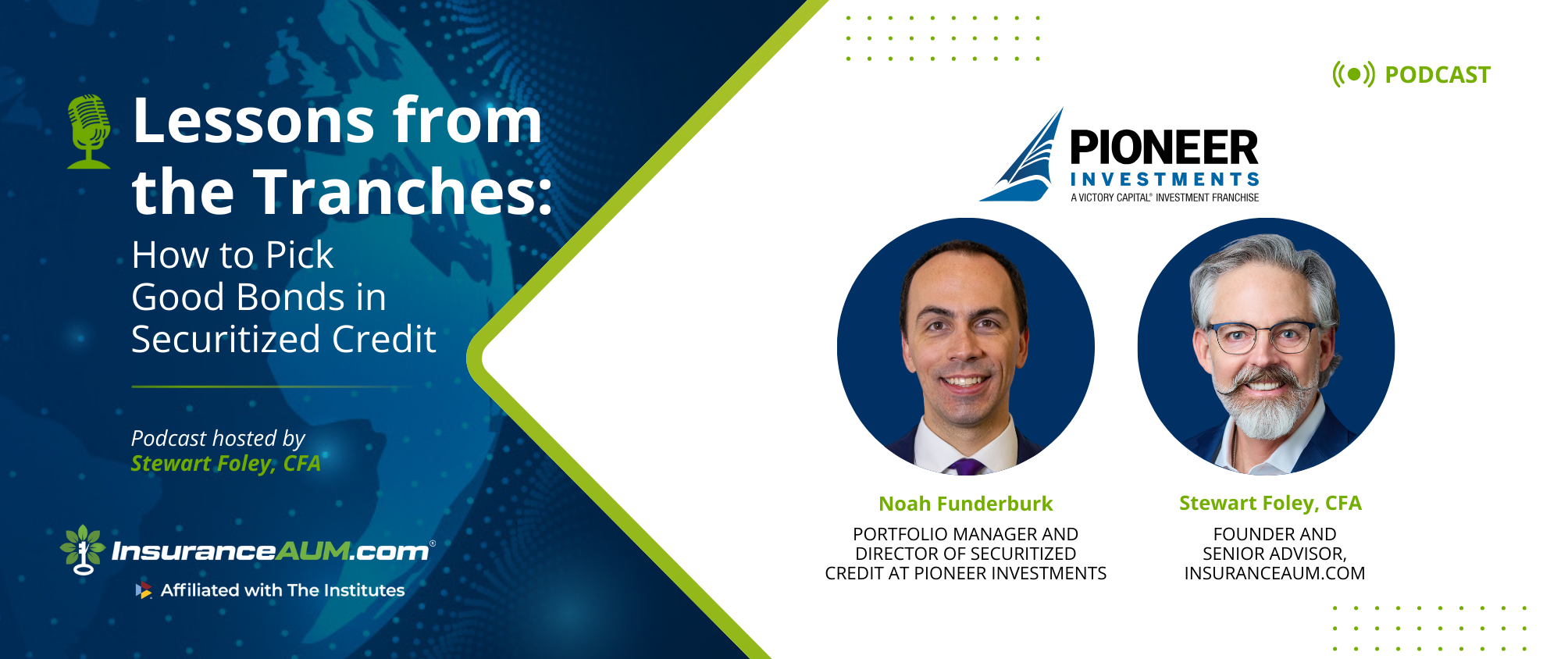
Lessons from the Tranches: How to Pick Good Bonds in Securitized Credit

Image
02.04.26 Victory Capital Management_Web


Stewart: I'm Stewart Foley, Founder and Senior Advisor of InsuranceAUM and the Principal Architect of the new CIIM designation. We're thrilled about that. So, today's episode is titled Lessons From the Tranches, which I love. I love this title. Lessons from the Tranches: How to Pick Good Bonds and Securitized Credit. Securitized Credit has been super hot. It's a space where structure matters, incentives matter, and small misunderstandings can lead to very different outcomes. For insurance investors in particular, it's an area that offers compelling opportunities, but only if risk is understood at the tranche level, not at the headline yield level. My guest today is Noah Funderburk, Portfolio Manager and Director of Securitized Credit at Pioneer Investments, a Victory Capital Franchise. Noah leads the firm’s securitized in short duration income strategies and brings deep expertise across ABS, RMBS, CMBS, and multi-sector portfolios with a background that blends quantitative modeling and practical portfolio management. Noah, welcome to the show.

Noah: Thank you. Glad to be here.

Stewart: We're thrilled to have you. It's a great topic. It's super hot. And with the prep stuff we've done, I know it's going to be very good, very educational for our audience. We want to start off the way we always do, which is where did you grow up? What was your high school mascot? And if you weren't doing this job today, what job would you most like to have instead?

Noah: Oh boy. Well, I was born in New Orleans, followed the oil and gas industry and my father out to Denver, Colorado. So I kind of really grew up out in Colorado. My high school mascot was the Bruins, Cherry Creek High School. And man, if I weren't doing this job, I would love to do some woodworking or restoration of antique Victorian homes.

Stewart: Wow, that's cool. My daughter is actually at the University of Denver, so that's not too far from Cherry Creek, is it? It's pretty close?

Noah: It's pretty close. It's very close to the world's first Chipotle.

Stewart: Wow. I bet you she doesn't know that. She taught me about Chipotle. She really did when she was a little bitty, but she's a junior now, and about to be a senior, so we're super proud of that. I appreciate you being on. It would be helpful, I think, to just get a sense about Pioneer. It's a firm with a really rich history, but one that maybe isn't a household name for everyone. So can you give us a high-level overview there, and then we'll get into the meat and potatoes here?

Noah: That's right. Pioneer Investments is one of the most seasoned asset managers in the United States. It was founded in 1928, and it's the manager of the second-oldest mutual fund in the United States, named the Pioneer Fund. Pioneer Investments joined Victory Capital last year as one of its independent investment franchises. So the company, the asset manager Pioneer, is just about a hundred years old, 100+ investment professionals, and a $100B+ of AUM. I'm not quite as old as the company. I joined Pioneer via the acquisition of a predecessor company that helped bring option-adjusted spread analysis to the mortgage-backed securities market back in the 1980s with the advent of the computer. We actually have securitized strategies with GIPS composites that go back to 1992.

Stewart: That's super interesting. I didn't know the history around OAS. So it's kind of a more advanced topic, necessarily for those who aren't steeped in the fixed income topic, but we'll talk more about that today. The first segment, it talks about risk being uncomfortable, and that's why it pays. You've said that risk is uncomfortable and that discomfort is why investors get paid. How should investors think about uncertainty and discomfort as signals in securitized credit rather than things to avoid?

Noah: Well, I think we were talking about some lessons to be learned or wisdom to share with our audience here. And as I assembled that list, I realized that it kind of came off with the wrong big picture. And so I think that this one, risk is uncomfortable, that's why it pays, is a bit of a preamble. It's a disclaimer to say, don't hate risk, embrace it, but make sure that you're getting paid for it. I mean, understandably, as credit investors, we are very much focused on the downside, but there's also no free lunch. If you're avoiding risk, you're avoiding return. So maybe one of the more important parts of investing and credit, at the very least, is being able to differentiate between fear and uncertainty. You've got to take risk, you've got to bear uncertainty, but you, as an investor, are tasked with just making sure that you're being well compensated for that uncertainty. Certainly avoiding all risks is a great way to avoid all returns.

Stewart: It's a great point. And when you hear people say, maximize return, minimize risk, it's like, that doesn't work that way. That does not work. You've warned about the dangers of combining credit risk and interest rate convexity in the same security. So we may have to do some definitions around what those terms mean, but can you talk a little bit about how those risks interact in securitized structures and why that combination has historically driven some of the biggest drawdowns?

Noah: Sure. So the idea of credit risk, I think, is well understood. Here, we're talking about the risk that you don't get the money back that you invested, the principal balance. And convexity, I think, is relatively well understood. It's the risk that your bond gets long when you want it to be short. It gets short when you want it to be long. Those types of events have a negative price impact on your portfolio and detract from the total return and certainly the risk-adjusted return. My little aphorism here is actually more specific. It's beware the complexity of credit convexity. And that's a little shout-out to one person in particular. I think every generation of Americans has a handful of events that they can remember where they were, what they were doing when it happened. You can name them all. One of them is when OJ Simpson was going down the highway in his Bronco.

So this is a shout-out to Mr. Johnny Cochran. "If the glove doesn't fit, you must acquit." Unfortunately, the reference there sort of ends at the fact that when things rhyme, they might be true, but beware of the complexity of credit convexity. The point here is that investors, in my experience, are pretty good at pricing credit risk, and they're pretty good at pricing convexity risk. It's when those two things overlap that it ends up feeling, oftentimes, like you only got paid for one and not the other. So the interaction between those two is what has driven some of the larger drawdowns in the securitized credit markets over the past couple of decades here.

Stewart: That's interesting. And I love those phrases that are memorable. Can you give us an example of what you're speaking about here?

Noah: The poster child for this one in recent memory is probably in 2021, where you had non-agency mortgages being issued in a tight credit spread market environment, paired with a very low-interest rate environment. Obviously, the monetary policy shifted pretty drastically, pretty quickly, soon after. And as a result, you had a sector that was maybe trading at 300 basis points over treasuries to 600 basis points over treasuries. And at the same time, the maturity on some of those bonds moved from three years to perhaps 12 years. So you had wider spreads, wider maturities, 300 basis points move times a 12-year duration type assumption, and that's a 36-point price decline. That's a pretty painful outcome for security that is still being looked at as likely to return its full principal, just not anytime soon.

Stewart: It's a great point, and it is particularly relevant to insurers who end up having to deal with OTTI issues when that sort of price activity happens. You have another interesting one as well, I like, which is you've made mention of this idea that you can't compete with stupid silly, particularly when certain securitizations are optimized for a specific pool of capital. So the question comes in, how should insurance investors think about cost of capital advantages and when it makes sense or doesn't to compete in a given part of the capital structure?

Noah: Well, I think we should all be aware of where we are in the ecosystem and should be mindful of when securitizations are really being optimized to be attractive to our pool of capital. What we've found is that every once in a while, you'll look at a transaction or a sub-sector and you'll see pricing levels that just don't make sense to you. And of course, we're Bayesians, right? So we assign some pretty reasonable probability that there's wisdom in the crowd. We're just the ones that don't see the value. But as we sometimes dig deeper and deeper, we either find the argument and we don't buy it or we just don't buy it at all. And ultimately, a lot of times the explanation there is that there are certain securitizations that have been optimized for a particular pool of capital. And the lesson there is that if you're not that pool of capital, it's really hard to compete with that cost of capital. And likewise, even if you are, you should be thoughtful about whether or not you're being sufficiently compensated for the level of risk, a type of risk that other people would charge more for.

Stewart: Is there an example there as well that we could talk about, or is that not lend itself well there?

Noah: I'm happy to speak broadly about examples. I would be wise to not get overly specific, but one broad category is really just CLOs as an asset class. They really have zero price appreciation upside. The typical structure is a five-year reinvestment period with a two-year optional call, and the managers of these securitizations are extremely efficient at exercising those calls. So man, does the coupon look good, but every once in a while, they can drop a few points at a time when the duration assumption or maturity assumption, I should say, switches from that five-year plus to that two-year assumption or vice versa. So the coupon looks good until, of course, it doesn't when you get called out of the bonds and have to reinvest into a security with a lower coupon. For book yield type investors, that is what we would call credit spread convexity is not a problem, but for other investors that are more total return focused, it sure is.

Stewart: That's super helpful. You've talked about the idea of following incentives of the sponsor. Can you talk a little bit about what you mean there? It's interesting because I mean, I've done a lot of podcasts and no one that I know of has actually kind of brought this point up. So, can you talk a little bit about what you mean when you say follow the incentives?

Noah: Sure. Well, I think it's probably one of the more basic insights, as a credit investor might be a little bit of a bold claim to even say it's an insight to say follow the incentives. But the reality is in markets, some of the simplest ideas are the most powerful. Incentives matter, number one. I would also say supply and demand is what a lot of it comes down to. So, as credit investors, we're really trying to understand when someone is bringing a collateral pool to us, what are their incentives? Are they more focused on originations, or are they more focused on earning the interest that's left over on that pool after the debt service? Do they have an incentive structure in place that prioritizes quality or quantity? In their various business lines, how much of their economics is tied to creating volume or servicing the assets or retaining the risk for the bottom pieces of the collateral pool?

We've seen time and time again, for example, that certain sponsors in the securitization space, meaning parties that pledge pools of collateral to securitization trusts, will have raised, frankly, too much money, and they take a track record of having made a whole lot of good loans. Suddenly, they raise too much money, and they have to find a way to deploy that capital, and they start making bad loans. And that one is pretty repeatable and pretty predictable across subsectors of the securitized world. In other cases, you might have a situation where a sponsor is really in the business for the originations and not so much on the risk retention side. In those situations, if the originations turn off, maybe the lights do too, and that can have an impact on your securitization trust, even though it's legally a bankruptcy-remote vehicle. So we're always trying to understand the incentives of the sponsor.

Another way to phrase this might be, we'd like to like the equity before we like the debt, and we'd like to see incentives aligned between what the management team is doing with make sure those incentives are aligned with the outcomes for the debt investors.

Stewart: It's a really interesting point. Another point that you've made is about avoiding asset obsolescence. And again, this is something that I've not heard anyone really discuss. What do you mean when you say avoid asset obsolescence, and how does it impact the investor community?

Noah: So the way I would describe this is that, as credit investors, the temptation is to think about the base case outcome. As credit investors, we should really be more focused on the probability of the left tail. So the way that I would phrase it mathematically is I would much rather lend against an asset that has a 100% chance of a 10% decline in value than a 10% chance of a 100% decline in value. A modest decline in asset prices is a problem for the equity slice, a non-zero probability of having an asset that's truly worthless. That's a problem for everyone in the capital structure. So those left-tail versus base-case type differentiations can be lost in big macro top-down themes that are more focused on what everyone considers to be the most likely outcome.

Stewart: That's a really interesting point. Is there an example that will help us sort of get clearer on what your point is here?

Noah: Well, I've got a very timely one without necessarily putting a flag on the ground here, but probably the du jour dichotomy for that trade-off is data centers versus multifamily apartments. Data centers are really an asset that's at the heart of disruption right now. It's really hard to say what the right compensation level is for an asset whose very nature is disruption. It's far easier to say, maybe multifamily apartments are a little oversupplied in certain Sunbelt-type markets, but those buildings are worth less, not worthless. And so, as an investor, that is something that we are going to require some pretty substantial compensation to move out of and into a new area with far less history to lean against.

Stewart: It's interesting. At the risk of misquoting Yogi Berra, "prediction is difficult, particularly when it involves the future." So you've mentioned this idea of incubating upgrades as a result of securitization structures that delever over time. Can you talk a little bit about that concept in general and how does that influence your asset allocation decisions or your security selection decisions?

Noah: Sure. The answer is both. Not every securitization works this way. Typically, ABS and RMBS do. Typically, CMBS and CLOs do not. So to get a little bit wonky, you're looking for a static pool of collateral, and ideally, the underlying loans are amortizing. And what that allows for is that as those loans are paying down, the liabilities are paying down too, allowing some of the mezzanine bonds to essentially move higher up in the capital structure as they replace the bonds that are being amortized away. So we are targeting that type of exposure at the security level, at the sub-sector level, at the sector level. It really influences all of the above. The way to think about this is one of two ways. One, you could think about this from a defensive perspective, which is maybe the first way to think about it. It's hard to predict the future.

Uncertain things happen. The further out in time, the harder it is to know what the macro state of the world looks like, what new disruptions or concerns that weren't on your mind today suddenly come into scope. It's easier to have a view on the next 12 months than it is on the next 12 years. And so to the extent that you can invest in a capital structure that de-risks over time, you can help insulate yourself against that uncertainty. Another way of putting this, for maybe some of the more mathematically oriented members of the audience, is as a credit investor, you're writing a put option. All else equal, you should like to write put options that slowly drift further and further out of the money. And that's what we mean by securitizations that deleverage over time.

Stewart: Yeah, it's a really interesting concept and super helpful here. So one of the talking points that you've provided us is that a put option on a portfolio is not the same as a portfolio of put options. I'd love for you to explain, kind of unpack that for us, and give us the lesson in there.

Noah: Sure. Well, I'm going to lead with a math metaphor despite the fact that those usually don't translate well. But in mathematics, we would always say the function of the average is not necessarily the average of the function. And a put option on a portfolio is not the same as a portfolio of put options. I hope somebody out there gets me on that. It's important to know as a credit investor, which one of these that you're writing. It's going to shape where you see value in the capital structure. For example, if you're the top half of a pool backed by 10,000 different idiosyncratic loan outcomes, it's conceptually difficult to envision a scenario in which half of those loans go bad, assuming that they're underwritten with some semblance of diligence. That's a situation where you are short a portfolio of put options, but since you're in that top half of the capital structure, you like it.

Conversely, if you're the top half of a pool backed by a single outcome, it is not conceptually difficult to envision that there's some non-zero probability, that some unforeseen circumstance creates core concerns for your position in the capital structure. And of course, if you're in the bottom 10% of that capital structure, the opposite is true. So some might call this correlation risk. Subs, subordinated bonds can benefit from high correlation collateral, while seniors generally benefit from low correlation collateral. CMBS is a great example of this dynamic, particularly if we think about some of the recent headlines around office properties. There are securitizations in CMBS called SASB, single asset single borrower, where a securitization will be backed by a single loan. If that single loan happens to be the wrong office property in the wrong city, the prior assumptions about how much the value of that asset might decline to impair the top half of the capital structure has probably changed in the post-COVID work-from-home type market environment.

Stewart: Yeah, it's super helpful. I think that you've done a great job of really bringing to the forefront of a number of concepts that are really you learn over the course of a career of doing this kind of work. And I think it has been a really interesting discussion around some of the finer points of securitized credit. I want to close with a couple of things that I think are important for our audience to know. And the first one is, what characteristics are important to you at Pioneer Investments when you're adding to members of your team? Less about what quantitative skills they have or what school they went to, but are there characteristics that you've found over the course of your career that turn out to be good hires?

Noah: Well, I like to say I am looking for people who are two standard deviations smart and three standard deviations work ethic. I'll take effort over acumen all day. One of those wins the race in the long run.

Stewart: I love that. I think it's good for students to hear what matters to guys in your position. I just think that sometimes students don't have much color there. All right, so our final question is always the same, which is dinners on us up to four guests, you and three others. It can be one, two, or three, you don't have to have all three. Who would you most like to have dinner with, Noah, alive or dead?

Noah: I've given this one some thought. I think there's some obvious biblical answers. One could be a little bit provocative as well. Some of those answers could be a little divisive or maybe misinterpreted. And then of course, there's the AI consideration because can't I talk to a lot of the debt in a sense for anyone whose authorship has been consumed by LLMs at this point? So I'm going to go with the practical approach, Bob Dylan.

Stewart: Oh, I love that.

Noah: So Bob, if you're out there, listening to InsuranceAUM.com, I have some questions for you on your lyrics that you've so far refused to answer for 60 years or so, but maybe you'll give me a chance. You can find me on your Bloomberg Terminal. I'm ready.

Stewart: I love it. It's been great to have you on. It's been a great lesson, a great education. The title of the podcast has been Lessons From The Tranches, which I think is a wonderful title, How to Pick Good Bonds in Securitized Credit. We've been joined today by Noah Funderburk, Portfolio Manager and Director of Securitized Credit at Pioneer Investments. Noah, thanks for being on. Thanks for taking the time.

Noah: Thank you, Stewart.

Stewart: If you like what we're doing, please rate us, review us on Apple Podcasts, Spotify, or wherever you listen to your favorite shows. You can also subscribe to our new YouTube channel at InsuranceAUM Community Now for more great content. My name's Stewart Foley. I've been your host. We'll see you next time at the home of the world's smartest money at InsuranceAUM.com.

Share this post

Sign Up Now for Full Access to Articles and Podcasts!

Unlock full access to our vast content library by registering as an institutional investor

Register

Contacts


Pioneer Investments

Pioneer Investments manages $132 billion in assets and has a long-standing history of innovation with deep expertise managing fixed income portfolios and creating customized solutions within the more opportunistic areas of the securitized market.

Pioneer Investments’ culture of innovation, in the securitized market, originated at Smith Breeden, where its founders developed early option-adjusted spread modeling techniques for MBS valuation. The innovative approach continues under Victory Capital, which manages over $9.1 billion for insurance companies. We are focused on delivering competitive risk-adjusted returns, while considering the accounting, regulatory, and capital management needs of our insurance clients to create long-term partnerships.  We understand the unique needs of insurers, and we provide customized and efficient risk-based capital solutions that align with insurers' risk tolerances and investment objectives.

Source: Pioneer Investments, a Victory Capital Investment Franchise, as of December 31, 2025
 

Jay Alexander, CFA, CAIA
Managing Director, Institutional Markets
jalexander@vcm.com
+1 (612) 965-5426
 
Emma White
Director, Institutional Markets
ewhite@vcm.com
+1 (617) 422-4569

Marko Komarynsky
Director, Institutional Markets
mkomarynsky@vcm.com
+1 (210) 697-3613

View the contributor page

Sign Up Now for Full Access to Articles and Podcasts!

Unlock full access to our vast content library by registering as an institutional investor .

Create an account

Already have an account ? Sign in

Ѐ Ё Ђ Ѓ Є Ѕ І Ї Ј Љ Њ Ћ Ќ Ѝ Ў Џ А Б В Г Д Е Ж З И Й К Л М Н О П Р С ΄ ΅ Ά · Έ Ή Ί Ό Ύ Ώ ΐ Α Β Γ Δ Ε Ζ Η Θ Ι Κ Λ Μ Ν Ξ Ο Π Ρ Ё Ђ Ѓ Є Ѕ І Ї Ј Љ Њ Ћ Ќ Ў Џ А Б В Г Д Е Ж З И Й К Л М Н О П Р С Т У Ф Х Ц Ч Ш Ā ā Ă ă Ą ą Ć ć Ĉ ĉ Ċ ċ Č č Ď ď Đ đ Ē ē Ĕ ĕ Ė fi fl œ æ ß