




We're currently experiencing email delivery delays. For urgent matters, please contact us directly at lindsay@insuranceaum.com.

T. Rowe Price-

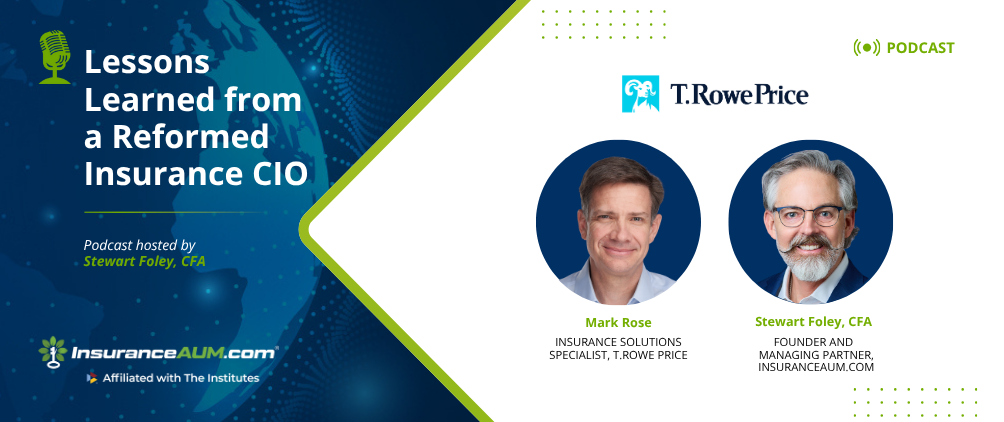
Lessons Learned from a Reformed Insurance CIO

Image
09.03 T. Rowe Price - 329


Stewart: Hey, welcome back. It's great to have you. We have a wonderful podcast for you today with a really good longtime friend of mine, Mark Rose. So we're going to talk a little bit about that. I do want to mention that we have a Private Credit/ABF event coming up in November in my hometown of Austin, Texas. That's going to be November 5th and 6th. It's open to insurance investment allocators that are focused on those areas. You can find it on our website under our events tab, and we certainly look forward to seeing you there. We had a great event last year, and it's going to be a good one this year. We're going to have a nice LP to GP ratio, and you're going to be able to see your friends, learn from them, and meet some leading asset managers as well. So the title of today's podcast is Lessons Learned from a Reformed Insurance CIO, which I love this one, and Mark Rose is the Insurance Solutions Specialist at T. Rowe Price. You have a deep background in fixed income. You were the Chief Investment Officer at the Argo Group. Mark, welcome to the show. You and I have homes close to each other. We've known each other a long time, and I'm thrilled to have you on.

Mark: Thanks, Stewart, I appreciate it. Good to be here. 

Stewart: Yes, sir. Well, here we go. Give us a little bit on T. Rowe and talk to me a little bit about your career, how you got here, kind of where you grew up, and how your career went from there. You have a degree in Mathematics from the United States Military Academy. Well done. I didn't know that. So what can you tell us about your career from the beginning to where you are today?

Mark: I grew up in Plano, Texas, outside of Dallas. Back when I was a young child there, it looked very different than it does today. You could walk outside and see fields. Average kid, went to high school, saw West Point as an option, and decided I wanted to climb that mountain. So I went there. I majored in Mathematics, you're right. I thought I might do engineering, but in the first year, I noticed that all the seniors who were in engineering courses were staying up all night, three or four nights a week. And I thought that was a bad idea. So I pivoted to math and was happy with that. From West Point, I was in the army for a few years. I eventually got out honorable discharge, like anyone who got out of the army, and my first job out of the army was at Electronic Data Systems (EDS) as a systems engineer.

So that didn't put me in the investment business, but I was close to the consulting business there, and one of my mentors had been in the investment business. So within four years, when I found a half-inch ad in the Wall Street Journal, I literally applied, faxed a resume in, and found myself working at a small boutique manager, sell-side manager for an equity research analyst in 1995, to put it exactly. And that's how I entered the investment business. And when I walked in my first interview, the guy said, “We walk in and out of the building with the value between our shoulders, and if you work for me and I get an offer to a larger firm, you're coming with me.” And sure enough, six months later, he got an offer to go to Credit Suisse, First Boston at the time, and I hung onto his coattail, and I ended up at Credit Suisse First Boston.

From there, I was an equity research analyst, but within about a year, my past crossed with a guy named Bob, who’s at Shankman Capital today, but he was running high-yield research, and Bob needed some support on his desk. They had lost their analyst who covered telecom, and that was my industry. And so through a project that I was doing for them, I ended up with a job in about two to three weeks as the telecom analyst for high yield. And that's when I really made a step into my investment career as a high-yield analyst and loved those years. I spent nearly four years at Credit Suisse and then another four years at Goldman Sachs. That's what put me into investments. And eventually, 12 years ago, I was working on the sell side again at Royal Bank of Canada, and I decided with my wife that living in Minnesota was a great thing as our kids went through high school, but that's not where we wanted to stay.

So I started looking for a job in Texas, and my resume ended up with the CEO of Argo Group, Mark Watson. And fortunately, he and the leadership there felt like my background was broad enough between equities, high yield, I'd had five years at two hedge funds as well, and pretty much done investments and just about everything you can invest in, from credit derivatives to private equity to distressed debt. You just line it up, and the board felt like they wanted someone with a broad investment background. So they hired me as a CIO. I can tell you that I did not appreciate or know the process of what a CIO should go through every year, but I soon learned by being surrounded by a number of good people. So that's how I got into it.

Stewart: It's funny, back when the earth was cooling, Argo Group was a client of ours. And it's interesting, this is predates you. And I remember when they ran that search. I'm almost certain I remember when you got hired there. And so, talk a little bit about what led you to go from this CIO suite to T.  Rowe Price? How did you connect? And I think that it's interesting you're not alone in this move. What was the thinking there, and how did you connect with T. Rowe?

Mark: That's a great question. I was 11 years CIO at Argo and learned a lot, and we can go over that at some point, but what brought me to T. Rowe, ultimately, Argo was sold to Brookfield Asset Management, and it went through some turnover and all kinds of stuff. In fact, I think that at year seven in my 11 years at Argo, I became the longest tenured senior executive left. And then within a year or two, it was “we're going to sell it.” And that took a couple of years because you don't just sell a company, especially an insurance company, you unpack it first, and then you line it up, and then it gets sold. But I took a severance package after the close of Argo to Brookfield, and I stepped back, and I was kind of torn between do I try to stay in Texas, or do I try to have another step into another CIO job?

And I interviewed at a couple of different places, and everything's a part of where are you located, who did you work for prior? Who are your mentors, and where are they? That next job is always tricky. I called a really good friend who runs Aspeda Insurance Solutions, a guy named Raj Krishnan, to chat with him on an opportunity, and he stopped me full circle on the call, and he said, “Mark, I really think you ought to talk to T. Rowe Price.” And he said, given your background and so many different assets and so much of the business, and then 11 years in insurance, they are putting together their insurance solutions, or let's just say, making it more today's insurance solutions. And if you look 10 years ago, insurance solutions looked a lot different than today, it’s migrated.

And he said, they have a really good team, why don't you talk to Ben Riley, who runs the group, and get to know them. And Stewart, the next day, I was on a video call with Ben Riley. The next week, I'm on a video call with the head of investment-grade fixed income. The week after that, I'm in their office interviewing, and the week after that, I accepted an offer. So within four weeks, it went very fast. But now why did I do? That's the real question. I get it. And a couple of reasons. One, if you look at T. Rowe, it's one of the storied histories of success in building an investment firm. Started in 1937, it is $1.7 trillion that they manage today. There are just not a lot of firms where you can say, “We manage nearly $2 trillion.” Secondly, if you look at the, and I knew this from my high yield research days when they were a client, the whole firm was founded with equity research.

So equity analysts found it, but that bled into credit research. And so credit research is really at the heart of how they select securities and markets, and decide to tilt a portfolio. They tactically move. They're exceptional and deep and broad in their research and in credit. And basically, for most insurance portfolios, you hold a world of credit in your portfolio, and you know that you're trying to avoid the left tail event. That means you're not going to find the right tail with research and credit unless you're running a special opportunities fund or something. But typically, you're just wanting to avoid the left tail. Well, T. Rowe is pretty solid at avoiding left tails, and I sat down with the team, and you look at Silicon Valley Bank, they didn't have any exposure, for example. The solid research that starts with that then started peeling the onion, or whatever you want to call it, peeling the story back about insurance business.

And if you look, T. Rowe’s always had some solid insurance business management. A lot of it was in high yield and emerging markets, where they're very exceptional in high yield, bank loans, and EM, they're very, very good. There are some very large industry names that T. Rowe runs EM and high yield for. And they've, in the last several years, been growing this core business; a very, very significant insurance name is a very large customer in the core business. So the company's had a pretty solid start, but when you say 1.7 trillion in assets, you start to realize insurance is very small and there's a lot of upside when you think of the BlackRocks, GSAMs, and the JP Morgans zone world. So I see a big opportunity to grow with this business with solid people like Ben and the people I met and the portfolio managers in IG, the portfolio managers in high yield, our EM team, it's a great bench. It's a big industry, and they're now, I would say, sharpening the point to address the insurance opportunity.

And you can lace in there too. Oak Hill Advisors, who they bought a couple of years ago, they've slowly started to integrate that, and Oak Hill is bringing a piece of that insurance solution. When you think about where the industry's gone with custom-rated notes and private debt and structured CLOs, private CLOs, Oakhill's in the thick of that. And it brings that component to an already very solid, what I would argue, public CUSIP team over at the T. Rowe side, who they do some private credit, but Oakhill brings in that whole flavor that we all know kind of got really opened up in the last few years.

Stewart: We've had a very good, very long relationship with T. Rowe. We've worked with Ben a long time, and we have a good friend in Bill, the president of Oak Hill. I'm one hundred percent with you all the way around there. You mentioned you were a longtime CIO, now that you're on the other side of the fence. And I mean, when I did that, one of the things that I noticed was that there's a fair amount of difference. I think every insurance company has some things in common, but how they view risk, what is defined as risk, their risk capacity, which is different than their risk tolerance. What lessons did you learn now that you're on the other side of the fence? How do you apply? It is a different role, right? It's hard to get as close to the liabilities, I think, when you're outside the company, but what lessons have you learned, and how do you apply those?

Mark: Yeah, so I was the CIO of a property and casualty specialty company for 11 years. And what I walked away appreciating, I would say, is that insurance is the one investor that doesn't start with “How do we make the most money?” They start with the line, “What can't we do? Let's figure out what we can't do,” whether it's a regulatory framework or a capital budget, but you're constantly focused on what can't I do? I don't want to do that for this reason. And then one other add to the regulatory and capital is the culture or appetite of leadership. The board, the CEO, their culture, and their appetite are going to drive a lot of your job, and if they don't have an appetite for that risk, even though you can take it, you're not going to. And so between leadership, regulatory framework, and capital budget, you come down to, “okay, here's what we're going to do because we figured out what we can't or what we won't do.” And then I think I gained in the 11 years a huge appreciation for those three in the process. You go about building your portfolio, and you're really just saying, “What risk will I strap on here?”

Because of those things, in my early days, the leadership wanted more risk, and so my focus was a lot on building a multi-asset risk portfolio and it did well, but the leadership left to me the process, the SAA, lot of the things they weren't involved in as much in the start because they just wanted to focus on taking more risk from a multi-asset. As Argo went through the activist event, and as you pointed out, it wasn't the portfolio; it had nothing to do with investments. An activist got into the stock for a list of reasons. You can go read about it on the internet. I'm not going to go through it, but at the end of the day, after an activist goes through your company and flushes two-thirds plus of the board and leadership, you're going to rewrite every process and governance in the company.

So we did that on the investment side. I had a good chairperson on the investment committee, and we rewrote the IPS governance, everything on how we did everything, from selecting a manager to doing an SAA, to what is exactly we want the board to approve and what do we want them to focus on when we're in a meeting, and what do we allow senior leadership to do and focus on. It was a good process, and I came away appreciating more after my 11 years when we did that. A good process allows you to manage that risk even better than just going out and saying, “let's go add more risk.” And so that's where I came out from my experience there. And, fortunately, I was surrounded by some good peers back then. I was talking to guys like Bill Cody, Jack Nelson, John Gauthier, and Mark Silverstein. A lot of these guys are retired now, but it was a good group, and you could compare notes, and I was blessed to be able to go through those times.

Stewart: Yeah, it's interesting. We're doing this chartered insurance investment manager designation with our educational partner, The Institutes, and we've had Mark Silverstein just do the case study on property and casualty insurance, and John Gauthier is going to be doing the one on reinsurance. So we're trying to get some of those sorts of highlighting, really showcasing the career of some folks who, and I think those folks are very highly regarded, and they also hold you in high regard, the CIO community, which, you know, well, it's a very sharp group of investors. It's nice that you can get in and compare notes. I guess the one question is, if you had the opportunity, would you do anything different with your role as CIO? Was there anything that you look back and you go, ‘Hey, I learned here, I learned there.’ Anything like that? 

Mark: I would say I would've put more effort into understanding best practices and processes between planning and managing investment committee meetings. Yeah, four meetings a year, and after the work we did post-activist, every meeting I walked into, the committee knew 90+ percent of what they would digest in the meeting, what the key issues were, and they were on top of it. It's not a lot of work, but we just put more attention to making sure, sure material was digestible, the right decisions were made, and the right topics were covered that manages the risk in our portfolio to support the company. So I didn't have that playbook when I started. So the first three or four years, I thought it was about, we ran an SAA, we ran capital models, but it was really how much risk can I add? And now let me go tell the committee about it. And by the end, I would argue our committee decks, our meetings were just flowing well, and because we really thought about how do we get to the critical things and not waste time on things we shouldn't be talking about. And I gained a huge appreciation for that. So that would be one is just don't the process and get through what you're supposed to get through and avoid wasting time.

Stewart: Yeah, I think it's really interesting. And I have someone who's been coaching me as well on those kinds of issues. And I mean, when you get right down to it, I mean you're doing this every day, all day for the whole quarter, and then you've got not a lot of time to communicate that to the investment committee, and it doesn't take that much to get kind of a rabbit going through the room. Okay, that's good. You mentioned one thing. Is there anything else?

Mark: Well, that was a big thing. I think other things, we ran an internal special SITs portfolio for about five years at Argo. We made good money. But looking hindsight, I would argue it's very hard to source and run investments directly at an insurance company if you're focused on plugging into the insurance company on what it needs, whether it's book yield or a specific requirement on a state that you have a portfolio in. And so I would say your core competency should be picking the right managers. It should be picking and communicating the right risk between the managers, and then going back to the committee and making sure we understand the risk and where you want to be. And then if I could do it differently, I would not have run a portfolio where we're sourcing ideas, but I probably would've continued to run. And we did have a huge success in doing co-investments and manager-generated ideas.

Where do we want to add on, whether it was private credit or an equity position by our activists fund that we were in, but I think focus more of your time on picking the right people to talk to on the other end on that manager, and then if you can even find that subset of best ideas and you want to add on, that's where we made significant money. And if I look back, most of banging our heads on the table when we ran the internal book was the names that we sourced directly and didn't have an idea from the manager. And focus on making sure your decisions on managers are right, your decisions on risk are right, your decisions on planning are right. And then if there's a best idea, great, but don't stray from your priorities as an insurance portfolio. So for me, that was a lesson learned.

Stewart: Yeah. You mentioned the term Special SITS, and just in case somebody doesn't know the jargon, can you unpack that term and tell us what it means?

Mark: Yeah, it was largely a portfolio that had the stress debt.

Stewart: Special SITs stands for special situations.

Mark: That's right.

Stewart: Yeah.

Mark: Special situations.

Stewart: Yeah, there you go.

Mark: It's kind of like saying the word hedge fund. It can mean a lot of things, but absolutely, it typically means you have an open slate to pick where you think value has been created. The investors have left. A lot of times it was in high-yield credit, but it could be an investment-grade credit, it could be in a stock, it could be in private equity. We had a liquidation, a company that was in liquidation, that we figured out was trading at 17 cents, and we were confident we would get 90 cents in recovery. And I think we got a buck 15, actually. And it was a special situation, and we did it fairly well. We had about a $300 million portfolio, and we were allowed place risk in different regions or different regulatory portfolios within the company. For example, on our Lloyd's portfolio, we were allowed to own equities, but there were certain rules. Well, we found we put some on the run equity best ideas in there for extra return, and it did well. So it wasn't a bad model. I just would say hindsight way too much work for a little return on sourcing ideas versus I've got all these funds I'm invested in, I'm an LP and all these funds. Let me pick the best ideas. Your investors, especially in LP funds, private equity, and private credit activists, they're going to tell you about the best trades or their best ideas. You're going to talk about it every quarter. Well, that's a great source that overlaps with a job you need to do, which is due diligence continually.

Stewart: Yeah, it's so true.

Mark: That's why.

Stewart: We have two more questions for you. I want to make sure we get to 'em. So in your view, how have markets evolved relative to insurance investors? And I think that you've seen a pretty strong trend toward private assets, but talk to us a little bit about that, and then I've got one more for you.

Mark: Yeah. First, I would say if you look at insurance, there's been a growth in annuities, and I would argue that in P&C and specialty, there's been an increased focus in capital budget over the last few years. Maybe it's because of reserves, maybe it's because of some people might think, well, it could be climate change with the hurricanes, could be the fires we're talking about, but it seems like capital's a bigger deal at P&C, and you've also seen a growth in annuities, which drives me to trends we're seeing because of this. There's been a lot of focus on dragging in lower-rated assets or non-rated assets into a rated structure, which gets you into the private credit realm, whether it be a private CLO or taking a portfolio of loans and doing a rated note on top of BBB and an unrated piece. And you could argue its ratings, arbitrage, not going to disagree.

And I would argue some of these ideas are really strong and good. Barring against LP commitments, I struggle with how that's a bad idea for a fund. So I think largely there's some great ideas. I do think there are some firms going that direction that may be in assets that may not be as good as we thought. We'll find out, time will tell, but so dragging lower-rated, higher-yielding assets into a structure is a trend. Another trend I like going on right now is just the resurgence in yields, and that could lower the demand on the private structures with time here. And that is, we're starting to see the IG core portfolio yielding 5% in book yield today. And you and I both know, well, P&C company runs between two and a half and three and a half portfolio to the book value. So if I can do over 5% in my return, even after tax, I'm double-digit to my book value.

So that trend to me is one that's countering that whole, let's go chase private illiquid credit. If we see a movement higher in rates or higher in yields on future opportunities in the public market, it'll be an interesting, where everything goes. So I would say those two things. And then something that's developed over the years is just the growth and core plus portfolios. When I started, it was core fixed income, and it was a risk portfolio, but that layer in between the CLOs, the commercial mortgage loans, those structured notes we just discussed, esoteric ABS, that's really started to become super important because of that first comment was on the fact that capital has become more important for P&C. And then annuities, it's always been that way. Right? So that's what I've seen.

Stewart: That's super helpful. You, my friend, are going to be at our private credit event that I introduced at the top of the show. If you were in an elevator giving a new contact of 30 to 45-second quick pitch on T. Rowe, what would you say?

Mark: I would say this, if you look at T. Rowe, we have a one insurance solution. It's a combination of T. Rowe and Oak Hill advisors. And when I say one Insurance Solutions, when you think about your core, core plus, and risk portfolio, you're thinking about IG fixed income, you're thinking about securitized, you're thinking about Munis, EM, and then you come into your core plus and you're looking for a little more illiquidity, but higher yields, and that's where we step in with, we have private credit as well as structured credit. We have custom CLOs, we have CLO management, and then you step down into the lower level, which is your risk portfolio, and you say, “Hey, I'm looking for high-yield bank loans or special situations portfolios”. And t. Rowe and Oak Hill Advisors have focused on putting this one platform together, and it really does. We have success stories, we have successful clients, and we have successful PMs that I'm happy to connect you with if you find a need in that between core, core plus, and risk.

Stewart: We've got a good friend, Mark Mercurio, who went the other way, right? He went from asset manager to the CIO seat, and you have come the other way. It's interesting because the skills are definitely applicable, and it's great to have you on. Nice to see you first of all. And I just wanted to ask a couple on the way out, which is one is really, it's a little unfair because you just got to T. Rowe, but you did go through the hiring process. You've also hired folks on your own teams, and the question goes, what characteristics do you think are important if you wanted to have a career in this business, and what characteristics in your perception were important to T. Rowe?

Mark: I think one is intellectual curiosity. I mean, truly wanting to understand how does this works and why we are not just putting numbers on paper, but understanding, do they make sense? In my career, the best people that have worked for me had a personal intellectual curiosity that I didn't have to go and point out mistakes because they would see it and go, I got to understand why. So that would be one. Then, honesty is always a critical one, and with T. Rowe, I think they look for those as well. I think T. Rowe is in it for the long game, not the short game. And the culture here, I've been super impressed with, if you walk the halls here, I mean, there are analysts here at T. Rowe who I spoke to on credits in 2010.

So they stay here a very, very long time, and there's a huge commitment to building the business, obviously, with insurance companies. But people generally love working here. From what I can tell. I mean, I don't see a lot of turnover at all. I would argue they're a long game. They want to do the right thing for the customer. I think you've met Jeff DeVack, a guy I work with who's been here a very long time, and he's head down. I mean, he does support some of our largest insurance portfolios, and I'll go over there and he's buried in something and he isn't going to stop until he has it done and figured out. And it's that kind of roll your sleeves up, I don’t know, maybe it's Maryland or Baltimore, but so far I've been really impressed.

Stewart: Yeah, that's super cool. We've had exposure to a lot of folks at T. Rowe over the years. We've got a very dear friend in Patrick Farn on the marketing side as well, and I'm kind of with you there. Alright, fun one on the way out. So, dinner, you've heard this question before, up to three guests, one, two, or three, alive or dead. Mark Rose, who's going to dinner with you.

Mark: I thought about this. I remember your questions, and you didn't ask about my paper route, so I couldn't talk about it.

Stewart:  know what? Honest to Pete, that's one of the most common answers is paper route. I bet you we've gotten that first job more than the one that we've been asking is our first concert.

Mark: So yeah, don't ask me about concerts because I'm just not that type. Dinner, here's the deal. My father passed away the week before Easter this year. He nearly made it to 89 this year. It was a great life. If I talk about the man, you'll just, I'll have you captivated. Wonderful man. But if I could have three people, it would be my dad, his dad, and his dad's dad. I had interaction with all three in my life, and I would love to go to dinner with them all at kind of the rough age of 50, but with the knowledge of what the whole life. I would love that dinner.

Stewart: If you showed your dad's dad, just handed him your iPhone, and just said, “here.” I have a good friend, a good buddy of mine I ride with, and his grandfather turned 102 and he said, what's the most amazing thing you've seen in your life? And he said, let me get back to you. And he came back to him and he said, the fact that you can ask your phone a question and it'll tell you the answer. So just part of that means, it's amazing that you'd have the line of your family, but it would also be astonishing for them to see kind of what the world's like today, right?

Mark: Oh yeah. It'd be nuts.

Stewart: We've been joined today by Mark Rose, who's the Insurance Solutions Specialist at T. Rowe Price. Mark, thanks so much for being on. We've really enjoyed it and got a great education today. So thanks a lot. If you like our show, please rate us, review us, and make some comments on Amazon, Spotify, or our brand new YouTube channel at InsuranceAUM Community. If you have ideas for podcasts, please shoot me a note at Stewart@insuranceaum.com. We are the home of the world's smartest money. We'll see you next time on the InsuranceAUM.com podcast.

Share this post

Sign Up Now for Full Access to Articles and Podcasts!

Unlock full access to our vast content library by registering as an institutional investor

Register

Contacts


T. Rowe Price

T. Rowe Price is a global asset management firm with broad investment capabilities across Equity, Fixed Income, Multi-Asset and Alternative Strategies, highly committed to excellence in service and putting client interests first. We understand that insurers have many unique considerations impacting portfolio design, and we are proud to work with many of the largest insurers in the world delivering diverse and custom solutions designed to meet those needs. Our dedicated insurance relationship managers act as an extension of your team and serve as a conduit to the T. Rowe Price organization while proactively bringing the firm’s vast resources to bear. We offer a consultative, problem-solving approach and the ability to implement solutions based on specific client objectives, constraints, and risk tolerance.

Ben Riley 
Head of Insurance 
benjamin.riley@troweprice.com 
410-345-2223

Chase Uhlein, CFA
Senior Relationship Manager
chase.uhlein@troweprice.com
410-577-3077

Blayze Hanson, CFA
Senior Relationship Manager
blayze.hanson@troweprice.com

Taylor Davis 
Relationship Manager 
taylor.davis@troweprice.com 
410-577-2054


1307 Point Street
Baltimore, MD 21231

 

View the contributor page

Image
trp_logo

Sign Up Now for Full Access to Articles and Podcasts!

Unlock full access to our vast content library by registering as an institutional investor .

Create an account

Already have an account ? Sign in

Ѐ Ё Ђ Ѓ Є Ѕ І Ї Ј Љ Њ Ћ Ќ Ѝ Ў Џ А Б В Г Д Е Ж З И Й К Л М Н О П Р С ΄ ΅ Ά · Έ Ή Ί Ό Ύ Ώ ΐ Α Β Γ Δ Ε Ζ Η Θ Ι Κ Λ Μ Ν Ξ Ο Π Ρ Ё Ђ Ѓ Є Ѕ І Ї Ј Љ Њ Ћ Ќ Ў Џ А Б В Г Д Е Ж З И Й К Л М Н О П Р С Т У Ф Х Ц Ч Ш Ā ā Ă ă Ą ą Ć ć Ĉ ĉ Ċ ċ Č č Ď ď Đ đ Ē ē Ĕ ĕ Ė fi fl œ æ ß