





We're currently experiencing email delivery delays. For urgent matters, please contact us directly at lindsay@insuranceaum.com.

17Capital-

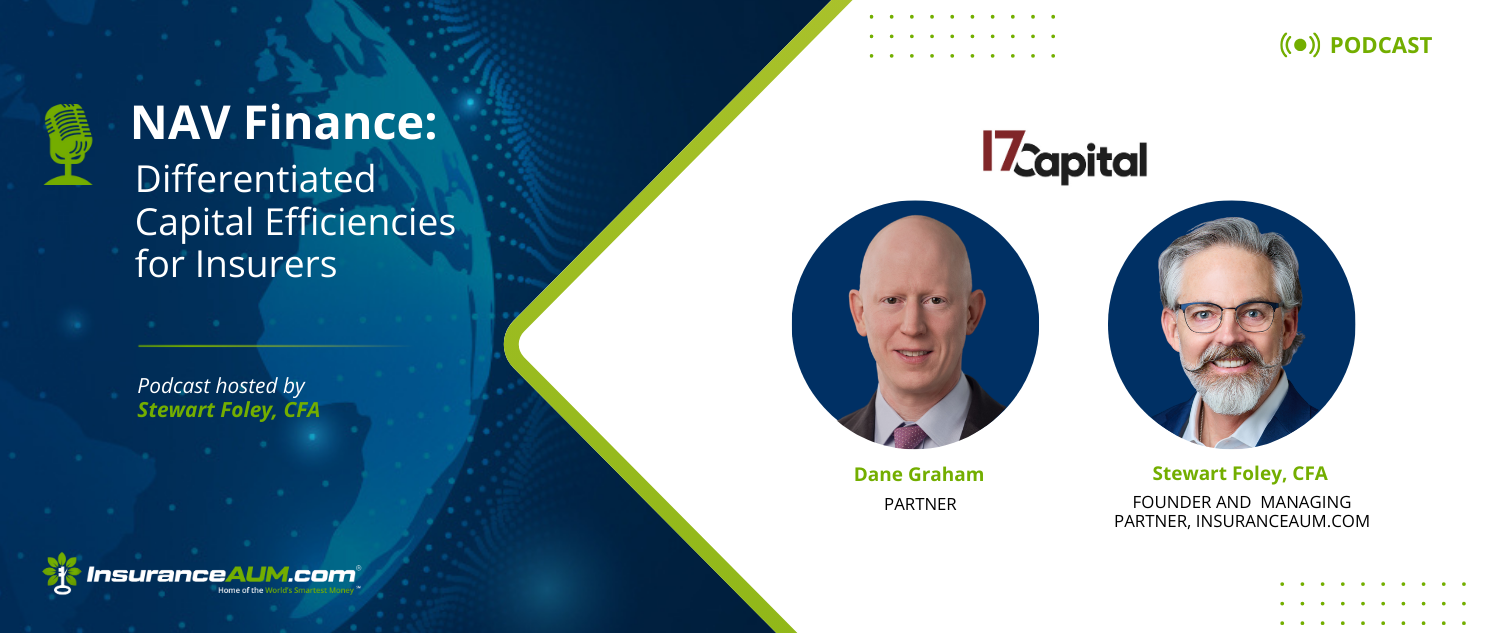
NAV Finance: Differentiated Capital Efficiencies for Insurers

Image
Dan Graham, Partner, 17Capital Podcast


Stewart: Hey, welcome back. Thanks for listening. I'm Stewart Foley and this is NAV finance: Differentiated capital efficiencies for Insurers. Today's guest is Dane Graham, Partner at 17Capital, a private credit manager specializing in NAV finance for the private equity industry. Dane leads the firm's New York office and serves on the investment committee. He earned his MBA from Penn State University, home of the Nittany Lions, one of the most iconic college mascots and a symbol of fierce independence and strength. Dane, welcome to the show. It's great to have you.

Dane: Great, thanks, Stewart. Thanks for the wonderful introduction and I appreciate you spending time with us today. And go Lions.

Stewart: Absolutely. There you go. We always start 'em off the same way, which is where did you grow up and we've changed this question a little bit. What was your first concert?

Dane: That's a good one, Stewart. So I grew up in Western Pennsylvania on a dairy farm, family-owned and operated. My father says you learn how to work there versus what I do today by talking on the phone and punching keys on a computer. And it's funny you brought up Penn State and the Nittany Lions because there's a long story we can go down there. The first college football game I ever was able to watch was when NBC bought the television rights for the 87 National Championships, so it was Penn State vs. Miami in a historic national night game with a lot of famous figures, and so I was obviously hooked at that point. So Penn State was the only school for me after that.

Stewart: Absolutely. What was your first concert? This has been a fun new edition.

Dane: I'm buying time there because I'm actually not sure. I think it was the Clarks, which is kind of a band I thought was great, but I don't know that they ever really broke out of the tri-state area.

Stewart: Oh, that's interesting. Yeah, my first one I went to see Billy Squier, who was opening for Pat Benatar and we didn't care at all about Pat. I mean we cared a little bit about Pat Benatar, but we thought Billy Squirer was just the end all and be all. I think I sat, this was back when they did line tickets and I ended up, we had to go the day before, get the line ticket, come back. It was a whole process. So what would be helpful, and we're talking about NAV finance today and kind of the set the stage, can you just explain with some big crayons, what is NAV finance?

Dane: Yeah, happy to do. I think it is helpful as we dive in because the term may be used differently by different folks. So when we refer to NAV finance, we are generally referring to diversified portfolios of private equity buyout exposure, and so that's the underlying, ultimately in everything that we do at 17Capital and what we're referring to as NAV finance, it's not underlying portfolios of credits of various types or real estate exposure or otherwise, it's private equity buyout exposure.

Stewart: What's the origin story there of NAV Finance? 17Capital was a pioneer in this space. How did it start and how has it changed?

Dane: Sure, yeah, we definitely do think we are a pioneer in this space and I sometimes use the term my son has taught me recently that the kids use, we have the OG, if you will, in NAV finance. It started with a couple of our co-founders from the secondaries landscape, pre-GFC, seeing the limited number of options that exist for folks who had exposure to a portfolio of private equity buyout assets that were of high quality and having really only a secondary as a tool to manage the portfolio and thinking that there should be more tools for those portfolios. And so their thought was if you have a diversified portfolio and it's of high-quality performing assets and that is managed by institutionalized high-quality GPs, then there should be able to be lending solutions for that portfolio to better manage it, whether that's for liquidity or further investment.

And so that was kind of the background in the thesis and it was a little bit geared toward an LP lens at the time. And then by the time the business was established, we were through the GFC, and there were acute liquidity needs from LPs, and that was really the thought of how it would take off. What was interesting to see was it really turned out to be largely a GP-led solution and that is because most of the capital that's being used for NAV is going into either the GP or the funds at a portfolio level to continue to grow the platform, continue to grow the value of that portfolio and those that are best positioned to see those opportunities to capture that value and drive that growth tend to be the GP or the management companies at the individual portfolio company level.

Stewart: And let's shift over to use cases. Can you walk us through the main applications today, specifically fund financing versus management company financing, and why fund financing is so relevant for insurance investors in particular?

Dane: We think about the many use cases of NAV at the highest level, its liquidity or capital invest further, as I mentioned. The pure liquidity option is very limited. The vast majority of NAV is capital to invest further and grow platforms or portfolios. And so as you dig down at the management company level, teams are utilizing NAV to maintain an outsized GP commitment to their existing funds or future funds to grow the size of their relative GP commitment to their funds, further aligning themselves with their LPs. It's to strategically grow the platform, so sometimes to acquire other capabilities, whether that's through the acquisition of another manager or through bringing on a new team and creating an adjacent strategy to offer more solutions to their LPs. And it also is used for things like succession planning and facilitating the rotation of equity from founding generations to the next generations, who are driving the business going forward, and something that's at its early days as well. 

At the fund level, so kind of moving from the GP level, the management company as some will refer it to the fund level, which the GP overseas the use cases are primarily growing the portfolio and that typically manifests itself in the form of M&A and that can take a number of forms, transformational add-on or roll up strategy, but largely an M&A execution with the NAV loan, but it also can be used for capital structure solutions with select portfolio companies facilitating a better, faster, better terms execution on underlying portfolio company debt by easing the overall level of leverage and cash burn that's at individual portfolio companies.

Stewart: That's super helpful. Let's talk about growth areas for a minute. Where are you seeing the greatest opportunities for growth within NAV Finance? And I always add this part at the end, which is there anywhere that you're cautious?

Dane: There's a lot to say there. So I think from a growth perspective we're early days. So if the secondaries market is in the second or third inning, which you hear some of the big platforms say now finance is in the first inning, it's an established asset class but it's still single digits adopted. And so market awareness and adoption is going to be, is by far the biggest drivers and that's through education of the various use cases of NAV and then putting it to work and finding additional use cases from platforms that become early adopters and then it's other platforms that haven't used it becoming adopters and using it for the first time. And that's on the rise and has been on the rise, and I really see three, I guess, inflection points if you think about recent history in the near-term future of the adoption of NAV. I think one is COVID because of necessity.

The second one was going to ILPA guidelines coming out about a year ago, enhancing conversation. And then the last is kind of the performance realization. So when you think of COVID, that was a meaningful inflection point because capital markets were shut. The education of NAV was essentially forced upon people with needing to think about alternative forms of financing and solutions for portfolios that the traditional forms were completely closed. And since then we've seen about a 30% year-over-year CAGR pretty consistently since COVID in terms of deal opportunities that we're looking at to execute on. That second inflection point, I think we're seeing live, it's on the back of the ILPA guidelines coming out last July and that's pretty early for ILPA in terms of a new asset class to come out with some guidelines and essentially saying it's new but it's a thing, it's going to continue to grow and exist.

Generally supportive but demanding of transparency, and I think that was helpful for both GPs and LPs in terms of understanding what's happening and just building a comfort level and the dialogue to chat with each other about it, and no longer have any sort of stigma associated with it. So we're seeing that adoption today and then I think you'll see a third inflection point that will probably take place when the users of NAV in the funds today, those vintages mature and the performance is just differentiated from those who have not used nav and I think that'll drive the third and major inflection point going forward. Stewart, you also asked where to avoid. I think that the whole conversation around adoption and use is really afforded to managers that are well-established, institutionalized, solid platforms, more value on the come than they have on the ground today type platform.

So it's really a tool only afforded to the best in the industry. It's not really being offered to managers who are struggling in the current market environment and where we look and think about, from a NAV perspective, how to focus our underwriting is around the manager first because it is franchise oriented and that they are truly institutionalized then that it's a performing portfolio and diversified and then we put a structure around it. So what we're avoiding is non-institutional managers' portfolios that are not performing, or are in distress, or otherwise. I don't think structure ultimately solves those two factors at the end of the day in these types of transactions.

Stewart: It's super helpful for the benefit of our audience. You mentioned the term CAGR, which just stands for compound annual growth rate, just in case somebody didn't understand what you were talking about there. So let's talk about insurer activity just a little bit. It seems to me that more insurers are allocating capital to NAV loans than ever before. In your mind, what is driving that surge and what does it say about how the market is evolving?

Dane: We do see that insurance is growing in and of itself as a primary pool of capital and that's supported by demographic trends and other trends. I don't think it's a surprise or at least it's not a surprise to us that insurers are growing their allocation to NAV, and it seems more of the natural progression of things. Insurers tend to be, in my opinion, some of the best at risk. That's ultimately what those platforms manage. They're very good at a risk-adjusted return experts, if you will. So I think they see the asset class for what it is: strong risk-adjusted returns, an asset class that can sustain that and one that's scalable so that they can put real money to work in it. And so that is driving the demand, particularly in the NAV loan universe, because those tend to be very high-grade investment-grade type quality transactions that would fit nicely on an insurance balance sheet and are very capital efficient. And so most of the insurers think about it as an alternative or a piece or a sleeve of their investment grade book. And so that's driving further adoption. We have about, I'd say 35% of our platform is insurance money. We have about 45 total insurance companies that we work with that's nearly 20 in the US alone. So the adoption from an insurance standpoint is very meaningful over the last couple of years.

Stewart: Just to go to strategic signals, Brookfield has made an investment in 17Capital. What do you think these major investments signal about growing insurer interest in the asset class?

Dane: There are a number of large insurance platforms that have made meaningful commitments to NAV, particularly in recent years as it's grown and adopted. And I think it is validating the asset class further as I alluded to in terms of its attractiveness from a risk adjuster return standpoint and in particular when you look at the overall size of the private equity buyout market at about 4 trillion today, expecting to roughly double in terms of the NAV over the next 10 years. If you're just a 10% LTV across that total pool, that's 800 billion of theoretical NAV loan volume right there. There's not a lot of capital that's been formed around to serve that demand that's coming, and so it should provide a consistent, ongoing, attractive risk-adjusted return that's attractive because supply is not keeping pace with demand there, and the fact that it is value-creating. So I think which is a key element of what's happening here is as I mentioned, the vast majority of the use cases in the NAV loans are to affect acquisitions and they tend to be very accretive for those portfolios and their LPs and that value creation is so meaningful that the focus is largely on the speed and certainty of execution to be able to capture that acquisition and put it into the portfolio in a competitive environment versus squeezing the basis points on the lending because those basis points are irrelevant ultimately to the overall return when capturing that acquisition.

So it's a different dynamic, it's a unique dynamic that enables the space to have good risk-adjusted returns for the lenders, but at the same time arguably even better returns afforded to because of the use of NAV to the borrower, and in particular the LPs in those borrowers. And the really unique thing about insurance in the space is they are LPs in the underlying funds and so I think that is also validating a lot of the things that we have been sharing around NAV finance and how it's very valuable to the underlying LPs. The insurance companies are LPs in those private equity funds and they are looking for a high performance out of those positions and they're very happy to participate in the NAV loan or allocate to somebody executing at NAV loan on those same portfolios because they see the value they're getting at multiple levels of the capital stack then but in particular in the underlying private equity fund, which is going to get an uplift as a result of using the NAV loan.

Stewart: That's a really interesting point. Let's talk about transaction structures, right? So we hear a lot about rated feeder notes. What should insurers know about that structure and other structural innovations in NAV finance?

Dane: Yeah, rated feeders are really in summary just an efficient way for insurance, particularly in the US, to access exposure that's been put in the fund form and that's kind of the easiest way to ultimately summarize it. I expect it'll continue to grow in popularity and I think we've seen over the last 18 months to two years it's grown substantially with the validation of the regulator in the space. And so I expect it to continue to be used across not just NAV but private credit and other underlying assets where managers are putting together an attractive solution, ultimately for insurers, but it's not necessarily efficient to access through a fund structure. And so they'll come in through their rated feeder. These types of feeder vehicles, they vary, and I think a feeder on just a pure play navone vehicle can be really unique amongst the broader range of feeders and that's because the underlying asset class that NAP loans themselves tend to be high grade and investment grade and our NAP loans are generally rated high investment grade.

And so when you put that into a rated feeder structure it becomes even more efficient. So you have a much deeper attachment point in terms of the investment grade tranches potentially as high as 95% on these types of structures and a much lower residual and therefore it makes it even more efficient. But I also think their rated feeders provide some other benefits. They provide efficiency for operations, which is certainly something everybody is focused on. And so, versus having a deal-by-deal booking tracking, reporting monitoring for the insurance company to do each one on the balance sheet, the rate of feeder makes that more efficient. It can also provide access across the entire market, so across both North America and Europe, which have different underlying currencies in those transactions, but can provide it in a single US dollar solution. And that can be attractive for insurers because then they get full access to what's happening across the market, which is still, as we talked about as early days, lumpy. So you kind of want to have the broadest origination funnel to get your exposure, and then a rated feeder does typically also provide subline benefit. There are a number of benefits there overall, and why I think the rated feeder market overall will grow, but we think it can be uniquely attractive in the NAV solution.

Stewart: That's interesting. You mentioned having about 35% of your clients as insurance companies. There's an old saying that goes: if you've seen one insurance company, you've seen one insurance company. But you can kind of generalize insurance investors into types. Have you learned anything about whether certain types of insurers are better positioned to benefit from NAV lending than others?

Dane: Yeah, it's a very fair question, Stewart. And I would say not in particular from our lens, I think insurance overall across the various types of insurers that exist are all looking for attractive risk-adjusted returns on the asset side, I think personal view maybe that you can differentiate more on the asset side than you can elsewhere in the insurance business because more judgment and investment oriented and every insurance company can improve and can outperform on that front. And so there's been a long-term search for these types of assets that provide that really attractive risk-adjusted return and seeking exposure there. So we have many different types within our group. I would say, I do kind of appreciate the statement, if you've seen one insurance company, you've seen one insurance company. But I do think the asset class as a whole is just really well suited for insurance, broadly speaking, given what their objectives are and how they're set up, and what the asset class provides.

Stewart: Alright, so this is where I ask you to dust off the crystal ball, right? Looking ahead, what's your outlook for nav finance? What does that landscape look like over three to five years?

Dane: Yeah, I think we expect it to continue to grow and adopt. I think it comes back to some of the things I mentioned and alluded to in the third inflection maybe of growth in the space where, as we see more users see the opportunity, utilize it and then ultimately you realize the benefits of it, then it becomes really powerful and so there'll be continual users of it and it will drive further adoption from their peer sets to keep pace and to continue to outperform. So we see adoption as by far the largest driver of growth going forward. We expect that that'll continue over the next three, five years and further out and that adoption curve is really inflecting at this time. So we were very excited about the growth of the space. We put out some numbers in the 2020 timeframe, and what we thought this space would become by 2030. I think we're still seeing that as a reality and the numbers I mentioned before in terms of the size of NAV and the lack of tools to really manage at the fund level, this is really a primary tool to utilize to continue to more efficiently manage those portfolios, capture additional value and create a benefit for everybody involved in the equation. So we expect that we'll probably hit those numbers from an overall market perspective.

Stewart: Very helpful. So a couple of fun wrap questions for you. One really tries to speak to the culture at 17Capital, and it goes something like this. What characteristics are you looking for when you're adding to members of your team? Not the school they went to or can they use Excel or can they write in Python but more around the characteristics?

Dane: Yeah, it's not a question I expected on this call, but it is something that's very core to how we think about our business and what we think has made us successful to date, and what we think will set us up for the longer term. It's really about being team-oriented. That's probably number one. We are now over a hundred people, we're 30 folks on the investment team. We're kind of fully matured, if you will in an industry that is still at very early stages and the way we're going to continue to lead the market is by being team-oriented, leveraging the qualities and the skills and the benefits that everybody brings to the table internally and putting that together to see the market shape and grow and form it over the next several years. That's exactly what we've done as a platform. If you wind the clock backward, so we pulled together, I mentioned our founders were from the secondaries landscape, we've got senior talent on the IC, and the senior members of the team that come from really the strategic landscape and M&A in this space.

Providing that level of lens is important and critical, given that NAV is franchise-oriented. We have folks that are from the leveraged finance world and that's where the bulk of their experience lies. We have folks that come from fund finance specifically as well, and it's pulling all of that talent together and if that isn't working as the team, you're not getting the benefits of what they all see in all of those experiences that really ultimately I think are really required to properly do NAV in the best way and that's what our plan is going forward and how we think about folks team orientation is going to win going forward in terms of those hires. We do see a lot of talent that has a lot of the other skills, but that's a key one for us.

Stewart: That's a terrific answer to that question. I think we've just kind of started asking it and we're getting some great insights as a result. Dane, thanks so much for being on. We've gotten an amazing education on NAV finance, for sure. I have, anyway. I just want to say thanks so much, and appreciate you taking the time.

Dane: Yeah, Stewart, it's been a pleasure. I appreciate the time today and am glad to spend the time with the audience, and we're always available to connect and share more.

Stewart: Good deal, appreciate it. This has been Dane Graham, Partner at 17Capital, a private credit manager specializing in NAV Finance for the private equity industry. Thanks for listening. If you have ideas for podcasts, please shoot me a note at Stewart@insuranceaum.com. Please rate us, like us, and review us on Apple Podcast, Spotify, or check out our video podcast on our new YouTube channel at Insurance AUM Community. We are the home of the world's smartest money at InsuranceAUM.com.

Share this post

Sign Up Now for Full Access to Articles and Podcasts!

Unlock full access to our vast content library by registering as an institutional investor

Register

Contacts


17Capital

Founded in 2008, 17Capital is a private credit manager specializing in NAV finance for the private equity industry, operating primarily from London and New York.

17Capital specializes in providing non-dilutive capital to high-quality private equity management companies, funds and institutional investors as part of a toolkit for value creation and portfolio management.

17Capital offers NAV finance across the entire capital structure, providing a broad range of financing options. Investments are structured to support clients’ objectives, while keeping the interests of GPs and LPs aligned.

As of 30 June 2025, 17Capital has completed over 119 investments and 55 exits, deploying more than $16 billion since inception. 17Capital has raised over $19 billion across eight NAV Finance funds and mandates.

Tyler Dziama, 
Director, Investor Relations
Dziama@17capital.com

One Vanderbilt Ave
Suite 5400
New York, NY 10017


View The Contributor Page

Image
17Capital-Burgundy-Black-RGB-Large (1)

Sign Up Now for Full Access to Articles and Podcasts!

Unlock full access to our vast content library by registering as an institutional investor .

Create an account

Already have an account ? Sign in

Ѐ Ё Ђ Ѓ Є Ѕ І Ї Ј Љ Њ Ћ Ќ Ѝ Ў Џ А Б В Г Д Е Ж З И Й К Л М Н О П Р С ΄ ΅ Ά · Έ Ή Ί Ό Ύ Ώ ΐ Α Β Γ Δ Ε Ζ Η Θ Ι Κ Λ Μ Ν Ξ Ο Π Ρ Ё Ђ Ѓ Є Ѕ І Ї Ј Љ Њ Ћ Ќ Ў Џ А Б В Г Д Е Ж З И Й К Л М Н О П Р С Т У Ф Х Ц Ч Ш Ā ā Ă ă Ą ą Ć ć Ĉ ĉ Ċ ċ Č č Ď ď Đ đ Ē ē Ĕ ĕ Ė fi fl œ æ ß