





Conning-

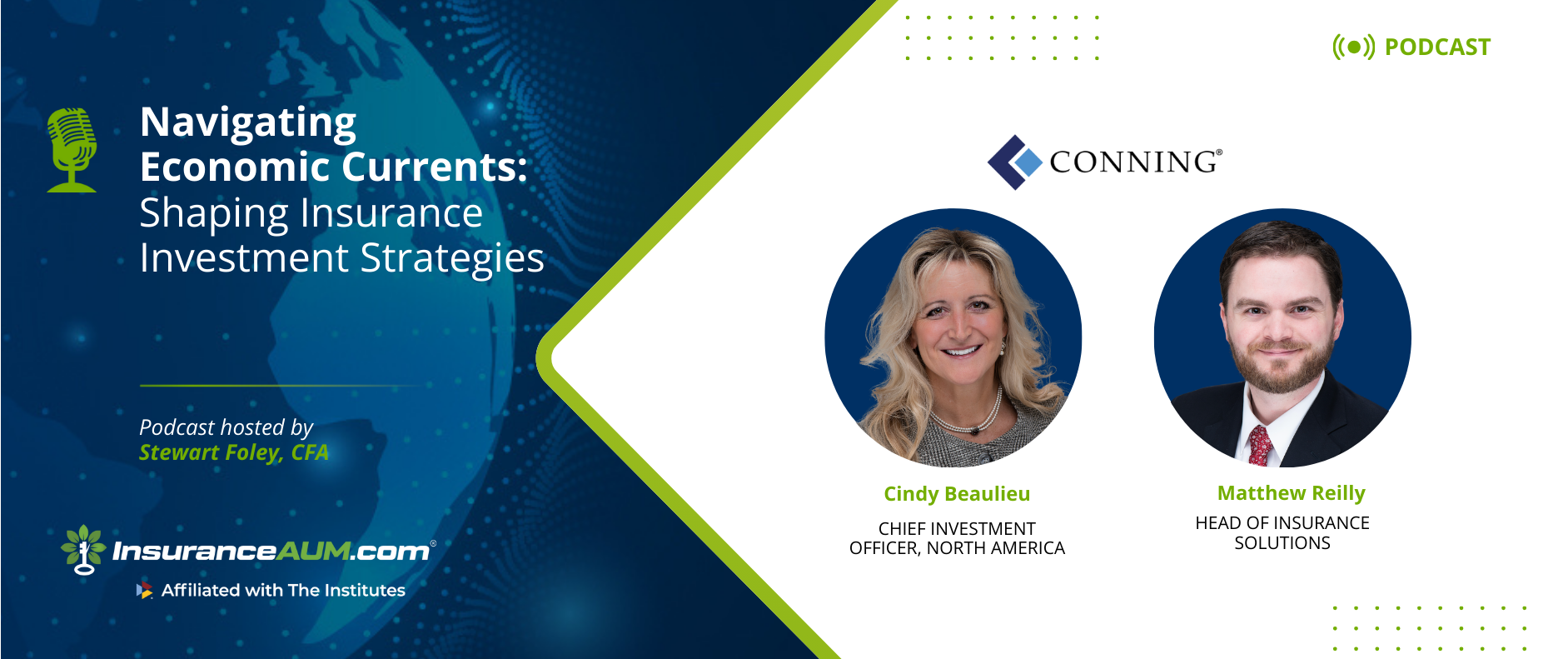
Navigating Economic Currents: Shaping Insurance Investment Strategies

Image
11.17 Conning_Web


Stewart: We've got a great episode for you today. I'm joined by two highly regarded leaders in the insurance asset management space, both from Conning. It's Cindy Beaulieu, Chief Investment Officer of Conning North America, and Matt Reilly, Managing Director and Head of Insurance Solutions at Conning. Thanks to both of you for being here.

Matt: Thanks for having us, Stewart.

Cindy: Thank you, Stewart. Great to be here.

Stewart: So the title of this podcast is Navigating Economic Currents Shaping Insurance Investment Strategies, and both of you have been on before. Both of you have been asked all my icebreaker questions as we near like 340 episodes. I'm like, I got to come up with something new. So here it goes. Cindy, what was your first concert?

Cindy: Oh wow. Okay. I'm going pretty far back here, but my very first concert I ever went to was Stevie Wonder at the Hartford Civic Center.

Stewart: Wow. What a great first concert.

Cindy: Absolutely.

Stewart: That's a great first concert. Alright, Matt, how about you? What was your first one?

Matt: I think my first concert was Blink-182, also in Hartford at the Meadowlands.  

Stewart: Oh wow. There you go.

Matt: That was a pretty good concert.

Stewart: I think I was 40 when they came on the scene.  

Matt: I was not 40, Stewart.  

Stewart: I know. I'm like, wow, okay. Every now and then when I taught, this happened all the time where I would feel like a dinosaur and I'll never forget this as long as I live. I can't remember who got bought, but Snapchat got bought and it was like 2 billion bucks or something. I walked into my class, and I'm like, “who in the heck has ever heard of Snapchat?” And every hand went up, and I was like, dinosaur, I'm the dinosaur. I'm like, what is that? They're like, come on, grandpa. Let me tell you some more stories. So I want to get into it here with you guys. We've had a policy environment that has injected a lot of volatility into markets. Conning expects a lower volatility in 2026. What is driving that outlook?

Cindy: I'll jump in on that one, Stewart. It has certainly been a very interesting year, 2025, and one, I would say most people probably got wrong if they go back and look at their projections versus where we sit today. It really has been very policy-driven. The difference has been that it's been both fiscal and monetary policy that have been the culprits here. You think back to the start of the year with a new administration, control, at least on paper of Congress, and a long agenda acting very aggressively right out of the gates to accomplish whatever was possible in terms of the way President Trump was approaching things. Where that left the Fed was trying to figure out, well, how do we manage through all of this because we're getting a lot of conflicting signals here.

But if you think back to some of the things the Trump administration did right out of the gates, it was immigration, and we're near zero right now, so it's already started to have an impact on the labor markets. We've had trade and tariff policy, which was absolutely extraordinary on April 2nd and looked very quickly like we are going to have a market crash, only to be saved about nine, 10 days later by a very nice effort by Scott Besson to get things back on track. It’s been much less volatility from that particular event since that time. It ebbs and flows, but it's way better than we were looking at back in April and May. Then you've got the One Big Beautiful Bill Act that they finally got over the finish line at the beginning of July. That actually is part of the reason why we're a little bit optimistic about next year.

But before I flip the calendar, just wrap up with the thoughts of this year. The other thing is deregulation from the Trump administration. That's been a little slower, and part of that has been because his Congress has been very distracted by things like the longest ever government shutdown in history. It has stalled some meaningful legislation, but nonetheless it has still had an impact on the direction of the economy, the direction of inflation in the labor markets, and therefore what the Fed is going to do in these circumstances. But why I say people got it wrong is because I think if you look back, so many people were looking for a recession, and that just hasn't happened. We had a tough first quarter, that was trade-induced. We had a great second quarter, better than anybody expected, very much on the heels of consumption.

It looks like the third quarter is very similar to that. The fourth probably isn't going to look as great because we're going to have a dip based on that very long shutdown. But in general, the economy is still on pretty solid footing. The labor markets, yes, they are softening, but they are not falling out of bed. So our view had been that the Fed really didn't have to be as active as they've been so far in the last half of the year here. We'd really prefer they hold in December, we'll see what happens. But alongside that, the reason why we feel that way is we're worried about inflation. It's not just a tariff-related inflation because that's going to ebb and flow, and it's really more of a tax. This is much more about secular shifts in the broader economy that are going to keep inflation elevated for a longer period.

The Fed has to be very careful with that. The last thing I'll say is really the reason why we're optimistic for next year. We’re coming into 2026 on pretty solid footing. As I said, the labor markets are not cratering; they are softening, they are getting to an equilibrium of the supply of labor versus the demand for it. In the meantime, we still have elevated consumption and higher inflation than anybody would like to see at this point. So you put all that together, it looks like a pretty okay year ahead. Then you throw on top of it some of the legislation we've gotten in the One Big Beautiful Bill Act. There's a possibility for a little bit more upside to GDP as we get to the middle of next year. So, for us, a little more optimism for next year.

Stewart: Yeah, there's a lot there. Thank you so much for that. Matt, I think we want to talk about increasing complexity in strategy and portfolio construction in the insurance space. And I mean, this business has changed a lot in the last little bit here. Certainly changed a lot since I started, when I had no gray hair, oddly enough. But ensure investment strategy and portfolio construction continue to get more complex both strategically and tactically. Can you talk a little bit about what's behind this acceleration and complexity?

Matt: I'll maybe start from the tactical perspective, and to just highlight some of the points that Cindy was talking about. Insurers, one of the challenges is that there's always money that needs to get put to work. Even if you don't think it's the most conducive or most certain environment for investing in, how do you avoid some of that noise and some of the volatility that might exist or be introduced, and think about really the long-term in nature. What we've seen is as insurers are thinking about that long-term, really a perspective of how do we put the long-term strategy in front of maybe some of those shorter-term volatility and uncertainty, and think about how to construct something that's going to be resilient throughout different environments. I think a couple of the big trends that you've continued to see and we've seen for the past couple of years, and been working with companies on, is really the increasing allocation to less liquid investments.

That creates a little bit more required conversation to balance that in terms of how that fits within the rest of the portfolio. We've been in a really strong environment from overall market performance, even though some of those factors that Cindy discussed have introduced volatility, overall most investments on insurers' portfolios have been performing really well. So it's been a relatively benign credit environment; overall interest rate and yield levels are higher, producing more income. Then if you look at charts of risk assets, it's pretty much been up and to the right outside of a few short downdrafts. Overall it's been a positive long-term story, but it's navigating through those short-term conversations that occur at management at the board level and making sure that our clients understand really how to navigate for the long-term as they're thinking about their portfolios.

Stewart: And in my notes, I've got core portfolios as a ballast, and so you had described core portfolio as a ballast that gives insurers the stability to take other risks, and I think that's really, it is a very insightful way to look at it. How should insurers be thinking about the role of the core portfolio today?

Cindy: That's really right at the heart of it. It's interesting, I just came back from a conference where I would say 90% of the topics were about a lot of what Matt just spoke of alternatives to core fixed income, different areas of the market outside of traditional public liquid markets. That’s really been a meaningful shift and it will continue, we expect that to continue, but what gets left with very little airtime seems to be the 70, 80, 90% of people's portfolios, insurers portfolios, that allows them to take that other risk. If you're not careful with what you're doing on the core side, if you're not fundamentals first and focusing on good long-term strategies, you're not going to have the opportunity to look at other areas of the market. We've always taken core portfolios very seriously at Conning, it's our bread and butter, but fundamentals first, it sits right at the heart of that we will not buy a single investment for a client's portfolio if we can't get comfortable with what sits underneath it.

Valuations are great, but we know where they can go when things go off the rails, so it's not about that. It's much more about really understanding what's going on fundamentally. As we look at the current market, the areas that we have been continuing to really think are attractive for core portfolios, it's a lot of quality investments these days, which helps because that means if you're locking down investments in the single A to AAA ratings category gives you much more flexibility to think about going down in credit or buying BBB/BBB-like type credits in the private space. We look at the market in kind of three distinct areas. We look at municipals, credit and structured. In muni land, tax municipals are tough. They ebb and flow as we have rate volatility. So there have been periods of time this year where they've been a little bit interesting, but most clients don't really have as much appetite for those as they used to.

Taxable munis, however, continue to give you a nice, high-quality, long-duration part of your portfolio that can really act as a nice quality anchor. Some of the deals we're seeing in other parts of the market, taxables don't look so bad. Then you get into the credit space, and you've got investment-grade corporates, high-yield, emerging markets, and we put private placements in that too. I know some people lump that in private credit, but we're hearing from more and more people that they look at private placements as part of a core investment strategy. When you look at it that way, investment-grade credit, it's in pretty good shape. I think fundamentals are pretty solid. We're constructive on that part of the market. Valuations are really tough, spreads are tight, and the challenge really there is that spreads are tight whether you're looking at single As or BBBs.

You certainly don't want to be taking extra credit risk, but you can again look for some duration there. We've been underweight high yield and EM really for the majority of this year. I mean there's nothing wrong with BB credits, but when you're starting to look at yields that are in the five-handle-ish range, that gets pretty tricky to think about for a long-term investment of that kind of risk. Emerging markets, we've had some sovereigns come to market in the last month that priced 10-year paper where taxable munis are trading in our market. That to us it's a great diversification play, but it has to be the right time. You have to be paid for that risk. And as I said, private placements really we continue to see as the place to go. You get the benefit of spread certainly over public alternatives because you're giving up that liquidity, you get quality, and you get covenants.

That seems to be the trifecta when you're thinking about long-term investing for income portfolios. In the structured sectors, we continue to see a lot of opportunities in residential land, both agency and non-agency. Esoteric ABS over traditional, for sure certain collateral types better than others, but gives you a nice area to invest in a little bit shorter on the curve for those that need less duration. And certainly, CLOs have been an interesting place to remain. We think the Fed doesn't have to do a whole lot. If you're looking at floating rate assets might actually be a pretty solid place to go for AAA/AA CLOs for portfolios.

Stewart: That's super interesting and really complete, right? That's a very complete core portfolio. What are the different components? So you'd both mentioned the growth in less liquid assets, and Cindy, you mentioned an event, you just came back from. Our annual meeting this year, the agenda is set by the CIO community, and there are about eight really active CIOs that help shape our agenda, and they confer with another 20 or so. Zero public asset topics, 100% private asset topics. So as allocations to less liquid assets grow, the sophistication required in asset allocation and ALM increases as well. In your mind, what are the biggest ALM considerations that insurers need to get? Right?

Matt: Yeah, Stewart, you talked about your conference and how the interest is really driven from what you're hearing from customers and CIOs and what people want to talk about. That's similar to really this point for us. We're getting a lot of inbound inquiries in terms of companies who know certain investments make sense or they could be complementary to other parts of their balance sheet, but are really struggling with frameworks to help bring those into that broader conversation. Maybe these are organizations that have looked at investment strategy and not really used as robust of techniques as are out there. I think that's really a position that we've had a lot of really strong and interesting conversations with companies. So as you're adding non-traditional assets, or I mean Cindy went through a list of what we'd consider kind of this core part of your portfolio, how do you model all of those different parts of the portfolio in a pretty interesting and holistic fashion and make sure that you're capturing not just cashflow characteristics from an ALM perspective, but also maybe yield characteristics, liquidity characteristics.

I think what it really just requires is an increasing robustness around these areas, as insurers are thinking about these types of strategies for their portfolio. We’ve seen and I know you've had some other guests on the podcast who have talked in depth about some of the modeling that they've taken and approaches that they use to approach asset allocation and ALM for insurers' balance sheets. We have a lot of advantages leveraging our own tools and capabilities at Conning and on my team using the software suite that Conning has to help companies think about these types of challenges and use proprietary techniques to look at not just yield or duration or matching, but really to look at things in a more holistic fashion and incorporate all of the analytics that insurers have on their balance sheet. When we're thinking about a company, we might have a preferred metric that we're trying to look to optimize around.

Take a life insurer in North America or really any environment, they want to be sensitive to capital, not just from their investments, but also that's required from their reserves, from their new policies that they're underwriting. They want to be mindful of maintaining that capital requirement. So we've developed techniques to optimize around present value distributable earnings while at the same time being able to show them a robust set of cash flows and key rate durations and durations and interest rate shock. I think it's not a solution that has one tool or one analytic that's going to be the silver bullet, but really just a robustness to thinking about and looking at a variety of analytics to ensure that all stakeholders, as you're making the portfolio and investment strategy a little bit more complex, can buy in and understand what these decisions mean from their perspective and from how the insurer's balance sheet is moving over time.

Stewart: It's interesting because the next topic here is liquidity, and that's a little harder to model. When you're teaching you can use big, over-the-top examples, and I used to say to people, I'd hold up some currency and say, how long does it take to turn this? This is already liquid now. If you were going to go out and sell your car and you had an hour to do it, it's about how much price degradation is there if I need to sell whatever it is I own now. The other side of it is just while I'm on it is liquidity has a price; taking less liquidity, you can gain yield, and a lot of insurance companies for a long time have been way over liquid. And so they're seeing, hey, I can pick up interest income or investment income by taking on some liquidity risk. So you've begun to see, we've talked about this, the role of private assets and how do we model liquidity around them, and how should insurers approach liquidity modeling in today's market?

Matt: I think this is really something to build on. Some of the points from the piece I was just talking about is it really depends on each company's specific situation, and even things that are liquid, to your point Stewart, might have some costs associated with them that you want to realize or don't want to realize. I'd take equities as a great example. A lot of property and casualty insurers have healthy allocations to common stock that I think everybody would say is a pretty liquid asset. If all of a sudden you have a lot of embedded gains in that portfolio, that might not be the first place that the CFO wants to go and realize taxes, which is going to be a cash flow that you actually need to realize and pay out at the end of the day. What we’ve seen is we constantly get this question of how do you think about liquidity?

The reality is, we have a lot of different ways to think about liquidity. I mean, we have everything from very simplistic approaches of liquidity buckets for certain types of assets to stochastic cashflow scenarios that are looking at not just how asset cash flows are performing, but also liability cash flows are performing, and can look across a range of scenarios that we're generating as well as deterministic and historic stress events. I think, as you're thinking about it from a property and casualty standpoint or maybe a casualty carrier, maybe you think back from the operational side of what COVID looked like. I think that was a unique stress where you had, if you were a workers' comp carrier and the economy shut down, maybe you're not getting any payrolls and premiums coming in, so your operational side is weak. Or if you're an annuity carrier, you want to look at,

and a common thing that we're helping companies think about, different lapse and surrender rates and what that means from policy outflows on their balance sheet, and then what's that stress means in terms of the needs from the portfolio is really what we're thinking about. So if you do take on less liquid assets, are you going to have to realize in that stress environment that you have to sell certain assets, and then you can make a decision? To your point, I think what we've typically seen is most carriers have a little bit more liquidity than they need and are thinking about, how can we continue to get there? I know within our clients, we've seen a lot of property and casualty carriers who for years really didn't think that illiquid or less liquid assets had anywhere on their balance sheet and weren't really appropriate.

Now we have many clients who were at a 0% allocation a few years ago, maybe now they're in the mid to high single digits, and they're looking at increasing that allocation even a little bit further. You would say that those are maybe more liquid liabilities than what you see in the life or annuity space, and yet you're still seeing an embracing of this trade because there's the increased yield, because there's that ability to match liabilities with assets that have better yield characteristics and increase overall returns and enterprise outcomes. I don't think there's a silver bullet, unfortunately, but I think it's just sitting down thinking about both the business and the liability perspective and then trying to marry that with an asset strategy that's appropriate.

Cindy: I was just going to pick up on that a little bit because I think the other part of it too, getting back to the core side is a lot of times there's an assumption that everything you own in your core portfolio is super liquid and you can sell it at any moment. We’ve seen even outside of shocks that there are parts of the portfolio, you're getting paid more to take them, but there is less liquidity associated with them. So even for our clients where they really haven't been able to delve into the world of alternatives for whatever reason, it may be that their business doesn't support it, their board doesn't support it. There are all kinds of reasons when you're talking about managing for insurers as to why they might be a little bit more risk-averse. But what we have done for those clients is even modeled the liquidity of their core portfolio and where they would be able to access things within a day and at a very narrow premium differential to where the bond sits in the portfolio versus ones that will take longer. Obviously, the far end of that spectrum is private placements. There's a secondary market, but it's not very liquid. But I think that that's another piece of the puzzle that often gets taken for granted as an assumption that you could just liquidate anything you need to on the public side at any moment. And another reason to just make sure, and Matt was getting into this, really knowing your client and knowing what their risk tolerances are, what their liquidity needs are to make sure the entire portfolio can address them as needed.

Stewart: It's a great point. I mean, obviously, liquidity is mission-critical at some point for an insurer. So the last thing we want to talk about here today is regulatory and stakeholder focus on the evolving balance sheets. And I think this is my opinion, and I don't want to put words in your mouth here, but I think the regulators are going to require better transparency in private assets. I don't think that's a big stretch at all. And it's understandable because they're being asked to regulate things they can't see. So as you can see, regulators, investors, and stakeholders are sharpening their focus on how insurer balance sheets are evolving. What are the most important regulatory and or stakeholder trends that you're seeing right now?

Matt: I'll start on this and then Cindy, maybe if you have any other points you'd like to highlight. I think there are really two things that we're seeing. So whether it's regulators, investors, other stakeholders, in some cases that's companies who are thinking about their competitors, I think there are two questions that we see a lot with regards to this change in investment strategy. So one is the examples of these companies that maybe have been caught on the wrong side of investment portfolios and what went wrong there? I think everybody likes to analyze those and why wasn't this caught before? But I think those are fewer and further between. The interests much more seems to be on the question of, Hey, we're going up against this company or we're looking at a peer analysis, and we're seeing that company X is doing this and we're not doing that.

That could translate to differences in yields for products that they're pricing in the market, could just be net investment income for the balance sheet, and you could be lagging. I think that understanding of from a competitive standpoint, how others are doing it is something that both regulators, investors, management seem to be really interested in just understanding a little bit more. We've got the benefit of having a lot of resources at Conning in terms of being able to pull together different competitor analysis, different research on trends in the industry, to help highlight and educate people on why some of these things are happening and how they're going about doing them. I think that's an area that we continue to see a lot of clients ask about, and everybody's kind of taking a different approach in terms of how they're pulling together their balance sheet. Cindy, anything you'd want to add on there?

Cindy: Yeah, just a couple things. One certainly is the evolution, and it's been a US-centric regulatory environment, obviously then added on by Bermuda. I think most insurers now that operate in the reinsurance space know the BMA, know their requirements and their standards. They've got that pretty well locked down. Now we're seeing Cayman and possibly Barbados and so it's kind of ever changing. You're always trying to keep up with different areas where companies can go to begin operations, and the regulatory environment there is different, and it does require a lot of effort to keep up with all of that. But even domestically focused in the NAIC, and I agree with what Matt was saying in terms of looking more into private assets, getting down to what sits inside of that trust or the feeder structure, whatever it may be, but trying to really get at what is the investment itself is going to be part of it. But even back on the core side, the bond project was a very big deal coming into 2025 and in 2026 for 2025 year-end filings, we're going to find out a lot more about where the NAIC’s mindset is in terms of understanding all these different structures that sit in portfolios and different types of investments and where they will end up ultimately falling. I think it's going to be probably a year of a lot of Q&A  between insurers and regulators in terms of the appropriate characterization of some of their investments.

Stewart: It's been a fantastic conversation, Cindy and Matt, and thanks for being on. I've got a couple of fun ones for you in the way out the door, but the first one really is important, I think to talk about the culture at Conning, and I'd let either one of you take this, but what characteristics do you think are most important when you're adding to members of your team?

Matt: Stewart, I think your podcast, and I think you said you're at episode 340, somewhere in that range. I think it's looking for people who want to embrace education every day. One of my colleagues just said, “Every day is a school day.” I really liked that saying. What I really like about insurance portfolio management is that there are levels to it. We’re not just managing against an index in an unconstrained fashion to generate excess returns, as great as that might sound some days. We're looking at a relative basis. We're overlaying that typically on customized strategies for each client and then we're interacting with people. I think that just continues to add on layers of, and we've been talking about regulators, capital requirements, these all create an ever more complex problem that we're trying to solve for clients. And so I think it's people who want to really step in, they want to learn, they want to understand the why, not just the what. So that's the first thing that I think we do well and look for within people.

Stewart: That's why we trademarked home of the world's smartest money. It's not that insurance companies have a better crystal ball or that insurance asset managers have a better crystal ball. I don't think you do. I don't think anybody does, but the ability to handle the four-by-four Rubik's cube of insurance asset management. And I think one of the things that most of us have been in this business a long time. Every day you wake up, the news is different, and nobody's ever figured out a way to forecast with any degree of accuracy what the hell is going to happen next. And so I think that's true. I think that people in this business, and it's really the whole reason that insurance AUM exists is to provide an education on its 30% of the world's invested assets. And until we founded this thing several years ago, nobody was really talking about it.

I think it's super important that the layers of complexity that you outlined are really true and it is a complex problem. And people who succeed in this business, I don't know very many of them that aren't pretty darn smart overall. So, alright, last one. Lunch or dinner? Up to three guests. Now here's the problem. There are two of you. So you each get one guest, you've both been on before, who's coming, the two of you have to go together, by the way. I always say dinner's on us. We got a new owner. So I go, I dunno if I can say that anymore, but anyway, who's coming to dinner with you? Matt, let's start with you,

Matt: Stewart. I might cop out. I joked that if you asked this, I was going to tell Matt Daly that I'd say him. So I'll invite our boss, Matt Daly.  

Stewart: There you go. Alright. Hey, listen, nothing wrong with that. Managing up, babe. That's always something about that. How about you, Cindy?

Matt: I just need to see Cindy's reaction on that.

Stewart: Well, with Matt Daly there and Matt Reilly, Cindy, who are you bringing?

Cindy: So the rules are still the same, though, right? It could be somebody alive or dead.

Stewart: Alive or dead. That's right.

Cindy: Business, not business. Okay.

Stewart: Business, personal, doesn't matter.

Cindy: Yeah. Yep. I mean, Ronald Reagan has always been my go-to, but I'm not going to say that today. I started to go into the sports world with this one. And so I actually think this turns out to be perfect because I am a huge Giants fan, and the biggest loss for me was watching Saquon Barkley put on an Eagles jersey. I still think he's tremendous. And our boss, Matt Daly, happens to be a huge Eagles fan. So I think actually that would turn out to be a fabulous dinner with four of us. Unplanned but wow that’d be great.  

Stewart: I love it. That's a great idea.

Matt: We could just sit at one side, Cindy, and they could just go, right.

Stewart: Exactly. Well, listen, thanks for being on. I really appreciate you both. You're both repeat guests, and it's always a great conversation. You guys are one of the OGs in this business without a doubt, and continue to evolve, and it's great to see how successful you've been. So thanks very much for taking the time.

Cindy: Absolutely. Thanks so much. There's great conversation.

Matt: Thank you.

Stewart: Thank you. If you like what we're doing, please rate us, like us, subscribe, and visit InsuranceAUM.com - The home of the world's smartest money. Just for whatever it's worth, there are 2000 pieces of insurance asset management content, 340 podcasts, and we do three events a year. So insurance asset management is all we do, and we certainly appreciate you listening. My name's Stewart Foley, I'll be your host, and we'll see you next time on the InsuranceAUM.com podcast. 

Share this post

Sign Up Now for Full Access to Articles and Podcasts!

Unlock full access to our vast content library by registering as an institutional investor

Register
Author Information

Authored by: Conning
Authored on:

Sign Up Now for Full Access to Articles and Podcasts!

Unlock full access to our vast content library by registering as an institutional investor .

Create an account

Already have an account ? Sign in

Ѐ Ё Ђ Ѓ Є Ѕ І Ї Ј Љ Њ Ћ Ќ Ѝ Ў Џ А Б В Г Д Е Ж З И Й К Л М Н О П Р С ΄ ΅ Ά · Έ Ή Ί Ό Ύ Ώ ΐ Α Β Γ Δ Ε Ζ Η Θ Ι Κ Λ Μ Ν Ξ Ο Π Ρ Ё Ђ Ѓ Є Ѕ І Ї Ј Љ Њ Ћ Ќ Ў Џ А Б В Г Д Е Ж З И Й К Л М Н О П Р С Т У Ф Х Ц Ч Ш Ā ā Ă ă Ą ą Ć ć Ĉ ĉ Ċ ċ Č č Ď ď Đ đ Ē ē Ĕ ĕ Ė fi fl œ æ ß