





We're currently experiencing email delivery delays. For urgent matters, please contact us directly at lindsay@insuranceaum.com.

Deerpath Capital-

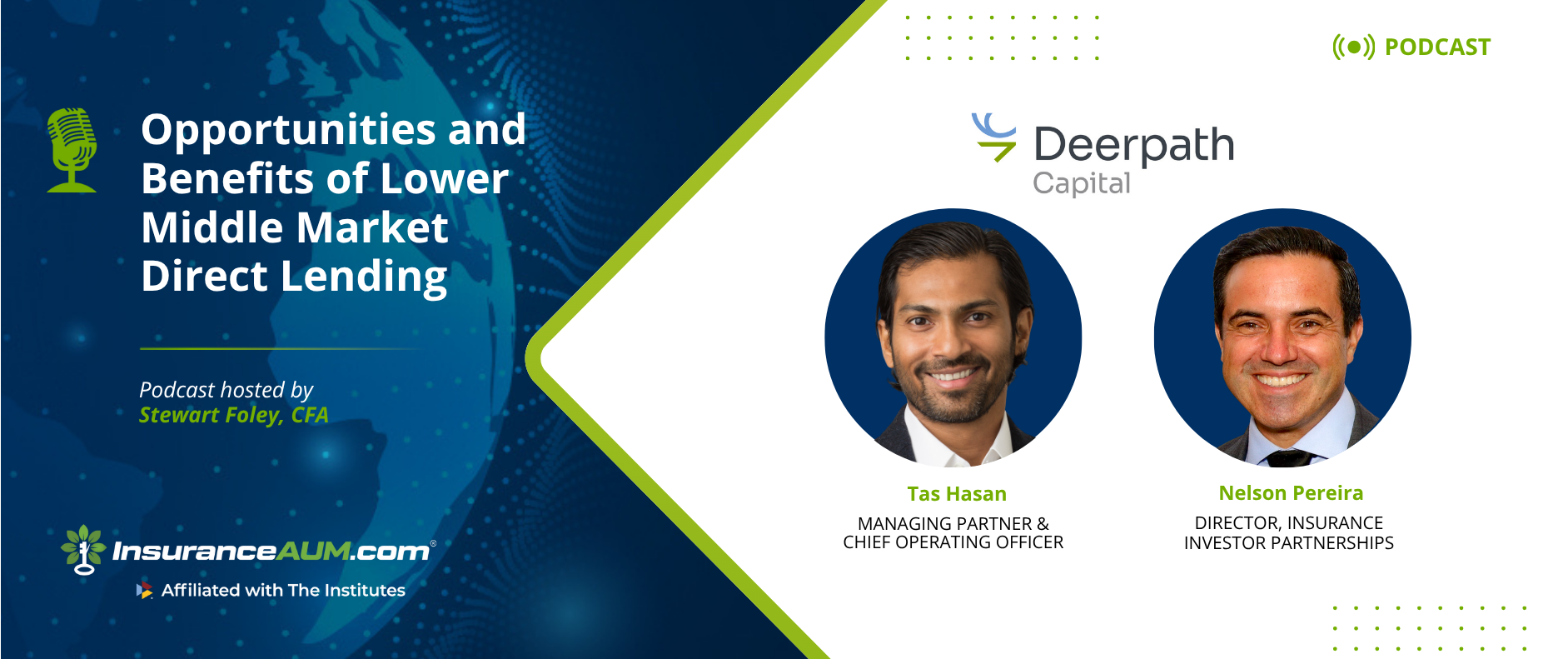
Opportunities and Benefits of Lower Middle Market Direct Lending

Image
09.09 Deerpath Capital_Web


Stewart: Hey, welcome back. It's great to have you. We've got a great podcast for you today. I want to do a little housekeeping on the front end. We've got a terrific Texas private credit and ABF event that's coming up on November 5th and 6th in beautiful Austin, Texas, at the Thompson Hotel. Registration is open for insurance investment allocators. You can find it on our events tab in the hamburger menu on our website. Just select the private credit event in Austin. We'd be thrilled to have you. We've gotten about a 75% acceptance rate on invitations, and we're hoping to have about 40 LPs. We'll have about 20 GPs, and it'll be a really nice ratio that should lead to some great conversations. Today's podcast is a good one, and it's very topical. It's called Opportunities and Benefits of Lower and Middle Market Direct Lending. And we're joined today by Tas Hasan, Managing Partner and Chief Operating Officer, and also Nelson Pereira, Director, Insurance Investor Partnerships. Gentlemen, welcome to the show. We're thrilled to have you both.

Tas: Thank you for having us.

Nelson: Thank you, Stewart. 

Stewart: Our pleasure. So we're going to start 'em off the way we always do. Tas, this goes to you: where'd you grow up? And our new question is, what was your first concert?

Tas: I grew up in a tiny country called Bangladesh, which is east of India. I don't know how much you know about it, but it's the size of Wisconsin, but has about 185 million people.

Stewart: Wow. So, get this, our audio editor, whose name is Mazed, is in Bangladesh, and he does all of our audio and video. He's been a wonderful part of our company for quite a little while. And so we have a real connection back when things were a little less stable in Bangladesh, when the government would get upset, they would cut off the internet, and we would lose him for a couple of days, and it was like “Hey, you okay?” But what was your first concert?

Tas: So my first concert was U2. I grew up a big fan of U2, and I remember saving a bunch of money and convincing my friends to come to U2 with me. I still remember it, and I have been to multiple U2 concerts. He just went on a book tour recently, and I went to see that in New York, so I'm a big U2 fan.

Stewart: Oh wow, very cool. We've had some answers that aren't quite as cool, but regardless, Nelson, we've known you for a long time. You used to be at Mercer, which is where we originally met. You're a graduate of Georgetown University's McDonough School of Business and the University of Connecticut. Where'd you grow up, Nelson, and what was your first concert?

Nelson: So I grew up in a small town in the Hudson Valley of New York, about two hours outside of New York City, called Pine Bush. And my first concert was Metallica in the early 1990s. So, a pretty good one and a memorable one to say the least.

Stewart: Oh, I can imagine. Super cool. So, Tas, let's go to you first. You hear terms in this business, and a lot of times, people are saying the same words, but they mean something different. So, how do you define lower middle market, otherwise known as LMM Direct Lending?

Tas: Sure, I think it's a good starting point. I think you will hear different definitions of lower middle market with 10 different lenders you speak with, but we believe that the lower middle market refers to senior secured loans to sponsor-backed US companies, typically valued between $100 million to $250 million of enterprise value. And that falls out in the $10-25 million EBITDA range that sits within the broader US middle market of about 200,000 plus companies generating anywhere between $10 million of revenue to a billion dollars of revenue, representing about one third of the US private GDP, employing close to 50 million people. So this market segment, what we call lower middle market, or sort of the middle market, is really the engine of our US economy. And just to add a little bit more, the banks have been retrenching from this segment for a very long time for multiple reasons, and that's what left a gap for the private credit lenders to fill, providing tailored capital where public markets aren't accessible to these companies in this size range.

Stewart: It's interesting because I kind of have, I'm a little bit on my soapbox for this, but there are folks who are like “oh my god, the insurance industry is getting into private credit.” And it's like, okay, the banks have been doing this for a long time, and you are, to your point, funding growth in this country, right? I mean, banks don't lend largely, especially not to businesses our size. And so it's a very important segment not only from a return perspective for investors, but also to grow the economy. To your point, and one of the things I kind of left out, gentlemen, and I apologize in advance, is that you're both with Deerpath Capital, so that's about the 320th podcast. I'll get it right sooner or later. So, specifically, Tas, it's back to you, specifically, where is Deerpath focused, and where do you think the opportunity in lower middle market lending exists?

Tas: Sure. So we are focused and we have been for 20 years now from our inception, we saw early that the banks are really not active in this size of the segment, but this segment is very big. It is the engine that drives our US economy. We focus on, again, $100 million to $250 million enterprise value companies in the $10-25 million EBITDA range. We think this is the sweet spot where the companies are big enough to withstand a recession with an operating history or close to 30 to 40 years. You can find quality businesses, but it's less crowded than the core and upper middle market. That's why we focus on this, I would say 50 to 250 million enterprise band deals in terms of number of deals, account for about 70% of US private equity deal volume, and about 35% of capital invested or capital deployed, leaving an attractive supply and demand imbalance for us in this segment. And that's why we focus on this, and lower middle market loans consistently have earned and still do earn a spread premium driven by sourcing and terms, not taking higher risk.

Stewart: That's super helpful. Nelson, I want to get you in here. So it would be helpful, I think, to our audience to understand your background as an investment consultant prior to joining Deerpath. Which leads me to the question, why is there an opportunity for insurance companies in the lower middle market?

Nelson: Yeah, that's a great question. So, in terms of my background, I started working with insurance companies on the investment side when I was at AON back in 2017, so almost a decade now. I've been working in the area of investments and insurance companies, in particular, alternative investments. And being at AON and being at Mercer, where I was the Investment Director for US Insurance, it really allowed me to work with a different number and different types of insurance companies, whether they are property and casualty, health insurers, or life insurers. And at the same point in time, alternatives became a bigger part of the portfolios for insurance companies and, in particular, private credit. And being at Mercer, I was not only able to work with insurance companies to really understand what their needs were, whether it was the search for yield premiums or structural protections or specific, let's say, capital-efficient vehicles.

But being on the research side and working in alternatives, I was able to get great insight into the asset management industry and understand the process of due diligence and the requirements that insurance companies have, specifically as their needs continue to grow and their appetite for private credit has grown. Now, if we think about the lower middle market, what drew me to Deerpath is that I've seen a lot of the due diligence and I've seen a lot of the mantras and from my perspective Deerpath, what they do and the track record they have since 2007, I found invaluable to insurance companies when they would potentially invest in this market segment. And that's what brought me here to Deerpath. And the last comment I'll make is that for insurance companies, they often look at the lower middle market direct lending space because it really aligns well with their investment objectives, their regulatory considerations, and their liability structures. As Tas mentioned, the core in the upper middle market is an area that has been invested in primarily for insurance companies, but they're looking to diversify the portfolios not only in terms of lower middle market, but let's say structured credit and specialty finance. So I really believe that, particularly in the next several years, the lower middle market is really a good way for them to diversify their private credit portfolios

Stewart: Tas, I want to go back to you. Can you talk a little bit about the structural advantages in US senior direct lending? And you'd mentioned sponsored versus non-sponsored, and we've covered this in other shows, but it's helpful, I think, for our audience to know what the difference is and why you're focused on sponsored versus what I believe is referred to as non-sponsored.

Tas: Sorry, there are two questions, and I'll answer them separately. The first question is the structural advantages of the US direct lending first, and I'll focus on the advantages of the US direct lending in the lower middle market, right? That's where we focus on, and I can speak of that. I've been doing that for 20 years now. I think there are significant structural advantages because these are privately negotiated transactions, so the access to information and the access to personnel are very, very different. So some of the advantages you can generate through that are spread premium and a less intermediated process, which supports stronger pricing. You've seen that over 20 years, and that exists even in this market today, which has gotten a lot more competitive, right? You can consistently see lower leverage, better cushion deals in the lower middle market, entering with a more conservative structure. That means they are more lender-friendly than borrower-friendly.

Again, supply and demand and competition drive that, right? If there are very few established institutional lenders going after the same deal in the lower middle market, then there will be less competition. And that's what's driving more conservative structures for the lenders. There are maintenance covenants. Those things are actually things of the past in the upper and core middle market and are more common in this segment, enabling better protection for the lenders and proactive portfolio management. You can solve a problem today versus waiting for the problem to be a bigger problem for you, right? And then you have agency advantage, which means that most transactions in the lower middle market are single lender agent, a high share of agented deals, giving lenders control in shaping outcomes when things go into trouble. Now, on the other side, sponsor versus non-sponsored lending, we are biased towards sponsored lending just because, in the capital structure, there is another well-funded institutional investor that is supporting the business.

And if you think about a capital structure, 50% of that, up to 50% of that, is senior loan, and the remaining 50% is actual cash equity that this well-funded institutional sponsor puts in. And in our example and our experience over the last 20 years, these sponsors do support these businesses when they go into trouble. They bring a lot of institutional knowledge, they have expertise in restructuring that expertise and operational change. I think that is extremely beneficial to have two institutional investors in the capital structure versus one. A lender is really not a private equity fund; they're not geared towards running a business operationally. So we like the sponsor-backed lending versus the unsponsored lending.

Stewart: That's super helpful. So Nelson, I'm going to get a smile on your face here. I bet you. So there's no discussion about insurance investing without some nod to the regulatory environment. I was fortunate enough to attend the national meeting in Minneapolis last month, where I saw some friends: the president-elect commissioner, Scott White, Kerry Mears, Nathan Hodak, and some other friends on the regulatory front. It continues to evolve. So how has it impacted the view of insurance companies when they're investing in private credit? You'd mentioned capital-efficient structures, but have a feeling that there's more to the story.

Nelson: There's certainly more to the story. And over the last several years, I've been monitoring closely what's happening in the NAIC. Most recently, there was the establishment principle-based bond definition, which happened earlier in 2025. And in terms of capital treatment, the NAIC insurance companies have been monitoring that very closely, particularly as it relates to private credit. And one of those aspects is mitigating equity arbitrage, per se. If we think about the evolution of capital efficient vehicles, you've had principal-protected notes, combo notes, and most recently, rated notes and CFOs. And that evolution has come out of what is a response to the NAIC. So many private debt investments, especially investment-grade senior secured loans, can receive lower capital charges compared to, let's say, public high yield bonds, and insurers benefit from better return on required capital, making private credit relatively more attractive. At the end of the day, they're focused more on statutory accounting principles and less so, let's say, on gap.

And where there's a focus on the insolvency of these insurance companies and where they invest. So that regulatory environment continues to evolve. It continues to be a part of the conversation when you're having a discussion with an LP who is investing in private credit. So it's important, really, when you think about focusing on transparency and risk monitoring, your long-dated or liquid investments in your portfolio, and then the scrutiny around the risk management of those portfolios when investing in alternative investments. The NAIC is an important part of this discussion when we're engaging with our LPs and really structuring a solution that is specific to them when they're trying to achieve their goals of their portfolio overall.

Stewart: Tas, you'd mentioned competition for deals and private credit deal flow is super important in your business, and obviously, the better established and the better your reputation in the space, the better deal flow you're going to see, right? So you've also seen more entrants in the market, particularly in the insurance space. Is there enough deal flow in the lower middle market for you to find good opportunities? Can you talk a little bit about the competition for deals and how your deal flow looks

Tas: When a market matures, competition increases. There's no question about that. If anybody says that I don't have competition, that's all right. It's just not right. So I can tell you that over the last 20 years, my competition has only increased, and I've seen that, but we still think there are plenty of transactions for established lenders with an established track record and who have been operating for 20 plus years. It's much harder for new entrants to enter the market today versus what it was 20 years back. Established lenders like us, or someone in the lower middle market like Golub, have an advantage because we've been in the market, the longevity in the market, the longevity of our sponsor relationships, our track record of doing transactions, we have an edge, there's no question about that. If you think in terms of even numbers, 70% as I mentioned, of the US private equity deal volume is in this lower middle market.

So it's a large deal volume and about 35% of capital. So, one third, more than one third of the capital deployed in the entire private equity middle market industry is in this segment. So there's plenty of transactions to do, but you need to be established, you need to have established relationships over a long period, and continued bank retrenchment ensures that private credit remains central to financing in this market segment. Because if someone tells me today that the private equity industry is going to go away and they're not going to raise any more capital, then there's trouble. But that's not happening. The private equity industry has been growing continuously for over 30 or 40 years. And if they are going to do the transactions, where are they going to get the debt from? They're going to get the debt from alternative lenders like us, who have increasingly taken market share away from the banks. So still the lenders differentiate through longevity in the market, longstanding sponsor relationships, selectivity, and agented structures rather than chasing volume and doing every single transaction, which the new entrant has to do.

Stewart: And right now, I think the economy is talked about, and we had a guest speaker at our event in Chicago, and that person drew a normal distribution, and then they drew a distribution that had fatter tails. And their point was that you have a higher likelihood of more extreme outcomes right now, but they made a point that the mean, the midpoint, is the same as one person's opinion. So what I've seen over the course of my advanced age is that when there's uncertainty, folks become a little more hesitant to deploy capital, a little more hesitant to expand their business, things like that. If there's a downturn in the economy, how is Deerpath positioned in the sponsor back lower middle market? And I don't necessarily think it's a downturn, but I do think that you could see some headwinds based on just more volatility.

Tas: Yes, I think volatility in our industry is never good for any industry. It is not good if you don't understand and don't have a good understanding of where the macro environment is heading, you don't want to invest your capital that's not new.

And that volatility will exist for a period of time, and I think that will settle in. And we've seen those kinds of volatilities before. But if you are a true senior lender, I think you should always invest with the mindset that there's a recession coming or there's a problem coming that's nothing new. That's why it's called true senior secured lending. What is that? That means you're at the top of the capital structure, you invest with conservative leverage four and a half times, that's conservative. You invest with a conservative loan-to-value. That means if you're lending $15 million and the enterprise value is a hundred million dollars, you're lending at 50% loan-to-value conservative again. And then in our case, we think having a good quality funded sponsor underneath is also an added layer of protection. So that's what underwriting, I think, for a pure place, senior lender underwriting should not change across multiple credit cycles.

What should change is the pricing we get, not your underwriting. If you do that, you'll be all right. So I think that's how we've always positioned ourselves. We are a pure place senior lender; a hundred percent of our loans are in senior secured loans, a hundred percent are floating, and a hundred percent are sponsor-backed. There's no mix in that bag of second lien mezzanine. So again, conservative structures, lower leverage, lower loan to value protect against EBITDA compression when there's uncertainty, demand pullbacks, and then that's what there's earnings contraction, things like active covenants. You should have covenants in the package that provide early warning and the ability to intervene to solve the problem today, rather than the problem being a bigger problem. And then last but not least, is sponsor support. Very important, we think.
 

Stewart: Yeah. And you mentioned the fact that you've been in this business a long time, isn't that really the proof point of your underwriting? Because if you don't have that right, I mean, you can't be in this business a long time, right?

Tas: Yes. And I'll tell you, there is no textbook in our college that taught us how to do this, right? What really happens is you learn from your experience and mistakes. The mistakes you make, you don't want to make them again, right? I think that is very, very important. So I think yes, it's lenders with 20 plus years experience have been doing it for a long time. They have a very different mindset on how to manage their businesses. They have sourcing discipline, they have long-term relationships with the sponsors, and they can pass on many transactions because they see a very large volume. They don't need to do every single transaction. They have underwriting rigor, they do lower leverage, stronger covenants, downside protections, discipline, discipline, discipline. There are three people on this call today, and each one of us has a very different risk appetite. I'll tell you that, given the opportunity for one of us to take some debt, each of us will take a very different level of debt. That's what risk tolerance is. And not every manager is created equal in portfolio management. You have to have proactive portfolio management through governance, monthly financials, and restructuring know-how, which again, comes with experience. And you can clearly see that the performance dispersion is real among the top quartile managers materially outperform over 10 years compared to managers that are newer in the market, the managers that don't have experience. So we think that experience longevity in the market is key to manager selection in this segment.

Stewart: Yeah, it's funny. As the only entrepreneur, I can assure you, my risk tolerance is multiples of, I mean, I can tell you that building this business was a harrowing experience.

Tas: I can tell you that too.

Stewart: It wasn't nothing conservative. So Nelson, can you talk a little bit about, and as well as I do, there are other folks in this space, many of them are on our platform. How does Deerpath differentiate itself from other asset managers in the insurance segment?

Nelson: Yeah, another good question. I think it's four things. I think first and foremost, it's the track record. The amount of time that Deepath Capital Management has been in this space really is something to think about when differentiating against competition. Secondly, is that in May of 2023, PGIM was just Prudential Global Investment Management and is a global investment management arm of Prudential Financial. They signed an agreement to acquire a majority interest in Deerpath Capital, which really illustrates that an insurance company such as Prudential made an investment not only in Deerpath but also in lower middle market direct lending. And that is another key proof point of where we differentiate. The third is having the talent and having the individuals, whether it's our origination team, our product specialist team, our underwriting team, or even myself sitting in the seat, having the insurance experience to have the dialogue, the necessary dialogue to speak the language of insurance companies, is part of that.

And then lastly, we take the approach of not having an investment solution, just bringing it to market. We take the approach of what we are trying to solve for the insurance company, whether it's capital efficiency, liability management, return on capital, etc. How do we customize that? So you have different types of insurers, whether it's a reinsurance company, life insurer, P&C, or health, and what are their needs? Where is it coming as a general account? Are there other types of assets that they have that they're trying to invest in to get return capital on? And then what is the appropriate structure that they should be investing in? We take the approach of, once you're an investor, how do we help you monitor that portfolio? So that's where I step in and have that dialogue about the NAIC, what is happening in the portfolio, and how it impacts them specifically. So I think it's those four key areas where Deerpath Capital Management really differentiates itself from other asset managers.

Stewart: And the last question, I kind of want to mix it together for the both of you. The question really goes to what sets a skilled direct lender apart? And the other part of it is, what areas of due diligence should insurers be looking for? I think those questions are related. If I'm a CIO today and, my friends, let me borrow the hat once in a while, how should I be looking when I'm looking for a lower middle market lender 
or making an allocation there? What am I looking for? What are the key things? And Nelson, you've done a lot of this in your time as a consultant, and I know you know this process well.

Nelson: Yeah. So I'll start. First, Tas, add additional comment. First and foremost, I want to give a shout out to David Scopelliti at Mercer, who really is someone that I respect and worked with and really helped me understand that the due diligence process and in due diligence, you should really consider four things. It's business management alignment, the strategy itself and the track record. As an insurance company, you are looking at those areas for the process of understanding if it's an investment that makes sense to portfolio, but also working with the right teams, with the GP that you're investing with at Deerpath Capital Management as an example, to really have that conversation in terms of where it falls on the balance sheet, whether it's Schedule BA or Schedule D assets, is it important to them to really think about how they're positioned in the market? And then thinking about going back to the statutory accounting principles and what's the regulatory environment, and what are they really focusing on? So is it risk-based capital? Is it capital efficiency, and how are they really thinking about it? So it's twofold in terms of you're looking at those four parts of business management, track record alignment, and the strategy itself, but also having the conversation of how it is going to impact the portfolio, what complexities are you working around to make the investment really work?

Tas: I'm going to add, and this could be much simpler, and in real estate, there are three words. Location, location, location, right? In investing, there are three words that are also for us, which are discipline. Discipline, discipline. Investing is not hard. If you have the ability to be disciplined and discipline comes over a long period of time, that means your experience, how long you've been doing this for, and that gives you the ability to be disciplined. So I come back to the point that it's the experience of a manager who's been doing this for a long time that will set themselves apart, and you will see the return burden over a long period of time.

Stewart: And it's been a tremendous education on this asset class. I mean, I really appreciate that. Our audience does too. I know the last two questions I have for you, one really speaks to the culture at Deerpath, and just for whatever it's worth, one of my former students named Michelle Greenway, is an associate there in Chicago. And you're not supposed to have favorites as a professor. But Michelle is not just a standing student. She was a two-sport athlete. She set the scoring record in both soccer and hockey. I think she broke one of those scoring records by 40 goals. I think she had 102 in one sport and 103 in the other, just to give you an idea. And in addition to that, she maintained a really good GPA, and that's all fine, and you can see that on a resume, but the question really gets into what characteristics do you find to be most important when you are adding to members of your team at Deerpath? What are you looking for? Not the school, not the hard skills, but the characteristics.

Tas: Yeah, that's a very good question. There are these intangibles of a culture that are so difficult to describe why. If you look at our retention rates, I think we have one of the highest retention rates in the industry, right? Our senior team and junior people. I think I look at it as I've started this business and I've built this, I've looked at it as: I don't want to treat anyone how I was treated, and I didn't like it. And what are those you needed to be? You need to be treated as a human being, as an adult. You need to be treated with respect, and respect comes well beyond just giving you the highest amount of dollars at the end of the year. That respect comes from giving opportunity to excel, giving opportunity to really express your ideas, and giving opportunity to spend time with friends and family. Family comes first. All of these little things not only come from me, but come from the guy who hired me 20 years back, before I even started Deerpath with him. So these intangibles, I've always heard from my partner James, that being kind and nice to people is free. It's a free currency. You have a lot of it. You can give a lot of that. But in our world, a lot of people don't use that. They use fear more than kindness. If we lead with kindness, I think we'll build a better team, and that's what we have done over a long period of time.

Stewart: Speaking of friends and family, I'll throw in Michelle's parents - Mary and Gary Greenway of Sheboygan, Wisconsin. I see you mentioned Wisconsin earlier today. So, alright, last one. You can have dinner with up to three guests. Well, that's not true for you guys. There are two of you. So you each get to choose one guest. Who would you most like to have dinner with, alive or dead? Nelson Pereira. We'll start with you.

Nelson: I would go with Jim Valvano. I'm a big college basketball fan, and he’s a leader and a person with conviction who can speak well. And I really would like to spend a dinner with Jim Valvano, who created the V Foundation.

Stewart: Very cool. I love that one. How about you, Tas?

Tas: I'm going to keep it very simple on that, and I've been asked this question recently, so I've thought about it, and I would actually spend some more time with my grandfather. I really would.

Stewart: That's cool.

Tas: I'll tell you why. As I have kids now, you notice that you really spent about 13 years with your parents' undivided attention. From 13 to 18 you are teenagers and you're just more focused on friends. And at the age of 18, you leave the hall and you're gone. I've left Bangladesh. And so if I have an opportunity, I would do anything now to sit in front of him, listen to his stories of resilience and how he rose to being a judge under the British in India back then, which was very, very difficult. So I would do.

Stewart: That's super cool. I really appreciate you both being on a great education on lower middle market lending, and thanks for taking the time.

Tas: Thank you, Stewart. Thank you, Stewart.

Stewart: We've been joined today by Tas Hasan, Managing Partner and Chief Operating Officer, and Nelson Pereira, Director, Insurance Investor Partnerships at Deerpath Capital. If you like what you hear here, please rate us, like us, and review us on Apple Podcasts, Spotify, Amazon, or wherever you listen to your favorite shows. You can also find video podcasts on our new YouTube channel at Insurance AUM community. Thanks for listening. We are the home of the world's smartest money at InsuranceAUM.com.

Share this post

Sign Up Now for Full Access to Articles and Podcasts!

Unlock full access to our vast content library by registering as an institutional investor

Register

Contacts


Deerpath Capital

Deerpath Capital is a U.S. Direct Lending manager focused on providing first lien, senior secured debt financing to U.S. companies in the lower-middle market, backed by a private equity sponsor. Since 2007, Deerpath has deployed over $12.5 billion of invested capital in more than 1,100 investments, across a diverse range of industries and transaction types. Deerpath maintains over 400 active private equity relationships, with originating professionals in deal sourcing cities across the U.S.

Antonella Napolitano   
Managing Director, Head of Investor Relations   
ANapolitano@deerpathcapital.com

646-786-1019

Nelson Pereira 
Director, Insurance Investor Partnerships 
NPereira@deerpathcapital.com

203-517-6082


View the contributor page

Image
Deerpath_Horizontal_RGB

Sign Up Now for Full Access to Articles and Podcasts!

Unlock full access to our vast content library by registering as an institutional investor .

Create an account

Already have an account ? Sign in

Ѐ Ё Ђ Ѓ Є Ѕ І Ї Ј Љ Њ Ћ Ќ Ѝ Ў Џ А Б В Г Д Е Ж З И Й К Л М Н О П Р С ΄ ΅ Ά · Έ Ή Ί Ό Ύ Ώ ΐ Α Β Γ Δ Ε Ζ Η Θ Ι Κ Λ Μ Ν Ξ Ο Π Ρ Ё Ђ Ѓ Є Ѕ І Ї Ј Љ Њ Ћ Ќ Ў Џ А Б В Г Д Е Ж З И Й К Л М Н О П Р С Т У Ф Х Ц Ч Ш Ā ā Ă ă Ą ą Ć ć Ĉ ĉ Ċ ċ Č č Ď ď Đ đ Ē ē Ĕ ĕ Ė fi fl œ æ ß