





Fidelity Investments-

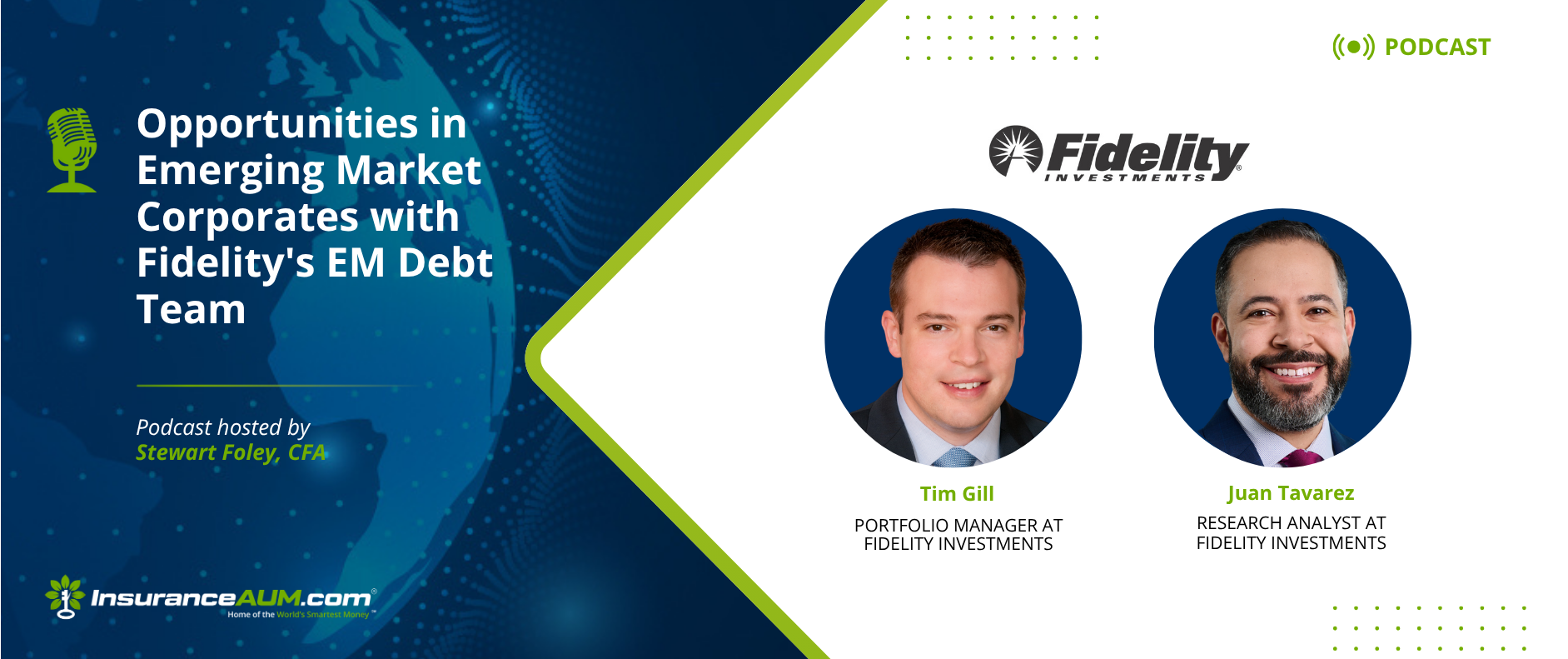
Opportunities in Emerging Market Corporates with Fidelity's EM Debt Team

Image
07.01 Fidelity_Web (1)


Stewart: Hey, welcome back. We've got a great podcast for you today. The topic is Opportunities in Emerging Market Corporates with Fidelity's EM Debt Team, and we're joined today by Tim Gill, Portfolio Manager in Fidelity's Global High Yield team, and Juan Tavarez, Research Analyst on the Emerging Market Debt team. Guys, thanks for being on. Thanks for taking the time. We're thrilled to have the opportunity to get this education today.

Juan: Thanks for having us.

Stewart: Our pleasure. These podcasts are about educating insurance investment professionals in various asset classes, and you're both very accomplished in this space, which we're thrilled about. But at the beginning, we always start out the same way: where did you grow up, and what was your first concert? That's our new question, by the way. We're trying to switch it up a little bit. So what was your first concert?

Juan: Great, Stewart. So, in terms of where I grew up, I grew up in New York, born and raised in Brooklyn. My parents are from the Dominican Republic, so growing up there was a lot of Spanish music going around. So when I was around 11 or 12, they took me to a Juan Luisa Guerra concert, which is a very prominent, well-known Dominican musician. They actually studied up here in Berkeley, in Boston, and yeah, it was a very lively concert. It ended up being one of my core memories, so it was a lot of fun.

Stewart: That's cool. Tim Gill, welcome to the show. Where'd you grow up? What was your first concert?

Tim: Thanks, Stewart. Pleasure to be here. Thanks for having us. So I'm a born and raised Vermonter. I grew up basically in Burlington Town, just outside of Burlington. Not the most cosmopolitan place on earth, but we, Vermonters, kinda like it that way. So I think around the same age as Juan, maybe 11 or 12. My first concert was in Burlington, and it was actually DJ Jazzy Jeff and the Fresh Prince. I think I'm pretty sure the opening for them was a band called Techtronic, which was pretty big. I don't know if you remember back in the eighties.

Stewart: I do.

Tim: So I remember going with my dad and one of my friends, and I'm sure it was a lot of fun, but nothing cool like Bruce Springsteen or anything like that.

Stewart: Yeah, I grew up in Imperial, Missouri, so believe me, wherever you grew up, it looks cosmopolitan to where I grew up. I remember seeing a DJ Jazzy Jeff and the Fresh Prince early on TV, whatever. It was like an eye-opening experience. So, I kind of want to start off with what makes Fidelity unique and high yield, and looking at your structure, your experience, or your process, what would you say highlights the things that set your team apart?

Tim: Sure. So just for your information, Stewart, I've been at Fidelity actually my entire career, so coming up on 25 years, years in September, which is a really long time. I think it's the longevity of Fidelity within the high-yield fixed income asset class that really sort of sets us apart from major peers in the market. I don't know if you or your listeners knew this, but Fidelity launched the first US yield mutual fund actually in the late 1970s. Fidelity launched the first retail emerging market debt fund, where some of our predecessors worked on in 1993. I think we launched the first leveraged loan fund around 2000. So Fidelity Management Research was a company we worked for that is just deeply steeped sort of in the culture, in our DNA, and in bottom-up research and bottom-up investing. When you're looking at high-yield bonds, whether they're in the US or in Turkey or Brazil, I think people feel more comfortable with PMs, with research analysts who are just deeply sort of steeped in that bottoms up and investing culture and who have been around the block, for lack of a better word, through different types of markets, different types of global macro events, and have been delivering steady, solid alpha for our shareholders for decades now.

Right before COVID, actually, Fidelity moved, with the high income team, emerging market debt included, into its own silo. So out of equity and fixed income, where we'd been at different times over the years, and into its own high income and alternative silo sort of equal with the equity and fixed income department, which I think really shows again acknowledges Fidelity's commitment to the asset class and really I think was a much better way for Fidelity to target investment specifically to the high income alternatives asset class on things like private credit, emerging market debt, US high yield, ETFs and less liquid asset classes. So the firm is well aware that it's a great growth opportunity and is investing in it as such.

Stewart: Yeah, super helpful. I mean, we've had some other folks on from Fidelity, and it seems that longevity is relatively common there. There are a lot of people who've been at Fidelity for a long time, which I think speaks volumes about the culture in the firm. It's interesting because a lot of times we use the same vocabulary, but we have different definitions for things. So what would be helpful is if we could get a hula hoop thrown around how you define your opportunity set. How do you define or how do you think about sector, geography, rating band,s and liquidity when you're building your portfolios?

Tim: Sure, absolutely. I mean, the thing about US high yield, US corporates is that it's pretty easy to define the opportunity set, right? US credit it's not investment grade rated. It's a little more nebulous when we talk about emerging markets or developing countries; there's no necessarily agreed-upon definition of what an emerging market is and what a developed economy is. Generally speaking, clearly there are more emerging markets than developed markets, and we invest in 75+ countries around the world in sovereign bonds as well as corporate bonds, which we're here to talk more about today. Emerging markets are developing economies, typically have a few things in common. Usually high growth rates, economic growth rates. Usually growing positive demographics, so populations that are young and growing, as in the developed world, tend to be more aged and dwindling populations. And they're developing markets, particularly because finance, insurance, we know what you're familiar with, pensions, the sort of finance nuts and bolts of those markets are not anywhere near as developed as they are here in the US.

So, without a sort of deep domestic base to sort of raise financing, a lot of these sovereigns and corporates go to our market, which is the international dollar-denominated market, to raise financing. So we're talking about investing in high yield and investment grade sovereigns and corporates around the world, like I said, 75, 80 plus countries, and specifically corporates within those countries. So places like Turkey, Brazil, South Africa, Mexico, et cetera, and all of that, or most of that, is done in US dollar terms, but similarly to high yield, we have very similar sectors. So it's energy, it's banking, it's telecom, it's retail, consumer, et cetera. So very similar to the US high-yield market, although just broader in its scope in terms of countries and jurisdictions.

Stewart: That's super helpful. I want to get you in here. So when you think about the companies, right, differentiating between high yield and investment grade, is that just about the balance sheet, or are there structural or behavioral differences between that insurance investors ought to understand?

Juan: No, it's a great question, right? Because I think as we dig into all these countries, like Tim mentioned, we need to differentiate between what's really quality, what's opportunity. So when I tend to think about IG credits, you know what you're getting, right? You know what you're getting with an IG credit stability, it's a proven track record. I put an analogy to it, it's kind of like you're buying a castle, that it's fortified, it has a moat, it has a drawbridge, that's actually working. And in high yield, when we look specifically in EM, I would say you're looking for a combination of work in progress and potentially some hidden castles. So when you're thinking about the work in progress, what we tend to look for are these companies that have a blueprint, have a vision where they're looking to create value, and I guess the analogy in construction would be they're looking to build a skyscraper, but in the current moment they're still scaffolding everywhere, sparks flying, people arguing where they should put the elevator in that concept.

But if the vision holds, if the team delivers, you might be looking at the next Empire State Building. So those are the type of high-yield-ish work in progress that we're looking for on the bottom up. And then the hidden castles, which I've mentioned to Tim in the past, are kind of like your Prius with an F1 engine, where these are names that are starting to deliver kind of almost investment-grade quality metrics. So they kind of fall in the rising star category, or they have cash flows that have less risk tied to them relative to where they're rated. So these are some EM names that have a lot of developed market exposure, but they're being categorized, and you're getting yield because of where their headquarters are. So it's like looking for a mix of this. So we kind of try to dig into the nuts and bolts of these companies, these corporates, and try to differentiate what's a work in progress that we kind of think we can partner with the management teams, with the families. There's a lot of family ownership in emerging markets to see this vision progress, or which are names that just haven't been recognized by the market, that have already delivered, that are these hidden castles, these hidden gems in the region.

Stewart: Yeah, that's super helpful. And the thing that I guess I ask is, will a country-level view ever keep you out of a market? The investment side of that is how do macro considerations or political risk factors come into your credit decisions?

Tim: Yeah, absolutely, Stewart, and I was just going to add that to what Juan had said. I think you can answer it in two ways and other people who look at EM corporates probably do this similarly, but one thing I think point out to your listeners, like I mentioned, we started an emerging market debt product here and built a team out in 1993, and the major focus of what we do is actually sovereign investing, but you need that base of sovereign macro understanding on a country level basis around the world in all these markets to do EM corporate investing. I really don't believe you can do the EM corporate investing without having a team in-house, same part of the same team, who sort of understands macro in country X, Y, or Z. So if you're looking at a bank or a washing machine producer in Turkey, it's hard to have a view on the value of that investment or what the total return might be, what the risk might be without having a good view on sort of what's macro, what's happening in Turkey.

So those things here for us go hand in hand. Our sovereign research team works very closely with me and with Juan as we build portfolios of EM corporates. Absolutely, we will stay out of a market if we don't like the country-level macro. This has definitely happened many times over the years in places like Turkey, whereas up until two or three years ago, the macro was very unorthodox and very sort of not friendly for the local business environment. In Brazil, around the time of the carwash scandal and the impeachments there when there was a lot of the Odebretch scandal and the fraud and those kind of things happening. We'd avoided Brazil during periods where there have been sovereign defaults. In Argentina over the years, the economic policy is just sort of not there and not positive enough for the corporate sector, so we've stayed out of that market. And probably the biggest one was China, as sort of a headline over the last few years. Sure, your listeners are well aware of the default spike in China, the corporate defaults across the property sector. That was a sector that we had completely avoided and had zero exposure in just because of our sector view and our macro view of China. So it's extremely important to know how we built corporate portfolios.

Stewart: That's super helpful. It's a great background. It does make sense to me that having that sovereign understanding is the underpinning, right? It's sort of, I want to say table stakes, but I could see how it's very important. And back to Juan, I mean, workouts and restructurings tend to come with a territory in non-IG. Is there a playbook or a set of principles that guide you when a credit becomes distressed?

Juan: Yeah, I guess firstly just keeping hope alive because we are entering when you begin the approach of looking at a workout. I guess the key thing for us, really, is active engagement. I think passive investing doesn't really work well in an environment where there's a lot of workouts. So you need to be involved, you need to understand legal jurisdictions, you need to coordinate with ad hoc groups and bondholders that have been in the market and that we have relationships with. Understand the corporate strategy and what's the goal post-restructuring from these corporates that we're looking at. I think thankfully for us here at Fidelity, we do have dedicated trained lawyers that work within our team here in high income that help us in this process of engaging with the management teams, with the ad hoc bondholder groups. And I like to look at it in three layers when we're considering how we approach this. First, we have to look at what type of legal leverage we have.

Is this jurisdiction New York law, where there tends to be better recovery? Well, is there any security that we can lean on in terms of tools that we can negotiate? Is there an opportunity just to stay with this company and not have to go into a courtroom and try to reorganize the debt and say, look, we can amend and extend, which we have some examples of that that we've seen over the last recent in a year, there was a Peruvian mining company called Vocon, which really they had two big pieces of debt. They had a syndicated loan of around $500 million of bank debt, and then they had the dollar bond, that was due in 2026. And they faced a bit of a headwind, a bit of a liquidity crunch with that loan coming due. And we got into a room, we had discussions, and we were able to just amend and extend.

We got an extra pickup in the coupon, we were able to upsize a little bit the security package. So in that discussion of what can we get and what can we partner with, we try to look at all those different levels of where's the best return and recovery we can get for our clients in this environment? And is this a company that we believe in enough that we can partner to figure out a solution we both can benefit from. Where we allow them to progress in their strategy, and when we're also getting something out of here of being along for the ride, let's call it.

Stewart: It makes total sense. Can you talk a little bit about bottom-up credit analysis? It seems to me that EM, and there are other markets too, but there's just not a substitute for rolling your sleeves up, right? Can you talk a little bit about your bottom-up credit analysis approach?

Juan: Yeah, yeah, sure. And I guess it's merging it with some of the points that Tim made in terms of the top-down. So, we kind of have this layer and this partnership with our sovereign analysts here of what is the top-down, what's happening in the countries, because we can't really look at these countries agnostically when we're looking at these business models. So the way I tend to approach it is, first, when I look at a company, I look at the quality of the asset. What is a competitive advantage? What's the return profile of this business model, and get it some type of conviction there that there is quality and there's an asset here that makes sense. And then I look at where we are in the business cycle, where are we at the bottom of the cycle? Are we expanding here to the peak of the cycle?

And then within that, once I have a view of what's the quality of this asset, where are we in the cycle? I think that's where we merge the corporate governance and top-down. Is who's running this business at this point in the cycle, at this level of quality that they have? And they're merging it with politics on the top down because in EM, as Tim was mentioning, politics is fundamental. Any political developments often drive creditworthiness, and more than what traditional financial metrics can give you insight into. So I think once we have that understanding, kicking the tires of the asset, understanding where are we in the cycle? And here we really partner a lot with our global team as well. We have a strong equity franchise here. We have people on the loan side who have been engaged with a lot of these companies for different episodes of their own cycle and development cycle that we're able to share meetings and get understanding and kick the tires together and learn and leverage that insight as we look at this bottom-up credit analysis.

So to put it in a nutshell, I think for me it's really what's the quality of the asset? Where are we in the business cycle? What's the corporate governance and top-down layer of that? And then it comes down to valuations. What's being priced in right now and looking for that sweet spot in the capital structure is where can we extract that value? Where can we see that opportunity? And it's a brick-by-brick type of build-out. We're building these portfolios kind of brick by brick, looking for premium yield and trying to also test where in EM there is headline risk, there will be bad news that comes in. So it's trying to figure out, has the bad news been priced in? Are we coming in at the right time trying to look for those roses in the concrete in terms of what's been priced in? And if in the cases where these bonds that have bad news priced in and that doesn't materialize, this is when you can get some equity-like returns. So that's how we try to dig in and peel back the layers of these corporates within emerging markets, kicking the tires and understanding also how it connects with the top down.

Stewart: Yeah, it's great. And I guess back to you, Tim, really talking about holding periods, right? How do you think about holding periods for the investment ideas that you're generating here? I think it's important for insurance companies because they have a varied set of liabilities depending on the lines they write. I think there's a commonality there.

Tim: Yeah, absolutely. So I mean, we're only long-term investors here at Fidelity. Our holding periods tend to be quite long. Our portfolio turnover is very low, probably something around 25% annually, which is quite low. So we are for the companies a great source of assets. We are long-term, long-focused, low-turnover, bottom-up focused investors. That being said, just to build on something that wants it, I mean it's emerging markets. Sometimes unexpected things can happen. They might be geopolitical, they might be domestic, political events, could be global macro, and just something that's impacting the sector or the cycle for a particular company. We have an institutionalized research process. We have analysts who put ratings on corporate bonds, who have an investment thesis, who have a handful of things that they're watching in terms of risks, in terms of things that could go right, things that could go wrong. So it's a very dynamic process in terms of doing the research and staying on top of the story constantly. But low-turnover, long-term investors. When things change, when the story changes, we change our positioning, but we tend to be very low-turnover, long-term buy-and-hold investors.

Stewart: And I want to go back on this, there have been some relatively highly publicized challenges in EM. I think that insurers have elephant-like memories, and they think back, oh, this happened, and that was negative, and whatever. And that sometimes I think impacts their investment decisions in ways that might not be a hundred percent current. So, can you talk a little bit about what has happened lately, and has that had an impact on opportunities?

Tim: Yeah, no, absolutely. It's a great question. I think it's funny because we talk about high-yield investing always, clearly by definition, has more risk than investing in investment grade. We all know that emerging markets, as you've alluded to, and I know you've alluded to in other podcasts, they make people a little nervous. But that's the beauty of what we do because sometimes the whole market can sort of be tainted with a view that this is really risky. When really, when you get in there, like you said, and roll your sleeves up and start doing the bottoms up work, you can find these opportunities that, I don't know if Juan created this term or if he used it earlier, but it's this DM in EM, we call it. So, developed market quality type issuers within EM. I always think about it as real estate and buying a home with a little twist.

You might want the cheapest house in the nicest neighborhood when you're looking for a house, In EM, the neighborhood might not be so good, but you can find some really good quality houses. And if you picked a company out of Turkey or a company out of Mexico and plopped it in Germany, it would be investment grade just based on its balance sheet and its cashflow generation, et cetera. So it is this added spread that the market requires and investors require for EM that really is the long-term value proposition. When you look at EM relative to US high yield, the long-term default rates are pretty similar. You get paid a little bit more spread to be an EM because of some of these country-level risks, some of the geopolitical risks, et cetera. So that's really what gives EMits value. And we find many opportunities within a risky asset class that have onset DM cash flows, really strong balance sheet, really strong free cashflow generation, that are trading their spreads that are not commensurate with the default risk.

That's really the long-term value proposition for EM. More directly to your point, we've had the Russia-Ukraine war, we've had the China property fallout, and at a lot of defaults in the China corporate sector, we've had a lot of sovereign defaults coming out of the COVID period. So, default rates in EM historically, they can go for long, long periods of time being very low. And then sometimes you have these spikes. So we've more recently gone through a spike and quite frankly, even though it was driven a little bit more by the China property sector, those tend to be the periods after the default rate picks up where you kind of find your best medium-term investment opportunities. So I think over the last maybe 12, 18 months or so, that's been a bit of a period where we've been in.

Stewart: Yeah, it's interesting. We had somebody on recently who talked about when you start thinking about passive or indexed investing in some of these markets, it's like it's not the same as indexing something else. You need this bottom-up bond picker mentality. It's important to have that, and that active management really, really matters in a market like this. I don't want to put words in your mouth, but I think that you're kind of making that point all the way around. Does that hold up?

Tim: Absolutely. Yeah. All of our funds at Fidelity are benchmarked. We are benchmark investors, but the benchmark is a guide. It's there to help us, but it is not by any means a rule. And I think you hit the nail right on the head. I mean, the index composition is what it is, whether it's JP Morgan or Bank of America that puts it together. And it's not always necessarily that passively you're going to get into something that's maybe super risky that you didn't think you wanted to own. It can be the opposite, too. It can be a company that's pretty good, but it's just fully valued, and there's no value there. So there's kind of no point owning it because why do you want to own something in China that trades at a really low yield or low spread, where there might be geopolitical risk?

You want to make sure you're avoiding the blow-ups always in EM. That's kind of our rule of thumb and has been for 30 years. But also, you just really need to understand relative value and top-down country risk. And sometimes, exactly to your point, the index can lead you to names where you don't want to be, either because spreads are too tight and it's too high quality, and there are better opportunities elsewhere. Or the risk is maybe just being underpriced. So rolling up your sleeves and the bottoms up to work in EM is absolutely essential.

Juan: Maybe just to add, sorry, just on that point, I think one of the impacts that we've seen off of a lot of the recent turmoil, let's call it in EM and COVID as the most recent example in terms of how deeply it did impact the region, is a lot of these corporates have come out of it with much stronger balance sheets and better prepared. So it is almost like they didn't waste the crisis. So that's what we look at when we're trying to look through these companies, is who learns, who has repositioned themselves coming out of these events that clearly have given them more longevity for the execution of their strategy. So I think that's another thing that we've seen. Yes, we've seen a lot of hurt come through the markets, but there's actually been some silver linings in terms of seeing really strong companies emerge and being well-prepared for any upcoming events that inevitably will occur. We just never know which side it's going to hit us from. But yeah, so that's been a kind of positive silver lining. Looking at the bottom up here, some corporates have emerged with really strong balance sheets to endure.

Stewart: That's super helpful. And those insights are valuable from folks who might not be in this market every day of the week like you both are. So this is the part of the show where we ask you to dust off the crystal ball. There's a lot of winds of change blowing across the globe. Where are you seeing opportunities? And I guess I would just start with Juan, and then we can go to Tim, the implications for regions, countries, and sectors. Are there things that you're favoring? And then I think maybe as importantly, where are you cautious?

Juan: Yeah, sure. So I guess again, coming from the bottom up approach, I think the interesting thing of also looking at things bottom up, which is my day-to-day as a nerd on here, how am I going to say any of you guys are? But I like to just shut the door, dig into these documents, and try to figure out where there's value. And when I'm doing that, I notice that even if we are negative, let's call it in a country specifically, we can take Brazil as an example, if we have some caution there, we can still find opportunities to be positioned because the sectors are so diverse, you still have pockets of the economy that will do well. And that's kind of how I'm approaching things right now is valuations aren't extremely attractive across the realm, but there are still opportunities. And I try to think about things as these compounder companies that are consistently generating cash flows.

They have strong competitive advantages. So I am favoring some of these clearly focused in cashflow generating companies. One example is there's a Pepsi Bottler, right in Guatemala. It's a solid company. They've been executing their strategy, they're looking at M&A opportunities and they're generating cash. I think that's a good place to have exposure to when you're uncertain about the next wave in this tariff world or what's going to happen. But then there are these transformation stories that we kind of touched on, where there's change happening either operationally, strategically, financially, or governance-related. We can see an inflection on the horizon, and I think there are a couple of cases also in SEMEA. Ashley just came back from a trip to Turkey. We're literally kicking the tires in some of these companies and trying to see where the value is. The tides are still choppy, let's call it in the region with all the geopolitical events, but there's value there. So we're looking at opportunities there as well to be able to participate to the eventual recovery in those economies. So being very selective, I think. So it's definitely a security selection type of environment right now versus just a big beta trade, for example. But there are opportunities, in my view, in terms of some pockets in Latin America and in SEMEA.

Stewart: That's awesome. Tim, how about you?

Tim: Yeah, I would just reiterate again, the beauty of what we do in the markets that we look at is that there are a lot of countries and many sectors, and many issuers. So the beauty with EM is if you're just looking at us or you're just looking at European high yield, there's more opportunity to find idiosyncratic situations or things that can be good diversifiers within a portfolio context. Well, like I said, 75, 85 countries, there's going to be something good happening somewhere. There can't be everything bad everywhere all the time. So over the years, we've always sort of been able to find those opportunities. I think we have to be honest with the volatility that we've seen now, particularly coming based on US trade policy, clearly globalization and global trade have been a tailwind for EM for decades. So we have to sort of take seriously risks that might be starting to head back in the other direction.

And we've seen that start to materialize clearly in 2025 so far. But to Juan's point, if we look at something like Brazil, one of the things that's coming out of this is that the dollar is starting to weaken a little bit because of what's happening on the trade side. So that's a definite tailwind, I think, for EM, right? So, EM and globally, there have been issues with inflation in the US and in developed markets, but also EM coming out of COVID with the supply shocks. So stronger currencies in Brazil, in South Africa, in Indonesia, wherever, help those countries a lot on the inflation side, potentially allowing them to cut rates like the Fed is starting to do and support their domestic markets more so, country like Brazil that Juan was talking about, where interest rates are very high north of 15% at the moment, once they get the scope to start cutting rates and maybe generate some more domestic economic growth.

What does that mean? Maybe that means instead of taking exposure to a pulp exporter, we want to look at a local rent-a-car company or a local consumer because the outlook for that sector might be better. So just take that example of Brazil and multiply it by sort of dozens of countries where these things are happening. There's always an opportunity, or relative value trade, or something to look at. And again, when we've got the ability to sort of go away from the index and take active credit bets, we're finding plenty of opportunity, even though the sort of global macro has been a little bit choppy, there's always going to be some corporates in EM that are going to benefit.

Stewart: Yeah, it's super helpful. I've got a great education today on emerging market data. I want to thank you both. We've got a couple of fun ones for you on the way out the door. One really speaks to the culture of Fidelity, Tim and Juan, and it really goes like this. What characteristics are you looking for when you're adding to members of your team there? Not the school they went to, not the hard skills, but what characteristics do you find most valuable?

Tim: Yeah, I would say to me that's an easy one, and it's intellectual honesty. I think we always have to sort of acknowledge what we don't know. And to the point I was making before, we're never going to be smarter than the market. We're never going to know everything that there is to know, and we're never going to get a hundred percent of our calls, and we are long-term investors. But like I said, when the story changes, we need to change our positioning. So I think the analysts that I've worked with over the years who are intellectually honest and don't take their calls so personally and get so vested in the call that you have sort of blinders on to what might be happening that you might be ignoring because you're so focused on your view. So it's just being intellectually honest and admitting that sometimes you got something wrong and you need to cut a position and move on because the worst thing to do in our market is to ride something down and continue to fight it and end up with something with a really poor recovery. So to me it's that's intellectual honesty.

Stewart: Juan, do you want to add anything there?

Juan: Yeah, no, and I would add just curiosity. I think that that's all goes hand in hand in terms of figuring things out, trying to discover, well, what's changed, what's a new piece of information that I can figure out and find? I think that's what keeps us active and finding things in emerging markets. It's a very dynamic environment here, very different drivers to value and risks that you have to be digging and curious on why is that happening? Why is it not happening as well? So that curiosity I think is important to have as a trait to dig into. For sure

Stewart: Good stuff. So we've got to wrap quick here. We're kind of at the end of our allotted time, but Tim and Juan, you can each have one guest to a dinner that is a little bit of a fictional dinner in that your guest can be alive or dead. You each get one start with you. Juan, who would you most like to have dinner with, alive or dead?

Juan: Oh, I'll probably pick Michael Jordan. Even though I'm a Knicks fan, I would pick Michael Jordan just because he's seen a lot of ups and downs and seen a lot of high-pressure environments, and just to pick his brain on building teams and how he's navigated all that pressure as well. And having started where he started and ended up where he is, it'll be super interesting just to dig into his whole life.

Stewart: It's interesting because everybody knows him for basketball, but he is right now a team owner in NASCAR. He has a very successful team called 23XI. He's partnered with a driver named Jenny Hamlin, and the two of them own, I have a multi-car team in NASCAR, so he's still actively involved, so very cool. Michael  Jordan. Juan and Tim and who's the fourth, Tim?

Tim: Think going to keep it in the sports room myself. I was thinking Diego Maradona. My family and I are big soccer fans. Obviously, my wife is British, so she's still her family snicker when I call it soccer and not football, but it's pretty incredible. So he passed away and hadn't played football obviously in a long time, but when you're in Buenos Aires and there's still huge billboards and stuff with him on the side of the highway, obviously one of the greatest soccer players of all time, obviously at a little emerging market angle too, with being in Argentina. And it'd be cool to pick his brain about how he grew up and what Argentina was like back then. So that would be a fun dinner, I think with him and MJ.

Stewart: Very cool. Thanks for being on. We've been joined today by Tim Gill, Portfolio Manager, and Juan Tavarez, Research Analyst in Fidelity's High Income and Alternatives Division. Guys, thanks for being on. We've got a great education today. Appreciate your time.

Juan: Thank you, Stewart.

Stewart: And if you have ideas for podcasts, please shoot me a note. It's stewart@insuranceaum.com. Please rate us, like us, and review us on Apple Podcast, Spotify, or our brand new YouTube channel, where you can find us at InsuranceAUM community. We are the home of the world's smartest money at InsuranceAUM.com.

Information provided in the program is for informational, educational purposes only. To the extent any investment information is deemed to be a recommendation, it is not meant to be impartial investment advice, or advice in a fiduciary capacity, and is not intended to be used as a primary basis for you or your clients’ investment decisions. 
Fidelity and its representatives may have a conflict of interest in the products or services mentioned in this material, because they have a financial interest in them and receive compensation directly or indirectly in connection with the management, distribution, and/or servicing of these products or services, including Fidelity funds, certain third-party funds and products, and certain investment services. 

Views expressed are as of the day of the recording, based on the information available at that time, and may be changed based on market or other conditions. Unless otherwise noted, the opinions provided are those of the speakers, and not necessarily those of Fidelity Investments or its affiliates. 

Alternative investments are investment products other than the traditional investments of stocks, bond, mutual funds, or ETFs. Examples of alternative investments are limited partnerships, limited liability companies, hedge funds, private equity, private debt, commodities, real estate, and promissory notes. Some of the risks associated with alternative investments are: Alternative investments maybe relatively illiquid. It may be difficult to determine the current market value of the asset. There may be limited historical risk and return data. A high degree of investment analysis maybe required before buying. Costs of purchase and sale may be relatively high. 

Fidelity does not assume any duty to update any of the information. Fidelity Investments is a client of InsuranceAUM, and is an independent company, unaffiliated with Fidelity Investments. Its business models, needs, and results may not reflect the experience of other Fidelity clients. 

Third-party trademarks and service marks are the property of their respective owners. All other trademarks and service marks are the property of FMR LLC or its affiliates. All other trademarks and service marks are the property of FMR LLC, or its affiliated companies. 

Fidelity Investments provides investment products through Fidelity Distributors Company LLC; clearing, custody, or other brokerage services through National Financial Services LLC or Fidelity Brokerage Services LLC, members NYSE, SIPC; and institutional advisory services through Fidelity Institutional Wealth Advisor LLC, copyright 2024 FMR LLC, all rights reserved, 
1213458.1.0
 

Share this post

Sign Up Now for Full Access to Articles and Podcasts!

Unlock full access to our vast content library by registering as an institutional investor

Register

Contacts


Fidelity Investments

Fidelity Institutional offers investment insights, strategies, and solutions as well as trading and prime brokerage services, to a wide range of wealth management firms, asset managers, and institutional investors. Fidelity’s mission is to strengthen the financial well-being of our customers and deliver better outcomes for the clients and businesses we serve. With an AUA of $15.1 trillion, including discretionary assets of $5.9 trillion as of December 31, 2024, we focus on meeting the unique needs of a diverse set of customers. Privately held nearly 80 years, Fidelity employs 77,000+ associates who are focused on the long-term success of our customers.

William Johnson     
Head of Institutional Large Market Sales     
William.R.Johnson@fmr.com     
773-454-4100

900 Salem Street 
Smithfield, RI 02917


View the contributor page

Sign Up Now for Full Access to Articles and Podcasts!

Unlock full access to our vast content library by registering as an institutional investor .

Create an account

Already have an account ? Sign in

Ѐ Ё Ђ Ѓ Є Ѕ І Ї Ј Љ Њ Ћ Ќ Ѝ Ў Џ А Б В Г Д Е Ж З И Й К Л М Н О П Р С ΄ ΅ Ά · Έ Ή Ί Ό Ύ Ώ ΐ Α Β Γ Δ Ε Ζ Η Θ Ι Κ Λ Μ Ν Ξ Ο Π Ρ Ё Ђ Ѓ Є Ѕ І Ї Ј Љ Њ Ћ Ќ Ў Џ А Б В Г Д Е Ж З И Й К Л М Н О П Р С Т У Ф Х Ц Ч Ш Ā ā Ă ă Ą ą Ć ć Ĉ ĉ Ċ ċ Č č Ď ď Đ đ Ē ē Ĕ ĕ Ė fi fl œ æ ß