


Pioneer Investments -

Pioneer Investments 2026 US Economic Outlook

PioneerFeatured

Paresh Upadhyaya - SVP, Director of Fixed Income and Currency Strategies


Executive Summary

  • Market underestimates growth potential
  • We expect the Fed to pause later this year, perhaps sooner than expected
  • Light legislative calendar with Midterm election focus
  • Republicans face uphill task to hold on to the House
  • Broad based opportunity in financial markets for 2026 with selective caution

The Great Moderation and What Comes Next

After a four-year sprint of robust expansion, the US economy finally downshifted in 2025, settling into its natural cruising speed of 2.0% growth. The slowdown wasn't a surprise as it reflected a predictable cooling in consumer spending and a sharp pullback in government consumption. Yet amid this broader deceleration, one segment continued to defy gravity: fixed investment, powered overwhelmingly by the relentless surge in AI-related capital expenditure.

Looking toward 2026, the consensus view anticipates more of the same — another year of 2.0% growth, a kind of economic equilibrium. This backdrop sets the stage for the Federal Reserve to pause its easing cycle, having guided monetary policy to what it broadly considers to be in neutral territory. In this Goldilocks stance — neither too hot nor too cold — policy could neither accelerate nor constrain activity, while keeping inflation relatively in check…even if above the Fed's 2.0% target. We believe the consensus view of a steady state growth outlook may prove too conservative, as several factors are in place that could push growth beyond expectations.

Economic Outlook: Growth Risks Skewed to the Upside

  • Market underestimates growth potential: Current 30% recession probability appears elevated given three powerful tailwinds supporting economic expansion through 2026.
    • Fiscal stimulus provides significant boost: The One Big Beautiful Bill Act (OBBBA) is projected to add 0.5-0.75% to GDP growth in each of the first three quarters of 2026, benefiting both consumers (record $344bn annualized tax refunds in Q1, roughly $1,000 more per refund) and businesses ($200bn tax cut through equipment expensing, R&D credits and manufacturing incentives).
    • Accommodative conditions amplify momentum: Easier monetary policy, AI deployment, deregulation, and wealth effects from elevated equity and housing prices could contribute an additional 0.5% growth impulse in H1 2026, particularly supporting upper-income consumption.
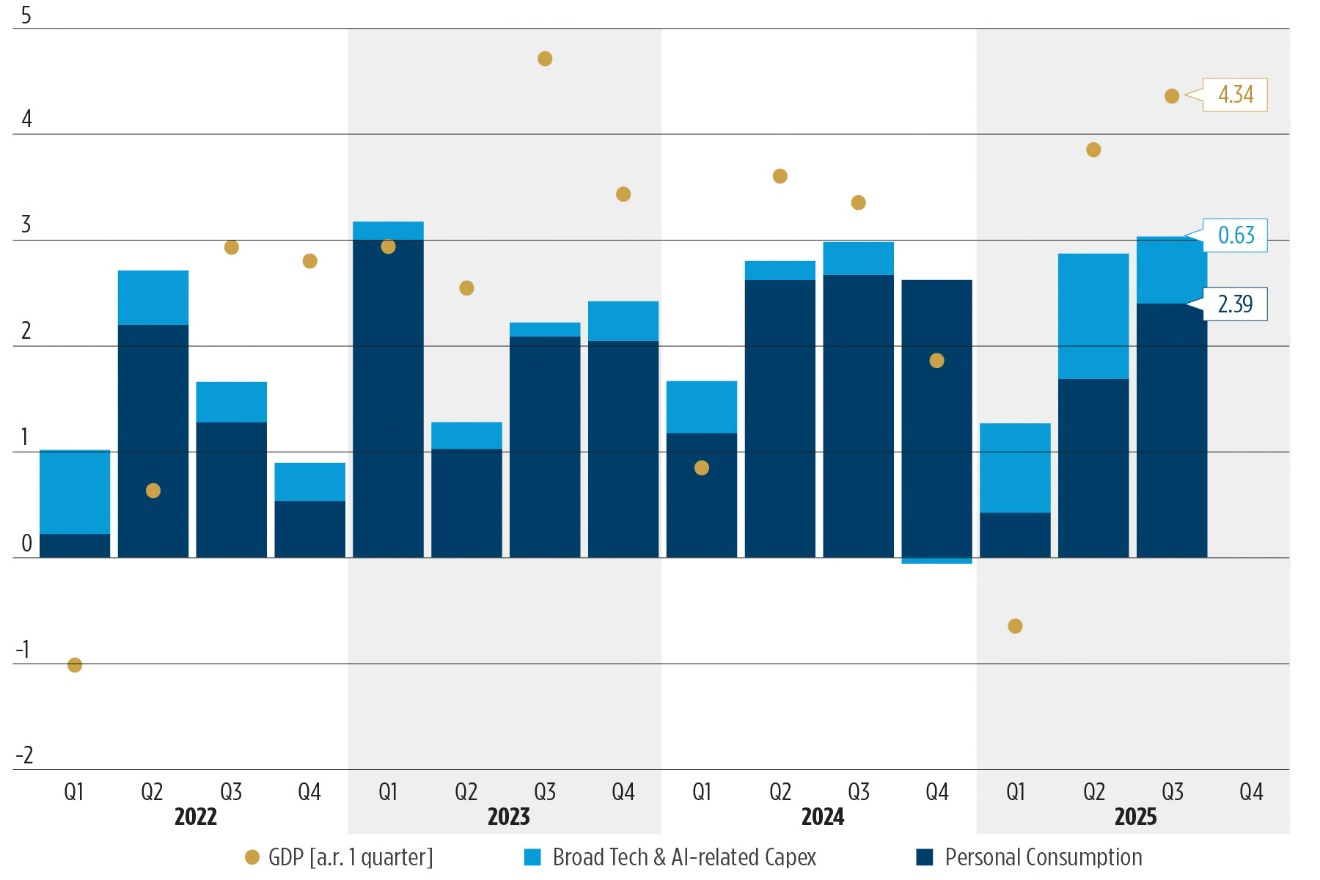
    • AI investment remains a structural growth driver: Fixed investment, especially AI-related capex, continues as a primary growth source with equity analysts projecting acceleration from ~$443bn (2025) to ~$600bn (2026). AI contributed a remarkable 63% of total growth in H1 2025, versus a 0.4% quarterly average since 2015 (Chart 1).
  • Key risks are bi-directional: On the upside, further asset market rallies would provide additional growth impulse beyond base case. The downside? Material asset price corrections could undermine wealth-effect-driven consumption.
  • Investment implications: Favorable outlook supports risk asset performance, particularly if growth surprises exceed consensus expectations.
     
Chart 1: AI and Personal Consumption Contribution to GDP
Image
Bar chart compating AI with GDP

Source: Macrobond as of December 31, 2025
 

Monetary Policy Outlook: Hawkish Pause More Likely than Consensus Expects

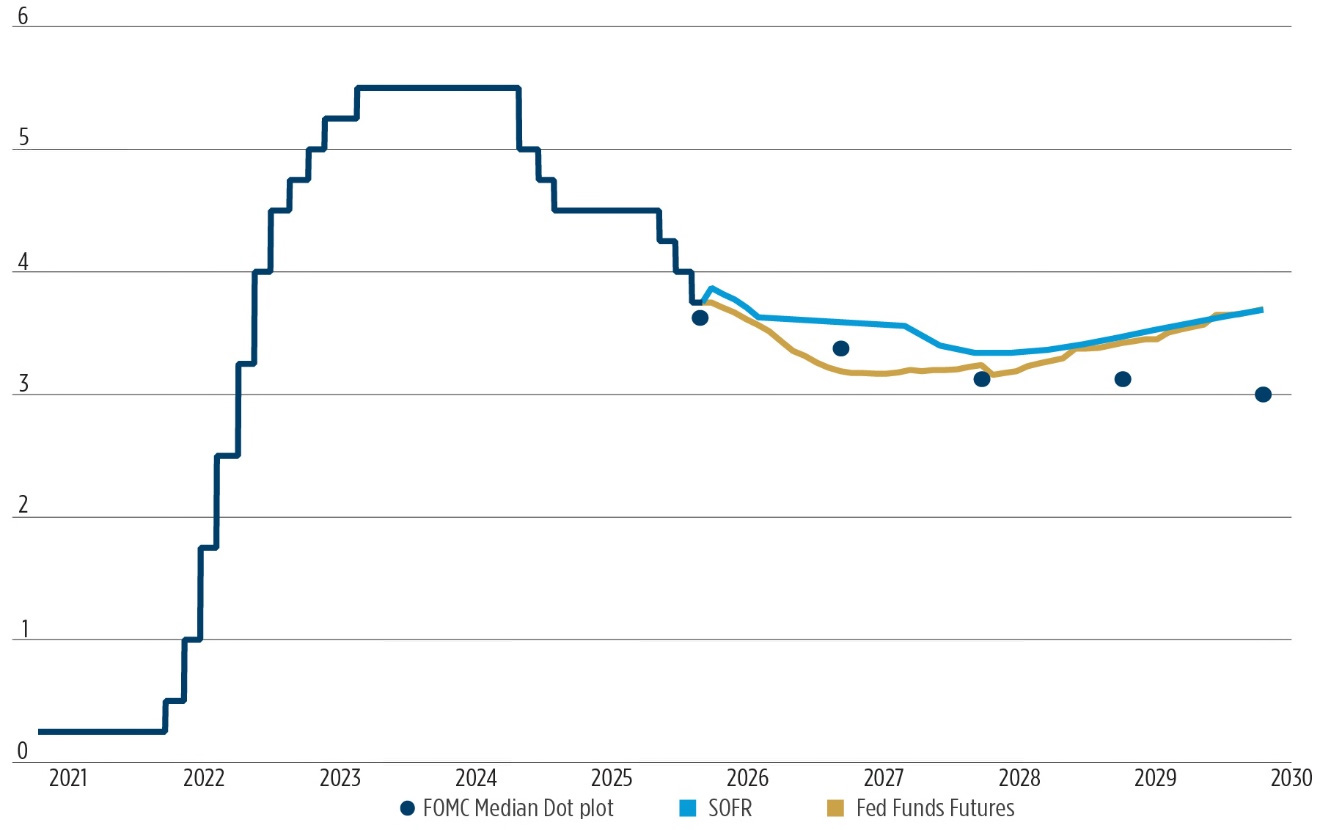
  • Consensus anticipates two rate cuts to 3.00% by Q3 2026: We see risks skewed toward a hawkish hold in Q1
    as labor market concerns fade while inflation worries persist with inflation lingering above the Fed's 2% target (Chart
    2).
  • Fed independence concerns appear overblown: Even a dovish Chair commands only one vote and must build
    coalition support for rate cuts; structural decision-making dynamics limit unilateral policy shifts.
  • Inflation remains sticky through 2026: While tariff effects may recede as the year progresses, solid economic
    activity will keep service prices elevated above the Fed's inflation target, constraining the central bank's ability to
    ease aggressively.
  • Policy downside risk: A sharp labor market deterioration or unexpected inflation collapse would prompt more
    aggressive easing than anticipated in our base case.
  • Investment implications favor risk assets: With the policy setting no longer restrictive, the backdrop provides
    supportive conditions for equities and other risk-sensitive investments without adding meaningful headwinds.
     
Chart 2: Market Rate Expectations and Fed Dots
Image
Graph showing market rate expectations

Source: CME Group, Fed, New York Fed. Actual data is through December 31, 2025. All other data is estimated.
 

US Government Policy Agenda: Light Legislative Year with Electoral Focus

  • Post-OBBBA legislative lull expected: With landmark tax legislation enacted, the Trump administration faces a quiet 2026 on major bills, though deregulation emerges as the primary policy focus area.
  • Fiscal challenges create near-term uncertainty: Two critical deadlines loom: resolving Affordable Care Act (ACA) subsidy expirations and securing government funding by January 30, though any shutdown would likely be partial rather than comprehensive.
  • Trade policy faces Supreme Court disruption: The administration will likely lose its International Economic Emergency Powers Act (IEEPA) case, forcing a shift to product-specific and country-by-country Commerce Department investigations to reimpose tariffs. Paradoxically, this setback could provide political cover to lower tariffs ahead of midterm elections, turning a legal defeat into an electoral strategy.
  • Affordability theater unlikely to materialize: While midterm pressures and voter concerns about costs could prompt proposals like $2,000 tariff rebates or 50-year mortgages, we view these populist measures as low probability given implementation complexities and divided Congressional attention.
  • Key risk – surprise Supreme Court ruling: The Supreme Court will rule on two potentially landmark cases before the end of its 2025-26 term in June. Learning Resources, INC v. Trump involves use of emergency tariffs while Trump v. Cook raises questions on Fed independence. We expect a ruling well before the end of its term, most likely in the first quarter of 2026. If the Supreme Court rules in favor of maintaining the emergency tariffs, asset markets could come under pressure from the re-emergence of policy uncertainty. A Supreme Court ruling against Lisa Cook could have implications for central bank independence and monetary policy credibility that could threaten market confidence.
  • Investment implications tilt modestly positive: Electoral incentives could drive pro-growth policy tweaks and price-containment measures as the Trump administration seeks to improve affordability optics before voters head to the polls.

Midterm Elections: Republicans Defying History, Democrats Riding Momentum

  • Republicans face a rare historical challenge: The party is attempting only the third successful midterm defense since WWII where the White House party avoids House seat losses, swimming against powerful historical currents.
  • Political fundamentals have turned decisively against the GOP: Key metrics including national direction sentiment, Trump's net approval ratings and the generic congressional ballot have all shifted negative, creating significant headwinds for Republican candidates.
  • Democratic enthusiasm translates to electoral outperformance: During 2025, special election results across 65 local races showed Democrats exceeding expectations by 16 percentage points, nearly triple the historic 6% average and signaling an energized base.
  • Gerrymandering caps the potential wave: While market expectations favor Democratic House takeover with ~80% probability (per Polymarket as of 1/6/26), aggressive redistricting by both parties since 2020 constrains potential gains to roughly 30 seats maximum, which is far below traditional wave election magnitudes. Mid-cycle redistricting provides only negligible Republican advantage.
  • Republican path to survival requires economic perception reversal: A comeback remains possible if voter sentiment on inflation, affordability and overall economic conditions undergoes significant improvement before November.
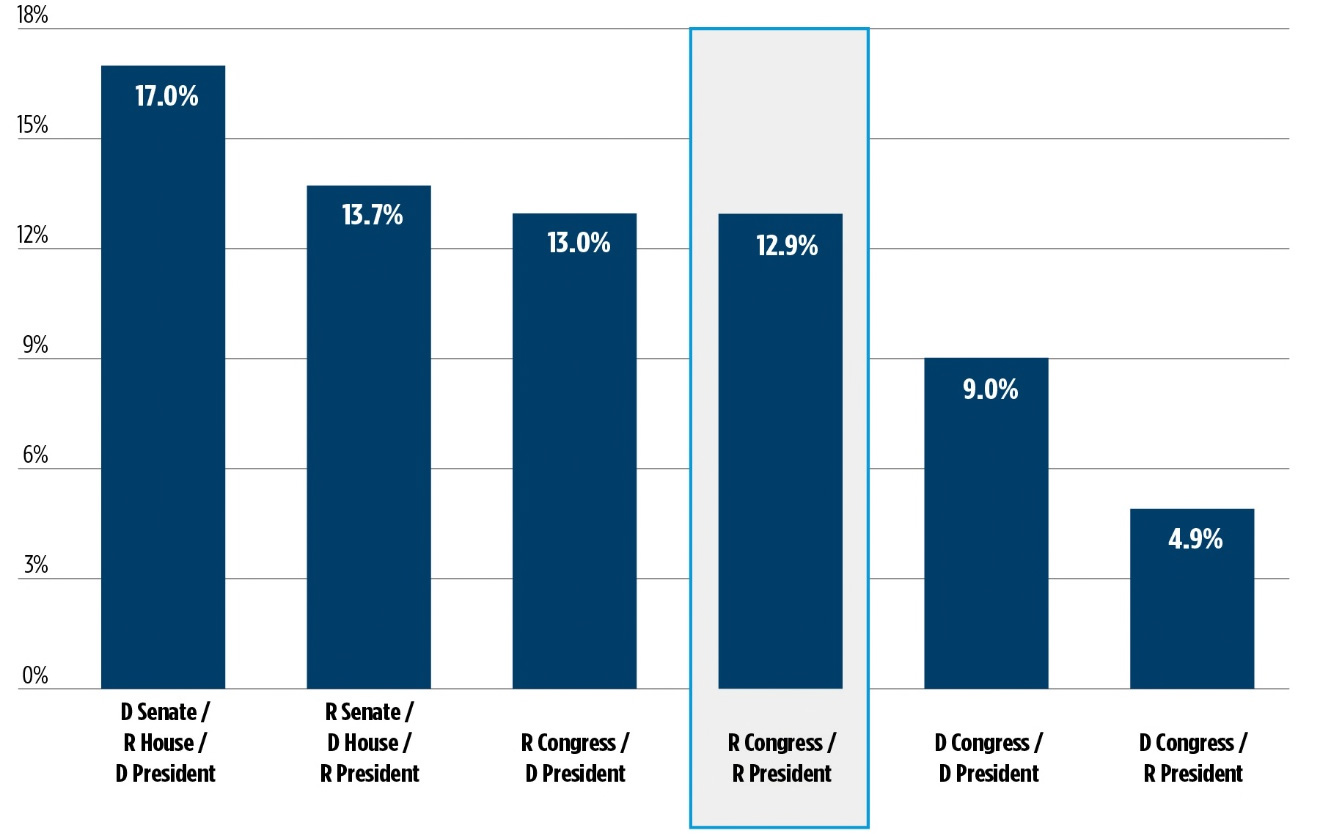
  • Investment implications favor equity exposure: Any Democratic takeover wouldn't take effect until 2027, limiting immediate policy impact. Historically, equity markets have performed positively under all party configurations, with divided government actually having produced the strongest returns compared to single-party control (Chart 3).
     
Chart 3: Partisan Control and S&P 500 Returns
Image
Bar chart showing partisan control and S&P 500 returns

Source: Strategas, as of December 31, 2025 * Data excludes 2001-2002 due to Sen Jeffords changing party mid-2001.
 

Financial Market Implications: Broad-Based Opportunity with Selective Caution

  • US equities supported by multiple tailwinds: The Fed's easing cycle, OBBBA corporate tax benefits, accelerating AI implementation and rising share repurchase trends create a favorable backdrop, though AI and Tech sector valuations remain a concern requiring selective positioning.
  • Market breadth poised to expand: Broad-based earnings growth and more attractive valuations outside megacap Tech could drive improved participation across equity markets, reducing concentration risk that has characterized the recent past.
  • International equities offer compelling value: More attractive valuations relative to US markets, a supportive global growth outlook and the continuation of the USD bear market all provide fundamental support for developed market international equity exposure.
  • Fixed income presents a nuanced picture: Short-term Treasury yields have remained anchored by solid growth and the Fed's neutral stance, while long-term yields face periodic pressure from fiscal sustainability concerns. Investment grade and high yield credit appear less compelling given narrow spread valuations, suggesting selectivity over broad exposure.
  • Emerging markets positioned for outperformance: The combination of positive global growth, coordinated monetary easing and dollar weakness creates an ideal environment for EM equities and fixed income to deliver above-benchmark returns.


Read More from Pioneer Investments


Important information

The views expressed in this presentation are those of Pioneer Investments, a Victory Capital Investment Franchise, and are subject to change at any
time. These views should not be relied upon as investment advice, as securities recommendations, or as an indication of trading intent on behalf of any
strategy. Future results may differ significantly than those stated. There can be no assurance that countries, markets or sectors will perform as expected.
This material does not constitute an offer or solicitation to buy or sell any security, fund units or services. Investment involves risks, including market,
political, liquidity and currency risks. Past performance is not indicative of future results.

©2026 Victory Capital Management Inc.

20260113-5113245

Share this post

Sign Up Now for Full Access to Articles and Podcasts!

Unlock full access to our vast content library by registering as an institutional investor

Register

Contacts


Pioneer Investments

Pioneer Investments manages $132 billion in assets and has a long-standing history of innovation with deep expertise managing fixed income portfolios and creating customized solutions within the more opportunistic areas of the securitized market.

Pioneer Investments’ culture of innovation, in the securitized market, originated at Smith Breeden, where its founders developed early option-adjusted spread modeling techniques for MBS valuation. The innovative approach continues under Victory Capital, which manages over $9.1 billion for insurance companies. We are focused on delivering competitive risk-adjusted returns, while considering the accounting, regulatory, and capital management needs of our insurance clients to create long-term partnerships.  We understand the unique needs of insurers, and we provide customized and efficient risk-based capital solutions that align with insurers' risk tolerances and investment objectives.

Source: Pioneer Investments, a Victory Capital Investment Franchise, as of December 31, 2025
 

Jay Alexander, CFA, CAIA
Managing Director, Institutional Markets
jalexander@vcm.com
+1 (612) 965-5426
 
Emma White
Director, Institutional Markets
ewhite@vcm.com
+1 (617) 422-4569

Marko Komarynsky
Director, Institutional Markets
mkomarynsky@vcm.com
+1 (210) 697-3613

View the contributor page

Sign Up Now for Full Access to Articles and Podcasts!

Unlock full access to our vast content library by registering as an institutional investor .

Create an account

Already have an account ? Sign in

Ѐ Ё Ђ Ѓ Є Ѕ І Ї Ј Љ Њ Ћ Ќ Ѝ Ў Џ А Б В Г Д Е Ж З И Й К Л М Н О П Р С ΄ ΅ Ά · Έ Ή Ί Ό Ύ Ώ ΐ Α Β Γ Δ Ε Ζ Η Θ Ι Κ Λ Μ Ν Ξ Ο Π Ρ Ё Ђ Ѓ Є Ѕ І Ї Ј Љ Њ Ћ Ќ Ў Џ А Б В Г Д Е Ж З И Й К Л М Н О П Р С Т У Ф Х Ц Ч Ш Ā ā Ă ă Ą ą Ć ć Ĉ ĉ Ċ ċ Č č Ď ď Đ đ Ē ē Ĕ ĕ Ė fi fl œ æ ß