





Northleaf-

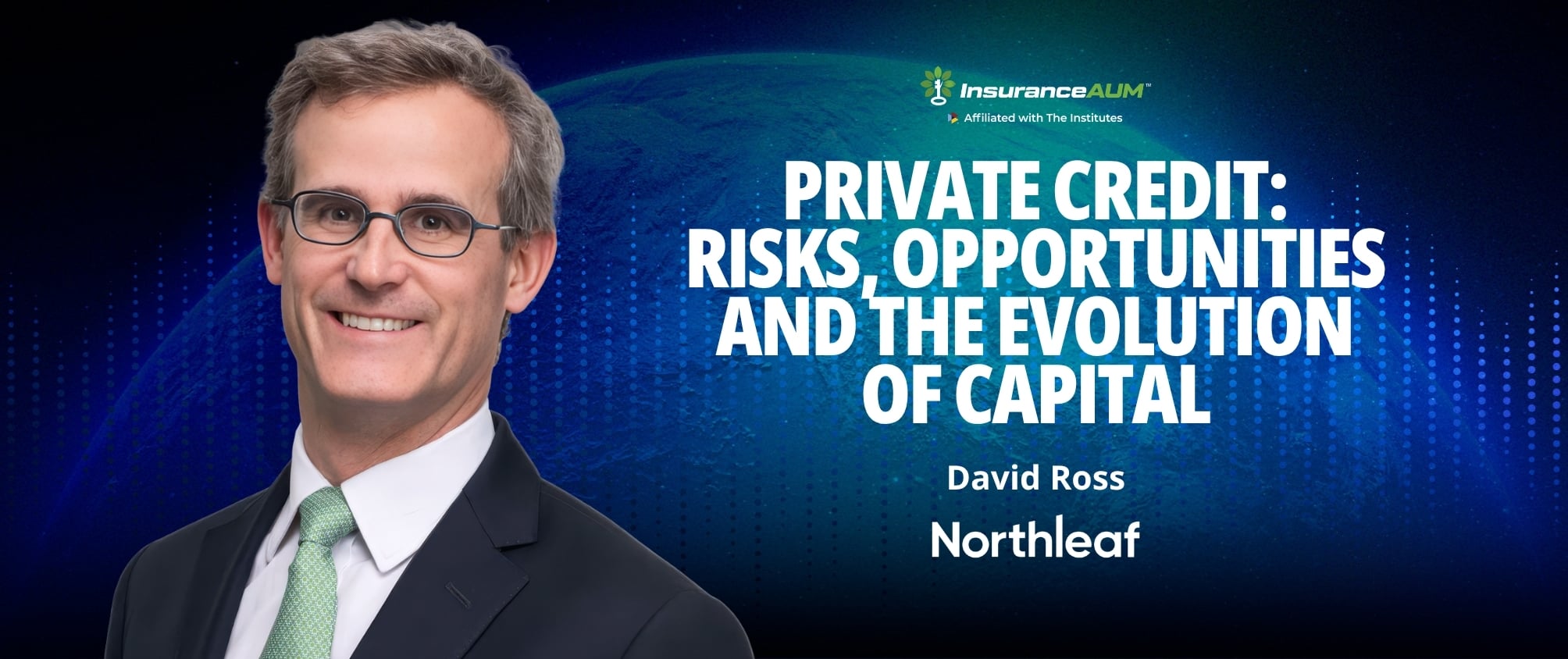
Private Credit: Risks, Opportunities and the Evolution of Capital

Image
IAUM_Podcast_Northleaf-10.05.26_Web_2026


Stewart: Hey, welcome back to another edition of the InsuranceAUM Podcast. My name's Stewart Foley. I'll be your host. We are approaching 400 podcasts. I don't know if this is going to be the 400th, but wow, we are close right in there. So, super excited today. And I want to talk about private credit at an interesting point in its evolution. As all of you know, I know that this asset class has grown tremendously. There's all kinds of stats on that. We've quoted some here on this show. Institutional demand remains significant and private credit has historically demonstrated resilience through periods of volatility. But we're also dealing with a different set of questions today from AI disruption and pockets of portfolio stress to changing capital flows, elevated base rates, and an increasingly complex macroeconomic and geopolitical backdrop.

So today we're going to talk about both sides of that equation, the risks and the opportunities and how sophisticated credit investors are thinking about the evolution of capital. So the title of today's podcast is Private Credit: Risk Opportunities and the Evolution of Capital. And today I'm joined by a repeat guest, David Ross, Managing Director and Head of Private Credit at Northleaf. David leads Northleaf's private credit program and oversees origination, evaluation, and monitoring of private credit investments globally. He also serves on Northleaf's executive committee and its private credit and private equity investment committees. David, we're thrilled to have you back. Welcome to the show. The hard part of my job's done. I know you're going to be brilliant. Welcome.

David: Great. Thanks for having me, Stew. It's great to be back on and it's great to be part of the library of 400.

Stewart: Yeah. Well, it's funny. I think not everybody's excited about it as I am. It's been an amazing journey from March of 2020 until now. It's interesting. I think I may have mentioned this before, but only a half a percent, less than a half a percent of podcasts make it to 400. And it's interesting because we have a really, really small audience, but it's a really consistent audience. And people say to me, "How do you know these are insurance investors that are listening?" And I go, "Well, try to get your significant other to listen to one." It's pretty much a geek fest over here, which is how we like it. So before we get going though, remind us, you're based in London, but remind us where you grew up. And we've changed this icebreaker question, David. I hope you'll be happy with it. What is a fun fact that your colleagues would be interested or might want to know?

David: Well, first of all, the first question, I grew up in Canada. I spent a fair amount of time in the U.S. and I've been in London since 2005, so I kind of split my time pretty equally. But now with my wife and kids here in London, this is where I hang my hat. Listen, I'm a debt guy, so I'm not sure that debt guys necessarily have lots of fun facts.

Stewart: Oh, come on, man! I'm a debt guy too. I'm a fixed income geek. I got fun facts!

David: Relative fun facts then. I mean, we did this with our team a number of years ago, and the one that I mentioned to them was that my first paying job was actually being featured in a Canadian newspaper. The advertisement was for Apple computers. This was in the early 1990s. And as many people asked, unfortunately, I was paid in cash, not in Apple stock. I think it would've been a significant increase in terms of the wage had I been so prescient as to taking Apple stock, but that was the early days in my very, very first paying job.

Stewart: Wow, that's a good first job. Mine was not nearly as good. All right, so you've been investing in credit through a lot of different market environments. Private credit has grown enormously. We know this. It's been talked about at length, and yet we've also had a fair amount of noise around the asset class recently. And as has been pointed out on this show a number of times, reporters at the Wall Street Journal and Bloomberg are not who I would go ask, "What's the deal in private credit?" I would ask you or somebody like you that's neck deep in it day in, day out, and has been for a long time. So what's the current state of play in private credit right now?

David: Yeah, and you're right. 2026 has been a year of headlines for sure. I mean, to be honest, in 25 years in the industry, it's the first time I got an email from my dad saying, "Is this what you do?" So definitely hit the headlines and hit retail for sure.

Stewart: Oh, that's great.

David: There's no doubt that there are new market challenges as there always are. I'd say diagnosing the AI risk is a pretty unique one. When we talk to investors, we really boil it up to three key themes that are sort of relevant for them today. The first is there's no doubt we're in a market of elevated market risk and volatility, so that is a focus for us. Now, very interestingly, when you can talk to investors about that and when you can relate to them about what actual risk there is as opposed to the perceived headline-grabbing risk, you get through that. And what we've seen in 2026 is really consistent investor demand for the asset class. And so institutional fundraising is pretty much the same as 2025, despite all of those headlines and despite some of the retail fund flows that people will have read about. And really we look at it and we step back and think, this has actually been a year where for patient capital with institutional support, yeah, returns have been a little bit lower this year, but really shaping up to be an interesting couple years ahead.

And so while there's market volatility and risk, that tends to be the creation of some of the most interesting opportunities for private credit investors. Second theme is really just around performance. I mean, I think people do, as you say, need to get away from the headlines and focus on what is happening to the actual companies that you're investing in. And we do describe it as very stable but bifurcated. So while you've got a portfolio that overall is very, very resilient, that risk is impacting a small subsegment of the portfolio, particularly in healthcare. That's facility or physician management businesses as well as consumer. That's what's driving up some of the slightly higher default rates that are coming through in the market. And also there's a layover from some of the 2021 vintage where you had COVID-acquired businesses at elevated multiples and elevated earnings. And so you really are seeing that overall strong performance, but the need to focus on that bottom couple percent of the portfolio.

And the final thing, which I think is most interesting for investors, is just around returns. So when we talk to investors about returns, you got to bake it down to the key ingredients. There's base rates, which as we all know from the Fed last week, those are going up, recently raised, spreads which have been stable or rising over the course of 2026, and that's really offset by what has been a slightly higher loss rate environment. But when you net those against each other, it continues to be an incredibly attractive all-in return. And we do compare it to 2021. In that period, you had low base rates, you had tight spread, so you're getting a mid- to high-single-digit net return with low loss rates. Fast-forward to 2024 to 2026, you're at a significantly higher gross asset yield, but a slightly higher loss rate. And so you really do need to look at the critical components and see the asset class on a loss-adjusted basis delivering still very attractive, if not higher, attractive returns in the mid- to high-single digits.

Stewart: All right, so talk about AI because this is one of the hardest things for a credit investor to handicap today. And I want to give you a little bit of background on here, but I mean equity investors can participate in upside. Credit investors have a very different payoff profile. So can you talk a little bit about AI and private credit? And here's the conversation. We have an unpublished or unadvertised call with chief investment officers of insurance companies in an information-sharing, kicking-it-around kind of a thing. And what came out of that was kind of a general consensus, which is unusual for this group, honestly. I think it's the first time it's ever happened, where they all wanted to know, “What is the extent of my AI exposure across my whole portfolio?” And the discussion starts around where do I even start? So can you talk a little bit about AI?

And if you have any great ideas for these guys, I know they would appreciate it, but how are you assessing the risk and opportunities associated with AI, and are there places that you like and is there anything you're cautious on?

David: Yeah, listen, you could do an entire podcast on the SaaSpocalypse and the recent AI doom, so it's definitely something that's worth unpacking and worth thinking a little bit more about. And listen, we've spent a lot of time on it over the course of the past year, whether that's with our portfolio companies, with the private equity sponsors, or internally with some of our internal resources. I guess if I were to unpack it for an investor within the private credit ecosystem, there's three or four really critical things that we've come to. The first is, and I think this is an important starting point, the current performance has had very little impact in terms of deterioration from AI, and I think that's good news, but that really is the starting point because, not surprisingly, every investor should be looking at the next 12 months or the next two or three years, but starting from a very solid base of actually continually growing businesses that are generating more cash flow and really more stability.

So that's the base that you're operating from. The reality is that the market has really turned away from software and AI-impacted industries in terms of new volume. So I don't think there's a creation of new volume that's helpful as a data point in terms of where's it trading or where is it priced. You just don't have very many data points there. And so as you look at the existing portfolio, and the key thing is that you're closely tracking, you're spending lots of time at the coalface with the CEOs, the CFOs, and the owners, I think there's four trends that really help you distill where the risk is in the portfolio. And I'll talk about the industry piece in a moment, but just in terms of the categories of risk that you're trying to better understand, the first one, and this has really only come about publicly in terms of the last month or two in terms of the public market, but we've been focused for the last six months on the CapEx spend and the impact on cash flow.

We're obviously investing in levered borrowers, and so we start with cash flow and say, what's going to pinch the cash flow the business has got? And there's no doubt you're starting to see some industries and some companies see CapEx spend start to tick up as they're seeing that rational impact of needing to spend on AI in order to deliver some of those cost out or some of those defensive measures that they're investing in. The second thing is it's not really a software thing. It's really more of a people-based thing in terms of the risk. So obviously people have been focused on software because of programming and the software industry's exposure to that, but we really do widen the aperture and look at what is the impact on financial services, what is the impact on business services? Those are kind of the key sectors as you're thinking about the cost-out opportunity and the impact of change in their particular service or business model.

And when you think about it on a two-by-two, the critical thing is how long will it take those companies to be impacted and what is the magnitude of the impact? And so for our analysis, we actually think software is going to take longer, but it's a higher impact, where something like business or financial services, you're seeing that impact quicker, but it's perhaps slightly less than it might be in other segments. The third thing is just around competition. So really getting to the core of are new AI businesses coming into their space? And when you talk to these businesses, what you hear is it's okay, we're still winning our business. You got to really probe to the dollar margin impact because you're winning it, but at what cost and what's the impact on the flow-through margin for those businesses? And so those are really the key issues that we're focused on with our portfolio companies.

And the most important thing if you talk to any consultant is the quality of the management and the quality of the owner. Do they have the ability to evolve and manage through this period of pre-seismic risk? And so when you get through that, for us with our investors, we've been talking in a very deliberate manner, company by company, industry by industry on where we see risk in the portfolio. And what we said is two things. One, we do think we can assess the risk today. Two, that risk is definitely evolving at a rapid rate, and so we need to keep an open dialogue about where we're seeing it manifest itself, both in the market and in our portfolio. So we feel very good. We're obviously underweight some of the most impacted segments of the economy. We have the benefit of diversification. And I think you're right that there is opportunities.

I mean, we have one company that does home installation services. They had someone come into their business, provide an AI solution around how to process insurance claims. That's led to something where you got a salesperson spending hours on a task that's highly manual to minutes, and suddenly that salesperson is much more productive, they're much more customer facing. So you've got to make sure you're looking at some of the opportunities in these portfolio companies as well. So having the tools and the time and the team to interrogate these things, making sure that your origination continues to be wide enough that you can avoid sectors where you see some of these issues manifesting itself and having transparency to your investors is the most important thing. But you're right, it is a known unknown. It's an impact on the broader market, and we feel really good about how to assess it. The issue is making sure that we can transparently communicate that to our investors and we can proactively manage that in the existing portfolio.

Stewart: Yeah, I mean, I think you coined, maybe this is the first time that word SaaSpocalypse has been used on this show, so congratulations.

So at the first half of 2026, we saw this market volatility, you talked about it. I think, and I don't want to put words in your mouth here, but it is fairly idiosyncratic and it is not widespread. Now the headlines, I mean, you're not the first person that's come on this show and said, "Hey, after being on, my mom understood what I did now," which is it's interesting that people in our business, it's often the case that no one around them actually knows what they do. So has that market volatility in those pockets, has that changed anything about how you're positioning your portfolios? And does today's environment require a different framework than it did a few years ago?

But my other point here is with AI, it seems like we're dealing in dog years. It's like a year from now, it seems like it's almost like I'd be saying five years from now, the pace of play is so much faster. So what impact has that had on how you position your portfolios and does it require a different framework?

David: Yeah, there's lots to chat about there and there's no doubt that to some extent this has taken longer, if you look back over the life cycle of AI generation, but it's now happening quicker than people anticipate. And so you're right about needing to have the resources to be responsive to it. I guess there's a couple things that I'd say. The first thing is that you're right to classify, and we do focus on this bifurcation where you really do need to bifurcate the portfolio in terms of the level of impact and what you need to do to manage these specific issues in the specific facts and circumstances of that company. And it's been cast with quite a general brush, but when you get down to the specific company, the way that they can navigate through is very idiosyncratic. And the nice thing we have is we've got private equity firms with lots of resources, whether that's capital or people, and they can really help those businesses navigate through and to some extent take advantage of the market environment.

So I guess there's a couple things that I would say. The first is an underwriting policy, if it's done right, should really remain constant. It should be about industry, it should be about company, it should be about structure, and it should be about the ownership alignment and capabilities. Those are really the framework that you apply everything to. But you're right that the risk lens that you apply is very, very different. I mean, when we moved from different points of risk, whether that's from storefront to more online type model, you need to apply a different lens to the way in which you're underwriting. And so for this point in time, you're definitely deciding, do I want to address AI risks or do I want to avoid them? And if I'm willing to address them, what kind of lens do I need to put on them? And right now, every business we look at, we're assessing for AI risk or AI opportunity.

So that's the first thing, that tons of business models are changing. And the most interesting thing for us as investors is it does get down to the unit economics of an individual business and understanding the key drivers and how AI is going to adjust those unit economics. So for us, we are adjusting the risk lens, but keeping the underwriting constant, really interrogating industry and company with the same rigor we did before, but with this overlay of an AI risk lens. What that flows through is capital structure, because for us, it's all about underwriting a specific business and the risks that apply to it and what kind of capital structure we can put in place. A number of businesses we've seen, we've just passed and said, "Listen, there's probably no structure today that we can do with confidence because of the level of unknowns." So where we're focusing is honestly a slightly narrower scope or aperture in terms of industries and companies.

We're still getting tons of diversification in there, but we are making sure that we're being very selective. And the second thing I'd say is that from a portfolio standpoint, diversification is critical, but you've got to be ready to both tilt, which is what we're doing very actively now by industry, and you've got to be ready to accordion, whether that's saying this is a particularly good vintage and I'm going to accordion out a little bit, or this is a challenging market environment and we're going to constrain the capital a little bit more and be a little bit more patient about what's coming tomorrow versus what we're seeing today. I'll come back to what I said earlier though. Throughout my 25-year career, I have always seen more opportunity come from points of volatility and dislocation.

Stewart: Absolutely.

David: The critical thing is being patient, and this is what I say to the deal teams all the time. It's sometimes like horses that are running and they just want to gallop. It's like, you guys do that, but my job is to decide when we need to be patient and wait for tomorrow versus where what I see today is particularly attractive. What I would say is coming out of the AI discussions in March, April when they first kicked off with some of the early models, we actually did see some really attractive businesses that had no AI risk that were purely a function of dislocation, large investors having liquidity issues, not able to support companies that were growing with no AI risk. And there we did see, call it 50-plus basis points of additional spread, that's now contracted back again. So we're back in this period of constrained capital, narrower aperture, and being very selective with an AI lens in terms of where we invest the portfolio and how we tilt and build what we've got from here.

Stewart: Yeah, that's super interesting. I think it's very well thought out. So at the end of the day, every now and then, the CIO community gives us a couple of fake CIO hats that we can put on over here. So you and I are going to put them on at this point, and this is really what I would refer to as the $64 billion question. Are we getting compensated for the risk? So you'd mentioned, and we know that you've got elevated base rates, spreads have changed, there's a lot of competition for assets. It's a much larger private credit ecosystem than we had not that long ago. So in your mind, if you've got your CIO hat on, do you think we're getting adequately compensated for risk? And where should a CIO focus when they're evaluating an allocation or thinking about an allocation to private credit? One little note, there are a lot of carriers that have not made a private credit allocation at all.

Everybody, the way that this podcast goes is everybody seems like, "Oh yeah, everybody's already done this." That's not the case. There's a lot of carriers that have not made an investment in private credit. So walk us through the relative value and what should I be looking for when I'm trying to get exposure here?

David: Yes, and this is the classic challenge that CIOs have, right? I mean, relative value is part scientific, part art, and it's about portfolio construction. I do come back to the basics of why people invest in private credit. And you invest in private credit because you're looking for a yield or spread premium relative to what you can get elsewhere, whether that's public markets or other specific products. You're looking for stability. I mean, a lot of people like it as a complement to their existing fixed income, but it gives them floating rate, it gives them additional diversification, and it gives them a stability in terms of the valuation of all volatility that they get relative to some of the stuff that they're doing in the public markets. And then the final thing is yield. I mean, people are looking for cash yield. At the end of the day, what can you deliver to me year on year in terms of the actual distributions if I'm taking cash yield out of the portfolio?

And I don't think those fundamental metrics have changed. I think those fundamental metrics are pretty comparable to what we would've seen over the last 10 or 15 years. So if I just take them in turn, number one, still getting the same premium. So you're talking 200 basis points or more over what you might get in public markets with lower volatility, whether that's public market volatility or volatility from loss rates. So I think you're really ticking the box in terms of the basics of the return driver, which is initiating the portfolio allocation. The second piece is just around what are you getting in terms of volatility and what is it doing in terms of diversification? And again, private credit is pretty good in terms of diversifying away in terms of what you might be getting from investment grade, what you may be getting in terms of public markets.

And I think in terms of the all-in return on a loss-adjusted basis, you're getting something that is actually better than you were probably getting five years ago. It's just different. So five years ago in 2021, you were probably getting base rates at, call it 0% to 1%. You were getting spreads at, call it 5%. So you're talking about a 6% all-in return and losses were low. So let's say they're 50 basis points, that's 5.5% return that you're generating, but that felt stable. Loss rates were low. It was very predictable. I knew what my base rates were. I knew what my spread was. Today, you're getting actually a better return, but the drivers have changed. Base rates are at 4%. You've got spreads still at around 5%, so you're getting a 9% return, but loss rates have shot up to call it 100, 150 basis points.

So they've doubled or maybe a little bit more across the market. But you take that off and you're still getting 7.5%, 8%, which is better than the 5.5% you were getting before. But I think for investors to really understand that that loss rate assumption is natural, you can't have 4% base rates and not have slightly higher loss rates. You got to look at the all-in return on a loss-adjusted basis and then the portfolio benefit that you're getting. And then the final thing I mentioned was cash yield. I think that's one of the critical things. Even though 2026 will have slightly lower all-in returns, mark-to-market volatility was higher, write-offs were slightly higher, you still generate that consistent stable cash yield, which I think is the underpinning for why it fits in a nice diversified fixed income portfolio.

Stewart: Yeah, it leads well into this next part, which is one of the biggest changes we've seen is the relationship between insurers and private credit managers. It's become much more sophisticated than simply committing capital to a commingled fund. These partnerships between insurers and private credit managers have evolved considerably in recent years and moving beyond traditional fund investments toward more custom solutions, which is like, I don't know, center of the fairway for insurance land. What's driving this trend? I feel like I know some of what's driving it. And what are insurers looking for in a long-term partner?

David: Yeah, first of all, insurers are great partners, but I will say that over my 20-plus years, that dialogue has just grown. The insurers have gotten more comfortable. The trust has built with the ecosystem and the number of managers and the solutions has continued to increase. So what's great about insurers is they're patient, they're sophisticated, they're actively engaged. And to be honest, they're a demanding client. I mean, you can say what you want, but actually a demanding client does tend to drive more sophisticated and solution-oriented type outcomes. And so they, I think, need partners that can engage in that, that can come that don't necessarily have a one-stop-shop solution. I mean, the way I describe it to our insurance solutions team is it's like the insurance puzzle. You got to sit down with the insurance partner and understand what is the solution they're looking for, whether it's returns, diversification, capital treatment, specific either strategic or tactical allocation.

So there's a number of different factors that go into piecing together what that specific solution is for that specific client at that particular period in time. And that relationship goes well beyond the traditional GP-LP relationship. It really is what I call bespoke capital partnership. It ultimately is structuring something that is very unique for each client and could be unique just for that point in time. The other thing I'd say that's really interesting is the last four or five years, the partnership on the co-investment side has really accelerated. So if you think about the fact that you're doing custom balance sheet IMAs, you're doing custom SMAs, you're doing rated note feeder structures, those have gotten to the point where they're sort of the peanut butter and jelly of a relationship with an insurer. I think the added piece that you're putting on top is this co-investment. And that's the piece that I think as the sophistication has grown, as the trust is built, people are looking for corporate lending, they're looking for ABF, they're looking for NAV lending, and that's part of the next phase or the existing phase even of the partnership that these insurers have.

So more discussions is better. Dedicated insurance solutions team is essential. And I would say that the relationship with the asset class is going to continue to grow, but it's also going to continue to take different shapes for different types of investors.

Stewart: Yeah, it's interesting as we're recording right now, right on the cusp of Q4, and whenever it's Q4, everybody starts looking at 2027 or the next year, in this case, 2027. So this is the part where we ask you to shine up the crystal ball and tell us your thoughts about how we're going to be looking as we roll into 2027.

David: Yeah, it's funny. I was talking to an investor the other day and they were saying, "I just need guaranteed 7%." No, I can't say that. It's not guaranteed, but you need to be confident that you can deliver that. And so you're right. I mean, people, they're looking at their fixed income portfolio, particularly their private credit portfolio, they want to know what it's going to look like. And obviously there is no crystal ball. But one of the things I would say over the past 20, 25 years for me personally is you do have a reversion to stability and consistency. Private credit is one of those things that maybe every 10 years used to have these periods of volatility. Post-COVID, that's been more like every five years you have these periods of volatility, but you do revert back to a consistent and stable operating environment. So while 2026 has been mostly about headlines and volatility, I think when we look ahead, we see a very, very different year.

And I guess there's a couple reasons that underpins that. No crystal ball, but obviously being fact-driven. The first is I think allocations for investors tend to be very, very selective. Most are under-allocated. And so while you've got insurance companies that are growing a denominator, they're growing confidence. And so that stability of continued support in the ecosystem, I do expect. And what is driving that? I think the most important thing is as we look at the underlying portfolio, as I said, you see some underperformance. It's very specific in certain industries, but what you haven't seen over the last six to 12 months is growth in that segment of underperformance. It has continued to deteriorate, those couple names that you may have in your portfolio, but you haven't seen more things flowing into the watch list or flowing into that underperforming basket. And so to the extent that you have transparency, you use a third party in terms of your evaluation, 2026 is probably the year where you have taken some level of impairments.

You've been transparent about that, but I don't see that flowing into the next couple quarters as you are resolving those issues that have been around for the last 12 to 18 months. The other thing is I do think that we're moving away from a media perception era, and we're focusing now on underlying performance and market dynamics. So some of that hype that's been driven by the media I think is going to start to subside, and that means that you're going to start coming down to facts and circumstances. And I think investors that do get to that point do have more confidence, which creates that virtuous cycle of continuing to invest, building portfolios with now well-underwritten and diversified underlying credits. So ultimately, I think it does come down to the discipline of the manager. It does come down to active risk management.

But as I look forward to 2027, I do see for credit investors higher base rates, portfolios that have stabilized to what's been a year that's been more challenging in 2026. And to the extent that the manager can stay disciplined, I think it's going to be a pretty attractive market as you've got a buildup of these non-AI-impacted companies that do need to come to market, they do need financing, and that should create the opportunity for patient capital to really invest sensibly.

Stewart: Yeah, it's been a phenomenal education today. You've been on before. It's one of those things like I'd love to have you back more often. It's great to get your perspective and I think it's a balanced perspective and it's based in facts, and it's super helpful way to educate our audience. And so I just want to say thank you so much for being on. I've got a new fun one for you on the way out the door. It's related to the old one.

David: I'm ready. I’m ready.

Stewart: So describe your best real or fantasy dinner.

David: Okay. I actually took two of my kids hiking in one of the high alpine huts up in Europe. So we're just above 2,000 meters and actually it was amazing to see their confidence and the sense of accomplishment, but they were definitely noticing the very basic meal that comes with that particular activity. But it was cool to see their adventure. And what I was describing to them is I've always had a dream of climbing Everest. It's just been since I was very young. So I just imagined that last meal before Tenzing Norgay and Sir Edmund Hillary summited Everest for the very first time. So you're talking about a tent on that Southeast Ridge of Everest at 28,000 feet. This is 1953. And just imagine them sitting in this tent, freezing cold. And I remember reading what they had was lemon juice, sugar, sardines, and biscuits. That was their final meal.

And you just imagine them. And that is not a heroic meal. They're reduced to the very basics, the core essentials, but they're sitting on the precipice of the highest place on the planet and probably the greatest, if you look back in adventures, the greatest accomplishments for people that are trying to set new boundaries for what human is capable of. So that would probably be my choice, sitting there in the tent with Tenzing Norgay and Sir Edmund Hillary. Now, maybe it becomes real. Maybe I sit there with my kids one day and that becomes a real dinner, but for now that would be my fantasy meal. To be honest, I hate sardines, but it would be pretty interesting nonetheless.

Stewart: I have to say, as a longtime bachelor prior, that's center of the fairway for some of the bachelors on the call.

David: That's what's in your fridge.

Stewart: That's right. That's right. It's really been great to have you on. I really appreciate it, David. Thanks for taking the time.

David: Great. Thank you very much, Stewart. Great to see you again.

Stewart: We've been joined today by David Ross, Managing Director and Head of Private Credit at Northleaf. If you like what we're doing, please rate us and review us wherever you're listening to your favorite podcast. And if you want to watch, this is a video podcast as well at InsuranceAUM Community on YouTube. My name's Stew Foley. We'll see you next time on the InsuranceAUM podcast.

Share this post

Sign Up Now for Full Access to Articles and Podcasts!

Unlock full access to our vast content library by registering as an institutional investor

Register

Contacts


Image
Northleaf logo


Northleaf Capital Partners is a global private markets investment firm with more than US$31 billion in private equity, private credit and infrastructure commitments raised to date from more than 375 institutional and family office investors and a growing number of wealth, asset management and insurance partners. Northleaf sources, evaluates and manages private markets investments, with a focus on mid-market companies and assets. Northleaf’s 300-person team is located in Toronto, Chicago, London, Los Angeles, Melbourne, Menlo Park, Montreal, New York, Seoul and Tokyo. For more information, please visit www.northleafcapital.com

William Allis 
Managing Director, Insurance Solutions  
william.allis@northleafcapital.com   
+1 646 512 9600

299 Park Avenue, 41st Floor  
New York, NY 10171


View the contributor page

Sign Up Now for Full Access to Articles and Podcasts!

Unlock full access to our vast content library by registering as an institutional investor .

Create an account

Already have an account ? Sign in

Ѐ Ё Ђ Ѓ Є Ѕ І Ї Ј Љ Њ Ћ Ќ Ѝ Ў Џ А Б В Г Д Е Ж З И Й К Л М Н О П Р С ΄ ΅ Ά · Έ Ή Ί Ό Ύ Ώ ΐ Α Β Γ Δ Ε Ζ Η Θ Ι Κ Λ Μ Ν Ξ Ο Π Ρ Ё Ђ Ѓ Є Ѕ І Ї Ј Љ Њ Ћ Ќ Ў Џ А Б В Г Д Е Ж З И Й К Л М Н О П Р С Т У Ф Х Ц Ч Ш Ā ā Ă ă Ą ą Ć ć Ĉ ĉ Ċ ċ Č č Ď ď Đ đ Ē ē Ĕ ĕ Ė fi fl œ æ ß