




We're currently experiencing email delivery delays. For urgent matters, please contact us directly at lindsay@insuranceaum.com.

Hamilton Lane-

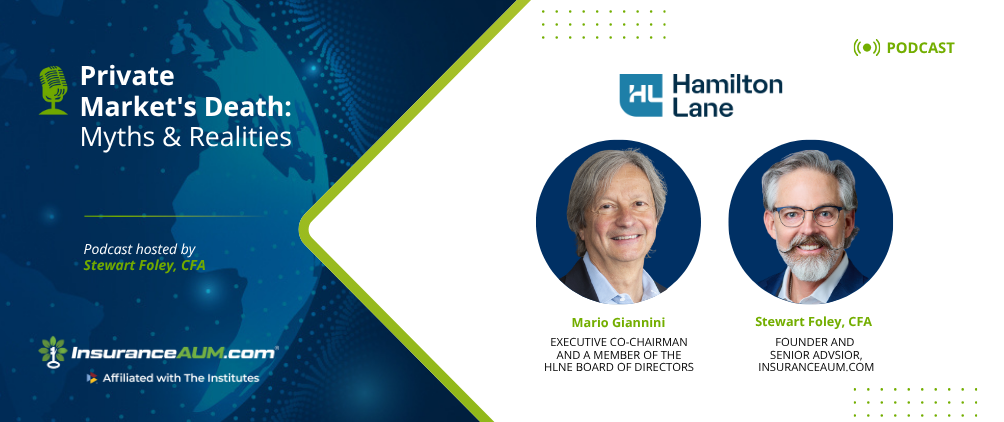
Private Market's Death: Myths & Realities

Image
Hamilton Lane podcast header image


Stewart: Hey, welcome back to the Home of the World's Smartest Money at the InsuranceAUM.com podcast. My name's Stewart Foley, I'll be your host, and I just wanted to say thanks so much for all the kind words. Lynde O'Brien, our executive director, and I were just in New York and met with a number of our clients and investors as well, and just had a lot of really nice comments from you about our podcast. So just want to say thank you. Big shout out to the Insurance Asset Management community in New York as well. So just a quick reminder, we have a credit forum coming up, private credit and ABF forum coming up in Texas. It is in beautiful Austin, at the Thompson Hotel, on November 5th and 6th. That is open to insurance investment allocators. You can find it at www.insuranceaum.com-events. And the title of today's podcast is Private Markets Death Myths and Realities, and we're joined by Mario Giannini, who is the Executive Co-Chairman and member of the Hamilton Lane Board of Directors. Mario has also been the CEO for 22 years. You are an industry icon, my friend. I'm very happy to have you on. Thank you for being on, and welcome to the show.

Mario: No, thank you for having me, and thanks for that introduction. It's downhill from here.

Stewart: There you go. Alright, so we always do the same thing. This is a kind of a brand new question. So where did you grow up, and what's your favorite movie?

Mario: Oh, well, I'll do where I grew up. So we immigrated to the United States when I was six, and I grew up in Los Angeles, so that was where I lived for 15 years and consider that kind of my home.

Stewart: Oh wow. Where did you immigrate from?

Mario: Italy. We came from Tuscany. I know everyone wants to go back to Tuscany and live there and we came out of there, so that's how it goes sometimes. Is there a story behind the favorite movie? Well, there's not a story, it's just I'm going to embarrass myself right out of the gate. There's two, I got to tell one that is kind my favorite because it's one I shared with my daughter's Jurassic Park, but actually my favorite movie is Pineapple Express, which don't hold that against me.

Stewart: Hey, listen, I find that movie, that's the purpose of these questions, right, is we want to get to know you a little bit, and it's nice people can know.

Mario: But it's hard to be credible after you've just explained that your favorite movie is about two drug-addicted people who get into crazy things, but I laugh through that entire movie.

Stewart: That's great. All right, so the first item up for bidshere is I think it always helps our audience to know a little bit of you and your background as an attorney, and you started doing some restructuring. Can you walk us through how your career, where you started and how it progressed to where it is today?

Mario: Yeah, I did start as an attorney. I don't like to admit that, but since you outed me on that one, thank you. Well, I mean, being an ex-attorney is like being an ex-smoker. You kind of never really gave it up. It becomes part of you, and you sort of try to avoid it. But I was an attorney for a while and was not very good at it and didn't enjoy it very much. But I did workouts, and I felt like that showed me that I'd really like to be more involved in running a company or in being on the operations side. 
So a partner and I took over a failing title insurance company, as it turns out, an insurance company turned that around, sold it, and then I ended up, I knew a couple of people that had just started Hamilton Lane, and it was a complete accident. I came to Hamilton Lane thinking that I would find another company to run. I had no intention of staying at Hamilton Lane because I didn't know what private equity was, and I never left. I was sort of like that bad penny that they're always trying to get rid of, and it just never goes away. So that's my story in a nutshell. I'm sort of someone called me the accidental CEO, and I think that's probably a pretty accurate description.

Stewart: This is very, very, very humble. You've had a tremendous number of accomplishments, and you mentioned private equity, and I guess the first thing here is private equity is dead, right? We've seen a few headlines lately. Matt Levine wrote that PE might be over. What's your take? Is this exaggeration? It seems like there's lots of exaggeration every day. What does the data actually tell us?

Mario: Yeah, I mean, look, I think it's fashionable whenever an industry is basically not outperforming, which private equity is not outperforming the public markets the last couple of years to say, well, it's over, and again, you see me, I'm old. The good thing about being old is that you've seen some things, and you hope your memory still helps you, and you remember some of that. I've seen this movie before. We saw it in the late nineties. We saw it during periods in the two thousands. We saw it in 2018, where private equity underperforms the public markets, and you hear that it's dead, it's over. It can't outperform. There's too much money. There aren't enough companies. And look, I know I'm in the industry, so I'm biased, I get that, but it's not dead. It will outperform. Compliance tells me never to say this, but I will. It outperformed the last 30 years; it'll outperform the next 30 years. I don't see any structural reasons why, over a longer period of time, it won't outperform, and yeah, no, it's not dead.

Stewart: Let's talk a little bit about current PE market conditions. Can you walk us through the current environment, valuations, distributions, and what's driving the LP sentiment right now?

Mario: Yeah, I'll give you the pros and the cons, and I'll start with the cons. So it has underperformed for the last couple of years. It has not been selling companies and returning capital to investors. It is in a terrible fundraising environment for those two reasons. A contrarian, by the way, the little hairs on the back of your neck would start to come out, going, Ooh, that seems like a more interesting time than other periods when we all loved private equity and couldn't get enough of it. But here's the pro side of this. You are having a shakeout in the industry. It is tougher to raise capital, and so there's a flight to quality. The better managers are able to raise money, and the poor managers are not. That's a good thing. In general, the number of private companies compared to the number of public companies, there's not even a comparison in the US you know  this as well as anybody, the number of public companies has come down by half over the last, what, 10, 15 years.

That's not going to change. There will be more private companies. Private companies stay private for longer. I had the head of a giant US pension plan say to me a few years ago, I'm going to increase my allocation of private equity. And I said, you hate private equity. You think we're greedy, awful bastards who take all your money and ruin everything. And he said, you are. That side of it hasn't changed, but what you have is my portfolio has a big gap of companies that used to go public when they were smaller. They're not going public. I need exposure to that. So when you think about how private equity has become a normal, natural part of the capital markets, the fundraising for companies, it just seems to me that that's really what's driving this secular movement towards more private capital, staying private longer, and opportunities are better in the private markets than the public markets.

Stewart: Yeah, it's a great point about the differences in the number of companies that are public and how that number continues to shrink. None of these conversations are complete without bringing in AI. It's everywhere. How do you see it impacting private markets, and is Hamilton Lane able to gain an advantage or drive efficiencies using AI?

Mario: Let me break this down into a couple of things. I think the AI question is, we all talk about interest rates and, like here, fundraising and distributions. The AI question is the single most important question any investment professional can spend his or her time on, and it's not so much because will AI dominate the world and put humans out of business? It is because when you look at the spend on AI, both for large language models and for implementation, it is driving economic growth, and you have to make a decision of whether you believe that will continue. In which case, there’s all these corollary things that will happen with it in the private markets. That is where all of the implementation around AI is going to happen. I was talking to the CEO of a public company, and he said, Mario, let me explain how it's going to work in the public world with AI.

It's going to take me a couple years to get a budget to redo everything I have for AI, and then if I decide to do it because it's going to crush my earnings, it's going to take me two or three years to get another budget to change it again. Five years for technology that changes every six months. Where is that going to be implemented? It's in the private world. And so if you think about the companies that are going to stay private longer, the growth capital companies, if you think about the buyout companies that are going to implement AI strategies, it just seems to me that that's going to be a more private-dominated discussion. The public world, it will all be about the giant LLM models and the giant semiconductor companies. Those are not in the private world. So if that's where you want exposure, you got it in the S&P 500, you got it in any index you have.

But again, in the private world, that's why I think this is the single most important question that will drive economic growth. It'll drive investment strategy, it'll drive geographic allocation. That's where you've got to be looking at it. I will say that when you think about implementation, AI is not revolutionizing everything. When we look at it in our world, it is changing a lot of, I'll call it data-intensive work that we have. And so a lot of the entry-level analysis that the world is changing, but is it changing the way we make investment decisions? There's no way we are seeing the implementation of agents that are making decisions; that's just not happening today. So that goes back to the ag question of will it develop fast enough to justify all the spending that's going on? I don't know. Is it making our world more streamlined in terms of the ability to deliver information internally and externally? Absolutely.

Stewart: It gets me to the question around risk-adjusted returns, and there are secondaries, there are infrastructure, there are other corners of the market. Where do you see the most compelling risk-adjusted returns right now?

Mario: Yeah, we have been focused on equity. I would say on the equity side, I think there are two areas. Secondary is one, simply because if you tell me that there's a market where there's such a supply-demand imbalance, it's secondary. There is so much more supply, if you will, people wanting to sell than there is demand. So I think that will continue to be an unbalanced market for some time. I think growth equity, growth capital is another interesting place in the equity side of the market because again, if you have a world where you think AI is driving a lot of the spend, you've got to be in some of these growth areas. But if the other areas to look at infrastructure, particularly in the US, if you tell me that the US has an enormous need for energy, then in order to fund all of this AI in order to provide the energy for the AI investments, then there's no way that the US will not have a huge infrastructure spend around that and it will come from the private side. I also think credit remains interesting. I know we all talk about the private credit bubble, that is just so overstated in terms of it being a bubble. There's a huge and has been for 10 years a very secular trend away from banks and the normal providers of credit capital to the private world.

Stewart: Let me just go back to this area. When you said that there are more sellers than buyers and secondaries, is there any consistent theme as to why that is? Is it folks that they need liquidity, or is it something else that is driving those sales? Because I'm just curious as to why that market condition exists.

Mario: It largely exists, I think simply because of the growth of private markets over the last 10 or 15 years. You have an industry that has exploded really in growth, and the secondary part of it has not really kept pace with that growth. So if I say that 10 years ago there was a hundred million of outstanding net asset value in the industry, OK, and you have a certain secondary amount, but now it's 10 times that, and the secondary market, the amount of capital available to buy any secondaries has not grown 10 times. So I think what you have is this increasing, if I'll call it supply, and the amount of secondary capital just has not kept pace. Now, the reasons that supply is being sold varies. Some of it is distressed sellers in the sense that they need to sell for liquidity, but that is a very small part of it. Now, what's becoming more normal, again because of the industry's growth, is that people want to use secondaries to rebalance their portfolios. I've got too many partnerships, I want to sell half of them. I don't need 'em. That has become more normalized. Yeah, 20 years ago, you only sold because you had to. Now you sell because the asset class has grown large enough that portfolio rebalancing is a thing.

Stewart: Yeah, it's really interesting. You touched on this. You'd mentioned private credit. It has increased in size significantly, direct lending, ABF, infrastructure debt, and you also said that this is nothing new that we've been moving away from the banks for quite a while, and I completely agree with that. How do you see this ecosystem evolving? We spoke with some folks in New York who were talking about the blurring of the BSL market with public. Is there a continuum that develops that goes from public into large private credit deals and then into more middle-market direct lending? How do you see that coming together?

Mario: I think the thing that amazed me over the last couple of years in terms of the change in the market is banks used to lend to this set of borrowers. They stopped and they started lending to these private credit funds that lend to that same set of borrowers. I mean, I think that disintermediation, if you will, or that change in the way the ecosystem works, is going to continue. And I think what you described is exactly right. There will be this continuum where private credit will increasingly, I don't know if encroach is the right word, but will grow into what we have always become accustomed to both banks doing and the public market doing. And I suspect in five or 10 years we will wake up and we will see private credit groups, institutions that dominate that market. Unless, and this is a big, unless the regulatory environment changes, and you're already hearing people talk about, wait a minute, we need to do something about this. We don't know where the loans are anymore. Maybe that slows down this development. I don't know. It seems unlikely, at least in the United States in this current administration and not really looking at the regulatory environment that way. But otherwise, I don't see what alters that dynamic on the private side. There's so much capital available that wants to move into it on the private side and so many providers that are very good at providing it.

Stewart: I'm a little bit on my soapbox here, but if you think about banks, and you say, okay, one of the things that insurance companies do really well is manage risk. They manage their liability risk very well. They manage their asset risk very well. And if you think about a bank that's funding long-dated loans with overnight deposits, and then they've got the FDIC standing behind them as a backstop, everybody thinks that's a safe way to do it. But you take an insurance company that's got long-dated liabilities, you can match up very nicely with these loan terms. It has in my mind, just one person's opinion, less systematic risk than the other way. I mean, it seems like this is a really good fit for the insurance industry to fund. I mean, to your point, and I don't mean to put words in your mouth, but these loans used to be made by banks. This is not like some new; they are just being financed in some part by the insurance industry, which has a really nice natural hedge for that asset. If I got that right…

Mario: You got it exactly right. I think if we were making the financial world today, if we were starting over, it is unlikely that we would have banks doing the kinds of loans that they've done for 50, 40, whatever years. You're right, we would try to match the liabilities and the maturities in a way, and I think private credit does that in a better way. Is it perfect? No, but is it better than having the banks do it? Yes, I think so. And that's why I think when I hear it's in a bubble, I just go, No, it's not in a bubble. It is just changing the way the financial system has operated for so long, and that will continue. 

Stewart: Can you talk a little bit about when you talk to an insurance company, are there common questions that you get or not? Right. I mean, the standard joke is insurance companies are like snowflakes. They look the same from about three feet away, but when you get up close, they are all different, and they define risk differently. And certain strategies, they got burned 27 years ago, and they're not doing it ever again. So it's not always a perfectly economic animal, but at the end of the day, they do have a generally common set of variables. So when an insurer comes to you, what are the questions that they ask you? Or what are you trying to solve for?

Mario: I would put it into three parallel buckets or paths. The one is common to almost every investor. What kind of return, what kind of risk profile? How do you see these assets? Again, everyone looks at 'em. So if you're talking about a loan, you're looking at sort of standard things, if you will, what's the return on it? Where do I stand in the capital structure? What's the cash flow? Whatever. That's phase one. Phase two gets a little more, I'll call it idiosyncratic around the industry, which is a different regulatory environment, different reporting requirements, different capital requirements. So there you are now, you've removed yourself, if you will, from your general economic risk return question that everyone asks, and now you're in the insurance umbrella, I'll call it. And then to your snowflake question, it becomes really idiosyncratic around that particular institution, their particular portfolio, their particular strategy, their particular regulatory requirements. So I would say the insurance industry is a little more challenging in that context because you have the three layers, with some, you're really only at layer one. You're really only talking about just general investment matters, and with most, you're really talking about one and two, whatever's applicable to them. With insurance companies, you've got all three. And so it does require, I'll call it a more specific set of discussions. I don't know that they're more difficult, but it's just something you have to understand and go through with each company.

Stewart: It's interesting because you have had an interesting vantage point as CEO of a significant private assets firm like Hamilton Lane, and we've gotten a great education today, but if you wanted to leave our audience with a couple of takeaways, as somebody who's been in the private markets for a long time, what would they be as we finish out 2025 and move into 26?

Mario: I would say a couple of things that have struck me over the period of time I've been doing this. The one thing is that too many people in the private markets spend too much time on individual deals, on individual investments, on individual. They get so lost in the details because one, they're fun. I mean, it's really cool talking about the transaction you did that's going to be in the Wall Street Journal, and it's just fun. And if you listen to people in this industry, you would think that asset allocation is irrelevant. You really would because you ask 'em about asset allocation and they go, did I tell you about my deal? I tell you about my fund, and you're going, wait, my head's exploding. I need to talk about asset allocation. In the public world, 90-something percent of returns is attributable to asset allocation. In our world, you think it's zero.

It's not, it's not 90, but it's closer to 50. And I think the one thing I would leave people with is you've got to spend more time around asset allocation and stop worrying about individual deals so much. That's not what's going to drive your return. It is the asset allocation part of it. The second thing I will say is, given the nature of private markets, the great thing about private markets is they keep you from making the mistake you invariably, I invariably make. Everyone wants liquidity. You want liquidity, so you can make your biggest mistake, you can sell at the bottom and buy at the top. That's what liquidity gives you. The thing about private markets, I hear this question, the single most common question I've gotten in 30-something years is now the time to invest in pick your thing, private equity, private credit. And my answer is, I don't mean to be glib.

Yes and no. Yes, it is. It doesn't matter so much. Stop worrying about is it up? Is it down? Just figure out how much you want in it. Figure out how you want to invest in it and just go do it. Just go do it and stop worrying about whether I should do it in September versus March. We as a group spend way too much time thinking we can time any of this. We can't, especially on the private side. Those are the two things that I think I've just been struck with over, and believe me, I make those same two mistakes all the time. I think I can market time, and I think I can pick the best deal on earth. History suggests I can do neither one, but I still believe it.

Stewart: Yeah, no, I can relate. This one's about the culture at Hamilton Lane, and you've been there a long time, and what are the characteristics that you think increase your likelihood of success in this business, right? I mean, you've interviewed folks from good schools. I've had phenomenal students at schools that have less headline notoriety, but there are characteristics that are separate and apart from that. What are you looking for when you're hiring? 

Mario: No assholes. In an industry filled with assholes.

Stewart: It's interesting, I get that. I have heard people with formal policies of no egos and things like that, right?

Mario: Yeah. But then the culture's a big deal, and I think, I don't pretend that there is one culture that works for everybody, it just doesn't, but you have to pick what your culture is and you have to stick to it. And I think for us as Hamilton Lane, the no asshole matters a whole lot, but what's more important for me, like a CEO, what I always wanted was a place where people felt respected. They felt like they were listened to. They didn't get their way, but they felt like, so remember the show, The Office, I don't even know if it's still on.

Stewart: Of course.

Mario: I hate that show. I watched one episode, and I'll never watch it again because it shows a work environment where people are backstabbing. It sucks. They hate each other, they hate themselves. That is not to me what an office environment should be all about. You spend a lot of time in the office with people, you're around, and you need to want to work with each other and with your clients, and that to me is the kind of culture that you want and people that want to be in that culture. Again, it's tough in this industry because this industry tends to be, you kind of kill each other. That's sort of what the industry prides itself on, but everyone doesn't have to be that way.

Stewart: That's true. I mean, I just shout out to our team at InsuranceAUM, right? That's a really good team. We're really small. They do a lot, and they really care. They're really client-focused, and they really, really care. And then Lynde O'Brien deserves a lot of credit for that, and I agree with you. I think your point's well taken. My last one is always a fun one, and it says, who would you most like to have dinner with, alive or dead? You can have up to three people. You can have one, two, or three. But I have a feeling this is going to be an interesting answer, Mario Giannini.

Mario: Well, number one is going to be Jimmy Page, the Guitarist for Led Zeppelin.

Stewart: Wow. There you go.

Mario: So I love music and I love it for a whole lot of reasons, but what's interesting about music to me is that it is the one topic today that you can violently disagree with people on and still keep talking. There's no other topic where you can do that. I am somewhat known for saying that the Grateful Dead are an abomination to music and should never have been allowed to record, and people get really pissed off with me. 

Stewart: Oh yeah, for sure.

Mario: But then you can keep talking, and you can't do that with, if I say something about the Republicans or the Democrats, you can't do that. If I say something about religion, I mean, there are all sorts of topics at this point, almost every topic. But anyway, Jimmy Page was sort of who I, oh my God, he was my hero for, probably still is for the last 50 years. So I would love to have dinner with him and just listen to him talk about how you came up with these rifts. How did you do all that? That just seems to me

Stewart: Amazing. That's super cool. Do you want anybody else with anybody else?

Mario: No, I just want him at that dinner. I wouldn't mind if Eddie Van Halen came by and a few, but it would be Jimmy. 

Stewart: There you go. That's awesome. I really appreciate it. I've got a really, really close friend back in Chicago named Arman, who is a Grateful Dead freak. So he's going to listen to this and go, oh!

Mario: Really sorry. I'm sorry to hear that. I mean, he has time to recover. There are recovery groups where he can go. 

Stewart: Hilarious. Hey, listen, great education. I've really enjoyed having you on, Mario, thanks for taking the time.

Mario: No, my pleasure. Thank you.

Stewart: We've been joined by Mario Giannini, who's the Executive Co-Chairman and Member of the Hamilton Lane Board of Directors. Also served as CEO for 22 years. Got a great education today. If you like what we're doing, please rate us, review us on Apple Podcast, Spotify, or wherever you listen to your favorite shows. If you want to see what we're up to, you can check us out on our new YouTube channel at Insurance AUM Community. We're the home of the world's smartest money at InsuranceAUM.com.
 

Share this post

Sign Up Now for Full Access to Articles and Podcasts!

Unlock full access to our vast content library by registering as an institutional investor

Register

Contacts


Hamilton Lane

Hamilton Lane (Nasdaq: HLNE) is one of the largest private markets investment firms globally, providing innovative solutions to institutional and private wealth investors around the world. Dedicated exclusively to private markets investing for more than 30 years, the firm currently employs approximately 770 professionals operating in offices throughout North America, Europe, Asia Pacific and the Middle East. Hamilton Lane has $1.0 trillion in assets under management and supervision, composed of $145.4 billion in discretionary assets and $859.8 billion in non-discretionary assets, as of September 30, 2025. Hamilton Lane specializes in building flexible investment programs that provide clients access to the full spectrum of private markets strategies, sectors and geographies. For more information, please visit www.hamiltonlane.com
 

John Brecker
Managing Director, Client Solutions 
484 531 6659
jbrecker@hamiltonlane.com


Seven Tower Bridge
110 Washington Street
Suite 1300
Conshohocken, PA 19428
USA
+1 610 934 2222

 

View the contributor page

Image
Hamilton Lane Icon

Sign Up Now for Full Access to Articles and Podcasts!

Unlock full access to our vast content library by registering as an institutional investor .

Create an account

Already have an account ? Sign in

Ѐ Ё Ђ Ѓ Є Ѕ І Ї Ј Љ Њ Ћ Ќ Ѝ Ў Џ А Б В Г Д Е Ж З И Й К Л М Н О П Р С ΄ ΅ Ά · Έ Ή Ί Ό Ύ Ώ ΐ Α Β Γ Δ Ε Ζ Η Θ Ι Κ Λ Μ Ν Ξ Ο Π Ρ Ё Ђ Ѓ Є Ѕ І Ї Ј Љ Њ Ћ Ќ Ў Џ А Б В Г Д Е Ж З И Й К Л М Н О П Р С Т У Ф Х Ц Ч Ш Ā ā Ă ă Ą ą Ć ć Ĉ ĉ Ċ ċ Č č Ď ď Đ đ Ē ē Ĕ ĕ Ė fi fl œ æ ß