

We're currently experiencing email delivery delays. For urgent matters, please contact us directly at lindsay@insuranceaum.com.

State Street Investment Management -

Q4 2025 Credit Research Outlook: Can Central Banks Land the Plane?

US credit research outlook graphic

Can Central Banks land the plane?
Central banks ease rates amid global uncertainty; US, Europe, Canada, Australia, and Japan banks show resilience. Credit markets remain open, but long-term yields and fiscal risks warrant close monitoring for investors.


Peter K Hajjar - Credit Research

We are somewhat encouraged by the modest decrease in policy uncertainty since our last quarterly update—Q3 2025 Credit Research Outlook, particularly as it pertains to US policy. US trade policy has seemingly reached a temporary equilibrium, and significant fiscal reforms appear improbable. Further, policy has become crystallized across sectors such as technology and manufacturing, where recent legislative acts and executive actions support domestic industry and supply chain security. Major global economies largely muddled through the quarter, even though there was clear evidence of slowing growth and weakening labor markets in the US and Canada. These developments provided the catalyst for a resumption of central bank easing biases. The US Fed delivered its first 25bp cut after a long pause as insurance to tackle its weakening labor market despite above target inflation.

Most economists that we follow are constructive on the economic outlook, given the expectation of additional rate cuts from many major central banks, as well as evidence that the global capex cycle is getting a sustained boost from AI-driven capital needs. These dynamics could drive economic growth rates higher into 2026, especially if the threat of policy uncertainty continues to diminish. Given the confluence of factors, there is much debate about how much further the Fed, the ECB, and other central banks will be inclined to ease policy.

In our quarterly updates we’ve often referred to the Bloomberg US Financial Conditions Index as a barometer for financial and credit market conditions. Leading up to, and after, the Fed’s rate cut on September 17th, financial conditions continued to be as accommodative as at any other point since the pandemic ended. The persistence of these conditions would suggest that the Fed is already providing an adequate amount of accommodation to assure the healthy transmission of credit and capital through the economy. Throughout this credit cycle, debt capital markets and lending markets have remained open to borrowers across the credit spectrum. The more leveraged parts of the credit markets (high-yield and leverage loan corporates, parts of the commercial real estate (CRE) market, subprime consumer lending markets), whose performance is most impacted by higher interest rates, have been continuously able to refinance, and get access to credit, allowing for the continuance of the cycle.

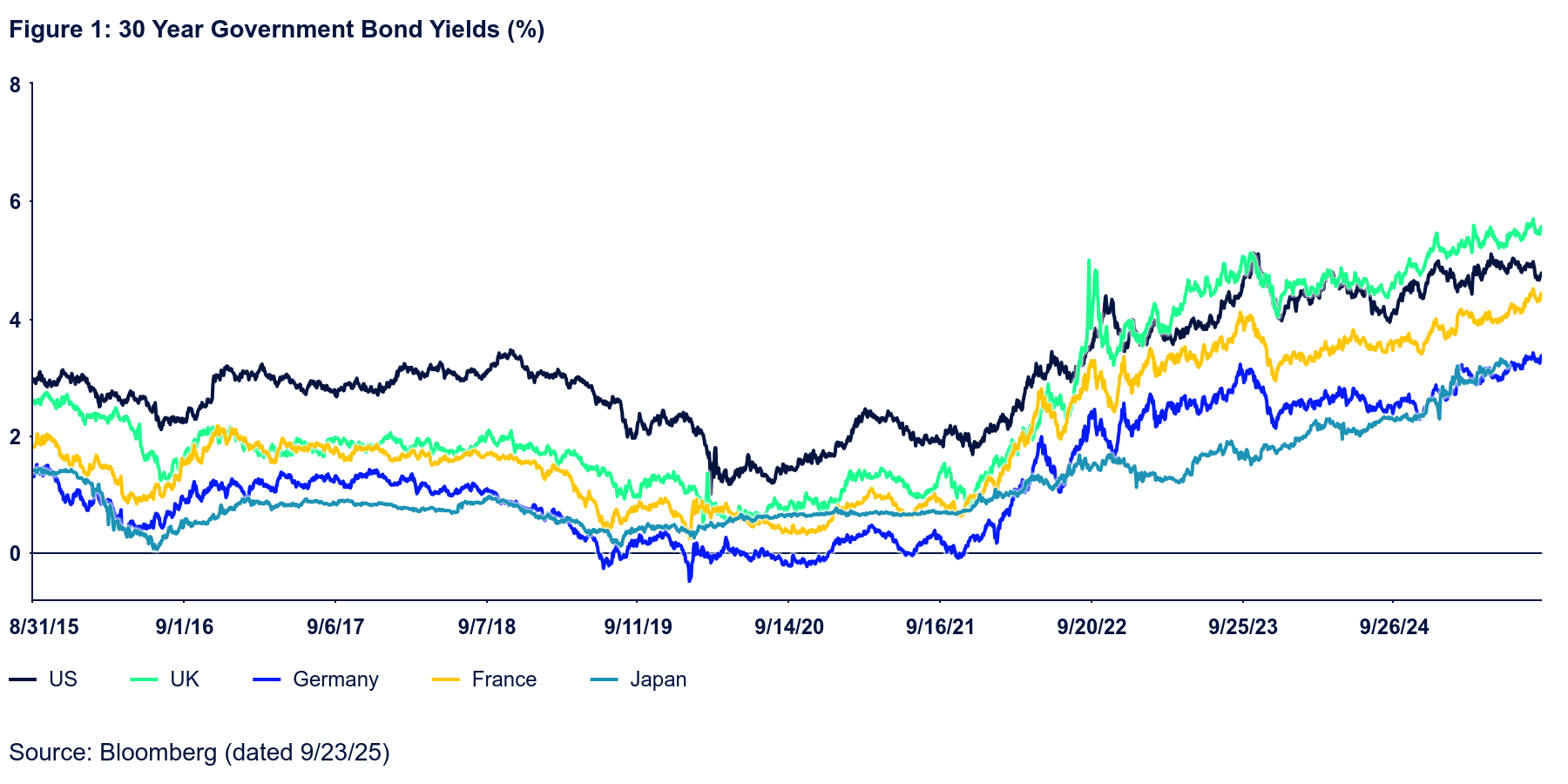
However, one corner of the fixed-income market that we are looking closely at, as it pertains to effectiveness of monetary policy, is the long end of the government bond curve. The selloff in government bonds of many of the world’s largest economies has taken 30-year yields to their highest levels in more than a decade.

Image
figure-1-30-year-governm

It is notable that as policy rates at the respective central banks have come down over the last 12 months, short term rates in these countries have fallen (as expected), but longer-term yields on their government’s bonds have not. This could suggest decreasing confidence that central banks have the ability and willingness to push inflation to or below target levels. There is a term premium associated with demand for long term government debt, as the balance of risks around interest rates and inflation over the medium term have shifted in recent years. The shape of the yield curve plays a pivotal role in financial markets and materially influences credit conditions. Higher bond yields have not made credit conditions restrictive, to date, but many central banks may have a more difficult time delivering sustained lower yields than in the past. Fiscal concerns can cause sovereign term premium to rise, tighten financial conditions in the private sector, and negatively impact demand in the economy. This dynamic is not observed, at present, but it is a risk we are monitoring.

Our investment team continues to monitor our key investment counterparties that are headquartered in each of these jurisdictions. The fiscal situation in France has continued to be a focus for our credit research team and our clients, especially as it pertains to investment opportunities in major French banks. Fitch’s sovereign credit rating downgrade of France to A+, on September 12th, highlighted that France’s sovereign credit profile is on a long-term deteriorating path and its risk is increasing.

However, perspective should be kept. As an example, France’s fiscal challenges are not comparable to Greece’s past sovereign crisis. Several factors differentiate France from Greece and other European peripheral countries that were at the center of Europe’s sovereign debt crisis of the previous decade:

  • France is the 7th largest economy in the world and part of a reserve currency (Euro).
  • It has an above-average savings rate and household wealth.
  • France hasn’t been in recession like Germany.
  • France has valuable exports in pharma and aircraft.
  • Its total debt average maturity is almost 9 years, limiting the impact of near-term increase in refinancing costs.
     

France’s fiscal problems stem from an unsustainable deficit, compounded by political fragmentation. Bringing down the deficit is not an impossible task because of the economic resources that the country has. However, the political will to implement tax increases and spending cuts continues to be absent and will likely only materialize if/when there is significant market pressure. In the near-term, we expect that any contagion from France’s government bond market to the rest of the euro-zone should be relatively muted unless France’s political crisis becomes more pronounced. The conditions for a systemic crisis in the eurozone are not currently in place. European institutions including the ECB now have tools to limit contagion.

Currently, negative sentiment and credit spread risk are the main concerns for French banks on our approval list. Credit fundamentals have held steady — asset quality is stable, capital levels are solid, and funding conditions are healthy. Maturity limits on our investments in French banks also reduce credit and duration risk in our funds. A more bearish outlook would require clear evidence of deteriorating loan quality or capital threats.

Regional Outlook

United States
Results from 2Q25 earnings season, as well as commentary from bank management teams late into 3Q25, indicate that the US banking sector is on solid footing. Major banks largely reaffirmed their full-year outlook and expressed optimism for 2026. Positive EPS revisions are underway, supported by strength in capital markets and wealth management, and possible improvements from regulation and interest rates. A softening labor market remains a key risk, though bank fundamentals appear resilient with high capital levels (despite still-elevated unrealized securities losses), stabilizing or improving asset quality, steadily rising loans, and stable deposit growth. Banks cite strong pipelines and a willingness to lend, maintaining cautious optimism around the economy despite uncertainties on global trade. Often cited themes have included resilient consumer spending, stable employment, and improving business sentiment.

The Fed’s 25bp rate cut in mid-September, with more expected in 2025–26, should broadly support risk assets. For banks, the impact is mixed: asset-sensitive institutions may see initial margin pressure, but lower rates could revive CRE and housing, boost loan demand, and improve credit quality. Lower rates could also benefit capital markets activity. While deposit costs trends should eventually catch-up and support net interest income – and a steeper yield curve should be positive overall for the sector – competition is a variable. Regardless, fixed asset repricing continues to be a key tailwind repeatedly cited by banks, underpinning strong guidance on net interest income into 2026.

Overall, the ‘pro-growth’ policy agenda of the new administration should remain a positive catalyst for US banks over time, with 2026 featuring a greater degree of implementation. More broadly, the sector is moving past a post-GFC era of “recalibration” to one of “optimization”, driven by relaxed regulations and a more normal rate structure, and consolidation is sure to accelerate in upcoming years. Though deregulation is a double-edged sword for creditors, banks with scale and strong management teams are best positioned to harvest the returns on multi-year investments as AI transforms the landscape. More broadly, these banks are in an underappreciated position of strength after having spent years de-risking and bolstering loss-absorbing resources, and they should also benefit from better private sector debt dynamics.


European Banks
European banks generated resilient earnings for the 2Q25 reporting period. Profits are generally down YoY, but net interest income headwinds have become somewhat less intense. Insurance and investment banking (particularly fixed income, currency and commodities) results boosted fee income. Almost all banks beat consensus estimates in the most recent quarter, and a third of banks revised-up full year RoTE guidance. Factors supporting the outlook upgrade include the ECB pausing at 2.00%, clarity on US tariffs, and the steeper yield curve since Germany’s fiscal easing announcement.

Bolt-on M&A has intensified. This includes: Santander selling its Polish bank to Erste, BPCE buying Novobanco in Portugal, and Santander buying TSB in the UK from Sabadell. Large, hostile take-overs faced government resistance (BBVA/Sabadell) and fell apart (UniCredit/BPM).

The 08/01/25 European banking Authority (EBA) stress test confirmed what was already known- banks are vastly more profitable and resilient when interest rates are greater than zero, with almost all banks improving versus the last biannual test. French and German bank results remain near the bottom of stressed capital ratios and serves as a reminder that French banks operate with lower capital levels. Germany’s economy (in terms of GDP) has been struggling for several years, which influences the test parameters.

2Q25 earnings results, continued bond/equity pricing gains, and the bi-annual EBA stress test all reinforced the same message: the earnings quality of European banks is vastly improved compared to 2022,even though the rate cutting-cycle has (marginally) decreased RoTEs versus the highs of 2024. Concerns lie largely outside of the sector, in the form of unsustainable deficits of high-debt European countries (France, Belgium, UK). While wary of the economic and sovereign outlook for Europe, we view the bank sector as resilient and well positioned for these challenges.


Canada
Canadian banks delivered solid 3Q25 results featuring growing core pre-tax pre-provision income growth, positive operating leverage, modest loan growth, and stable capital levels. Net interest margin expansion stood out, supported by reinvestment yields, deposit migration, and disciplined competitive behavior, while capital markets performance was also strong driven by investment banking. While credit costs were below expectations and impaired loan formation saw their smallest sequential increase in years, opinions on the macro backdrop were mixed: some banks signaled caution over the lagged effects of tariff uncertainty and rising unemployment, while others were more neutral. A key watchpoint going forward will be the ’26 mortgage refinancing wave, though the “sticker shock” that may pressure affordability should be cushioned by falling rates. In any case, the sector appears well-placed having built reserves well-above pre-covid levels in recent years. Looking out, clarity on a U.S. trade deal under the USMCA framework could unlock business investment and hiring, but ongoing political friction and brinkmanship risks undermining consumer confidence. This leaves markets focused on whether the Carney administration can deliver on its pro-business policy agenda.


Australia
Australia’s largest bank reported its half-year results in August, broadly in line with expectations, with solid pre-tax, pre-provision profit growth and credit costs beating forecasts on stable trends in problem loans. Consensus sees a below-trend economic recovery over time, but optimism is building as inflation returns to target, modest rate cuts take effect, household confidence improves, and discretionary spending rebounds. Indeed, despite ongoing cost-of-living pressures, consumer arrears have stabilized, lower inflation and tax cuts are boosting disposable income—especially for younger borrowers—and unemployment is historically low. On the business side, conditions are steady and loan impairments have shown signs of improvement, though provisioning has risen with portfolio growth and macro adjustments. On revenue, while net interest margins face pressure from deposit repricing and slower loan growth, the sector benefits from government support, proactive regulation, and a concentrated market structure. Looking out, loan growth could strengthen on the back of lower rates, improving confidence, and strong fiscal momentum.


Japan
Japan’s banking sector is adapting to a fundamentally different operating environment as the country transitions from decades of deflation and ultra-low (or negative) rates to moderate inflation and a positive interest rate regime. After years of compressed net interest margins and sluggish domestic lending—conditions that pushed banks to seek growth overseas—the Bank of Japan’s policy shift in 2024, ending negative rates and raising the benchmark currently to 0.50%, has begun to restore profitability. Major banks have reported stronger results of late, driven by wider lending margins, robust fee income from wealth management, and gains on equity holdings, which more than offset unrealized losses on foreign bond portfolios. Capital positions remain healthy, supported by these equity gains, while asset quality is stable with nonperforming loan ratios holding steady. Still, credit costs and top-line pressure from weaker overseas earnings are risk factors, as well as shrinking unrealized securities gains. Looking out, consensus sees Japan’s economy growing slowly, but the recent trade agreement with the U.S. reduces geopolitical risk and supports loan demand from exporters (i.e., steel & auto), reinforcing a more predictable and constructive backdrop.


Read State Street Investment Management


Disclosures
Marketing Communication

State Street Global Advisors Worldwide Entities

State Street Global Advisors (SSGA) is now State Street Investment Management. Please go to statestreet.com/investment-management for more information.

The whole or any part of this work may not be reproduced, copied or transmitted or any of its contents disclosed to third parties without State Street Global Advisors’ express written consent.
Investing involves risk including the risk of loss of principal.

The views expressed in this material are the views of Peter Hajjar through September 29, 2025 and are subject to change based on market and other conditions. This document contains certain statements that may be deemed forward looking statements. Please note that any such statements are not guarantees of any future performance and actual results or developments may differ materially from those projected.

Bonds generally present less short-term risk and volatility than stocks, but contain interest rate risk (as interest rates raise, bond prices usually fall); issuer default risk; issuer credit risk; liquidity risk; and inflation risk. These effects are usually pronounced for longer-term securities. Any fixed income security sold or redeemed prior to maturity may be subject to a substantial gain or loss.

The value of the debt securities may increase or decrease as a result of the following: market fluctuations, increases in interest rates, inability of issuers to repay principal and interest or illiquidity in the debt securities markets; the risk of low rates of return due to reinvestment of securities during periods of falling interest rates or repayment by issuers with higher coupon or interest rates; and/or the risk of low income due to falling interest rates. To the extent that interest rates rise, certain underlying obligations may be paid off substantially slower than originally anticipated and the value of those securities may fall sharply. This may result in a reduction in income from debt securities income.

All information is from State Street Global Advisors unless otherwise noted and has been obtained from sources believed to be reliable, but its accuracy is not guaranteed. There is no representation or warranty as to the current accuracy, reliability or completeness of, nor liability for, decisions based on such information and it should not be relied on as such.

Past performance is not a reliable indicator of future performance.

The trademarks and service marks referenced herein are the property of their respective owners. Third party data providers make no warranties or representations of any kind relating to the accuracy, completeness or timeliness of the data and have no liability for damages of any kind relating to the use of such data.

These investments may have difficulty in liquidating an investment position without taking a significant discount from current market value, which can be a significant problem with certain lightly traded securities.

The information provided does not constitute investment advice and it should not be relied on as such. It should not be considered a solicitation to buy or an offer to sell a security. It does not take into account any investor's particular investment objectives, strategies, tax status or investment horizon. You should consult your tax and financial advisor.

The information contained in this communication is not a research recommendation or ‘investment research’ and is classified as a ‘Marketing Communication’ in accordance with the Markets in Financial Instruments Directive (2014/65/EU) or applicable Swiss regulation. This means that this marketing communication (a) has not been prepared in accordance with legal requirements designed to promote the independence of investment research (b) is not subject to any prohibition on dealing ahead of the dissemination of investment research.

This communication is directed at professional clients (this includes eligible counterparties as defined by the “appropriate EU regulator” who are deemed both knowledgeable and experienced in matters relating to investments. The products and services to which this communication relates are only available to such persons and persons of any other description (including retail clients) should not rely on this communication.

© 2025 State Street Corporation. All Rights Reserved.
8557140.1.1.GBL.INST 
Exp: 10/31/2026

Share this post

Sign Up Now for Full Access to Articles and Podcasts!

Unlock full access to our vast content library by registering as an institutional investor

Register

Contacts


State Street Investment Management

At State Street Investment Management, we have been helping to deliver better outcomes to institutions,  financial intermediaries, and investors for nearly half a century. Starting with our early innovations in indexing and ETFs, our rigorous approach continues to be driven by market-tested expertise and a relentless commitment to those we serve. With over $4 trillion in assets managed*, clients in over 60 countries, and a global network of strategic partners, we use our scale to create a comprehensive and cost-effective suite of investment solutions that help investors get wherever they want to go.

*This figure is presented as of March 31, 2025 and includes ETF AUM of $1,553.58 billion USD of which approximately $106.42 billion USD in gold assets with respect to SPDR products for which State Street Global Advisors Funds Distributors, LLC (SSGA FD) acts solely as the marketing agent. SSGA FD and State Street Global Advisors are affiliated. Please note all AUM is unaudited.

Benjamin Woloshin   
Head of Insurance    
Benjamin_Woloshin@ssga.com (929) 567-5882

Meta Tomai Curry   
Head of Insurance Strategy   
Meta_Curry@ssga.com (929) 567-5697


One Congress Street, Boston, MA 02114-2016


View the contributor page


Sign Up Now for Full Access to Articles and Podcasts!

Unlock full access to our vast content library by registering as an institutional investor .

Create an account

Already have an account ? Sign in

Ѐ Ё Ђ Ѓ Є Ѕ І Ї Ј Љ Њ Ћ Ќ Ѝ Ў Џ А Б В Г Д Е Ж З И Й К Л М Н О П Р С ΄ ΅ Ά · Έ Ή Ί Ό Ύ Ώ ΐ Α Β Γ Δ Ε Ζ Η Θ Ι Κ Λ Μ Ν Ξ Ο Π Ρ Ё Ђ Ѓ Є Ѕ І Ї Ј Љ Њ Ћ Ќ Ў Џ А Б В Г Д Е Ж З И Й К Л М Н О П Р С Т У Ф Х Ц Ч Ш Ā ā Ă ă Ą ą Ć ć Ĉ ĉ Ċ ċ Č č Ď ď Đ đ Ē ē Ĕ ĕ Ė fi fl œ æ ß