





We're currently experiencing email delivery delays. For urgent matters, please contact us directly at lindsay@insuranceaum.com.

Ares Management Corporation-

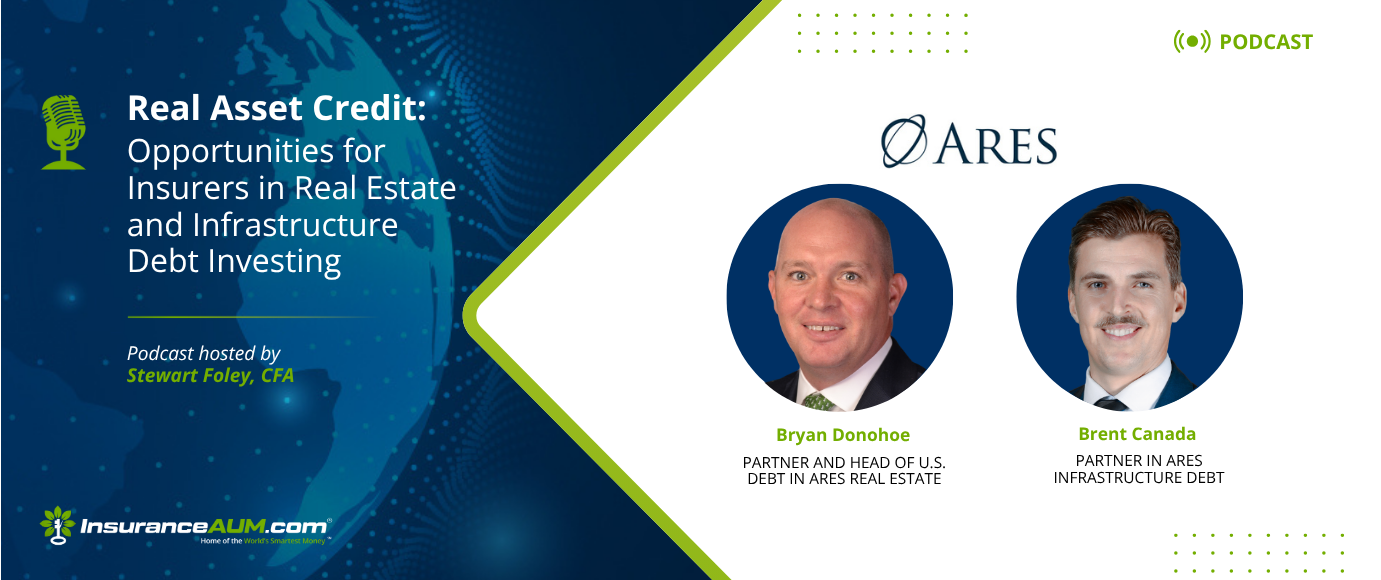
Real Asset Credit: Opportunities for Insurers in Real Estate and Infrastructure Debt Investing

Image
07.01 Ares_Web


Stewart: Hey, welcome back. This is the Insurance AUM.com podcast, and I'm your host, Stewart Foley. And today we're diving into real asset credit, specifically the opportunities for insurance investors in real estate and infrastructure debt. With rising capital charges and volatility in public markets, insurers are seeking stable, income-generating private assets in real estate and infrastructure debt have moved out of the niche areas and into the mainstream, but not all private credit is created equally, and that's where today's conversation begins. Please join me in welcoming two senior leaders from Ares Management, one of the largest and most experienced credit managers in the world. We're joined by Bryan Donohoe, who is a partner and head of US Real Estate Debt and Brent Canada, partner in the infrastructure debt group, both with Ares in the New York office. Gentlemen, thanks for being on. Very happy to have you both.

Bryan: Thanks, Stewart. Good to be here.

Stewart: So, let's get started the way we always do, which is, and we've changed this question just a little bit, we want to know where did you grow up and what was your first concert? So Bryan, I'll start with you. Where'd you grow up and what was the first concert you went to?

Bryan: Yeah, I grew up in Morristown, New Jersey, and my first concert was actually New Kids on the Block, which is difficult to admit, but I think I've outgrown it and added a dose of humility along the way. But that was at the old Brendan Byrne Arena in the Meadowlands.

Stewart: I like it a lot. Go ahead, Brent, how about you? Where'd you grow up and what was your first job?

Brent: First of all, I'm glad that Bryan got the embarrassing answer out of the way. So, I grew up in California at a ski resort and the first concert was we had it in town at the mountain. It was House of Pain, that must've been 13 years old.

Stewart: Wow. There you go. There you go. That's a good one. Alright, so you both started off as you get going here, what was your path to your current positions at Ares? I'll go back to you, Brent. Talk a little bit about how you got here. For folks who listen that are a little earlier in their careers. I know for myself as a first gen college kid, I had no idea how someone becomes a senior person at a firm like Ares. So give us some insights.

Brent: I've spent my whole 25-year career in credit. I started in the Bay area right at the tail end of the dot-com crisis, which also coincided with really kind of the emergence of structured credit and credit derivatives. And I spent the beginning part of my career in these really kind of esoteric asset classes that post-GFC kind of went away and I had to do a bit of a reckoning with my career of where I wanted to go in credit direct lending and private credit was starting to emerge. It was an interesting way for me from an intellectual standpoint to just get closer to the borrowers, closer to the business owners and the entrepreneurs that are actually driving these businesses. And as I started kind of diving deeper into private credit, my path led me to infrastructure.

Stewart: There you go. And how about you, Bryan?

Bryan: Yeah, I think a bit of a winding road, but I guess if I go back to my college experience, I spent my sophomore summer driving an ice cream truck and the real job started the following school year when I had to figure out how to describe what I did that summer in order to get an internship. So what was a relatively simple route down Route 10 in New Jersey became all about sourcing product and managing inventory and marketing and sales, which led me to get an internship the following summer at Deutsche Bank in their real estate credit group. Real estate obviously is cyclical business, but over the following 10, 11 years I was able to touch a lot of real estate but also have a lot of different hats to wear along the way from origination to subordinate debt distribution and then obviously throughout the GFC did a good bit of workouts and actual property management. And fast forward 10 years later, and I joined Ares in December of 2019.

Brent: Incidentally, Bryan and I both worked at Deutsche together, so our paths have reconnected.

Stewart: Oh, very nice. Very nice. Okay, good deal. So Ares is well known and well regarded as one of the largest direct lenders, private credit shops, in the US and globally. You're particularly well known for your sponsor relationships and boots on the ground. Can you talk a little bit about how your respective businesses benefit from that model that Ares has built in your respective spaces?

Bryan: Yeah, I'm happy to start. I mean I think it's a great point, Stewart, that, but if you go back to the culture of our firm, one of the key attributes that I think you'd find fairly uniformly throughout each of our businesses, direct lending, infrastructure, real estate and otherwise, is that we transact with a good bit of integrity. Those sponsor clients you're referencing have grown accustomed to based on the work we do from a diligence perspective at the outset, we're able to do what we said we were going to do. And if you think about all the money that changes hands in a given transaction, when you can be relied upon by those sponsor clients to actually accomplish and put forth the capital that you promised them earlier on, that adds a lot of value, it adds a lot of value for that corporate buyer. It adds a lot of value for a real estate owner. Then in effect, and we're able to pass along the benefits of that to our constituent LPs as well.

Stewart: Super helpful. How about you, Brent?

Brent: Yeah, listen, infrastructure is such a big asset class and these transactions require so much capital that sponsor relationships are critical. And these are private markets, and so originating these deals from those sponsors is a huge amount of the work. And so being on a platform like Ares where we have such a big credit platform and we have institutional relationships with so many different sponsors, it just puts us in this really privileged situation where we see all the deal flow in the market. It allows us to be highly selective and when we do select those deals, we can really put the weight of the organization behind these transactions and support these companies in a meaningful way.

Bryan: I'll cut in there again, if it's okay. But one of the key statistics that we point to along these lines within real estate is that over 70% of our borrowers come back for multiple loans. Sometimes we're sitting here today with some of the largest borrowers in the real estate credit space having taken 6, 7, 8, 10 plus loans from us over time. The efficiency that comes with that, I don't think we could highlight enough.

Stewart: That's a great point. And our firm at InsuranceAUM, we see a lot of interest from insurance investors who are increasingly excited by the world of real asset investing. We hosted a conference in Philadelphia in May, and it was very interesting to see the excitement from insurers around the space. Can you talk a little bit about the benefits of real assets in a private credit portfolio, particularly for an insurance company?

Brent: Yeah, I mean maybe starting with infrastructure, I'd say one of the main benefits is the resilience of the asset class. So infrastructure as a sector, it's characterized by highly defensive companies. These assets provide truly essential services. So we think of kind of non-discretionary demand and there tends to be real barriers to entry. It could be a regulatory barrier, it could be a geographic barrier. So these credits that we put into portfolios are highly defensive, they're very resilient to the macro stresses that we see in times like this, but that doesn't mean you're giving up return. These are transactions that offer significant relative value as compared to public benchmarks. It's not uncommon that we see private deals in the infrastructure space trade anywhere from three to 400 basis points above liquid benchmarks for similarly rated deals. So it is just a really strong relative value thesis.

Stewart: Can you just while you're at it, and I was a municipal treasurer when the earth was cooling still, and I'm familiar with the term essential services, but just in case somebody isn't, can you talk a little bit about how you're defining essential services?

Brent: So it has to be truly non-discretionary. So you think provision of electrical power, everybody needs to power their homes to have electricity to run their life on a day-to-day basis. If we're financing a baseload power plant with a long-term contract with a utility, the power produced by that power plant is non-essential, it’s non-discretionary, a critical part of how people run their lives. And so we see these themes across power, energy, transportation, utilities, digital infrastructure has been a big theme. The digitalization of information and how we're kind of moving and storing kind of all of the data that's being produced is similarly becoming an essential part of how we live.

Stewart: That's super helpful. So Bryan, what about you on the real estate side?

Bryan: Well, there's certainly a lot of similarities between Brent's business and ours, and it really does come down to those contractual cash flows and durable income profile of the asset class. One of the things that we think about is the difference between market value and intrinsic value, and the bedrock of real asset investing is that those assets that we are secured by that provide our collateral, have long-term intrinsic value. You might see markets move, but when you think about loss severities in corporate land, you can effectively have a bankruptcy that would wipe out the overwhelming vast majority of the company. I think what attracts insurance company and liability driven investors to real assets is that there's an underlying bedrock of stability that comes with the assets that we are investing in. Obviously it's not without its cyclicality, but I think the attractiveness comes from that hard asset underlying the collateral.

Stewart: It's interesting, I mean over the last 24 months we've seen significant market volatility, including one of the sharpest interest rate shocks in decades, dislocation in the capital markets, continued pullback from traditional lenders, i.e. banks. From your perspective, how has this environment shaped the opportunity set for real asset lending and how does that translate in positioning your strategies right now?

Bryan: I think one of the, you cite this really generational rise in interest rates, and I don't think anyone was without pain along the way in the real asset sector, right? I think you could have had your underwriting spot on from rents and vacancy within real estate, but the fact is that assets were worth less because of the leverage that exists within the ecosystem of real estate investing. But what that leads to, if you had chosen the right assets, the right markets you've survived. And on the other side of that is a vacuum of supply, both in terms of supply of capital as well as supply of assets. And you are attaching now with a reset with value. The loan to value equation has a very attractive V from an historic basis today. So part of the catalyst for a lot of the interest that you mentioned and you cite from that conference a couple months back is the fact that you can attach at a new lower loan to value, and you can produce durable income along the way as a function of those higher base rates. So, basically I'd say it's a cyclical change that is causing a true secular evolution in the way this asset class is financed, and we are certainly the beneficiaries of it.

Brent: And I wanted to touch on something you said in your question, Stewart, about the pullback from traditional lenders because we talk a lot about in private credit markets that private credit fills the gap that traditional banks have pulled away from. The story's a little bit different in infrastructure. We see the banks still very active lenders to our market just given the resiliency of the underlying asset class. But what's really driving the opportunity set in my mind is there's so much fundamental growth. We need trillions of CapEx to fund the energy transition and the digital transformation and changing the way we move people and products around the world, that funding all of this growth CapEx has exceeded the ability of the banks or the private equity sponsors to support that through traditional means. And so they're coming to private lenders like us to help fill the gap in their CapEx plans.

Stewart: I mentioned being a municipal treasurer and I mean some of those essential services they have to be financed somehow or the other. How often are you partnering with that sort of a sponsor? Is that part of this market or not so much? On the infrastructure side, I mean.

Brent: Yeah, so we're definitely seeing more participants enter our market from the public side, from the private side debt and equity. I think there's been a realization that infrastructure is not only a dynamic asset class, it's a non-correlated asset class and it's a really stable place to put debt and equity capital and really kind of inflation adjusted low default rate assets. So we are seeing more types of partners in this market, and we expect to be working with more types of counterparties on the go forward.

Stewart: Yeah, it's interesting. I mean it gets me to my next question, which is how do you see the role of insurance capital in real asset lending? And we've talked about this on several other podcasts where through some regulatory changes or whatever it may be, some of these assets that were on bank balance sheets are now moving to insurance company balance sheets, and they're beautifully pairing up against the liabilities of various insurance companies. They're a great match. And there's not a risk of a run on the bank, if you will, on the insurance side. So it seems to me that the insurance capital is here to stay. How do you see it?

Brent: I think the convergence between insurance capital and infrastructure, it's honestly, it's one of the most exciting things happening in our market. If I take a step back, most of the large cap infrastructure assets we lend to are investment grade entities. And what that means is that anywhere from 40% to 50% of their total capital structure is investment grade. That investment grade debt isn't going to sit on the bank balance sheets for long term. And given that infrastructure tends to be long life assets, the perfect home for these deals are people that need duration, relative value and spread and investment grade capital. So I just think the more insurance capital comes into this market, I mean it's going to be a huge theme of how we arrange these deals.
Stewart (16:45): If you're an actuary pricing liabilities, that sort of dependable, durable, I think Bryan used the term durable income, that's exactly what they're looking for. Can you talk a little bit about the value proposition of real asset credit for insurance balance sheets and just talk about, I mean we've kind of touched on it, but why insurance companies should be active here?

Bryan: Yeah, I mean, you cited a little bit, Stewart, with respect to the liability matching, but when we take the liabilities, and we can pair them up with durable asset classes like Brent's referencing with super long duration assets that are investment grade in nature, clearly that's a match for a CIO of an insurance company. Within real estate, I think you've got, insurance companies have always been active, but the nature of the play has evolved, right? So it's the same characters just playing a little bit of a different role in terms of where they sit within the capital structure. I think you've seen the evolution where fortunately, or unfortunately, you've seen more and more floating rate and shorter duration investments within real estate as private equity has probably superseded the old family offices or families that owned real estate almost in perpetuity. But the fact is that the transparency that comes with shorter duration investments in real estate credit has allowed for better underlying performance. And the change in the forward curve similarly has produced a lot more durable income. So you're kind of perpetually able to invest into assets with a 3 to 5 year viewpoint alongside anchoring those liabilities with what was traditionally insurance company capital as the 10 to 15 year type credits. So I think it's extremely complementary to what those CIOs are trying to accomplish.

Brent: Yeah, I'd add two other points for your CIO listeners. Number one, if you want exposure to these big multi-trillion dollar mega trends like energy transition and digitalization, infrastructure debt and private investment grade credit within these infrastructure deals is one of the best ways to get allocation. There's just not that many public issuers of data center debt, for example, which has been one of the biggest themes in our portfolio. And then number two, diversification. From a quantitative standpoint have really looked at what is the relative correlation of infrastructure debt relative to corporate credit or even other real assets. And we find that the correlation is very low. And so even within portfolios of private credit, real assets, other kind of credit instruments, infrastructure debt tends to be a diversifier within those portfolios.

Stewart: So let's take a moment just to zero in on each of your sub-markets individually, Brent, there's a lot of different types of infrastructure investing, be it building, improving existing infrastructure or developing entirely new projects. There's also different markets, developed markets, emerging markets. Where does Ares see value and where are you pursuing your investing? And is there anything that you would be cautious on? The last part's optional, but I think it's also helpful for folks who may, I think it's important to hear kind of both sides.

Brent: The way we define infrastructure. I talked on some of the characteristics we want to find assets that provide an essential service have real barriers to entry are characterized by having long-term contracts on both the revenue and the cost side of their business and is underpinned by a tangible asset. And so we typically find these types of assets in the energy sector: power generation, telecommunications, utilities. There's a real kind of divide though between what we call greenfield infrastructure and brownfield infrastructure. Greenfield is when you're going out on a speculative basis and developing a project pre-construction, and then taking the project through construction. Where we see the best opportunities, particularly in this market where there's headline concerns around inflation and tariffs and macro pressure is on what we call brownfield infrastructure. We're lending to an operating asset. It's built, it has contracts in place, it has operating history, and we can really see how the performance of that asset class has kind of occurred through multiple market cycles. So I'd say from an area standpoint, we are strongly skewed towards large cap brownfield projects, and we're pretty cautious around Greenfield right now where there's a lot of construction risk.

Stewart: Bryan, how about you? Real estate debt has been a cornerstone of insurance investing for a long time, especially for life insurance companies in the traditional 10-year fixed rate CML commercial mortgage loan space. Where are you focused at Ares and are there things that you favor, and anything that you're cautious about?

Bryan: Yeah, I think the fact is we try to transact where we have what we characterize as a right to win, where do we have unique insights or ability to operate real estate? So we've built out vertically integrated platforms within real estate in those asset classes that we believe will have long-term durable demand drivers. So for Brent, obviously, that's in the data center space and otherwise where there's a long-term play there. But when we think about it within real estate, where we've been most active has been in industrial and logistics. We've been active in the living space, whether that's student housing, senior housing or apartment living. And even self-storage where we're starting to see behavior shifts obviously away from retail, away from office over the past decade, and we've concentrated our investments in those areas where there's a long-term secular tailwind. The fact is no matter what AI does over the next decade plus, we're still going to need a place to lay our heads at night. And so for-rent housing, we have a structural shortage there and logistics and industrial where we're about the third largest owner and operator in that space globally, we think we've got some unique insights and the fact is everybody has a dozen or so Amazon boxes showing up on their front step every week. So I think we certainly try to pick the right assets in the right markets, but from a macro perspective, that is where we've placed our bets.

Stewart: I'm glad to hear you say that number of Amazon boxes, Bryan, it makes me feel a lot better. So the mega companies always have access to asset classes, but some other insurers may not have that level of scale. What challenges do you see insurers facing when they're accessing your respective markets? I'll go back to you, Bryan. Just a start.

Bryan: Yeah, I think look, scale in this space, Brent touched on the value of the relationships earlier and being able to target those sponsors. I think what we've attempted to do is provide, we talk about the democratization of capital for retail investors, and I think it's the same for insurance companies that might not be at the tip of the tongue or might not have their name on the side of a stadium, right? We've tried to provide capital solutions for our sponsors to benefit from all of the scale that we've created with the data, the information and those relationships, and be able to give insurance companies and other limited partners access to the yields and the durable income that we've referenced throughout. The fact is that by owning, operating and participating in these sectors at scale on a daily basis basis, I think we're able to produce a good bit of alpha for the benefit of some of the smaller players out there.

Stewart: That's super helpful. Brendan, anything there?

Brent: Yeah, I think there's generally two challenges, and I'd segment the market for infrastructure debt between syndicated deals and private deals. So if you're an insurer and you want to participate in the syndicated market infrastructure debt is still a specialized asset class. You actually need specialist investors that can underwrite these deals and evaluate these deals, and it's a somewhat distinct kind of skillset relative to your buyer of investment grade corporate bonds. But even when you're participating in those syndicated deals, getting your right allocation and getting spread targets that hit your yield hurdles can be challenging. And so we're seeing a real opportunity in private bilateral deals where these are large directly originated deals that a platform like Ares would go out and negotiate and structure on behalf of our sponsors and then place these deals directly into insurers. And so having access to those private deals I think is a really important part of portfolio construction in this market.

Stewart: And that's a way for smaller carriers to take advantage of your scale.

Brent: Yeah.

Stewart: Yeah. So, there's a lot of sophistication here and a lot of sophisticated lenders. What does it take to compete at scale in this market when it comes to sourcing and execution? Are there benefits to having flexible capital across the risk spectrum? You talk a little bit about that.

Brent: Yes, and I'd say ‘flexible capital’ is probably one of those terms that gets used so often by everybody. You have to have flexible capital. But I think the key ingredient for Ares is just how long we've had these sponsor relationships and how deep these relationships are. I mean, we've been one of, as you mentioned at the beginning, one of the biggest longest standing lenders in the market. We've got sponsor relationships that go back decades plus. And so when they're thinking about who do we want to work with on a large scale complicated financing, particularly when there's time pressure around it, having that trust that's been built up over a really long time I think is the key piece that differentiates us.

Bryan: Every business is cyclical in some way, but by having that breadth of capital, the dexterity of capital goes from core to core plus to value add to opportunistic. It allows you to really pick your spots at a given point in that market cycle. There's certainly a time to be risk-on as it relates to deploying more capital, but having the flexibility to say, you know what? We're going to effectively de-risk this book. We're going to go up in the capital structure, still create that income profile. But certainly the name of the game in credit investing is to avoid principal loss and to recognize where we're at and to basically take chips off the table while still producing the income profile that comes from a less liquid asset class, I think is where Brent and I both found our chops going back to our days at Deutsche Bank.

Stewart: Well, as you know, there's no discussion of investments is complete without talking about the regulatory landscape. It is evolving, certainly. And how has that impacted, I think we'll go first to infrastructure debt with Brent and then real estate debt with Bryan.

Brent: Yeah, listen, it's a good topic and I think one of the interesting evolutions of the market is the rated note feeder. And this is similar to other private credit vehicles where asset managers and insurers have worked with the rating agencies to structure vehicles that hold sub investment grade debt in a way that's more operationally efficient. And importantly, that results in capital charges, which on a blended basis is much more similar to holding the underlying assets in a separately managed account.

Stewart: Terrific, thank you. How about you Bryan?

Bryan: I think at a very high level, when we think about the participants in the real estate sector, we've seen it get more expensive or more difficult for banks to participate as a direct lender, or competition to ourselves as private lenders and by extension for insurance capital. So, when we think about high grade institutional real estate assets at moderate leverage where an insurance company can effectively invest with a CM1 or a CM2 rating, the capital efficiency is certainly attractive. And like we've talked about elsewhere, the ability to find excess yield when things trip over the wire to some degree. So the regulatory framework, I think overarchingly has made the environment more safe for LPs while still allowing folks to pick the risk that they find most attractive.

Stewart: That's terrific. So this is a question that's kind of, I don't know, it occurs to me and I think it probably occurs to our listeners. So, how do you collaborate as a team within Ares? I mean it's a big company. For example, do you do deals with other parts of Ares? Can you just talk about the dynamic of working inside of Ares?

Brent: Yeah, you hit on the main point. We do deals across the platform. I talked about how big the infrastructure markets are getting. It's not uncommon that deals that we're underwriting are $1 billion if not $2 billion plus in size. And so for us to be able to go and commit to transactions that large as a single lender, because we think we get incremental value in these deals by showing up as a single lender, we have to bring in lots of different partners into these transactions. Our infra debt funds, our direct lending funds, our alternative credit funds, our real estate colleagues. We've really been able to make the argument internally that I talked about a few minutes ago that infrastructure debt is strong relative value, it's resilient, it's low correlation, it plays a role in other portfolios of credit. And so that's how we collaborate. We go out and win big deals and we bring in our partner pools of capital into these transactions.

Stewart: Same for you, Bryan.

Bryan: Yeah, absolutely. The entire firm is based on a culture of collaboration where all of us are better investors together than any of us individually. If you think about, certainly we have teams with a specific charge to generate opportunities based on whether they're on infra, real estate, direct lending or otherwise. But the fact is the information that sits in one business line or another, certainly and there is to the benefit of that deal team. So if you think about a real estate transaction, it's certainly location and supply demand, all of that. But it's what's the credit worthiness of those tenants to continue to pay their rent to create the durable income you referenced earlier, Stewart. So we call in our direct lending colleagues to understand the strength of those corporate tenants. We understand the macro from other parts of the firm, so it is a collaborative culture that benefits each business line.

Brent: Bryan and I actually don't even like each other, but we like pooling our capital together in deals.

Stewart: I find that hard to believe. I'm looking at you two. So it's been a great education on real estate and infrastructure debt investing. We've got a couple of closing ones for you. The first one really attempts to get at the culture of Ares and it goes like this. What characteristics are you looking for when you're adding members to your team? Not really school, not necessarily Python or Excel skills, but what characteristics are you looking for?

Brent: I can go first. It's pretty simple for me, and I kind of look at this from almost all levels of seniority. I want to hire the person that can't believe they got the job at Ares and they show up with a level of humility where it's like, “I'm going to do absolutely everything possible to make this work.” I don't care about the school, necessarily relevant experience, grades. It doesn't matter if they show up and they have that mindset of “I got the seat, I'm going to grab onto it and do whatever I can to keep it.” Those tend to be the best employees I've found.

Stewart: How about you, Brent?

Bryan: I love that. I think that's well said. I would add, I think humility is a superpower as it relates to investing. Kind of with that in the back of your head, thinking about the idea that you might be wrong and therefore going out to prove yourself to be right. But I think Brent's spot on. I mean the energy level that comes from, “Holy cow, I'm pretty blessed to be here.” And then going out and proving the person that hired you to be right as well. That's a pretty strong attribute.

Stewart: Okay. And the last one is totally fun. So you can have the two of you for dinner and-

Brent: Each, we're having dinner together?

Stewart: Yeah, it's you and Bryan and you can each invite one guest alive or dead. Who do you most want to have dinner with? I'm going to start with you, Brent. Give Bryan a little, the benefit of a moment to think, but what do you think?

Brent: This is easy. It's Will Ferrell, but not just any Will Ferrell. It's Talladega Nights’ Will Ferrell.

Stewart: Oh, beautiful. Okay.

Brent: Who are you bringing, Bryan? I brought the comedy. You got to-

Stewart: Are you a racing fan at all?

Brent: No, I'm just a late 90’s comedy- 

Stewart: That's even better. Okay. Bryan, how about you? You got Talladega Nights’ Will Ferrell, you got Brent Canada, you got Bryan Donohoe, and who else?

Bryan: That's a tough one. I think Bill Murray would be a good at if we're going to laugh, but you could also go with the Step Brothers’ vintage Will Ferrell as well.

Stewart: That's awesome. You could get two versions of Will Ferrell at the same dinner would be interesting too.

Bryan: Yeah, why not.

Stewart: Really been a great podcast. Great to have you both on. The topic has been real asset credit opportunities for insurers and real estate and infrastructure debt. We've been joined by Bryan Donohoe, partner and head of US Real Estate Debt, and Brent Canada, partner in the infrastructure debt group, both at Ares in the New York office. Gentlemen, thanks for being on. Certainly appreciate your time. 

Brent: Thanks, Stewart. Great to be here.

Bryan: Same here, Stewart. Thank you.

Stewart: Thanks for listening. If you have ideas for podcasts. Please shoot me a note. It's stewart@insuranceaum.com. Please rate us like us and review us on Apple Podcast, Spotify, or our brand new YouTube channel at InsuranceAUM Community. We are the home of the world's smartest money at InsuranceAUM.com.

Share this post

Sign Up Now for Full Access to Articles and Podcasts!

Unlock full access to our vast content library by registering as an institutional investor

Register

Contacts


Ares Management

Ares Management Corporation (NYSE:ARES) is a leading global alternative investment manager offering clients complementary primary and secondary investment solutions across the credit, private equity, real estate and infrastructure asset classes. We seek to provide flexible capital to support businesses and create value for our stakeholders and within our communities. By collaborating across our investment groups, we aim to generate consistent and attractive investment returns throughout market cycles. As of December 31, 2023, Ares Management Corporation's global platform had approximately $419 billion of assets under management with approximately 2,850 employees operating across North America, Europe, Asia Pacific and the Middle East. For more information, please visit www.aresmgmt.com.

Robert Torretti  
Partner  
Co-Head of Insurance, Americas Relationship Management  
rtorretti@aresmgmt.com212-515-3385

Amanda Healy   
Partner   
Co-Head of Insurance, Americas Relationship Management   
ahealy@aresmgmt.com212-515-3351


www.aresmgmt.com

Ares Management

245 Park Avenue, 44th Floor,

New York, NY 10167


View the contributor page

Image
ARES Logo


Sign Up Now for Full Access to Articles and Podcasts!

Unlock full access to our vast content library by registering as an institutional investor .

Create an account

Already have an account ? Sign in

Ѐ Ё Ђ Ѓ Є Ѕ І Ї Ј Љ Њ Ћ Ќ Ѝ Ў Џ А Б В Г Д Е Ж З И Й К Л М Н О П Р С ΄ ΅ Ά · Έ Ή Ί Ό Ύ Ώ ΐ Α Β Γ Δ Ε Ζ Η Θ Ι Κ Λ Μ Ν Ξ Ο Π Ρ Ё Ђ Ѓ Є Ѕ І Ї Ј Љ Њ Ћ Ќ Ў Џ А Б В Г Д Е Ж З И Й К Л М Н О П Р С Т У Ф Х Ц Ч Ш Ā ā Ă ă Ą ą Ć ć Ĉ ĉ Ċ ċ Č č Ď ď Đ đ Ē ē Ĕ ĕ Ė fi fl œ æ ß