



Barings -

Secondaries Spotlight: Up, Up & Away

BaringsFeatured

With deal volumes projected to hit $230 B in 2025, the secondaries market is booming. Growing investor demand, new capital sources and scalable structures are creating compelling opportunities—though sustained growth will hinge on continued capital access.

Image
Wiese-Ian-portrait
Ian Wiese

Managing Director, Portfolio Finance

In an article penned a year ago, we used the word “staggering” to characterize the growth of the secondaries market over the last three decades, and we predicted that this growth would continue. Predictions, of course, can be dangerous. Who would have predicted the economic policy starting with a “T” would be one of most talked about topics of 2025? Who would have predicted that England would have a summer filled with sunshine or that M&A volumes would continue to remain subdued (again)?

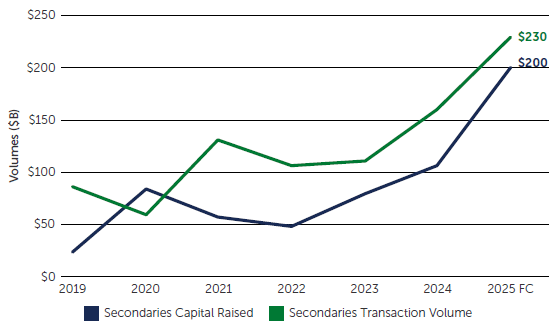
In our case, the prediction of secondaries’ continued ascendance seems to have been correct. In June 2024, many forecasts called for market volumes to exceed $140 billion by the end of that year.1 The figure ended up closer to $160 billion.2 This prompted some market participants to take a more bullish view, predicting that 2025 market volumes would reach $230 billion. To put this in context, transaction volume in 2019 was just $88 billion—six years later it looks on track to reach $230 billion, a compound annual growth rate (CAGR) of 17%+. The word “staggering” feels justified.

With cumulative deal volume over the last five years reaching $645 billion, and investor capital raised during the same period only $294 billion, there is still a significant capital mismatch (Figure 1). There is also consensus in the market that the capital overhang ratio is at its lowest yet, with some estimates putting it as low as 1.3x.3
 

Figure 1: Transaction Volumes Continue to Exceed Fundraising
Image
Graph showing transaction volumes increasing and exceeding fundraising

Sources: Pitchbook; Jefferies. Data on capital raised as of March 31, 2025.
Data on transaction volumes as of June 30, 2025.
 

Against this backdrop, it’s worth revisiting two key questions to assess how the landscape has changed and evolved over the last 12 months:

1. Will fundraising sufficiently keep pace with expected transaction volumes?

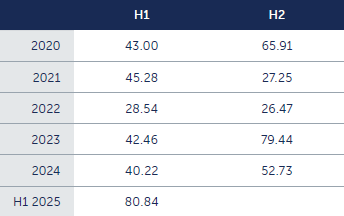
Fundraising got off to a fast start in 2025. During the first half of the year, the total capital raised exceeded $80 billion, up from $40 billion during the same period in 2024. The following trends have also persevered: (i) funds are becoming even larger, (ii) funds are exceeding their target sizes (some by more than 40%), and (iii) new investors are entering the market (retail capital and insurance capital) to supplement existing dry powder. Underscoring the impact of these trends, market estimates suggest that up to $200+ billion will be raised in the next 12 months.
 

Figure 2: Secondaries Year-on-year Fundraising
Image
Table of secondaries year-on-year fundraising

Source: Secondaries Investor. As of June 2025.
 

The use of collateralized fund obligations (CFOs) has unlocked an additional source of investor capital, with a record number of new issuances providing broad-based support for secondary fundraising initiatives. These instruments allow certain investors to invest in rated debt (rather than equity), which is much more capital efficient and allows for investment at scale. These vehicles also allow sponsors to tailor solutions for investors seeking higher returns than what a traditional LP investor may be targeting.

So, while forecasts suggest fundraising will still fall short of total volumes, the gap in 2025 is likely to narrow and will ease some pressure on the capital overhang ratio in the short term.

2. Is the secondary market adequately capitalized for the significant growth expected in years to come?

Macroeconomic and geopolitical uncertainty have kept traditional M&A deal volume subdued, with current activity hovering near historic lows (exit activity is down 25%4 year-on-year). This dearth has served as a tailwind to the secondaries market, driving strong growth in LP and GP led volumes as investors and buyout managers look to counteract the lack of liquidity.

When it comes to assessing the secondary market’s current capitalization, the capital overhang ratio is one indicator to determine whether an industry is adequately capitalized and well positioned to sustain volume growth.

Capital Overhang Ratio = Available Capital (current dry powder plus near-term fundraising [A] + level of debt available [B]) / Secondary deal volume [C].

Generally speaking, the higher the capital overhang ratio, the more capital there is available to sustain future deal volume. More specifically, a higher overhang ratio may lead to heightened competition for new deals, potentially driving pricing up as discounts shrink and decrease investor returns. A low overhang ratio, on the other hand, may curtail further market growth.

Today, the capital overhang ratio in the secondary market has fallen to 1.3x, its lowest level since 2021.5 This suggests that despite a strong growth trajectory, undercapitalization is a potential concern for further growth. Without additional fundraising or use of leverage, some estimates suggest there are only 12–18 months of dry powder available—which is considerably lower relative to other private market segments. Going forward, our calculations suggest the capital available (before the use of debt) as a percentage of deal volume in the secondary market is likely to remain between 1.16x and 1.48x. For context, capital overhang ratios for many other private market asset classes fall between 1.8x and 2x.

BREAKING DOWN THE CAPITAL OVERHANG RATIO

A breakdown of the secondary market’s capital overhang ratio and the current drivers of each component provides further context:

[A] Fundraising

This is likely to exceed $200 billion in 2025 given the lack of M&A, increased investor allocation, and the introduction of new investor types.

[B] The level of debt available to a secondary manager

Secondary managers have access to various forms of financing tools to assist with portfolio management, acquisitions and distributions, as well as to manage their own capital overhang ratios. The introduction of non-bank capital has been, and will continue to be, critical to filling the funding gap that has resulted from the balance sheet constraints on traditional banks.

[C] Deal volume

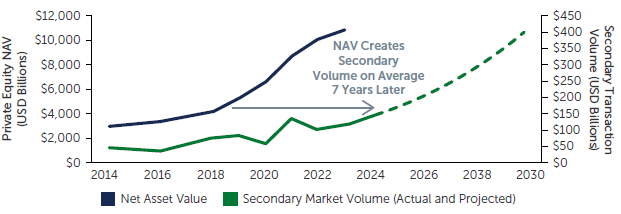
Secondary market volume neatly matches NAV growth offset by seven years.6 This growth in NAV suggests the value of secondary transactions may double from around $200–230 billion forecast in 2025 to more than $400 billion in 2030.7 Ensuring that there will be sufficient capital available to absorb this volume is a key consideration for market participants.
 

Figure 3: Potential NAV Growth Suggests Further Expansion of Secondaries
Image
Graph showing increase in NAV and projected secondary market volume

Sources: Preqin database, Assets Under Management by Date. As of January 22, 2024. Greenhill Global Secondary Market Trends & Outlook. As of January 2024. Evercore FY 2023 Secondary Market Survey Results—Highlights. As of January 2024.
 

“Funds are becoming even larger and exceeding their target sizes as new investors are entering the market. Underscoring the impact of these trends, market estimates suggest up to $200+ billion will be raised in the next 12 months.”

Key Takeaway

The secondary market continues to grow in leaps and bounds, and raising capital remains a primary consideration for managers seeking to benefit from the expected increase in deal volume. On this front, the market has demonstrated success as (1) new investor types, such as retail and insurance, have entered the market, and (2) existing investors have increased their allocations. The inherent diversification potential and steady cash flows characteristic of this market, coupled with the ability to now gain exposure to the market through investment grade offerings, should continue to drive these trends.

That said, deal volumes are expected to continue to outpace capital raising going forward as the secondary market expands across both asset classes and product offerings. While there is enough capital currently to absorb these short-term volumes, there are questions around whether sufficient dry powder can be sustained over the next two to five years.

It is also clear that secondary sponsors will be required to actively manage their own capital overhang positions to ensure they can continue to share in the expected increase in transaction volumes. But it is often the “B” in the capital overhang equation that doesn’t receive the attention it deserves—and, indeed, it may be the capital market teams (rather than investor relations) that become the crucial component in helping secondary sponsors raise different forms of capital to sustain future growth.


Read More From Barings


Barings is a $456+ billion* global asset management firm that partners with institutional, insurance, and intermediary clients, and supports leading businesses with flexible financing solutions. The firm, a subsidiary of MassMutual, seeks to deliver excess returns by leveraging its global scale and capabilities across public and private markets in fixed income, real assets and capital solutions.

IMPORTANT INFORMATION
Forecasts in this document reflect Barings’ market views as of the preparation date and may change without notice. Projections are not guarantees of future performance. Investments involve risk, including potential loss of principal. The value of investments and any income may fluctuate and are not guaranteed by Barings or any other party. PAST PERFORMANCE IS NOT INDICATIVE OF FUTURE RESULTS. Examples, portfolio compositions, and investment results shown are for illustrative purposes only and do not predict future outcomes. Actual investments may differ significantly in size, composition, and risk. No assurance is given that any investment will be profitable or avoid losses. Currency exchange rate fluctuations may impact investment value. Prospective investors should consult the offering documents for detailed information and specific risk factors related to any Fund/Strategy mentioned.
Barings is the brand name for the worldwide asset management and associated businesses of Barings LLC and its global affiliates. Barings Securities LLC, Barings (U.K.) Limited, Barings Australia Pty Ltd, Barings Japan Limited, Baring Asset Management Limited, Baring International Investment Limited, Baring Fund Managers Limited, Baring International Fund Managers (Ireland) Limited, Baring Asset Management (Asia) Limited, Baring SICE (Taiwan) Limited, Baring Asset Management Switzerland Sarl, Baring Asset Management Korea Limited, and Barings Singapore Pte. Ltd. each are affiliated financial service companies owned by Barings LLC (each, individually, an “Affiliate”). Some Affiliates may act as an introducer or distributor of the products and services of some others and may be paid a fee for doing so.
NO OFFER: The document is for informational purposes only and is not an offer or solicitation for the purchase or sale of any financial instrument or service in any jurisdiction. The material herein was prepared without any consideration of the investment objectives, financial situation or particular needs of anyone who may receive it. This document is not, and must not be treated as, investment advice, an investment recommendation, investment research, or a recommendation about the suitability or appropriateness of any security, commodity, investment, or particular investment strategy, and must not be construed as a projection or prediction.
Unless otherwise mentioned, the views contained in this document are those of Barings. These views are made in good faith in relation to the facts known at the time of preparation and are subject to change without notice. Individual portfolio management teams may hold different views than the views expressed herein and may make different investment decisions for different clients. Parts of this document may be based on information received from sources we believe to be reliable. Although every effort is taken to ensure that the information contained in this document is accurate, Barings makes no representation or warranty, express or implied, regarding the accuracy, completeness or adequacy of the information.
Any service, security, investment or product outlined in this document may not be suitable for a prospective investor or available in their jurisdiction.
Copyright and Trademark
Copyright © 2025 Barings. Information in this document may be used for your own personal use, but may not be altered, reproduced or distributed without Barings’ consent.
The BARINGS name and logo design are trademarks of Barings and are registered in U.S. Patent and Trademark Office and in other countries around the world. All rights are reserved.

1. Source: Jefferies. As of June 30, 2024.
2. Source: Evercore H1 2025 Secondary Market Report.
3. Source: Evercore H1 2025 Secondary Market Report.
4. Grant Thornton Private equity mid-year review 2025: Insights for what’s next. As of June 2025.
5. Source: Jefferies. As of June 30, 2024. Read with Evercore H1 2025 Secondary Market Report.
6. Sources: Preqin database. As of January 2024. Greenhill Global Secondary Market Trends & Outlook.
As of January 2020. Evercore FY 2023 Secondary Market Survey Results-Highlights. As of January 2024.
7. Sources: Preqin; Greenhill; Evercore. As of February 6, 2024.

Share this post

Sign Up Now for Full Access to Articles and Podcasts!

Unlock full access to our vast content library by registering as an institutional investor

Register

Contacts


Barings

Barings is a $470+ billion* global asset management firm that partners with institutional, insurance, and intermediary clients, and supports leading businesses with flexible financing solutions. The firm, a subsidiary of MassMutual, seeks to deliver excess returns by leveraging its global scale and capabilities across public and private markets in fixed income, real assets and capital solutions.  

*As of September 30, 2025

Ilena Coyle
Head of North American Insurance and Intermediary  
ilena.coyle@barings.com973-271-2400

www.barings.com
 
300 South Tryon St, Suite 2500,
Charlotte, NC 28202


View the contributor page

Sign Up Now for Full Access to Articles and Podcasts!

Unlock full access to our vast content library by registering as an institutional investor .

Create an account

Already have an account ? Sign in

Ѐ Ё Ђ Ѓ Є Ѕ І Ї Ј Љ Њ Ћ Ќ Ѝ Ў Џ А Б В Г Д Е Ж З И Й К Л М Н О П Р С ΄ ΅ Ά · Έ Ή Ί Ό Ύ Ώ ΐ Α Β Γ Δ Ε Ζ Η Θ Ι Κ Λ Μ Ν Ξ Ο Π Ρ Ё Ђ Ѓ Є Ѕ І Ї Ј Љ Њ Ћ Ќ Ў Џ А Б В Г Д Е Ж З И Й К Л М Н О П Р С Т У Ф Х Ц Ч Ш Ā ā Ă ă Ą ą Ć ć Ĉ ĉ Ċ ċ Č č Ď ď Đ đ Ē ē Ĕ ĕ Ė fi fl œ æ ß