


Morgan Stanley Investment Management -

Semi-Liquid Private Credit: A Quiet Revolution

IAUM Article - 2026-03-05T142058.130

Key Points

  • Innovative fund structures in private markets have opened the once closed door to alternatives investing to the intermediary and wealth management channels.
  • These structures, known as semi-liquid funds, offer a number of key advantages for wealth investors with features designed to meet their unique liquidity, risk and performance needs.
  • Semi-liquid funds have grown fastest in private credit, an asset class exhibiting liquidity, diversification and valuation features that are well suited to these structures.

Democratizing access to alternatives
A recent report projects that alternatives AUM will rise to $32.0 trillion by 2030, having more than doubled since 2021.1 As alternative asset investing continues to see robust growth, the investor base is inevitably broadening out as fund providers innovate to meet a more diversified set of investor needs.

In particular, the wealth management segment is fast emerging as a key growth area. Our own research indicates that alternatives could reach 5% of U.S. wealth management assets by 2029, up from 3.5% in 2025, a rise of $2.7 trillion in assets.2 Investor requests for increased liquidity and accessibility has been a an increasingly important feature of the alternatives’ quiet but steady take-off in the wealth channel.

Asset managers are responding to these needs by developing new fund structures and adjusting strategies to help address their varied requirements. In short, they are “democratizing” access by taking a range of private markets asset classes that have historically been the preserve of institutional investors and making them available to a wider investor audience.

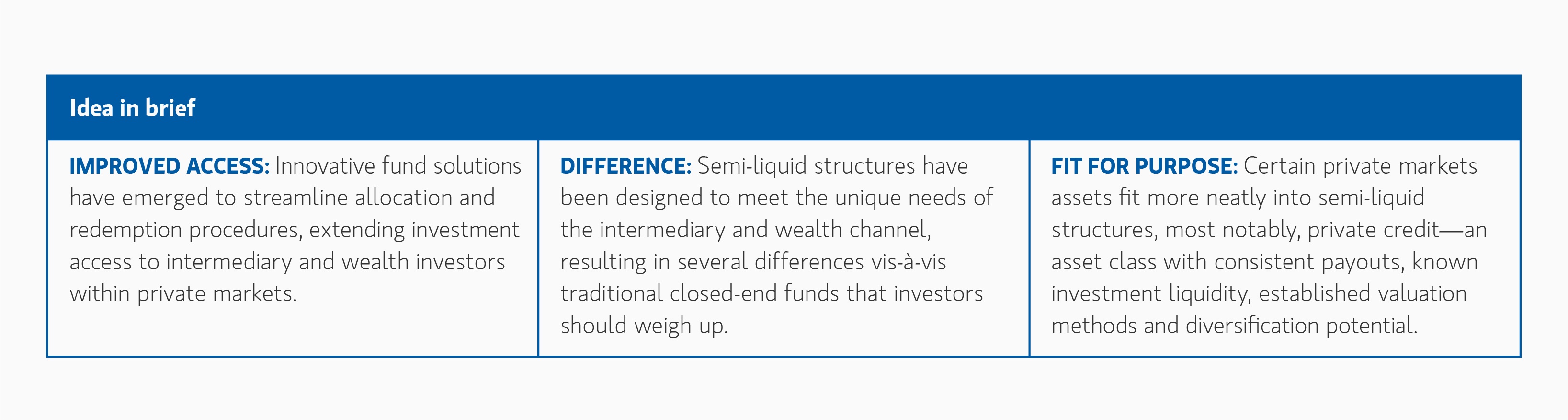
Often called semi-liquid funds, these innovative structures offer several advantages for professional and non-professional investors catered to in the wealth management channel.

There are also important liquidity and performance considerations to which investors should remain aware. In this paper, we walk through the main features of semi-liquid funds. We then highlight semi-liquid funds’ suitability for private credit, an increasingly in-demand private markets sector.

Investing on an ongoing basis
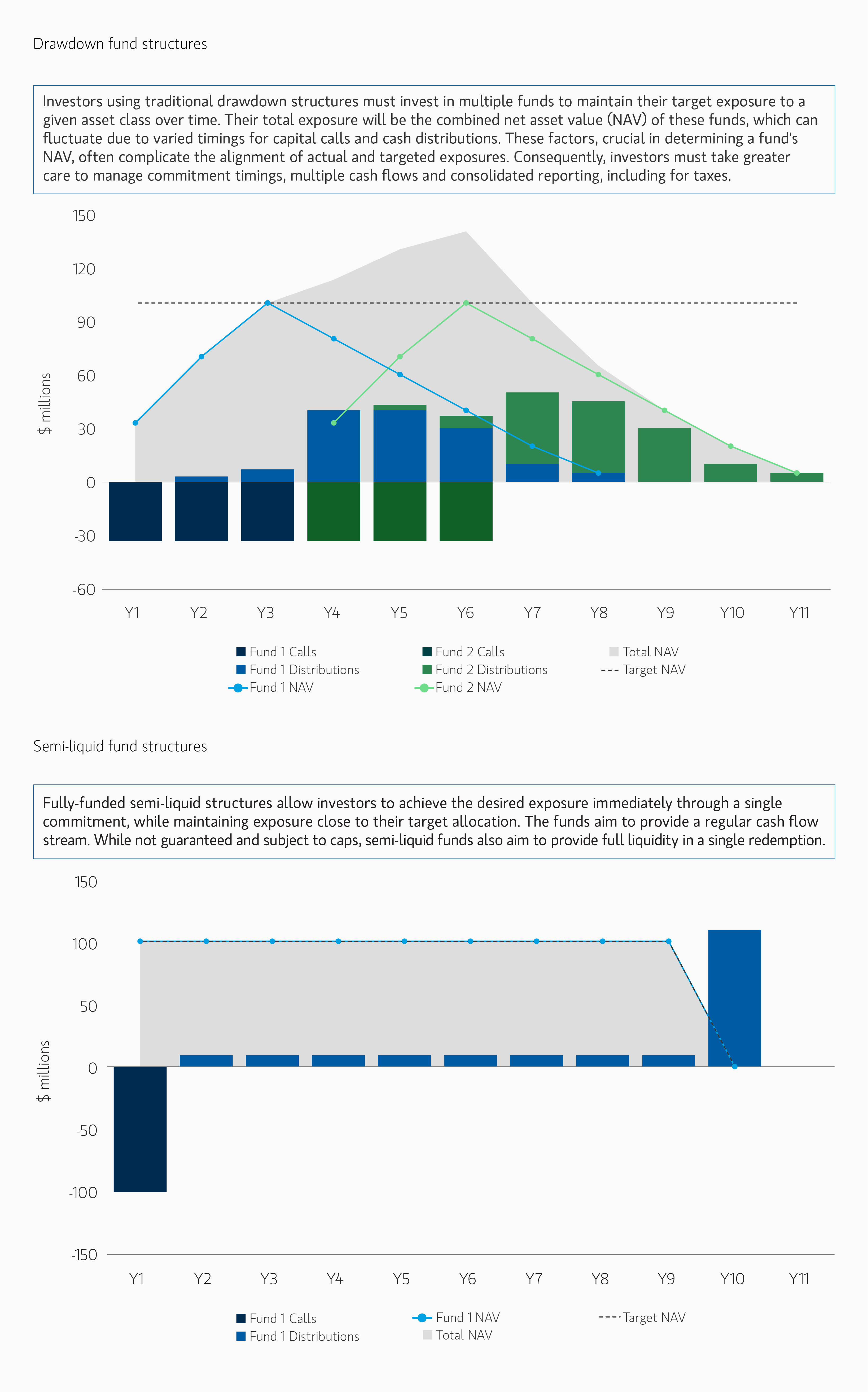
Traditional private market funds, known as drawdown or close ended funds, typically have a pre-defined marketing period after which the investment manager (“General Partner” or “GP”) gradually calls down investor (“Limited Partner” or “LP”) capital subscriptions, typically over four to six years. In contrast, semi-liquid funds are open ended and provide ongoing access, allowing asset owners to remain invested for as long as they choose. From the investor perspective, this is often seen as the democratization of alternatives, placing them closer to traditional investments in how they are transacted. To attract investors into these new structures, investment minimums have also been lowered by some regulators through the introduction of new types of investment vehicles.

Calls and distributions: Semi-liquid vs. drawdown funds
DISPLAY 1

Image
insight_the-quiet-revolution-in-private-markets_Display-1

Source: Morgan Stanley Investment Management. As of November 12, 2024. The statements above reflect the views and opinions of MSIM as of the date hereof and not as of any future date and will not be updated or supplemented. For illustrative purposes only and is not representative of any actual or anticipated transactions. Historical trends are not indicative of future results. All forecasts are subject to change and may not come to pass due to changes in market or economic conditions.


Beyond stop/start due diligence
Intermediaries and wealth managers spend a large part of their time performing due diligence on behalf of investors to put products “on platform.” When funds are closed-ended, the process typically requires them to perform due diligence on the fund manager and the strategy. Then, they repeat that process each time the manager comes to market.

For each closed-end fund, the allocator must engage their due diligence team in an episodic fashion and then, upon approval of the due diligence work, promote the offering within a typical short and constrained marketing window. Open-end semi-liquid solutions alleviate stop/start due diligence. Their structure allows the intermediary or allocator to underwrite upfront and then focus on monitoring and ongoing marketing rather than continuously reengaging a new process each time.

“On the shelf” product availability allows investors to gain exposure at the time of their choosing. In a way, the convenience is not unlike allocating to a series of funds over time, but in a much more efficient manner that grants investors greater choice in their given exposure and vintage diversification. Unlike closed-end funds, if conditions change, semi-liquid structures provide investors the flexibility to halt allocations as they see fit.

Operational simplification
From an operational standpoint, avoiding the demands of periodic capital calls appeals to intermediaries and end investors alike. In semi-liquid structures, capital is committed and called just once, after which time investors can opt to make additional subscriptions. For many investors, the ability to make a one-time commitment, as they would in traditional funds, is highly valued. Compare this to a typical private markets closed-end fund: Capital calls and investment occur over several years, obligating the investor to carefully manage capital that has been committed in order to meet future calls.

For intermediaries and wealth managers, semi-liquid funds are less resource intensive. The need for operational teams to monitor and communicate upcoming capital calls or past calls that an investor may have delayed or missed is far reduced in the semi-liquid format.


DISPLAY 2

Image
insight_the-quiet-revolution-in-private-markets_Display-2

Considerations

Investment Return
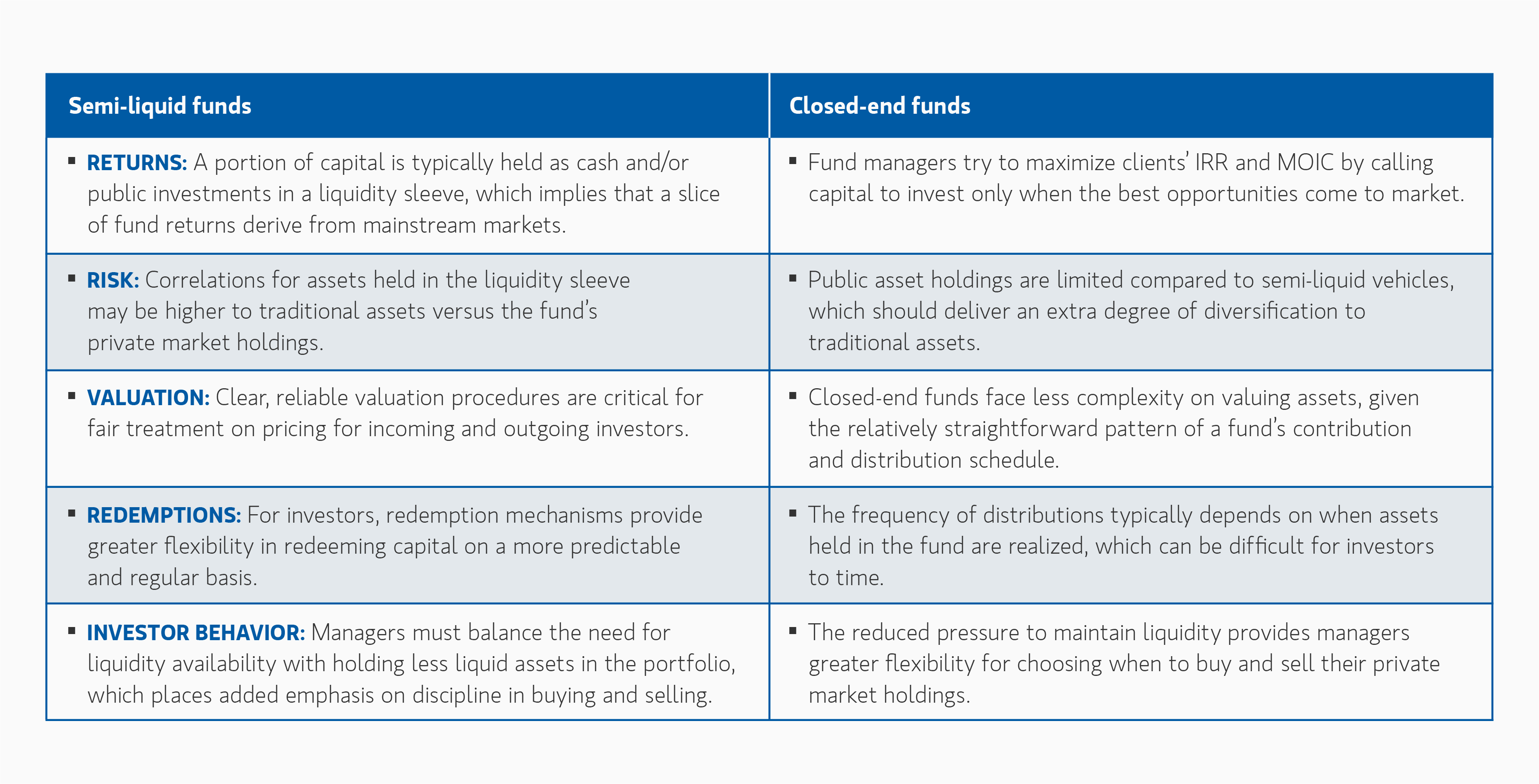
Traditional closed-end funds are designed for specific investment reasons. For example, by calling capital only when needed, fund managers try to maximize clients’ internal rate of return (IRR) and multiple of invested capital (MOIC) by investing in the best opportunities when they come to market. The arrangement gives investors optionality on their use of that cash in the period when their closed-end fund manager is not calling capital.

The upfront investment for semi-liquid funds may have different return implications. Responsibility for capital deployment passes to the fund manager, who must endeavor to act promptly to avoid “cash drag” on returns, i.e. the lower return of cash sitting in the portfolio diluting the overall return. But by trading off control of cash flow timings, the manager of the semi-liquid fund typically has to maintain a “liquidity sleeve,” consisting of cash and/or public market investments, to hold capital if it cannot immediately be matched with a private investment opportunity.

The untapped capital in the liquidity sleeve may affect the overall return, depending, of course, on how it performs in comparison to the private market targeted. Investors evaluating semi-liquid funds will have to consider this feature and decide if the illiquidity premium is acceptable and whether having some liquidity is justified.

Risk Profile
With upfront capital calls in semi-liquid funds, the investment manager must deploy the capital fully. As mentioned, managers unable to invest quickly into private markets may invest elsewhere, such as mainstream asset classes. Inevitably, such exposure could increase the correlation to traditional markets. Understanding how such exposure affects the risk profile warrants some consideration by investors.

Valuation
Confidence and accurately calculating valuations for both incoming and exiting investors is paramount in semi-liquid structures. For instance, issues could arise if investors exit at heightened valuations and this occurs at the expense of remaining investors. Likewise, investors coming in at undervalued entry points could disadvantage other fund participants. Valuation issues can, of course, be mitigated through appropriate valuation procedures. Investors should test the procedures through the due diligence process and select only those strategies that display a consistent ability to price investments in a fair manner for all investors.

Like semi-liquid structures, reliable valuation methods for closed-end funds are also key. However, the more synchronous nature of calling and distributing capital to all fund investors on a simultaneous basis reduces the complexity on pricing that is faced by semi-liquid funds.

Redemption Benefits
Investors will always find the ability to make redemptions at their own discretion to be an attractive feature. Semi-liquid structures facilitate choice in redemptions compared to less liquid conventional private market solutions. Specifically, semi-liquid funds feature an option that allows periodic redemptions, typically on a quarterly basis subject to fund level gates (a mechanism in place to restrict redemptions when over a set percentage). The redemption mechanism lets fund managers pay out cash in an orderly fashion, giving investors the option to adjust their exposure over time and to tap liquidity from a hitherto less liquid solution.

Other liquidity provision mechanisms include subscriptions replacing redemptions and, in some cases, credit lines; both, while helpful, should not be fully depended on.

Investors should assess the redemption options to determine what is most appropriate for their needs. They must also consider any potential trade-offs in their sought-after illiquidity premium and whether they believe they will receive a commensurate level of return and risk. Answers will vary for each semi-liquid strategy and individual investor appetite.

Other Investor Behavior
By introducing additional liquidity demands, manager behavior may change and influence the fund’s risk-and-return profile. In a semi-liquid structure, the manager may be under pressure to deploy cash quickly to avoid cash drag and in response lower underwriting standards. They may also need to satisfy redemptions by selling to meet investor orders. In contrast, more traditional structures grant managers the flexibility to deploy and liquidate as they see fit over time.

Consequently, the investment process is not as straightforward for the semi-liquid fund manager. They have to employ a disciplined approach to asset sales in order to avoid becoming a forced seller. Gating mechanisms, which allow managers to limit redemptions, do help with this. However, they may risk some client dissatisfaction if mishandled. Managers can also mitigate liquidity risks by having a diversified investor base.

Key differences
DISPLAY 3

Image
insight_the-quiet-revolution-in-private-markets_Display-3

Popularity in Private Credit 
Private credit is a growing private markets segment with gross invested assets of roughly $3 trillion globally.3

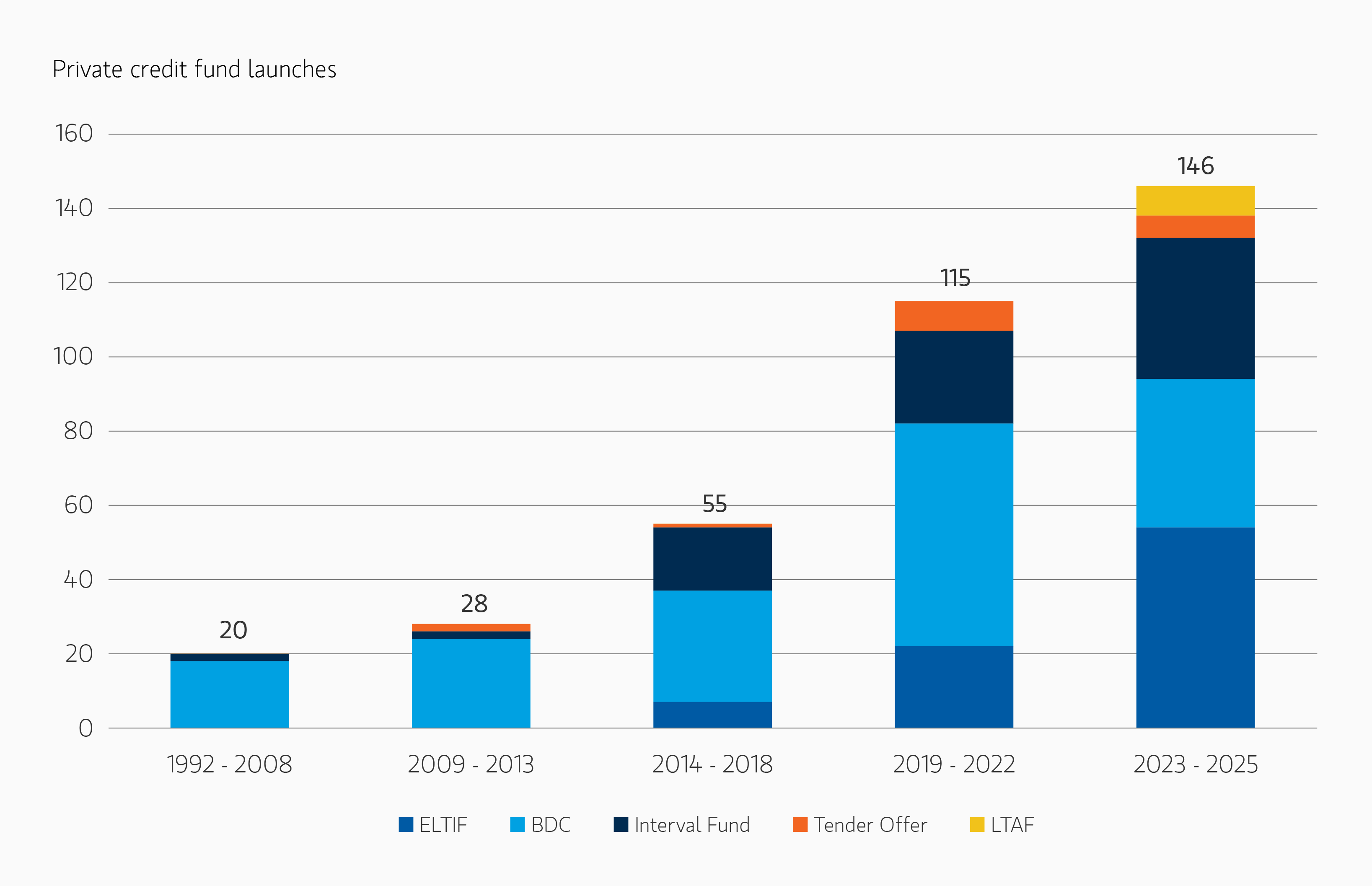
Semi-liquid vehicles are becoming part of this growth story, helped by rising numbers of fund launches in recent years, particularly over 2023 to 2025 (Display 4).

While the availability of semi-liquid funds is increasing across private markets, private credit has been the fastest growing segment to date. The principal investment structures include BDCs, European Long-Term Investment Funds (ELTIF), interval funds and tender offers. Part II SICAV structures are also becoming recognized and available in Europe and Asia.

That the asset class has seen such strong growth is not surprising. Private credit securities exhibit several characteristics that are well suited to a semi-liquid structure, including:

  • Contractual payouts through regular coupons 
  • Known liquidity through return of principal at term 
  • Consistent valuation through standardized metrics

Private credit funds proliferate to meet increasing investor demand
DISPLAY 4

Image
insight_the-quiet-revolution-in-private-markets_Display-4

Source: Preqin, Morgan Stanley Investment Management. As of December 31, 2025.

Conclusion
The growth of semi-liquid funds is likely to continue and, as highlighted, there are many positives for investors seeking exposure to private markets through these vehicles. Importantly, there are a number of key differences when compared to traditional closed-end funds that merit investor consideration. Investors should also consider the investment characteristics of individual asset classes within an open-ended structure and how an allocation could complement their overall strategy. The availability of semi-liquid vehicles is rising across the alternatives space, with their largest increase in private credit. While this isn’t surprising, given the asset class’s suitability for these structures, we believe it is only the start of a longer-term secular trend across private markets. Simply put, wealth investors, like their institutional peers, want access to private markets’ potential return and diversification benefits – and now that’s becoming possible.


READ MORE FROM MORGAN STANLEY INVESTMENT MANAGEMENT


1 Preqin. "Private Markets in 2030." October 16, 2025.
2 Morgan Stanley Research, "Private Wealth: Capturing the Next Wave of Growth." May 22, 2025.
3 PitchBook. 2029 Private Markets Horizons  report. As of December 31, 2024.

IMPORTANT INFORMATION

The views and opinions are those of the author as of the date of publication and are subject to change at any time due to market or economic conditions and may not necessarily come to pass. The views expressed do not reflect the opinions of all investment personnel at Morgan Stanley Investment Management (MSIM) and its subsidiaries and affiliates (collectively the Firm”), and may not be reflected in all the strategies and products that the Firm offers.

This material is for the benefit of persons whom the Firm reasonably believes it is permitted to communicate to and should not be forwarded to any other person without the consent of the Firm. It is not addressed to any other person and may not be used by them for any purpose whatsoever. It is the responsibility of every person reading this material to fully observe the laws of any relevant country, including obtaining any governmental or other consent which may be required or observing any other formality which needs to be observed in that country.

This material is a general communication, which is not impartial, is for informational and educational purposes only, not a recommendation to purchase or sell specific securities, or to adopt any particular investment strategy. Information does not address financial objectives, situation or specific needs of individual investors.

Any charts and graphs provided are for illustrative purposes only.

Past performance is no guarantee for future performance.  The value of money invested in the fund can increase or decrease and there is no guarantee that all of your invested capital can be redeemed

Any performance quoted represents past performance. Past performance does not guarantee future results.

For the complete content and important disclosures, refer to the article PDF.

This is a Marketing Communication.

FINRA BrokerCheck. Investors may check the background of their Investment Professional by contacting the Financial IndustryRegulatory Authority (FINRA). FINRA BrokerCheck is a free tool to help investors check the professional background of current andformer FINRA-registered securities firms and brokers. FINRA BrokerCheck is available by calling 1-800-289-9999 and at www.FINRA.org. The FINRA BrokerCheck brochure describing this program is available to investors at www.FINRA.org.

Before investing in any Eaton Vance, Calvert or Morgan Stanley Investment Management Inc.-advised fund, prospective investors should consider carefully the investment objective(s), risks, and charges and expenses. Read the prospectus carefully before you invest or send money. For open-end mutual funds, the current prospectus contains this and other information. To obtain an open-end mutual fund prospectus or summary prospectus and the most recent annual and semiannual shareholder reports, contact your financial advisor or download a copy here. For closed-end funds, you should contact your financial advisor. To obtain the most recent annual and semi-annual shareholder report for a closed-end fund contact your financial advisor or download a copy here. To obtain an exchange-traded fund, ("ETF") prospectus or summary prospectus, contact your financial advisor or download a copy here.

Before purchasing any variable product, consider the objectives, risks, charges, and expenses associated with the underlying investment option(s) and those of the product itself. For a prospectus containing this and other information, contact your investment or insurance professional. Read the prospectus carefully before investing.

See the Fund's prospectus for information related to a primary benchmark index selected (if applicable) to comply with a regulation that requires the Fund's primary benchmark to represent the overall applicable market.

The information on this Web page is for U.S. residents only and does not constitute an offer to sell, or a solicitation of an offer to purchase, securities in any jurisdiction to any person to whom it is not lawful to make such an offer.

Eaton Vance, Atlanta Capital, Parametric and Calvert are part of Morgan Stanley Investment Management.  Morgan Stanley Investment Management is the asset management division of Morgan Stanley.

MSIM, the asset management division of Morgan Stanley (NYSE: MS), and its affiliates have arrangements in place to market each other’s products and services.  Each MSIM affiliate is regulated as appropriate in the jurisdiction it operates. MSIM’s affiliates are: Eaton Vance Management (International) Limited, Eaton Vance Advisers International Ltd, Calvert Research and Management, Eaton Vance Management, Parametric Portfolio Associates LLC, and Atlanta Capital Management LLC.

Morgan Stanley Distribution, Inc. serves as the distributor for Morgan Stanley Funds. Morgan Stanley Distribution, Inc. Member FINRA / SIPC. Eaton Vance open-end mutual funds are offered through Eaton Vance Distributors, Inc. One Post Office Square, Boston, MA 02109. Member FINRA/SIPC. Exchange-traded funds are distributed by Foreside Fund Services, LLC.

It is important that users read the Terms of Use before proceeding as it explains certain legal and regulatory restrictions applicable to the dissemination of information pertaining to Morgan Stanley Investment Management's investment products.

The services described on this website may not be available in all jurisdictions or to all persons. For further details, please see our Terms of Use.

To report a website vulnerability, please go to Responsible Disclosure.

For USA PATRIOT Act Disclosure Notice please click here.

NOT FDIC INSURED | OFFER NO BANK GUARANTEE | MAY LOSE VALUE | NOT INSURED BY ANY FEDERAL GOVERNMENT AGENCY | NOT A DEPOSIT

© 2026 Morgan Stanley. All rights reserved.

Share this post

Sign Up Now for Full Access to Articles and Podcasts!

Unlock full access to our vast content library by registering as an institutional investor

Register

Contacts


Morgan Stanley

Morgan Stanley Investment Management’s Insurance Solutions team proudly supports our insurance clients with bespoke investment solutions and a comprehensive range of strategies that align well with insurers’ investment objectives and risk tolerances. We provide risk-based capital efficient solutions across public and private market strategies, and add value through thought leadership across insurance research, portfolio management, strategic asset allocation, reporting, risk management, and rating agency/regulatory considerations.

Joel Cramer, CFA
Managing Director, Head of North American Insurance Solutions
joel.cramer@morganstanley.com
Office: 312 706 4216
Mobile: 630 222 6765
 
1585 Broadway,
New York, NY 10036


View the contributor page

Sign Up Now for Full Access to Articles and Podcasts!

Unlock full access to our vast content library by registering as an institutional investor .

Create an account

Already have an account ? Sign in

Ѐ Ё Ђ Ѓ Є Ѕ І Ї Ј Љ Њ Ћ Ќ Ѝ Ў Џ А Б В Г Д Е Ж З И Й К Л М Н О П Р С ΄ ΅ Ά · Έ Ή Ί Ό Ύ Ώ ΐ Α Β Γ Δ Ε Ζ Η Θ Ι Κ Λ Μ Ν Ξ Ο Π Ρ Ё Ђ Ѓ Є Ѕ І Ї Ј Љ Њ Ћ Ќ Ў Џ А Б В Г Д Е Ж З И Й К Л М Н О П Р С Т У Ф Х Ц Ч Ш Ā ā Ă ă Ą ą Ć ć Ĉ ĉ Ċ ċ Č č Ď ď Đ đ Ē ē Ĕ ĕ Ė fi fl œ æ ß