





We're currently experiencing email delivery delays. For urgent matters, please contact us directly at lindsay@insuranceaum.com.

Invesco-

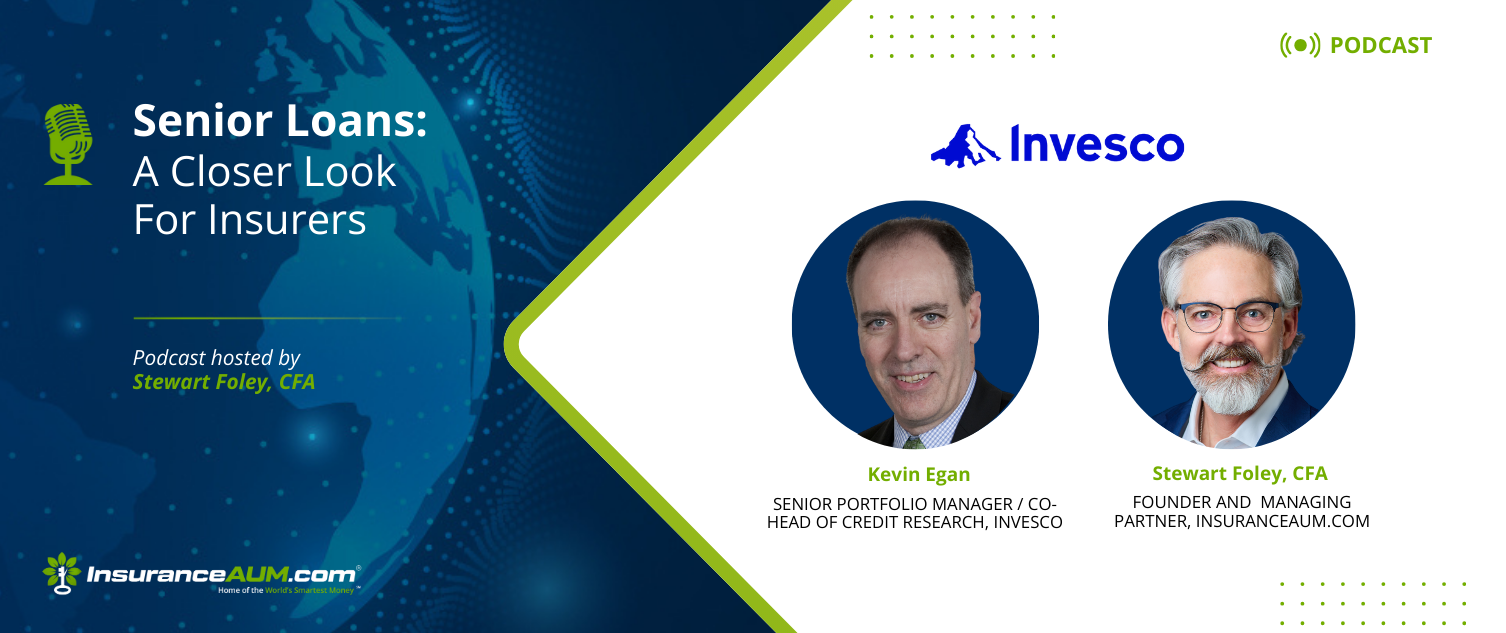
Senior Loans: A Closer Look For Insurers

Image
08.26 Invesco_Web


Stewart: Hey, welcome back to the ‘home of the world's smartest money.’ I'm your host, Stewart Foley. And this is the InsuranceAUM.com podcast, where our focus is on educating insurance investment professionals. And today our topic is Senior Loans: A Closer Look for Insurers. And we're joined today by Invesco's Kevin Egan, CPA. You are a Managing Director, Senior Portfolio Manager, and Co-Head of Credit Research for Invesco's Global Private Credit Team. You're also a member of the Investment Committee, which is a big deal at a place like Invesco. You are a product of Georgetown University undergrad with an MBA in finance from the Wharton School. Kevin Egan, welcome to the show.

Kevin: Stewart, thank you very much for having me. Really appreciate the opportunity.

Stewart: Well, okay, so the breaking news today is that Taylor Swift and Travis Kelsey got engaged. So I see this hit on my newsfeed, and I immediately text my daughter and get her response back in two words. “I know .” That's it. I couldn't scoop her. I got news all over my screen, Kevin, and I still couldn't scoop her. Any thoughts on the engagement announcement before we get going here?

Kevin: I mean, this is going to be the equivalent to the American equivalent of a royal wedding. I mean, the attention is going to be huge. I did the same thing you did. I text my friends who I thought would be interested in all of them told me the same thing. Stay in your lane. I already knew all about this. So it's going to be a media sensation. It really will be.

Stewart: Well, here we are, and we're in our lane. Let me ask you, you've been on before. Let's talk about this. I mean, where did you grow up and what was your first concert? Different question this time.

Kevin: Okay, so I grew up on the north shore of Long Island, a very small town called Greenlawn. Huntington is the closest town to that. My first concert was actually here in the city, not Taylor Swift, although I did see her on this tour. It was The Cars, back at a place called the Palladium, which no longer exists. It was down on 14th Street. We told my parents it was at The Garden because The Garden was right upstairs from the island railroads. They just thought we'd just come in, go right upstairs, and go to the show, and then head back out. They would not have let us go if they knew we were getting on the subway and heading 14, 16 blocks south to a small club. So it doesn't exist anymore. But it was a great experience and I've been a lover of live music ever since.

Stewart: Yeah, I mean you are speaking my language with the cars. I mean, when I was in high school, The Cars were a big deal and I had a friend named Eric Osteen that was a real music aficionado, and he passed at a really young age, but always really loved, always really loved The Cars. So let's start off by level setting a little bit, and I think that a lot of these terms get tossed around, Kevin, and sometimes people know what they mean, and sometimes they just act like they know what they mean. So what exactly are we talking about when we're talking about senior loans?

Kevin: Yeah, senior loans, and you're right, there are a lot of terms. Senior loans, secured loans, and broadly syndicated bank loans. They all mean the same thing. These are loans, loans to large corporations here in the US and in Europe made for purposes of making acquisitions or dividends to private equity sponsors or capital markets activity, expanding your CapEx, your working capital. They're issued by big banks, and then they're syndicated to investors such as ourselves who invest in these on behalf of third parties, mutual funds and pension funds, and insurance companies. They offer a number of attractive characteristics. They are senior in name and in priority, which means we're first in right of repayment, they are secured, secured by all the property plant equipment of the company. So, if something goes sideways, we can foreclose and take the assets of the company in the same way that the bank has a mortgage on your house and can take your house if you fail to make the payments.

The good news about that is that senior secured loans typically recover about 70 cents in a dollar in the event of default, where high yield bonds, which in many cases are below us in the capital structure, same issuer in many cases typically recover 30-40 cents in a dollar. Their floating-rate obligations, so what we've seen over the last couple of years, is that as rates have risen, yields on bank loans have risen to where they are today, just about a little bit less than 8%. So they provide a very attractive yield because they are floating rate, and they have no duration. Very little correlation to other fixed-income securities. So negative correlation to govvies, very little correlation to high yield bonds, and then it seems counterintuitive, but even in the rate environment that we're in currently, obviously, we're anticipating further rate decreases this year, senior secured loans while still offering about a 7.8% deal. Currently, if we look at the forward curve over the three years, senior secured loans are still expected to return somewhere between 6.5 and 7% on a coupon basis. That's going to be very attractive on an absolute basis and very attractive relative to high-yield bonds as well. So that's what the asset class has been so popular over the last couple of years.

Stewart: Yeah, it's super helpful. So let's talk a little bit about who the players are here. How would you describe the profiles of the companies that participate in the bank loan market, and are there certain segments within that market that your team focuses on in particular?

Kevin: Yeah, so these are all household names: United Airlines, Burger King, PetSmart, Virgin Media. These are large, what would be Fortune 500, Fortune 1000 corporations in many respects, in many instances, and in many cases, these are public corporations, and those that aren't are still of considerable size. So these are not mom and pop companies, these are not startups, these are not the province of sort of the middle market. These are all large multi-billion-dollar corporations. The average loan in our market is a little bit less than a billion dollars. The loans that we invest in are generally north of $250 million, but they're going to be loans as large as $5, $7, or $10 billion. The loan market in the US is actually a little bit bigger than the high-yield bond market. Most people are not necessarily as familiar with senior secured loans, but this is one of the largest capital markets in the US. 

With respect to sectors, it is broadly diversified. Every sector that's in the s and p 500 is also in the bank loan market. There are certain sectors that we favor currently. For instance, right now, leisure travel entertainment. Anybody who has been on a plane this summer or been to a hotel where a theme park knows that the demand for entertainment has been unabated. There was a brief pause around Liberation Day, but demand has resumed quite strongly, and so we're very favorable in that sector, which continues to perform quite well. These companies have a lot of pricing power; they've not added a lot of capacity, and so as you know, airline fares and hotel fare rates have only gone one way. So that's a sector we're very significantly overweight. On the opposite side, sectors like technology, there's a sector where valuations have really been stretched. A lot of the loans that came to market in 2018, 2019 were done at 50% loan to value, but that's when value was 14, 15 times.

And so you can have a 50% loan-to-value company that's levered seven, eight times. Well, if interest rates go up by 500 basis points, that's a 35 to 40% cut in the company's free cash flow. That will really put stress on a lot of these borrowers, and that's what we've seen in this space. So that's a sector that we're significantly underweight, even though it is the largest sector in the index overall. And then healthcare, another one that we're underweight. Obviously, the government's the biggest payer, and even if the government's not the payer, it's paid off the government reimbursement rates. The government's been reimbursing healthcare providers at 1.5% Labor, which is the largest input cost has gone up much more rapidly than that. So these companies are being squeezed on a margin basis, really tough when you can't control your revenue line, and that's a sector which is also one of the largest in the loan index that we're underweight as well.

Stewart: That's super helpful, and I understand the reasoning there. You mentioned high yield a couple of times, and that's the comparison that often comes up, right? So how do you compare the two, and how do you assess the relative value between bank loans and high yield?

Kevin: Yeah, so as I mentioned before, the reason why the comparison comes up is, in many cases, they are the same issuer. United Airlines issues both loans and bonds, and for different reasons if you're a corporate treasurer. So 50% of the loans we issue actually have bonds below us in the capital structure. But that's one of the key differences right there is below us in the capital structure. So loans are senior, so they're first and right payment secured by all the assets of the company. So if there is a default, senior secured loans are going to have a much higher recovery rate than high-yield bonds. Now, historically, bank loan investors have been willing to accept a lower rate of return because of that seniority and security, that protection. We're running a very unusual situation right now where loans, as I mentioned before, are yielding just about 7.8%.

High-yield bonds are yielding about 7.2%. So you're getting a better yield and a better coupon. Loan coupons say are about 425 basis points. High-yield bond coupons are about a hundred basis points behind that. So you're getting a better yield and a better coupon to be senior secured top of the capital structure. So the relative value really favors loans. It's a pretty unusual situation, and the reasons for it really have to do with who the buyers are in each of the markets. The loan market is dominated by institutional buyers who have a minimum cost of capital. And so, therefore, need a minimum yield to invest in the asset class. The high-yield bond market is really dominated by ETFs and retail investors who don't have a minimum cost of capital and therefore can really accept lower yields. Loan spreads right now are just about their long-term average high yield bonds after sort of the blip of Liberation Day, are actually close to their all-time tights. That really favors the loan asset class currently.

Stewart: And it's interesting because on the other side of that, you see direct lending getting larger, so at the upper end of direct lending and the lower end of bank loans. Are those two touching yet? Are they colliding? Can you talk a little bit about the upper end of the direct lending market versus banking?

Kevin: Yeah, I mean they used to be two completely separate markets, but to your point, direct lending has gotten so popular and so much has flown in the way of AUM into that asset class that at the upper end of the middle market, which is not where we play. Invesco is invested in what's called the core middle market, the $150 to $250 million loans. But at the upper end, you've seen funds raise $10, $20 billion. So huge funds because the demand for the asset class has been so strong, and that's brought the two asset classes into competition with each other. You think about it, you have a $20 billion direct lending fund. Loans are freely callable, so a direct lender manager and a broadly syndicated loan manager are going to get about a third of their portfolios repaid or prepaid every year. So if I have a $20 billion direct lending fund, that means I have $6 or $7 billion that I need to put to work at the beginning of the year before I invest an incremental dollar.

That's a lot of money to put to work. And you can't do that in the $150, $200 million loan that used to be the province of direct lenders. So what's happened is these large direct lending funds have moved up into the billion-dollar, 2-billion-dollar loans. As I mentioned before, the average loan in the broadly syndicated market is a billion dollars. So the two markets have come into competition with each other. And what does competition mean? Well, a couple of different things. One, the spread differential, which direct lenders used to enjoy 200 basis points over where spreads in the broadly syndicated market are. That's collapsed. 125, 100 basis points in some instances. So that spread differential that really used to differentiate the direct lending market and made the market so attractive as two markets have come into competition. Obviously, borrowers won't pay 200 basis points more to have a direct lending deal versus a broadly syndicated.

So the spread differential has come down, you start layering on top the performance and other fees for direct lenders, and the net return differential collapses even further. The second thing is that direct lenders used to always advertise, well, we have covenants in our deals, and the broadly syndicated market does not, and that is still true at the lower end of the middle market, the $150 to $200 million loans, 70-80% of them do have maintenance covenants. But for loans that are $500 million or more, which now again is where a lot of these direct lenders are playing, only 10% of them have covenants. So that whole idea that they have covenant protections at the smaller end, still true at the larger end, not true anymore. Only 10% of the loans. and where there are covenants used to be they were set 25% above or below the company plan. Now that's widened out as well. They're 35, 40% below the company plan. If you have a company that's missing its plan by 40%, you have a problem and no covenant set that wide is really going to protect you. So you put all those together, and you're really seeing a convergence of the markets as they start to compete with each other.

Stewart: I think a lot of times folks who are listening to this podcast are looking for an update on a particular market. Right. So if we focus on the bank loan market today, on Tuesday, August 26th, at 1:24 PM Central, what is your outlook? What can you tell us about the bank loan asset class right now?

Kevin: Yeah, I think a couple of different things. I think if you focus first on fundamentals, fundamentals remain strong for the asset class, in fact, have been improving. A lot of companies obviously levered up during COVID. We saw leverage in the market peak at a little bit less than eight times. Companies have been using, obviously, the very strong performance that they've seen resulting from the very strong US economy to deliver. So, leverage today is a little bit less than five times overall; it's actually lower today than it was pre-COVID. So we've seen a complete round-tripping in terms of leverage levels. That's obviously a positive for us. Similarly with the lower rate environment, we've seen interest coverage ratios, the borrower's ability to service their interest costs, start to move up. So we were very fearful that during the rate hiking cycle, borrowers would not have sufficient free cash flow to cover their debt and their interest payments.

That ratio bottomed about three times, let's call it 18 months ago. But with the 100 basis points and rate cuts that we've seen last year, interest coverage ratios have now improved to about 3, 4 times. They were expected to be closer to four times by the end of the year. Borrowers typically don't get into trouble unless their interest coverage ratio is below one and a half times. So we've seen the average borrower in the market have more than sufficient free cash flow to cover their interest expense. Now obviously there's a tail that's still below that 1.5 times, but it's only about 3% of the market currently. And so that 3% is probably a pretty good indicator of potential defaults in the market going forward. But it's really a much smaller portion of the market in general. Performance for our companies has been good. If we look at revenues for the first quarter, up 2.2% EBITDA for our borrowers, up 3.3% year over year.

And so this is on tougher comps. So we're still seeing positive growth from our borrowers. I saw this morning that I guess 85% of the S&P 500 has also surprised to the upside for earnings. I would expect similar performance from our borrowers. So we're seeing that as well. So if you look at all those fundamentals together. And then I guess maybe the last thing to sort of point out is the maturity wall. Two things can cause a default: obviously inability to service your interest expense and your debt service. And also obviously, if you have a looming maturity that you can't refinance, well, less than 2% of the market has maturities between now and the end of 2026. So, no maturity wall, not really concerned about interest coverage ratios. So fundamentals are strong across the board. The technicals have really been the driving story for the market CLOs, which again represent 70% of the market overall.

Demand for them has been 120 billion of CLO issuance this year - that is on a record pace. So despite all the volatility we saw around Liberation Day, CLO demand, which is the primary driver of demand in the market, remains unabated. The supply side has been relatively muted. That's where we've seen the impact of Liberation Day supply in the form of acquisitions, companies making acquisitions, and PE firms making acquisitions. That really was put on pause. We're starting to see that resurge, but we've had this huge supply-demand imbalance, which has really buoyed the market. And prices today are the highest they've been all year. So we've seen the average price in the loan market close to 97 cents in a dollar. 60% of loans are trading above par. So the technicals in the market remain very supportive. And while we do expect more supply post-Liberation Day, I still think that we're going to see a very strong technical in the market overall demand is returning to the asset class, even from regular way investors, the retail fund investors, the ETF investors are all coming back to the asset class after that dislocation we saw back in April.

Stewart: Yeah, super helpful. So the rule of thumb in lending people money is you need to get paid back, right? So the old saying goes, you make it in basis points and lose it in percentage points. So with that in mind, I mean, default risk is always at the top of mind for our insurance audience. And just touching on that for a moment, and a good friend some time ago, a guy by the name of Phil Totolo was talking about this at an event we were attending and he said, you're likely to see, and this kind of goes to the question, a decrease in big D defaults, but an uptick in LMEs or otherwise known as liability management exercises, which is kind of a polite way of saying workouts. What's your take on this trend with workouts? There's been talk of lender-on-lender violence. I'm not even exactly sure what that means, to be honest with you. How does this typically play out? What can you tell us about this topic here?

Kevin: Yeah, so I would say one, I think it's correct, big D defaults continue to move down. Big D defaults right now, payment defaults as we define them, are about 1.1%. That was 1.4% at the beginning of the year. So we continue to see payment defaults decline in the market. Similarly, if we look at loans trading, as I mentioned before, below 80 cents in the dollar, which is typically a sign of future defaults, that's 2.8% currently, that was 4% at the beginning of the year. So stress in the market and actual defaults in the market continue to decline. And it's true, however, that we've seen a trend over the last 18 to 24 months away from in-court restructurings and Chapter 11 filings to out-of-court liability management exercises. And that's an opportunity in a lot of respects for lenders like ourselves, where we can provide additional liquidity to a corporation to a business, like we're not obligated to do so, but we can provide additional liquidity to a company we like.

A company avoids Chapter 11, the costs and time associated with that, and gives the company additional runway to hopefully recover and rightsize their business plan, and we get that additional liquidity or provide that additional liquidity in return for up-tiering our obligations in the capital structure. So we get fees associated with providing that additional liquidity, and we get an up tier in our existing debt. Now the outcomes can be different for lenders that originally had the same security. Those that are able to participate in the liability management exercise are able to provide that additional liquidity; generally speaking, they are able to exchange their debt at much more favorable rates than those that are not. And so it can result in different outcomes for different lender groups. Those who are able to participate, who sit on the steering committee or the ad hoc committee that is driving the transaction, will generally speaking have a more favorable economic reimbursement for making that additional liquidity extension.

So those firms like Invesco that are large, that have the ability to provide additional liquidity, provide additional capital, have the legal resources, the relationships, and importantly, when these groups are forming, generally speaking, it's the largest lenders that are able to be participants in the ad hoc and the steering committees. So an investor of size is important, and Invesco, given its size in the market, is almost always large enough in any transaction where liability management exercise is contemplated to be on the steering committee, be able to provide that additional liquidity and, as a result, have better outcomes in those situations.

Stewart: Yeah, that's an important point when those unfortunate situations come about. I think it's a great point. So bank loans have been tested across a multitude of cycles. I look at stuff that nobody reports on, which is like I see tons of stuff getting sold, folks are selling toys, you're seeing motorcycles getting sold and trailers getting sold, and all kinds of stuff getting sold. I kind of look at those markets historically speaking, and the economic numbers don't reflect weakness, but I think to some extent there's uncertainty, right? There's just a feeling of a little bit of an uptick of uncertainty. So, historically speaking, how has this asset class fared during downturns in particular, and how does that potentially apply to what we see right now as a little bit of ongoing market turbulence?

Kevin: Yeah, I mean, I think the good thing, and some of what I alluded to before, bank loans have remained remarkably stable over time. Over the last 33 years, since the inception of the asset class, bank loans have only had three negative years. So 2008, not surprisingly, bank loans were down 29%, which again was a lot less than other asset classes were up 44% in the next year. 2015, sort of the industrial slowdown - bank loans were down 30 basis points or so, but the next year they were up almost 10%. And then with COVID bank loans, again were down about a hundred basis points, were up 13% the next year. So in any period, one: the absolute level of decline in bank loans, relatively modest with the exception of the GFC, and in each year, the next year rebound was quite sharp and quite positive. So bank loans have generally been insulated from a lot of the volatility by two things.

One, a high current income. As mentioned before, on average, we're getting about 6% a year right now which is closer to 8%. That buffers a lot of market volatility. Also, being senior and secured, top of the capital structure by definition, that portion of the capital structure is going to be less price volatile than high yield bonds below us and equity below that, because those are in the first loss position, senior secured loans are in the last loss position. And so there's less volatility around that. And then if you look at sort of a traditional recession, 2001, 2002, bank loans returned positive, had positive returns in those years, during COVID, bank loans had positive returns. So in each year, you've seen bank loans in most cases have positive returns even in periods of market volatility. So we look going forward and saying, okay, even with all the uncertainty you mentioned, bank loans back in April were down at their bottom, down two and a half percent from April from their peaks in early March to April 7th, which was low by the end of April, it had recouped half that loss.

So it was a short and quick comeback. And then since then, loans have been up almost more than 4% year to date. So we completely round-trip that and more at this point. So I think that sets us up going forward for one strong returns this year, both on an absolute basis as we talked about before. And then relative to high-yield bonds, which are our closest competitor, you're getting a better yield and a better coupon on an asset class that's less risky. So I think time has really tested this asset class and the results sort of speak for themselves and periods of recession, loans of offered positive returns. During COVID loans offered positive returns. So I really think that that should give investors some comfort that this is an asset class that is far less affected by market volatility than many others.

Stewart: That's super helpful. I really appreciate that. We've had a phenomenal education on bank loans this time around. Kevin, I appreciate you being on. Got a couple of ones on the way out the door. One really speaks to the culture at Invesco, and you've been an institutional investor for a long time, and you've seen a lot of different folks come and go over the course of your career when you started out. Now, when you're more senior, what characteristics are you looking for when you add folks to your team? And a kind of related way to look at it is what characteristics of folks have you found are particularly successful in your specific genre?

Kevin: I think for young people coming in, intellectual curiosity, first and foremost, we can teach you the modeling, we can teach you our credit process, but if you don't like to dig in, discover things about businesses, which I always thought was the most fascinating thing, sometimes I'll tell my friends about, oh, we're looking at this company and they're like, I didn't even know there was a company that did that type of thing. I mean, you have to sort of love that and dig into that, trying to uncover rocks, be curious, don't make assumptions. I think that is the type of thing that we really look for. The technicals we can teach, but the curiosity, the joy of investing and trying to discover things, that is something that you can't teach, and that's what we look for in people. And listen, this is a collaborative environment. You want to learn from your peers. No one's going to do it by themselves. I certainly didn't get here by myself. So I think that stat was important, that intellectual curiosity. And a love to invest. I mean, I still get tremendous joy out of picking up a new credit memo and saying, “okay, I didn't know this was a business”. And it's just fun to learn, and I think those people who really love that, they're going to succeed in this business.

Stewart: That's very helpful. Alright, last one. You can have dinner with up to three people, one, two, or three. They can be alive or they can be dead. Who would you most like to have dinner with?

Kevin: Alright, well, I think I would go back to what we started talking about, the output. I mean, I love live music. I still see two or three shows every month, so I'd have to go with sort of a round table of deceased musicians because obviously that's a unique opportunity. Three is so hard. John Lennon, Prince, David Bowie. I think that that would be a really eclectic conversation.

Stewart: That would be amazing.

Kevin: So I would love it, that would be so much fun. Well, Prince, I got to see live. The other two I didn't. So that would be such a unique opportunity. So that would be a great dinner.

Stewart: I remember seeing, I got a chance to see Ray Charles live at the very end of his career, and I can imagine that it's similar like with Prince and whatever. You just go, this is a special time right here. It's not every day. So I really appreciate you being on, Kevin, and thanks for a really good education today. Appreciate you taking the time.

Kevin: Not at all, Stewart. Thanks for having me. Always fun to discuss loans and music with you. 

Stewart: You've been joined today by Kevin Egan, CPA, Managing Director, Senior Portfolio Manager, and Co-Head of Credit Research for Invesco's Private Credit team. The title of today's podcast is Senior Loans: A Closer Look for Insurers. We appreciate you listening and would really appreciate you rating, liking, and reviewing us on Apple Podcast, Spotify, wherever you listen to your favorite shows. We also have a brand new YouTube channel at @InsuranceAUMCommunity. If you have ideas for podcasts, please shoot me a note. It's Stewart@insuranceaum.com. My name's Stewart Foley. This is the home of the world's smartest money at InsuranceAUM.com.


Share this post

Sign Up Now for Full Access to Articles and Podcasts!

Unlock full access to our vast content library by registering as an institutional investor

Register

Contacts


Invesco

Invesco is a leading independent global investment management firm, dedicated to helping insurance investors achieve their financial objectives. We understand insurers have unique investment needs, from optimizing capital efficiency and yield, to managing reserves and reporting. That’s why we offer specialized solutions across a broad set of asset classes and vehicles. With $2 trillion in total assets under management,[1] and $89 billion on behalf of insurance clients,[2] we strive to understand your distinct capital requirements, accounting tax treatment, and risk factors.

Invesco Advisers, Inc. and Invesco Senior Secured Management, Inc. are investment advisers that provide investment advisory services to Institutional Investors and do not sell securities. Invesco Distributors, Inc. is the distributor for Invesco's retail products. Invesco Advisers, Inc., Invesco Senior Secured Management, Inc. and Invesco Distributors, Inc. are indirect wholly owned subsidiaries of Invesco Ltd.

1 Invesco Ltd. AUM of $2,001.4 billion as of June 30, 2025
2  As of December 31, 2024


1331 Spring Street NW, Suite 2500, Atlanta, GA 30309


View the contributor page

Sign Up Now for Full Access to Articles and Podcasts!

Unlock full access to our vast content library by registering as an institutional investor .

Create an account

Already have an account ? Sign in

Ѐ Ё Ђ Ѓ Є Ѕ І Ї Ј Љ Њ Ћ Ќ Ѝ Ў Џ А Б В Г Д Е Ж З И Й К Л М Н О П Р С ΄ ΅ Ά · Έ Ή Ί Ό Ύ Ώ ΐ Α Β Γ Δ Ε Ζ Η Θ Ι Κ Λ Μ Ν Ξ Ο Π Ρ Ё Ђ Ѓ Є Ѕ І Ї Ј Љ Њ Ћ Ќ Ў Џ А Б В Г Д Е Ж З И Й К Л М Н О П Р С Т У Ф Х Ц Ч Ш Ā ā Ă ă Ą ą Ć ć Ĉ ĉ Ċ ċ Č č Ď ď Đ đ Ē ē Ĕ ĕ Ė fi fl œ æ ß