




We're currently experiencing email delivery delays. For urgent matters, please contact us directly at lindsay@insuranceaum.com.

State Street Investment Management-

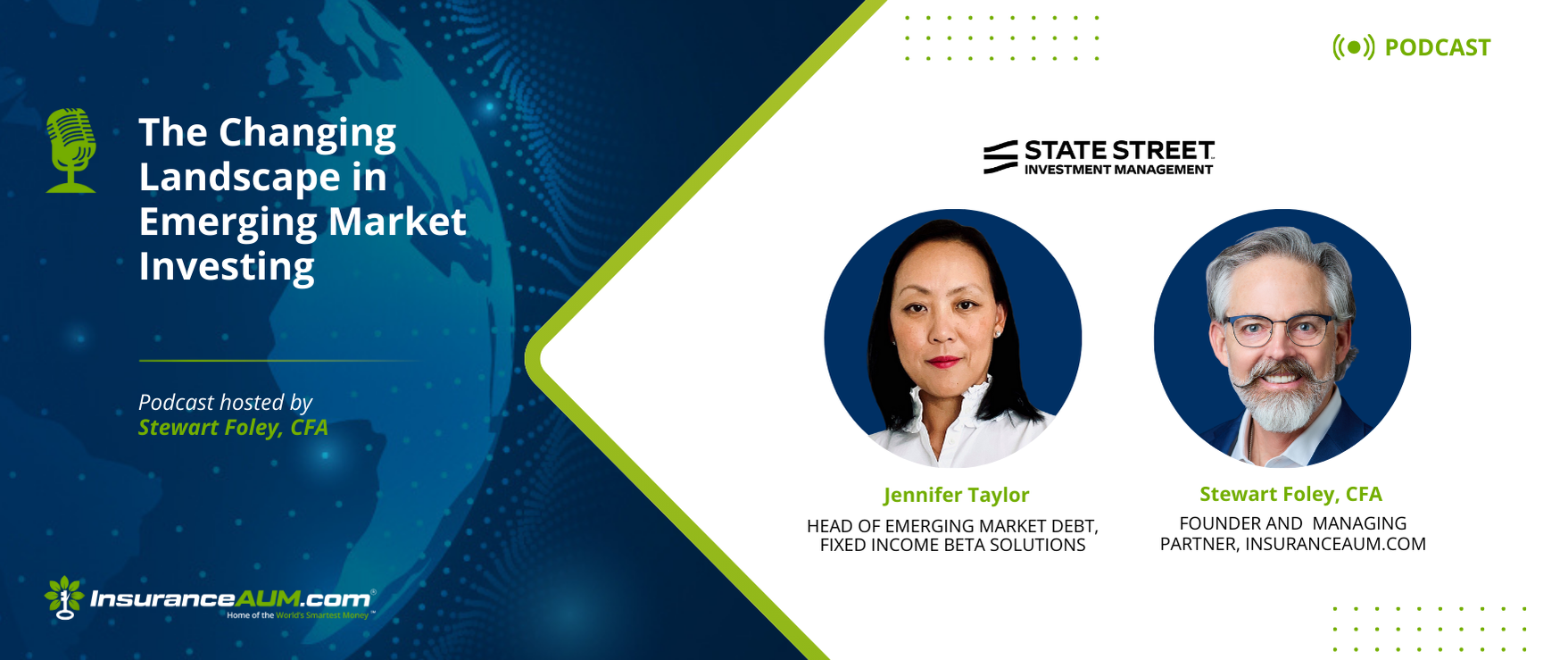
The Changing Landscape in Emerging Markets Investing

Image
09.05 State Street Investment Management_Web


Stewart: Hey, welcome back. It's great to have you. I want to make mention of a couple of things, just housekeeping stuff. We have a Private Credit and ABF event coming up on November 5th and 6th in beautiful Austin, Texas, at the Thompson Hotel. We've got some very interesting things planned. It's going to be a great chance for you to come and see your friends, see your colleagues, and learn a bunch about the asset class, and also have a little fun in the process. So you can find that on our homepage. On the hamburger menu, there is an events tab, and you'll see it right there. Open to insurance investment allocators only, and hope to see you there. My name's Stewart Foley. We are the home of the world's smartest money at InsuranceAUM.com. The title of this podcast is The Changing Landscape in Emerging Market Investing. We're joined by Jennifer Taylor, Head of Emerging Market Debt and Senior Portfolio Manager at State Street Investment Management. Jennifer is a graduate of Boston College with a degree in Accounting and Finance, and you are a holder of the certificate of ESG Investing issued by the CFA Institute. Welcome Jennifer. We're glad you're here.

Jennifer: Thank you so much for having me, Stewart.

Stewart: So you're a veteran. You've listened to a bunch of our podcasts, so you kind of know what the drill is here, but we want to always start getting to know our guests a little bit, right? So you are, I believe, based in London, but where did you grow up, and our new question, what was your first concert?

Jennifer: Okay, I am based in London. I've lived here for about 20 years. I grew up in New York City, in Manhattan, and I loved it there, and I also love London. My first concert was the Clifford Ball in 1996, and it changed my life.

Stewart: Wait a minute, what is it? What is it?

Jennifer: The Clifford Ball was a festival run by Fish, and they were pretty much the only performer there for three days, and they went on all night, all day for three days straight and it was life-changing. I was a teenager at the time, so I didn't really know what to expect, but it was fantastic.

Stewart: Wow, that's cool. So it starts off like this. I think it's helpful for folks to understand your career path, and I don't mean just yours but our guests’, because I remember I taught a lot of students and I know when they look at the world and they're trying to find their first job and they're really trying to figure out the landscape. I mean, the thing about college is that the syllabus comes out, and how to get an A is pretty clear, and you can either do that or you're going to get less than an A, but when you're in the professional ranks, that is not the case. There's no clear set of how to do this. And so I think that everybody kind of comes at it a different way. But can you talk us through coming out of college up until now, just kind of at a high level, so that folks get an idea of your path?

Jennifer: Sure. I've become really circumspect about career paths. I think a lot of where people end up has a lot to do with luck, and sometimes you can create your own luck, and sometimes you are lucky to be at the right time, right place, right part of the market cycle, for example, or the opposite of the wrong part of the market cycle. I started off at JPMorgan in New York City. I had a stint in London as well. That's where I fomented my love for this country. And then I just took opportunities where I thought I could learn something, and when you're in your early twenties, you can learn something from almost every job. And then the next criterion that I was really prioritizing was, can I learn something from this person or these people that I'm working with? So it's really about becoming a sponge and really sucking in everything I can and it might not be the most interesting thing and let's face it, sometimes we are doing jobs that aren't a hundred percent interesting a hundred percent of the time, but you always do learn something whether it's interpersonal, it is very technical or otherwise, and there's a lot in between too.

So I've kind of just said yes to opportunities that I thought were interesting, and sometimes I did it without really that much consideration. For example, I moved to London, I think, with about four weeks' notice. I took a job with a hedge fund that no longer exists, and it was a great decision. I did it because I really liked the portfolio manager who was running it. It was for a distressed credit fund here in London. They had a big operation in Greenwich, Connecticut, as well. So I did that for about a year and a half until the fund blew up, and then I moved on to another hedge fund to do something similar. And then I've sort of gradually moved from very, very active into a lot less intense as I've matured myself. Not because the work was overwhelming or anything like that, just because I kind of felt like I learned sort of what I needed to, and I could move on to something else. And I have to admit that half the time I just got lucky, and hard work does a lot for luck, or it can replace a lot of your luck. But a lot of it is just appreciating that I didn't have some of the other disadvantages that I think a lot of candidates have, or I had some advantages that I worked really hard to achieve as well.

Stewart: Yeah, I think luck is when you're prepared for an opportunity. I don't know who said it, but I think many people have, and it's like the harder I work, the luckier I get. So I appreciate that. What drew you to emerging markets as a career focus?

Jennifer: I'll be honest, I kind of got stuck with an EM book that I had to wind down somewhere along the middle at one of the local hedge funds I was working for. And I thought it was really kind of scary and a bit icky, but I really liked it because it is weird and wonderful and there is always something going on and some of it is really banal elections and those are pretty repetitive and some of it is just bizarre. And I'm not talking about corruption, I'm talking about unique and different cultural and political norms, and they're all different across all the countries within the broader emerging markets. And so once I kind of started doing it, I really enjoyed it, and I just started navigating my career toward that. And then when an opportunity came up to focus solely on emerging market debt, I took it.

So that kind of goes back to that luck part that we were talking about earlier. I was prepared to take it, but it sort of happened upon me as well. It's a really interesting asset class because if you think about it, we're not really creating new countries. What we are doing, though, is allowing these countries to access debt in different ways. And sometimes that gets disintermediated by other parties, or perhaps just because the landscape is changing in financial markets. But ultimately, what we've done is sort of created another conduit for these issuers, and you can think of them as companies, just as you can think of them as countries, to find financing for whatever purpose they're seeking to do it for. Now we typically want financing for CapEx, whether that's a country or a company. And if you think about what emerging markets really means, it kind of means that they're growing and the aspiration is clearly for them to achieve developed status. It doesn't happen very often, but you can very easily see the path for some countries to maybe diversify their economy or grow their economy and kind of create a wealth uplift for their population. And that's what I like about EM, certainly.

Stewart: Yeah, that's interesting. So it's my understanding that State Street Investment Management emphasizes a beta-first approach in emerging market debt. Could you help us understand what beta first means, first of all, and why State Street takes that approach?

Jennifer: Well, State Street's one of the largest asset managers in the world. We just crossed the $5 trillion AUM mark, so we're really happy and proud of that.

Stewart: That's a big deal.

Jennifer: Yeah, and we're really happy about it. Like a lot of other asset managers, we are here to provide solutions for our clients. And within a context of emerging market debt, for example, I think it's a really common belief. And I also came from the active side doing emerging market debt, so I can really sympathize with this belief. It's really idiosyncratic. I just talked about how we have importers, exporters, we have countries that are growing rapidly, and countries that are not growing so rapidly. We have unique demographic differences across these countries. And so, because of that, I think the common belief is that it is an asset class that's suited best for an active manager. I listened to a few of their previous guests speak about this as well, and they were basically talking about how you really should focus on the alpha opportunities where there are inefficiencies.

And actually, I want to just maybe challenge that notion and think about it in reverse. When you have this many idiosyncratic opportunities, how do you participate in all of them in a risk-managed way? You really can't. And so this is where the beta comes in, and the reference benchmark that we use in the hard currency emerging market debt space. So that is sovereign debt issued to foreign investors in typically US dollars. There are about 70 countries in this benchmark. It is not a monolithic benchmark at all. And what we tend to see, and I think I understand why, I think you tend to see managers who are focused on specific situations, thinking that those are the opportunity sets that will generate alpha in and of themselves. You have to be very good at calling these opportunities. And not only do you have to be good at getting the thesis right, but you have to be good at getting the timing right.

And so from a beta perspective, though, when you think about this index, it is really elegantly constructed. It's got a thousand bonds, 70 issuers. The diversification works really well for an asset class like this. And so instead of thinking about it from an active manager's perspective, which is I want to focus on a few of the shiny objects one at a time or maybe a couple at a time for a beta manager, you're focused on all of them, you get access to all of them. And equally, you also unfortunately get access to the downside for all of them as well. And so what this is really about is minimizing your tracking error volatility, so allocating your risk correctly and thinking about how we deliver a broader market to our clients. And we at State Street are really good at that. We do it across equities, we do it across debt, and we have gold as well. There are loads of different ways that we can help partner with our clients to deliver them a market. And then if they want to go look for those alpha building blocks, there are plenty of good managers out there that can provide that.

Stewart: So you mentioned idiosyncratic risk. Maybe you've already touched on this, but how do you think about managing idiosyncratic risk in EM debt? And you talked about some of the challenges, right? And to be clear, you mentioned that this is sovereign debt and not corporate because some of our podcasts on EM have been related to corporate debt. I want to make sure that we know what we're working with.

Jennifer: I'm so glad that you mentioned that this is sovereign debt, not corporate debt. One thing that might be worth mentioning for your listeners and perhaps for you is the difference between sovereign debt and corporate debt, and the way it's defined is that 100% government-owned entities are considered sovereign debt. So even if one share is outstanding, that would be considered corporate debt for a company. There is a default cycle that is fairly routine, and for corporate debt, once you enter into a credit event – an industry prolongs a failure to pay – you leave the benchmark because you have defaulted. And so what that means for an investor in the corporate debt space, be it developed market or emerging market, is that you ride this bond from par all the way down to 20 cents for example, and then you crystallize your losses there because it's left the benchmark in sovereign debt, we have defaults, but those countries do not leave the benchmark because a country cannot cease to exist.

It can cease to have a government, it can cease to have a functioning set of rules, but it still exists as a country. And so a really good example of that would be Lebanon. Lebanon is still in the benchmark. They have bonds that have matured in 2021, and they're still in the benchmark now. Those bonds have done really well in the past few years on the back of regional developments in the Middle East. And what that means is investors who bought those bonds at maybe par or even at 5 cents on the dollar now get an opportunity to participate in the upside as those bonds recover. So what I really like about sovereign debt, or many things, but sovereign debt in the EM space, to me, you get to participate in both the downside and the upside. And so, from versus corporate debt, and I'm not saying there's anything wrong with EM corporate debt, it's a little bit more exciting because if you, like me, want to geek out on restructurings, you can do that here without really leaving your core benchmark.

Stewart: That's super helpful, and I want to give you the benefit of a timestamp for the following question. It is September 5th at 10:32 central time. How is US policy influencing EM debt today?

Jennifer: That is a great question, and you are stealing my thunder when I tell you that when we published our emerging market debt outlook at the start of the year, the title of it was All Roads Lead to the US. And this is probably the first time in a very long time that when we speak about emerging market debt, we are not speaking about emerging market countries. In the past, we might've been talking about China's growth or India or elections in countries X, Y, and Z. This is the first time where really the external environment, which for emerging markets is anything outside of EM, is really the main driver of what's happening within emerging markets. It's impacting EM in different ways depending on the sub asset class, but for the most part, everything, all of the policy, be it from tariffs or even geopolitics, is kind of emanating from the US for the time being. The axis that seems to be emerging coming from Russia, India, and China may have influenced later on, but for the time being, pretty much since the start of the year, we've really been looking to the US for direction. Now, when we have a weaker dollar, that obviously impacts EM local currency, which is a big portion of the book that we manage.

Not to say that EM effects has been particularly strong, it's just that US dollar has been weak, and that is a fairly monolithic impact on EM local. For hard currency, emerging market debt, it is dollar-based and it's traded off of US treasuries. So clearly, when treasuries rally, as they have done meaningfully today and yesterday, that benefits spread products like emerging market debt. So we are looking to the US for policy direction, and then for emerging market debt, we're also looking to it for geopolitics, which has a downstream effect on fundamentals. Now, as index managers, we are less concerned about fundamentals. For example, we are not evaluating fundamentals; we don't have sovereign debt analysts looking through that because we own a little bit of everything in the index. That is the purpose of the delivery strategy. But we do have to still pay attention to what's happening because it impacts technicals and risk sentiment as well. So all of that is really important to what we do. So it isn't just to say, and I think there's a really common belief that index investing is akin to passive. When definitionally passive means you do nothing. We do a lot. We're very, very active. We're just following an index and trying to deliver the index.

Stewart: Yeah, it's super helpful. And so when we think about segments of EM debt, can you talk a little bit about the key differences that investors should understand? And I do think to some extent there are investors that sort of view EM in a monolithic way, in some of us, and I say us like I'm on the back end of the age scale here, may have a dated view of that market. So, can you just talk about these various segments and what investors should know?

Jennifer: Investors should know that EM hard currency is an investment-grade asset class with high-yield-like returns that is beta to, for example, equities, and let's say we define that as S&P 500 is fairly low. It's only about 62% correlated from a returns perspective. And I think a lot of people think of high yield and equities as being kind of cousins, and this kind of underscores that EM and equities are fifth cousins or something. It's further away, but it's still delivering sort of those high-yield returns, I think a lot of people like. It's also bigger than US high yield, but a lot less efficient. So the way I usually think about hard currency is it's kind of going off to college. That's how old this index is. Whereas high yield has had babies already. If you liken it to a person, EM corporates is really interesting, but it's a lot more of a high-yield strategy.

I think for a lot of people, they think of it that way because you're still evaluating countries, and then you have that macro overlay. So it's a really interesting beast. The duration for both high yield and EM corporates, of course,  is fairly low because of the way the structures usually look EM sovereigns, the duration is very, very long. So, for example, we're not constantly reinvesting in new issues. So I think that covers sort of the dollar EM asset classes. EM local currency is its own unique thing, and it actually has very low correlation to EM hard currency because here you're buying a bond in a foreign currency. So there's the bond element and then there's the effects element as well. There, there's only about 19 countries, maybe 20 soon to come, and it's a more concentrated benchmark. We cannot compel certain countries to open up their financial markets to foreign investors.

That's what external debt is for. So local currency is actually still very much dominated by locals. It was created for locals dominated by locals, although foreigners can buy it. So you'll find that, depending on the country, some of the debt is predominantly held by locals, and it's difficult to access. So again, this is why, from an index perspective, it makes a lot of sense to have that balanced approach. When you're thinking about local currency, the volatility is a lot sharper for local because of that effects component as well. So I think for probably a lot of your listeners in the insurance space, local currency, emerging market debt is probably not a natural reach when you're entering into emerging market debt, it would make a lot more sense to reach for EM sovereigns, for example.

Stewart: Yeah, it's super helpful. So I've been in this business for over 30 years, and one thing that's pretty common is some constraint or something or the other that requires a little bit of a bespoke approach, and things like, I can't own below this credit, I can't own these countries, I can't, whatever it is. How does State Street partner with clients to deliver customized EMD exposure?

Jennifer: That is a great question. A lot of people define emerging market debt very differently, even from the same industry, the same country. So we manage scores of different kinds of mandates. Some of them are pooled funds, some of them are segments or separately managed accounts, and two-thirds numerically, two-thirds of those mandates are customized in some way. And it might be something as blunt as we'd like to remove Country X or something very sophisticated in which you're scoring, for example, based on sustainability factors, or however you choose to do it. What I always like to tell people is, if you want to create a portfolio of countries with red in their flags, we could do that for you. We're not really here to opine on your methodology. We can certainly help you with it if you'd like, but we're here to provide you with a solution, and if your solution is limited or wide, we can do that.

So it kind of keeps us on our toes. But I think it also really just speaks to the opportunity set in that you can invest and gain exposure to emerging markets that way. There are going to be countries or political regimes or even certain aspects of a country's strategy that make people feel uncomfortable. And we're not really here to judge that. We're also equally not here to encourage the opposite of that. It's not a one-stop shop. And I really like that for us. And I think asset managers are becoming increasingly more sophisticated at I think meeting client and customer needs for these kinds of things. And EM is a perfect place for it because there are just so many different ways that you can slice and dice the universe to achieve that.

Stewart: It's been a phenomenal education today. I appreciate your expertise and your willingness to come on and share it with us. I've got a couple of fun ones for you on the way out. This really speaks to the culture there, and it goes like this. What characteristics are most important to you at State Street Investment Management when you're adding to your team? I've had the good fortune of teaching at a school that does not have as much name recognition as some others and has some phenomenal finance students, but it's not about what school they go to or if they can code. This is more about characteristics that you've seen over your career that make somebody successful.

Jennifer: That is such a good question. I really like to probe and assess whether or not candidates have self-awareness. And I think in a professional setting, people might refer to that as intellectual honesty, but what I am talking about is an awareness of the whole self. So it isn't just about your intellect, it's about knowing what you know and knowing what you dunno, knowing how to ask questions, not being afraid to peer, I don't want to say weak, but in a position where you might need some help. And I think that's really important in a professional setting because it speaks to integrity. And that is something I think State Street really focuses on, is that you are someone with that kind of character that not only do other people want to work with, but that can be additive to the overall culture. So I really like to look for self-awareness.

It's very hard to get someone to reveal that. You can't just say are, you have to start asking some pretty probing questions about it. And even the way people answer kind of reveals a little bit about it. And I've had a few candidates where, partway through an interview, they catch on to what I'm really trying to get at. And I really like that because it kind of forces you to maybe think differently about how you engage with people. And ultimately, this is a people business. We're talking about numbers and asset classes and whatever, but ultimately always engaging with people, whether they're clients or people on your team or people just broadly as colleagues. And so I think that's an important attribute, not just in a workplace setting, of course, but perfect in life as well.

Stewart: That's super. And the last one, and I know you've listened to a lot of our podcasts, but the question is, do you listen to the end, right? And because the ending question is always about the same, which is if you could have dinner with up to three people, it could be one. We had somebody yesterday choose just one. One or two or three, alive or dead. Who's it going to be, Jennifer?

Jennifer: This is topical because I just read his book. I would choose Anthony Bourdain.

Stewart: Oh wow.

Jennifer: And yes, the late Anthony Bourdain, who left us too early, but he was the first, I think, bad boy celebrity chef before celebrity chefs were even a thing. And because I grew up in New York City, he was around when I was younger, and I remember hearing his name growing up, and what a cool guy. So I would love to sit with him and learn about some of the places that he's seen, the things that he's eaten. And he does have, I think, a few videos that are still in circulation of his travels. But there's something really visceral, I think about listening to him talk because he so clearly loves not just food, but culture. And I find that really interesting because I would love to have dinner with him. It would be a riot, I'm sure. And I'd bring a few friends along. I'm sure they'd enjoy it too.

Stewart: Absolutely. I have 9 8 8 tattooed on my forearm and a semicolon. Right. Which is, and I'll show it and know we're not going to do a video, but I'll show it to you. Right. There it is. That's the number to the mental health crisis hotline, and the semicolon is, of course, a symbol of suicide prevention.

Jennifer: I'm familiar with it. I volunteered for Samaritans when I was in university.

Stewart: Oh wow. Good for you. Really appreciate you being on. The title of the podcast has been The Changing Landscape and Emerging Market Investing. We've been joined by Jennifer Taylor, who's the head of Emerging Market Debt, Fixed Income Beta Solutions at State Street Investment Management. Jennifer, thanks for taking the time.

Jennifer: Such a pleasure. Thanks so much for having me.

Stewart: Jennifer, this has been fantastic. Certainly appreciate it. Thank you for joining us today and sharing your thoughts. And also thanks to all of you for listening. If you like what you hear, please rate us, review us, and subscribe to the InsuranceAUM.com podcast. We are the home of the world's smartest money at InsuranceAUM.com.

Share this post

Sign Up Now for Full Access to Articles and Podcasts!

Unlock full access to our vast content library by registering as an institutional investor

Register

Contacts


State Street Investment Management

At State Street Investment Management, we have been helping to deliver better outcomes to institutions,  financial intermediaries, and investors for nearly half a century. Starting with our early innovations in indexing and ETFs, our rigorous approach continues to be driven by market-tested expertise and a relentless commitment to those we serve. With over $4 trillion in assets managed*, clients in over 60 countries, and a global network of strategic partners, we use our scale to create a comprehensive and cost-effective suite of investment solutions that help investors get wherever they want to go.

*This figure is presented as of March 31, 2025 and includes ETF AUM of $1,553.58 billion USD of which approximately $106.42 billion USD in gold assets with respect to SPDR products for which State Street Global Advisors Funds Distributors, LLC (SSGA FD) acts solely as the marketing agent. SSGA FD and State Street Global Advisors are affiliated. Please note all AUM is unaudited.

Benjamin Woloshin   
Head of Insurance    
Benjamin_Woloshin@ssga.com (929) 567-5882

Meta Tomai Curry   
Head of Insurance Strategy   
Meta_Curry@ssga.com (929) 567-5697


One Congress Street, Boston, MA 02114-2016


View the contributor page


Sign Up Now for Full Access to Articles and Podcasts!

Unlock full access to our vast content library by registering as an institutional investor .

Create an account

Already have an account ? Sign in

Ѐ Ё Ђ Ѓ Є Ѕ І Ї Ј Љ Њ Ћ Ќ Ѝ Ў Џ А Б В Г Д Е Ж З И Й К Л М Н О П Р С ΄ ΅ Ά · Έ Ή Ί Ό Ύ Ώ ΐ Α Β Γ Δ Ε Ζ Η Θ Ι Κ Λ Μ Ν Ξ Ο Π Ρ Ё Ђ Ѓ Є Ѕ І Ї Ј Љ Њ Ћ Ќ Ў Џ А Б В Г Д Е Ж З И Й К Л М Н О П Р С Т У Ф Х Ц Ч Ш Ā ā Ă ă Ą ą Ć ć Ĉ ĉ Ċ ċ Č č Ď ď Đ đ Ē ē Ĕ ĕ Ė fi fl œ æ ß