




We're currently experiencing email delivery delays. For urgent matters, please contact us directly at lindsay@insuranceaum.com.

Principal Asset Management-

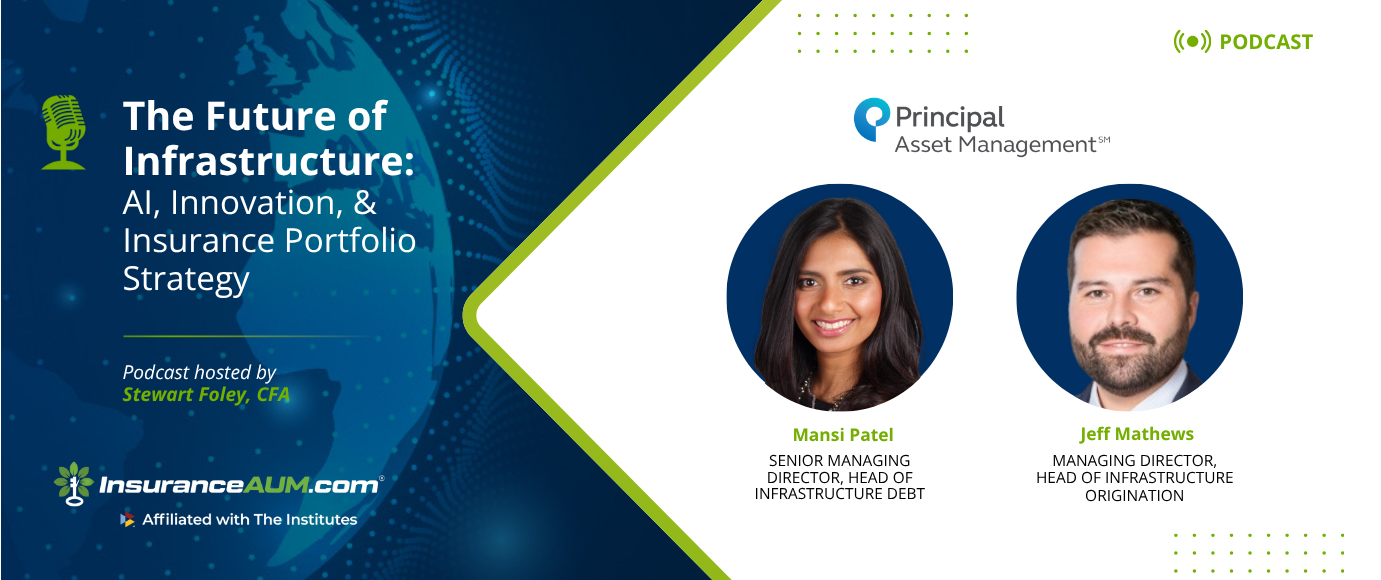
The Future of Infrastructure: AI, Innovation, & Insurance Portfolio Strategy

Image
10.13 Principal_Web


Stewart: Hey, welcome back. It's great to have you. I just got back from a trip to New York, and we had a chance to meet with a number of our clients and also some folks out of the CIO community. It was really nice, and often coming from the most unexpected places, folks, I had a chance to be with a lot of the members of the IWiN community at a social event that they had, and it is just nice to hear the kind words that come about our podcast. We really do try and do a solid job of educating people on here, and I know we've had kind of a similar format, and I hear nice things. If you think we need to change it up or something, if we can do a little bit better job, please let us know.

But I just want to say big shout-out to everybody there at IWiN and all the folks in New York and the New York metroplex. We were thrilled to be there and appreciate the warm reception we got just everywhere we went, so thank you. Also, want to mention that we do have a private credit and asset-backed finance (ABF) event coming up in beautiful Austin, Texas, at the Thompson Hotel. That is November 5th and 6th. It is open to insurance investment allocators in those asset classes. You can find the registration information on our website at insuranceaum.com. On the upper left, there's a hamburger menu. There's an events page, and it is listed number one. We'll be thrilled to see you there. We've got some fun and exciting stuff going on there, so look forward to seeing you. We've got a great podcast for you today. I love the title, which is The Future of Infrastructure: AI Innovation and Insurance Portfolio Strategy, and we're joined by Mansi Patel and Jeff Matthews of Principal Asset Management. Thanks for being on. I'll do a little intro, but I want to welcome you as I've been talking for a minute.

Mansi: Thank you, Stewart. Pleasure to be here. 

Jeff: Same. Thank you, Stewart. Excited for the podcast.

Stewart: We're thrilled to have you. Mansi Patel is a Senior Managing Director, Head of Infrastructure Debt, and I love to get into the education because I think it's important, right? So you have an MBA from Fairleigh Dickinson University and a Bachelor of Science in finance and statistics from Rutgers University. Very cool. I was walking through the Newark airport, and Rutgers had this giant R. They were doing some big-time marketing out in the middle of the concourse, so it was super cool. And Jeff Matthews, Managing Director, Head of Infrastructure Origination. You have a little bit different background. You have a Bachelor of Arts with a concentration in business & psychology from Washington University in St. Louis. I was raised just outside of St. Louis and am very familiar with that university. Welcome to the show.

Jeff: Thank you very much.

Stewart: Alright, so first question off the bat here, we're going to go to you both and just ask you where did you grow up, and a new question for this podcast--first time ever, what was your favorite movie? And by the way, I consistently hear, I love this part of the podcast. Alright, so Mansi, we'll go with you.

Mansi: These are great questions. I grew up in India, so I was born there. I moved to the U.S. when I was about nine, and I've been on the east coast since. So I really grew up in Jersey, and I’m spending my time in Jersey and New York these days. In terms of favorite movie, that's a great question. I've got many. The one that keep watching over and over again is probably The Greatest Showman. The soundtrack alone is quite interesting, and so that would be my favorite movie. 

Jeff: I'm actually born and raised in Manhattan, so I'm a New Yorker through and through. I've been here my adult life as well, but as you mentioned, I was in St. Louis for school and lived a bit in London. But yeah, born right here in midtown Manhattan and raised there. Favorite movie? Gosh, I'll go with two Christopher Nolan movies that I love, Interstellar and The Dark Knight.

Stewart: Oh wow, there you go. Alright, cool. That's a good question. I kind of threw it out there last week, and people were like, Ooh, that's a good one. So I'm like, hey, let's try it out. So let's just talk about infrastructure debt for insurance companies. A lot of good characteristics that have been discussed prior, but can you talk a little bit about how you're defining infrastructure debt, what are the assets, and what type of assets are you actually investing in?

Mansi: I can start. Our definition of infrastructure is purest in a way. We look for hard assets; we look for stable, predictable cash flows in terms of the assets we invest in. When we think about our structuring, these are assets and structures that have collateral in covenants. Long duration is quite attractive to our insurance clients, and so often we're looking at long duration infrastructure. In addition to that, we're thinking about high-yield infrastructure. When we think about the sectors that are thematic and where we're exposed, it's five buckets. So we start with digital infrastructure, so that's towers, that's data centers, that's fiber. Pretty impressive growth in that space as you can imagine. The other sectors we're involved in are power, renewables, that's generation. We're involved in energy so think mostly midstreams, so pipelines, LNG. We’re around, of course, transportation, so that's your ports, your airports, your roads, your rail. Along with social infrastructure, our fifth bucket, and in social we put in there water, we put in there hospitals, healthcare, education, stadiums, arenas, and venues. It’s a really broad scope in terms of the types of assets we’re involved in and intentionally diversify to provide that benefit to our clients.

Stewart: That's super helpful. I'm going to go out on a limb and try to define when you said LNG, that is liquid natural gas, is it not?

Mansi: That's right. Liquefied natural gas, which is a really interesting space.

Stewart: This was actually part of a case that I taught when I was a prof, so it came in handy. But let's just talk about the next piece here, which is: how is AI changing the infrastructure investing landscape? And based on everything I'm seeing, the impact is pretty significant. And what are other trends in infrastructure both today and, if you can dust off your crystal ball, five or so years out.

Jeff: Well, it is certainly a dynamic landscape, and maybe just before that question, Stewart, piggybacking on Mansi's description, one thing that I find infrastructure can be inherently long duration, but particularly it's very measurable and precise, it's very engineering focused. And when you compare it to other long duration opportunities, what sticks out to me over my 20 years in infrastructure is just how precise and measurable, and detailed everything gets. So that sort of sticks out, and that is true with the AI, the infrastructure side of the AI boom. So, like every other hard asset, every time we are involved in data center development and construction, that comes with useful life analysis and engineering and development, which is by nature a hard asset, quite measurable, and comes with defined useful lives and renewal cycles. But how is AI changing the investing landscape? I mean, tremendously, the largest deal flow in infrastructure has been in renewables and power, but I think if it hasn't been eclipsed already, it certainly will be soon.

Data centers, I mean, the data center boom in the middle market and large-cap markets are just in every headline. AI as a software and as a tool in everyday life affects every person, and it affects every business and every industry and every sector. So it's unavoidable, and infrastructure is no different. So when you think about it, it's about how do we accommodate, financially, the buildout of the data center infrastructure needed to accommodate both cloud and AI. And cloud, really when I think about AI, I'm thinking about the software that cuts across industries and individuals. But then the infrastructure side of it, first and foremost, is data center buildout that is hyperscale and cloud, which is different than co-location, which has more multi-tenant occupancy in it, which is wholesale, different than AI training data centers that don't need the low latency or the backbone fiber.

So when you sort of think about how AI is affecting infrastructure investing, it's sort of this massive growth in different types of data centers, and you've got to drill down on which type fits best for you. And then just be very cognizant of how AI as a tool is affecting every asset around you, every sector around you. But behind the data centers there’s a bottleneck, which is the power supply. So, where are we going to get the power supply? It seems the transition fuel is gas. So I think we're going to see on the back of this data center boom, another boom in new build gas-fired generation, and it's going to be behind the meter and micro grids. It's going to be within utilities. And so there's a public markets play here, but a huge private markets play, and behind-the-meter gas-fired power to supply the energy needed for data center build out.

And then behind that is the fuel supply and the natural gas itself and the pipelines, and the fiber optic. So it all comes bundled together, but it is just a massive growth area. And then behind all that is environmental concerns and P/E ratios, and water usage. But the explosion is undeniable, and I think that when you're constructing an infrastructure investment portfolio, the opportunity set has grown so big due to AI and cloud that it's not just data centers, it's power and fuel and cooling. So that's number one. And other interesting things that I'll roll on with is how does the industry transition continue, maybe in spite of the AI boom? How does it change between U.S. policy and European policy, and other international policy? How does the definition of infrastructure expand into other areas that are core to core plus and value add, and how do you structure to make that a safe infrastructure debt investment? How do private investors work with bank investors and collaborate with them? And this is all sort of like an evolving market by itself, but supercharged by what is the inevitability of data center investing taking front and center of the infrastructure world. So I'll pause there, Mansi may have some thoughts on that, but it's definitely front of mind and center of our focus here at Principal.

Stewart: So my jargon detector went off when you said “behind the meter.” So can you help me or help our audience understand what that means? I think I know what it means, but just to be sure, can you help us with the definition of “behind the meter?” 

Jeff: Of course. So forgive me for the jargon.

Stewart: Oh no, we love the jargon because the next podcast, I'll be like, I'll throw that out, I know what I'm talking about. So you're helping me, Jeff. I appreciate it.

Jeff: So traditionally, whether it's a renewable or a thermal power plant, you would build that or develop and build that power plant front of meter, meaning it is producing power for the grid. For example, if you're in the northeast area you have the PJM (Pennsylvania-New Jersey-Maryland Interconnection) market or if you're in the Texas area you have the ERCOT (Electric Reliability Council of Texas) market, those are separate grids. And if you're front of meter power supply, then you're providing power to that entire grid. And then there's a market for power trading and capacity markets within each grid. If you are developing a power plant, whether it be thermal or renewable, in this case we're talking CCGT, which is combined cycle gas turbine power plants behind the meter means you're building that as a captive facility to power something like a data center. Now that doesn't mean it's not also connected to the grid for backup sales to the grid, but it is a behind-the-meter data center, also known as a microgrid or a district energy system. But behind the meter means it's not being metered as sales to the grid, but instead being behind the meter and being sold directly to a specific built-to-suit asset like a data center, which requires lots of power.

Stewart: So it basically means that they've got their own private power plant that's powering that facility. So which infrastructure sub-sectors and geographies are most active and how do you see them responding differently or similarly to macro trends and shocks?

Mansi: That's a great question, Stewart. And maybe just to piggyback on Jeff's comments prior. So AI and digital infrastructure are certainly a thematic growth strategy. We are also seeing quite a bit of activity around other tailwinds in the space and growth. And that leads into your question around geographies and where in the world you are. Other avenues of growth and sector development are really in climate resiliency. If you're living in the East Coast across the country, experiencing weather events and shock events, this affects your transmission, affects your power grids, it affects assets, your roads, your airports. So resiliency is certainly thematic for us globally. We are also seeing an aging population when you look across the world, and there is a need to support social housing and address aging population needs. So that is also thematic for us. And then energy security continues to be an area where we see a lot of interest.

As you think about geographies, our strategy is focused across the world in OECD (Organization for Economic Co-operation and Development) countries. Our primary focus is in North America, it's in Europe, it's in Latam, and it's in Asia. I would say North America and Europe are where we spend a lot of our time, although Latin America and Asia create an opportunity set that's quite unique for us. In terms of sub-sector, there are themes that are consistent across the globe when you think about whether it's digital or power, or transportation CapEx, that's a consistent theme. But when you scale out, different parts of the world are in different spaces. So where we're spending a lot of time in CapEx on transportation, there's a lot of new builds happening in Asia and Latam, for example. It's quite an exciting part of our strategy, really, to be able to have a global lens. I don't see a meaningful shift in sub-sectors. I would say when we think about Europe, we lean into transportation and social a bit more than the U.S., where there is a very robust municipal finance market for those sectors. And when we think about the U.S., it's more power and digital and energy. So there are things that we lean into. At the end of the day, we're looking for the best deals with the right protections for our clients, but the global element creates our ability to find some diversified and really interesting things that you won't find in public markets.

Stewart: I think insurance CIOs are always trying to balance is the correlation between their investments, and then it's also, what happens to those correlations when markets are stressed. So, can you talk a little bit about how infrastructure correlates with other asset classes and what makes it unique?

Jeff: Yeah, absolutely. And Mansi, curious how you would revise what I'm about to go into. It's consistent. We'll piggyback on this and it'll transition into this question. When you think about the sectors that Mansi described and you think about the sub-sectors within them, there are certain asset classes depending on the structure and the tenant, the offtaker, et cetera, that make it very a good fit for long duration investment grade style investing. And there are some that are very, very stabilized, where you can have subordinate debt that is also investment grade, longer duration. And then there's some where the subordinate is more high yield, and we can talk about the high yield opportunity today or another day. There are also some asset classes where you want to avoid that. You want to be senior secured always. You want to sort of manage the debt sizing in a different way.

And I think that depending on which asset class you are, where in the capital structure you are, and how you leverage it, how you structure it has to do with the correlation with other markets. So, going into that, we see infrastructure as quite a good diversification opportunity for insurance investors. We've talked about the long-duration opportunity here to asset liability match that is inherent with infrastructure investing. I talked about the measurability and the predictability, and the precision within infrastructure investing on the long-duration part. But when you look at the data, and sometimes it's hard to cut the data, given infrastructure is a 20-year-old asset class, give or take, we don't see a strong correlation anywhere, really. So even if you're looking at other private credit, corporate private credit, if you're looking at even real estate, which is a different real asset class, you don't see strong correlations.

I could quote different numbers, but 0.55 correlation to broader corporate credit, 0.20 to real estate credit, basically no correlation to global equities or other sorts of alts in the equity space. I think infrastructure debt and infrastructure equity, obviously one is higher risk, one is lower risk, but even there, there's a diversification play and lack of correlation. So at the end of that sort of speech there infrastructure can be a great correlation, especially within investment grade and duration against fixed income and corporate debt. It can also be a great diversification for those who have exposure to infrastructure equity markets. When you talk about the latter, you can sort of splice your infrastructure equity a little bit more like PE or more core infra. And I think infra debt will inherently behave more like core infra. But regardless where rates are today and where the opportunity set is today, and given the size of the market–which by the way we clocked, I think 2024 clocked in across debt and equity infrastructure was at 1.15 trillion globally–and volume, the opportunity set is large. The opportunity to curate a very diversified portfolio within infrastructure debt is right there. And it can be a great lack of correlation or diversification against infrastructure, equity exposure or corporate debt exposure, fixed income or really anything else. So that's one of the great features, the diversification and the ability to match asset and liabilities for insurance investors.

Mansi: And Jeff, I may just add to that, Stewart, why is that the case? And we've spent now, Jeff and I collectively two decades in infrastructure, and I've seen market cycles, and what you see is the resiliency comes through because of the essentiality of the assets you're invested in. People will continue to drive and continue to need roads and continue to access power and how you live your daily lives, right? Infrastructure is such a key element of that. That lack of correlation comes through in 20 years, 40 years of data, really if you look at the Moody studies when you think about project finance markets pre 2000. So it's really the definition of infrastructure that creates that opportunity that's different and not correlated with broader markets. And that is where we do see our insurance clients very intrigued and interested because it's an asset class that's not cyclical and it's intentional.

Stewart: Yeah, it's interesting. When I was the treasurer of a city, the city of Columbia, Missouri, shout out to those folks, we had essential service revenues, electric water, refuse, sewer, things like that. You use the term essentiality, which is, we are going to use AI whether or not we've got a GDP that's growing or shrinking. I suspect that our use of AI is probably not going to be affected a whole lot, right? Or our power consumption to create that AI. I assume that that's the same case. I mean there's all sorts of different categories here, but none of them are like consumer cyclicals where the economy catches a cold and all of a sudden luxury goods fall off a cliff. This is a different kind of thing. 

Mansi: That's exactly right, Stewart. It's how you define your first question of what infrastructure is, that leads exactly into that. I would say we saw a pretty meaningful stress test with the pandemic, right? Insurance investment infrastructure portfolios tend to be 30-40% transportation. Having a global shutdown was not in anybody's base case, and we survived through that event  pretty clean because of the essentiality. Government stepped in where they had to, equity stepped in where they had to protect these long-lived assets really into even through such a stress scenario that's not really in anybody's base case of: nobody's flying, nobody's driving, nobody's on the road. The sector did incredibly well. So the resiliency has proven itself, and it goes to the essentiality of the assets directly.

Stewart: It wasn't in their base case, and I'm not sure it was in their stress case either. So today, as I look out my window, October 13th, 2025, the way the vehicle that an insurer can invest in can have an impact on capital charges, which impacts return on statutory capital. So, can you talk a little bit about what type of infrastructure debt vehicles can an insurance investor look at and what are the drivers of successful strategies in your mind?

Mansi: In terms of where we see the opportunity set for insurance clients on infrastructure debt, the vehicle formats are pretty simple actually. It's SMAs and IMAs for clients that have scale and scope, and they want very specific things. We can design a bespoke relationship to allow for them to achieve their targets and their goals. So we see that a lot in the investment grade side for infrastructure, that's pretty typical. We also see opportunity for high-yield funds, and there we do address the needs from an NAIC regulatory capital perspective through rated feeder structures to ensure that it's the right treatment for our clients. But those would be generally the two strategies that we see most, it’s either through SMAs and IMAs or through a fund strategy, both of which we think are attractive for different reasons. Jeff, if you had more thoughts there?

Jeff: No, I think that covers it. I think the prevalence or the pickup of the rated feeder structure is now not novel. It's a pretty base case for making sure you get that regulatory relief when you invest in a fund structure and that's perhaps the right way to do it for high yield. But any IMA and SMA, as Mansi described, can be tailored exactly to a client's needs. So that's how we see the world.

Stewart: And if you could just give our audience a couple of takeaways, maybe one takeaway from each of you would give us a chance to wrap, and I've got a question that kind of leans into the culture at Principal before we go.

Mansi: Yeah, Stewart, I think this was a really engaging discussion. To me, a takeaway would be as you're thinking about infrastructure and a potential asset allocation into infra debt, it’s who you're partnering with, the experience of their teams, the understanding of market relationships, the ability to source unique transactions, and longstanding partnerships, right? It's a private market, and the relationships will drive success. So I would say that would be the key takeaway for me--define it correctly and work with partners that have the depth and reach that you need.

Jeff: And I would echo exactly that. Of course, Mansi is a hundred percent correct, and maybe that just finding partners that have the same investment strategy, they have the same general account with the same objectives and mission. Yeah, I think at Principal we're very, very focused on growth and infrastructure, and it is a primary strategy. So I think that's important as you look across the field and who's investing with you.

Stewart: Yeah, it's what we call in Missouri, eating your own cooking, which is exactly, I mean, I think that speaks volumes. Alright, so here's the one, a little fun one for you. What are the characteristics that you're looking for when you add, you've both had deep, long careers, very successful, you've hired people on your team, at various levels. What characteristics do you think make for a successful career in your world?

Mansi: Oh, that's a really interesting question, Stewart. I think it stems from the ability to analyze and understand a very quant-driven sector, as Jeff was describing earlier. Everything we do has an element of engineering around it, has legal analysis around it. I think a curious mind that's able to handle models and legal documents and terms sheets and negotiations with the right people skills, it takes a lot, and we've got an amazing team with all of those skills. So building a career in infrastructure requires a very curious mind and also a very specific approach to these things because there is a lot to do on the underwriting. These are complex transactions, and being able to analyze them correctly will help the career in a meaningful way.

Jeff: I don't think I could add much more to that answer. Perhaps an element of perseverance, an element of proactivity. So I think I would've had a different answer for people in different stages of their career, to be honest. But more senior stages in of career. The deal flow, as Mansi said, is a relationship game and there's sort of lower middle market, middle market, up middle market, large cap, and there are so many players in this market. This infrastructure as an asset class has become so big that you need to cultivate those relationships and you need to manage them and keep them close, and utilize the benefit of them. So sort of having that no fear mentality along with the ability to really analyze and understand all the things you're doing, like the sculpted data analysis, the protection of the term sheet, the engineering reports, the due diligence, in partnership with your issuers is critical.

Stewart: That's super helpful. Alright, fun question. You guys know this one's coming. You each get to invite one person to dinner, so it's the two of you. And then each gets to invite one guest. So we started with Mansi, so we'll go to you, Jeff. Who do you most want to have dinner with? Alive or dead?

Jeff: Oh gosh. This is not my professional answer. Warren Buffett would be the professional answer, perhaps.

Stewart: Like he's the leader in the clubhouse, by the way. It's very predictable.

Jeff: I’m amazed by history and spending as much time as I can on history on a personal level. Genghis Khan, how about that?

Stewart: Wow, I think that's a first. 330 podcasts, Jeff, that's a first.

Jeff: He basically took over the world, and maybe it’d be fun to meet the person who basically took over the world.

Stewart: That's a super cool answer. All right, Mansi, how about you?

Mansi: I might go on the opposite of Jeff's answer and suggest maybe the Dalai Lama would make for an interesting dinner.

Stewart: That would be an interesting dinner to be able to listen to the conversation between those two.

Stewart: Yeah, that's right. That's very cool. Well, I just want to say thank you very much. It's been an amazing education. The title of the podcast has been The Future of Infrastructure: AI Innovation and Insurance Portfolio Strategy. We've been joined today by Mansi Patel, senior managing director, head of Infrastructure Debt, and Jeff Matthews, managing director, head of infrastructure origination at Principal Asset Management. Thanks so much to both of you for being on with us today.

Mansi: Thank you, Stewart. Pleasure to be here.

Jeff: Thank you so much.

Stewart: My pleasure. If you like what we're doing, please rate us, review us on Apple Podcast, Spotify, wherever you listen to your favorite shows. If you want to see us, you can check us out on our YouTube channel at Insurance AUM community. If you have ideas for podcasts, please shoot us a note at podcast@insuranceaum.com. My name's Stewart Foley. This is the Home of the World's Smartest money at InsuranceAUM.com podcast.


Principal Asset Management and Insurance AUM Journal are not affiliated.

Important Information

Past performance is no guarantee of future results and should not be relied upon to make an investment decision. Investing involves risk, including possible loss of principal. Infrastructure investments are long-dated, illiquid investments that are subject to operational and regulatory risks.  Infrastructure companies may be subject to a variety of factors that may adversely affect their business, including high interest costs, high leverage, regulation costs, economic slowdown, surplus capacity, increased competition, lack of fuel availability, and energy conservation policies. Infrastructure companies may also be subject to regulation by various governmental authorities and may also be affected by governmental regulation of rates charged to customers, operational or other mishaps, tariffs and changes in tax laws, regulatory policies and accounting standards. Strategies that concentrate investments in specific industries, sectors, markets or asset classes may underperform or be more volatile than other industries, sectors, markets or asset classes and then the general securities market. Real assets are subject to its own unique investment risk and should be independently evaluated before investing. As an asset class, real assets are less developed, more illiquid, and less transparent compared to traditional asset classes.  
Principal Asset ManagementSM is a trade name of Principal Global Investors, LLC.

Principal®, Principal Financial Group®, and Principal Asset Management, and Principal and the logomark design are registered trademarks and service marks of Principal Financial Services, Inc., a Principal Financial Group company, in various countries around the world and may be used only with the permission of Principal Financial Services, Inc.

© 2025 Principal Financial Services, Inc., 711 High Street, Des Moines, Iowa 50392


MM14680 | 10/2025 | 4804802-102026
 

Share this post

Sign Up Now for Full Access to Articles and Podcasts!

Unlock full access to our vast content library by registering as an institutional investor

Register

Contacts


Principal Asset Management

With public and private market capabilities across all asset classes, Principal Asset ManagementSM and its specialist investment teams are focused on harnessing the potential of every opportunity to secure an advantage for its clients.

The 28th largest manager of worldwide institutional assets under management of 411 managers profile, Principal Asset Management applies local insights with global perspectives to identify compelling investment opportunities and deliver distinctive solutions aligned with client objectives.1

Principal Asset Management is the global investment management business for Principal Financial Group®  (Nasdaq: PFG), managing $559.1 billion in assets and recognized as one of the “Best Places to Work in Money Management” for 13 consecutive years.2,3

Learn more at PrincipalAM.com

1 Managers ranked by total worldwide institutional assets as of December 31, 2023. Pensions & Investments, “Largest Money Managers,” June 2024.
2 Principal Asset Management AUM as of December 31, 2024.
3 Pensions & Investments, “The Best Places to Work in Money Management” among companies with 1,000 or more employees, December 2024.
 

Thomas Metzler  
Managing Director, Institutional Sales  
metzler.thomas@principal.com  
+1.510.427.6490

711 High Street  
Des Moines, Iowa 50392

 

View the contributor page

Sign Up Now for Full Access to Articles and Podcasts!

Unlock full access to our vast content library by registering as an institutional investor .

Create an account

Already have an account ? Sign in

Ѐ Ё Ђ Ѓ Є Ѕ І Ї Ј Љ Њ Ћ Ќ Ѝ Ў Џ А Б В Г Д Е Ж З И Й К Л М Н О П Р С ΄ ΅ Ά · Έ Ή Ί Ό Ύ Ώ ΐ Α Β Γ Δ Ε Ζ Η Θ Ι Κ Λ Μ Ν Ξ Ο Π Ρ Ё Ђ Ѓ Є Ѕ І Ї Ј Љ Њ Ћ Ќ Ў Џ А Б В Г Д Е Ж З И Й К Л М Н О П Р С Т У Ф Х Ц Ч Ш Ā ā Ă ă Ą ą Ć ć Ĉ ĉ Ċ ċ Č č Ď ď Đ đ Ē ē Ĕ ĕ Ė fi fl œ æ ß