

We're currently experiencing email delivery delays. For urgent matters, please contact us directly at lindsay@insuranceaum.com.

T. Rowe Price -

The Greatest Fixed Income Investment Opportunity in Decades?

TRPFeatured

Jeff Helsing Institutional Fixed Income Strategist 
Som Priestley, CFA Head of Multi Solutions—North America
Mark Rose, CFA Insurance Solutions Strategist
 

Key Insights

  • Fiscal concerns, higher inflation, and the prospect of global growth holding up should put upward pressure on Treasury yields, with the potential for the 10‑year yield to hit 6%.    
  • This scenario would create a historic investment opportunity in fixed income, with significant implications for asset allocation, as bonds could offer equity‑like returns with less volatility.    
  • In the insurance space, we suggest focusing on shorter maturities in the current environment to reduce drawdowns and create opportunities for reinvestment at higher yields.

Are you ready for a world where the 10‑year U.S. Treasury yield goes to 6%? According to our head of Global Fixed Income and CIO Arif Husain, this scenario—unthinkable just a few years ago—has become a real possibility in the next 18 months due to U.S. fiscal expansion and the potential for tariffs to drive inflation higher. 

Let’s explore why such a shift may occur, what the asset allocation implications are, and what strategies can help effectively navigate this landscape.


The path to higher bond yields—three key drivers

  1. Fiscal concerns: The recently enacted “One Big Beautiful Bill” looks likely to keep the U.S. deficit elevated for at least the next two to three years, as stimulus is front‑loaded and spending cuts are back‑loaded. Consequently, fiscal concerns will persist, as the deficit must be financed through Treasury debt issuance. This will occur at a time when other developed markets also need to issue more government debt to finance deficits, creating competition for buyers and pressuring yields higher.
  2. Upside inflation risks: The pass‑through to consumer prices from tariffs is likely to be greater than markets anticipate, driving inflation higher in the second half of this year. Blerina Uruçi, our chief U.S. economist, estimates that a 10% across‑the‑board tariff on U.S. imports would increase annual headline inflation by between 0.5 and 1.0 percentage point. With a 15% effective tariff rate, the inflation shock could be as high as 1.5 percentage points.
  3. Global growth to hold up: While tariff policy may keep global growth below trend, a recession is unlikely. All three of the world’s largest economies—the U.S., the eurozone, and China—are fiscally expanding right now, which should be supportive. The effects may take time to feed through, however.
     

From an asset allocation perspective, the potential implications are significant, as investors might not need to hold as much equity.

– Jeff Helsing
Institutional Fixed Income Strategist
 

The confluence of these three factors means that Treasury yields should go higher, with a 6% 10‑year yield in the next 18 months within the realm of possibility. The path to that level will be volatile. However, it’s worth highlighting how far the 10‑year Treasury yield has already moved. In March 2020, it was below 0.5%; now it’s comfortably above 4%—nearly nine times higher. With this context, a move to 5% or even 6% doesn’t seem so large. If it happens, we believe it would create a historic investment opportunity in fixed income, with meaningful implications for asset allocation. We think it’s crucial to begin planning now.
 

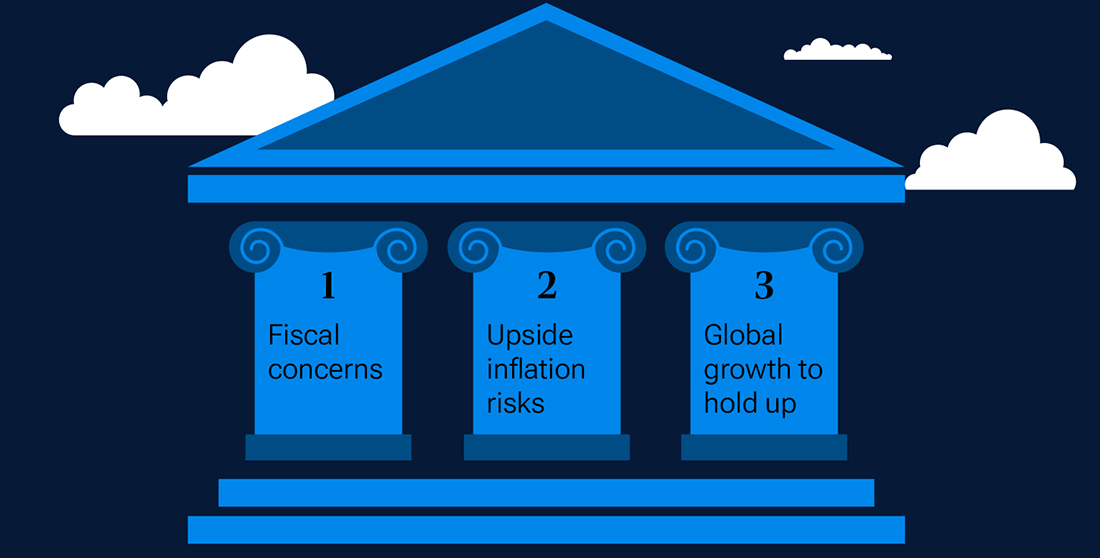
(Fig. 1) Three key reasons Treasury yields should go higher
Image
Fig. 1 is a graphic showing the three key reasons we believe Treasury yields are going higher: fiscal concerns, higher inflation, and the prospect of global growth holding up.

As of July 2025. For illustrative purposes only.
Source: T. Rowe Price.
 

Potential implications

Generational opportunity in fixed income

The share of fixed income in asset allocation has been growing in recent years thanks to higher bond yields. A rise in the 10‑year yield to above 6% would amplify this trend as it would offer investors a generational opportunity to earn the most attractive income from bonds in decades. For example, the yield on the Bloomberg U.S. Aggregate Bond Index (Agg)—a widely used benchmark for U.S. investment‑grade bonds—would likely surpass 6% if the 10‑year yield rises to 6%, a level not seen since the early 2000s.

For perspective, the Agg averaged a yield of just above 2% between December 29, 2011, and December 31, 2021. During this period, investors were compelled to take on more risk in equity and alternative markets to help them meet their return goals. Although bond yields have risen in recent years, leading to investors adding back to fixed income, they still remain an underweight allocation for many. This dynamic could change if the 10‑year yield increases to 6% as sectors sensitive to Treasuries—such as investment grade and high yield—would also rise, offering investors the potential to earn more income from bond investing.

Less equity exposure needed to achieve return goals

From an asset allocation perspective, the potential implications are significant, as investors might not need to hold as much equity. For example, those seeking a return goal of, say, 7%, could hypothetically achieve this through a higher allocation to bonds, which are historically less volatile than equities. However, investors would be exposed to more duration1 risk if they increase their fixed income allocation.

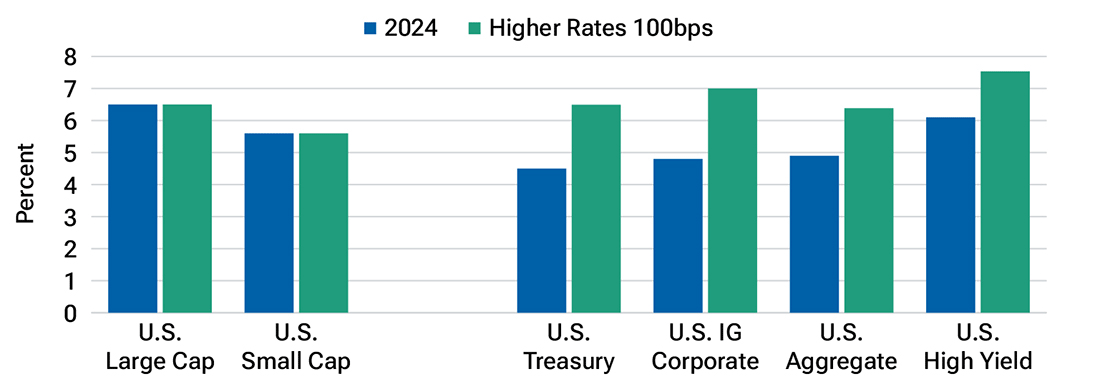
Based on our five‑year capital market assumptions, if the only change in market valuations across asset classes was a 100‑basis‑point rise in U.S. Treasuries for all maturities, the projected annualized return would be around 6.5% for the next five years. Although this approach is simplistic, it is meant to illustrate that an increase in yields from current levels could lead to similar or even higher return expectations for bonds compared with stocks over the next five years. For U.S. investment‑grade corporate bonds, based on our five‑year capital assumptions, the expected return is 7% if Treasury yields were to increase by 100 basis points, while U.S. high yield bonds are forecast to return 7.5%. These equity‑like return levels would appeal to investors not only from a total return perspective, but also due to the stability of income as bonds are typically less volatile than stocks. Nonetheless, fundamental research remains crucial to reduce default risk.
 

Five‑year capital market assumptions under higher rates*

(Fig. 2) Return expectations for bonds could rise to similar or higher levels than stocks

Image
Fig. 2 is a bar chart showing our 2024 five-year capital market assumptions and how they would look if rates were to increase 100 basis points across the curve. The U.S. equity sectors are U.S. large-cap and U.S. small-cap, and fixed income sectors are U.S. Treasury, U.S. Aggregate, U.S. investment-grade corporate, and U.S. high yield.

*This assumes an approximately 100‑basis‑point shift in U.S. interest rates across all maturities only.
Source: T. Rowe Price Capital Market Assumptions. See Additional disclosures.
 

Considerations for navigating this evolving fixed income landscape

A higher fixed income allocation seems like an obvious choice if yields get to 6%, but what about the intervening period? Navigating the rising yield path is as important as what to do when the destination is reached.

In the insurance space, most portfolios are focused on income with the aim of maximizing their book yield, while some prioritize total returns, making it important to avoid drawdowns. Given our view that intermediate‑ and longer‑maturity bond yields are likely heading higher, we suggest that both types of portfolios focus on shorter maturities and consider reducing duration below their strategic duration target in the current environment. If yields get closer to 6%, consider adding longer maturities and possibly exceeding the strategic duration target. This approach may help mitigate drawdowns if yields go higher, which is particularly crucial for total return‑focused portfolios. Additionally, this strategy should provide opportunities for reinvestment at higher yields, which is important for income‑focused portfolios that are seeking to gain more yield.
 

"Navigating the rising yield path is as important as what to do when the destination is reached.

– Mark Rose
Insurance Solutions Strategist

Conclusion

We believe that a rise in the 10‑year Treasury yield to 6% would present a historic investment opportunity in fixed income with significant implications for asset allocation. Investors might not need as much equity or equity‑like exposure to achieve return goals in such a scenario as bonds could offer stock‑like returns with potentially less volatility. This doesn’t mean that investors should sit and wait for this big shift to happen—there are strategies they can consider now in preparation. This includes focusing on shorter maturities where yield levels are still appealing. Further out the curve, investors are not being compensated yet for the duration risk. But the closer yields move to 6%, longer maturities should start to become attractive again.

Sign up to receive valuable insurance insights from T. Rowe Price


1 Duration measures a bond price’s sensitivity to changes in interest rates. The longer a bond’s duration, the higher its sensitivity to changes in interest rates and vice versa.

Additional Disclosures
CFA® and Chartered Financial Analyst® are registered trademarks owned by CFA Institute.  
T. Rowe Price Capital Market Assumptions: The information presented herein is shown for illustrative, informational purposes only. Forecasts are based on subjective estimates about market environments that may never occur. This material does not reflect the actual returns of any portfolio/strategy and is not indicative of future results. The historical returns used as a basis for this analysis are based on information gathered by T. Rowe Price and from third‑ party sources and have not been independently verified. The asset classes referenced in our capital market assumptions are represented by broad‑based indices, which have been selected because they are well known and are easily recognizable by investors. Indices have limitations due to materially different characteristics from an actual investment portfolio in terms of security holdings, sector weightings, volatility, and asset allocation. Therefore, returns and volatility of a portfolio may differ from those of the index. Management fees, transaction costs, taxes, and potential expenses are not considered and would reduce returns. Expected returns for each asset class can be conditional on economic scenarios; in the event a particular scenario comes to pass, actual returns could be significantly higher or lower than forecast.

Important Information
This material is being furnished for general informational and/or marketing purposes only. The material does not constitute or undertake to give advice of any nature, including fiduciary investment advice. Prospective investors are recommended to seek independent legal, financial and tax advice before making any investment decision. T. Rowe Price group of companies including T. Rowe Price Associates, Inc. and/or its affiliates receive revenue from T. Rowe Price investment products and services. Past performance is not a guarantee or a reliable indicator of future results. The value of an investment and any income from it can go down as well as up. Investors may get back less than the amount invested.
The material does not constitute a distribution, an offer, an invitation, a personal or general recommendation or solicitation to sell or buy any securities in any jurisdiction or to conduct any particular investment activity. The material has not been reviewed by any regulatory authority in any jurisdiction.
Information and opinions presented have been obtained or derived from sources believed to be reliable and current; however, we cannot guarantee the sources’ accuracy or completeness. There is no guarantee that any forecasts made will come to pass.
The views contained herein are as of August 2025 and are subject to change without notice; these views may differ from those of other T. Rowe Price group companies and/or associates. Under no circumstances should the material, in whole or in part, be copied or redistributed without consent from T. Rowe Price.
The material is not intended for use by persons in jurisdictions which prohibit or restrict the distribution of the material and in certain countries the material is provided upon specific request. It is not intended for distribution to retail investors in any jurisdiction.
Canada—Issued in Canada by T. Rowe Price (Canada), Inc. T. Rowe Price (Canada), Inc.’s investment management services are only available to non‑individual Accredited Investors and non-individual Permitted Clients as defined under National Instrument 45-106 and National Instrument 31-103, respectively. T. Rowe Price (Canada), Inc. enters into written delegation agreements with affiliates to provide investment management services.
USA—Issued in the USA by T. Rowe Price Associates, Inc., 1307 Point Street, Baltimore, MD 21231, which is regulated by the U.S. Securities and Exchange Commission. For Institutional Investors only.
© 2025 T. Rowe Price. All Rights Reserved. T. ROWE PRICE, INVEST WITH CONFIDENCE, the Bighorn Sheep design, and related indicators (see troweprice.com/ip) are trademarks of T. Rowe Price Group, Inc. All other trademarks are the property of their respective owners.

ID0008381
202508-4688976

Share this post

Sign Up Now for Full Access to Articles and Podcasts!

Unlock full access to our vast content library by registering as an institutional investor

Register

Contacts


T. Rowe Price

T. Rowe Price is a global asset management firm with broad investment capabilities across Equity, Fixed Income, Multi-Asset and Alternative Strategies, highly committed to excellence in service and putting client interests first. We understand that insurers have many unique considerations impacting portfolio design, and we are proud to work with many of the largest insurers in the world delivering diverse and custom solutions designed to meet those needs. Our dedicated insurance relationship managers act as an extension of your team and serve as a conduit to the T. Rowe Price organization while proactively bringing the firm’s vast resources to bear. We offer a consultative, problem-solving approach and the ability to implement solutions based on specific client objectives, constraints, and risk tolerance.

Ben Riley 
Head of Insurance 
benjamin.riley@troweprice.com 
410-345-2223

Chase Uhlein, CFA
Senior Relationship Manager
chase.uhlein@troweprice.com
410-577-3077

Blayze Hanson, CFA
Senior Relationship Manager
blayze.hanson@troweprice.com

Taylor Davis 
Relationship Manager 
taylor.davis@troweprice.com 
410-577-2054


1307 Point Street
Baltimore, MD 21231

 

View the contributor page

Image
trp_logo

Sign Up Now for Full Access to Articles and Podcasts!

Unlock full access to our vast content library by registering as an institutional investor .

Create an account

Already have an account ? Sign in

Ѐ Ё Ђ Ѓ Є Ѕ І Ї Ј Љ Њ Ћ Ќ Ѝ Ў Џ А Б В Г Д Е Ж З И Й К Л М Н О П Р С ΄ ΅ Ά · Έ Ή Ί Ό Ύ Ώ ΐ Α Β Γ Δ Ε Ζ Η Θ Ι Κ Λ Μ Ν Ξ Ο Π Ρ Ё Ђ Ѓ Є Ѕ І Ї Ј Љ Њ Ћ Ќ Ў Џ А Б В Г Д Е Ж З И Й К Л М Н О П Р С Т У Ф Х Ц Ч Ш Ā ā Ă ă Ą ą Ć ć Ĉ ĉ Ċ ċ Č č Ď ď Đ đ Ē ē Ĕ ĕ Ė fi fl œ æ ß