
The Regulation Recap
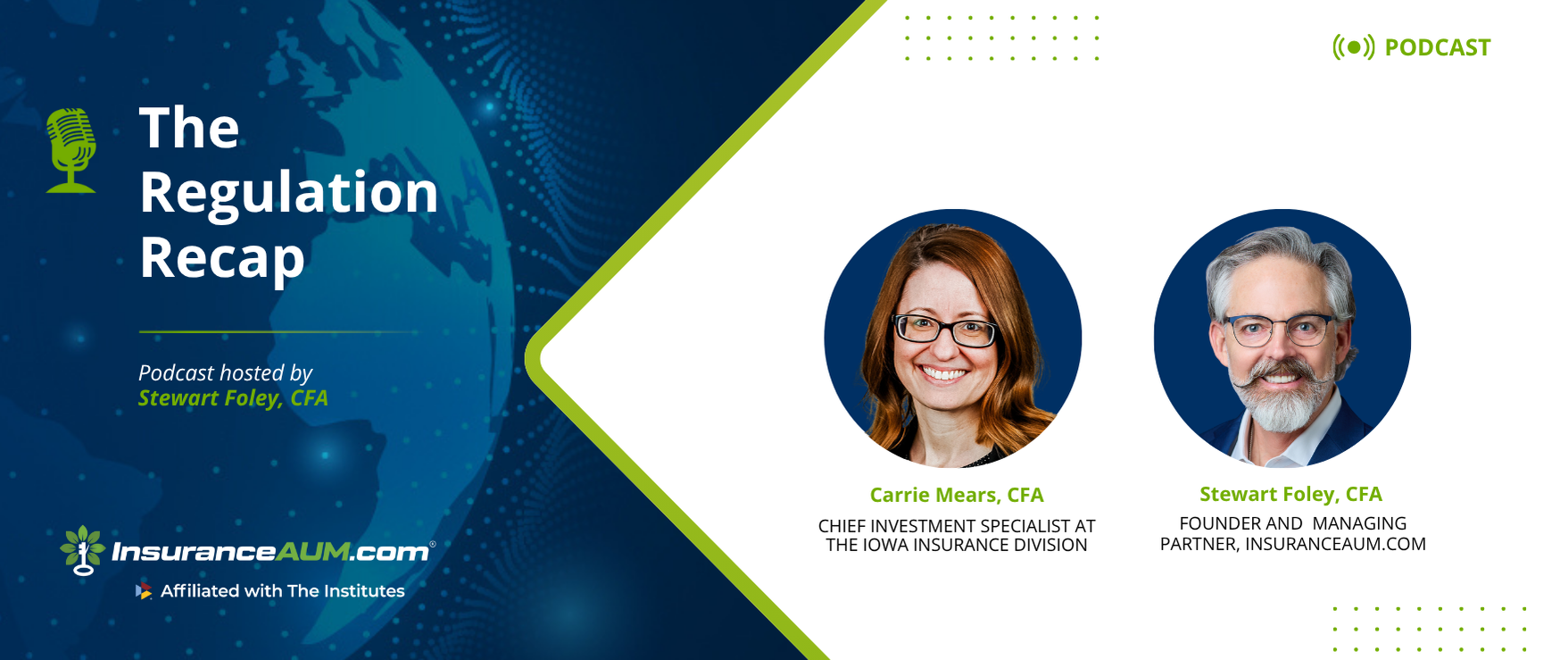
Stewart: Hey, welcome back. We're glad to have you. This is Stewart Foley, and we're on the insuranceAUM.com podcast. And today we have a very special guest for you. We've had a lot of asset managers on, we've had CIOs on, and today we get to have a regulator on, and not only a regulator, but one who is very well liked out there among us.
She's so accessible, as evidenced by today being on the podcast with us. So our guest today is Carrie Mears, who's the Chief Investment Specialist for the Insurance Division of the Iowa Department of Insurance and Financial Services. You've been in that role since 2018. You lead investment policy, oversee insurer portfolios and hedging programs to represent Iowa at the NAIC. You are the chair of the NAIC Valuation of Securities Task Force. You're the vice chair of the Macro Prudential Working Group and a member of the IAIS Macro Prudential Supervision working group. You're a CFA charter holder, and you are also an industry vet. Welcome, Carrie. How are you?
Carrie: Welcome. Hi. Wow. I'm used to those kinds of introductions. That's kind of fun.
Stewart: So we always start these podcasts off like this. Where did you grow up? And we've been asking what was your first job? Not the fancy one. Or you can answer what was your first concert?
Carrie: Ooh, okay. I mean, I can do all of those things, so we'll see. I was actually, and I think we have a connection here, if I remember right, we're not side of St. Louis, in St. Charles, and then we moved to Kansas City, the Kansas City area, when I was in middle school. So Midwest, born and raised, went to college at the University of Illinois, lived in Chicago for a hot minute, and then moved over to Des Moines. I've been in Des Moines since 2002, which probably started doing math on my age now... Goodness.
Stewart: So you were born northwest of St. Louis, and I was born straight south of St. Louis in Imperial, Missouri.
Carrie: Yes, there you go.
Stewart: Which is the next town. Passed the Arnold Water Tower on Interstate 55 between the roads.
Carrie: See, I moved when I was 12.
Stewart: Right.
Carrie: So you give me landmarks and I'm not, yeah, I got nothing. But I do remember going to St. Louis Cardinals games and seeing Ozzie Smith do back flips.
Stewart: Yes, yes. That was like high school for me. Yeah, it was really a good time to be in St. Louis. I mean, Cardinals were amazing at that point. So it's interesting. You have an interesting career because you've got industry background. You've worked, in fact, I was on the phone this week with Jack Bishop at Principal, and I believe you worked with him a while ago. Can you talk a little bit about your background, what led you to regulation?
Carrie: Perfect.
Stewart: Just talk a little bit about how you got there. There are people who I'm confident who are listening to this podcast who would consider a career there, but maybe they don't know how.
Carrie: Sure, sure. Going back to your initial question, I can start with that. My very first job was working at a retirement home in the dining hall, serving dinner. So that probably did not lead me here, although I suppose many of those people did have great insurance policies in their day. And so, thinking about people aging and needing those, maybe we can make some sort of connection there.
Stewart: My mother is 88, and she stays in a skilled nursing facility across the street, literally like two minutes from my house. And if you go there at lunchtime, I can tell you that it is tough duty in the lunchroom of a nice
Carrie: Meal happens in place, right? There's a lot going on.
Stewart: Yeah.
Carrie: So much. It was fun. So right out of school, I was supposed to work for Arthur Anderson, so this will date me as well, and I never got to my first day of work because that's when Enron happened, and they just effectively disintegrated before my eyes. So the job that I thought I had very solidified went away, and through a course of events, ended up in Des Moines and worked very briefly for an accounting firm here, and just really, it wasn't my jam. So had moved over to industry and started more on the accounting side, but worked with derivatives and hedging policy and hedging strategies and policy around that. So did that for several years, and I really enjoyed it. I think one of my favorite parts was working with the business units and the actuaries and the business units and the portfolio management team, just kind of thinking about how all those things fit together. So decided I was pretty interested in that. Went back to school for a graduate degree, did my CFA charter, and ended up moving over more to that side to continue that work in effectively an asset liability management role. So then did that for several more years. And then this position came up in the division. It was one of those word-of-mouth kinds of things. It wasn't really posted anywhere. It had not existed before, but cut one did that and thought it sounded interesting, had lunch with the commissioner, and then now here I am, seven years later.
Stewart: Here you are.
Carrie: Yeah.
Stewart: Well, I think it's interesting that with insurance regulation, and I had the good fortune of attending NAIC’s national meeting in Minneapolis, where we actually bumped into each other. I did not appreciate how large and how broad and how many people were going to be there.
Carrie: It was huge. It's very overwhelming the first time you go.
Stewart: Yeah. So you have a role in Iowa. You have a role with the NAIC. Talk a little bit about what your day-to-day is like when just leaving investment policy at the division? What does that look like day to day?
Carrie: Well, I know it's probably a very standard answer you get from most people, but no day is the same, and it really just depends on what's going on. The joke is, well, not the joke. The real story is that my primary role and really my main focus would be working for the state of Iowa. And that means overseeing the companies that are actually domiciled in Iowa and having consistent communication with them. We have obviously regular cadence-type meetings, say on a quarterly basis, to get updates on what's happened over the quarter, issues they may be having, observations they have, updates from risk management and performance, and things like that. But honestly, with most of them, it's a lot of ad hoc-type of meetings too. We're very both fortunate and purposeful in the fact that within Iowa, we've built out with at least most of our insurers very transparent relationships.
So we do have where they feel very comfortable picking up the phone, I suppose, picking up the Zoom now and reaching out and saying, we're working on this transaction, we're looking at this strategy, we're making this type of change. Can we run it by you? Get your thoughts. So we can be very proactive with those types of issues. And I realize that not everyone's like that with the regulators. So I think that puts us in a really good position. And I think the insurers down here would ideally say the same, and that really then informs the things that we can do on a national level. And so Iowa as a whole is very involved in national initiatives. I just have some fantastic colleagues, and we're super fortunate to have a lot of support from our government and our division to make sure we're getting the right people in the right places and that we don't have one person who's wearing 45 different hats.
We can at least remain fairly focused on our key areas of expertise. So that's been just really good support from the state of Iowa, really good relationships with the insurers, so they feel comfortable coming to us. And so really, yeah, it just depends. If I'm working on a key thing at the NAIC, that could take up all my time for a week, but it may be that some weeks we're doing company meetings all week, and then I throw in, as you know, I work on some international issues too, which involves travel. So then you add all those things together, and it's ultimately really three jobs instead of one, but they really all feed into one another, and that's what makes it manageable.
Stewart: What they told me at the University of Chicago, they said, is that busy people find a way.
Carrie: Yeah, I think I'm more efficient when I have more to do. I would say that's absolutely true.
Stewart: For sure. Right. So you chair the NAIC's valuation of securities task force.
Carrie: Yeah, very unfortunately named.
Stewart: There's restructuring underway. What changes should insurers expect, and what are the big issues on the table today? And just for whatever it's worth for our audience, we don't have an ax one way or the other. We don't want anything. We're not angling for anything. But at the end of the day, I think a lot of people who talk to you are angling for something. What are the big issues that are facing you today that, if folks don't necessarily follow the NAIC meeting circuit and so forth, I mean, just in a high…
Carrie: Like what they care about?
Stewart: Yeah.
Carrie: So valuation of securities task force, as I joked, is unfortunately named because we really do much with the valuation of securities. Obviously, back in the day that was more relevant. But the role has evolved over time, not so much the name, but historically, even that task force, maybe I say historically, even in the last multitude of years, really has focused on credit risk assessment. So, looking at bonds within the portfolio and ensuring that they have some adequate measure of credit risk that can be utilized for a variety of sources. Investment people use quality measures for a lot of things, even asset allocation, investment guidelines, and things like that. And then, most importantly, in insurance, it drives how much capital needs to be held against those types of investments. And one thing, while that's still super important, credit is obviously a huge part of most insurers' portfolio, particularly more asset-intensive life insurers, recognizing that we needed something a little bit broader.
And so we established that starting at the beginning of next year in 2026, they'll become more of the invested assets task force. So that's just been able to pull in investments more like mortgages, real estate, equities, whatever it may be, to really have a more holistic view of the whole portfolio. And then really a secondary component of that is people may not be super familiar with our committee structure, but there's, as you've noticed from probably attending the meeting, there's a lot of groups and they all kind of feed into a tree with one another. And traditionally, you have these working groups that are staffed by insurance staff like myself who are really working on the nitty gritty of everything. And that flows up into a task force, which traditionally includes the commissioners, the leads of each state, and then they're able to look at that, whatever the issue is, whatever key policy was adopted, can look at that at a more holistic level, as then they prove that to continue to move forward.
And valuation security task force historically had no working groups underneath it. So it's kind in this dual role where it was doing these more specific policies really down in the weeds, and then immediately it went past that group up to kind our overarching committees. And so I think it was really helpful, and the feedback we got from industry is to have some separation there so we can really be more like some of the other groups within the NAIC and have some of those smaller working groups that are really working on the details of everything, and then have that task force be more commissioner-led. And so realistically, staff like me who are developing out a lot, so you'll probably see my face on that as well, but really trying to make sure commissioners are staying engaged and educated. We plan to use that task force as an education forum.
And so certainly welcome any of your listeners if they have key issues, they think really, “hey, these regulators should know what's going on here. This is a big update.” And sometimes we have them reaching out at national meetings and doing one-on-one meetings. “Hey, bring it to this task force, you'll get everybody at once.” And then we can do that in public, and we'll keep those working groups then focused on really key issues. So we'll have one that continues the traditional work of the task force related to credit risk assessment. We'll have one that is going to implement a procedure that we're putting in place for due diligence over the use of credit rating providers. And then we'll have one that's more of a catchall investment analysis working group that's really looking at key issues as they percolate up working on some of that education, looking at specific companies, things that may need more assessment and putting together reports that can then ultimately go up to that task force.
So I'm actually really, really excited for this restructure. I think one, it will give people a lot of opportunities to kind of step up to the table and work on things and spread out the work a little bit. And I think really what's probably most important then to listeners is realizing that they have a resource that they can go to as well when they're looking for that education, or even to provide it, we'll be reaching out for that as well, so we can have a lot of that dialogue with even what insurers themselves are seeing.
Stewart: Yeah, that's super helpful. I think from your vantage point, and we've talked a little bit about this, but there's a rapid growth of private assets, whether that's credit structure, other income asset classes. I don't want to put words in your mouth, but from my seat, it looks like you want greater transparency of what is actually being held. Can you talk a little bit about how regulators are viewing this growth in these private assets, and are there efforts to make things be more capital efficient? What's the underlying? That's the name of the game, I hear, I think.
Carrie: I think you've got it.
Stewart: Talk to us about it.
Carrie: Sure. So yes, I think probably very recently, private credit is kind of the topic du jour. I think you led off this podcast, right, with your upcoming forum related to that. But I would say yes, we've at least somewhat had a head start within insurance for that to some extent because we have so many initiatives that are already in place that are really addressing what some of those underlying concerns are. Probably more related just to asset strategies in general. And these things would also be applicable to whatever you want to put in that private credit category, which I know people have different views on what that is. But if we think about just we've seen increasing, probably the biggest structural shift we've seen within the US in terms of investments is really a move towards securitizations and structured assets. And then obviously a lot of those don't necessarily fit into the private category, but more do with more asset-backed finance.
And then the catch phrase is financing the real economy and bringing that onto insurers' balance sheets. And so generally there are no issues surrounding that, except to the point that you made, which is we have a lot of disclosures around investments and they're very not descriptive. So it's really difficult for regulator like myself if I'm not able to go in and work with individual insurers to get details on some of those, to really get a sense of: are these the credit quality of these being accurately represented? Is the capital being held appropriately? Is it even reported in the right place? And so I think probably one of the biggest changes we've had that will be fully implemented at the end of this year, it was technically effective at the beginning, is our principles-based bond definition. And so what that said is a lot of things, we have rules around bonds and certain capital treatment for bonds, but got to a point where you can make a bond out of anything.
And so provided some more specifics around what types of characteristics you need to be able to be called a bond. And so that's a pretty seismic shift to have those principles in place rather than just making a list of bond types that would be acceptable. And so we can use that type of information. Then potentially some additional disclosure that'll be up by the end of this year to help with that assessment of credit quality, the use of deferring interest payments, and how that could impact liquidity. We'll have some disclosures around that, how we're looking at capital factors, because right now we're looking at changing those for specifically CLOs, but ongoing likely F securities overall. And so we're really headed in that direction of trying to look to your point under the hood of what some of these types of investments are and just make sure that we're reflecting those characteristics underneath using the principles that we're putting out rather than using the rules that we've always had in place that may have not contemplated some of these types of investments. So from that perspective, you can call it private credit. You can dig in and say, but okay, well, that's strict lending to small or more middle market companies. It already kind of fits into that overall structure. So I don't know that we really need to do anything particularly different than what we're doing, as much as it falls overarchingly into some of those focus on some of those principles that we're laying out.
Stewart: So I mentioned earlier that you have a role at IAIS, which gives you, it's really difficult to say it's, it gives you a global perspective, right? And the other regime, solvency two, is very different than what we do here, the Bermuda Monetary Authority. There are other insurance regulatory entities around. Is there anything that you see, or is there convergence? Is there anything that we can learn from each other? How does that work? What influence your global lens have on your domestic lens?
Carrie: I think it goes both ways. Both ways. I know there's been concerns about forced convergence, I think between some of the jurisdictions. And one of the things we've really stood by, at least from the US and I think it's being seen across the board, is that really all of our regulatory frameworks were built out of what was needed from what was in the jurisdiction, the types of products we offer, what the types of liabilities are overarchingly, and sometimes that's a little bit circuitous that you build a framework. So the liabilities are built to be responsive to that, but often it's tax codes, it's what's available for retirement if you have a national pension plan or something along those lines. Obviously, your needs to meet some of those societal requirements are different amongst jurisdictions. So I think there's an increasingly good recognition of that. I may be more optimistic than some, but I do see that of realizing that there is a reason that some of these jurisdictions have different frameworks to approach those types of liabilities.
And so then you're going back to, I think this concept of just using principles is really what gets carried through. And so we can say even bringing it back just to the investment side, one of the things we've highlighted even on a global scale is shifts in asset portfolios. And we said, well, okay, for example, I pointed out in the US securitizations, you don't really see that for various reasons. In Europe, they have some capital restraints around that, but that doesn't mean they don't still have increase in some complex assets, increase in more illiquid assets, in assets that maybe have some difficulties in ascertaining what the valuations would be. And so it really doesn't matter what call it, you are more concerned about those attributes. And so that's where we can really have more dialogue and say, okay, what are some best practices in place?
Or how are you approaching this? Or what are some risks that we can identify that we can all collectively address? But it might be, obviously for different types of assets and in different types of ways, it's just the concept of ensuring that we have back to that transparency, that you have the right capabilities in place at the insurer and the risk management and governance that surrounds those, the understanding of how those assets could perform in different types of environments, that overarching more holistic approach applies everywhere no matter what the asset is. And so I think that's where you get some of the dialogue back and forth. It's super helpful.
Stewart: Yeah, that's very helpful. So we'll get into a fun question or two, but having worked across, you've worked in the investment management business, you've been in the regulatory leadership. What are some lessons or insights that would be helpful to CIOs and insurance investment portfolio managers as they listen in today? Is there anything that you would say, Hey, keep X in mind or whatever?
Carrie: Yeah, a few things I do think is really actually helpful to be transparent with your regulator, and I appreciate that that's not in the culture of some insurers, but I think if you were able to talk to some or they feel like they can go to their regulator and explain what they're working on and try to provide that education that generally is very positive for them. We're known, at least in Iowa, we're known to be fairly tough in that we challenge things and ask a lot of questions and really try to peel back all the layers to understand the underlying risks and the types of transactions we see, but we're also willing to listen and learn and hear about new things and receive that education and then apply our regulatory lens on top of that. And so it's really helpful to do that upfront because then you can build out whatever it is that you're working on with that lens already in place, versus possibly having something come up and an examination later and having to kind of unravel all of it.
That's not a place anyone wants to be. And so that transparency, I think, is incredibly helpful. Otherwise, we as regulators may tend to overcorrect for the things that we don't understand or that we don't know. If we see kind of a black box there, we're having to put some sort of control around that. And we may not be doing really the most pragmatic or best thing because we don't really know what's underneath there. So the transparency goes both ways. So to be that transparent with us, and we can be very open about what our thoughts and views are, and how we'd like to address that going forward. I think the other big one I'd probably say is just to some extent a reminder that in the end, despite the fact that we're in this Insurance AUM, we're talking about investments. Obviously, this is very asset-focused, insurance is liability-focused.
It exists for the liability; it exists for the policyholders. It doesn't exist just to originate more assets. And obviously, that balance is getting a little upended with a lot of the entrance into the market. And there's absolutely a symbiotic relationship there with the types of assets that you can see some of the investment changes in the market, and how that can ultimately support better products and better outcomes for policyholders. And that's recognized, but in the end, it's the policyholders that matter and really ensuring that that lens is always in place. As you're looking at potential new initiatives within any of the companies, it's really important to have that relationship with your liability teams, keep the actuaries informed, the ones that have to think about pricing and asset adequacy testing. We've really tried to build some initiatives in place that kind of force those conversations to occur and make sure it's really an asset liability management-driven organization versus just a focus on the assets.
Stewart: That's good stuff. Alright, so fun ones. You ready?
Carrie: Sure.
Stewart: What characteristics do you look for when you're adding to members of your team is the usual question. But, for this: what makes a good regulator? When somebody comes out of school, they may be interested in learning more. What characteristics do you think make for a good regulator?
Carrie: I think it's really trying to balance, effectively, skepticism, which is important on this end, but with pragmatism. So I think you can easily fall into one or the other too easily. It is our job to challenge, it's our job to question. And so we can be kind of tough and sometimes need lots of dialogue with an insurer to really walk through where our concerns are and where we're going to poke holes in something. But on the flip side, it's very easy for a regulator to fall on the trap of just disallowing things or saying no or putting huge capital charges on something without really fully appreciating the actual underlying risks. And so I think some sense of pragmatism and ability to welcome education constantly, be trying to learn of what's going on in the market, where new opportunities and enhancements and innovations may be. Trying to think about how that fits into the framework we have already, or what are the missing pieces that we need to address, but in a way that ensures everything can move forward appropriately. And finding that very good balance between those two, I think is what is probably the most effective way a regulator can then interact with insurers.
Stewart: Alright, last one. Fun one. You can have dinner with up to three guests. Oh
Carrie: Shoot. I forgot about this one.
Stewart: Oh no, this is the fun part.
Carrie: Okay.
Stewart: Who would you most like to have lunch with? Alive or dead now? It doesn't have to be all three. You can take one, two, or three.
Stewart: Yeah.
Carrie: Oh, pressure's on. Okay.
Stewart: No pressure. No.
Carrie: Trying to come up with someone who makes me sound really, really smart. Right.
Stewart: Or someone the other day said they're family. Hey, there are no bad answers on here.
Carrie: Certainly. Yeah, always. That's a good one. Okay. No, I do have one. And actually, because I was just talking to my kids about this recently too, I'm kind of obsessed with the history of food. How did our ancestors realize how you can manipulate food, a fire or cold or fresher or whatever it is, and come up with things that were actually edible beyond just forging and throwing.
Stewart: I think that's true. Coffee to me. When you look at a coffee bean, you go, how did you guys come up with that? You can make something that you can make coffee out of it. This looks nothing like coffee.
Carrie: Yeah. Who sat through this it out? We should talking about this. I would want to be at the dinner table the first time someone made a true fluffy, yeast-filled loaf of bread. So not the flat, just kind of by bread that probably exists first when they first said, let's let it sit and rise a little bit, and then we'll heat it up and it'll be really squishy and really excellent. And the first time they sat down and put that on the table, and you got to try that, that's where I'd want to be. So I don't have dinner with that person. Would great. Want to bring my grandma because I miss her. My grandma, too.
Stewart: Yeah. That's sweet. I was just talking about my grandmother this weekend. My grandmother was a really big influence on my life as well, so I can relate on that front. But the person who invented bread, I'm in with you. I'm a bread fan myself. Absolutely.
Carrie: And then we could fast forward a little bit to the first pizza, so they're like, oh, this would work as a crust for cheese and cured meat.
Stewart: No. Excellent. It's actually, how do you figure out cheese? How does that work?
Carrie: All the different types, or gosh, if you think about aged liquor that is aged beyond someone's actual lifespan. So they just had to, I'm going to keep working on this, and hopefully my grandkids think it's good.
Stewart: That's right. That's true. I really appreciate you being on. It's been fun whenever we have a complete meal. There you go. But it's been fun, and thanks for coming on. I hope you come back again, and thanks for sharing your views and giving us a little bit of the buy in the scenes. So thanks for taking the time. Yes,
Carrie: And thanks for coming to our meeting, and hopefully I'll see you at a feature one.
Stewart: Absolutely. Thanks for listening. The title of the podcast has been Current Happenings in Insurance Investment Regulation. Our guest has been Carrie Mears, Chief Investment Specialist for the Insurance Division of the Iowa Department of Insurance and Financial Services. If you like what we do here, please rate us, review us on Apple Podcast, Spotify, or our brand new YouTube channel at Insurance AUM Community. My name's Stewart Foley. We're the home of the world's smartest money@insuranceaum.com.
The InsuranceAUM.com podcast is available on




Share this post


Sign Up Now for Full Access to Articles and Podcasts!
Unlock full access to our vast content library by registering as an institutional investor
Sign Up Now for Full Access to Articles and Podcasts!
Unlock full access to our vast content library by registering as an institutional investor .
Create an accountAlready have an account ? Sign in