





We're currently experiencing email delivery delays. For urgent matters, please contact us directly at lindsay@insuranceaum.com.

Oaktree Capital-

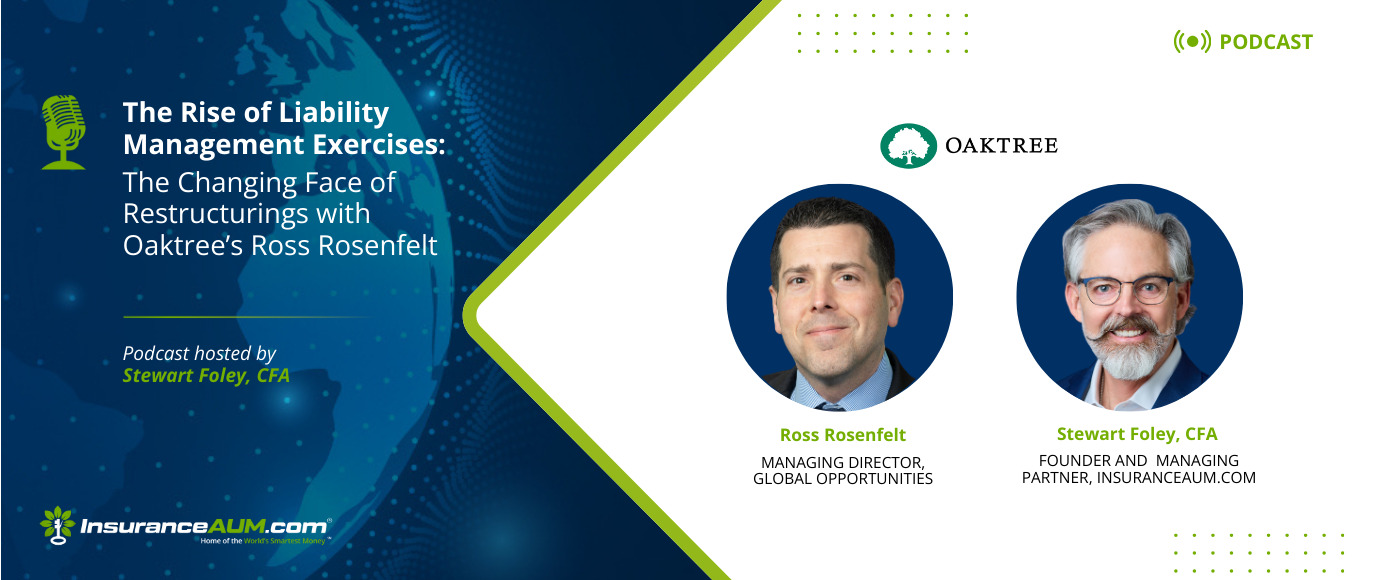
The Rise of Liability Management Exercises: The Changing Face of Restructurings with Oaktree’s Ross Rosenfelt

Image
09.04 Oaktree Capital_Web (1)


Stewart: Hey, welcome back. We've got a great podcast for you today. Really appreciate you listening. We've got a really dedicated audience and appreciate all the kind words. I do want to make mention of our upcoming Private Credit/ABF event that's going to be in Texas, November 5th and 6th. If you are an insurance company investment professional and you're focused on Private Credit or ABF, or if you're curious to learn more, if you're an expert or just curious, we'd love to have you. There's a link to register on our website under the events tab. Look forward to seeing you there. And a related topic is this podcast, and I love the title of it: The Rise of Liability Management Exercises: The Changing Face of Restructuring, and we're joined by Oaktree’s Ross Rosenfelt. Ross, thanks for being on. I appreciate you taking the time. I'm going to do a little bit on your bio in just a second, but I wanted to get you in here right away.

Ross: Yeah, no, it's really great to be here. So thanks so much for having me on the podcast.

Stewart: We are thrilled to have you. Ross Rosenfeld is a Managing Director of Global Opportunities with Oaktree in Los Angeles. You, sir, have a J.D. from the University of Virginia's Law School and a B.A. Magna Cum Laude, I want to make a note that that's no kidding, from the University of Pennsylvania. You're also a member of the State Bar of New York. So you are the perfect person to talk about this today. We want to start 'em off the same way as we always do, which is where did you grow up? And our most recent question: what was your first concert?

Ross: Oh boy. You threw me for a loop there because I've listened to the podcast for a while, and I was all ready for what was my first job, so I'm going to have to do this one on the fly. But I grew up in New York City. I'm a born and raised New Yorker, and as you mentioned, I spent some time in Philly and then switched gears entirely and went down to Charlottesville, Virginia, which is amazing. And then four years ago, I moved to Los Angeles to join Oaktree, which we'll get into. My first concert was an Eagles concert, actually, in I think someplace outside of LA in high school.

Stewart: Oh wow.

Ross: Yeah, it was amazing. And I've since gotten my son into the Eagles, and I took him maybe a year ago to the forum out in LA because I thought that would be the last show they would ever play. It was the end of their tour and he still gives me some gentle ribbing because they've subsequently went on to play about a hundred shows at the sphere in Vegas. So less significant than I thought at the time, but I'm a big Eagles fan, so that was memorable.

Stewart: That's super cool. I mean, if you could, can you talk a little bit about your background, how you got to this role at Oaktree? And just for anybody who doesn't know, maybe start with a little bit about Oaktree.

Ross: Yeah, I'm happy to do that. So Oaktree is a global alternative asset manager, founded in 1995 by Howard Marks and Bruce Karsh. As of the end of 2024, it managed over 200 billion on behalf of clients. I sit within what's referred to as the opportunities group. So it's a platform that has a history spanning 27 funds. It's a global all-weather strategy, goes wherever the opportunities present themselves, invests the cost public and private credit with a flexible capital mandate, and is, as I mentioned, global in nature. So we have investment professionals in Europe and in Asia. And I can talk a bit about the investment philosophy if you'd like, or we can save that for later.

Stewart: No, absolutely, please do.

Ross: Okay. Yeah, so this strategy is very focused on downside protection and diversification first and foremost. So we tend to skew towards larger companies. We generally invest at the top of the capital structure. So you'll often find us holding first lien debt. When we invest in the secondary market, we tend to do so at a discount to face value. You may have heard of distress for control strategies. We are not that, but we're definitely comfortable taking the keys when necessary. As I mentioned, tend to be diversified portfolios and also tend to deploy well are always diversified and tend to deploy heavily in periods of significant dislocation. And then I would say finally, in terms of maybe some differentiating attributes, one would be scale. So, as of the end of last year, the strategy managed over $45 billion on behalf of clients, including our most recent opportunities fund 12, which is a $16 billion fund, $16 billion in commitments, including co-invest and affiliated vehicles. And the prior fund was similar in size. So that and the depth of the team, I think are real differentiators, large team 81 investment professionals, and the PMs each have over 20 years of experience. So we've been doing it for a while

Stewart: And it's super helpful. And can you talk a little bit about your background and your role at Oaktree? I've met people with J.D.s in this business, but it's not, I don't think, super common. Give us some background about how you found your way into this senior role that you're in today.

Ross: Yeah, so I was a restructuring attorney at a law firm called Paul Weiss in New York. And I really appreciated the versatility of the practice, the practice of bankruptcy law. So there's a lot of litigation, but the process is also very transactional and practical, and things move quickly because companies typically don't age well in bankruptcy. So I really enjoyed that experience, but ultimately it was a lot of implementing strategy for the investment firms versus coming up with the strategy. And so the latter was intriguing to me. And so I made the transition to, first, the sell side. So, I had a brief stint at a couple of large investment banks and then, ultimately, the buy side. Oaktree, as you know, I'm sure distressed investing is done in bankruptcy court or with the prospect of bankruptcy court, and with the attendant laws that go along with it. So having a J.D. is helpful to help guide the team and make sure that we're assessing the risks and staying within the bounds of the laws appropriately.

Stewart: And you've been involved in restructuring for over 20 years. How has restructuring changed over that period of time? And I know we're going to get into this a little deeper, but if you can just give us a little bit of historical perspective.

Ross: Yeah, so enormously is the short answer. And in fact, I would say even in the last handful of years, it's been remarkable how much things have changed. So it used to be the case when I started, and again, until relatively recently bankruptcies were typically considered to be the value-maximizing option. And there were out-of-court restructurings for sure. I know at the time they were commonly referred to as distressed exchanges, but they were much less common than they are currently. And so companies used to utilize the bankruptcy process, implement changes that made the pie bigger. They would reject leases, they would sell assets, and of course, they would deleverage their balance sheet by equitizing debt. Today, and happy to get into it, the larger cap companies that we follow typically view bankruptcy court as a last resort, and instead these companies are attempting to restructure their debts out of court in what is commonly referred to today as a liability management exercise or LME in an effort to defer the need for bankruptcy or ideally avoid it altogether.

Stewart: And it gets to me this whole proliferation of what's the kind of an acronym is LME, liability management exercise. How has it impacted the opportunities group investing in distressed situations? And is LME a nice way of saying lender-on-lender violence? Can you talk a little bit about that, too?

Ross: Yeah, in terms of how we approach situations, there are just more variables to consider, as it always has. The underwriting process for us starts with the bottom-up analysis of the issuer, the capital, its capital structure, its credit documentations, including covenants, if any. But it used to be the case that one could deduce from this information the proximate timing of a bankruptcy filing and the likely fulcrum security after restructuring would take place. But in a post-LME world, as we'll get into in a moment, capital structures can change dramatically and unexpectedly in very short order. So the game theory just becomes a lot more complicated. And maybe at this point, it would make sense for me to step back and talk about what a liability management exercise is and maybe provide a brief example, and then we can circle back to how it impacts our underwriting process with a bit more specificity. Would that be useful?

Stewart: Absolutely.

Ross: Okay, great. So well first, just again, I think just to put in context how significant the shift has been. In 2015, 5% of defaults in the broadly syndicated low market were liability management exercises. And in 2024, that number went to 73% of defaults in the broadly syndicated low market were liability management exercises. So that should just give you some perspective as to how pervasive they've become. What they are is really what we talked about earlier; it's just an attempt by a distressed issuer to restructure its debt outside of bankruptcy court or to obtain capital when it's unavailable through conventional means. So what does that mean in practice? I'll give an example of a typical up-tier transaction, which is a type of LME. And while each of these, as you might imagine, has its own unique attributes and nuances, I'll try to take a shot at describing them briefly at a high level.

So, assume a company with a capital structure consisting solely of a first lien term loan, assume it's overleveraged and in need of liquidity, which of course it can't obtain because it's distressed. Assume further that it has covenants in its credit agreement for the term loan that prevent it from reducing debt or raising new capital that's senior to its existing debt. So in order to effectuate an up-tier, the company would get together with lenders holding a majority in dollar amount of its term loan, and the parties would negotiate an amendment to the credit agreement, which typically allows for this to occur, and through which that first lien is retrenched into a first out, a second out, and a third out priority. So, snapshot day one, you have one credit agreement with everyone, par passu, having the same rights and priorities, and then post-amendment, you effectively have three different levels of priority.

The implication being that in the event of a subsequent bankruptcy, assuming that the up-tier survives any legal challenge, this retrenched loan would be the recovery waterfall that would dictate lender recoveries in that future bankruptcy. And so now, with the loan retrenched, the majority of creditors agree to provide fresh capital to the company; they can do it on a first-out basis, and this new loan is now protected as it's the most senior debt in this restructured waterfall. And the majority of lenders also get to roll up their old first lien debt into that second out position. So they've now effectively put in new money at the top of the waterfall, they've rolled up their position to a relatively safe second out position, and they've subordinated the minority lenders into the third out or below. And importantly, the minority lenders are typically offered the chance to then elevate their claims, maybe into that third out position or maybe into a mix of the second and third out, but at a discount to par. And so they then have a decision to make: they can opt not to accept this treatment and remain at the bottom of the waterfall altogether, again, subject to any litigation rights that they may have, or they can participate and give the company the de-leveraging that it seeks. And so the borrower, assuming it works, gets fresh liquidity, and it importantly, again, creates that coercive dynamic with the minority lenders that allows it to capture debt discount if it succeeds.

Stewart: Is the pronounced increase in the percentage of LMEs in that BSL market, is that the result of the 550 basis point increase in short-term rates, or is it indicative of problems in the companies? Right. In other words, is it an interest rate impact, or are you seeing companies experiencing distress for operating reasons?

Ross: Yeah, I think the answer is both. Clearly, the increase in base rates from approximately zero to where they are today has left many companies with floating-rate debt in need of options and has been the catalyst for stress. But obviously, there are idiosyncratic operational reasons why companies do as well. So it runs the gamut, but clearly, there are more LMEs because of the movement rates. Unquestionably.

Stewart: It's super helpful. And so, how have you seen the lending community more broadly adapt to the changed restructuring landscape?

Ross: There's been a lot of technology and change in behavior. I would say maybe the most notable adaptation has been the rise of something called the cooperation agreement. And I say the rise because it has increased in prominence and degree of use, but it's been around for many years. They've just become more important to defend against these liability management exercises. So maybe if you'll permit me, I'll spend just a minute describing what it is and some of the benefits and burdens of it.

Stewart: Absolutely.

Ross: Okay. Again, with anything as complicated as the subject matter we're talking about, there are different types and different nuances that we won't have the opportunity to get into too deeply. But I would say generically speaking, a co-op is a contract signed by a group of creditors in which they agree to coordinate their actions when negotiating with a borrower regarding a debt restructuring. And so really the goal is for creditors to lock arms with each other, to gain some negotiating leverage against an issuer, and really mitigate the risk that the issuer can divide and conquer its creditor base through cutting side deals, which can lead to a race to the bottom kind of in effect. And so, as I mentioned, while these have been around for a while, as LMEs have exploded, co-ops have been a necessary tool to give the creditors some modicum of protection against that coercive dynamic that the companies would like to establish.

And I would say, as a general matter for Oaktree, or I'll speak for the opportunities group specifically now, where I sit, we found that they make a lot of sense. And I think most creditors in the creditor universe would agree. I think that, as a general matter, better returns can be achieved by creditors working together, and there's just a better outcome than in fighting. I will say, though, that they don't make sense for every situation, and even when they do make sense that there are costs. And so for us, for example, we lose optionality. So in addition to buying debt on the secondary market, we make loans to stressed and distressed companies, rescue financings, and the like. And so when we sign a co-op, we foreclose the opportunity to unilaterally provide that financing. And then I would also say that creditors in a co-op have to agree upon the definition of success, and it's not unanimous, but there's a high threshold, typically at least 50%, in many instances higher, and when you're dealing with funds that have different structures and can take different forms of consideration and just measure outcomes and success differently, it can be sometimes a difficult process to get to success. But overall, I think it's been a very important tool in swinging some of the negotiating leverage back to creditors.

Stewart: Yeah, it's super helpful. And Ross, I guess it kind of begs the question, are there things that sponsors can do to reverse the pendulum, if you will?

Ross: Yeah, it's been a fascinating kind of back and forth, and there are lots of things. I mean, I'd say it's some of the more recent technology that we've seen is we've seen anti co-op provisions, or at least attempts at anti-co-op provisions, making their way into credit agreements on the front end. Luckily or so far, the broadly syndicated market has largely pushed back on those provisions. We've also seen what's called disqualified lender provisions, which are kind of what they sound like, but really borrowers deciding who can take assignment of their loan at the end of the day, so that if they do need to negotiate with creditors, they can try to handpick the creditors that you're negotiating. So it's kind of been this cat and mouse game going back and forth, and I'm sure there'll be more to come.

Stewart: And you mentioned earlier how LMEs might affect your underwriting. I'm not sure that you had a chance to actually cover that. Was there anything that you wanted to add there?

Ross: Yeah, just now that we have the full picture of what an LME is and how it works, I think one of the things that folks should probably take away from this is that it's a more complicated landscape. And so for us on the underwriting side, in addition to the nuts and bolts things that I mentioned earlier about the business and the likelihood of a filing, I think there's just a lot of softer variables. There are sponsor motivations and reputations, and there are relationships with restructuring advisors. There are the size of a firm's position and the likelihood that they'll need to be included if a sponsor does attempt an LME. So it's just a more interesting multi-dimensional game. And so I guess for the sake of completeness, I would add that, but it's a lot of fun.

Stewart: Well, it's interesting when you say, and one of the things I think that this is my words and not yours, but size helps. And I assume that over 20 years, you have relationships with folks whom you have been through the soup with before, and that's got to make things easier. I would think the person, you know, what their reputation is, what their track record's been, I'm sure that that seems like it would be helpful.

Ross: Hugely. It's a repeat player game, and the best-positioned firms are the ones, in my opinion, that have those deep and longstanding relationships, not just with the advisors and the other market participants, but with the sponsors. Inevitably, things happen, and there are twists and turns, and if you build a reputation of being commercial and that stuff happens, it really does matter. And so the relationships are huge. And then you mentioned size, and just when you're counting votes to try to get to the majority, the sponsors and their advisors are interested in who has the size. So I think those are both really important attributes in today's distressed investing landscape.

Stewart: It's been a super helpful podcast. I've learned a lot. I appreciate that. I didn't know a whole lot about restructuring prior to this, and so it hasn't been part of my background, so I really personally appreciate it very much. I got a couple of fun ones for you on the way out the door. One really speaks to Oaktree culture, and so it goes something like: We've had the opportunity to work with Oaktree on a number of different things. Howard Marks was the keynote speaker at our annual meeting this year, which we really appreciated. What characteristics are you looking for when you are adding to members of your team or to Oaktree more broadly?

Ross: Well, I could speak to our team best, and look, we have added and continue to find some of the best and brightest folks out there. So we've been very, very fortunate. I think the caliber of person and the cultural fit are hugely important. And in addition to wanting to work with nice, good people, which fortunately I do here, relationship building is huge. So, distressed investing, especially today in the era of liability management, is really relationship-based investing more so than any other asset class that I'm aware of. I think there's a misconception by some that distressed investing is all about fighting and litigation, and there's absolutely some of that, but the community is fairly small, and most disputes and with compromise. And so relationship building is important, and finding the type of person that can build relationships and not just sit behind a computer screen, no matter how smart they are, is really important. So we've been very fortunate to not just pick really smart people, but really good people who have interpersonal skills to succeed.

Stewart: That's awesome. Alright, so here's the fun one. You can go out to dinner with one, two, or three guests. Who would you most like to have dinner with, alive or dead?

Ross: That is a good question. So I'm a history major. I'm a World War II buff, and I have subjected my family to countless hours of documentaries and grainy black and white footage of World War II. So I will go with Winston Churchill. My guess is that whiskey wouldn't be involved, so maybe a liquid lunch. And I think it would be fascinating to hear about how he balanced some of the considerations behind his most important decisions, and certainly discussing geopolitics with him would be fascinating. He was a master of navigating complex alliances, which is clearly very relevant today. So I'm going to go Winston Churchill.

Stewart: Oh wow. And just the one, I love that, that's perfect.

Ross: Yeah.

Stewart: That's way enough. I mean, way enough. Really nice to have you on great education today. I just want to say thank you so much for taking the time, and we appreciate it, and our audience does too, so thanks, Ross.

Ross: Yeah, thank you so much for having me. This was great.

Stewart: It's a lot of fun. We've been joined today by Ross Rosenfeld, Managing Director, Global Opportunities at Oaktree Capital Management. If you like our podcast, please rate us, like us, and review us on Apple Podcasts, Spotify, or wherever you're listening to your favorite shows. You can also find us on our brand new YouTube channel at Insurance AUM community. We are the home of the world's smartest money on the InsuranceAUM.com podcast.

Share this post

Sign Up Now for Full Access to Articles and Podcasts!

Unlock full access to our vast content library by registering as an institutional investor

Register

Contacts


Oaktree Capital Management, L.P.

Oaktree is a leader among global investment managers specializing in alternative investments. The firm emphasizes an opportunistic, value-oriented and risk-controlled approach to investments in credit, private equity, real assets and listed equities. Insurance companies are one of the largest client segments at Oaktree, with more than 27 years of experience managing capital for the sector. Our dedicated global insurance solutions team partners with clients to develop new strategies and customize our solutions. 

Greg Halagan
Managing Director and Head of Insurance Solutions

333 South Grand Ave., 28th Floor,  
Los Angeles, CA 90071


View the contributor page

Image
Oaktree logo

Sign Up Now for Full Access to Articles and Podcasts!

Unlock full access to our vast content library by registering as an institutional investor .

Create an account

Already have an account ? Sign in

Ѐ Ё Ђ Ѓ Є Ѕ І Ї Ј Љ Њ Ћ Ќ Ѝ Ў Џ А Б В Г Д Е Ж З И Й К Л М Н О П Р С ΄ ΅ Ά · Έ Ή Ί Ό Ύ Ώ ΐ Α Β Γ Δ Ε Ζ Η Θ Ι Κ Λ Μ Ν Ξ Ο Π Ρ Ё Ђ Ѓ Є Ѕ І Ї Ј Љ Њ Ћ Ќ Ў Џ А Б В Г Д Е Ж З И Й К Л М Н О П Р С Т У Ф Х Ц Ч Ш Ā ā Ă ă Ą ą Ć ć Ĉ ĉ Ċ ċ Č č Ď ď Đ đ Ē ē Ĕ ĕ Ė fi fl œ æ ß