
T. Rowe Price -

Why Investors Should Think Differently About Global Government Bonds

Graphic illustration of a diver

Joran Laird, CFA - Portfolio Specialist, Fixed Income
Ken Orchard, CFA - Head of International Fixed Income
Adithya Rao, CFA - Associate Portfolio Manager


Key Insights

  • Casting the net wider to global developed market government bonds opens up a larger pool of intrinsic factors to source potential alpha opportunities.
  • Intrinsic factors are typically known with a high degree of certainty before investing and can make up the large majority of a bond’s total return, particularly for bonds with shorter maturities.
  • Our analysis shows that a reconstructed U.S. Treasury bond index that incorporates global intrinsic factors has the potential to outperform the traditional single‑country U.S. government bond index while exhibiting less risk.

The debate over whether to add global government bonds in a U.S. Treasury portfolio has been going on for some time. Some investors view global bonds as too risky or argue that they do not add much value due to the high correlation among developed government bond markets. Consequently, many investors prefer to stick with U.S. Treasury bond portfolios. However, such an approach limits exposure to intrinsic factors. Given the key role these factors play in bond returns, expanding the investment universe to include other government bond markets exposes the investor to a much larger pool of intrinsic factors, potentially creating more opportunities to find alpha. This strategy can be particularly beneficial when non‑U.S. curves are steeper because of higher currency‑hedged yields and rolling down the curve. In addition to this, there are possible diversification benefits given the ability to spread out interest rate risk among a larger pool of countries rather than be concentrated in a singular market. 

Given the many preconceived notions around global government bonds, we have undertaken a three‑part study analyzing returns and volatility in major developed government bond markets. We then break down the components of a bond return and reconstruct a U.S. Treasury bond index to incorporate a broader set of global intrinsic factors. 

Dissecting global government bonds 

Study 1: What does history tell us? Analysis of historical returns, volatilities, and correlations 

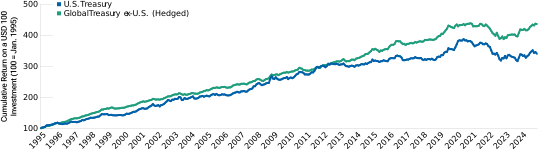
The first part of our research into global government bonds centered on conducting an analysis of historical returns, volatilities, and correlations of the major developed government bond markets. This involved analyzing data for the 30‑year period from January 1, 1995, to December 31, 2024, at an overall index level (Bloomberg Global Treasury ex‑U.S. Index) and individual country level (8 of the 10 largest countries in the Bloomberg Global Treasury index—the U.S., Japan, France, the UK, Italy, Germany, Australia, and Canada). Spain and South Korea were excluded due to data limitations. The example shown in Fig. 1 is the cumulative returns of the Bloomberg Global Treasury ex‑U.S. Index and the U.S. (represented by the Bloomberg U.S. Treasury Index).

Image
Fig. 1 is a line chart showing the cumulative returns of the Bloomberg Global Treasury ex U.S. USD-hedged Index and the Bloomberg U.S. Treasury Index since 1 January 1995 until 31 December 2024.

As of December 31, 2024.
Past performance is not a guarantee or a reliable indicator of future performance.
The chart shows cumulative returns of the Bloomberg Global Treasury ex U.S. USD‑hedged Index and cumulative returns of the Bloomberg U.S. Treasury Index from January 1, 1995, through December 31, 2024.
This is not representative of an actual investment and does not reflect the deduction of fees associated with actual investments.
Source: Bloomberg Finance L.P. Analysis by T. Rowe Price.

Takeaway: Compelling headline return numbers, but duration differences are not considered
The results showed that the Bloomberg Global Treasury ex‑U.S. USD‑hedged Index outperformed the Bloomberg U.S. Treasury Index by an average of around 86 basis points annualized during that three‑decade period. Not only were headline returns higher, annualized volatility (as measured by standard deviation) was lower on average by around 156 basis points. While this is compelling, duration differences were not taken into account, so it’s too early to conclude at this stage that global bonds are a superior investment. Further investigation is needed.
 

Study 2: Do duration differences matter? Analysis of historical returns along the yield curve

To allow for rigorous comparison on a like‑for‑like duration basis, we undertook a further analysis of historical returns generated within the yield curve over the same three‑decade period. This was done for the eight countries outlined earlier (the U.S., Japan, France, the UK, Italy, Germany, Australia, and Canada). Our study involved separating the yield curve into maturity buckets (outlined below) and then calculating the marginal returns from extending into the next maturity bucket. To adjust for the differences in the duration in each maturity bucket, we divided the marginal returns by the duration difference to calculate a “marginal return per year of duration.” We also calculated the volatility of these returns for each maturity bucket. 

  • Extending from 3 months to 1–3 years
  • Extending from 1–3 years to 3–5 years
  • Extending from 3–5 years to 5–7 years
  • Extending from 5–7 years to 7–10 years
  • Extending from 7–10 years to 10+ years 
      
Image
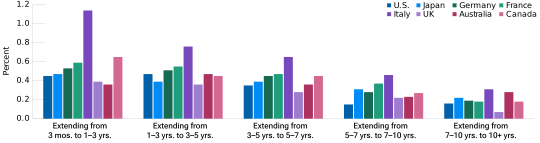
Fig. 2 is a bar chart showing the marginal return per year of duration for the U.S., Japan, Germany, France, Italy, UK, Australia, and Canada from extending from 3 months to 1-3 years, from 1-3 years to 3-5 years, from 3-5 years to 5 7 years, and 5-7 years to 7-10 years, and 7-10 years to 10+ years.

As of December 31, 2024.
Past performance is not a guarantee or a reliable indicator of future performance.
The chart shows the marginal return per year of duration for the U.S., Japan, Germany, France, Italy, the UK, Australia, and Canada from extending from 3 months to 1‑3 years, from 1 to 3 years to 3 to 5 years, from 3 to 5 years to 5 to 7 years, from 5 to 7 years to 7 to 10 years, and from 7 to 10 years to 10+ years. We used monthly total return data for each country maturity bucket for the 3‑decade period from January 1, 1995, through December 31, 2024, and divided the marginal return by the duration difference to calculate a marginal return per year of duration. The returns used are from the individual country components of the Bloomberg Global Treasury Index broken down by maturity bucket. Reconstitution is monthly as per index. All returns are U.S. dollar hedged and from the Index provider.
For illustrative purposes only. Does not represent an actual investment.
Source: Bloomberg Finance L.P. Analysis by T. Rowe Price.

Takeaway: Marginal returns stable, but curve requires more investigation
The results of our study (Figure 2) show that the marginal rate of return for extending duration along the curve was remarkably consistent across the countries observed. Italy is an exception, however, but the results are likely to be distorted by the massive widening in spreads during the eurozone sovereign debt crisis. On the whole, though, there does not appear to be much difference in the returns. While this doesn’t support the case for global bonds, what does deserve a closer look is another observation from the results: diminishing returns. Up until the 5–7‑year portion, marginal returns are stable, but when extending to the 7–10‑year point and beyond, returns start to diminish. This suggests that the slope of the curve is important.

Study 3: Do slope differences matter? Analysis of historical returns under different conditions 

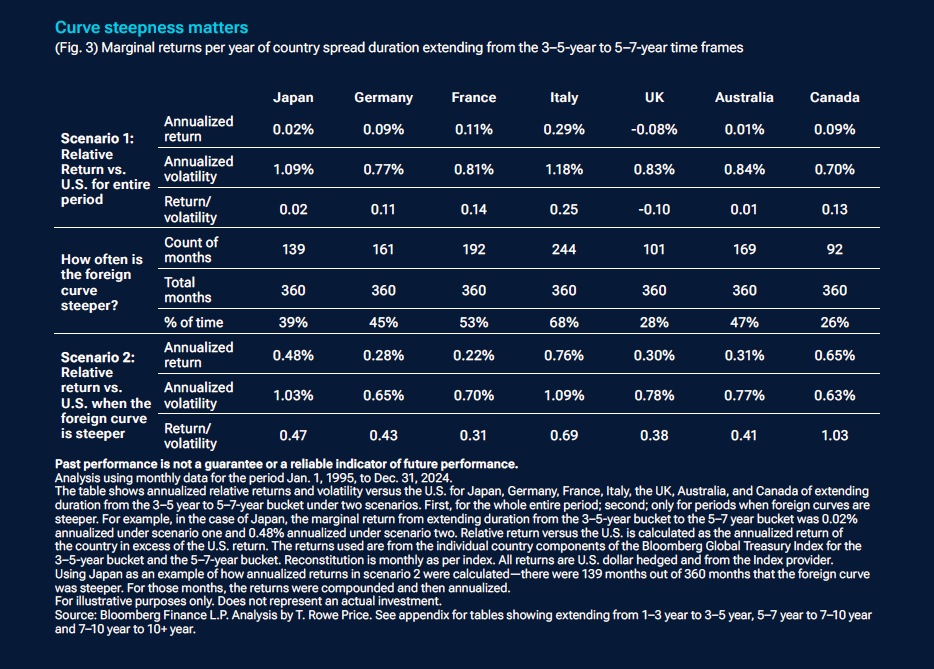
Digging in to more detail about the significance of curve slopes, we evaluated the historical annualized relative returns and volatility of extending duration along the curve under two scenarios: first, how each individual country market performed relative to the U.S. over the entire period and second, only for periods when foreign curves were steeper than the U.S.
 

Image
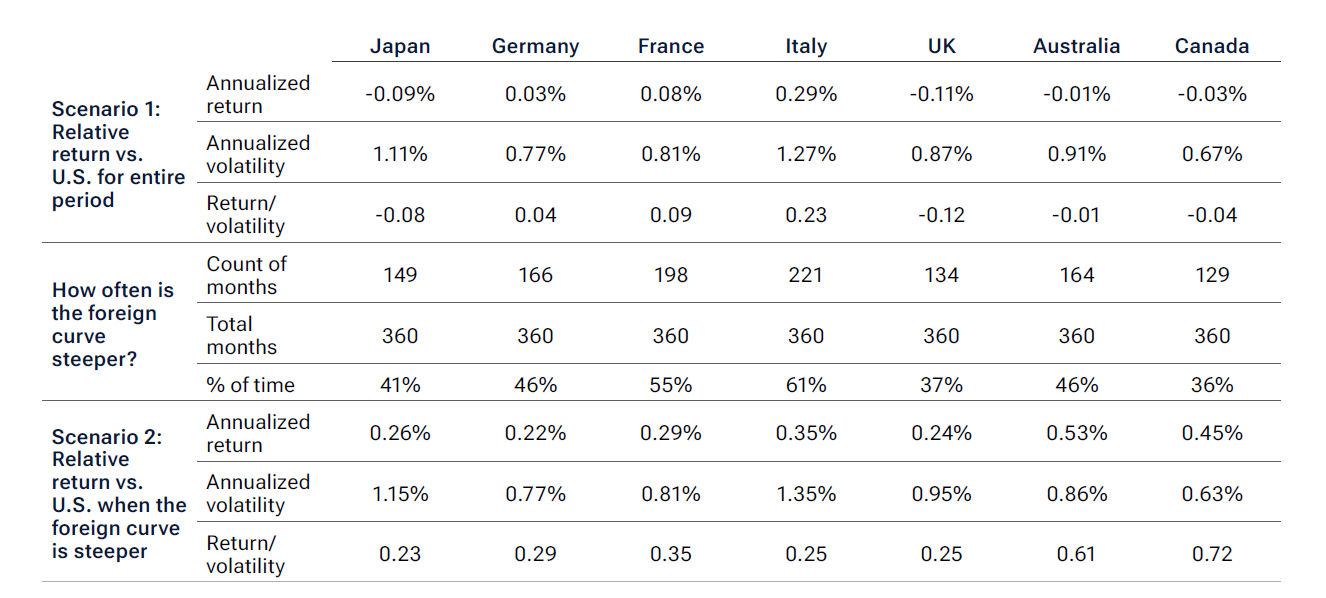
Fig. 3 is a table that shows annualized relative returns and volatility versus the U.S. for Japan, Germany, France, Italy, the UK, Australia, and Canada of extending duration from the 3-5 year to 5–7-year bucket under two scenarios. First, for the whole entire period; second; only for periods when foreign curves are steeper.

Takeaway: Steeper curves helped boost returns
The results show that not only were headline relative returns higher under scenario two, but volatility was generally lower. This was observed across all the maturity buckets we examined in our analysis, which suggests that curve steepness matters

Dissecting sources of a bond return 

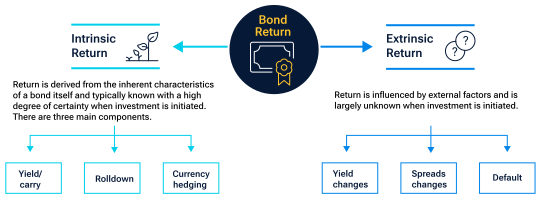
To understand why curve steepness matters, let’s drill down into the two sources that make up the expected return of a bond: extrinsic and intrinsic. For default‑remote, high‑quality government bonds, the extrinsic component of a return is based on factors that lead to yield and spread movements, resulting in changes in the bond’s price. Since these are influenced by external factors such as the interest rate environment, inflation expectations, and/or geopolitical events, they are largely unknown at the time of investment initiation. By contrast, the intrinsic components of a bond return are derived from the inherent features of a bond itself and are typically known with a relatively high degree of certainty when an investment is initiated. Specifically, there are three main components of an intrinsic return:

  • Yield or carry—The return that accrues from holding the bond.
  • Rolldown—The return captured as yields fall the closer a bond gets to maturity. This return is positive if the yield curve is upward sloping. An inverted yield curve, by contrast, will generate a negative rolldown return.
  • Currency hedging—The return captured by hedging non‑U.S. bonds to the U.S. dollar. When U.S. rates are higher than the foreign country where a bond is being purchased, there is a positive interest rate differential and currency hedging will typically boost returns. By contrast, when U.S. rates are lower, the differential is negative, and the currency hedge will generally lower returns.

To evaluate the influence of intrinsic factors, we analyzed their contribution to historical total bond returns across various time horizons. The study encompassed the same government bond markets outlined earlier (the U.S., Japan, France, the UK, Italy, Germany, Australia, and Canada) and covered a range of sub‑indexes (1‑3 years, 3‑5 years, 5‑7 years, 7‑10 years, and 10+ years) within each market. The results showed that intrinsic factors were significant drivers of historical total returns on average across different time horizons.  For example, in the case of the French 5–7‑year index (as shown in Figure 5), intrinsic factors accounted for 97% of total return over a one‑year horizon and 81% over a 10‑year horizon. Similarly, for the UK 5‑7‑year index, intrinsic factors explained 98% of total return over a one‑year horizon and 83% over a 10‑year horizon.

Image
Fig. 4 is a graphic showing the two main sources that make up a bond return; intrinsic and extrinisic.

For illustrative purposes only.

Image
Fig. 5 is a table showing the percentage of historical total returns which come from intrinsic factors on average for 5-7-year government bond indexes for the U.S., UK, Germany, France, Italy, Japan, Australia, and Canada.

As of December 31, 2024.
Past performance is not a guarantee or a reliable indicator of future performance.
The table shows the percentage of historical total returns which come from the three intrinsic factors of yield/carry, rolldown and currency hedging on average for the named government bond 5–7‑year sub‑index. The calculations are on a rolling monthly basis covering the period January 1, 1999, through December 31, 2024. The returns used are from the individual country components of the Bloomberg Global Treasury Index for the 5–7‑year bucket. Reconstitution is monthly as per index. All returns are U.S. dollar hedged and from the index provider. Yield/carry return is the yield to worst of the sub-index. Rolldown return is calculated as the difference in yields between two adjacent maturity buckets (within the same currency) and multiplied by the duration of the longer maturity bucket. Currency hedging return is calculated using 3-month FX forwards. All returns are annualized for consistent comparison across time horizons.
Source: Bloomberg Finance L.P. Analysis by T. Rowe Price.

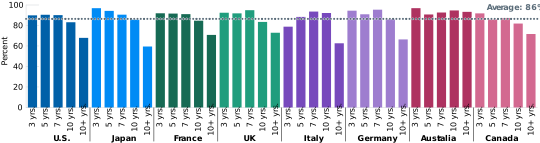
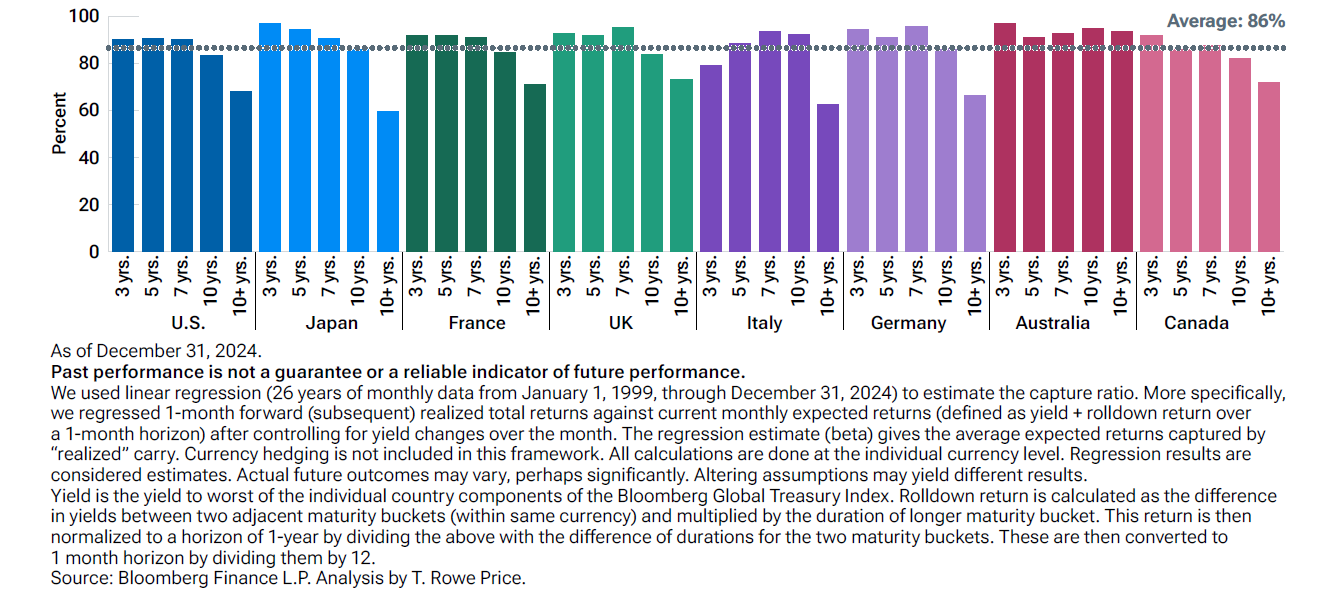
Intrinsic factors not only have a significant influence on total returns, but they are also typically known in advance, making them deterministic—a valuable quality for investors. Our analysis (see Figure 7  in the appendix) found that U.S. Treasury debt maturing between five and seven years had a capture ratio of 0.9, indicating that 90% of the intrinsic factor return were reflected in realized returns. While results for longer maturity bonds were somewhat lower, the proportion of intrinsic factor returns captured in realized returns was still meaningful, exceeding 60% in most cases. These findings suggest that intrinsic factors can potentially serve as a good estimate of future returns.

Overall, intrinsic factors have proven to be both a strong driver of returns and highly predictable—a powerful combination. Their observable and invariant features contribute to their high quality. With this in mind, allocating solely to a single government bond market, such as the U.S. Treasury market, means an investor is exposed to just two intrinsic factors, as no currency hedging is required. Casting the net wider to include other government bond markets opens up the investor to a much larger pool of intrinsic factors (three for each country), which provides more opportunities to source potential alpha. After all, economic and monetary policy cycles can vary from country to country, so at any one time, there is potential to take advantage of differences.

1 Past performance is not a guarantee or a reliable indicator of future performance.

Reconstructing a U.S. Treasury Index with global intrinsic factors

Given how powerful intrinsic factors are, the final part of our research centered on how to lean in on these factors and away from other factors. This compelled us to reconstruct a traditional U.S. Treasury government bond index by incorporating a dynamic element that allocates up to 20% to a broader set of high‑quality government bonds (Japan, France, the UK, Italy, Germany, Australia, and Canada). This allocation is based on the three intrinsic factors of yield/carry, rolldown, and currency hedging. When one or more of these factors are favorable, the specific government bond is included in the index, subject to certain rules around volatility and correlation. The key parameters of our new “Intrinsic Factor Index” are outlined below :

  • Allocation to non‑U.S. countries up to 20%.
  • Tracking error volatility of 50 basis points relative to Bloomberg U.S. Treasury Index. 
Image
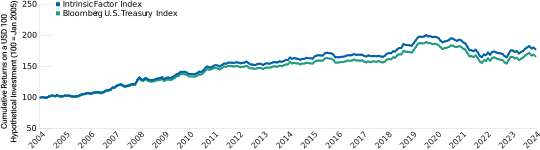
Fig. 6 is a bar chart showing the cumulative returns of our Intrinisic Factor Index versus the traditional Bloomberg U.S. Treasury index for the twenty year period ending December 31, 2024.

As of December 31, 2024.
For illustrative purposes only and not a recommendation to buy or sell any security. Fees associated with an actual investment are not taken into account If taken into account, this would impact the results shown. See the Appendix for additional important information on this analysis.
Bloomberg U.S. Treasury Index—Past Performance is not a guarantee of future results.
Intrinsic Factor Index—Backtested performance does not represent actual performance, and is created with the benefit of hindsight, and there are inherent limitations. Actual results may differ.
Source: T. Rowe Price analysis.

  • Index duration the same as the Bloomberg U.S. Treasury Index
  • Allocation to a single non‑U.S. country no more than 0.25 years of duration.
  • U.S. maturity weight changes were limited to 10% to avoid skews in U.S. yield curve positioning.

To compare the new Intrinsic Factor Index with the traditional Bloomberg U.S. Treasury Index, we conducted a backtest using data from the 20‑year period spanning December 31, 2004, to December 31, 2024. The results showed that the Intrinsic Factor Index outperformed the traditional benchmark by an average of 32 basis points per year with an annualized tracking error volatility of 57 basis points. This resulted in an information ratio of 0.56. Note that transaction costs and other fees are not assumed. If transaction costs and fees were assumed, the results for the Intrinsic Factor Index would be lower, and the conclusions provided could differ.

Delving into the details of what drove the outperformance, the Intrinsic Factor Index allocated to Japanese government bonds before the financial crisis in 2008, as Japanese yield curves were steeper than other countries, and currency hedging benefits made Japanese bonds more attractive. During the early 2010s, a mix of UK and Italian government bonds were favored in the index, with roll‑down benefits the main driver behind the UK allocation, while high carry boosted Italian bonds. In the post‑pandemic bond market regime, the index allocated to Australian bonds due to their attractive roll‑down benefits. Overall, the results are encouraging and demonstrate the power of considering a broader set of intrinsic factors from high‑quality government bond markets. 

2 Figure 7 data does not include currency hedging.
3 See Appendix for additional detail on the methodology.

Conclusion 

With a single‑country U.S. Treasury portfolio, there’s limited exposure to intrinsic factors, which we have demonstrated in our studies as having a significant impact on bond returns, often surpassing other sources of return in the long run. Furthermore, these factors are observable, invariant, and typically known at the time of investment initiation, making them extremely powerful. That’s why considering a broader set of these factors when they are in favor could be beneficial and can be done in a way that is risk aware. By expanding the investment universe to include global government bond markets, investors can access a larger pool of intrinsic factors (three for each country) compared with the two available in a U.S. Treasury‑only portfolio. This broader approach enhances opportunities for sourcing potential alpha.

Appendix

Returns shown in this material, including that of the Intrinsic Factor Index, do not represent the actual returns of any T. Rowe Price product or strategy. Actual outcomes may differ materially from any estimates provided. 

Intrinsic Factor Index: Favorable factors are determined by magnitude when comparing bonds of different countries cross‑sectionally. Index construction is on a systematic basis. The three components of yield, roll‑down, and the currency hedging cost are added together to give an expected return assumption for a specific country bond. The bonds with the highest expected returns are included in the index, subject to certain parameters/rules stated earlier in the paper. The index is rebalanced monthly based on this criteria. Country weightings can vary month to month based on expected returns, subject to country limits stated earlier in the paper. Bonds are removed from the index if they no longer meet the criteria. Volatility and correlations are both calculated using hedged monthly returns, using a 5yr rolling‑window and Exponentially Weighted Moving Average (EWMA) with 1yr half‑life. This methodology gives more weight to recent market performance. The Intrinsic Factor Index was created by T. Rowe Price for purposes of this research. The index may not be updated in the future. The index returns represent hypothetical returns based on the criteria outlined, do not reflect actual investment results, and are not a guarantee of future results. Back‑tested results of the index were developed with the benefit of hindsight and have inherent limitations. Results do not reflect actual trading or the effect of material economic and market factors that may be utilized in the decision‑making process. Certain assumptions have been made for modeling purposes that may not be realized. Management fees, transaction costs, taxes, potential expenses, and the effects of inflation have not been considered and would reduce returns. Results have been adjusted to reflect the reinvestment of capital gains and coupons (not dividends). Actual results experienced may vary significantly from the results shown.

Supplement to Fig. 3
(Table 1) Marginal returns per year of country spread duration extending from the 1‑ to 3‑year and 3‑ to 5‑year

Image
Appendix 3

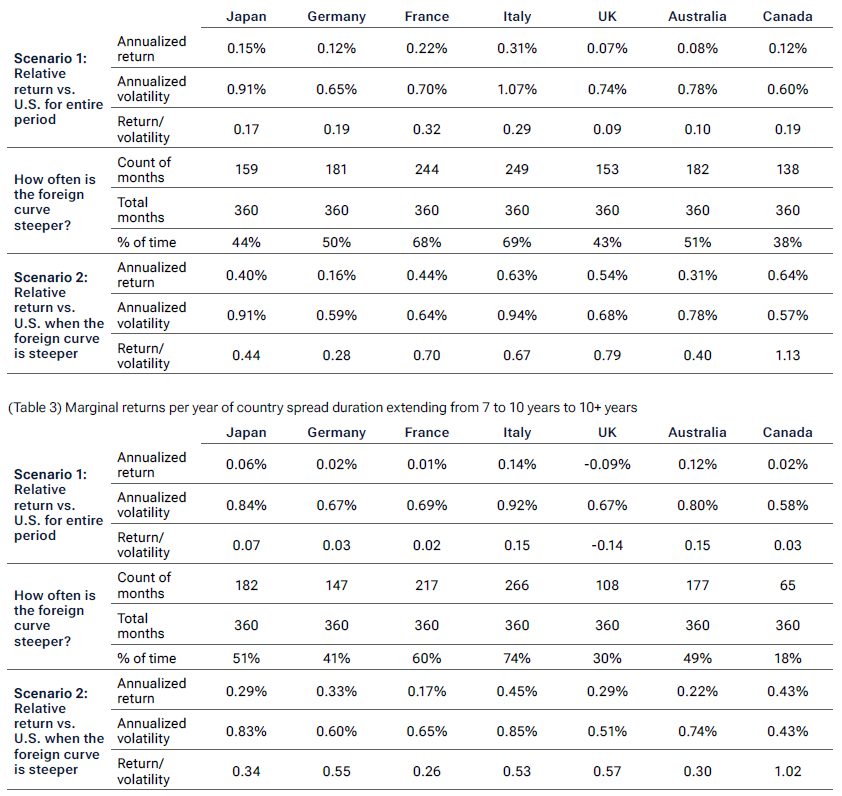
(Table 2) Marginal returns per year of country spread duration extending from 5 to 7 years to 7 to 10 years

Image
Appendix 3a

Past performance is not a guarantee or a reliable indicator of future performance.
Analysis using monthly data for the period January 1, 1995, to December 31, 2024.
Table 1 shows annualized relative returns and volatility versus the U.S. for the countries listed for extending duration from the 1–3‑year to 3–5‑year bucket. Table 2 shows annualized relative returns and volatility versus the U.S. for the countries listed for extending duration from the 5–7‑year to 7–10‑year bucket. Table 3 shows annualized relative returns and volatility versus the U.S. for the countries listed for extending duration from the 7–10‑year to 10+ years. For all tables, the calculations are for two scenarios: The first is the whole entire period and the second is only for periods when foreign curves are steeper. Relative return versus the U.S. is calculated as the annualized return of the country in excess of the U.S. return. The returns used are from the individual country components of the Bloomberg Global Treasury Index for the maturity buckets stated in the table. Reconstitution is monthly as per index provider. All returns are U.S. dollar hedged and from the Index provider.
For illustrative purposes only. Does not represent an actual investment.
Using Japan in Table 2 as an example of how annualized returns in Scenario 2 were calculated —there were 159 months out of 360 months that the foreign curve was steeper. For those months, the returns were compounded and then annualized.
Source: Bloomberg Finance L.P. Analysis by T. Rowe Price.

Capture ratio analysis
(Fig. 7) Proportion of intrinsic factor returns captured in realized returns

Image
Fig. 7 is a bar chart that shows the proportion of intrinsic factor returns captured in realized returns for the 3-year, 5-year, 7-year, 10-year, and 10+ year maturities in the following government bond markets: the U.S., Japan, France, UK, Italy, Germany, Australia, and Canada.


Sign up to receive valuable insurance insights from T. Rowe Price.


Additional Disclosure
For retail investors, visit troweprice.com/en/us/glossary for definitions of financial terms.

Important Information
This material is being furnished for general informational and/or marketing purposes only. The material does not constitute or undertake to give advice of any nature, including fiduciary investment advice. Prospective investors are recommended to seek independent legal, financial and tax advice before making any investment decision. T. Rowe Price group of companies including T. Rowe Price Associates, Inc. and/or its affiliates receive revenue from T. Rowe Price investment products and services. The value of an investment and any income from it can go down as well as up. Investors may get back less than the amount invested.

The material does not constitute a distribution, an offer, an invitation, a personal or general recommendation or solicitation to sell or buy any securities in any jurisdiction or to conduct any particular investment activity. The material has not been reviewed by any regulatory authority in any jurisdiction.

Information and opinions presented have been obtained or derived from sources believed to be reliable and current; however, we cannot guarantee the sources’ accuracy or completeness. There is no guarantee that any forecasts made will come to pass.

The views contained herein are as of December 2025 and are subject to change without notice; these views may differ from those of other T. Rowe Price group companies and/or associates. Under no circumstances should the material, in whole or in part, be copied or redistributed without consent from T. Rowe Price. The material is not intended for use by persons in jurisdictions which prohibit or restrict the distribution of the material and in certain countries the material is provided upon specific request. It is not intended for distribution to retail investors in any jurisdiction.

USA—Issued in the USA by T. Rowe Price Associates, Inc., 1307 Point Street, Baltimore, MD 21231, which is regulated by the U.S. Securities and Exchange Commission. For Institutional Investors only.

© 2025 T. Rowe Price. All Rights Reserved. T. ROWE PRICE, INVEST WITH CONFIDENCE, the Bighorn Sheep design, and related indicators (see troweprice.com/ip) are trademarks of T. Rowe Price Group, Inc. All other trademarks are the property of their respective owners.

ID0008269
202509‑4568188

Share this post

Sign Up Now for Full Access to Articles and Podcasts!

Unlock full access to our vast content library by registering as an institutional investor

Register

Contacts


T. Rowe Price

T. Rowe Price is a global asset management firm with broad investment capabilities across Equity, Fixed Income, Multi-Asset and Alternative Strategies, highly committed to excellence in service and putting client interests first. We understand that insurers have many unique considerations impacting portfolio design, and we are proud to work with many of the largest insurers in the world delivering diverse and custom solutions designed to meet those needs. Our dedicated insurance relationship managers act as an extension of your team and serve as a conduit to the T. Rowe Price organization while proactively bringing the firm’s vast resources to bear. We offer a consultative, problem-solving approach and the ability to implement solutions based on specific client objectives, constraints, and risk tolerance.

Ben Riley 
Head of Insurance 
benjamin.riley@troweprice.com 
410-345-2223

Chase Uhlein, CFA
Senior Relationship Manager
chase.uhlein@troweprice.com
410-577-3077

Blayze Hanson, CFA
Senior Relationship Manager
blayze.hanson@troweprice.com

Taylor Davis 
Relationship Manager 
taylor.davis@troweprice.com 
410-577-2054


1307 Point Street
Baltimore, MD 21231

 

View the contributor page

Image
trp_logo

Sign Up Now for Full Access to Articles and Podcasts!

Unlock full access to our vast content library by registering as an institutional investor .

Create an account

Already have an account ? Sign in

Ѐ Ё Ђ Ѓ Є Ѕ І Ї Ј Љ Њ Ћ Ќ Ѝ Ў Џ А Б В Г Д Е Ж З И Й К Л М Н О П Р С ΄ ΅ Ά · Έ Ή Ί Ό Ύ Ώ ΐ Α Β Γ Δ Ε Ζ Η Θ Ι Κ Λ Μ Ν Ξ Ο Π Ρ Ё Ђ Ѓ Є Ѕ І Ї Ј Љ Њ Ћ Ќ Ў Џ А Б В Г Д Е Ж З И Й К Л М Н О П Р С Т У Ф Х Ц Ч Ш Ā ā Ă ă Ą ą Ć ć Ĉ ĉ Ċ ċ Č č Ď ď Đ đ Ē ē Ĕ ĕ Ė fi fl œ æ ß