


Pioneer Investments -

Agency Mortgage-Backed Securities (MBS) Market - November 2025

IAUM Article (64)

Tyler Patla - Senior Vice President, Deputy Director of Core Fixed Income, Director of Agency Mortgages Portfolio Manager

MBS Tacked through November’s Offsetting Moves    
Evolving Federal Reserve policy expectations reshaped investor sentiment in opposing directions as November progressed. Early in the month, hawkish Fed speaker commentary served as the primary catalyst, prompting investors to sharply dial back expectations for a December interest rate cut. This put spread assets under pressure as Treasury yields climbed and equities declined. Later in the month, investor tone improved as weaker economic data readings encouraged more dovish-leaning Fed rhetoric. September's employment report, delayed by over six weeks due to the US Government shutdown, revealed a 4.4% unemployment rate, the third consecutive 0.1% monthly increase, and provided economic justification for renewed policy easing expectations. This data-driven shift in Fed tone reintroduced dovish and risk-on sentiment. The implied probability for a 25 basis point rate cut in December whipsawed from around 25% mid-month to 83% by month's end. The Treasury curve responded with a bull steepening pattern: 2-year and 5-year yields dropped 8-10bp, and 30-year yields held steady, reflecting confidence in near-term policy easing without longer-term inflation concerns.

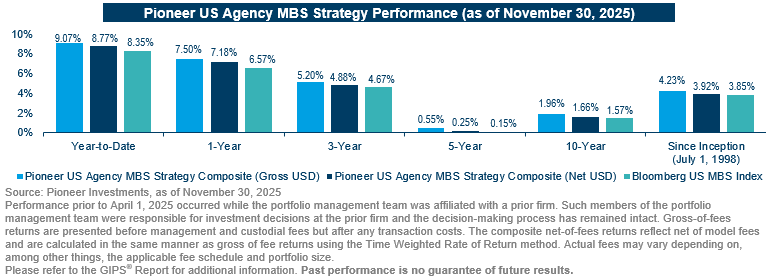
The agency MBS market was slightly worse for wear after November’s round-trip volatility, but performance remains strong for the year. The Bloomberg US MBS Index gained 0.62% on the month, reflecting a -0.05% excess return to Treasuries. Sector option-adjusted spread (OAS) tightened by 2bp to +29bp, with current coupon outperforming lower coupons. With one month to go in 2025, The Bloomberg US MBS Index has returned 1.20% in excess of Treasuries, tightening by 13bp in OAS and on pace to outperform investment-grade corporates in excess return terms for the first time since 2018. 

Trump Proposed 50-Year Mortgage 
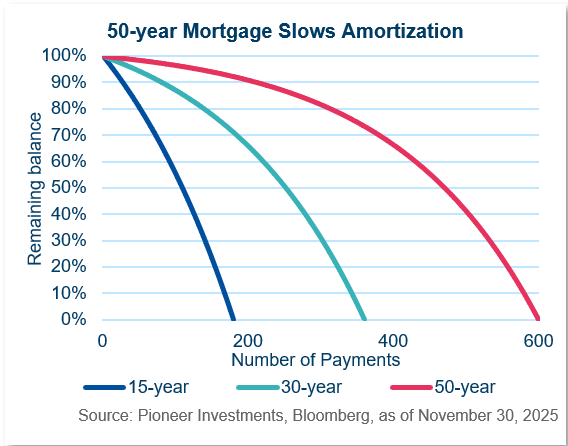
On November 8, President Trump and Federal Housing Finance Agency Director Bill Pulte proposed the idea of a fixed-rate mortgage with a 50-year maturity to help combat housing unaffordability. Such an extension could reduce monthly mortgage payments by about 12% relative to a 30-year fixed-rate mortgage at the same interest rate. Most market experts have panned the idea, and we agree:

  • 50-year mortgages are likely to have a higher interest rate, as higher term premium, higher value of the prepayment option, and reduced liquidity would likely put the rate around 0.50% higher, offsetting at least half the monthly payment savings.
  • Since borrowers are often approved based on a mortgage payment rather than a house price, borrowers may bid more aggressively with the savings from a longer mortgage term. This could drive up home prices, transferring the benefits to the home seller rather than the borrower.
  • A 50-year mortgage nearly doubles the amount of interest paid over the life of the loan.
  • With the average age of first-time home buyers just eclipsing 40 years, asking borrowers to take out debt they would not pay off until turning 90 would not be a political win with voter sentiment.

Bill Pulte also alluded to adding mortgages with assumability (the buyer could take over the loan from the seller) and portability (a borrower could bring over a mortgage to a new home). This would certainly reduce prepayments on low coupon mortgages. However, we do not see a way existing MBS could be modified to add these features, and if they were offered going forward, investors would price this additional optionaility, which would likely lead to higher mortgage rates.

We will continue to monitor the situation and the investment opportunities it may introduce if the administration tries to push through any of the above plans.

Image
Screenshot 2025-12-17 114041


Prepays Rose as Borrowers Responded to Lower Rates
The fall in mortgage rates from late August and early September’s bond market rally hit November’s prepayment report. For clean borrowers with large loan sizes, prepayments came in on the high end of investor expectations, rising 33% overall and upwards of 60% on higher coupon bonds. Increased efficiencies from digitization and artificial intelligence along with excess capacity from relatively few refinanceable borrowers (22% of outstanding mortgages) has allowed originators to efficiently solicit and reprocess refinance applications.

The previous fast prepayment report was released in November of 2024, where a brief drop in rates inspired a rush of applications into a short window before retreating. The most recent report exceed those speeds for the same level of refinance incentive as illustrated in the graph at the right for worst-to-deliver 30-year conventional bonds 6-to-36 months old.

Despite the increase, we expect prepayments to temper in December and January’s reports on reduced daycount, reduced seasonals, and moderating mortgage rates. We have also been reassured by the endurance of call protection and its positive impact on security selection opportunities.

Outlook: Improving Technicals Reflected in Valuations 
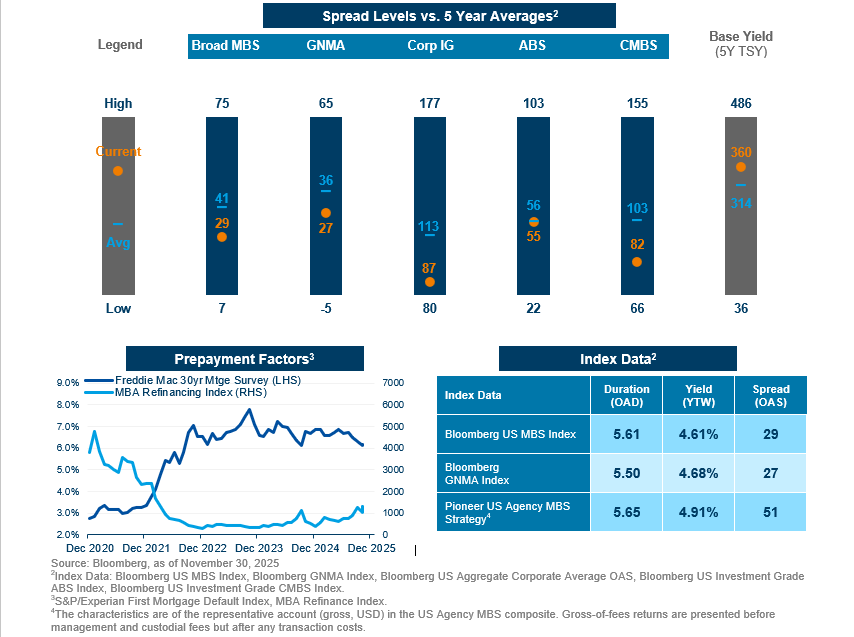
November’s price gyrations ended with market prices and expectations ending the month roughly where they started. While we no longer find spreads compelling on a standalone basis relative to Treasuries and have been content to take profits on recent outperformance, a constructive outlook for demand from a wide range of investors motivate us to maintain a benchmark weight, or a potential overweight versus interest rate swaps.

In MBS’s favor:

  • Improving supply-demand dynamic: If the Federal Reserve continues its rate cuts, MBS will become an increasingly attractive asset class for some of its larger investor bases. Banks expect to get clarity on the Basel III Endgame soon, and the carry on MBS relative to interest on excess reserves (IOER) and other short-term alternatives has expanded as the Fed has lowered interest rates. Mortgage Real Estate Investment Trusts (mREITs) have been able to raise capital to fund purchases. Meanwhile, the currency hedging costs for overseas investors has decreased. Fannie Mae and Freddie Mac have become more active in managing their retained portfolios, it appears they could be a backstop bid on material widening events, and there is an outsized chance Washington will instruct them to perform a form of quantitative easing in an attempt to offset housing unaffordability.
  • Stronger relative value to investment-grade alternatives: Despite recent outperformance, agency MBS has remained historically attractive versus corporate bonds, which are significantly tighter than agency MBS when compared to their respective long-term averages by most metrics. As a result, we are more bullish on agency MBS beta as a positive contributor to an aggregate, multi-sector, or multi-asset portfolio than we are versus Treasury or cash benchmarks.

The argument against:

  • Signs of increased prepayment responsiveness: November’s prepayment report marked another quick reaction to a drop in mortgage rates. If extrapolated over a larger, sustained rally from a weakening economy, prepayments on cheapest-to-deliver bonds could meaningfully deteriorate market returns. Consolidation and innovation among several aggressive mortgage originators could yield increased technologically-driven operating efficiencies in the next refi wave. While our data analysis assuages some of our fears relative to other investors, we have more confidence that security selection could help offset fundamental sector underperformance from faster-than-model prepayments.
  • Nominal spreads are relatively tight: By some metrics, like Bloomberg MBS Index OAS and current coupon nominal spread, MBS spreads are around the tightest they have been over the past 3 years. We believe a longer-term perspective, a comparison to alternative spread assets, and the improved technical outlook justify these valuations. However, it would be reasonable for investors to consider selling agency MBS in a risk-off scenario, particularly for investors whose alternative is US Treasuries and for asset managers sitting at historic overweights to the sector.
  • Hearty demand is not guaranteed: Despite a constructive backdrop, aggregate agency MBS demand could still disappoint. Active allocators could opportunistically reduce, and we are also wary of continued de-dollarization from overseas investors in response to geopolitics, trade wars, threats to central bank independence, and public trust in federally published economic statistic.
Image
Screenshot 2025-12-17 114438
Image
Screenshot 2025-12-17 115355

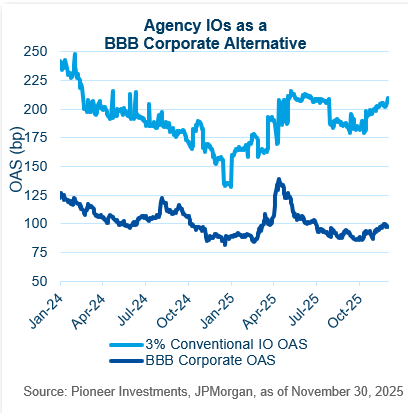
In specific circumstances, agency MBS structures can potentially serve as attractive alternatives to credit-based cash flows. As illustrated in the graphs to the right, we also find floating rate agency collateralized mortgage obligations (CMOs) attractive when compared other floating-rate and short interest rate duration assets, like AAA-rated collateralized loan obligations (CLOs). Similarly, agency MBS CMO interest-only strips (IO) have comparable volatility to BB and BBB corporate bonds, but offer wider spreads and risk diversification1

Overall, while we continue to find agency MBS to be an attractive alternative to credit, we feel a neutral allocation to most benchmarks is prudent at this time. Since many potential sources of demand in 2026 (mREITs, banks, Fannie and Freddie) hedge with interest rate swaps, and spreads to swaps are nominally higher thanks to an inverted swap curve, we are more constructive for investors who can hedge or are benchmarked this way. A more supportive technical dynamic has already moved MBS tighter, but the sector could struggle to find support in a reflation-induced, bear flattening curve environment. In the interim, our strongest conviction is in specified pools with characteristics we find underappreciated by the market, particularly for higher coupons with the most model risk premium, and the CMO structures mentioned above. We remain nimble to reduce on short-term outperformance and are willing to add more if spreads widen due to technical factors or exogenous event risk.

1. Diversification does not assure a profit or protect againstloss.

Securitized Market Dashboard

Image
Screenshot 2025-12-17 114936
Image
Screenshot 2025-12-17 115005


Read More From Pioneer Investments


The views expressed in this presentation are those of Pioneer Investments, a Victory Capital Investment Franchise, and are subject to change at any time. These views should not be relied upon as investment advice, as securities recommendations, or as an indication of trading intent on behalf of any strategy. Future results may differ significantly than those stated.

The services and any securities described in this document may not be registered for sale with the relevant authority in your jurisdiction and may not be regulated or supervised by any governmental or similar authority in your jurisdiction. Where unregistered, they may not be sold or offered except in the circumstances permitted by law. Pioneer Investments is not making any representation nor does this document constitute a representation with respect to (i) the eligibility of any recipients of this document to acquire any securities or any services described herein in any jurisdiction or (ii) the eligibility of any recipients of this document to receive this document in any jurisdiction. If you are in doubt about the content of this document or your eligibility, you should obtain independent professional advice.

Each portfolio is actively managed. Sector allocations will vary over other periods and do not reflect a commitment to an investment policy or sector. Holdings are subject to change due to active management. This should not be construed as a recommendation to buy or sell the securities listed.

Performance shown is past performance, which is no guarantee of future results. Current performance may be lower or higher than the performance data quoted.

This document and any subsequent information (whether written or verbal) provided by Pioneer Investments are private and confidential and are for the sole use of the recipient. Such documentation and information is not to be distributed to the public or to other third parties and the use of the documentation and/or information provided by anyone other than the recipient is not authorized. The recipient will notify Pioneer Investments immediately upon the discovery of any unauthorized use or redistribution of the materials contained in this submission or information subsequently provided in connection with this submission.

Advisory Services offered by Victory Capital Management Inc.
©2025 Victory Capital Management Inc.

20251210-5054321

Share this post

Sign Up Now for Full Access to Articles and Podcasts!

Unlock full access to our vast content library by registering as an institutional investor

Register

Contacts


Pioneer Investments

Pioneer Investments manages $128 billion in assets and has a long-standing history of innovation with deep expertise managing fixed income portfolios and creating customized solutions within the more opportunistic areas of the securitized market.

Pioneer Investments’ culture of innovation, in the securitized market, originated at Smith Breeden, where its founders developed early option-adjusted spread modeling techniques for MBS valuation. The innovative approach continues under Victory Capital, which manages over $8.4 billion for insurance companies. We are focused on delivering competitive risk-adjusted returns, while considering the accounting, regulatory, and capital management needs of our insurance clients to create long-term partnerships.  We understand the unique needs of insurers, and we provide customized and efficient risk-based capital solutions that align with insurers' risk tolerances and investment objectives.

Source: Pioneer Investments, a Victory Capital Investment Franchise, as of September 30, 2025
 

Jay Alexander, CFA, CAIA
Managing Director, Institutional Markets
jalexander@vcm.com
+1 (612) 965-5426
 
Emma White
Director, Institutional Markets
ewhite@vcm.com
+1 (617) 422-4569

Marko Komarynsky
Director, Institutional Markets
mkomarynsky@vcm.com
+1 (210) 697-3613

View the contributor page

Sign Up Now for Full Access to Articles and Podcasts!

Unlock full access to our vast content library by registering as an institutional investor .

Create an account

Already have an account ? Sign in

Ѐ Ё Ђ Ѓ Є Ѕ І Ї Ј Љ Њ Ћ Ќ Ѝ Ў Џ А Б В Г Д Е Ж З И Й К Л М Н О П Р С ΄ ΅ Ά · Έ Ή Ί Ό Ύ Ώ ΐ Α Β Γ Δ Ε Ζ Η Θ Ι Κ Λ Μ Ν Ξ Ο Π Ρ Ё Ђ Ѓ Є Ѕ І Ї Ј Љ Њ Ћ Ќ Ў Џ А Б В Г Д Е Ж З И Й К Л М Н О П Р С Т У Ф Х Ц Ч Ш Ā ā Ă ă Ą ą Ć ć Ĉ ĉ Ċ ċ Č č Ď ď Đ đ Ē ē Ĕ ĕ Ė fi fl œ æ ß